We have a brand new updated website! Click here to check it out!

Kansas Sued Over Foster Care That’s Bounced Several Children Between 100 Homes

 MADELINE FOX

A lawsuit filed Friday contends Kansas violates foster children’s civil rights by moving them too often, adding to their trauma and restricting their access to necessary mental health treatment.

Gina Meier-Hummel started her job as secretary of the Kansas Department for Children and Families on Dec. 1, 2017
Photo by MADELINE FOX / KANSAS NEWS SERVICE

The National Center for Youth LawChildren’s Rights and Kansas Appleseed filed the suit against Gov. Jeff Colyer and the heads of the Department for Children and Families, the Department for Aging and Disability Services and the Department of Health and Environment.

The class-action suit alleges the state violated foster kids’ rights by shifting them — some of them more than 100 times throughout their time in care — often from one single-night placement to the next. The suit says that renders kids in care effectively homeless.

“There’s a chunk of the population of abused, neglected and abandoned kids in Kansas for whom the state has no housing at all,” said Ira Lustbader, litigation director for Children’s Rights.  “Kids are rotated through just extreme numbers of placements.”

This process of “churning,” as described in the suit, has kids sleeping “anywhere a bed, couch, office, conference room, shelter or hospital can be found” overnight. Then they’re picked up the next morning and kept in a foster care contractor’s office for much of the next day, often into the next evening.

“Every change in placement a child experiences is a major disruption in that child’s life,” said Michelle Johnson-Motoyama, a professor of child welfare at Ohio State University who’s studied the Kansas welfare system.

She said churning creates a vicious cycle — each new placement adds compounded trauma and attachment issues, which makes it harder for them to stay in a foster home — increasing their moves almost exponentially.

The organizations seek no financial damages. Rather, the suit calls for the agencies to put together a plan to fix the churning and mental health problems, and to see that it’s implemented. A similar suit filed nearly 30 years ago led to the privatization of much of the state’s services for children in crisis.

Ten children, ten stories

The suit details the experiences of 10 children ranging from ages 7 to 17 who have been in foster care anywhere from a few months to nine years. Several have slept in foster care contractors’ offices, including one girl who was discharged from a psychiatric residential treatment facility into a series of one-night and short-term placements that included nights in an office.

One boy has been in more than 130 placements since entering the foster care system in 2012. Lustbader said that based on interviews the organizations conducted with advocates and attorneys across the state, that wasn’t unusual.

“That’s what can happen if you’re thrust into this night-to-night madness,” he said.

A 17-year-old girl described in the suit entered the foster care system in 2007. She was adopted three years later with her siblings into a family where she and her sister were sexually assaulted by their adoptive father and brother. They weren’t removed until 2013. In the five years since, the girl has been moved more than 42 times, including multiple night-to-night and short-term placements.

In one placement, the suit alleges, she was sexually exploited and trafficked. She stayed overnight in the office of a foster care contractor, including once for an entire week.

Churning kids through the system

From April to September of 2018, St. Francis Community Services, the foster care contractor for the western half of the state, had 764 children in one-night placements. Its eastern counterpart had 695 kids stay just one night in a placement.

The suit alleges DCF has enabled churning by letting contractors and child placement agencies waive capacity and sleeping space requirements — such as one home that had 10 children and that was only regulated to keep six kids. DCF approved 98 percent of approximately 1,100 requests to waive requirements for capacity and sleeping space in a 15-month period, according to a 2016 audit report.

The suit alleges that since 2017, DCF hasn’t even required agencies to ask for exceptions. As long as a child doesn’t go to that placement more than once in a week, homes can take on more kids than they are regulated to take without the state needing to sign off.

Under national standards, kids shouldn’t be moved more than 4.12 times for every 1,000 days they’re in foster care.

But according to reviews by the federal Department of Health and Human Services, Kansas hasn’t met that standard since it was set out in 2014. In its most recent fiscal year, Kansas moved kids an average of 8.6 times per 1,000 days, more than double the federal standard, and 30 percent more times than its 2016 average of 6.6 moves.

The suit alleges Colyer and the heads of the three agencies violated foster children’s 14th Amendment rights — which grants equal protection under the law — as well as the federal Medicaid Act.

It alleges Colyer, sued in his official capacity as governor, had the responsibility to make sure agencies followed state and federal law and the ability to reshape the function of agencies to ensure they were looking out for the children in the state’s care.

DCF Secretary Gina Meier-Hummel, the suit says, has “direct non-delegable custodial responsibility” for the state’s children, meaning her office is ultimately responsible for civil rights violations that happen to foster children under the supervision of the state’s foster care contractors.

Lustbader said it was important to make it clear that while DCF has delegated foster care placement to private agencies, the state welfare agency and Kansas Department of Health and Environment and Kansas Department for Aging and Disability Services still have ultimate constitutional responsibility for the state’s children.

“The buck stops with the government agencies responsible for these kids in their care,” Lustbader said. “You can certainly use private providers, but not without accountability.”

Mental health services

The secretaries of KDHE and KDADS are responsible for administering Medicaid and mental health services according to federal and state laws. They also oversee Medicaid waiver programs and operating hospitals and institutions in the state.

All foster children are eligible for Medicaid, which requires mental health screenings for children under the Early Periodic Screening Diagnosis and Treatment provisions of the federal Medicaid Act. Lustbader said under Medicaid, kids in state custody have “absolute access and entitlement” to basic screening, assessments and treatment.

The lawsuit charges that the agencies responsible didn’t meet that requirement.

Data Kansas reported to the federal government in 2016 indicated more than 3,000 foster children, nearly half the number of kids in foster care at the time, were identified as emotionally disturbed.

Changes coming

The lawsuit comes in the midst of a lot of changes coming through Kansas and its child welfare system.

Gov.-elect Laura Kelly will take office in January, and will likely bring with her a new cabinet – including new heads of DCF, KDHE and KDADS.

The foster care system is also bracing for a transition between foster care contractors. KVC and St. Francis, the two organizations that have held Kansas’ foster care and family preservation contracts since 2013, will cede family preservation to two new statewide providers, Florida-based Eckerd Connects and Missouri-based Cornerstones of Care.

TFI, a former contractor and current subcontractor for Kansas foster care, will join KVC and St. Francis as a state contractor for foster care.

Becci Akin, a professor of social work at the University of Kansas, said transitions can be chaotic. She said it’ll likely take 18-24 months after the contracts switch over in July before it’s possible to really judge whether the new providers and other new aspects of the child welfare grants are working.

task force examining the state foster care system is submitting its final recommendations to the Legislature in January. The recommendations, which include expanding Medicaid, examining the effects of privatization and improving work conditions for social workers, could prompt legislation taking aim at some of the challenges in Kansas’ child welfare system.

Deja vu

The lawsuit echoes a case filed over foster care in 1989. That suit accused the Department of Social and Rehabilitation Services, the precursor to DCF, of failing to protect children. It evolved into a class-action case joined by the ACLU. Its Children’s Rights project has since become an independent nonprofit and is one of the parties suing now.

Rochelle Chronister, who headed SRS, said she’s not surprised Kansas is being hit with another lawsuit. She said the state’s cutting back on preventive measures to keep kids out of foster care is leading to more kids coming in, and hitting an agency that isn’t prepared to handle them.

The new suit, unlike the previous case, is in federal court. Rene Netherton, the attorney behind the earlier case, said it’s more narrow in scope than the one filed nearly 30 years ago. That earlier case focused on not only short-term placements but also worker caseloads, resources and numerous other problems with the foster care system.

Netherton also thinks the circumstances could be better this time around.

“I don’t think the climate could be any better than it will be with the new governor,” Netherton.

Netherton’s suit, and SRS’s failure of several resulting quarterly reviews, prompted the Legislature to privatize Kansas’ foster care system at the behest of then-Gov. Bill Graves.

The first contracts, for six nonprofit providers, began in 1996. Privatization has drawn the ire of some lawmakers, child advocates and birth and foster parents. They say it’s allowed the state to push blame for problems in the system to contractors and shortchange a system starved for resources.

Lori Burns-Bucklew, a Missouri attorney on the suit, says she wants the state agencies to stop treating children’s bad situations like an inevitable consequence of strains on the system.

“I have been ranting, I’ve been pounding the table, I’ve been worrying about these kids being schlepped around from night to night and I’ve been seeing it treated like it’s inevitable fallout from this messed up system,” she said. “I don’t want to let the institutional changes ignore the individual faces.”

Madeline Fox is a reporter for the Kansas News Service. You can reach her on Twitter @maddycfox.
BOOR: DEA Agriculture and Natural Resources

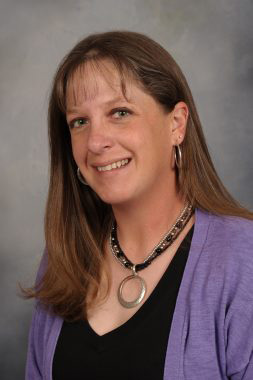
Alicia Boor

A Kansas State University veterinarian is urging the state’s producers to be especially diligent about monitoring for mycotoxins in livestock feed this winter on the heels of weather conditions that promoted their growth this fall.

Toxicologist Steve Ensley said Kansas’ summer drought conditions led to a heightened risk of aflatoxin in the state’s grain crop, while wet conditions during the 2018 harvest also made that grain susceptible to fumonisin.

“This year we have already had some death losses associated with mycotoxins in pigs and horses and so we’ve measured just a very few samples of corn and found very high concentrations of fumonisin and aflatoxin,” Ensley said. “I’m very concerned that it may be a bigger health issue statewide than the localized cases we’ve seen so far.”

The fall weather patterns in Kansas were conducive to a buildup of mycotoxins in feedstuffs, particularly harvested grain and livestock feed, Ensley said. It simply means that livestock producers should be on the lookout for feed that may contain unsafe concentrations of mycotoxins, or mold toxins.

“These molds are present in agricultural environments all the time, but when they get on the right substrate with the right temperature and humidity, then they grow and produce a toxin,” Ensley said. “They can be there and not produce a toxin or be there and produce a toxin like we are seeing this year.

“They are not infectious in nature. It’s a toxin that gets in the feed, and then the animal has to consume the feed at the right concentration to get ill.”

Different species show different symptoms, including damage to the animals’ liver, kidney, brain or other organs. The disease is not transferable to humans.

In addition to aflatoxin and fumonisin, Ensley said that other mycotoxins of concern in Kansas this year include vomitoxin and zearalenone. He also noted that dried distiller’s grains, a by-product of corn ethanol production, can concentrate mycotoxins.

Ensley said that collecting a reliable sample of grain is key to detecting mycotoxins in an operation.

“The best time to sample is anytime you move grain from the field to the bin, or from the bin to feeding,” he said. “Anytime that grain is moving and you can get multiple samples along that line, that’s the best way to obtain a random sample.”

Ensley said samples that test positive for a mycotoxin can sometimes be diluted to a safe level, except for aflatoxin, a carcinogen that is regulated by the U.S. Food and Drug Administration.

Ensley recommends that producers work with local veterinarians to collect reliable samples and interpret results, or they can also contact the K-State Veterinary Diagnostic Laboratory at 866-512-5650.

K-State’s lab is also available by email, [email protected].

Alicia Boor is an Agriculture and Natural Resources agent in the Cottonwood District (which includes Barton and Ellis counties) for K-State Research and Extension. You can contact her by e-mail at [email protected] or calling 620-793-1910.


LETTER: Broward County, Kansas?


As a native Floridian, and moving here 25 years ago, I would never have believed the Democrats in Hays America would throw their own election official under the bus! Are you kidding me?

I would expect hanging chads, mysterious ballots, corrupt election representatives to be present in Broward County. However, I never expected similar charges to be brought by the Democratic Party in my new hometown.

I am embarrassed by the Democratic officials challenging the election office as being incompetent and in need for legal supervision. I wonder if the same standard would apply if Eber had won the election? From sea to shining sea, the new normal for the Democratic Party is if you don’t like the election outcome, hire attorneys, challenge the election process and cry foul.

Very sad day for this transplant to Hays.

Don Tillman
Hays

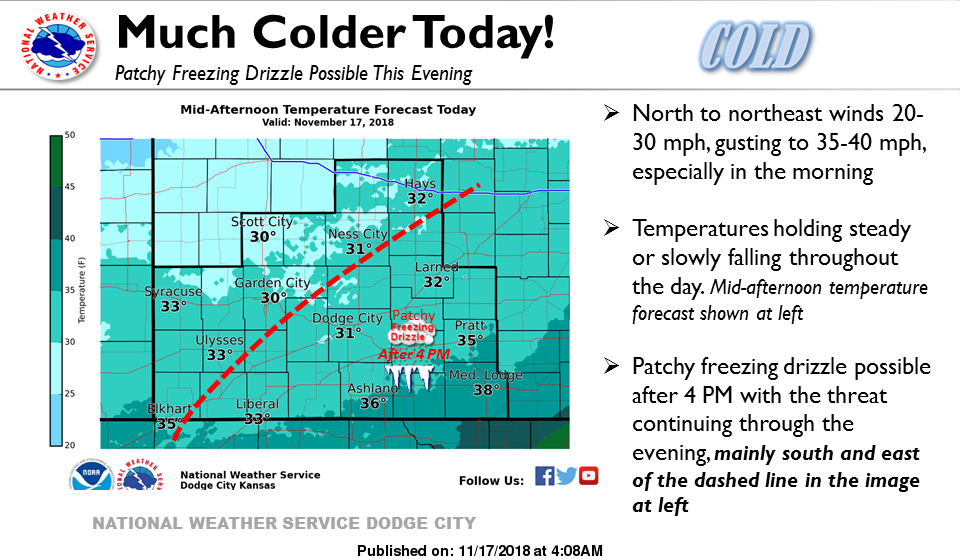
Cold, windy Saturday

Today
A 20 percent chance of snow after 3pm. Cloudy, with a temperature falling to around 27 by 5pm. Windy, with a north northeast wind 20 to 25 mph, with gusts as high as 38 mph.

Tonight
A 40 percent chance of snow. Cloudy, with a low around 21. North northeast wind 13 to 18 mph decreasing to 7 to 12 mph after midnight.

Sunday
Mostly cloudy through mid morning, then gradual clearing, with a high near 38. North wind 6 to 8 mph becoming south southwest in the afternoon.

Sunday Night
Clear, with a low around 25. South southwest wind 6 to 8 mph becoming west after midnight.

Monday
Sunny, with a high near 50. North northwest wind 7 to 11 mph.

Monday Night
Mostly clear, with a low around 26.

Tuesday
Sunny, with a high near 55.

Tuesday Night
Clear, with a low around 31.

Wednesday
Sunny, with a high near 57.

Kansas man dies in 3-vehicle motorcycle crash

MONTGOMERY COUNTY — One person died in an accident just after 3p.m. Friday in Montgmoery County.

The Kansas Highway Patrol reported a 2007 Harley Davidson Motorcycle driven by Nathan L. Lock, 32, Macksville, was southbound on Kansas 99 five miles south of Frankfort.

The motorcycle traveled left of center and side-swiped a 2014 Ford Fusion driven by Katheryn L. Gregerson, 21, Herman, NE., causing Lock to be ejected from the motorcycle.

A northbound 2013 Ford Fusion driven by Laura C. Edelman, 20, Sabetha also struck the motorcycle.

Lock was pronounced dead at the scene and transported to Kinsley Funeral Home. Gregerson and Edelman were not injured.

Telemedicine gives instant access to mental health services

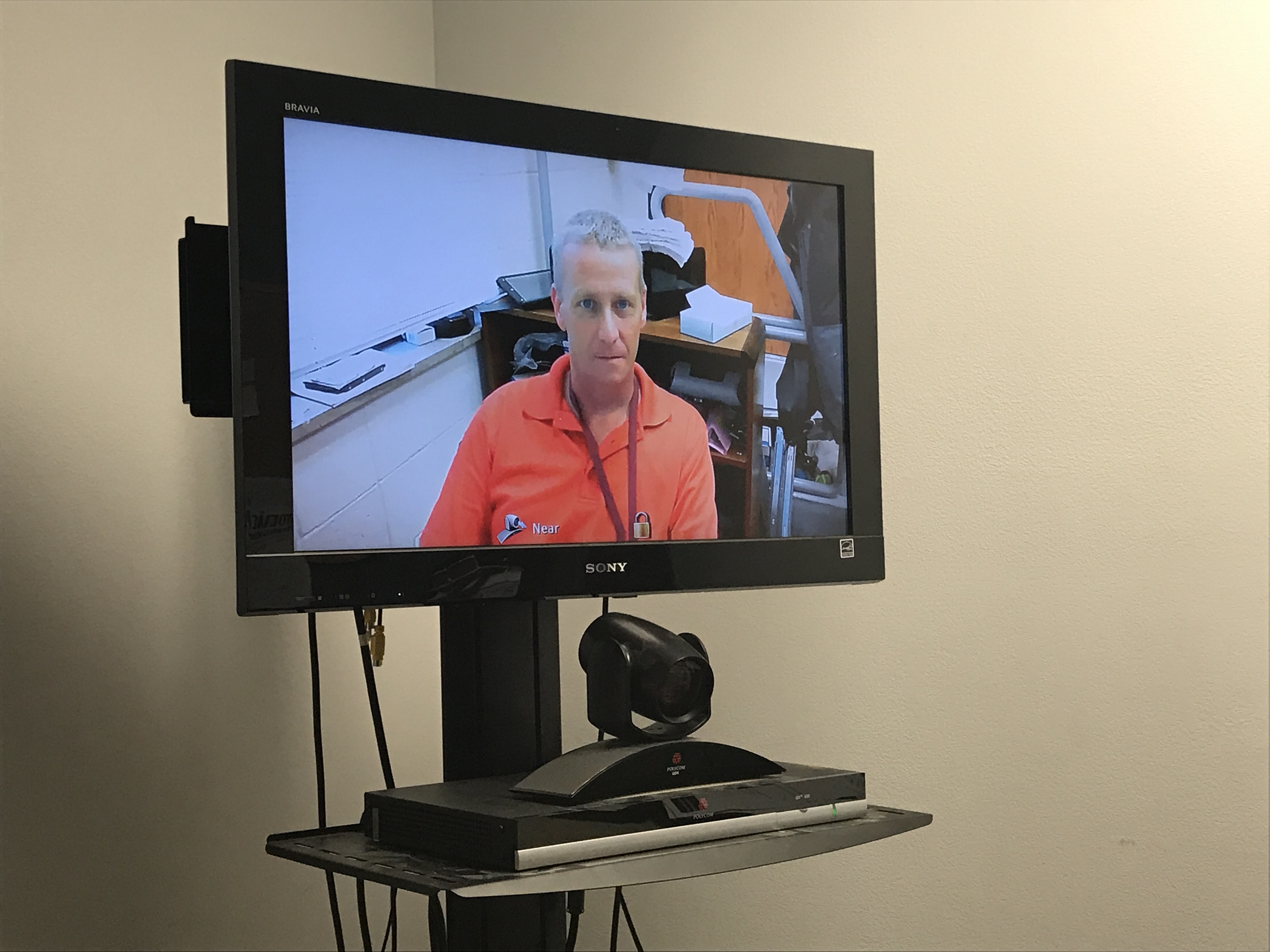
Stephen Kuhl, High Plains Mental Health IT director, tests a telemedicine terminal at the Schwaller Center in Hays.

By CRISTINA JANNEY
Hays Post

Kansas just this year passed legislation to open more opportunities for telemedicine in the state, but High Plains Mental Health Center has been offering the service for almost 20 years.

Technology associated with service has greatly improved over the years and so has the center’s reach using the tech.

High Plains has 50 telemedicine interfaces at its branch offices and in medical clinics, emergency rooms and jails. Ellis County has a telemedicine unit in the court for mental health court, and High Plains is also connected to Larned State Hospital through the system.

In the last 12 months, High Plains has seen 3,500 clients for 4,500 visits via telemedicine.

“We have come to expect pretty quick access to things, and this is really a way to keep up,” Walter Hill, High Plains executive director, said. “If we order light bulbs from Amazon, they are here in two days as opposed to having to wait. We as culture, our expectations of access have increased. That is not bad. …

“Health care needs to be more responsive, and this is one of the tools that allows us to do that.”

High Plains covers a 20-county catchment area, which is about 19,000 square miles and covers about 100,000 people.

Before the advent of telemedicine technology, High Plains struggled to get therapists and psychiatrists to the far reaches of its coverage area. Today, for example in Sharon Springs, High Plains has a telemedicine unit in the rural health center.

When therapists physically had to travel to remote offices, the clients were limited to one therapist and scheduling only on the day the therapist was in town. Telemedicine increases provider choice and can increase the frequency a therapist can see a client.

Walter Hill, High Plains executive director, interacts through the telemedicine system.

The system involves cameras and television screens on both ends of the teleconference. The psychiatrist or therapist conducts a medication check or therapy session just as they would in a face-face session. If a client is seeing a psychiatrist through telemedicine at a branch office, a nurse on site would record vitals and relay them to the doctor.

Hill said nothing is lost in the video format, and research has born out telemedicine mental health is as effective as in-person services.

The telemedicine system reduces the time a client has to wait to be seen by a provider, especially in a crisis.

On-call clinicians do evaluations at night through emergency rooms or jails. HaysMed has a telemedicine unit on a cart that can be wheeled directly to a patient’s bedside.

High Plains contracts with a provider that also works with other community mental health centers across the state to provide 24/7 coverage for these types of evaluations. These contractors specialize in emergency mental health, just as a ER doctor would have a speciality in emergency medicine. High Plains has IT staff available 24/7 in case work is needed on the system.

“In the middle of the night, if someone was say in Goodland at the hospital or the police station, we would have to send a therapist from Colby,” Hill said. “If there was a patient at Norton and the on-call therapist was in Osborne, they would have to drive from Osborne to Norton, which often in the middle of the night would take two hours or more to get there. [Telemedicine] is relatively instantaneous.”

Reducing drive time is more cost efficient and helps the mental health center in recruiting staff. The system also saves drive and wait time for law enforcement officers who are either responding to a mental health emergency or dealing with an inmate who is being evaluated.

Telemedicine is still an emerging field, Hill said. In the future, telemedicine may allow more clinicians to work from their homes and someday even patients be seen from their homes. High Plains has looked at adding a part-time psychiatrist who lives in Texas and works from home.

“The whole nature of health care is being decentralized,” Hill said. “Telemedicine and Smartphone apps are the two big changes that are going to happen to health care and mental health. People can take more control of their services on their PC at home or in their smartphone app.”

For more information about High Plains and its services, call 1-800-432-0333. If you are having a mental health emergency, call 911.

Learn more about High Plains in the Hays Post’s recent story: Schwaller Center to offer care for uninsured.

Track Chair Program designed for outdoorsmen with disabilities

KDWPT

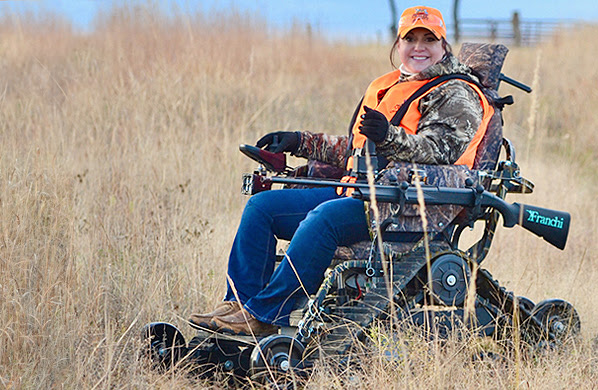
PRATT – Accessibility, a barrier to outdoor participation for many with disabilities, shouldn’t keep anyone from enjoying the outdoors. The Kansas Department of Wildlife, Parks and Tourism (KDWPT) is launching an all-new program – Adaptive Sportsmen of Kansas (ASK) – to ensure that hunters and anglers with disabilities have a new option for safely getting around outdoors.

KDWPT has secured eight electric, all-terrain track chairs that will be made available on a first-come, first-served basis at pre-approved events. Each chair, which is controlled by a joy stick on the right armrest, is camouflaged and equipped with several useful accessories, including a gun holder, fishing rod holder, LED headlight, and utility box for storage. Operators can also sit comfortably using the chair’s head rest, padded armrests and flip-out foot rest, all while having peace of mind they’re secure, thanks to the chair’s front stabilizer wheels and four-point harness.

“There are a lot of sportsmen out there who want to be hunting and fishing, but they just can’t get to where they need to. And it’s time we did something to fix that,” said Todd Workman, KDWPT Assistant Secretary for Administration.

What started as just an idea earlier this year has since blossomed into a fully-fledged program, backed by the support of Bushnell Optics and the National Wild Turkey Federation. Workman hopes other conservation-based organizations will see the value and impact of this program and consider helping it grow.

“I’m excited to begin working with conservation groups and people who need these chairs,” said ASK program coordinator, Jessica Rice. “We want these chairs in the field, helping people enjoy the outdoors.”

Anyone wanting to learn more about reserving chairs or donating to the ASK fund can contact Rice at [email protected] or (913) 278-2362.

Additional information on the program can also be found at https://ksoutdoors.com/Outdoor-Activities/Track-Chairs-ASK-Program.

High school football scoreboard Nov. 16

8-Man Division 2
Hanover (11-0) 60 Axtell (10-1) 14
Dighton (9-2) 0 Osborne (10-1) 46

8-Man Division 1
Canton-Galva (10-1) 12 Solomon (10-1) 28
St. Francis (11-0) v. Central Plains (11-0)  playing Sat. 11/17/18

1A
Pittsburg-St. Mary’s Colgan HS (9-2) 0 Olpe HS (11-0) 14
Plainville HS (9-2) 7 Smith Center HS (10-1) 49

2A
Humboldt HS (11-0) 16 Riley County HS (9-2) 46
Hoisington HS (9-2) 14 Phillipsburg HS (11-0) 31

3A
Galena HS (11-0) 0 Sabetha HS (11-0) 21
Andale HS (11-0) 19 Pratt HS (11-0) 21

4A
Bishop Miege HS (9-2) 46 Basehor-Linwood (10-1) 7
Goddard HS (9-2) 15 McPherson HS (11-0) 14

5A
Olathe West HS (5-6) 21 St. Thomas Aquinas (10-0) 67
Maize HS (10-1) 60 Wichita-Northwest HS (11-0) 67

6A
OP-Blue Valley North (8-3) 51 Olathe North HS (9-2) 49
Manhattan HS (10-1) 6 Derby HS (11-0) 24

UPDATE: 67 inmates seek Kansas prison release over secret recordings

KANSAS CITY, Kan. (AP) — A court-appointed attorney investigating whether federal prosecutors in Kansas improperly listened to recorded conversations between prisoners and their attorneys testified Friday that he was stunned and disappointed when he realized months into the investigation that the U.S. Attorney’s Office was not cooperating with him.

David Cohen, an Ohio attorney who was appointed by U.S. District Judge Julie Robinson to investigate the matter, said he believed federal prosecutors were working to identify attorneys in the office who might have listened to the recordings made at the privately run Leavenworth Detention Center. He said he wanted any attorneys involved to voluntarily speak to him and optimistically believed the investigation, which started in October 2016, could wrap up by early 2017.

Instead, it took months to get any documents from federal prosecutors and those documents provided little usable information. He also was surprised to learn that the office was seeking to recuse itself from the investigation and that at least one attorney had been told not to talk to him.

Early in the investigation, Cohen said he told Tom Beall, who was acting U.S. Attorney at the time, that there were problems in the federal prosecutor’s office in Kansas City, Kansas.
“I said since I was from out of town, I could be the bad guy and they could blame everything on me so we could fix things, and (Beall) could be the hero,” Cohen said. “That’s not what happened. I wasn’t given the tools to burn out the cancer. It’s a sad state of affairs that two years later the problems are still not fixed.”

Friday’s hearing came after Federal Public Defender Melody Brannon filed a motion to have the government declared in contempt for its conduct during Cohen’s investigation. She also wants the government to pay the legal costs as a sanction. Judge Robinson did not indicate Friday when she would issue a ruling on the motion.

The U.S. Attorney’s Office stopped cooperating with an investigation in October 2017 at the direction of Steven D. Clymer, a federal prosecutor in New York who was appointed to be the liaison with Cohen after the federal prosecutors’ office decided it had a legal conflict during the investigation.

In testimony earlier Friday, Beall insisted that his office had cooperated with Cohen and had not intentionally slowed the investigation or hidden information. He said the delay in providing requested information was due in part to his belief that he needed permission from the Department of Justice before responding to Cohen’s requests. And he said he didn’t want to commit the office to legal procedures while waiting for a new U.S. attorney to be named.

“Our effort to get things right governed (the delays),” Beall testified. “I would like to have moved faster but there was no deliberate attempt to slow walk the investigation.”
In her motion, Brannon asked for the release of 67 inmates from a Kansas federal prison and plans to seek freedom for more than 150 others because of the secretly recorded conversations between prisoners and their attorneys. Most of the federal inmates are being held on drug or firearms-related cases.

The recorded phone calls first came to light in a prison contraband case during which criminal defense lawyers discovered the privately run Leavenworth Detention Center was routinely recording meetings and phone conversations between attorneys and clients, which are confidential under the Sixth Amendment to the Constitution.

At least one Texas woman has been released early because a former prosecutor listened to recorded phone calls with her attorney. Michelle Reulet , 37, had been serving a five-year sentence for mail fraud and was not due for release until September 2020. She was freed last month.
The Justice Department has argued that there is no evidence the recordings at the prison were done for reasons other than “legitimate security considerations,” but did not elaborate on that point further.
—–

KANSAS CITY, Kan. (AP) — The federal public defender’s office said Thursday it has asked for the release of 67 inmates from a Kansas federal prison and plans to seek freedom for more than 150 others because authorities secretly recorded conversations between prisoners and their attorneys that are supposed to be private.

Most of the federal inmates are being held on drug or firearms-related cases.

The practice first came to light in a prison contraband case during which criminal defense lawyers discovered the privately-run Leavenworth Detention Center was routinely recording meetings and phone conversations between attorneys and clients, which are confidential under the Sixth Amendment to the Constitution. A court-appointed expertwas brought in to independently investigate whether prosecutors had improperly listened to the recordings.

The court expanded the responsibilities of the federal public defender’s office to represent any inmate in Kansas who may have been affected by the prison recording.

At least one Texas woman has been released early because a former prosecutor listened to recorded phone calls with her attorney. Michelle Reulet, 37, had been serving a five-year sentence for mail fraud and was not due for release until September 2020. She was freed last month.

The Ethics Bureau at Yale wrote in a friend-of-the-court brief this week that the intrusion into the attorney-client relationship violates the Sixth Amendment by endangering the ability of a lawyer to represent a client, erodes the right to counsel, and undercuts public trust in the legal system.

“The government’s intrusion into the attorney-client relationship and subsequent failure to disclose its possession of privileged materials transgresses the foundational principle of attorney-client confidentiality. … Fairness and the integrity of the adversarial process demand that this Court condemn the large-scale erosion of the principles at the heart of our profession and our justice system,” the group argued.

U.S. District Judge Julie Robinson will hear arguments Friday in Kansas City, Kansas, on Federal Public Defender Melody Brannon’s motion to have the government declared in contempt for its conduct during the special master’s investigation. She also wants the government to pay the legal costs as a sanction.

Prosecutors rejected her arguments.

“To the extent that the (federal public defender’s) present motion can be read to suggest government wrongdoing, the government denies such allegations,” wrote Assistant U.S. Attorney Steven Clymer.

The Justice Department has argued that there is no evidence the recordings at the prison were done for reasons other than “legitimate security considerations,” but did not elaborate on that point further.

Also at issue Friday is whether former and current prosecutors testified truthfully at an earlier hearing , whether the government knew it had recordings of attorney-client conversations, and whether prosecutors properly disclosed evidence.

Brannon first raised the issue of potential contempt last year when she accused the U.S. attorney’s office in Kansas of destroying evidence. She alleged the government wiped clean the hard drive on the one computer in the U.S. attorney’s office dedicated to playing videos from the prison after the court had ordered the government to turn over all hard drives.

The government denied the accusation, saying that the software upgrade happened before the court order.

Autopsy reveals cause of death of Kansas inmate

TOPEKA, Kan. (AP) — Complications from chronic alcohol abuse are blamed in the death of a Topeka jail inmate.

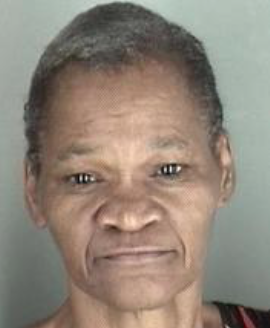
Spence-photo Shawnee Co.

An autopsy report related to the Sept. 19 death of 55-year-old Ruth Spence was released Thursday. The coroner, citing the chronic alcohol abuse, called the manner of death “natural.” No alcohol was found in her blood at the time of her death.

Spence was arrested and booked into the Shawnee County Jail on Sept. 18 for allegedly driving under the influence of alcohol and other crimes. She was found unresponsive in her cell the next day and taken to a hospital, where she died.

Ed Secretary proposes overhaul to campus sexual misconduct rules

By COLLIN BINKLEY

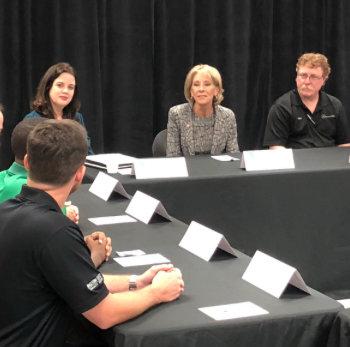
U.S. Education Secretary Betsy DeVoss – photo U.S. Dept. of Education

Education Secretary Betsy DeVos is proposing a major overhaul to the way colleges handle complaints of sexual misconduct.

The Education Department released a plan Friday that would require schools to investigate sexual assault and harassment only if the alleged misconduct was reported to certain campus officials and only if it occurred on campus or other areas overseen by the school.

The plan would narrow the definition of sexual harassment and allow students accused of misconduct to cross-examine accusers in campus hearings.

DeVos’ proposal would replace Obama-era guidelines she scrapped last year, saying they were unfair to students accused of sexual misconduct.

The new guidelines aim to give greater protections to accused students while also giving schools flexibility to offer support to victims who don’t file a formal complaint.

Martina Younger

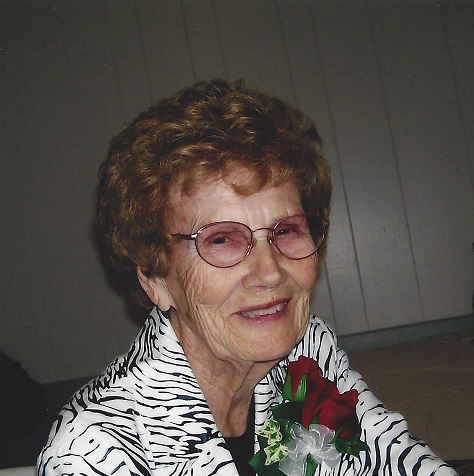
Martina Younger, age 92, of Munjor, Kansas died Friday, November 16, 2018 at the Good Samaritan Society of Ellis.

She was born September 15, 1926, on a farm at Munjor, Kansas to Felix and Anna E. (Wasinger) Korbe. She married Walter Younger on October 19, 1948 at Munjor, Kansas. He preceded her in death on October 21, 2014.

She was a homemaker and a farmer. She worked at the Ellis County ASCS in Hays for 35 years and worked a few years at the Walker Air Base. Martina retired in 1981. She was a member of St. Francis of Assisi Catholic Church, loved the outdoors, enjoyed quilting, gardening, collecting depression glass and rosaries.

Survivors include one son, Neal Younger and wife, Carolyn, Munjor, KS; one daughter, Gladys Powell and husband, Jamie, Beloit, KS; on sister, Mary Richmeier, Denver, CO; one brother-in-law, Don Hintz, NE; one sister-in-law, Olivia Korbe, Liebenthal, KS; six grandchildren, Mike Gross (Lisa), Jeremy Zimmerman, Amy Swanson(Virgel), Erin Garst (Justin), Maeghan Linder (Dustin), Brianna Younger and companion, McKinley Ross; nine great grandchildren, McKenzie Gross, Taylor, Merritt and Isabella Swanson, Clayton and Trinity Garst, Arya Linder, Bella Bailey and Lennon Ross.

She was preceded in death by her parents; her husband, Walter; one daughter, Gloria Zimmerman-Gross; one grandson, Cody Younger; three brothers, Felix Korbe and wife, Evelyn; Killian Korbe; Fred Korbe and wife, Zora; two sisters, Isabelle Dougherty and husband, Eddie; Bernadine Hintz and one brother-in-law, Cletus Richmeier.

Services are 10:30 A.M. Tuesday, November 20, 2018, at St. Francis of Assisi Catholic Church, Munjor, Kansas. Burial in St. Francis of Assisi Cemetery, Munjor, Kansas.

A vigil service and rosary will be at 6:30 P.M. Monday, at Cline’s-Keithley Mortuary of Hays, 1919 E. 22nd Street, Hays, Kansas 67601.

Visitation is From 4:00 to 8:00 P.M. Monday and from 8:30 to 9:30 A.M. Tuesday, all at Cline’s-Keithley Mortuary of Hays.

The family suggests memorials to St. Francis of Assisi Catholic Church or the Cody Younger FFA Memorial Scholarship Fund.

Condolences can be left by guestbook at www.keithleyfuneralchapels.com or can be sent via e-mail to [email protected]

Copyright Eagle Radio | FCC Public Files | EEO Public File