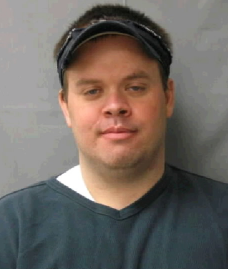
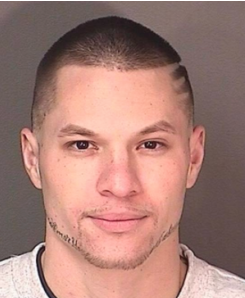
SHAWNEE COUNTY — Law enforcement authorities are investigating two suspects on numerous charges after an arrest.
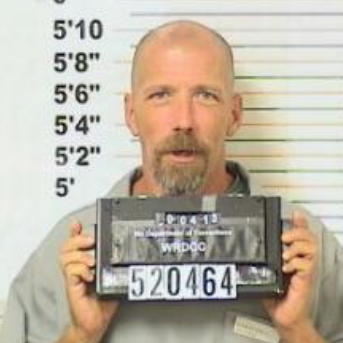
Burgess -photo Shawnee Co.Darr -photo Shawnee Co.
Just after 4 p.m. Wednesday, police responded to Motel 6 at 709 SW Fairlawn in Topeka to locate a subject with outstanding warrants, according to Lt. John Trimble.
During the investigation, officers discovered a gun, ammo and narcotics.
They also took 20-year-old Jatavious Darr and 41-year-old Allan Burgess into custody. They are convicted felons and were in possession of a firearm, according to Trimble.
In addition, police removed 3 children from the room and put them police protective custody.
Both Burgess and Darr were booked into the Shawnee County Department of Corrections on the following charges for Criminal Possession of a Firearm, Possession of Methamphetamine, Possession of Marijuana, 3 counts Aggravated Child Endangerment and Possession of Drug Paraphernalia. Darr was also booked for a Felony Pottawatomie County Warrant and a Topeka City warrant, according to Trimble.
KANSAS CITY – A Kansas City man who wore a skeleton mask while disrupting traffic was indicted by a federal grand jury today for illegally possessing a sawed-off shotgun, according to the United State’s Attorney.
Robertson -photo Mo. Dept. of Corrections
Daniel A. Robertson, 54, was charged in a two-count indictment returned by a federal grand jury in Kansas City. Tuesday’s indictment replaces a federal criminal complaint that was filed against Robertson on Oct. 29, 2018.
The indictment charges Robertson with being a felon in possession of a firearm and with possessing an unregistered firearm.
According to an affidavit filed in support of the original criminal complaint, Kansas City police officers responded to a call at 152 Highway and N. Indiana on Oct. 28, 2018. A caller had reported a suspicious man (later identified as Robertson) walking on the entrance ramp of the highway wearing a black skeleton mask over his face. The caller said the man walked toward her car, causing her to nearly hit him.
When officers arrived, they contacted Robertson. Robertson allegedly was carrying a loaded sawed-off 12-gauge shotgun concealed in the front of his jacket. He had additional ammunition in his jacket and pants pockets, the affidavit says.
Under federal law, it is illegal for anyone who has been convicted of a felony to be in possession of any firearm or ammunition. Robertson has prior felony convictions for burglary, possession of a controlled substance, endangering the welfare of a child, child molestation, failure to appear in court, and failure to register as a sex offender.
The charges contained in this indictment are simply accusations, and not evidence of guilt. Evidence supporting the charges must be presented to a federal trial jury, whose duty is to determine guilt or innocence.
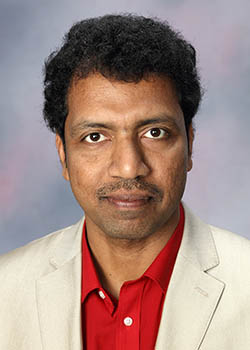
Dr. Babu George, associate professor of management and international coordinator in Fort Hays State University’s W.R. and Yvonne Robbins College of Business and Entrepreneurship, was selected to participate in the 2018 Jewish National Fund Winter Faculty Fellowship Program in Israel.
George, along with 27 other participants from colleges across the United States, will travel to Israel for two weeks, starting in Haifa and ending in Tel Aviv.
U.S. universities that will be represented include Temple University, the University of California-Davis, the University of Texas-El Paso, Arizona State University, Stetson University, Cornell University, Washington State University, the University of Florida, Rochester Institute of Technology, and Loyola University-New Orleans.
Participants will meet Israelis from all walks of life and hear from a variety of speakers. They will also be exposed to contemporary Israeli society, culture, historical sites, the people and the way of life in Israel.
Professors will also have the opportunity to meet with professors of similar disciplines with the goal of developing collaborations, research projects, co-authoring articles, and establishing exchange programs between faculty and students. George aims to discuss possibilities of developing inter-institutional partnerships in business and allied areas.
Those who take part in the program will develop a deeper awareness of Israel as a nation and how the country addresses regional and global challenges.
We’d all like a “better” internet in terms of privacy, politeness, taste and safety. And who would oppose eliminating false or misleading information from social media sites, or preventing online bullying and such?
Last week, some of the world’s most significant, influential and powerful figures around such issues — in the words of The Wall Street Journal, “the giants of the web” — gathered at the 2018 Web Summit in Lisbon, Portugal and in Brussels at an international conference on data privacy and policy.
At the Lisbon meeting, an audience reportedly cheered for a proposed international institute to propose regulations worldwide on social media. United Nations Secretary-General António Guterres warned in a speech that “the weaponization of artificial intelligence is a serious danger” and Microsoft President Brad Smith called for “a digital Geneva Convention” to end state cyberattacks against civilians.
Web inventor Tim Berners-Lee called for private companies, governments and internet users to unite around what he called a “contract for the Web,” a nine-point plan with goals to protect personal privacy, create online methods to counteract harassment and hate speech and for universal access to the web.
In Brussels, Apple CEO Tim Cook advocated for the U.S. to adopt the European Union’s strict data privacy law, enacted in May, allowing consumers to review, edit and delete personal information on the web. Cook warned that technological advances are leading to a “data industrial complex” and that “our own information, from the everyday to the deeply personal, is being weaponized against us with military efficiency.”
So much for the once-hoped for era of “peace, love and harmony” that the World Wide Web was supposed to usher in on behalf of all humanity.
Still, we’ve been here before — and need to keep in mind we’ve overreacted to the threats, real and imagined, posed by new technology before dialing down regulations and codes to a reasonable compromise on free expression, privacy and safety.
Early concerns about privacy noted that the new-fangled telephone could ring into a home at any hour of the day, while proper guests of the day would knock on the door and announce themselves.
Content on radio was relatively unregulated, with government attention directed more to the actual problems with frequencies and interference — until the Communications Act of 1934 gave the Federal Communications Commission power not only to govern the technology but what was said over the airwaves via the so-called “Fairness Doctrine.” Intended to ensure that all voices were heard on public airwaves, the doctrine was abandoned in the 1980s as no longer needed in a world of virtually unlimited cable and satellite channels, but also with the realization that it actually diminished discussion on matters of public interest.
In movies, the “Hays Code” was adopted by Hollywood filmmakers in the early 1930s to head off moves to have Congress set strict standards for what movies could show across a wide range of topics and issues — from comments about the law and drug use to sex and violence. One silly example of the code’s restrictions: Childbirth was considered a “taboo” subject. In the acclaimed film “Gone with the Wind,” as a character was giving birth, actors in the scene could only be shown as shadows on a wall.
The code was on the books for decades but was weakened in the 1940s and 1950s — particularly in 1952 when the U.S. Supreme Court, considering a case involving the movie “The Miracle,” extended First Amendment protections to films.
Likewise in television, the “Television Code” was adopted by the National Association of Broadcasters under threat of a government council to set rules. From 1952 to 1983, the code ruled on everything from how actors dressed to references to religion, sex, family life and more. Famously, the code resulted in married couples shown on TV only using double beds and in 1952, when the star of “I Love Lucy,” Lucille Ball, became pregnant, that word was not permitted — the show was allowed to say only that she was “with child” or “expecting.”
When the sound of a flushing toilet was heard in 1971 in an episode of the groundbreaking sitcom, “All in the Family,” it reflected a growing demand by the public for realism rather than the unrealistic depictions of everyday life that the code had encouraged.
Note that all of those overreactive attempts to regulate came early in the development of those mediums of expression.
The web is barely out of its teenage years, in effect, and social media megaliths such as Facebook and Twitter are even younger. The web’s revolutionizing impact extends from newly accessible public records to instant global communication. And our reliance on social media as a means of reporting news, recording our lives and relaying our views is unlike anything seen in generations, if anything before.
But if history is a guide — and it is — we need to temper calls to “protect” ourselves from that which we do not like or find dangerous, lest we replace such with censored, sanitized and government-regulated messages or content intended to pacify rather than provoke and inform.
There may well be a need to rein in the wild web, to set privacy boundaries and fight real misuse. But we must be certain that the control over what we see, hear, say and access remains as close to our own fingertips as possible — and not handed over to some “National Nanny” claiming to act on our behalf, lest we be confined to a future of shadows on the wall, double beds and a view of life where no one ever uses a toilet.
Gene Policinski is president and chief operating officer of the Freedom Forum Institute. He can be reached at [email protected], or follow him on Twitter at @genefac.
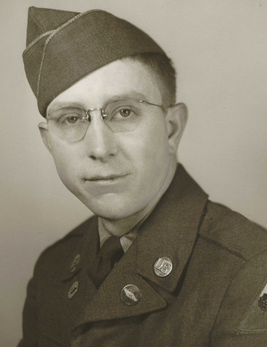
Donald Austin Stuvick, son of Austin and Gladys (Dodson) Stuvick, was born January 25, 1929, in Adams County, Iowa, and passed away at the Hays Medical Center in Hays, Kansas, on November 10, 2018, at the age of 89.
Don grew up in the Red Oak, Iowa, community and graduated from the Villisca High School. He also served his country in the U.S. Army. On February 17, 1957, he married the love of his life, Dorothy Good, in Red Oak. They moved to Junction City, Kansas in April 1958, and later to Norton in October 1962, where Don managed the J.C. Penney store for many years. Dorothy passed away July 1, 2011. Don remained in Norton where was active in the community.
Don was a member of the First United Methodist Church in Norton, where he served as treasurer for many years and was a long time member of the Norton Lions Club where he helped with the blood drive and had personally donated over 10 gallons of blood. Don was also a volunteer of Norton Cares, where he was a driver, making over 200 trips in helping others. Don enjoyed taking walks and was an avid Nebraska Cornhusker fan. He enjoyed college baseball and was a regular at the college world series. He was also a very big supporter of the local Norton sporting events.
Survivors include: two sons, David (Rhonda) Stuvick, Garden City, Kansas, and Douglas (Gina) Stuvick, Highlands Ranch, Colorado; one daughter, Diane Schlageck, Munjor, Kansas; one brother, Loren Stuvick, Huntley, Illinois; one sister, Karen Kraft, Omaha, Nebraska; three grandchildren and four great-grandchildren; other relatives and many friends.
Don was preceded in death by his parents, his wife, and sister-in-law, Virginia Stuvick.
MEMORIAL SERVICE – Wednesday, November 14, 2018—10:30 a.m.
PLACE – First United Methodist Church – Norton, KS
MEMORIAL SERVICE – Thursday, November 15, 2018 – 11:00 AM. Visitation will be held at the Nelson – Boylan – LeRette Funeral Chapel in Red Oak, IA
Cindy Ann DeLeon, age 54, left this earthly life on Tues., Nov. 13, 2018 at the Wesley Medical Center, Wichita, KS. She was born on Dec. 18, 1963 in Beloit, KS to Robert H. & B. Irene (Byers) Elniff Shelton.
Cindy graduated from Jewell High School in 1982. She attended Cloud County Community College, Ft. Hays State University & Kansas State University. She married David H. DeLeon on Nov. 25, 2001 in Hutchinson, KS. She worked as a caregiver for home healthcare, as a Para-educator in the public schools and for the Randall City Clerk’s office. She was a member of the Concordia Wesleyan Church, Celebrate Recovery & the Jewell United Methodist Church where she was a member of the choir and the United Methodist Women.
She is survived by her husband, David of the home; children, Cianna, of the home, Jenna, Hays & Valentin, Asheville, NC; brothers, Ron Elniff (Heidy), Concordia, Jay Shelton (Pam), Norton & Kevin Shelton (Myrna), Randall; sister, Marlene Kenyon (Alan), K.C., MO; step-mother, Mary Shelton, Jewell; several nieces, nephews and a host of relatives & friends.
She was preceded in death by her parents.
Funeral services will be at 10:00 am, Monday, Nov. 19, 2018 at The Wesleyan Church, Concordia with Rev. David Redmond & Pastor Bob Burns officiating. Visitation will be Sun., Nov. 18, 2018 from 1-8 pm with the family greeting friends from 4-6 pm all at Chaput-Buoy Funeral Home, Concordia. In lieu of flowers, the family suggests memorials to the Cianna DeLeon Education Fund or the Wesleyan Youth in care of the funeral home. For online condolences, please visit www.chaputbuoy.com.
High Plains Mental Health announced last week that it will expand services at the Schwaller Crisis Center to people who are uninsured.
The four-bed center, which is located in Hays, serves as a mental health crisis center for High Plains’ 20-county catchment area.
In the past, the center has provided care to Medicaid and private-pay clients. An increase in state funding allowed High Plains to expand its care to individuals who are homeless and experiencing a mental health crisis. State funding had been cut by almost a third in the last six to eight years, Walter Hill, High Plains executive director, said. Some of that funding has been restored.
The center provides 24/7 care as a voluntary alternative to hospitalization.
A sitting area at High Plains Mental Health’s Schwaller Center. The center provides 24/7 crisis care in a home-like setting.
Although crisis centers similar Schwaller are opening in metro areas such as Kansas City and Wichita, the Schwaller Center opened in 2002. The center opened after the in-patient hospital unit in Hays closed in the same year.
The center is a half-way point between outpatient treatment and hospitalization.
“There’s a gap between coming in once or twice a week or every couple of weeks versus going to a state hospital where it is locked and people stay overnight and see a psychiatrist,” Hill said.
Since the center opened, it has diverted 6,000 admissions away from Larned State Hospital and allowed people to find support locally. The center has also been used as transition between the hospital and home.
The center provides many of the same services as a hospital, such as access to a psychiatrist and therapy. However, it offers care in a home-like setting. The center has four private bedrooms, a community kitchen and dining room, as well as laundry facilities. The average stay at the center is three to five days.
Individuals receive support to cope with stressful circumstances, strengthen coping skills, improve sleep and manage daily life skills. They make meals with the staff or with the other individuals staying at the center. The staff may help individuals with life skills, such as managing money, and the staff can help connect the individuals with community resources to use when they leave the center.
Some clients are paired with case workers who help them access resources to look for a job, find a place to live or apply for health care.
Hill said individuals who stay at the center do a lot of work on goals on managing their symptoms. They create kits with reminders of how they can better cope with symptoms and stressors.
“It has reminders about those things so they can pull those reminders out about how do I deal with a situation when I am feeling so depressed or so anxious. How do I calm myself down? So it is really teaching self-help skills. It is probably the most important activity,” he said.
Dealing with your time and handling loneliness can be a significant problem for people who suffer from mental illness, and staff help clients with strategies to cope with those issues. Having the center in the community also means clients are closer to friends and family who can come visit during the individual’s stay.
“People still feel like they have a lifeline to pull themselves back into being on their own,” Hill said. “Sometimes going into the hospital increases their feelings of hopelessness and helplessness because they are so far away in a much different environment in a locked environment. This is not a locked environment like it would be at a state hospital.”
The clients receive medication reviews and work with the staff to create plans for transitioning back to independent living.
Sometimes people’s ability to cope gets worn down and having a place where those stresses are reduced is needed, Hill said.
“One of the key issues is [this is] a safe place where we can help them learn to deal with issues in their lives that are kind of coming in on them,” he said.
“Usually mental health issues at that level of severity are a combination of getting things rebalanced and then learning to deal with those things in life once things are stabilized in your nervous system so you are less depressed and you are thinking more clearly and are less anxious,” Hill continued.
High Plains covers 19,000 square miles and a population of about 100,000 people. Sometimes there is a waiting list for the center and people have to go to the hospital instead of using the center. However, Hill said there are no plans to expand the program. At this point, space and funding would be barriers, he said.
The Schwaller Center was named for Julia Schwaller, who was one of the founding members of the High Plains board.
For more information about High Plains and its services, call 1-800-432-0333. If you are having a mental health emergency, call 911.
Fatal Kiowa County crash scene -photo courtesy KWCH
KIOWA COUNTY — Three people died in an accident just before 7a.m. Wednseday in Kiowa County.
The Kansas Highway Patrol reported a 2019 International semi driven by Gary Allan Heald, 55, Fergus Falls, MN., was westbound on U54 at Orange Street.
The semi crossed left of center and collided with a 1995 Peterbilt semi driven by Justin Wise, 38, Arkansas City, and both trucks caught fire.
Heald, Wise and a passenger aboard the International Cheryl Marie Thomas, 56,Fergus Falls, MN., were transported to the hospital in Dodge City where they died.
The KHP had no information on seat belt usage.
———-
WELLSFORD, Kan. (AP) — The Kansas Highway Patrol says three people have died in a crash involving two semi-trailer trucks.
The head-on crash occurred early Wednesday on Highway 54 near the town of Wellsford in Kiowa County.
The patrol says both trucks caught fire. The highway was closed for several hours after the crash.
One truck was empty and the other was carrying pork products.
The names of the three people killed have not been released.
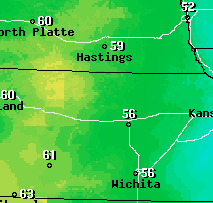
Today Sunny, with a high near 61. West southwest wind 5 to 10 mph becoming north in the afternoon.
Tonight Clear, with a low around 29. North northwest wind 5 to 7 mph becoming west after midnight.
Friday Sunny, with a high near 57. Light west southwest wind becoming south southwest 9 to 14 mph in the morning. Winds could gust as high as 24 mph.
Friday Night Partly cloudy, with a low around 32. Breezy, with a southwest wind 5 to 10 mph becoming north 15 to 20 mph after midnight.
Saturday Mostly cloudy, with a high near 34. Breezy, with a north northeast wind 17 to 21 mph.
Saturday Night A 30 percent chance of snow, mainly before midnight. Cloudy, with a low around 21.
TOPEKA – Winter Weather Awareness Day in Kansas is Thursday, Nov. 15. That day would be an ideal time for Kansans to take stock of their emergency supplies and review their home emergency plan.
A home emergency supply kit should include enough nonperishable food and water for each person to survive for a minimum of seven days, a safe alternate heat source, blankets, flashlights and batteries, a battery-operated weather radio, essential medicines, and other items needed for health and comfort should the power go out.
Vehicles should be equipped with emergency kits, too, particularly if you are planning to travel long distances. These kits should include weather appropriate clothing; bottled water for everyone; nonperishable, high-energy snack items; flashlights and batteries; a battery-operated radio; blankets; a compact snow shovel; extra medications; signal flares and other emergency supplies to allow you to survive until help can arrive. It is also advisable to fill your gas tank before you start on a journey, check engine fluid levels and tire pressure, and make sure cell phones are fully charged.
Emergency plans and preparations should also include family pets. During winter storms, bring outdoor pets inside, if possible, or ensure that they have a draft-free enclosure with straw type bedding that is large enough to sit and lie down, but small enough to hold their body heat if they must remain outside. Always make sure that your pets have access to food and non-frozen water.
KANSAS CITY, KAN. – A Kansas man was sentenced Wednesday to 151 months in federal prison for soliciting a 16-year-old girl to send him child pornography, according to U.S. Attorney Stephen McAllister.
Drake photo KDOC
Jamie Drake, 40, Lawrence, Kan., pleaded guilty to one count of coercion and enticement of a minor. In his plea, he admitted he solicited a 16-year-old girl from Franklin County, Mo., to send him photos of herself in sexual poses. He offered to pay her bills and send her money in exchange for photos.
Drake has two previous convictions for DUI and forgery, according to the Kansas Department of Corrections.
WICHITA, Kan. (AP) — The man accused of running over a Wichita police officer last year has pleaded guilty.
Terrazas-photo Kansas Dept. of Correctios
Justin Terrazas pleaded guilty Wednesday to aggravated battery and other charges.
Prosecutors say Terrazas ran over officer Brian Arterburn while fleeing in a stolen vehicle in February 2017.
Terrazas will be sentenced Jan. 14.
District Attorney Marc Bennett said the state and defense have agreed to a 39.5-year prison sentence.
Arterburn, a 25-year police veteran, suffered chest, abdomen and brain injuries when the vehicle hit him as he placed spike strips on a road in south Wichita. He spent nearly 10 months in hospitals in Colorado and Texas before returning to Wichita last November.
Earlier this year, the city approved Arterburn’s medical retirement.
GEARY COUNTY — One person was injured in an accident just before 2p.m. Wednesday in Geary County.
The Kansas Highway Patrol reported a 2000 Mercury Sable driven by Alcinder D. Dawson, 45, Junction City, was northbound on Lyons Creek Road four miles south of Junction City.
The vehicle pulled to the edge of the road and stopped to allow a 2016 John Deere Combine driven by John A. Kramer, 68, Milford to pass. The combine swerved into the east ditch, strikingthe Mercury and then pushed it across the roadway and into the west ditch.
Dawson was transported to the hospital in Salina.
Kramer was not injured. Dawson was wearing a seat belt at the time of the accident, according to the KHP.