Peter Werth (standing) and Dr. Mark Bannister (right)
By DIANE GASPER-O’BRIEN FHSU University Relations and Marketing
It’s not every day someone after whom a college is named visits that university.
Fort Hays State University had the pleasure of hosting Peter J. Werth last week.
Werth – of the Peter Werth College of Science, Technology and Mathematics – was on campus as the featured speaker at Entrepreneur Direct, a speaker series conducted by Fort Hays State’s Center for Entrepreneurship.
Two years ago, Werth, a Hays native, and his wife, Pamela, pledged $6 million to Fort Hays State’s College of Science, Technology and Mathematics. The Kansas Board of Regents approved naming the college after Werth, an FHSU graduate.
Also returning to Hays for this year’s Entrepreneur Direct was Dr. Mark Bannister, who started the event back in 2012. Bannister, then dean of the College of Business and Leadership – which was later named after W.R. Robbins – has been a part of Entrepreneur Direct all seven years.
“We wanted to bring successful entrepreneurs to campus for students to learn from and to be inspired by and to help spark their own entrepreneurial spirits,” Bannister said.
This year, Bannister had further to travel than across campus to the Robbins Center from his office in McCartney Hall.
After 26 years at FHSU, Bannister accepted the position of interim dean of the College of Business and Economics at Boise State University in Idaho.
He served as the facilitator for Thursday’s session, saying he was pleased that Werth could be part of this year’s event.
“Peter Werth embodies the Tiger spirit of western Kansas,” Bannister said.
Werth founded ChemWerth Inc., a privately held, Connecticut-based corporation in 1982. It is a full-service generic drug development and supply company providing high quality active pharmaceutical ingredients to regulated markets worldwide.
He graduated from Fort Hays State with a Bachelor of Science degree in chemistry and received the Alumni Achievement Award in 2013.
Other panelists Thursday were Dr. Melissa Hunsicker Wilburn, interim dean of the Robbins College of Business and Entrepreneurship; Dr. Arvin Cruz, chair of the Department of Chemistry; and Dr. David Snow, director of the Center for Entrepreneurship.
Before answering questions about his successful business ventures, Werth highlighted numerous points for success, including:
• If it sounds too good to be true, don’t do it.
• Work smarter, not harder.
• Remember your organization will take on your personality.
• Say what you do, and do what you say.
• Have a life goal other than business.
One of Werth’s most noteworthy philosophies is inscribed on a conference room wall in the Dane G. Hansen Scholarship Hall: “Do good. Make a difference. Change the world.”
“Don’t be afraid to take chances,” Werth told the audience Thursday. “You learn from your mistakes.”
Werth also stressed to “never stop learning.”
He ended his talk like he said he often does.
“Customers come and go, but good friends are forever,” he said. “I consider you all my friends. Thank you, thank you, thank you.”
“I’m just one of roughly 400 members, men and women who compose VFW Post 9076 here in Hays. Our post is a great group. We have several heroes among us. In fact, some of them are here in the first few rows. But I want to make clear that I do not consider myself one of them.”
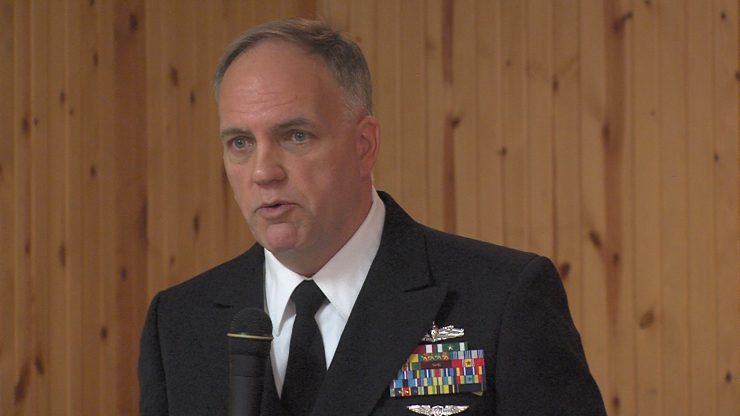
That was how retired Hays Lt. Commander Mike Morley, who served in the U.S. Navy for 23 years, introduced himself to the crowd gathered Saturday for the annual Hays VFW Veterans Day observation.
As the program’s featured speaker, Morley, who is communications coordinator for Midwest Energy, focused on what he called “my heroes, invisible veterans.”
He started with a reflection back to the devastation of World War I in which 20 million people were killed on all sides.
“Twenty-one million were wounded. And that’s significant because it was the first war where more men came home injured, surviving their combat wounds, than dying from them,” Morley noted.
There were horrific physical injuries. But other injuries were not so obvious.
“For example, shell shock. That’s a polite term for what we call today PTSD (Post Traumatic Stress Disorder). Or nerve and brain damage from widespread use of chemical weapons.
Flag-raising ceremony Saturday at the Hays VFW
“H. G. Wells famously wrote that World War I will be ‘the war that will end war’ because a rerun would be just to horrific to contemplate. Of course, we know things didn’t turn out that way.”
Morley recalled the wars since then, several other smaller actions and places today where troops are fighting in small numbers.
“In the 100 years since the end of World War I, November 11th, 1918, tens of millions of men and women have worn the uniform of their country and all of them to a greater or lesser degree, have been changed forever by that experience.”
Life is just a little bit different for those invisible men and women who made it home, just like those in World War I, he said, whether they served in combat or not.
Morley talked about his friend Brian. “He doesn’t have any ships or places named after him, but his sacrifice is every bit as real as those who do.”
The two met 26 years ago as young sailors. Brian was from Texas; Morley was from Topeka, Kansas.
“We had three things in common: a love of heavy metal music, a love of Japanese beer and a curiosity about amateur boxing.”
One evening after work the two put on sparring gloves. “It wasn’t pretty,” Morley said with a wry grin.
Morley was knocked down in about 40 seconds. Brian had neglected to mention he was a Texas high school Golden Gloves boxer. Rather than rub it in, Brian taught Morley how to improve his boxing skills.
They kept in touch over the years by email and Facebook.
While Morley stayed on active duty, Brian went inactive and into the Navy Reserve, moving to Manhattan, Kansas, and taking a job at Fort Riley to raise his family.
Brian volunteered for his first combat deployment to Afghanistan in 2008. While on patrol with a Marine squad, a teenage boy approached them with a smile, said hello in English, and then detonated the explosive vest he was wearing.
The bomber was killed instantly. The blast scattered the Americans who suffered various injuries, including lost limbs and eyes. Brian was sent into a wall, knocked unconscious and shattered three vertebrae in his back.
After a long convalescence stateside, Brian received the Purple Heart and re-enlisted in the Navy Reserves.
“I was stunned when he volunteered for a second tour,” Morley recalled.
This time, Brian’s base was hit several times by Taliban rocket attacks. During a nighttime attack, Brian fell from his bunk, hitting his head hard on a metal table. He was knocked unconscious and re-injured his back.
His tour was again cut short and he was sent home to recover.
Brian’s wife reported something was different after that event; his normally happy-go-lucky personality had changed. “He became short-tempered, suspicious. His mood swings at work became more pronounced and he couldn’t deal with stress very well,” she said.
Brian ended up losing his job at Fort Riley.
His medical care was also different the second time. Instead of the long inpatient stay at National Naval Medical Center in Bethesda, Maryland, he received after his first injury, Morley said, “Brian was given cursory outpatient treatments at the VA [hospital] in Topeka.”
Brian was on 26 prescription medications in 2010, according to his wife. He was taking anti-psychotics, anxiety drugs, sleeping pills, stimulants and pain pills, all at the same time.
The VA twice scheduled and canceled the back surgery Brian needed for permanent pain relief. There was a surgeon shortage and more severely injured veterans took priority.
“So Brian was simply given more and stronger pills, and the chemical mix made him more and more unpredictable.”
In July 2011, when Brian’s mood swings were at their highest, his wife and children moved out.
“For seven months, Brian rarely left the house, only for food, doctor’s appointments and to pick up prescriptions. His Facebook posts had gone from fun and edgy to being an incoherent mix of statements and paranoid rants.”
On Feb. 11, 2012, Brian received a mail-order prescription for 90 pain pills, double the dosage of an earlier prescription.
That evening he took 10 of the new pills along with the cocktail mix of his regular meds.
When Brian didn’t show up for his son’s track meet the next afternoon, his son went by the house and found him on the basement couch.
The chief petty officer was just 39 years old.
“Ironically, Brian was not among the 22 veterans who would take their own lives that day, or the next day, or every day since,” Morley said.
Brian left no note. His death was declared “respiratory arrest by accidental overdose.”
“He died as he lived his last few years, as an invisible veteran,” said Morley of his longtime friend.
Brian’s story is not unique.
“This country, its VA system, and dozens of non-profit groups have bent over backwards to ease the transition for severely [physically] disabled combat vets. These guys are true heroes,” Morley declared, “and they really deserve to be cared for as such.
“But for the thousands and thousands of invisible veterans whose injuries are less obvious or poorly documented, they fall through the cracks trying to navigate a system that wasn’t designed for them, and this is not new.”
There are Vietnam War Agent Orange vets with cancer, veterans with Gulf War Syndrome, and more recently, veterans suffering from traumatic brain injuries from non-fatal blasts or severe PTSD from events they’ve experienced but can’t unsee.
“They suffer in silence for years on end, hoping and praying that a slow-moving bureaucracy will someday validate or at least acknowledge that they are now different from before they served.
“So H.G. Wells was dead wrong when he predicted an end to war a hundred years ago,” Morley declared.
“Today, we’re in a war against faceless, nameless terrorists with no end in sight, which means we are continuing to make these invisible veterans.
“As we pause today to remember the veterans we’ve lost, let us also remember those we still have with us, especially the invisible ones. Let us vow to never again minimize their service or minimize their symptoms. Instead, let’s embrace them and their families with dignity, compassion, and most of all, understanding,” he concluded.
Morley’s speech was met with a standing ovation by the audience, filled with veterans, family and friends.
Steve Gilliland
Picture this; you’re a law enforcement officer in Kansas City, MO and you show up one morning at a home to evict the tenant, along with his belongings, only to find his “belongings” include a 7 foot alligator.
On Wednesday morning law enforcement officers arrived at the home of Sean Casey in southeast Kansas City, Missouri to evict him from the home he was renting, giving him just a short time to gather his possessions. They soon found his possessions included 3 python snakes, several domesticated dogs and cats, a rabbit named “Dinner” and a 7 foot alligator affectionately called “Katfish” found lounging in a hot tub at the home. The officers had to enlist the help of animal control officers and Dana Savorelli who operates Monkey Island, a local exotic wildlife rescue group. It took 4 men and Savorelli to remove the gator, and after a lengthy rodeo, Katfish was finally extracted from the hot tub and exiled to Monkey Island.
Casey got Katfish when he was only 15 to 18 inches long and now 4 years later he is 7 feet long and weights 200 ponds. Casey insists “Gators are not big and ferocious like people think. Katfish doesn’t seem to know he’s an alligator and thinks he’s a dog. He likes to come out and play and sit on my lap. Sometimes he gets kinda’ smelly but he wags his tail when I come home.” Casey said “I tell people I have an alligator that can’t swim and is afraid of the dark and thunderstorms.” Casey says he fed Katfish chicken nuggets, steak, deer and fish.
I personally think Casey is being really naïve. I have to think ole’ Katfish made secret nightly soirees out into the hood for snacks. I’ll bet if you only knew, that neighborhood is devoid of most anything else on 4 legs but Katfish, and is possibly missing a few occupants on 2 legs as well. Parts of Kansas City have a whitetail deer problem and that would be a novel “natural” solution.
Since Kansas deer have never seen the likes of a gator before, ole’ Katfish could probably waltz right up to grazing whitetails, wish them a good evening and invite them for dinner… his dinner that is. It looks like the house where he lived with Casey is very near a pond and not far from the Little Blue River, so after dinner a short waddle to either body of water would allow him to dispose of any remains and no one would be the wiser (at least for awhile.) Katfish must have had a special “Don’t Eat Us” contract with the rest of the pets and the rabbit named Dinner and with Casey too for that matter. After all, if Casey were to disappear, who would pay the electric bill to keep his hot tub warm? Casey told reporters he had made Katfish a ramp to get himself in and out of the hot tub and the house, so after his late night banquet he could just drag his fat and sassy carcass back up the ramp, plop back into his comfy warm hot tube sanctuary and life would be good; he’d be livin’ the dream!
Alligators are illegal to possess in Kansas City, so Katfish will remain for now at Monkey Island. Casey says he will fight to get Katfish back, but animal control says “That’s not going to happen.” When asked about Katfish’s new living situation, Savorelli told reporters his sanctuary was now full because he’s had to “rescue” 2 more alligators in the last couple months. Explaining that rescued alligators need separate pens, he said “You can’t just put these guys together, they’d be fighting like dinosaurs.” Wait, I thought Casey said “Gators are not big and ferocious like people think.” …I say isn’t there a Tony Lama
factory somewhere close??? Continue to Explore Kansas Outdoors.
Steve Gilliland, Inman, can be contacted by email at [email protected].
WASHINGTON – Bureau of Reclamation Commissioner Brenda Burman announced today that Reclamation has selected two projects in Kansas to receive $97,000 for small-scale water efficiency projects. The funding from Reclamation will assist the selected applicants with converting open ditch laterals into buried pipeline systems.
Kirwin Irrigation District No. 1, located in northwestern Kansas, will receive $34,000 for its conversion of Lateral 6.8 to buried pipeline. They will convert 3,696 feet of an open ditch lateral to polyvinyl chloride pipe, reducing seepage and evaporation. This project meets goals identified in the district’s Water Conservation Plan and District Operating Plan, and is part of Reclamation’s Pick-Sloan Solomon Division Kirwin Unit.
Webster Irrigation District No. 4, located in Gaylord, Kansas, will receive $63,000 for its conversion of the Osborne Lateral 14.9 into a 1.5-mile buried pipe system. The project will eliminate evaporation, seepage, and operational losses. This project aligns with the Webster Irrigation District’s Water Conservation Plan and the district’s Operating Plan.
Funding is provided to projects on a 50-percent cost-share. A complete list of the selected projects is available at: https://www.usbr.gov/watersmart/swep/.
Small-Scale Water Efficiency Projects are part of Reclamation’s WaterSMART Program. The program aims to improve water conservation and reliability, helping water resource managers make sound decisions about water use. Learn more at https://www.usbr.gov/watersmart/swep/.
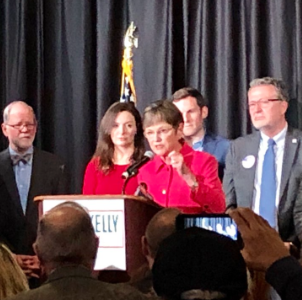
Governor-elect Laura Kelly on election night -photo courtesy Kansas Dems
From New York to New Mexico, residents in a number of states can expect a leftward push for expanded health care coverage, gun control, education funding and legalized recreational marijuana as Democrats who gained new or stronger powers in the midterm elections seek to put their stamp on public policy.
While Republicans remain in charge in more states, Democrats nearly doubled the number of places where they will wield a trifecta of power over the governor’s office and both chambers of the state legislature. Democrats also broke up several Republican strongholds, forcing GOP lawmakers who have been cutting taxes and curbing union powers to deal with a new reality of a Democratic governor.
All told, Democrats gained seats in 62 of the 99 partisan state legislative chambers, according to data provided by the National Conference of State Legislatures (Nebraska is the lone state with a single, nonpartisan chamber). Democrats also added seven new governorships.
In Kansas, Democrat Laura Kelly’s election as governor immediately recasts the debate over several big fiscal issues.
She supports expanding the state’s Medicaid health coverage as encouraged by the Affordable Care Act. While bipartisan backing for that has grown, supporters had not achieved the legislative supermajorities that would have been needed to overcome the opposition of Republican Govs. Sam Brownback and Jeff Colyer.
Kelly also is pledging to reinstate an executive order barring anti-LGBT bias in state hiring and employment decisions, something Brownback rescinded in 2015.
In New York, where a new Democratic-run Senate will provide the missing link in liberals’ political power, the expansive agenda could go beyond guns, pot and health care to also include more protections for abortions rights and higher taxes on millionaires.
“We will finally give New Yorkers the progressive leadership they have been demanding,” said Sen. Andrea Stewart-Cousins, who stands to lead the Senate when the new session begins in January.
The U.S. is a deeply divided nation politically, a fact reflected in a midterm vote that gave Democrats the U.S. House while adding to the Republican majority in the U.S. Senate. But within states, the overall outcome of the 2018 elections was a continued trend of one-party control — Democrats in some places, Republicans in others.
For the first time since 1914, there will be only one state — Minnesota — with its two legislative chambers led by different parties.
If Republican gubernatorial candidates maintain their slim leads in Florida and Georgia, Republicans will hold full control over the governor’s office and legislative chambers in 22 states compared with 14 for Democrats. Just 13 states will have a split partisan control between the governor’s office and legislature, nearly matching the 60-year low point set in 2012.
There also has been a decrease in ticket-splitting between governors and state attorneys general, with the number of such divisions expected to decline from 12 to 10 as a result of Tuesday’s elections.
“This is the most hyper-polarized, hyper-partisan time we’ve see in generations, and nobody can deny that,” said Illinois state Sen. Toi Hutchinson, a Democrat who is president of the National Conference of State Legislatures.
Illinois is one of a half-dozen states where Tuesday’s election put Democrats in control of the governor’s office and legislature.
Democrat J.B. Pritzker, who ousted Republican Gov. Bruce Rauner, wants to legalize and tax recreational marijuana. He also has promised to push for a constitutional amendment to replace Illinois’ flat income tax system with a progressive one that requires the wealthy to pay a greater share.
Democrats also are planning aggressive agendas in other states where they expanded their political power:
— Nevada is expected to pass a ban on bump stocks on guns as the state Legislature meets for the first time since the October 2017 mass shooting on the Las Vegas Strip. Democrats also will be pushing to spend more on education, expand Medicaid coverage, raise the minimum wage and require employers to provide paid sick leave.
— In New Mexico, Democratic Senate Majority Leader Peter Wirth said minimum wage and teacher pay increases will be at the top of the agenda. Democrats also could overhaul the state’s approach to climate change, gun control and marijuana.
— In Colorado, Democrats are planning a renewed push to expand health coverage, adopt gun controls, boost public education funding and enhance environmental protections.
— In Maine, new Democratic Gov.-elect and Attorney General Janet Mills has vowed to finally expand Medicaid as voters demanded in a 2017 referendum but which has been slowed by her Republican predecessor.
The states shifting to Democratic dominance can look to New Jersey, which held its governor’s election in 2017 and replaced a Republican with a Democrat. With the Legislature already controlled by Democrats, the state promptly tightened gun regulations, passed a paid sick-leave requirement and restored funding to Planned Parenthood.
But it hasn’t been like Christmas every day for liberals. It took a last-day deal before the budget expired over the summer to avoid a state government shutdown as Democrats disagreed over which taxes to raise. Lawmakers have missed their own deadlines on legalizing marijuana for adults, and some advocates are upset the state has not moved faster to boost the minimum wage.
New Jersey state Sen. Loretta Weinberg, a Democrat who’s been in the legislature since 1992, said there’s a big difference in legislative debates when there’s one-party control.
“It is more about details than the broader principles,” she said.
Some states that became accustomed to Republican control over the past decade also will be making adjustments.
In Wisconsin, Republican lawmakers have been privately discussing ways they could limit the rule-making powers of Democratic Gov.-elect Tony Evers, who narrowly defeated Republican Gov. Scott Walker. Republican Senate Majority Leader Scott Fitzgerald said they are looking at reconstituting boards to make sure they have equal representation.
North Carolina’s Republican-led Legislature did something similar after Democrat Roy Cooper won the governor’s race in 2016. But Cooper successfully sued over a law weakening his influence over the state elections board.
In Michigan, Democratic Gov.-elect Gretchen Whitmer broke a Republican trifecta while campaigning to “fix the damn roads” and replace aging water pipes with a multibillion-dollar infrastructure plan. But tax increases or increased borrowing could be a tough sell in the Legislature, which remains under Republican control.
The next Senate majority leader, Republican Sen. Mike Shirkey, signaled that he would oppose raising Michigan’s corporate income tax and said he would fight any attempt to repeal Michigan’s right-to-work laws “with every ounce of my body.”
Republicans who control the Minnesota state Senate said they will fight Democratic Gov.-elect Tim Walz if he follows through with a proposal to raise the gas tax to pay for infrastructure improvements. A number of states have taken that step in recent years to fund road repairs. That includes states where Republicans control the legislature and governor’s office, including Indiana, Oklahoma and Tennessee.
Split power at the Minnesota Legislature also could lead to gridlock on the top issue from the election — health care. Walz campaigned on expanding one of the state’s low-income health care programs to offer a public option, but Senate Republicans have shot that down as an unworkable government takeover of health care.
MIAMI COUNTY —One person died in an accident just before 4a.m. Sunday in Miami County.
A 2016 Jeep Wrangler driven by Jacob Knapp, 29, was traveling south in the northbound lane of Highway 69 just north of 223rd Street, according to the Miami County Kansas Sheriff’s Department.
The Jeep struck a 2011 Chevy Malibu driven by Charlene Crabbe, 44. The Jeep then caught fire.
A passenger in the Malibu Joshua Alexander Kinsey, 25, Kansas City, Kansas, was pronounced dead at the scene, according to the sheriff’s department.
Crabbe suffered critical injuries. She and Knapp were transported to local hospitals. The accident remains under investigation.
OLATHE, Kan. (AP) — A former housekeeper has admitted stealing more than $500,000 in jewelry while working for a woman in Stillwell.
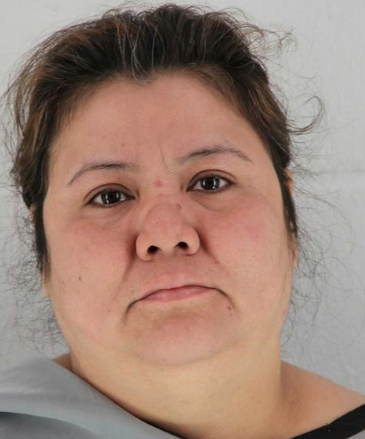
Garcia-Rivera -photo Johnson Co.
43-year-old Sabina Garcia-Rivera, of Olathe, pleaded guilty Thursday to one count of felony theft and three counts of making a false writing.
She was charged in January with stealing the jewelry over two years before the thefts were discovered in 2017.
The false writing charges involve false statements Garcia-Rivera made while pawning some pieces of the jewelry.
Prosecutors say she pawned several pieces for far less than they were worth.
Under terms of the plea agreement, prosecutors will seek a sentence of three years and two months. The defense will ask for a two-year sentence. She will also be required to make restitution.
TOPEKA —The United State Marshal’s Service and FBI are alerting the public of several nationwide imposter scams involving individuals claiming to be U.S. Marshals, court officers or other law enforcement officials.
Anyone receiving the calls is asked to contact their local FBI office and file a consumer complaint with the Federal Trade Commission which has the ability to detect patterns of fraud from the information collected and share the information with law enforcement, according to a media release from the U.S. Marshals’ office in Kansas City.
During the calls, scammers attempt to collect a fine in lieu of arrest by purchasing a pre-paid debit card, green card or similar gift card and read the numbers over the phone to satisfy the fine.
Scammers use many tactics to sound credible. They use badge numbers, names of actual law enforcement officials, federal judges and court addresses. They also spoof their phone numbers to appear on Caller ID as though calling from court or a government agency.
The U.S. Marshals Service will never ask for credit/debit card numbers, wire transfers or bank routing numbers for any purpose.
Don’t divulge your personal or financial information to unknown callers. Report these calls to the FBI and the FTC.
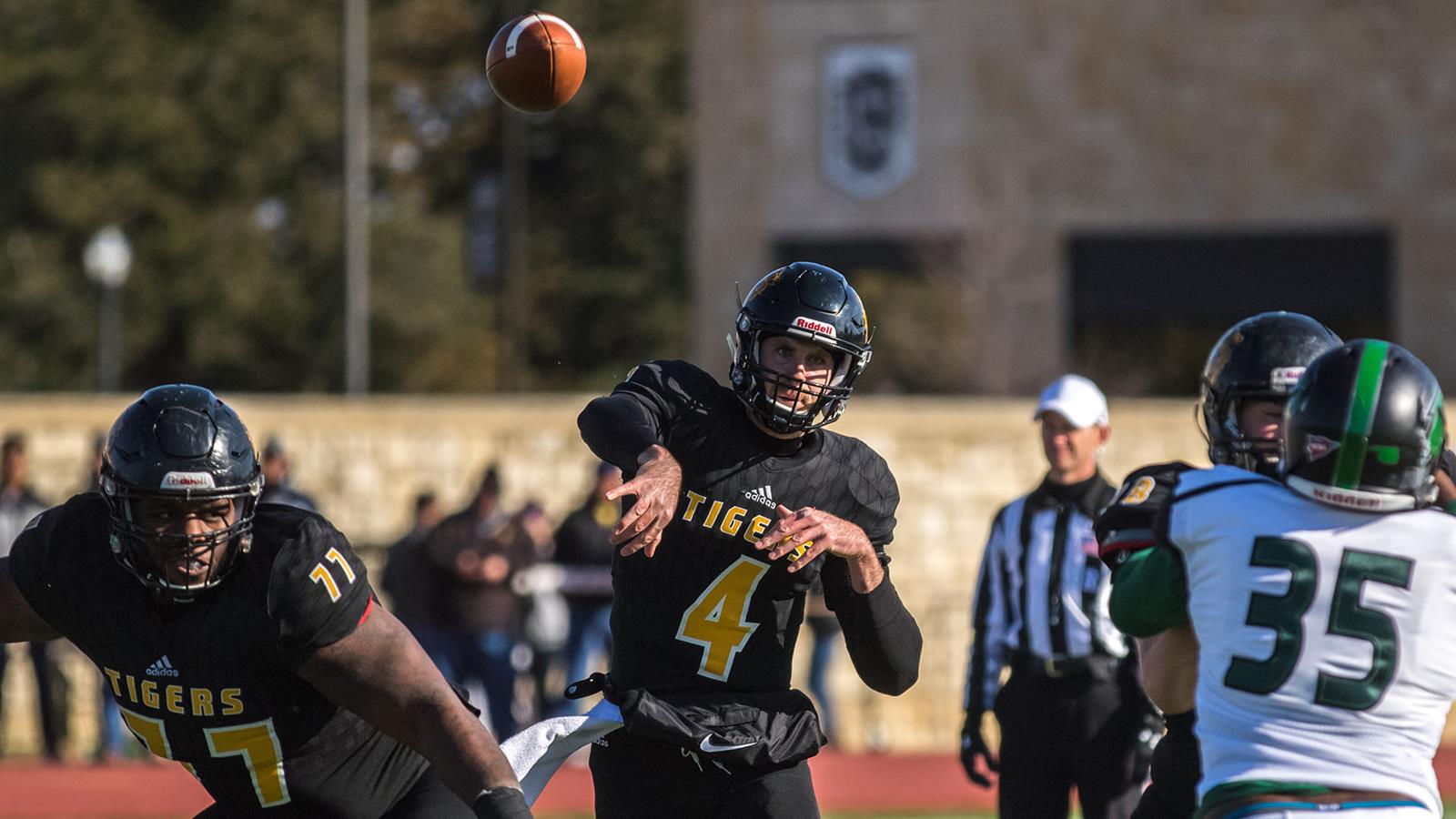
INDIANAPOLIS – Fort Hays State received the No. 5 seed in Super Region 3 for the NCAA Division II Football Playoffs. The Tigers will go on the road in the first round to play Great Lakes Valley Conference champion and No. 4 seed University of Indianapolis. The Tigers are 9-2 overall, while the Greyhounds are 9-1.
The Tigers enter the playoffs on a five-game win streak after claiming their second-straight MIAA Championship on Saturday with a win over Northeastern State. The Greyhounds are on a nine-game win streak after falling in their season opener to the super region’s No. 3 seed Grand Valley State. Indianapolis went undefeated in GLVC play at 7-0, and 2-1 in non-conference play.
The game will take place Saturday (Nov. 17) at Key Stadium on the campus of the University of Indianapolis. Game time will be available soon when set by the University of Indianapolis.
This is the first time in program history that Fort Hays State is appearing in the NCAA Division II Playoffs two consecutive years.
Fort Hays State and Indianapolis were the top two seeds in Super Region 3 last year, both going undefeated in the regular season. However, both fell in their first contest of the playoffs last year. A No. 2 seeded Indianapolis squad fell to No. 7 seed Harding in the opening round, while the No. 1 seeded Tigers lost at home to No. 4 seed Ferris State in the second round.
This year, undefeated Ouachita Baptist receives the No. 1 seed in the region. Ferris State also went undefeated during the regular season and held the No. 1 ranking in all three releases of the super region rankings. However, due to the use of an ineligible player early in the season, the NCAA dropped the Bulldogs slightly in the rankings to No. 2 due to the nullification penalty assessed for the violation.
Rounding out the rest of the teams competing in the Super Region 3 bracket are Northwest Missouri State at the No. 6 seed and Harding at the No. 7 seed. Both teams are in the same seed positions as they were last year. Harding was the Super Region 3 champion last year, knocking off the No. 2, No. 3, and No. 4 seeds to reach the national semifinals.
The winner of the Fort Hays State vs. Indianapolis game will move on to face Ouachita Baptist the following week in Arkadelphia, Arkansas.
All first round games occur on Saturday, November 17. On the opposite side of the Super Region 3 bracket, No. 2 seed Ferris State hosts No. 7 seed Harding, while No. 3 seed Grand Valley State hosts No. 6 seed Northwest Missouri State.
KANSAS CITY, Mo. (AP) — Patrick Mahomes will always have some special TV footage of the Kansas City Chiefs celebrating his record-setting touchdown pass in a win over the Arizona Cardinals on Sunday.
That’s because Tyreek Hill was the one recording it.
Mahomes threw for 249 yards at was too with two TD strikes to Hill, but it was the second one that sent the Chiefs’ first-year starter past Hall of Famer Len Dawson for the single-season TD record. It was the 31st for Mahomes — with six games yet to play — and it helped lift Kansas City to a 26-14 victory over the Cardinals and another game closer to the No. 1 seed in the playoffs.
Hill celebrated the score by leaping into the stands, then commandeering the CBS camera — earning him an unsportsmanlike conduct penalty from the officials and a sharp rebuke from coach Andy Reid.
“The celebration just came into my head,” Hill said. “For him to come in and do that, that’s amazing, man. People doubted him — ‘He wasn’t going to do this, he wasn’t going to do that.’ I’m proud of him.”
Hill had seven catches for 117 yards. Kareem Hunt pounded his way for 71 yards rushing. The defense came up with five sacks and two picks. And the Chiefs’ special teams were nearly perfect, helping to keep the Cardinals (2-7) winless in six meetings at Arrowhead Stadium.
“It was definitely a grind out there,” Hunt said, “and definitely a team that was trying to come up big in a big-time win to get their program back on track, but most importantly we got the win.”
Josh Rosen had 195 yards passing with a touchdown, but two interceptions and several brutal hits in the fourth quarter no doubt left a lasting impression. David Johnson ran for 98 yards with TDs on the ground and through the air, while Larry Fitzgerald had six catches for 50 yards and passed Terrell Owens for No. 2 on the NFL’s career receiving yardage list in the closing minutes.
Fitzgerald has 15,952 yards in 15-year career, trailing only Hall of Famer Jerry Rice.
“I’m pretty close to T.O. His friendship and my relationship with him is valuable to me. He means a great deal to me,” Fitzgerald said. “It’s frustrating that it comes in another loss.”
The Chiefs’ weekly air show got started on the game’s first play, when Hill ran right past Patrick Peterson to haul in a 38-yard reception. Two plays later, Hill ran past the rest of the Arizona defense and Mahomes found him streaking into the end zone for a 37-yard scoring catch.
Arizona answered with a time-consuming 75-yard touchdown drive of its own.
Both defenses fared better the rest of the half, with the Cardinals sacking Mahomes four times and the Chiefs’ rejuvenated defense getting enough pressure to keep Rosen uncomfortable.
The Chiefs finally reached the end zone again when Mahomes zipped a third-and-goal pass into double coverage to Hill, who cradled it for his quarterback’s record-setting score.
“Listen, he’s had a heck of a year,” Reid said of Mahomes, who was not available after the game because of a family emergency. “He’s played his heart out and I love the backside of that, how he goes about his business. He has a lot on his plate as far as responsibility goes to run the offense.”
As for Hill’s touchdown celebration?
“That was too much,” Reid said, hiding a smile. “I was not happy.”
The Cardinals stuck with Johnson in the second half, and they slowly grinded their way to another touchdown. He carried it six times and finished a 12-play, 61-yard drive with a TD plunge to get Arizona within 20-14 midway through the third quarter.
But after the Cardinals got the ball back early in the fourth, Rosen had a screen pass picked by Justin Houston at the line of scrimmage. And instead of marching for a go-ahead TD, the Cardinals watched Spencer Ware dive in for a touchdown to extend a lead the Chiefs would never relinquish.
“Thought the guys fought to the end,” Cardinals coach Steve Wilks said. “There are no moral victories in this game. All credit goes to Kansas City. Well-prepared, good football team.”
QUOTABLE
“I think we did a couple things really well. We’ve just got to duplicate it. Our opening drives were pretty long and sustainable, and kept our defense off the field. We had pretty well-timed possessions. A little good nugget here and there, but some bad things to clean up.” — Rosen.
COIN-TOSS LOSS
The Chiefs lost their first coin toss all season when the Cardinals successfully called tails. They deferred to the second half, forcing Kansas City to start on offense for the first time.
INJURIES
Cardinals: WR Chad Williams (ankle), LG Mike Iupati (back) and DL Robert Nkemdichi (calf) were inactive. … RG Justin Pugh left early in the second half with a knee injury.
Chiefs: WR Sammy Watkins (foot), SS Eric Berry (heel), LB Frank Zombo (hamstring) and OL Mitch Morse (concussion) were inactive. … Houston (hamstring) was active for the first time since Oct. 7.
UP NEXT
Arizona returns home to face the Raiders next Sunday.
Kansas City faces the Rams next Monday night in Mexico City.
TOPEKA – Since 2013, the Centers for Disease Control and Prevention (CDC) has recognized a threat to antibiotic resistance and has begun working with many partners across the state and nation to safeguard the effectiveness of antibiotics. In an effort to promote awareness of this important initiative, Governor Jeff Colyer has designated Nov. 12-18 Use Antibiotics Wisely Week.
Kansas Department of Health and Environment (KDHE) Chief Health Officer, Dr. Greg Lakin, says health professionals, patients and their loved ones need to be informed and only prescribe or use antibiotics when appropriate.
“The general public, health care providers, health care facility administrators, veterinarians, food producers and policy makers can all play a part in ensuring that antibiotics are only used when truly needed and likely to be effective,” Dr. Lakin said.
In Kansas, a broad range of individuals, professionals and organizations are working together to adopt best practices to help stem the inappropriate use of antibiotics. A statewide advisory group is assisting KDHE in spearheading this effort.
According to data from the CDC, the total number of antibiotic prescriptions written in Kansas ranked among the highest nationally. In 2015, more than 900 antibiotic prescriptions were written per 1,000 individuals statewide.
Antibiotic awareness does not mean stopping the use of antibiotics; it means changing the way antibiotics are prescribed and used today—when necessary and appropriate.
Since the 1940s, antibiotics have been used to treat patients who have bacterial infections, greatly reducing the number of related illnesses and deaths. But now, more than 75 years later, antibiotics have been overused and misused to the point that the infectious organisms the antibiotics are designed to kill have adapted to them, making the drugs less effective, according to the CDC.
The CDC finds that more than one-third of all antibiotics prescribed or otherwise used in the United States are either unnecessary or the antibiotic does not match the germ. Antibiotics are not needed for viruses, such as colds, most sore throats and many sinus infections.
Especially during the cold and flu season when viruses are prevalent, the public can do its part by recognizing that antibiotics are likely not the right medicine. Antibiotics can fight infections and save lives when used to fight the right germ, at the right time and for the right duration.
More than two million people in the United States get infections that are resistant to antibiotics, and each year, at least 23,000 people die as a result. If drug-resistant germs keep growing, and if we lose the effectiveness of antibiotics, we may also lose our ability to treat patients who need them.
(Click to enlarge)
Here are ways you can help:
Do not request that your doctor prescribe antibiotics.
Antibiotics may have side effects. When your doctor says that you do not need an antibiotic, taking one may do more harm than good.
Only take antibiotics that are prescribed for you and take the whole course as directed. Do not share or use leftover antibiotics. Antibiotics treat specific types of infections. Taking the wrong medicine may delay correct treatment and allow bacteria to multiply.
NEW YORK (AP) — Federal health officials have reported the first death in an ongoing salmonella outbreak linked to raw turkey.
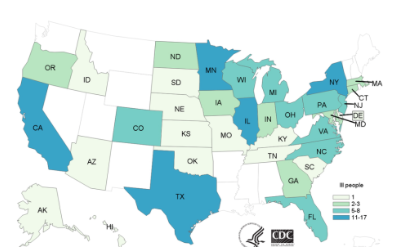
People infected with the outbreak strain of Salmonella Reading, by state of residence, as of November 5, 2018 (n=164) CDC Image
The Centers for Disease Control and Prevention said the death was in California but didn’t have any immediate details. Since last November, the agency said 164 people have fallen ill in 35 states, with the most recent case being reported on Oct. 20.
No products have been recalled, and the agency hasn’t recommended that people avoid turkey. But it said it believes the outbreak is widespread and ongoing, and it reminded people to properly cook and handle turkey with Thanksgiving approaching.
“We are still seeing new illnesses being reported on a weekly basis,” said Colin Basler, an epidemiologist with the CDC.
Basler noted there is a lag time between when a person gets sick and when the illness gets reported to health officials. The California Department of Public Health did not immediately respond to an email seeking additional details about the death.
A single supplier hasn’t been identified in connection with the outbreak. The rare salmonella strain was identified in live turkeys, as well as in ground turkey, turkey patties and raw turkey pet food.
The National Turkey Federation said in a statement that its members have reviewed their salmonella-control programs. The industry group said programs include vaccination and sanitation, such as wearing protective boots and clothing to reduce birds’ exposure to pathogens.
To limit risk, the CDC recommends cooking turkey to an internal temperature of at least 165 degrees, and washing hands and counters that have touched uncooked meat.
Salmonella can be found in a variety of foods, including packaged foods. This week, Conagra Brands recalled 2.4 million boxes of Duncan Hines cake mix because of a link to salmonella.
The CDC estimates salmonella causes about 1.2 million illnesses a year. Symptoms include diarrhea, fever and abdominal cramps and can last up to seven days. Illnesses are more likely to be severe in the elderly and infants, according to the CDC.