The race for the 111th Kansas House of Representatives District is still too close to call.
According to the unofficial vote total Tuesday night Republican Barb Wasinger leads incumbent Democratic Representative Eber Phelps by just 40 votes (4,259 to 4,219).
There are still 196 provisional ballots and at least 39 advanced votes that have not been counted.
According to County Election official Donna Maskus, it is possible that not all of the 196 provisional ballots can be counted. They have to be checked against state statute to determine if they are counted.
They will also count advanced ballots that were postmarked by Election Day and received by Friday. They will begin counting those ballots this week.
The official canvass of the vote totals will be on Thursday Nov. 15th at 5 p.m. at the County Administrative Center.
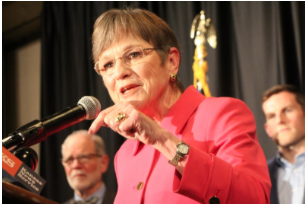
Kansas Governor-elect Laura Kelly celebrates her victory over Kris Kobach on election night
Democrat Laura Kelly fended off perhaps the most energizing and divisive figure in Kansas politics on Tuesday to become the next governor of Kansas.
Kelly beat out self-described “full-throttled” conservative GOP nominee Kris Kobach, the secretary of state who’d forged a kinship with President Donald Trump while dabbling in anti-immigration and voter fraud crusades across the country.
He lost to a 68-year-old state senator from Topeka who ran as a moderate, banking on a reputation in the Legislature as someone willing to find compromise rather than as a charismatic force for change.
Instead, Kelly called for Kansas to roll back the clock a decade to when previous Democratic governors formed coalition governments by cobbling together support from party regulars and Republicans uncomfortable with its far-right factions. Kobach represented the most aggressive version of that conservative wing.
Kelly pledged to restore school spending and move past the tax-cutting, service-slicing ways of former Gov. Sam Brownback’s time in the office.
To win the overwhelmingly Republican state, she walked a delicate line of appealing to moderate GOP voters while trying to enthuse bleed-blue Democrats. She also championed the endorsements of several high-profile Republicans from an earlier era of Kansas politics.
Her campaign focused time and again on Brownback, arguing to voters that Kobach would return the state to the policies that carved away tax revenue and triggered cuts in a range of services.
“The people of Kansas spoke, and they spoke so loudly. They put partisanship aside,” she told supporters giddy over a Democratic win in the Republican-dominated state. “Kansans voted for change. … A change in tone in the state. That tone will come to Topeka now.”
In her victory speech, she congratulated Kobach and independent Greg Orman on their campaigns. An otherwise raucous crowd went quiet.
“No,” she chided her supporters gently, “we’re going to be civil.”
She said the election wasn’t so much a Democratic win as a “wave of bipartisanship. … Partisanship was put above all else and it tore our state apart,” Kelly said. “That ended today.”
Kobach spoke to supporters briefly, mostly thanking his family and campaign staff for weathering the grind of the campaign.
He said his loss resulted from political forces pushing against Republicans in the midterm election.
“Headwinds all the way,” Kobach said.
He said Kelly had too much money. Much of Kobach’s campaign was financed by running mate Wink Hartman whereas Kelly relied more on smaller donors. Other spending in the campaign came from independent groups, notably the Republican Governors Association.
Still, Kobach insisted Tuesday night that he couldn’t keep up in the money and advertising parts of the campaign.
“I wish campaigns were all about debates and every single voter watched the debate and that would be different,” he said. “But spending money on campaigns matters.”
Orman, who made a close run for the U.S. Senate four years ago, turned out not to be a factor in the race. Kelly supporters had pressured him to drop out, fearing he would capture the votes of moderate Republicans who would otherwise opt for the Democrat.
In the end, Orman pulled about 6 percent of the vote. Kobach would have needed nearly every one of those votes to overcome Kelly. At the most, Orman’s candidacy might have denied her a clear majority — not of the plurality that swept her into office.
In other statewide races, Republicans maintained their grip on races farther down the ballot. In the race for secretary of state, State Rep. Scott Schwab beat former Google executive Brian McClendon. Attorney General Derek Schmidt bested a candidate the Democratic Party had abandoned. Vicki Schmidt ran away with the insurance commissioner’s race. Jake LaTurner will remain treasurer.
The governor’s race
When Kelly begins her term in January, it will be the first time since 2011 that Republicans haven’t controlled the governor’s office, the Kansas House and the Kansas Senate.
Kelly’s election revives the prospect that Kansas could expand Medicaid coverage. After moderates made sweeping wins in the 2016 election, the Legislature voted for the expansion in 2017 but failed to overcome a veto by then-Gov. Sam Brownback.
Kelly has made clear her support for Medicaid expansion, which represents an embrace of the Affordable Care Act, commonly known as Obamacare. Lawmakers might now rally behind expansion.
Her victory likely will mean an end to tax cuts, and the possibility of tax increases to pay for greater state aid to local school districts and an array of social programs. Those were virtually impossible under Brownback and his successor, Jeff Colyer.
Young supporters at Kelly’s Topeka election party said they were inspired by her positions on immigration and education — issues where she differed sharply from Kobach.
“She’s been so active with college students,” said Alyssa Evans of Russell. “I just wanted to show her that we’ve been paying attention and we do care that she’s been coming to different universities.”
Brecken Shimel of Hutchinson pointed to the differing personas of the top candidates — Kelly’s mild-mannered ways versus what he called Kobach’s delight in “intellectual combat.”
“She’s not as hateful as Kobach when it comes to, well, mostly everything,” Shimel said.
In 2014, fewer than 870,000 people voted in the governor’s race and Brownback beat Democrat Paul Davis by about 3.5 percentage points — despite a steady string of polls suggesting Davis was leading in the days running up to the actual voting.
This year, more than 1 million Kansans voted in the governor’s race. Kelly got about 48 percent, Kobach 43 percent and Orman roughly 6 percent.
The election returns showed a split in Kansas mirroring that in the country. In places where people live close together — the Kansas City suburbs, Wichita, Topeka, college towns — the Democrat won. Where they live far apart, the Republican piled up votes.
Even as statistically sound polls continued to suggest Orman was doomed to fall far behind the main contenders, he stayed in the race. His campaign treasurer quit a week before the election and endorsed Kelly, saying Orman had promised to drop out of the race if his stock hadn’t risen beyond spoiler status a month before the election.
Some supporters remained convinced even early Tuesday evening that Orman could pull off a shocker. Sean Reilly, a retired school teacher, hung his hopes on an unscientific poll of self-selected voters that suggested he might win with a plurality just shy of 40 percent.
“Over 7,000 people on the poll,” Reilly said. “They don’t have a dog in the hunt.”
And, it turned out, they weren’t representative of the electorate.
In the end, he may have denied Kelly a clear majority but not a win. Orman promised to advocate for those independents who voted for him and challenged the coming Kelly administration to avoid partisanship.
“Despite the fear, the anger and the hate that both parties threw at them,” Orman said, voters “still stood up and voted for me. I am so very grateful.”
Secretary of state
In the secretary of state’s race, conservative state Rep. Scott Schwab continued Republicans’ hold on the office by beating out former Google executive Brian McClendon. While one Democrat was appointed to briefly serve in the office in recent years, only Republicans have won election to the post since the middle of the 20th century.
Kobach elevated the job’s profile, using the force of his personality and headline-grabbing claims about immigration and claims of widespread voter fraud to catapult himself to national prominence as a Fox News regular and a sometimes-confidant to President Trump.
Schwab promised voters a less controversial tenure, although he’d been a key player in the Legislature backing Kobach’s wide-ranging efforts. Schwab said he at least wouldn’t oppose efforts to strip the secretary of state of one-of-a-kind powers to directly prosecute voter fraud cases granted during the Kobach years.
McClendon promised an aggressive re-make of the office aimed at making voting easier and using his Silicon Valley know-how to tailor the job’s record-keeping chores to business needs.
Schwab pledged Tuesday night to help county clerks navigate Kansas statutes and avoid conflicts with the American Civil Liberties Union, which was often at odds — and campaigned against — Kobach.
“We’re gonna make sure you get the understanding of what the legislature wanted so you will be able to execute on elections in a way that you don’t have to worry about the ACLU trying to kick down your door anymore,” Schwab said.
Madeline Fox, Nomin Ujiyediin, Brian Grimmett and Amy Jeffries contributed to this report.
Scott Canon is digital editor of the Kansas News Service. You can reach him on Twitter @ScottCanon.
————-
TOPEKA, Kan. (AP) — Democrat Laura Kelly won the Kansas governor’s race Tuesday, prevailing over Republican Kris Kobach after promising to slam the door on conservative budget and tax-cutting policies that were followed by persistent budget problems.
Kelly, a veteran state senator from Topeka, defeated Kobach, the Kansas secretary of state, even though Kobach is President Donald Trump’s closest ally in a state that Trump won handily in 2016. Independent candidate and Kansas City-area businessman Greg Orman trailed far behind.
The Democratic governor-elect made former Republican Gov. Sam Brownback and his ill-fated 2012-13 experiment in slashing state income taxes — not Trump — a key issue in her red state. Budget woes made Kansas a cautionary example of how not to do trickle-down economics, and Kelly was visible in the successful and bipartisan effort in 2017 that reversed most of the cuts.
“They spoke with a single thunderous voice,” Kelly said of voters in her victory speech at a Topeka hotel. “Kansans voted for change, a change not only in the direction of our state but a change in the tone in our state.”
Kelly wooed GOP moderates and independent voters upset with Brownback’s tax-cutting experiment. She said her victory signaled greater bipartisanship.
Kelly’s message resonated with even Republican voters such as Kimberli Evans, a 43-year-old federal employee from Topeka, who voted for the Democratic nominee. She said fair funding for public schools is one of her big concerns.
“I believe that the Brownback experiment did not work and needs to be reversed,” Evans said after casting her ballot.
Kobach had criticized the $600 million-a-year income tax increase and campaigned on shrinking government so that the state could resume cutting taxes.
Kobach brought some celebrity to the race, having built a national profile as an advocate of tough immigration policies and strict voter identification laws. He has advised Trump and served as vice chairman of Trump’s since-disbanded commission on voter fraud.
He narrowly ousted Gov. Jeff Colyer in the GOP primary in August after Trump defied a split among his advisers and tweeted an endorsement of Kobach. Trump carried the state easily in the 2016 presidential race and had a rally to help Kobach’s campaign in October. Donald Trump Jr. had two fundraising events for him.
“We fought the good fight,” Kobach told his supporters at another Topeka hotel. “This one just wasn’t God’s will.”
The contrast between Kobach and Kelly was stark because Kelly not only portrayed Kansas as in financial recovery but also had a list of places where she’d like to bolster spending, including higher education, early childhood education and mental health services.
Kansas is considered a deep red state with party registration 44 percent Republican and 25 percent Democratic. But its dominant Republican Party sometimes splits between moderates and conservatives, leaving an opening for a Democrat to peel off disaffected GOP voters. In recent decades the state has alternated between Republican and Democratic governors.
Kobach cited that historical trend in telling supporters that the race came with, “headwinds all the way for our team.”
That GOP rift emerged this year with the nomination of Kobach, who concentrated on motivating his conservative base rather than wooing moderate voters. Kobach said that if elected he would encourage immigrants living in the state illegally to leave Kansas.
Kelly said Kobach’s immigration policies would hurt the state’s economy, particularly in western Kansas, which depends on immigrant workers for the meatpacking industry.
Ellie Smith, a 24-year-old Democrat, stay-at-home mom and musician from Topeka, said Kobach’s positions on immigration “hurts my heart.”
“I believe that everybody belongs here,” she said.
HAYS – Republican Butch Schlyer claimed the race for the Ellis County Commission 1st District in Tuesday’s election.
Schlyer defeated Democrat Chris Rorabaugh 43.45 percent to 33.54 percent (1,443 to 1,114). Independent John Walz was third with 22.88 percent (760 votes).
Schlyer said Tuesday he was pleased with the outcome.
“I knew it was going to be a pretty close race,” Schlyer said. “I’m just glad I came out ahead of the deal.”
The official canvass of the vote totals will be on Thursday Nov. 15th at 5 p.m. at the County Administrative Center.
Schlyer will begin serving his term on the county commission in January.
Michael L. Spicer, Jr., age 22, of Larned, KS, passed away on Sunday, November 4, 2018 at HaysMed. He was born on December 12, 1995 in Russell, KS.
Michael will be remembered as someone that was outgoing and always willing to help someone in need. He enjoyed playing video games and spending time with his family and friends
Survivors include his mother, Ruth Pagh of Larned; four sisters, Tasha Spicer, Alexandra Rees, Rheanon Clark, Kya Rabenseifner; maternal grandparents, Chad and Sandra Rees; one niece and two nephews; three aunts and three cousins. He will be dearly missed by his family and friends.
He was preceded in death by his cousin, Matthew Dell.
Cremation has taken place. A memorial service will be held at a later date.
TOPEKA—The Kansas Supreme Court reappointed five people to two-year terms on the Juvenile Justice Oversight Committee.
The committee, formed in 2016 at the direction of the Kansas Legislature, reviews and oversees improvements to the juvenile justice system in the state. Membership includes representation from all three branches of government.
The Supreme Court appointees are:
District Judge Delia York, serving in the 29th Judicial District, composed of Wyandotte County.
District Magistrate Judge Paula Hofaker, serving in Phillips County of the 17th District, also composed of Decatur, Graham, Norton, Osborne, and Smith counties.
Kevin Emerson, chief court services officer for the 28th Judicial District, composed of Ottawa and Saline counties.
Lara Blake Bors, Garden City, a juvenile defense attorney.
Amy Raymond, director of trial courts programs, Office of Judicial Administration, Kansas judicial branch.
KANSAS CITY, Mo. – The U.S. Army Corps of Engineers announced it will waive day use fees at its more than 2,800 USACE-operated recreation areas nationwide in observance of Veterans Day, Nov. 11 and 12.
In western Kansas, the eligible lakes include Wilson and Kanopolis.
The waiver covers fees for boat launch ramps and swimming beaches. The waiver does not apply to camping and camping-related services, or fees for specialized facilities (group picnic shelters) and events. Other agencies that manage recreation areas on USACE lands are encouraged, but not required, to offer the waiver in the areas that they manage.
“This Veterans Day we will continue the valued tradition of honoring our veterans, active and reserve service members, and their families with an invitation to visit one of the thousands of USACE recreation sites throughout the country, free of charge,” said Maj. Gen. Scott Spellmon, USACE Deputy Commanding General for Civil and Emergency Operations. “This year we extend this invitation of a fee waiver on November 11 and 12 to all visitors.”
Kanopolis Lake
USACE is one of the nation’s federal leaders in providing outdoor and water-based recreation, hosting millions of visits annually to its more than 400 lake and river projects. It’s estimated that 90 percent of the USACE-operated recreation areas are within 50 miles of metropolitan areas, offering diverse outdoor activities for all ages close to home.
Tickets are now on sale for the Aquila Theatre in Mary Shelley’s “Frankenstein,” a performance of the 2018-2019 Encore Series at Fort Hays State University.
The performance is set for 7:30 p.m. Monday, Nov. 12.
Written two centuries ago in 1818 by Mary Shelley, “Frankenstein: The Modern Prometheus,” is the first true science fiction novel. Years ahead of its time, the story has since become the inspiration for countless film and stage adaptations. Frankenstein is a living, breathing, gruesome outcome of scientific discovery. The piece raises an important universal question about the nature of innovation – just because it can be done, should it be?
Victor Frankenstein is a Swiss scientist with a mission to create an artificial human. Without considering the consequences of such progress, he succeeds with terrifying results. After wandering the world alone, the monster eventually comes for Frankenstein’s family. Horrific events unfold until the doctor tentatively agrees to create a mate for the creature.
Ultimately, the doctor refuses in an effort to spare humanity but bears the terrible and personal penalties of his decision. Two hundred years later, Frankenstein still poses a myriad of critical ethical questions. Aquila Theatre’s production of this timeless classic will be bold and thrilling – while paying homage to the original, frightening writing of Mary Shelley.
This performance is sponsored by Chartwells.
Tickets are available at the Memorial Union Student Service Center, by calling 785-628-5306 or by visiting www.fhsu.edu/encore. Tickets for the general public are $32 reserved and $28 unreserved; for seniors and children ages 5-17, tickets are $30 reserved and $26 unreserved; and for FHSU students, tickets are $23 reserved and $19 unreserved with a Tiger Card.
TOPEKA (AP) — Immigration and health care were the most important issues for Kansas voters casting midterm election ballots, according to a wide-ranging survey of the American electorate.
As voters cast ballots for governor and members of Congress in Tuesday’s elections, AP VoteCast found that nearly half of Kansas voters said the country is on the right track while the other half said the country is headed in the wrong direction.
Here’s a snapshot of who voted and why in Kansas, based on preliminary results from AP VoteCast, an innovative nationwide survey of about 139,000 voters and nonvoters — including 3,963 voters and 780 nonvoters in the state of Kansas — conducted for The Associated Press by NORC at the University of Chicago.
___
RACE FOR GOVERNOR
Democratic state Sen. Laura Kelly defeated Republican Kris Kobach, the outspoken secretary of state and strong ally of President Trump.
Kelly captured a sizeable lead with women and younger voters in Tuesday’s race.
Jerry Wright, a 26-year-old die-cut machine operator from Topeka, said he’s a Republican but didn’t support Kobach. He said he wanted a break from former Republican Gov. Sam Brownback’s tax-cutting.
“We need time to recover from that,” Wright said.
Voters ages 45 and older were split between the two candidates. College graduates were more likely to favor Kelly while those without a college degree were divided between Kobach and Kelly.
___
TOP ISSUES
About a quarter of Kansas voters considered health care to be the most important issue in this election while another quarter named immigration as the top issue.
Margaret Masilionis, an 84-year-old state worker and self-described “proud Democrat,” took exception to President Donald Trump’s rhetoric on immigration.
“We all came from immigrants, Masilionis said. “I don’t understand how we can exclude people and go to bed at night feeling that we’re fair Americans.”
But Keith Noe, a 79-year-old semi-retired farmer who lives outside the small town of Lecompton, said he wanted to see the border wall built, saying his views were shaped by living near the Mexican border in California in the 1990s.
“The farmers down there had to shut down their dairies down there because of illegal aliens coming through,” Noe said. “They cannot raise any crops where there’s good fields to raise them because of people tramping through. There was a constant flow even then.”
Kansas voters also named the economy, foreign policy and gun policy as top issues in this election.
___
STATE OF THE ECONOMY
Voters had a positive view of the nation’s economy — about 6 in 10 voters said the nation’s economy is good, while the remaining said it’s not good.
The state’s low unemployment rate, currently 3.3 percent, has remained exceptionally low.
The economy is on an upswing, said Angie Turnbow, a 43-year-old owner of a small Topeka business that makes uniforms and other items for sports teams.
“I probably am a little bit more conservative, and I definitely think there is something to be said for encouraging growth in small businesses, businesses in general, American business,” she said.
___
TRUMP FACTOR
Kansas voters have a mixed opinion of President Donald Trump with half saying they approve of his performance as president and the other half saying they disapprove.
Trump was a factor in the election for about half of the state’s voters, who were split on casting a ballot to support the president or oppose him.
Trump is doing a “terrible job” said James Jenkins, a 48-year-old truck driver from Topeka and a registered Democrat.
Perry Schmiedeler, a 22-year-old Washburn University of Topeka student and a registered Republican, said Trump is doing a fine job but the president didn’t sway his votes for other offices.
“It’s not as bad as everyone thought, I think,” he said of Trump.
___
STAYING AT HOME
In Kansas, a majority of registered voters who chose not to vote in the midterm election were younger than 45. A large share of those who did not vote — nearly 8 in 10 voters — did not have a college degree. Republicans accounted for 4 in 10 of nonvoters while Democrats made up about 2 in 10.
___
AP VoteCast is a survey of the American electorate in all 50 states conducted by NORC at the University of Chicago for The Associated Press and Fox News. The survey of 3,786 voters and 755 nonvoters in Kansas was conducted Oct. 29 to Nov. 6, concluding as polls close on Election Day. It combines interviews in English or Spanish with a random sample of registered voters drawn from state voter files and self-identified registered voters selected from opt-in online panels. Participants in the probability-based portion of the survey were contacted by phone and mail, and had the opportunity to take the survey by phone or online. The margin of sampling error for voters is estimated to be plus or minus 2.0 percentage points. All surveys are subject to multiple sources of error, including from sampling, question wording and order, and nonresponse. Find more details about AP VoteCast’s methodology at https://www.ap.org/votecast.
___
RUSSELL – The seven-member, non-partisan commission that serves as the Kansas Department of Wildlife, Parks and Tourism’s regulatory body will meet Thursday, Nov. 15, in Russell to conduct a public meeting. The public is encouraged to attend the meeting, which will begin at 1:30 p.m. in the Dole-Specter Conference Center at Fossil Creek Hotel, 1430 S. Fossil in Russell. Time will be set aside for public comment on non-agenda items at the beginning of both the afternoon and evening sessions.
Attendees will first hear a report on the agency and state fiscal status, and an update on the upcoming 2019 legislature. General Discussion items will then be discussed, to include e-bicycles (pedal-assist electric bicycles), operational requirements for controlled shooting areas, public lands regulations, and squirrel regulations.
Topics that will be discussed during the Workshop Session include squirrel hunting regulations; antelope and elk hunting regulations; public land regulations; big game regulations, including deer; 2019-2020 turkey hunting regulations; Coast Guard navigation rules; the use of unmanned aerial vehicles; electronic licensing; fishing regulations; and backcountry access passes.
The Commission will recess by 5 p.m. and reconvene at 6:30 p.m. to hold a Public Hearing and vote on the following items:
-Camping utilities and fees
-Trail access passes
-The taking and/or use of baitfish or minnows
-The commercial sale of fish bait
-Rules and restrictions for importing and/or possessing select wildlife
If necessary, the Commission will reconvene at 9 a.m. at the same location, November 16, 2018, to complete any unfinished business. Should this occur, time will again be set aside for public comment on non-agenda items.
Information about the Commission, as well as the November 15, 2018 meeting agenda and briefing book, can be downloaded at ksoutdoors.com/KDWPT-Info/Commission/Upcoming-Commission-Meetings.
Live video and audio streaming of the meeting will be available at ksoutdoors.com, and live updates of the evening Public Hearing will be tweeted on KDWPT’s Twitter account (@KDWPT).
If notified in advance, the Department will have an interpreter available for the hearing impaired. To request an interpreter, call the Kansas Commission for the Deaf and Hard of Hearing at 1-800-432-0698. Any individual with a disability may request other accommodations by contacting the KDWPT Commission secretary at (620) 672-5911.
The next KDWPT Commission meeting is scheduled for Thursday, Dec. 13, at the Great Plains Nature Center, 6232 E 29th St. N., in Wichita.
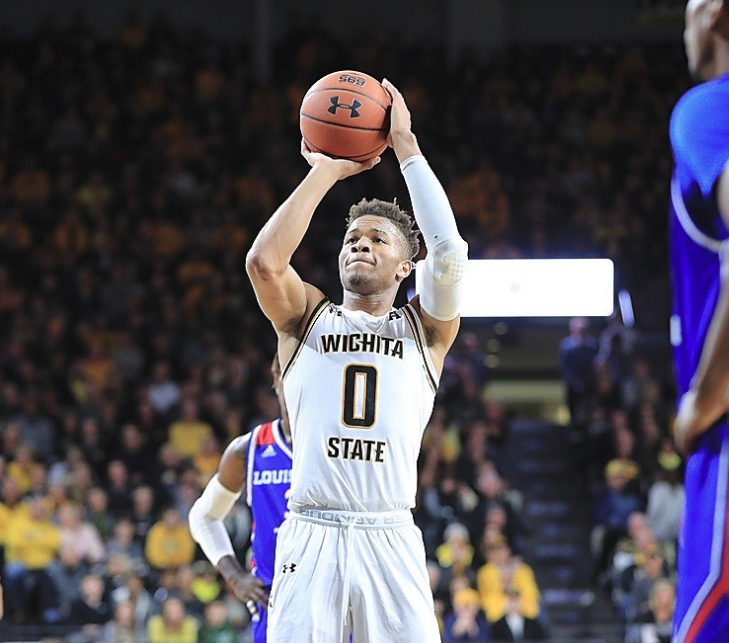
WICHITA, Kansas (AP) – Amorie Archibald scored six straight free throws in the final minute and Louisiana Tech held on for a 71-58 win that shocked the Wichita State Shockers Tuesday night, snapping a 22-game winning streak in home openers.
Wichita State had won 72 of its last 75 games at home until Tuesday. Archibald scored 14 points and was 7-for-8 at the free throw line for the Bulldogs and also pulled down nine rebounds. Daquan Bracey added 16 pointd, Exavian Christon 12 and Mo Muhammed 10.
Erik Stevenson led the Shockers with 16 points, making 4 of 6 3-pointers, and Dexter Dennis scored 10 points. The Shockers had whittled Louisiana Tech’s double-digit lead down to five, 63-58 when Markis McDuffie made 1 of 2 free throws with 1:19 remaining.
Archibald was fouled a second later, starting his string of six straight points from the foul line, pushing the Tech lead to 69-58 with 41 seconds remaining. He then fed Muhammed for a dunk as Wichita State missed four 3-pointers in the final 67 seconds.