We have a brand new updated website! Click here to check it out!

KZ Country Cheesy Joke of the Day 1/28/19

khaz cheesy joke logo 20110802Cautious Student

A young student reported for a final examination that consisted of only
true/false questions.

The student took a seat in the hall and stared at the test for five
minutes. He then removed a coin from his pocket and started tossing the
coin and marking the answer sheet; heads for true, tails for false.

The young student finished the exam in just 30 minutes, while the rest
of the class was sweating it out.

Suddenly, during the last few minutes, the young student began
desperately throwing the coin and scribbling frantically.

The moderator, alarmed, approached the student and asked what was going
on.

“Well, I finished the exam in half an hour,” said the student. “But I
thought I ought to recheck my answers.”


Join fans of 99 KZ Country on Facebook:  https://www.facebook.com/99KZCountry


KS Academy of Mathematics and Science to hold info session in Hays

FHSU University Relations

Staff from Fort Hays State University’s Kansas Academy of Mathematics and Science will host six free information sessions across the state for interested students and their families in February, March and April.

The Academy offers high school juniors and seniors an opportunity to live and learn at Fort Hays State University and get a head start on their college educations.

Students and guests can learn about KAMS and visit with representatives from the Academy at these sessions. Please visit the registration website at https://www.fhsu.edu/kams/Info-session-registration/ to find a session in your area.

The information sessions are listed chronologically.

February 18
Salina, 6 p.m.
Salina Public Library, Prescott Meeting Room
301 W. Elm St.

February 20
Topeka, 6 p.m.
Topeka and Shawnee County Public Library, Marvin Auditorium
1515 SW 10th Ave.

March 6
Wichita, 6 p.m.
Advanced Learning Library, Conference Room C
711 W. Second St. North

March 7
Shawnee, 6 p.m.
Johnson County Library – Monticello Branch, Community Meeting Room
22435 W. 66th St.

April 2
Hays, 6 p.m.
FHSU Memorial Union, Pioneer Room
700 Park St.

April 10
Junction City, 6 p.m.
Dorothy Bramlage Library, Meeting Room
230 W. Seventh St.

All information sessions are free and open to the public. For more information, contact Abby Anderson, coordinator for marketing and recruitment, at 785-628-4719 or [email protected]. Visit www.fhsu.edu/kams for more information regarding the program.

About KAMS:
KAMS is an early college program that focuses on advanced mathematics and science coursework. While studying at KAMS, students live on the FHSU campus in a select residence hall with other Academy students from around the world. Over the course of two years, students complete over 60 hours of college credit and complete their high school diploma. These college classes are taken alongside traditional college undergraduates and taught by college professors while simultaneously contributing to their high school graduation requirements.

NW Kansas communities among those receiving block grants from state

$11 Million in Community Development Block Grants awarded for community improvement projects

TOPEKA — The Kansas Department of Commerce has announced that 23 communities will receive federal grants for a variety of community improvement projects, including sewer and water projects, housing rehabilitation and community facilities improvements. These communities will share a total of $11,019,485 in federal grants.

Through the Community Development Block Grant program, 12 Kansas communities will share a total of $6,806,637 in federal grants for water and sewer projects, two Kansas communities will share $600,000 for housing rehabilitation and nine communities will share $3,612,828 for community facility projects.

“Vital public services including water, sewer and community facilities are essential to all communities in Kansas,” said Secretary David Toland. “The CDBG grants will help provide the funding needed by these 23 communities to ensure improved quality of life for their residents.”

The CDBG program, administered by the Kansas Department of Commerce, provides federal funds to local governments for the development of viable communities by addressing their housing, public facilities and economic development needs. To be awarded funds, local government units must meet at least one of three program objectives:

• The grant will benefit low and moderate-income persons
• The grant will prevent or eliminate slums and blight
• The grant will resolve an urgent need where local resources are not available to do so

The CDBG funds are one of the Department of Commerce’s primary tools in supporting the state’s small, predominantly rural communities.

The following northwest Kansas communities have been awarded CDBG grants:

he City of Bird City will receive $200,50 in CDBG grant funds to complete a street project throughout the city. The city will contribute $200,507 city funds towards this project.

The City of Brewster will receive $409,980 in CDBG funds to make water distribution improvements throughout the city. The city will provide $409,980 in matching funds it secured through the Kansas Department of Health & Environment.

The City of Downs will receive $600,000 in CDBG funds to make water treatment plant improvement for the city. The city will provide $1,580,532 matching funds it secured from the Kansas Department of Health & Environment. The city is also contributing $900 of their local funds.

The City of Oberlin will receive $600,000 in CDBG funds to make improvements to its water distribution system. The city will provide all matching funds themselves in the amount of $475,045.

The City of Phillipsburg will receive $462,837 in CDBG funds to make improvements to its water distribution system throughout the city. The city will provide $460,738 in matching funds they have secured through the Kansas Department of Health & Environment. The city is also contributing $2,100 of their local funds.

The City of Russell is being awarded $600,000 in CDBG funds to make water distribution improvements throughout the city. The city will provide all matching funds themselves in the amount of $893,300.

NW Kansas students named to Dean’s List at Bethany

LINDSBORG — Nearly 240 Bethany College students have earned semester honors for their academic performance during the fall 2018 semester and have been named to the Dean’s List.

To qualify for the academic honor, students must be enrolled full-time and earn a semester grade point average of 3.5.

The following area students received the honor:

Hoxie
Lisa M. Stone, Pre-Profession Art Thera

Luray
Rudolph J. Haberer, General Studies

Norton
Hailey R. Branek, Psychology

Phillipsburg
Hannah J. Imm, English Teaching 6-12

Stockton
Reed A. Stephens, Social Science Teaching

Winona
Maia R. Carter, Exercise Science

Police investigate series of Kansas armed robberies

SEDGWICK COUNTY — Law enforcement authorities are investigating two more armed robberies and one attempted armed robbery that occurred Sunday in Wichita.

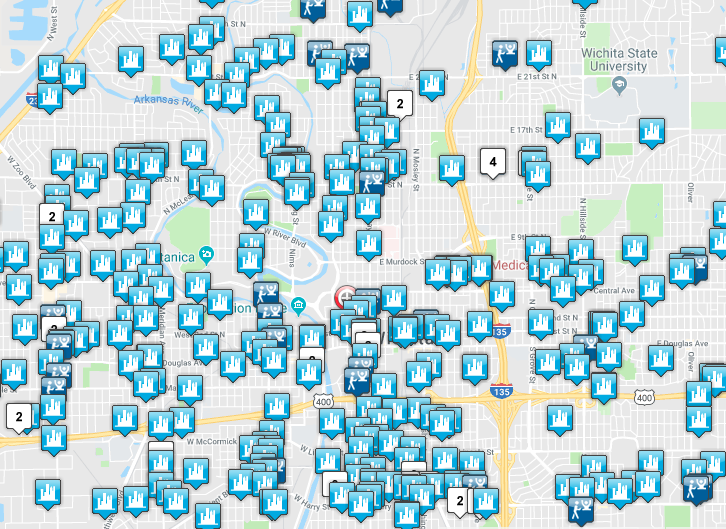
Wichita police crime tracking map shows business robberies or burglaries since July 1, 2018

Just after 4:42 a.m., police responded to an armed robbery at the Quik Trip, in the1000 block of East Douglas, according to officer Paul Cruz.

A 21-year-old store employee reports an unknown suspect entering the business, armed with a handgun and demanding money.  The suspect identified as a black male wearing a hoodie took cash then fled the store.

Just after 6:15 a.m., police responded to an attempted armed robbery at the Petrol America,  in the 2700 block of North Amidon. A 57-year-old store employee told police an unknown black male suspect wearing a hoodie entered the business armed with a handgun and demanding money. The suspect fled the store and no loss or injuries were reported.

At 6:48 a.m., police responded to an armed robbery at the Casey’s General Store, in the 1100 block of West Central. A 40-year-old store employee told police an unknown black male suspect wearing a hoodie entered the business armed with a handgun and demanded money.

WPD investigators are currently investigating all three robberies to determine if they are connected.

High Plains Mental Health reaches out to farmers as rural suicide rates soar

By CRISTINA JANNEY
Hays Post

Tariff wars, low commodity prices, weather and isolation all take their toll on farmers and rural residents who depend on the agriculture economy.

Those stresses are starting to show in some alarming statistics in northwest Kansas.

Between 2014 and 2017, the suicide rate in the 20 northwest counties served by High Plains Mental Health increased by 64 percent. In addition, a Centers for Disease Control study released in July 2016 reported farmers, fisherman and forestry workers as a group had the highest suicide rate of any occupation in the U.S.

High Plains Mental Health is trying to reach out to this affected population through new printed materials, telemedicine services and Mental Health First Aid training.

The suicide rates are not just getting attention from community mental health professionals.

Sen. Jerry Moran, R-Kan., championed  the Farmers First Act, part of the most recent Farm Bill. The act establishes helplines and suicide prevention training for farm advocates, and re-establishes the Farm and Ranch Stress Assistance Network through state departments of agriculture, state Extension services and nonprofits.

“We don’t know completely,” David Anderson, High Plains director of clinical services, said when asked why he thought the number of suicides had jumped. “I think we believe certainly the farm economy plays a role in that. It may be that they are being more accurately counted. There was certainly a time, because of the stigma around suicide, that corners, particularly in small communities, there was some desire to not attach a suicide to a what might have been called an accidental death.”

Brenda Seaman, High Plains assistant clinical director, comes from a farm family. She says she sees farmers facing many circumstances that are out of their control.

“What other profession do you have where you certainly don’t know what the commodity price will be for the product that you are making every year?” she said. “It could be $15 soybeans. It could be $6 soybeans. You don’t know when you plant them.”

If the price is good, that usually means other growers have had catastrophic crop loss due to weather. Regardless of the price of the commodity, the input prices go up every year.

“The weather is out of your control,” Seaman continued. “The overall political environment is out of your control, so now there is tariffs and trade wars. These are not predictable.”

Seaman said communities and loved ones should also remember those families whose livings depend on agriculture, because when the ag economy is down, they suffer too.

Farming is not an easy profession to walk away from when you are one of multiple generations who have lived on and worked a piece of land, Anderson said. There is an emotional attachment to the land.

“It is not just the economy of ‘Can you make this work?'” he said,” but it is the pressure of generations. This has been in the family for a long period of time. You don’t want to be the person who ends up losing that land or the farm.”

Technology is requiring fewer people to operate farms and farms are consolidating.

“My wife’s family farm is out near Collyer,” Anderson said. “Thirty years ago, there used to be several family farms in that area. Now there aren’t.

“More of the land is rented. Instead of a community of families in the area who relied on each other and helped each other, there may be more isolation. We know that across populations that is one of the factors that increases depression, anxiety and the risk for suicide.”

Population loss in rural Kansas counties is only projected to increase, further worsening isolation and leading to the lose of vital services for rural families, including local schools, hospitals and grocery stores.

Stigma is a serious impediment for farmers to receive help in a mental health crisis, Anderson said. They consider themselves independent, resilient and self-reliant, and it can be difficult for them to admit they need help.

Although rates are on the rise in Kansas for women, suicides in Kansas were highest among white men, age 25 to 64. During the farm crisis in the 1980s, Anderson said mental health workers were encouraged to try reach out to farm wives to reach men in farming communities that may be at risk.

High Plains is implementing a similar strategy today by putting information and resources in the hands of people who interact with farmers and their families the most.

A new brochure titled “Hope in the Heartland” is being made available to extension agents, rural bankers and grain elevators.

Kaley Connor, High Plains marketing director, said local county governments have reached out to the agency for Mental Health First Aid training courses for their employees. The 8-hour course helps to prepare people to help individuals who are experiencing a mental health crisis.

“A lot of what we are doing with the pamphlet and Mental Health First Aid is trying to raise awareness and break down the stigma surrounding mental health services — that it is OK to reach out for help if you are struggling, that mental illness is a real illness and it needs to be taken seriously. It is not a sign of weakness if you need to reach out to somebody.”

Farmers’ and ranchers’ schedules are also often not conducive for out-patient therapy visits. However, telemedicine, satellite clinics, and partnerships with rural hospitals and clinics are making mental health care increasingly accessible for rural residents.

The vast majority of clients are seen in the community on an outpatient basis, Anderson said. If a person who is suffering from depression or suicidal thoughts can ensure their safety, they will likely not be admitted to a hospital. Even those who do receive in-patient treatment for depression usually have very short stays.

If you or someone you know is at immediate risk of suicide, call 911. Call High Plains at 1-800-432-0333 to get started with a mental health screening or to access crisis services, which are available 24/7 with a qualified mental health professional.

High Plains also offers a sliding-fee scale for services based on income.

See related story: BOOR: Rate of suicide among farmers alarming

AFC wins 3rd straight Pro Bowl over NFC in Orlando

The AFC owns Orlando after a third consecutive victory in the Pro Bowl

ORLANDO, Fla. (AP) – The AFC owns Orlando.

Kansas City’s Patrick Mahomes completed an 18-yard touchdown pass to Indianapolis’ Eric Ebron, and the AFC beat the NFC 26-7 in steady rain in the Pro Bowl on Sunday. It was the third consecutive victory for the AFC in the NFL all-star game, all of them coming at Camping World Stadium.

The last two were played in sloppy weather, with the latest one also coming amid temperatures in the mid-50s.

It was far from ideal conditions, fairly fitting considering the effort players provided. It was two-hand touch most of the day, with officials blowing plays dead at the slightest hint of contact.

The AFC rallied in the rain last year, outscoring the NFC 21-3 after halftime to win 24-23.

The AFC led 20-0 early in the fourth quarter Sunday, looking like it might notch the first shutout in Pro Bowl history. But Dallas’ Dak Prescott found Atlanta’s Austin Hooper for a 20-yard score on fourth down with 9:09 remaining.

Mahomes completed 7 of 14 passes for 156 yards and was named the offensive Most Valuable Player. New York Jets safety Jamal Adams, who had an interception and a sack, was the defensive MVP. Each got a luxury vehicle.

Each player on the AFC will get $67,000 for the victory, $8,000 more than the players who lose the Super Bowl next week in Atlanta. The Pro Bowl losers will get $39,000 each.

The game turned comical late, with several offensive guys playing defense and a few defenders taking offensive snaps.

Jacksonville Jaguars cornerback Jalen Ramsey caught a 6-yard slant pass from Houston’s Deshaun Watson for a touchdown with 19 seconds remaining. Los Angeles Chargers safety Derwin James failed to haul in the 2-point conversion.

The NFC had plenty of chances before that. The conference failed to score on a fourth-and-goal run early. Chicago’s Mitchell Trubisky, Minnesota receiver Adam Thielen and Prescott threw interceptions.

Trubisky also was sacked by Adams on a flea flicker, and Dallas’ Amari Cooper had a wide-open touchdown pass bounce off his face mask.

Seattle’s Russell Wilson also was sacked four times.

The AFC had several chances to put the game away, but Indy’s Andrew Luck and Watson threw interceptions.

Tampa Bay Buccaneers receiver Mike Evans picked off Watson. The play ended after several laterals and even more half-hearted attempts at tackles.

New York Giants rookie running back Saquon Barkley and New Orleans Saints running back Alvin Kamara also played defense.

IN-GAME HIJINKS

Indianapolis Colts tight end Eric Ebron had his phone tucked into the pocket of his sweatshirt and used it between the third and fourth quarters. Except Ebron didn’t take pics with teammates. He got opposing players to pose with him, working his way around the entire NFC defense.

Several players used their phones on the sidelines, but Ebron was the first to pull his out on the field.

ANOTHER NO-CALL

New York Jets safety Jamal Adams hugged a line judge after he didn’t throw a flag on an obvious pass interference play against Green Bay receiver Davonte Adams. Davonte Adams dropped to the ground in disbelief, and several NFC teammates protested.

Jamal Adams, meanwhile, celebrated alone for a moment and then hugged the smiling official.

Players from both conferences spent the week lamenting a now-infamous no-call in the NFC title game.

INJURIES

Pittsburgh Steelers receiver JuJu Smith-Schuster and Los Angeles Chargers receiver Keenan Allen left the game with bruised knees. Neither was considered serious. Allen caught four passes for 95 yards before sitting down.

UP NEXT

New England and the Los Angeles Rams play in the Super Bowl next Sunday.

Strong Economy And Costly Tuition Stall Increases In Kansas College Graduates

DUSTPUPPY72 / FLICKR / CREATIVE COMMONS

A hot job market and the increasing cost of tuition have slowed the growth in the number of Kansans earning a college education nearly to a halt. Educators are worried that will worsen shortages of high-skilled workers and impede prosperity long term. 

“It is concerning,” said Donna Ginther, an economist at the University of Kansas. “Having these types of degrees and certificates are very important for the future of economic growth in the state and the country.” 

Kansas’ public colleges and universities granted 40,856 undergraduate degrees and certificates last year, according to the latest progress report from the Kansas Board of Regents. That’s virtually the same as five years ago and well short of the state’s goals. 

The number of undergraduate degrees and certificates earned in Kansas is well below the goal set by the Kansas Board of Regents.
CREDIT STEPHAN BISAHA | SOURCE KANSAS BOARD OF REGENTS

Kansas is nine years into the 10-year “Foresight 2020” plan designed to increase the number of Kansans getting post-secondary education and to better align state college and university programs with economic needs. 

The Regents have found some success, particularly in technical education. 

An initiative started in 2012 greatly increased the number of Kansans earning college credit before they graduated from high school. More than 10,000 students participated last year. And many of those students have continued technical education programs after high school, contributing to the growth of technical colleges by more than a third from 2012 to 2017. 

Yet most of the state’s other colleges and universities have gone the other direction. 

The headcount at community colleges shrank by 12 percent between 2012 and 2017. State universities grew less than half of a percent, with many seeing declines. 

There are likely not enough students currently enrolled for the main objective in Foresight 2020 — more than 53,000 degrees and certificates earned by the end of this decade — to be achieved. 

Much of the declining enrollment at Kansas colleges and universities is among white students. Their enrollment numbers have dropped 12 percent since 2010, according to data in the Foresight 2020 progress report. Enrollment by Hispanic students has grown the most, by more than 42 percent. 

The progress report blames several factors outside of the Regents’ control, including the Kansas economy. The low unemployment rate means Kansans are able to find jobs without a college degree. 

In the early days of the recovery from the 2008 recession, college enrollment increased in Kansas as elsewhere. Unemployed Americans decided to go back to college instead of hunting for non-existent jobs. 

The reverse was true as the economy continued to improve. In 2013, enrollment in Kansas colleges plunged as the Kansas unemployment rate hit 5.3 percent. 

But while more Kansans are now employed, many remain shut out of high-skill, high-paying occupations that offer a pathway to the middle class. 

“A high school education is not going to cut for economic prosperity,” Ginther said. 

Ginther and others also worry that high-skill industries such as aerospace manufacturing that Kansas is trying to foster will experience increasing workforce shortages without more Kansans completing a college education. 

Rising tuition has also driven students away from Kansas schools. 

Students have born more of the cost of their education at public universities as the state repeatedly cut over the past decade. 

Higher tuition could be an outsized barrier for poorer students. The number of Pell Grant recipients at Kansas universities, students receiving grant money for college from the federal government, has been declining since 2015. 

Studies have shown a link between increasing tuition and decreasing enrollment, though there are disputes over the size of the effect. What’s indisputable is the massive leap in cost colleges have seen over the years. At Kansas State University, the sticker price for a semester has increased 57 percent over the last ten years

“When I started at K-State in the late ‘60s I paid out-of-state tuition and was able to work my way through the university with summer jobs and employment through the school year,” said Pat Bosco, the vice president for student life at Kansas State University. “That’s no longer the case now.” 

Stephan Bisaha reports on education for the Kansas News Service.  Follow him on @SteveBisaha.


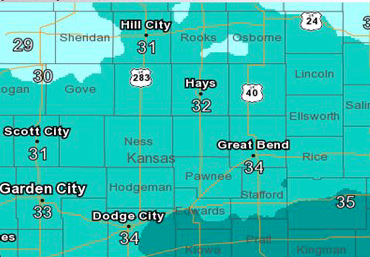
Cold, windy Monday

Monday Partly sunny, with a high near 32. Very windy, with a north northwest wind 22 to 31 mph, with gusts as high as 43 mph.

Monday Night Mostly clear, with a low around 18. Wind chill values as low as 5. West wind 12 to 17 mph decreasing to 6 to 11 mph in the evening.

Tuesday Sunny, with a high near 37. Wind chill values as low as 5. Northwest wind 10 to 17 mph.

Tuesday Night Partly cloudy, with a low around 9. North northwest wind 7 to 10 mph becoming northeast after midnight.

WednesdaySunny, with a high near 25.

Wednesday NightPartly cloudy, with a low around 12.

ThursdayMostly sunny, with a high near 38.

Insurance Commissioner names acting Securities Commissioner

KID

TOPEKA –Insurance Commissioner Vicki Schmidt announced Monday she will name Jeff Wagaman as acting Securities Commissioner while he awaits Senate confirmation.

Wagaman joins the Securities Commission after serving the past eight years as Executive Director of the Crime Victims Compensation Board – a division of the Attorney General’s Office. Wagaman will also bring regulatory experience to the position having served as Executive Director of the Kansas Corporation Commission.

“A number of the past Securities Commissioners have failed the test of public trust. The Legislature’s decision to move the Securities Commission under the Insurance Department was a direct result of past transgressions,” Insurance Commissioner Schmidt said. “Jeff Wagaman has a professional track record of effectively leading people and turning around struggling organizations. I am thrilled Jeff has agreed to serve in this role and I look forward to working with the Kansas Senate on his confirmation.”

“Throughout my career in public service I have been entrusted to lead a number of critically important agencies and organizations,” Wagaman said. “I am honored to be able to continue my public service in this new role.”

In 2017 the Kansas Legislature moved the Securities Commission under the purview of the Insurance Department. The Securities Commissioner is appointed by the Insurance Commissioner and confirmed by the Kansas Senate.

Police: Another Kansas felon caught with a handgun

SHAWNEE COUNTY – Law enforcement authorities are investigating a Kansas felon on new charges after a traffic stop.

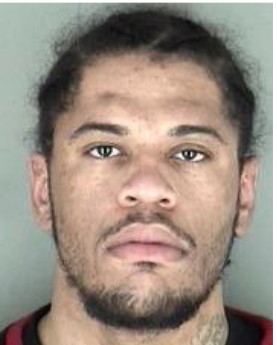
Anderson photo Shawnee Co.

On Friday, a police officer observed Dominique Anderson 27 of Topeka leaving the Law Enforcement Center, according to Lt. Aaron Jones.

The officer recognized Anderson and knew he was wanted for a felony criminal damage domestic case which occurred January 20.

Anderson left the property in a vehicle which was stopped at 4th and SW Jackson in Topeka. Police took him into custody without incident.

A search of the vehicle revealed a small amount of marijuana, other suspected narcotics, drug paraphernalia and a stolen Taurus 9mm handgun. Anderson has at least one prior felony conviction leading to a charge of Criminal Use of a Firearm, according to Jones.

He was transported to the Shawnee County Department of Corrections under suspicion of felony Criminal Damage (Domestic), Criminal use of a Firearm, and narcotic related charges.

This is the 6th case in 2019 with a charge involving a felon in possession of a firearm reported by the Topeka Police Department.

Chiefs wide receiver arrested on marijuana charge

ALLEN COUNTY — Kansas City Chiefs wide receiver De’Anthony Thomas is out on bail after a weekend arrest, according to a report by the Allen County Sheriff’s Department.

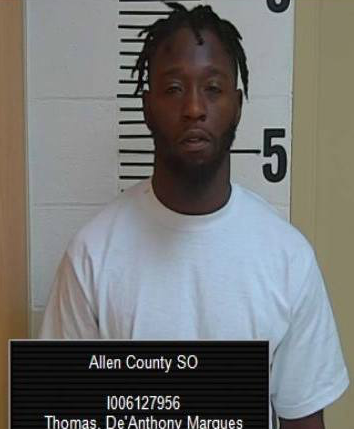
Thomas -photo Allen Co. Sheriff

De’Anthony M. Thomas, 26, Lee’s Summit, Missouri, was booked Saturday into the Allen County Jail on suspicion of Possession of Marijuana and Possession of Drug Paraphernalia.

He was no longer in custody Sunday, according to online jail records.

The Chiefs selected Thomas from the University of Oregon in the 2014 NFL Draft. He played in  five games in the 2018-19 season before a leg injury in practice ended his season.

The Chiefs had not released a statement on the arrest late Sunday afternoon.

Study: Most people overestimate total number of U.S. gun owners

Don Haider-Markel

KU NEWS SERVICE

LAWRENCE — Most people vastly overestimate the population of gun owners in the United States, and it potentially influences how groups approach gun policies, according to a study by two University of Kansas political scientists.

“Because gun owners are actually a minority, perceiving their group as larger and even as a majority could make them feel more empowered to advocate on gun issues,” said Don Haider-Markel, professor and chair of the Department of Political Science. “Likewise, non-gun owners that perceive a larger gun owner population now and in the future might be less likely to advocate for gun regulations.”

Mark Joslyn

Mark Joslyn, professor of political science, and Haider-Markel are co-authors of the study, recently published in the journal Politics & Policy. They examined results from a 2016 nationally representative survey of 1,290 American adults who answered questions on a variety of policy, election-specific, psychological and political questions, including a number on gun ownership and regulation.

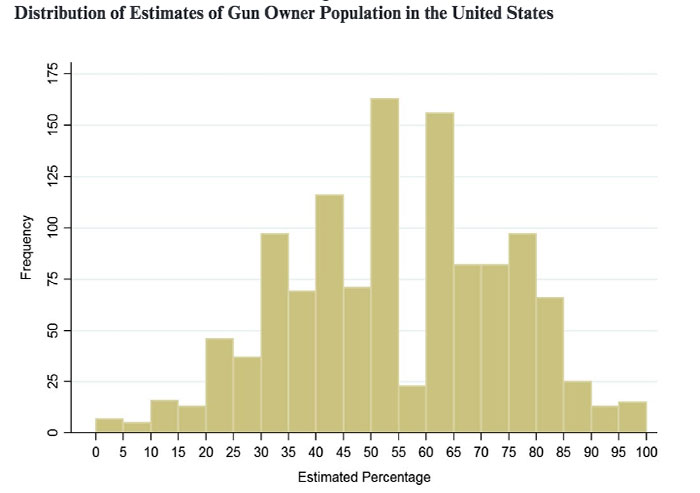
Specifically, the survey asked people to give their “best guess” on what percentage of Americans owned firearms. The actual percentage of U.S. individual gun owners is roughly 25 percent, and about 33-40 percent of U.S. households have at least one gun in the home, the researchers said.

However, the researchers found that more than 75 percent of respondents overestimated the number, and only a small minority, 2.3 percent, underestimated the number of gun owners.

The most common estimate was 50 percent, and nearly one-fifth of respondents estimated the gun owner population was 70 percent or higher.

“Generally speaking, less knowledgeable people tend to overestimate the size of groups, but so, too, do people who belong to the group, have contact with the group or have positive affinity towards the group,” Haider-Markel said. “In short, we inflate the size of groups we belong to or are close to.”

The overestimation of the population among both gun owners and non-gun owners could provide some explanation for the level of support surrounding pro-gun policies or the lack of support for federal gun control measures, even in wake of high-profile mass shootings, such as Newtown, Connecticut; Las Vegas; and Orlando and Parkland, Florida, though the professors said future research would likely examine potential trends after more recent advocacy efforts by gun violence victims.

“We see this as another in a line of politicized issues where facts are contested and factual beliefs might influence policy attitudes on the issue. As such, we wanted to explore basic knowledge about gun owners, perceptions of future gun ownership, and determine whether these perceptions influenced gun attitudes,” Haider-Markel said.

He added that past research in this area is built around the notion of a perceived threat of a group, but rarely is that threat actually assessed.

The researchers have conducted similar research on how people overestimate the gay population in the United States.

“As with the earlier study, people are not very good at estimating the size of groups, and this has implications for their policy preferences,” Haider-Markel said. “Here we can also show that people tend to think that the gun owner population will grow in the future even though all indications are that the gun owner population is getting smaller.”

Copyright Eagle Radio | FCC Public Files | EEO Public File