We have a brand new updated website! Click here to check it out!

Kan. officials: WIC funding available into March despite shutdown

TOPEKA, Kan. (AP) — State health officials say Kansas has enough money to provide WIC benefits into March, even if the partial federal government shutdown continues.

The Kansas Department of Health and Environment said in a news release Monday that the U.S. Department of Agriculture provided enough extra funding to keep the Women, Infants and Children program going until March 4.

The agriculture department gave Kansas more than $1.4 million for food purchases and nearly $900,000 for Nutrition Services and Administration.

The state agency says the new funds will keep its staff operational until March 13, regardless if the government shutdown continues through February.

Kansas abortion foes brace for state Supreme Court decision

By JOHN HANNA

TOPEKA, Kan. (AP) — Abortion opponents in Kansas have been bracing themselves for nearly two years for a ruling from the state’s highest court that protects the right to have an abortion and potentially upends politics in a state long at the center of the national debate.

The Kansas Supreme Court is relatively liberal in a state with a Republican-dominated Legislature that has strong anti-abortion majorities.

Court watchers also are asking: Why is it taking so long for the justices to rule?

No one outside the court knows for sure and the justices are not saying, as is their long-standing custom. One educated guess is that they still are wrestling with the implications of declaring that the state constitution protects abortion rights.

That was the core legal issue when the court heard attorneys’ arguments in March 2017 in a major abortion lawsuit . An abortion-rights decision could allow state courts in Kansas to chart their own course on abortion and invalidate restrictions that the federal courts would uphold.

“What’s the test for that?” said Jeffrey Jackson, a Washburn University of Topeka law professor. “There’s any number of weird possible decisions that you can get to.”

The case arises from abortion opponents’ numerous legislative victories during eight years under Republican governors. Democratic Gov.-elect Laura Kelly, a strong abortion rights supporter, takes office Monday, but the Legislature emerged from last year’s elections more conservative — and as anti-abortion as ever.

GOP conservatives’ power in the Legislature surged following “Summer of Mercy” protests in 1991 against the late Dr. George Tiller’s clinic in Wichita, among a few in the U.S. known to do late-term abortions. An anti-abortion zealot shot Tiller to death in 2009.

Legislators debate abortion annually. Kansas recorded its lowest number of abortions in 30 years in 2017, fewer than 6,800 — 46 percent less than the peak of more than 12,400 in 1999.

“It’s more important than ever for Kansas to recognize that women have protections under the state constitution,” said Genevieve Scott, a Center for Reproductive Rights attorney. “Any time that a court recognizes women’s rights, it has an important impact in shaping our national discourse.”

Despite abortion foes’ political rise, six of the seven Kansas Supreme Court justices were appointed by Democratic or moderate Republican governors.

In 2016, abortion opponents, GOP conservatives and others upset with capital punishment decisions tried unsuccessfully to oust four of those justices when they faced a yes-or-no statewide vote on whether they would remain on the court for another six years. Anti-abortion leaders cited the case now before the court as one reason.

During arguments in the abortion case in 2017, four justices peppered the state’s solicitor general with skeptical questions when he argued that the state constitution cannot protect abortion rights because abortion generally was illegal when it was drafted in 1859.

Mary Kay Culp, executive director of the anti-abortion group Kansans for Life, worries that the decision will make it impossible for legislators “to pass pro-life bills.”

“That’s worst-case scenario, and that’s kind of what we expect,” she said.

Her fears are not unfounded. California voters added a right to privacy to their state’s constitution in 1972, and courts there have struck down even restrictions on public funding for abortions. In 2000, Tennessee’s highest court declared that the state constitution protected abortion rights; abortion foes did not pass an amendment until 2014.

The Iowa Supreme Court ruled last year that the state constitution protected abortion rights.

The Kansas case involves the state’s first-in-the-nation ban on a common second trimester procedure. Two abortion providers sued just before the law was supposed to take effect in 2015. It has been on hold since.

A district court judge agreed with their arguments that that broad language in the state constitution’s Bill of Rights implies a right for a woman to obtain an abortion.

The Kansas Supreme Court decision has taken so long that it is compared to a small number of heavily litigated capital punishment cases. Spokeswoman Lisa Taylor said the Supreme Court’s goal is to have 95 percent of its cases decided within nine months of oral arguments.

“It’s a groundbreaking case of first impression, but my goodness, two years?” said Kansas Attorney General Derek Schmidt, a Republican whose office is defending the 2015 law.

The state’s Bill of Rights says Kansas residents have “natural rights,” including “life, liberty and the pursuit of happiness” and that “free governments” are created for their “equal protection and benefit.” Abortion opponents argue that the “life” clause protects the fetus in the womb — not the right to abort it.

“Maybe the fact that it takes so long to figure out whether there’s a previously undiscovered right in the Kansas Constitution suggests they’re having to look awfully hard,” Schmidt said.

Culp believes the Supreme Court didn’t want to issue its decision during the governor’s race last year because it would have hurt Kelly’s campaign by energizing angry anti-abortion voters.

But Jackson said if the justices have concluded that the Kansas Constitution does protect abortion rights, they still must consider how far such protections go. He said they might not have a majority yet for “any single opinion.” He worked for the court several times between 1992 and 2003 and said he saw cases sometimes “going back and forth.”

Abortion rights advocates appear to be less frustrated with the delay because the 2015 law is blocked. Several declined to speculate on what is taking the court so long.

“If the Supreme Court finds a right to abortion in the state constitution — I mean, that is huge,” said Rachel Sweet, policy director for the political affiliate of Planned Parenthood Great Plains.


Kansas seeks to expand housing program for mentally ill

TOPEKA, Kan. (AP) — Kansas officials are offering an unconventional housing program to mentally ill homeless people that they hope will ease overcrowding at state hospitals.

The state Department for Aging and Disability Services is considering offering the Housing First program beyond Wichita, Shawnee County and Wyandotte County. The program deviates from traditional housing assistance programs because it has no curfew and sobriety requirements.

“What this lets us do is get these folks who need help out of this cycle where they’re in the state hospital, they get discharged, and then pretty soon they end up back on the street,” said agency spokeswoman Angela de Rocha. “This intervenes in that cycle and stops it.”

The department secured legislative support last year to maintain the three existing programs. It’s seeking an additional $250,000 to help homeless communities in other parts of the state.

More than 320 residents have entered the program and more than 240 have found a permanent home. There were more than 2,000 homeless people across the state last year, according to state data.

Melissa Bogart, who works in housing employment and benefits for the department, said it’s been effective in Wichita, which has the state’s largest homeless population.

“What we’ve seen is persons being housed at a much quicker rate — people with a roof over the head, people being safe, people being up off the street,” Bogart said.

___

FHSU wrestling takes home Kansas Cup

Ten Tigers place, two claim individual titles

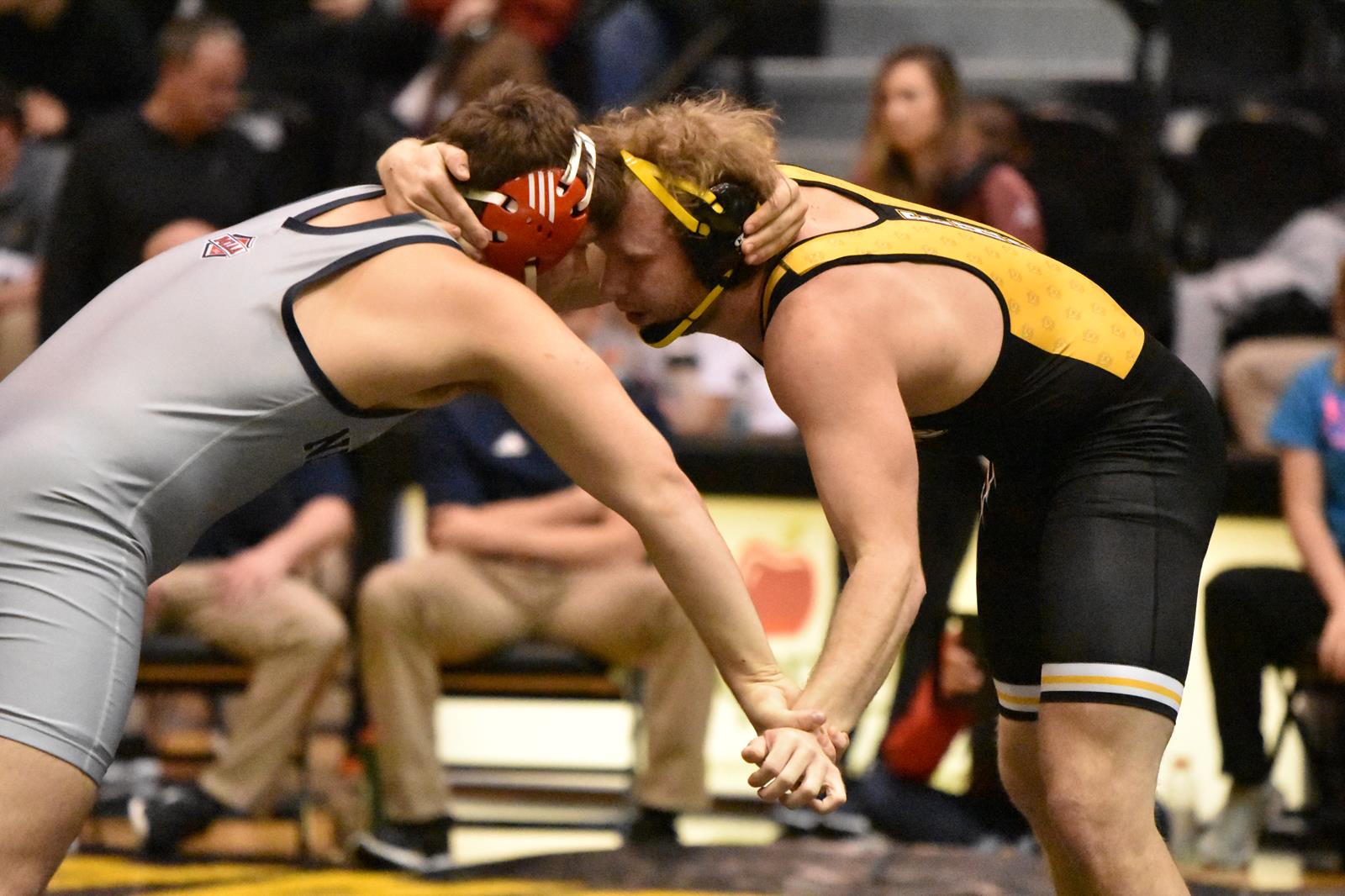
HAYS, Kan. – The No. 12 ranked Fort Hays State wrestling team captured their fifth Kansas Cup title in six years inside Gross Memorial Coliseum on Sunday (Jan. 13). The Tigers won the event with 137 team points. No. 4 ranked Efe Osaghae claimed his second individual title of the season in the 165-pound weight class. Sophomore A.J. Cooper (285 pounds) captured his first individual title this year.

Broderick Green (125 pounds), Ryne Cokeley (149 pounds), No. 9 ranked Marty Verhaeghe (174 pounds), Micquille Robinson (184 pounds) and Jordan Davis (197 pounds) all earned runner-up finishes. Reese Cokeley (141 pounds) and Jonathan Ball (157 pounds) claim third-place finishes and Conrad Cole (133 pounds) finishes in fourth-place.

Osaghae went 2-0 on the day with a 9-3 decision over Noah Perkins of Newman in the semifinals and a narrow 3-2 decision over Nick Lucas of Pratt CC to claim the individual title. Cooper topped off a 2-0 day with his first title this season and going 2-0 in the tournament. Cooper earned a fall over Lexington Plummer of Kansas Wesleyan in the semifinals before using a 9-2 major decision over Thor Balavage of Newman in the title match.

Green defeated Brayan Balderrama (Pratt CC) by fall in the first round before pinning Logan McDowell of Bethany in the semifinals. Green dropped the title match to Emmanuel Brown (Baker) by a 7-3 decision. Ryne Cokeley went 1-1 in the tournament with a fall over Cody Wuthnow (Cloud County CC) in the semifinals before falling to Kameron Frame (Newman) by a 9-6 decision in the title match.

Verhaeghe finished 1-1 on the day with a pin in the semifinals over Kobryn Mann (Cloud County CC) and dropping the title match to Lucas Lovvorn (Baker) by a 10-2 major decision. Robinson finished 2-1 in the tournament with a 9-7 sudden victory over Joshua Wilson (Bethany) in the first round. Robinson then defeated Matthew Cruickshank (Cloud County CC) with a 15-3 major decision, before falling to Jacob Smith (Baker) in a 3-2 decision in the title bout.

Davis picked up two wins on his way to the runner-up finish after picking up a major decision (10-2) over Sean Jackson (Colby CC) and a 6-5 decision over Chris Henderson (Pratt CC) in the semifinals. Davis dropped the title bout to David Dow (Baker) by major decision (17-3). Reese Cokeley saw his first action on the mat as a Tiger with a solid third-place finish. Cokeley went 1-1 on the day, including a 10-1 major decision over Caysen Smith (Bethany) in the consolation championship.

Jonathan Ball also earned a third-place finish after earning a pin in the first round over Luke Culbertson (Pratt CC) and earning another fall over Isaiah Frederick (Kansas Wesleyan) in the consolation semifinals. Ball defeated Victor Monarrez (Bethany) with a 10-0 major decision. Conrad Cole picked up two wins on the day with a fall over Brady Lowell (Cloud County CC) and a 4-2 decision over Joshua Crager (Kansas Wesleyan).

Fort Hays State won the team title with 137 team points. Baker finished second with 125 points, while Newman (121 points) earned a third place finish.

The Tigers are back in action Thursday (Jan. 17) when they host Colorado School of Mines for a non-conference dual. The Tigers and Orediggers will battle it out inside Gross Memorial Coliseum, beginning at 7 p.m.

Police: One hospitalized after Kansas shooting

SHAWNEE COUNTY — Law enforcement authorities are investigating a shooting.

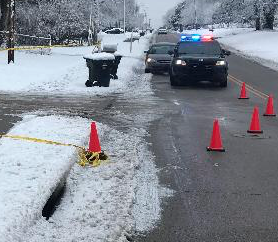
Police on the scene of the shooting investigation -photo courtesy WIBW TV

Just before 3 a.m. Monday, police were dispatched to a Topeka hospital after a victim arrived with a gunshot wound, according to Lt. Jerry Monasmith.

The victim advised officers of a possible location where the incident took place.  Officers located a crime scene in the 2400 Block of SE 21st in Topeka.  They have not reported an arrest.

Anyone with information regarding this crime is encouraged to contact police.

Hope Pantry helps 68 families during holidays

USD 489

The USD 489 Hope Pantry spread some holiday cheer with families in need for the holiday break.

Sixty-eight families received boxes full of food and hygiene items.

Many of the students and staff from the Learning Center helped package the boxes of supplies for families.

ADK Teacher Sorority, Cornerstone Orthodontics, Arnett Chiropractic, and the Hays First United Methodist Church collected donations to be included in the boxes.

Democrats collect food for Day of Service despite snow

Although Gov-elect Laura Kelly and Lt. Gov-elect Lynn Rogers were unable to fly in for their planned Day of Service on Saturday, local Democrats stilled braved six inches of snow in order to collect food for the needy in Hays.

A cleanup of Aubel Bickle Park was scheduled, but had to be canceled due to the weather.

The Day of Service was set to celebrate Kelly’s inauguration, which will be Monday.

Food collected during the drive will go to First Call for Help and the Community Assistance Center.

Read more 0n the upcoming session:

Gov.-elect Has Her Work Cut Out Fixing State Government In Kansas

Local legislators seek tax relief, budget stability in 2019


Watch: Delegation from Kansas helps commission USS Wichita

JACKSONVILLE, FL. The U.S. Navy commissioned the USS Wichita (LCS 13) Saturday at Naval Station Mayport, Florida., near Jacksonville, where the ship will be homeported.

Kansas governor Jeff Colyer and members of the Kansas congressional delegation participated in the ceremonies.


USS Wichita is the 13th vessel in the Freedom class of littoral combat ships, the Navy’s fastest and most versatile warships.

According to a media release from the Navy, the USS Wichita is designed to operate in shallow waters close to shore. A draft of only 13 feet enables the ship to conduct minesweeping operations, humanitarian support, anti-submarine and drug trafficking surveillance, among other missions. USS Wichita assets include a launching pad for two MH-60 Seahawk helicopters.

Crewmembers from the ship have visited Wichita three times to get to know their ship’s namesake city.

LCS 13 is the third Navy ship to bear Wichita’s name. The first USS Wichita (CA 45), a heavy cruiser commissioned in 1939, earned 13 battle stars during World War II. The second USS Wichita (AOR 1) was a replenishment oiler commissioned in 1968. During 24 years of service, that ship’s awards included four battle stars earned in Vietnam.

Hays school board to consider sale of Washington school

By CRISTINA JANNEY
Hays Post

The Hays USD 489 school board is set to vote on the sale of the former Washington School building at its meeting Monday night.

The district has purchased the Oak Park Medical Complex on 13th Street and is remodeling it for use by Early Childhood Connections, which is currently in the Washington building at 305 Main.

Overland Property Group Land Development has offered $500,000 to purchase the property. The company hopes to use the property to develop affordable housing.

The company also built Stonepost Apartments in Hays.

Matt Gillam, OPG vice president of development, told the school board in December the company would like to renovate the school, which opened in 1926, using federal low income housing tax credits administered by the Kansas Housing Resource Corporation.

If tax credits cannot be secured for the renovation, OPG will likely tear down the building.

OPG has developed other historical properties in the region. The company renovated the former Lee Hardware buildings into lofts in Salina and the Tabor Grand Hotel in Leadville, Colo.

The school district plans to complete the Oak Park Medical Complex renovations by June 30.

Best case scenario, construction would start at Washington school at the end of 2019 and into the first quarter of 2020, Gilliam said.

Computer study

The school district has completed a semester-long study on the use of Chromebooks. The study was requested by members of the school board.

Select classes at O’Loughlin, Hay Middle School and the Learning Center were involved in the study.

The schools used some software in the pilot study that would require additional fees if the Chromebooks were rolled out district-wide.

Teachers found having keyboards was an advantage, especially when the students were answering essay questions.

However, elementary teachers noted issues have occurred with annotating PDFs and having pages for notes, diagramming, graphic organizers and drawing pictures.

Middle school teachers provided some of the following feedback:

• Lack of world-facing camera complicated many learning goals.

• Using Office365 accounts was clunky, and added steps are frequent. Process is derailed due to constant prompting to integrate with Google Drive.

• Concern was expressed over the loss of instructional time due to device limitations.

Middle school students in the study were surveyed about the Chromebooks, and the majority said they preferred using the iPads. However, they liked having a keyboard for typing. They also said the Chromebook’s ability to access and submit files in Canvas was frustrating and time consuming.

The study concluded, “Many hurdles were encountered over the course of the semester. Several can be overcome, but at a large annual cost incurred by the district.”

Concern was also expressed about the number of professional hours to convert just a few classes to the Chromebooks — 323 professional learning hours at an average of $40 per hour.

Fees

The school board will hear a report on summer school and driver’s education fees. Staff is recommending reducing driver’s education fees by $50 and keeping the summer school fees the same.

In other business, the board will:

• Vote on the 2017-18 audit report
• Vote on Hays High School curriculum changes
• Discuss the superintendent evaluation

Lana Marlene (Sawyer) Bretz

Lana Marlene (Sawyer) Bretz, 84, died January 11, 2019, at Keepsake Cottage, Wichita, Kansas. She was born November 17, 1934, in Goodman, Missouri, the daughter of L.E. and Eula J. (Steitz) Harris.

Lana was a resident of Hoisington from 1970 until 2004 when she moved to Russell. She then moved to Wichita in 2010.

On March 18, 1956, she married Robert A. Sawyer in Larned, Kansas. He preceded her in death on July 10, 1980. She then married Everett L. Scott in December of 1983. He preceded her in death on April 25, 1998. On October 3, 1998, she married Marvin Bretz. He preceded her in death on November 12, 2004.

Survivors include; son, Robert L. Sawyer of Loveland, Colorado; daughter, Brenda Lea Sawyer and husband Rick Kimpler of Wichita; step-children Everett L. Scott, Jr., Leon Scott, Donald Scott, Tom Scott, Emma, Shirley, Ruby; sisters, Bette Ardrey of McAlester, Oklahoma, Henrietta Whitman of Neosha, Missouri, Carolyn Stipp of Springfield, Missouri; 5 grandchildren and 14 great grandchildren.

She was preceded in death by her parents, husbands; step-son Randy Scott; brothers, Tom and Jimmy Harris; and sisters, Pauline Edmonds, Ruth Pogue, and Alice Fleetwood.

Friends may call 1 p.m. to 5 p.m. Sunday at the funeral home.

Funeral service will be 10 a.m., Monday, January 14, 2019, at Nicholson-Ricke Funeral Home Chapel, with Pastor Don Fisher presiding. Burial will follow in Hoisington Cemetery.

Memorials may be made to the American Kidney Fund, in care of Nicholson-Ricke Funeral Home, PO Box 146, Hoisington, KS 67544.

Harvey Richard ‘Dick’ Adolph

Harvey Richard “Dick” Adolph, 79, passed away peacefully in his sleep January 10, 2019, at his home in Colby.

Born June 10, 1939, in Milliken, Colo., Dick spent many childhood summers on a farm north of Levant. He eventually moved fulltime to Levant and attended Colby High School, graduating in 1958. On the farm he learned to fly and to drive fast.

Dick worked hard from an early age, and saved up to buy a new car at age 14. The car helped a few years later in 1958 when he met Julie Hess, a young woman who lived in Kansas City, Mo. One year and many road trips later, Dick and Julie married in Colby on September 1, 1959. They lived on the farm north of Levant. They later moved to Colby and lived there until 1972 when they moved to Topeka, so Dick could attend Washburn University. He received a Bachelor of Arts in Sociology. While attending school, Dick worked nights as a Licensed Mental Health Technician at the Menninger Foundation. He was also a member of National Guard.

After Dick’s education was complete, Dick and Julie moved back to Colby, where Dick farmed.

In retirement Dick pursued his passions of bowling with friends and gardening with Julie.

Dick was preceded in death by his Aunt Veda and husband Chet Moore, and granddaughter Candace (Adolph) Gay. Surviving are wife Julie, Colby; son Kerry and wife Kathi Adolph, Lawrence; daughter Jennifer and husband Ab Smith, Sharon Springs; daughter Kristin and husband Greg Issinghoff, Clovis, Calif; sister Jean Richers, Saint Francis, and five grandchildren.

A memorial service will be held at 1 p.m. on Monday, January 14, 2019 at Baalmann Mortuary in Colby. Burial will follow at Beulah Cemetery, Colby. Memorials are suggested to Citizens Medical Center, in care of Baalmann Mortuary, PO Box 391, Colby, KS 67701.

Richard ‘Dean’ Dinkel

Richard “Dean” Dinkel, 47, passed away on January 9, 2019, in Sharon Springs, KS. He was surrounded by his family when he went to be with the Lord after a hard-fought, two-and-a-half-year battle with brain cancer.

Dean was born on November 21, 1971, in WaKeeney, KS to parents Henry and Suzanne “Sue” (Mather) Dinkel. He was the eldest of five children, including, Randy, Devin, Joe, and Geni. Dean married Vicki J. (Sommerfeld) Dinkel on June 18, 1992 and they spent 26 years together building a family.

He graduated from Wallace County High School in 1990 and attended Pratt Community College, Chadron State College (B.S. in Political Science, 1994), and Washburn University School of Law (Juris Doctorate, 1998). Following graduation, Dean, Vicki, and children, Ashli Kate (1994) and Sarah Marie (1997) moved back to Sharon Springs where children Ellie Rose (1999), Janaeha Ann (2000), Brookley Jo (2003), and Kean Phillip (2006) were born.

Dean took pride in working hard and, upon moving back to Wallace County, practiced law and later became involved in the businesses owned by his father. He had a love for farming and also coached track for Wallace County Junior High and Wallace County High School.

Throughout his years in Wallace County, Dean spent time volunteering by coaching youth softball and baseball, helping with 4-H and the county fair, teaching religious education classes and serving as a eucharistic minister at Holy Ghost Catholic Church. He also enjoyed attending his children’s numerous sports, music, and academic activities, as well as spending time preparing 4-H projects especially swine, rocketry, and woodworking. One of his special talents was making breakfast for his family every morning before school.

He had many hobbies some of which include golfing with his brothers, playing pitch on Monday nights, helping with projects on his dad’s farm, gathering with family on the holidays, and spending time with his wife and kids. Dean always enjoyed lacing up his shoes and going for a run. There is no doubt he has them on now running on those “streets of gold”.

Dean is survived by his wife Vicki Dinkel; his daughters Ashli, Sarah Klinge (Nate), Ellie, Janaeha, and Brookley, and son Kean; granddaughter Sophie Sue Klinge; grandmother Rosalie Mather; father Henry Dinkel; siblings Randy, Devin, Joe, and Geni Wilcox; father and mother-in-law Stan and Jan Sommerfeld; and numerous brothers-in-law, sisters-in-law, aunts, uncles, cousins, nieces, and nephews.

He is preceded in death by infant grandson Raphael Ignacio Q. Windell; mother Sue (Mather) Dinkel; and grandparents John Mather and Katie and Fred Dinkel.

Funeral services for Dean were held on Monday, January 14, 2019 at 10:30 AM MT at the Holy Ghost Catholic Church in Sharon Springs with Father Andrew Rockers and Father Norbert Dlabal officiating. Burial followed in the Sharon Springs Cemetery, Sharon Springs, KS.

Visitation was held on Sunday, January 13, 2019 from 5:00 to 7:00 PM MT at the Church in Sharon Springs with a Vigil Service and Rosary to begin at 7:00.

Memorials may be designated to the Wallace County Community Foundation for the Track Project and may be left at the services or mailed to Koons-Russell Funeral Home, 211 N. Main Ave., Goodland, KS 67735.

Online condolences may be left at www.koonsrussellfuneralhome.com.

Funeral services have been entrusted to Koons-Russell Funeral Home in Sharon Springs.

First Amendment: A growing list of threats to freedom

Gene Policinski

First Amendment threats and defenses have, for much of the past 100 years, largely focused on protecting individual speech — the rights of any one of us to express ourselves without interference or punishment by the government.

Not to be too glib but, oh, those were the days! This glee is due, in no small part, to the degree that individual speech and press rights triumphed in that era. But looking into this new year, that situation — and those victories — may be more nostalgia than norm. There is increasing danger to our core freedoms from what I’ll call “systemic” challenges, which often appear focused on other issues, but which carry a First Amendment impact, if not wallop.

The increasing public and commercial use of drones raise issues of noise, public safety and congestion in the airways — but also questions about what on-board cameras see and record that go far beyond earlier “peeping Tom” worries.

Consider a new network of drones constantly crisscrossing the skies over your hometown, constantly sending video of the passing scene to the insatiable maw of computer storage. Combine that record with facial recognition software, vehicle tracking devices and surveillance cameras that can ID license plates from miles away and it’s but a small step to government discovery of who we meet, where and when, with resulting impact on the right of assembly or association.

We’ve known for some time there’s a running joke, in national security and spy circles in this country and elsewhere, that we’re now doing most of the surveillance work they used to do simply by living our lives on social media. Add the abilities of artificial intelligence to collect, collate and match social media and online data about any one of us and the kind of “anonymous” speech that produced the Federalist Papers is ever more nonexistent.

Put another way, George Orwell’s draconian “Big Brother” presence was predicated on government installing a device in every home — and life — to observe each of us. In 2019, we’re the ones installing the devices. Not just at home, but 24/7 in pockets and purses through smart phones, watches and the like.

In 2018, in two decisions involving GPS and cell phones, the U.S. Supreme Court pushed back on this new technological threat.

Chief Justice John Roberts said that cell phone location information is a “near perfect” tool for government surveillance, analogous to an electronic monitoring ankle bracelet. “The time-stamped data provides an intimate window into a person’s life, revealing not only his particular movements, but through them his ‘familial, political, professional, religious and sexual associations,'” Roberts wrote.

Try being a reporter, under such involuntary transparency in the future, attempting to meet secretly with a source about government corruption or official misconduct or a botched criminal investigation or an undisclosed, invasive national security policy. Good luck.

Let’s round up this Pandora’s box assembly of threats with a look at the 2020 election cycle. Not only will legitimate reports by a free press be mixed in with mis- and disinformation, a new technological threat challenges the adage that “seeing in believing.”

What’s included in “involuntary synthetic imagery” (a mouthful of a title) is the sinister possibility of videos that take real situations and seamlessly “paste” faces of politicians and others onto actual participants. Imagine misleading or embarrassing video that’s nearly impossible for most to distinguish from the real thing. Tragically, such fakery already has invaded our lives thanks to what’s known as “deepfake” porn.

How do we square such “deepfake” videos with First Amendment law, which — with the exceptions when such fake video clearly is being used for extortion or blackmail — would tend to side with free expression and with those who create such works? When would satire cross the line into defamation or intentional infliction of emotional distress — two traditional, but often expensive, time-consuming legal tools available to those who claim injury from such fakery?

And what of news consumers, already besieged by fakery on social media, claims of bias in news reporting by various outlets old and new, photo and video edits that distort, who already have a deep distrust of much of what they see, hear and read?

Despite all this, not the entire look into 2019 is glum. News consumers have more tools to identify misleading items. The fact-checking industry can be paired with “trust” projects and background programs — such as (self-promotion alert!) the Freedom Forum Institute’s “Newstrition” tool.

More of us than ever appear concerned about our First Amendment rights than at any time in the past 25 years. Let’s keep that concern and attention going and growing in the new year.

Gene Policinski is president and chief operating officer of the Freedom Forum Institute. He can be reached at [email protected], or follow him on Twitter at @genefac.

Copyright Eagle Radio | FCC Public Files | EEO Public File