At 3:26 p.m. Monday, Feb. 25, the Ellis County Fire Department was dispatched to a structure fire at 2670 E. Ninth St.
Upon arrival, heavy smoke was found coming from a metal storage building.
Fire crews made entry into the building and found multiple vehicles inside the structure, with one being on fire.
Firefighters used two fire attack lines to extinguish the fire and keep the fire to the vehicle of origin.
The building and other vehicles inside suffered extensive smoke damage.
The fire was reported out at 4:03 p.m. and under control at 4:13 p.m. at which times fire crews were starting to be released from the scene.
Midwest Energy was contacted to shut off utilities to the building. Fire crews remained on scene until 6:05 p.m. to assist the Ellis County Sheriff’s office with the fire investigation.
The employees of the business did a great job to keep the building closed. Keeping the doors shut slowed fire growth and stopped fire spread to the building and other vehicles inside.
Thirty-three firefighters from the Ellis County Fire Department (Hays, Ellis, Victoria, and Munjor) responded to assist. The fire was located within the automatic aid program area and the Hays Fire Department responded with an additional seven firefighters.
The ECFD was also assisted by the Ellis County EMS, Sheriff’s deputies, and the Kansas Highway Patrol.
By CRISTINA JANNEY
Hays Post
Firefighters are on scene at a fire in a commercial building at 2670 E. Ninth St.
According to scanner reports, everyone was able to escape the building.
Crews reported at least one vehicle on fire inside the building.
Crews were starting to be dismissed from the scene as of 4:30 p.m.
Watch the Hays Post for more information as it becomes available.
The Fort Hays State University Student Veterans Association in conjunction with the Hays Recreation Commission is proud to announce the kickoff of a project to give back to the community.
The SVA is starting an all-donation-based sports equipment locker to be located at the Hays Recreation Commission building.
The purpose of the Area Youth Equipment Locker is to provide new or gently used, sports equipment to those youth in our community that may not be afforded the opportunity to purchase sports equipment otherwise.The AYEL will not charge for the equipment that a child receives; however, we do request those participating in the program either bring in a piece of sports equipment that they are no longer using or return the equipment they take if it is still in good working condition.
Student Veterans Association is asking for the help of the community in providing some gently used equipment to help get us started or a monetary donation that can be dropped off at HRC marked attn: Area Youth Equipment Locker or AYEL.
The Student Veterans Association is just coming off a fundraiser that raised $2,500 for scholarships for veterans and current service members to take classes at FHSU.
The kickoff for AYEL fundraising will be a 50/50 raffle at the basketball game on Thursday when the Fort Hays State Tigers take on the Lions of Missouri Southern. A portion of the proceeds raised by the SVA will go to pay fees at the rec commission for the children whose families cannot afford to do so, the other half will go to one lucky winner at the game.
The goal of this program is to help make children’s lives a little better.
“We will never know the full impact of the AYEL.If a child receives a pair of cleats from the AYEL, gains confidence, becomes a world-famous soccer player, and changes the lives of others it is a big win!!!If a child receives a pair of cleats from the AYEL, and that child smiles, it is just as big of a win!!!” the SVA said in a news release.
“Please help us to start creating smiles for all those children in our community that may need it.We are looking for sports equipment for all ages for both boys and girls alike,” the release said.
See the following list of locations that will have a drop box for equipment.Continue checking for more drop off locations as the group is hoping this list continues to grow.
The Student Veterans Association would love your support on this community project.If you would like any further information, you can send an email to [email protected].
Logan County NRCS and KSRE’s Golden Prairie District are co-hosting a prescribed burn workshop from 9 a.m. to 2:30 p.m. March 8 at the Northwest Educational Service Center at 703 W. 2nd St. in Oakley.
The workshop will focus on safe and effective means of burning the land that you manage. Topics include reasons for burning, regulations, weather considerations, liability, burn contractors, equipment and crew, hazards, fuels, firebreaks, fire types and behavior, ignition techniques, and burn plans.
This workshop is open to the public. There is a $25 fee for admission, which includes meals and materials. Registration is requested by calling Dana Charles at 785-672-3841 by March 1 or by visiting goldenprairie.ksu.edu.
K-State Research and Extension is a statewide network of educators sharing unbiased, research-based information and expertise on issues important to Kansas. Learn more at ksre.k-state.edu.
TOPEKA, Kan. (AP) — Republican lawmakers in Kansas have wedded a popular proposal to cut taxes on groceries to a GOP income tax relief bill in hopes of winning over skeptical colleagues and making Democratic Gov. Laura Kelly think harder about vetoing it.
The House Taxation Committee endorsed its expanded tax relief bill Monday on a voice vote, sending the legislation to the full chamber for debate, possibly later this week. The Senate approved its version earlier this month, but as a measure aimed at keeping individuals and businesses from paying higher state income taxes because of federal income tax changes at the end of 2017.Top Republicans in the GOP-dominated Legislature see income tax relief — and returning what they call an unexpected revenue “windfall” — as a top priority . But their plan would thwart the new Democratic governor’s plans to boost spending on public schools and expand the state’s Medicaid health coverage for the needy.
Kelly has urged legislators to wait until at least next year to pursue changes in tax laws, but she also said repeatedly during her campaign for governor last year that she wanted to lower the state’s 6.5 percent sales tax on groceries to help poor and middle-class families. The idea also has strong bipartisan support.
“That had been a hot button across the state,” said House committee Chairman Steven Johnson, an Assaria Republican. “That is one that has broad appeal.”
Kelly and her staff have called the GOP income tax relief proposals irresponsible, and Democrats have criticized the package as a corporate give-away. She hasn’t said explicitly that she would veto them, but her comments and those of her aides have lawmakers in both parties expecting her to do so.
“While the governor strongly supports reducing the sales tax on food, she knows it is critical that we first stabilize the state’s budget before we make changes to the tax code,” Kelly spokeswoman Ashley All said after the committee’s vote.
Rep. Jim Gartner, of Topeka, the Taxation Committee’s top Democrat, said Republicans are trying to box Kelly in by adding the provision to cut the sales tax on groceries to 5.5 percent, starting in October. Kansas is among only a handful of states imposing its full sales tax on groceries.
“I don’t think it’s going to make it any more palatable because of the mix,” Gartner told reporters after the committee’s vote.
The federal tax overhaul in 2017, championed by President Donald Trump and Republicans in Congress, cut federal income taxes for individuals and businesses but included provisions expected to raise revenues in some states and lower it in others. Kansas’ tax code is tied to the federal tax code.
This year’s bill in Kansas would save its taxpayers $208 million during the state budget year that begins in July.
The cut in the sales tax on groceries would save consumers about $44 million during the state’s next budget year, but the committee also added a provision to help Kansas collect more sales taxes on internet sales.
A key part of the bill would prevent thousands of individuals from losing itemized deductions on their state forms. State law now prevents people from itemizing on their state returns if they do not on their federal returns, and the federal changes discouraged itemization. The change would save individuals about $50 million during the next budget year.
Even with the cut in the sales tax on groceries, most of the tax relief still would go to corporations during the next budget year — $137 million, or 66 percent of the total. The federal tax changes included provisions preventing corporations from sheltering income and assets outside the U.S. that would otherwise lead to Kansas and other states taxing foreign income.
WICHITA, Kan. (AP) — Opening remarks Monday in the trial of a former Kansas legislator offered jurors contrasting portrayals of his handling of campaign funds.
Michael O’Donnell-photo Sedgwick Co.
Sedgwick County Commissioner Michael O’Donnell is accused of fraudulently taking $10,500 from campaign fundsfor his personal use. He faces 23 federal counts of wire fraud and three counts of money laundering related to his state and county campaign funds.
Jury selection took up most of the first day of the proceedings. The trial before U.S. District Judge Eric Melgren is expected to last five days.
The prosecution’s opening statement outlined O’Donnell’s extraordinary access to resources through his elected position and his access to campaign donations through his state and county campaigns. Prosecutors say he was a great fundraiser.
The defense in its remarks focused on explaining the legitimacy of the campaign funds, saying nothing illegal occurred and the checks were for legitimate work done on behalf of his campaign.
The indictment alleges O’Donnell wrote a series of checks in 2015 and 2016 from his “Michael for Kansas” and “Michael for Sedgwick County” campaigns to various people who would cash the checks. Prosecutors alleged some of the money went into his personal checking account and some to friends.
O’Donnell, a Wichita Republican, was elected to the Kansas State Senate in 2012 for a term that ended in January 2017. He did not run for re-election and instead ran for and won a seat on the Sedgwick County Commission. His term began in 2017 and is set to expire in 2020.
He remains free on bond and continues to serve as county commissioner.
___
WICHITA, Kan. (AP) — A former Kansas legislator accused of fraudulently taking $10,500 from campaign funds for his personal use goes to trial Monday in federal court in Wichita.
Sedgwick County Commissioner Michael O’Donnell has pleaded not guilty to 23 counts of wire fraud and three counts of money laundering related to his state and county campaign funds.
Defense attorney Mark Shoenhofer said that his client was innocent of the allegations when the charges were initially unsealed in May. O’Donnell and his attorneys did not immediately return messages left this week seeking comment.
The trial before U.S. District Judge Eric Melgren is expected to last five days.
O’Donnell, a Wichita Republican, was elected to the Kansas State Senate in 2012 for a term that ended in January 2017. He did not run for re-election and instead ran for and won a term on the Sedgwick County Commission that began in 2017 and is set to expire in 2020.
The indictment outlines a scheme whereby O’Donnell allegedly wrote a series of checks in 2015 and 2016 from his “Michael for Kansas” and “Michael for Sedgwick County” campaigns to various people who would cash the checks. Prosecutors alleged some of the money went into his personal checking account and some to friends. The indictment identifies the people who cashed the checks only by their initials.
Defense attorneys tried unsuccessfully last year to get charges dismissed, saying “overzealous prosecution” sometimes occurs when prosecutors throw a wide net on criminal corruption. His attorneys argued O’Donnell came to law enforcement’s attention during an investigation of other people in Wichita suspected of illegal gambling. Prosecutors subsequently indicted several local residents, including law enforcement officials, stemming from that gambling probe.
Several people, including then-Gov. Sam Brownback and other state officials, received notification letters in 2017 from the U.S. Justice Department telling them that the federal government intercepted phone calls between them and O’Donnell’s phone number. O’Donnell, a conservative known in part for championing tougher rules for welfare recipients, was a political ally of Brownback who won his legislative seat in the 2012 purge of Senate moderates.
He remains free on bond and continues to serve as county commissioner.
Attorney Austin Parker held a news conference in November during which he claimed three commissioners tried to fire then-County Manager Michael Scholes after he cooperated in the FBI investigation of O’Donnell. Parker, who represents then-County Counselor Eric Yost, told reporters there is an FBI investigation into that effort and that Yost had been interviewed twice by FBI agents on that subject.
It is unclear whether that investigation is ongoing, but no charges related to Yost’s allegations have been filed. Kate Flavin, the county’s spokeswoman, said there have been no further developments.
Scholes and Yost left their county positions after reaching termination settlements with the commission.
Commission Chairman David Dennis said in a statement released through Flavin it was not appropriate to comment on O’Donnell’s case because the charges are not related to the county.
Customer service is no longer face-to-face conversations and phone calls. Rather, businesses are increasingly interacting with their customers online utilizing Facebook posts, tweets, snaps, and texts.
Learn more about digital customer service strategy at “Customer Service in the Digital Age: First Impressions Matter 2.0,” a new workshop from Fort Hays State University’s Management Development Center.
This follow-up to the popular “First Impressions Matter” workshop will be from 8:30 a.m. to noon on Wednesday, Feb. 27, in the Trails Room of the Memorial Union on the FHSU campus.
This training will give participants tools to begin implementing a service culture within their organizations’ digital channels, including on their websites, social media channels, and instant messaging. Specifically, the facilitators will cover what to do when an angry customer posts a negative review, as well as discuss chatbots and self-serve customer service.
Participants can also expect to examine a variety of helpful online service-oriented tools, as well as learn about updates on where the customer service industry is headed in the future.
Dr. Stacey Smith, chair of the Department of Applied Business Studies Department, and Hannah Hilker, training specialist at the Management Development Center, will facilitate.
Each person who completes the workshop will receive a completion certificate. The cost is $119. Hays Area Chamber of Commerce members are eligible for a 15-percent discount.
It’s going to take a few days, but the first and biggest fight of new Gov. Laura Kelly and, well, apparently the entire Legislature, will break out this week.
The bell that started the first round: Friday’s 117-0 passage by the House of the Senate’s unanimously passed on Valentine’s Day of a short little bill that sends $115 million to the Kansas Public Employee Retirement System to pay back the $97 million (plus interest) that it didn’t pay in 2016.
Repaying debt…not a bad idea, except that everything is different when the Legislature is dealing with the pension fund that, while “not actuarially balanced,” is still making those monthly pension check payments to retirees.
But here’s the big fight over the very first bill passed by this year’s heavily Republican Legislature to the brand-new Democrat governor Kelly: pay KPERS now, or pay KPERS later…
Why is this so mesmerizing? Because the governor clearly lost her argument to the Legislature for her own KPERS plan. Now, she can sign the bill, reluctantly, and say she just didn’t want to waste time with a veto.
Or, she could veto the bill and get overridden. Hard to say who would want to be in that picture with her.
Or she could just put it in her desk drawer, and after 10 days it becomes law anyway with none of her DNA on it.
The governor hasn’t said what she intends to do with the bill.
There really isn’t a good choice for her, and it’s going to be interesting to see how she describes what she’s going to do with the bill. A well-thought-out explanation is necessary, one that will make the ultimate beneficiaries of the pension program believe she’s working for their best interests.
The “pay KPERS now” side of the issue makes sense to pay back money that lawmakers borrowed from the pension fund back when the state was scrambling to keep its annual balance out of red ink. That $97 million non-payment to KPERS was needed as the state started a series of tax increases to dig out of the former Gov. Sam Brownback “lower taxes and the economy will boom, and we’ll take in more money” experiment which just didn’t work.
The “pay KPERS later” side of the issue? Well, Kelly had a different idea. Refinancing the pension fund’s actuarial shortfall (basically the amount it would need to pay off all its members in one day) over another 30 years brings smaller annual payments that the state is more likely to actually pay. Everyone gets paid, it just takes longer…and the state pays interest on that refinancing for 30 years, a long time.
***
The politics are interesting, because that borrowed money is from the schools/state workers’ section of the pension fund. Democrats voted for the bill because those two categories of pensioners are often solid Democrat voters.
Republicans decry that interest the state would pay on refinancing the pension system under the Kelly plan. They’ve made a big deal out of the $24,000 per day interest the state is running up by not paying that $115 million now. They apparently pay cash for their cars and houses.
What happens next? Nobody but the governor knows. But whatever Kelly does, it is going to influence future governor-Legislature fights, and whatever happens, she’ll go into Round 2 of the prize fight a little weakened.
Dramatic, and it might tell the future. Or at least change the relationship between the governor and the Legislature.
Get your bets down…
Syndicated by Hawver News Company LLC of Topeka; Martin Hawver is publisher of Hawver’s Capitol Report—to learn more about this nonpartisan statewide political news service, visit the website at www.hawvernews.com
During certain parts of the year I secretly cringe when someone walks into my house. It’s not that I don’t like visitors; it’s more about what my houseguests might see when they enter our home. In the winter and spring, odds are my floors will have some mud deposits that someone tracked in. In the summer and fall, dirt clods and seeds sprinkled around my house are a given.
“It’s just part of life,” I tell myself. Even then, at times it still creates a bit of uneasiness for me when someone comes to visit.
My concerns about my house have had to take a backseat though, as we have an extended houseguest this year. My farmhouse — in all its seasonal, messy glory — has been on full display as we have opened our home to a high school foreign exchange student. She’s a Sicilian from a large city who is accustomed to warm weather, ocean views and pasta. Lots of pasta.
In preparing for her exchange experience, she watched all the Hollywood teen movies to help her formulate an understanding of what life would be like for her in America. There were dance routines, musical interludes, mean girls, study groups and school dance scenarios that she studied.
She made a conscious choice to come to the United States to study and participate in the lifestyle and culture. Little did she know, the images, events and people portrayed in the movies she studied in preparation for this once-in-a-lifetime experience would be very different from her reality: life on a farm in rural, central Kansas.
Our family’s goal is to carry on our business as usual while also working to give her the best possible experience this year. It’s safe to say Hollywood didn’t prepare her for the majority of it.
Common conveniences including accessibility to a mall, a movie theater, a great pizza place and a coffee shop are all still possible, although getting there requires a bit more planning and miles on our part.
She’s experienced early drives into town to get to school, dirt road treks required to get to a classmate’s house, small class sizes at our rural school where the math teacher is also the cross country and scholars bowl coach, making selections at our small town grocery store and the beauty of a community coming together for a weeknight high school basketball game.
She’s had friendly conversations with folks during a community meal served family-style at a local church, checked out books from our local library, discovered butterscotch, experienced slow Wi-Fi, which affects her Netflix viewing. She’s also learning the beauty of Amazon’s two-day shipping.
She’s watched our farm dog give birth, and she’s held a piglet in her arms. Our local FFA chapter members welcomed her and then put her to work , and she has experienced the joy (and chill) of traversing the farmyard on an inner tube pulled by a four-wheeler following a recent snowstorm.
While the clothes shopping options are limited, especially for a teenager who usually spends portions of her weekends visiting shops trying on clothes with her friends for fun. She’s beginning to realize that we have to plan our shopping adventures a little more than she would in Sicily. And, thank God almighty, it only took two trips to Wichita to secure the prom dress!
After multiple video calls with her family and Snapchat posts seeking advice, she has even purchased her own pair of cowboy boots. The girl is committed and living a life she didn’t even know existed. To say she’s adjusted nicely is a huge understatement. She has become part of our small, rural community, and she has fully embraced the lifestyle and all the community has to offer.
While she has learned and experienced a lot during her time with us, I know my family has gained some valuable lessons as well. And for me, allowing her to view our farmhouse in all its seasonal, messy glory is something I’ve been able to relax about. After all, it is just a part of life for our farm family here in rural, central Kansas.
“Insight” is a weekly column published by Kansas Farm Bureau, the state’s largest farm organization whose mission is to strengthen agriculture and the lives of Kansans through advocacy, education and service.
Women’s health can be directly tied to the burden of household responsibilities. In a 2016 study, researchers found that women are more often the primary parent of children, the one who determines family healthcare decisions, the caregiver for the elderly parents on both sides and the one that does more of the cooking and dishes, cleaning, laundry and grocery shopping. Other studies have found that doing dishes alone was particularly burdensome.
The U.S. Bureau of Labor says our society is getting somewhat better in sharing the household work, but a difference still remains. For example, in 2003, men participated in food preparation and clean-up on average of 35 percent of his days, and in 2015 it was 43 percent. Nice to see an eight percent improvement but the women’s share in 2015 was still 70 percent. In 2015, women participated in cleaning housework 50 percent of her days while it was 22 percent for men. Lawn and garden work was the only chore accomplished more by men than women.
How much does this happen because the man is often the primary earner? In another study done at Indiana University in 2016, they studied household work in families where the woman’s income was larger than the man’s. They found that household burdens seemed not to align with income but rather with the traditional roles of masculinity and femininity. They also found that in same-sex couples, gender identity still directs roles. We haven’t reached equality of the sexes at work and we haven’t reached equality at home, either.
This is important because of the possible negative effect it may have on family relationships. There are studies to show that each person in a household has expectations and responsibilities, whether it be the alpha mom, the alpha dad, the children or even the grandparents. If the woman (or the man) expects the other to pitch in but ends up stuck with all the chores, she or he may be disappointed, embittered, angry and feeling abused. If those hard feelings are not resolved and are covered up, then depression may be the result.
When one member of the family is hurting, everyone feels the pain. Research data from Myrna Weissman PhD, a professor of psychiatry, shows that mental illness and depression spreads within a household. Strong emotional sharing occurs there, and when emotional pain of one person in the family is treated and improves, everyone gets better.
Simply helping with the dishes might be an enormous step toward making a happier home.
For free and easy access to the entire Prairie Doc® library, visit www.prairiedoc.org and follow The Prairie Doc® on Facebook, featuring On Call with the Prairie Doc® a medical Q&A show streaming live most Thursdays at 7 p.m. central.
HUTCHINSON — A man who was extradited to Kansas from Florida and charged with three felonies entered a guilty plea Monday to one of the counts against him.
Richmond -photo Reno Co.
Charles E. Richmond, 57, was charged with rape, aggravated criminal sodomy and aggravated indecent liberties with a child. He entered a plea for the aggravated indecent liberties charge and the other two charges were dropped.
The alleged crimes occurred over a period from Jan. 1, 2013, to Dec. 31, 2017. The child told investigators she had been molested by Richmond more than 100 times.
The conviction falls under Jessica’s Law statutes, meaning he could face a life sentence. However, both sides will be able to argue disposition in the case.
ST. LOUIS (AP) — The United Methodist Church teetered on the brink of breakup Monday after more than half the delegates at an international conference voted to maintain bans on same-sex weddings and ordination of gay clergy.
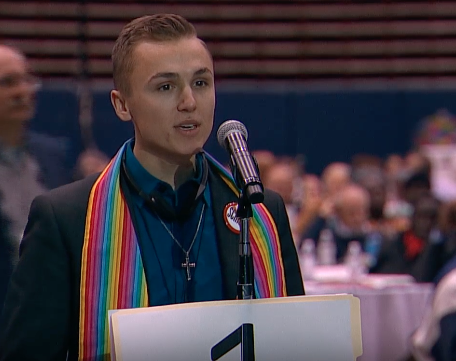
Jeffrey Warren addressed the conference on Monday -image courtesy United Methodist Church
Their favored plan, if formally approved, could drive supporters of LGBT inclusion to leave America’s second-largest Protestant denomination.
A final vote on rival plans for the church’s future won’t come until Tuesday’s closing session, and the outcome remains uncertain. But the preliminary vote Monday showed that the Traditional Plan, which calls for keeping the LGBT bans and enforcing them more strictly, had the support of 56 percent of the more than 800 delegates attending the three-day conference in St. Louis.
The primary alternative proposal, called the One Church Plan, was rebuffed in a separate preliminary vote, getting only 47 percent support. Backed by a majority of the church’s Council of Bishops in hopes of avoiding a schism, it would leave decisions about same-sex marriage and ordination of LGBT clergy up to regional bodies and would remove language from the church’s law book asserting that “the practice of homosexuality is incompatible with Christian teaching.”
Monday’s voting did not kill the One Church Plan but makes its prospects on Tuesday far more difficult.
As evidence of the deep divisions within the faith, delegates Monday approved plans that would allow disaffected churches to leave the denomination while keeping their property.
“This is really painful,” said David Watson, a dean and professor at United Theological Seminary in Dayton, Ohio, who was at the gathering. “Our disagreement has pitted friend against friend, which no one wanted.”
Formed in a merger in 1968, the United Methodist Church claims about 12.6 million members worldwide, including nearly 7 million in the U.S. While other mainline Protestant denominations, such as the Episcopal and Presbyterian (U.S.A.) churches, have embraced the two gay-friendly practices, the Methodist church still officially bans them, even though acts of defiance by pro-LGBT clergy have multiplied and talk of a possible breakup has intensified.
The strong showing for the Traditional Plan reflects the fact that the UMC, unlike other mainstream Protestant churches in the U.S., is a global denomination. About 43 percent of the delegates in St. Louis are from abroad, mostly from Africa, and overwhelmingly support the LGBT bans.
“We Africans are not children in need of Western enlightenment when it comes to the church’s sexual ethics,” the Rev. Jerry Kulah, dean at a Methodist theology school in Liberia, said in a speech over the weekend. “We stand with the global church, not a culturally liberal church elite in the U.S.”
The Africans have some strong allies among U.S. conservatives, including the Rev. John Miles II, senior pastor of First United Methodist Church in Jonesboro, Arkansas, who opposes same-sex marriage and gays in the pulpit.
“I have a very difficult time even though I have gays in my family and in my church,” he said. “I know it grieves them and it grieves me to grieve them. But it’s just what we believe is the truth.”
In recent years, the church’s enforcement of its LGBT bans has been inconsistent. Some clergy members have conducted same-sex marriages or come out as gay from the pulpit. In some cases, the church has filed charges against clergy who violated the bans, yet the denomination’s Judicial Council has ruled against the imposition of mandatory penalties, which typically called for an unpaid suspension of at least one year.
The Traditional Plan would require stricter and more consistent enforcement.
Among the outspoken supporters of the more permissive One Church Plan was the Rev. Adam Hamilton, a pastor in Leawood, Kansas, who said it offered a way for Methodists “to live together — conservatives, centrists and progressives — despite our differences.”
For LGBT Methodists, it is a time of anxiety.
“For me it’s about who’s in God’s love, and nobody’s left out of that,” said Lois McCullen Parr, 60, a church elder from Albion, Michigan, who identifies as bisexual and queer. “The Gospel I understand said Jesus is always widening the circle, expanding the circle, so that everyone’s included.”
Tuesday Scattered snow showers before 11am. Cloudy, with a high near 20. Wind chill values as low as -5. North northeast wind 5 to 10 mph. Chance of precipitation is 30%.
Tuesday NightMostly cloudy, with a steady temperature around 20. Light and variable wind becoming north northeast 5 to 9 mph after midnight.
WednesdayMostly cloudy, with a high near 19. Wind chill values as low as -1. North northeast wind 8 to 13 mph.
Wednesday NightMostly cloudy, with a low around 13. Northeast wind 5 to 8 mph becoming south after midnight.
ThursdayPartly sunny, with a high near 29.
Thursday NightMostly cloudy, with a low around 18.


 Watch the Hays Post for more information as it becomes available.