Farmers, come and join us for a “Weed Control Update for Field Crops” program featuring K-State Research & Extension Weed Control specialists Dallas Peterson and Vipan Kumar on Tuesday, February 19, at the Hays K-State Agricultural, 1232 240th Ave.
Topics of discussion will be weed research in western Kansas, herbicide resistant weed management, and weed control updates for field crops. As always, there will be time for your questions and answers.
Continuing education units for Certified Crop Advisers and Commercial Applicators are available.
Registration begins at 8:30 a.m. with the program kicking off at 9 a.m. and concluding at 12 noon with a complimentary lunch.
RSVP is requested for the meal count by Friday, February 15. Call the Cottonwood District Extension Office in Hays at 785-628-9430, or email Theresa [email protected].
Current Hays Superintendent John Thissen resigned in October, citing personal reasons. He will serve the remainder of his contract, which ends June 30.
Oak Park Medical Complex
The board will see plans Monday for renovations for the Oak Park Medical Complex.
The board purchased the property, which it plans to use to house the Early Child Connections program. The program is now housed in the former Washington school, which the district will close and has sold.
The Washington building was purchased by a developer to be renovated into low-income housing.
The school board purchased the Oak Park Complex for $2 million. It received a $1.47 million federal grant to renovate the facility. HaysMed, which was the primary owner of the complex, also donated $500,000 toward the renovation project.
The federal grant money must be used by June 30. The school district hopes to have the renovated space open for fall classes.
Driver’s education fees
The board is set to vote on a change in driver’s education fees. The program is doing well and has a significant reserve. The recommendation is to reduce the fees by $25 to $225 for district students and $275 for non-district students. Administration has recommended to keep summer school fees the same as they were last year.
In other business:
• The board is set to vote on contracts for Shanna Dinkel, assistant superintendent, and Chris Hipp, director of special education, for the 2019-20 school year.
• Thissen will share the district-wide KESA educator, student and parent survey results with the board.
• Keith Hall, interim director of finance, will share the five-year Capital Outlay Resolution with the board.
• The board will consider the approval of negotiating agents for the 2019- 20 school year contract.
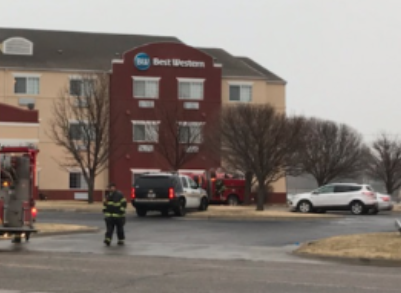
On Sunday, fire crews responded to the Best Western Hotel in the 4700 Block of South Emporia in Wichita, according to Lt. Jose Ocadiz.
First crews at the scene found and a man hanging from a third-story hotel window and smoke coming from the room.
Crews and the hotel sprinkler system were able to contain the fire to the room of origin.
The man was transported for treatment of injuries primarily due to the fall, according to Ocadiz.
The cause remains under investigation but is believed to have been intentionally set due to some tampering with the sprinkler system, according to Ocadiz.
Most of the $100,000 in damage at the hotel was from the sprinkler system. Damage to contents was estimated at $25,000. Authorities have not released the man’s name.
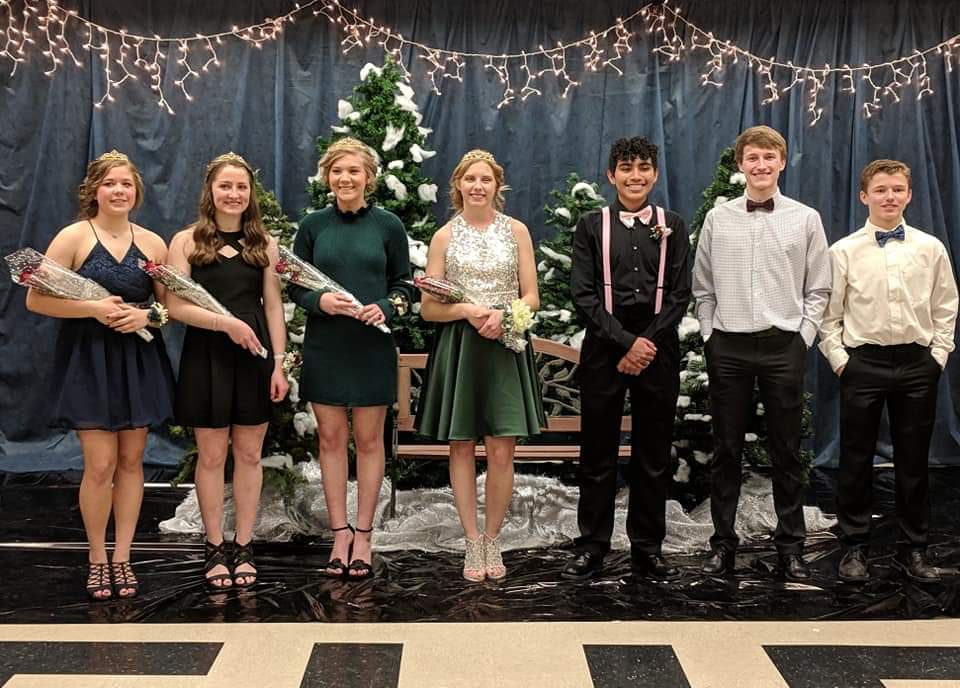
Ellis High School had its annual KAY Snowball Dance on Saturday.
The Snowball Royalty class winners are as follows:
Freshman Queen, Lakyn Fischer, daughter of DJ and Julie Fischer; Sophomore Queen, Grace Eck, daughter of Mark and Sarah Eck; Junior Queen, Breonna North, daughter of Travis and Ava North; Senior Queen, Cameryn Kinderknecht, daughter of Tim and Rhonda Kinderknecht; Junior King, John Gamez, son of Domingo and Martha Gamez; Sophomore King, Brady Frickey, son of Brad and Stacy Frickey; and Freshman King, Tyson Jimenez, son of Javi and Jessica Jimenez.
Allen Henry Robey was born January 21, 1954 in North Platte, NE to Jean and Shirley (Bruhn) Robey. He passed away February 6, 2019 in Oberlin, KS at the age of 65.
Allen graduated from North Platte High School. He then served in the United States Army Corps of Engineers. Allen worked at Rayes Grocery Store for over 30 years. He enjoyed riding motorcycles and was a people person.
Allen is survived by his brother, Terry Robey and wife Mary of Wichita, KS and many friends. He was preceded in death by his parents.
A Celebration of Life will be held at a later date. Condolences may be left at www.paulsfh.com
Clifton Daniel Jamison, “Cliff” or “Clifford the Big Red Dog”, age 62, of Quinter, KS passed away on February 8, 2019
Cliff was born on April 8, 1956, at the Gove County Medical Center. He graduated from Quinter High School in 1974. He worked for Flex-King in Quinter, then farmed the remainder of his lifetime on the family farm in Quinter.
Cliff was united in marriage to Rita Briard, on July 11, 1975, at Mt. Pleasant Baptist Church, rural Studley, KS. They later divorced. He then married Leiana West on December 14, 1997. This union continued for 21 years. He was part of Tractorcade in 1978 and 79 in which he drove a tractor from Quinter to Washington DC at 15 mph. He was also a proud member of the Free Tomorrow Motorcycle Club for 34 years.
Cliff is survived by his wife, Leiana (West) Jamison of Quinter; son, Kris Jamison of Inman; daughters, Cherie Pfannenstiel and husband Whitey of Munjor, and Jackie Diaz and husband Elias of Farmington, NM; parents, Herb and Mildred Jamison of Redding, CA; sisters, Jeanne Elliott, CA, Beth Meier and husband Rod of CA, and Cheryl Reese and husband Ted of OR; grandsons, Dawson Jamison and Tobias Diaz, and many aunts, uncles, cousins and friends.
Cliff was preceded in death by grandparents; three stepsons, Brandon, Michael, and Dusty Smith; and brother-in-law, Jim Elliot.
Funeral service will be 11:00 am Saturday, February 16, 2019, at the Church of the Brethren, Quinter. Burial will follow in the Baker Township Cemetery.
Visitation will be prior to the service from 9:00 – 10:30 am, at the Church of the Brethren.
IN LIEU OF FLOWERS, memorial contributions are suggested to the Keller K-9 Rescue. Donations made to the organization may be left at the service, or sent to Schmitt Funeral Home, 901 Main Street, Quinter, KS 67752.
Michael W. “Mike” Dirreen, 48, died February 9, 2019, at his home in Hutchinson, surrounded by his friends, Keno, and his family.
He was born March 13, 1970, in Kansas City, Kansas, the son of Bill and Ruth Ann (Wahaus) Dirreen.
Mike enjoyed cooking and did so at the Redwing Store, Redwing, Kansas, The Elks Lodge, Goodland, Kansas, and most recently the Applewood Grill, South Hutchinson. He also loved being around animals especially his dog Sassy Girl.
He is survived by his father and stepmother, Bill & Connie Dirreen of Hoisington; brother, Richard “Rich” Dirreen of Rush Center; 5 nieces, 2 great nephews, and 2 great nieces.
He was preceded in death by his mother, Ruth Ann Dirreen.
A graveside service will be held at 1 p.m., Saturday, February 16, 2019, at Hoisington Cemetery, officiated by Ron Bailey. There will be no viewing as cremation has taken place.
Memorials may be made to the Golden Belt Humane Society in care of Nicholson-Ricke Funeral Home, PO Box 146, Hoisington, KS 67544.
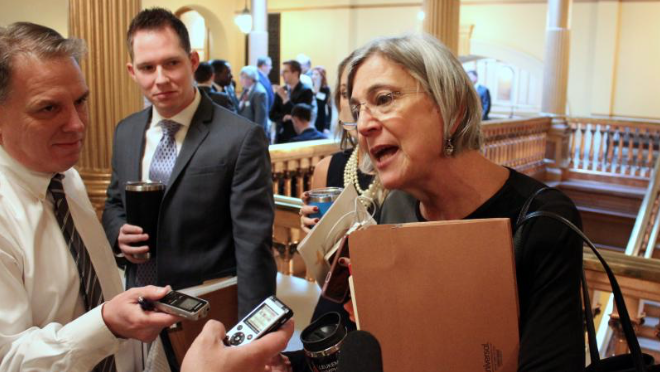
Republican leaders in the Kansas Senate are forging ahead with plans to plow millions into tax relief that would largely benefit big business. Some Democrats and more moderate Republicans suspect it’s also a strategy to deprive the governor of the money to fund her priorities.
Republican Senate President Susan Wagle is leading the charge for a tax relief plan that could lock up funds the governor wants for schools and roads. STEPHEN KORANDA / KANSAS NEWS SERVICE
Carving out chunks of the state savings account now could send lawmakers scrambling to fund schools and other services with the cash that’s left when they’re knitting up the budget later this spring.
“When we get to the end of session, then we are stuck,” Democratic Rep. Cindy Holscher said.
Republicans say there’s urgency to tackling tax relief, and that the state can afford it.
The year started with a financial picture rosier than many forecasts in recent memory. After lawmakers in 2017 reversed the tax cuts then Gov. Sam Brownback had pushed for in 2012, Kansas has seen tax collections rebound. A revenue estimatefrom November showed the state would have $900 million in the bank at the end of the current fiscal year.
But, a bad monthly revenue report for January prompted Gov. Laura Kelly to reiterate her feeling that the state needs to be picky about what it spends money on.
“We must make wise, financial prudent choices to ensure the future is bright for our children,” Kelly said in a statement.
The governor said she favors investments in schools, roads, and fixing what she points to as the “damage done” during the Brownback years.
The Senate on Thursday approved a tax relief bill that the state department of revenue estimates would cost more than $400 million over three years. That includes around $190 million this year, cutting into that projected ending balance.
Democrats in the Senate, who all voted against the bill, said the state can’t give up the revenue while staring down a Kansas Supreme Court order to adequately fund schools.
“We can’t afford this unless we do something drastic to our budget,” Democratic Sen. Tom Holland said as a committee worked on the bill before it went to the full chamber. “We have to fund our schools.”
Sen. John Skubal was one of two Republicans who joined the Democrats in voting “no.” He criticized the bill for focusing too much on corporations.
“They have had tax breaks long enough,” Skubal said after the vote. “I think we need more money right now to take care of the core functions of government.”
Republican Senate President Susan Wagle said lawmakers don’t have to choose between tax relief and funding schools.
She calls the money in question a “windfall” — an unexpected boon to the state resulting from changes to the federal tax code.
“If we don’t pass this bill,” Wagle said during committee work on the plan, “Kansas individuals, families and businesses will all have a tax increase this year.
If lawmakers do nothing, the federal tax cuts passed in 2017 could result in some corporations owing more state taxes on foreign income and some individual Kansans would owe more because they would no longer be able to take itemized deductions.
Wagle said concerns about the cost of acting to let Kansas taxpayers keep that money may be overblown because staff aren’t fully confident in their estimate of the fiscal impact.
“It’s a shot in the dark,” she said.
The Senate president and other Republicans argue too that not providing the tax relief could be detrimental to Kansas if it prompts large companies to leave the state.
“Then we’re going to lose a bunch of jobs,” Sen. Julia Lynn said. “That’s my issue, pure and simple.”
Some lawmakers expect Kelly would veto the bill should it pass the House and make it to her desk. The governor has voiced strong opposition.
“I can’t imagine why anybody who was here in 2012 and lived through the Brownback tax cuts and the experiment would even consider voting for that bill,” Kelly told reporters. “It is a redo.”
At the same time Republicans are pursuing tax relief, they’re also showing little interest in a Kelly’s idea to give the state more spending flexibility.
The governor has proposed refinancing the debt of the Kansas Public Employees Retirement System. Her proposal would stretch out the payoff schedule. That would lower the annual payments and free up money for other priorities, such as education or expanding health coverage through the state’s Medicaid program.
But ultimately it would add billions of dollars to the state’s pension liabilities.
“This whole budget is built on a house of cards,” Republican Senate Majority Leader Jim Denning said of the proposal last month.
Since then, opinions from Republican leaders haven’t improved. The chairman of the House pension committee, Steven Johnson, believes the plan is likely dead in the water for this session.
Democrats agreed to spend $115 million to make up for a missed payment to KPERS. That legislation, passed with a unanimous vote in the Senate, is heading to the House.
The governor said Kansas can afford that payment now, but insists the state has to refinance its pension debt to keep the payoff schedule manageable in the long term.
“It really is a fiscally sound thing to do,” Kelly said.
BARTON COUNTY — Authorities in Barton County have responded to several fires since Friday and all of them were heating related, according to Sheriff Brian Bellendir.
photos courtesy Barton Co. Sheriff
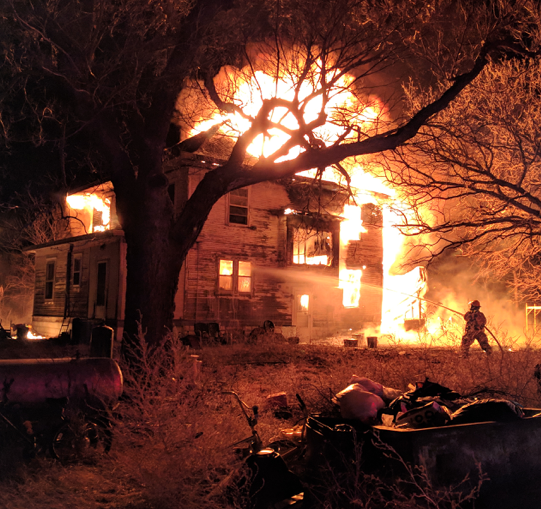
The most serious of these fires occurred at about 11:30 p.m. Feb. 10. Sheriff’s deputies were dispatched to 789 E. Kansas Highway 4 near Claflin. Upon arrival, firefighters and deputies discovered a house fully involved in flames.
Investigation at the scene indicated that the house was not occupied at the time of the fire but, the tenants had been using wood burning equipment to keep the structure warm. The residence was a total loss.
Just after 11:30 a.m. Feb. 8, sheriff’s deputies responded to a structure fire at 672 Barton Ave. south of Hoisington and another just after 5 p.m. on Feb. 9, at 11 NE. 30th Road, just north of the city of Great Bend.
Both of these fires caused substantial damage to the residences and were heating related, according to Bellendir. Authorities reported no injuries.
William J. (Bill) Goscha was called home by the loving Lord on February 10, 2019.
Bill was born on December 30, 1939 to John and Helen (Meitl) Goscha in Selden, Kansas where he lived with his family. Bill graduated from Decatur Community High School in 1957. He went on to serve in the Air Force, and upon his father’s death came back to Oberlin to take care of his family. He is best known for being a father, grandfather, brother, and friend to all who knew him.
He is survived by his sons: Don Goscha and wife Dienna, Dave Goscha and wife Shelley, Bradley Goscha, and Todd Goscha and wife Sara; his daughter, Shawnda Rumbaugh and husband Bruce and 10 grandchildren. He is also survived by his brothers: Dennis Goscha and Michael Goscha and his sisters: Henrietta Juenemann, Mary Eichner, Kathleen Spellman, and Carmela Werner.
He was preceded in death by his parents, John and Helen Goscha and brothers and sisters: Verna Wearing, Albert Goscha, Charles Goscha, Daniel Goscha, Herb Goscha, and Patricia Buell.
His funeral will be held 2:00 pm Tuesday, February 12, 2019 at Pauls Funeral Home 121 N. Penn Ave in Oberlin, KS. In lieu of flowers, the family has asked that memorials to be sent to Pauls Funeral Home 121 N. Penn Ave. Oberlin, KS 67749 in care of William Goscha for Bill’s final expenses or donate to your local charity benefiting cancer research in Bill’s honor.
Vincent Mathias Ritter, 94 of Phillipsburg, KS died Sunday, February 10, 2019 at the Phillips County Retirement Center, Phillipsburg.
Vincent was born January16, 1925 at the family farm near Dresden, son of August & Agnes (Jacobs) Ritter. He graduated from the Leoville High School in 1943. He served in the United States Army.
He married Mary Edna Reinert on May 29, 1950 at St. Martin’s Catholic Church in Seguin. To this union,
they were blessed with eleven children.
His work ethic started at a young age when he helped on thefamily farm. During his lifetime he had many jobs including working at the railroad, trailer plant, various construction jobs and township motor grader operator. His main desire remained in farming. He was an avid sports fan & spent many hours following the Kansas City Royals or any other team that played!
Survivors include five sons, Charles & Laura Ritter of Kanas City; August (Joe) Ritter of Goodland; Will & Tina Ritter of Olathe; Rick & Lynette Ritter of Colby; Paul & Kalyn Ritter of Monument; Four daughters, Irene & Steve Whorton of Topeka; Doris & Kevin Yonke of Holton; Louise & Randy Phillips of Lawrence; Jayne & Darryl Leidig of Phillipsburg; 33 grandchildren; 40 great-grandchildren; and a sister, Cordula (Ed) Werth of Park, KS.
Vincent was preceded in death by his parents; sister Augusta Jansen; brother Albert Ritter; wife, Mary; daughter, Carol A. Wilson; son, John M. Ritter; son-in-law James Fuller & granddaughter, Jennifer Whorton.
Mass of Christian Burial will be at 11:00 a.m. Saturday, February 16, 2019 in the Immaculate Conception of the Blessed Virgin Mary Catholic Church in Leoville, KS. Burial will follow in the Mt. Calvary Cemetery, Leoville.
A Scriptural Wake and Rosary will be held at 7:00 p.m. Friday, February 15, 2019 in the Olliff-Boeve Memorial Chapel, 1115 2nd Street, Phillipsburg, KS 67661.
Mr. Ritter will lie in state from Noon until 9 p.m. Thursday and 9 a.m. to 9 p.m. Friday at the funeral chapel.
Memorial contributions may be made to Hospice Services or Johnson Cancer Research Center.
Hello from Topeka! The weather much like the Kansas legislature can be a bit of a challenge, as there have been several days of bitter cold, icy streets and snow only to give way to bright sun shine and temperatures near 50 degrees. Inside the statehouse, there has been much anticipation of several bills being introduced, but it looks like they may wait until next year, as the deadline for individuals to introduce legislation has passed, but there is still time for some select committees to do so if the need arises.
Probably the highlight of the last week was on Wednesday when Chief Justice Lawton Nuss delivered the annual State of the Judiciary in the courtroom of the Kansas Supreme Court. The Chief Justice spoke about the pay of district court judges, recognizing six district court judges who attended the address (Judge Mike Ward, El Dorado; Judge Bruce Gatterman, Larned; Judge Kelly Ryan, Olathe; Judge Mary Christopher, Topeka; Judge Sally Pokorny, Lawrence; and Judge Jeff Dewey, Wichita).
The Chief Justice shared positive progress for the Judicial Branch, focusing on e-filing, which enables court documents to be filed electronically. The Judicial Branch is working to connect e-filing with a centralized electronic case management system (eCourt). This integration will give judges, court staff, and attorneys “immediate, statewide electronic access to case information and records provided by the Kansas Courts. One of the many benefits cited by the Chief Justice is to: increase efficiency and effectiveness by streamlining some activities and automating others–like improving the ability to process electronic payments. The first “Go-Live” of this system will be in June in the 8th Judicial District (Dickinson, Geary, Marion, and Morris counties) and the 21st Judicial District (Clay and Riley counties).
Other successes mentioned by the Chief Justice were: the committee that investigated the state’s municipal courts, which came back with 18 recommendations; recently formed task force studying pretrial detention practices in district courts (“to see that no person is unconstitutionally or unnecessarily deprived of his or her liberty before a decision is made on guilt or innocence). Also cited were the Self-Help centers set up in the courts of five counties: Ellis, Miami, Johnson, Shawnee, and Wyandotte. Additionally, the Supreme Court has increased access to justice by increasing the number of lawyers who can provide pro bono, or free, legal services.
Also last week, the Family First Prevention Services Act, an important piece of Federal legislation, was signed into law. The Act aims to prevent children from entering foster care by allowing federal reimbursement for mental health treatment, substance abuse treatment, and in-home parenting skill training. In addition, the Act focuses on improving the well-being of children already in foster care through an incentive to states to reduce placement of children. The basic premise is to keep children safe and supported at home and ensure that children in foster care are in the least restrictive appropriate settings.
The House Children and Seniors Committee and the House Appropriations Committees discussed how Family First would be implemented in Kansas. The Children and Seniors Committee heard HB 2103. Under the Family First Prevention Services Act, states will have the option, beginning on October 1, 2019, to use Title IV-E funds, at a 50% federal match rate, for certain evidence-based prevention services and programs. Most of the changes that are required by the Act for the state of Kansas to receive the additional federal funding will be made on a policy and regulatory level by the Kansas Department for Children and Families.” There are statutory changes that need to be made so that Kansas can qualify for the new funds.
Testimony from the Department of Children and Families noted that the Act allows states to use Title IV-E (in Social Security Act) funding for time-limited prevention services for children at risk of being placed into foster care, for the children’s parents and kinship caregivers, and pregnant and parenting youth. The Act allows children who need special services and treatment to be placed in a Qualified Residential Treatment Programs (QRTPs), with specific requirements in place so that Kansas can receive federal reimbursement. A joint committee of members of the Kansas Supreme Court Task Force on Permanency Planning and the Judicial Council Juvenile Offender/Child in Need of Care Code Advisory Committee studied the Federal Act and HB 2103 results from their efforts. Further action is planned for the bill.
The House Appropriations Committee heard Tuesday February 5 from Laura Howard, interim Secretary for Department of Children and Families and Department of Aging and Disability Services. She presented an agency overview and budget summary for the Department of Children and Families. She indicated that the Governor included funding for 26 FTE positions in child welfare in the FY 19 budget and an additional 26 FTE positions in the FY 20 budget. In relation to the Family First Prevention Services Act: $8.8 million AF is budgeted for FY 20 for evidence-based prevention programs; $36K FY 19 and $73K FY 20 for children at substance abuse treatment; $502K FY 19 and $452K FY 20 for 3 FTE, background checks, and licensing.
This past week, Kansas Farm Bureau had their day at the statehouse and was glad to welcome: Myndi Krafft and Doug Zillinger from Phillipsburg and Chris Tanner from Norton and Miranda Atchison from Kirwin. There were also days focused on economic development and tourism, it was good to see Roger Hrabe from Rooks County. Speaking of Rooks County, the group from Stockton made their annual trip to Topeka and I believe had a productive couple of days. Also, Leading Edge Kansas held meetings and we were able to catch up with Jay Shelton from Norton and Amber Atkisson from Stockton.
I enjoyed being co-host of “SportsTalk” with Tad Felts Saturday morning on My Phillips County Online and saw lots of friends at the Phillips County Livestock Association Annual meeting and banquet in Phillipsburg.
If you come to Topeka during the session, my office is in Room: 149-S. My phone number is 785-296-7463 and email is: [email protected] and you can always try my cell number is 785-302-8416.
I look forward to seeing you around the 110th District. It is my honor to by your representative.
Rep. Ken Rahjes (R-Agra), is the 110th state representative and chairman of the Higher Education Budget Committee. House District 110 includes Norton and Phillips counties as well as portions of Ellis, Graham, and Rooks counties.
Sen. Rick Billinger (R-Goodland), 40th Dist.Last Tuesday we passed SB9, 40-0, which is the KPERS bill that pays the missed payment from 2016 with interest. In 2016 the legislature postponed a $97.4M payment and promised this payment would be made in 2018 with interest.
The executive director of KPERS calculated interest to make the payment actuarily sound for FY 2018 for a total amount of $115M. By not making this payment it caused an increase of $630,000 to unfunded liability/interest expense monthly or $20,712.32 per day.
In 2018, the legislature opted to postpone the payment, to see what future revenues produced. Kansas’s revenues ended FY18 with $317M more than expected in the 4th quarter. This left the approved ending balance at $905M.
Since the payment was postponed 30 months ago it has already cost KPERS $18.9M.
I argued that it was irresponsible to build our ending balance with KPERS money and also questioned why we wouldn’t meet our obligation. There is no reason to not make this payment unless it is going to be used for something else. We made a promise we need to keep our promise.
According to KPERS, the actuarial effect of repaying the contribution would be a net savings of $186.1M from all funds over 30 years. Making the payment would result in meeting the actuarial required payment for the first time in 25 years.
The House will hold a hearing on SB9 Tuesday morning at 9:00. I am scheduled to testify in support of this bill and will encourage the House to move swiftly to pass this legislation on to the Governor. I will encourage the Governor to sign this bill.
SB22 was passed out of the Senate on Thursday by a vote of 26-14. SB22 would prevent a tax increase for middle class Kansas families and small businesses.
When Congress made changes to the Federal tax code last year, it triggered the need for states, like Kansas, to take action so families in our state wouldn’t be penalized.
That’s what this bill is about. It updates the Kansas tax code so that middle income Kansans can continue to write-off their medical expenses, charitable contributions, property taxes and mortgage interest. For individuals and small businesses, SB22 adjusts the Kansas tax code so that Kansans with itemized deductions that total between $7,000 and $24,000 can continue to itemize on their state income taxes even if they no longer itemize on their federal income tax.
Some middle-income tax filers might not itemize at the Federal level this year due to recent changes Congress made to the Federal tax code to raise the standard deduction. Without this bill, these middle-income tax filers will no longer be able to itemize at the state level, triggering a higher state income tax liability for these families and small businesses. This would be a tax increase for these families and small businesses.
Kansas is one of only seven states that have not de-coupled from the Federal government tax code.
For multi-national companies, SB22, clarifies language in the Kansas tax code so that changes in the federal tax code do not trigger unintended tax hikes at the state level for business owners.
Right now, Kansas companies that do business outside of the United States pay taxes on those profits at the federal level. Those profits are not taxed at the state level and never have been. Without this bill, these Kansas companies would be subjected to additional taxes at the state level, making Kansas a more expensive state for businesses to operate in.
Congratulations to Kansas Farm Bureau who were recognized on the Senate floor to celebrate the bureau’s 100th anniversary.
Thank you to the students, educators and program directors for presenting an overview of the JAG-K program. The success of this program is shown by the 97% graduation rate in school year 2016-2017.
I would like to thank all of the visitors who stopped by my office this week or held receptions in Topeka.
I am honored and grateful to represent the 40th Senate District in Kansas. Please do not hesitate to contact or call me with your questions and concerns, my office number is 785-296-7399 or my cell is 785-899-4700. If you are in Topeka stop by my office at 236-E.
Sen. Rick Billinger, R-Goodland, is the Kansas state senator for the 40th District, which includes Cheyenne, Decatur, Ellis, Gove, Graham, Logan, Norton, Rawlins, Sheridan, Sherman, Thomas, Trego and Wallace counties as well as portions of Phillips county.