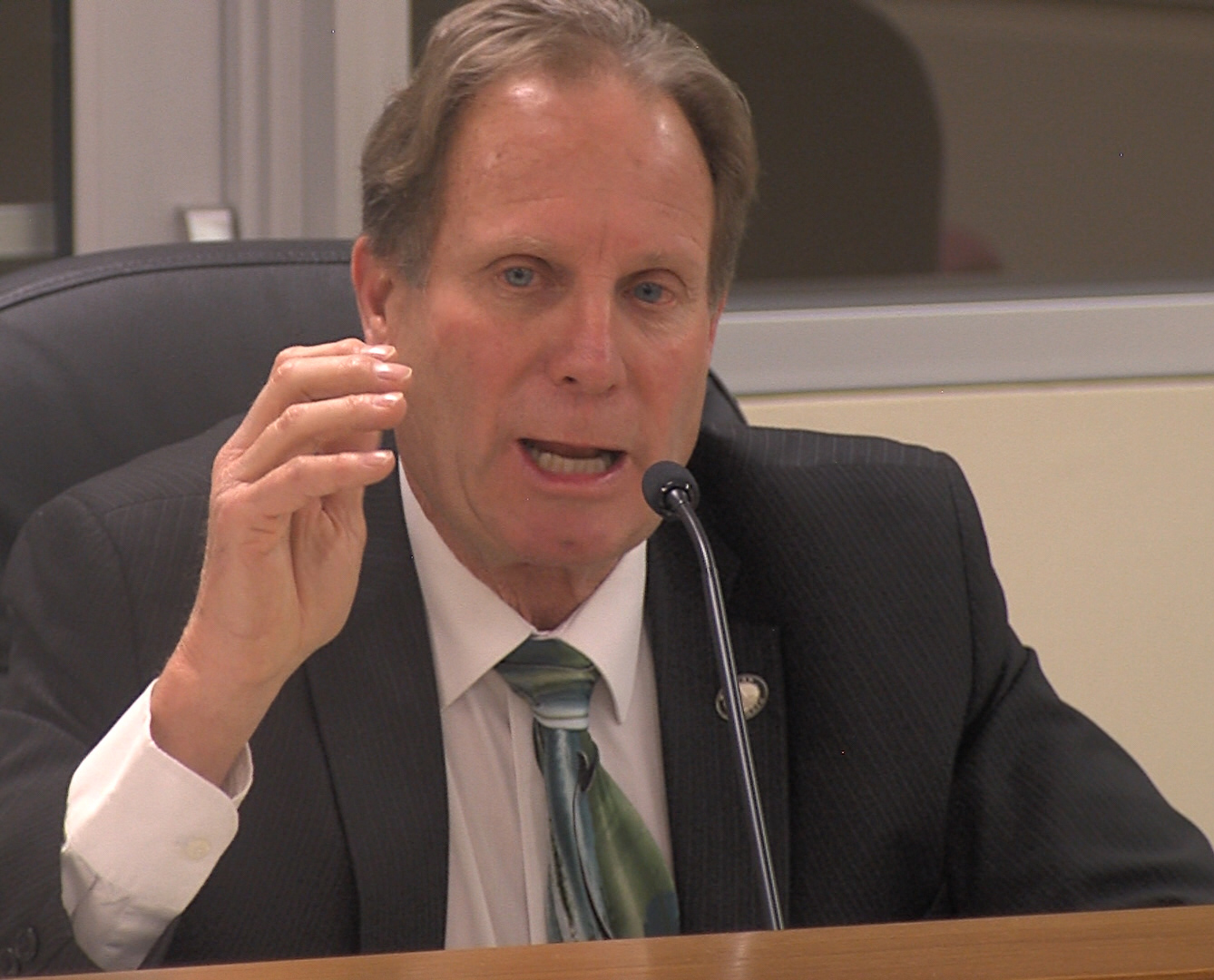
LEAVENWORTH, Kan. (AP) — Prosecutors are researching an appeal after a Kansas judge called two teenage girls the “aggressor” in a sexual encounter with a 67-year-old man and eased his prison sentence.
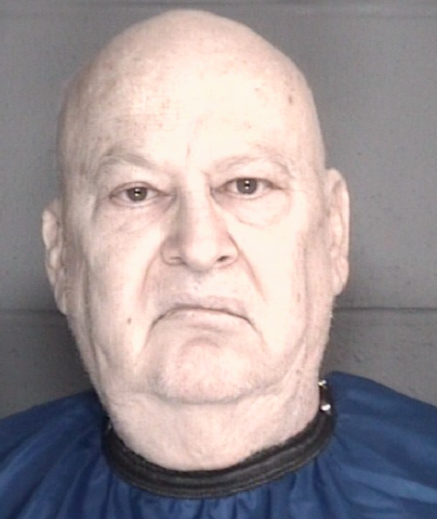
Soden -photo Leavenworth Co.
Leavenworth County District Judge Michael Gibbens sentenced Raymond Soden in December to five years, 10 months in prison. Prosecutors sought more than 13 years behind bars because Soden had prior convictions.
Gibbens said at the sentencing that the girls were “more an aggressor than a participant,” citing as a reason that the girls had voluntarily gone to Soden’s house and taken money for sexual favors.
Harleigh Harrold with the Metropolitan Organization to Counter Sexual Assault tells the newspaper children don’t have the ability to understand the consequences of such an act.
Michelle Herman, president and CEO of the child advocacy center Sunflower House, says “sexual assault is never the victim’s fault.”
—————————-
LEAVENWORTH, Kan. (AP) — Prosecutors are researching an appeal after a Kansas judge found that a 13- and 14-year-old girl were partly to blame for a sexual encounter with a 67-year-old man and reduced his prison sentence.
Leavenworth County District Judge Michael Gibbens said that “the victims in this case, in particular, were more an aggressor than a participant in the criminal conduct” before sentencing Raymond Soden to five years and 10 months in prison. Prosecutors sought 13-plus years because Soden had prior convictions for battery and for sexual battery
In ordering a lighter prison term than what sentencing guidelines called for, the judge noted at the Dec. 4 hearing that the two girls had voluntarily gone to Soden’s house and had taken money for sexual favors.
No. 6 Tiger Women avoid upset-minded UNK in overtime Saturday
Fort Hays State was down by 20 midway through the third quarter in Kearney and things looked bleak for the Tiger women and Tony Hobson. The Tigers shot 20.5% from the field in the first half and 1-13 from three before Kacey Kennett knocked down three three-pointers in the third to spark the comeback for Fort Hays State. From that mark until around six minutes left in the fourth quarter, Fort Hays State went on a 25-4 run to take their first lead 50-49. Tatyana Legette came alive in the overtime period, scoring 11 of her career-high 25 points in the extra period carrying the Tiger women to a 74-64 victory. The 20-point comeback was the biggest comeback of Tony Hobson’s career at Fort Hays State as the Tiger women remain at the top of the MIAA conference.
The Tiger men fell to Nebraska-Kearney 59-56. Aaron Nicholson lead the Tigers with 15 points.
Both teams will be on the road this week to take on Pittsburg State on Thursday and Missouri Southern on Saturday. You can listen to the games on Tiger Radio 103.3 FM, the KJLS app, or online here.
Hays High girls go 2-0 in back-to-back
The Hays High girls got two WAC wins Friday and Saturday with wins over Dodge City and Garden City at home. Hays High took a 10-point lead in the third quarter against Garden City but went 10 minutes without a field goal until Mattie Hutchison tied the game with a three 38-38 with 12 seconds left. After a Garden City turnover, Brooke Denning buried an NBA three at the buzzer to give Hays the 41-38 win.
The Hays High boys split the back-to-back with a 75-63 win over Dodge City Friday and a 50-39 loss to Garden City Saturday. Hays falls to 7-7 on the year and 2-2 in the WAC. You can listen to the interviews and highlights of Saturday’s games here.
TMP girls move to first place in MCL; both teams sweep Norton Friday
The TMP girls took down a good Norton team on Friday last week, moving them to first place in the conference. Emily Schippers scored 11 straight points for the Monarchs in the second half to give them a 25-20 lead with 6:50 left to go in the game. TMP would never give up the lead and won 37-34. With the win the Monarchs take over sole of first place in the MCL at 6-0. They also improved to 11-4 overall.
The TMP boys made nine first-half threes and had four players in double-figures as they ended a three-game losing streak with a 55-42 victory over Norton. TMP improved to 9-7 on the season and 4-2 in the MCL. You can listen to the interviews and highlights of Friday’s games here.
OVERTIME
Trego’s Lili Shubert surpassed 500 points last Thursday in a 45-43 win over Phillipsburg. Only a sophomore, Shubert has 508 points in her career.
The Central Plains girls basketball team reached 100 straight wins last week. The state record is 107 straight victories set by Hoxie from 2012-2016.
Have highlights you want to share for next week’s Hoops Highlights? Email them to C.D. DeSalvo. Photos are encouraged!
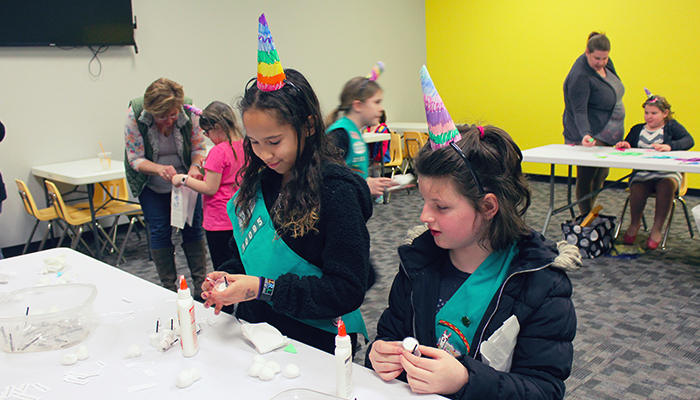
Girl Scout Troop 11268 Hays practices for booth sales. Pictured are Allison Werth, Adalynn Wilkie, Alexis Bickle, Brooklynn Dinkel, Kayden Eaton, Anna Kuhn and Lynsi Kanak-McGrath.
Girls Scouts from the area converged Friday on Celebration Community Church for their annual Cookie Kickoff.
Cookies go on sale Saturday, Feb. 9 and the sale will run through March 17. Cost of cookies are $4 per box.
The event included girls from Service Unit 74, which includes Ellis, Trego, Ness, Russell and Gove counties. More than 90 girls pre-registered for the event.
The girls sampled Girl Scout cookies, decorated their own cookies, practiced their selling skills, made crafts, snapped pictures at photo booths and played games.
This year’s mascot for the cookie sale is Sparkles the Narwhal. For those of you who don’t know what a narwhal is, it is an Arctic whale with a large horn. The narwhal and its horn have been cited by many as the creature from which the unicorn legend sprung.
Junior Scouts Delilah Meyeres and Lisa Dible, 10 of Troop 10095, color narwhal horns at the Cookie Kickoff Friday.
In honor of the cookie mascot, girls at the kickoff colored and wore their own narwhal horns.
Junior Scouts Jordan Flavin and Arianna Ayarza, both 10 of Troop 10095, said they hope to use the money they raised from their cookie sales to go to camp this summer.
The girls earn Cookie Credits through cookie sales they can use for Scout activities.
Girl Scout Troop 11268 said they had already been to several camps this year, including the first part of three-part campout in Ellis, a Halloween camp and Cookie Camp in Scott City. The Juniors hope to raise enough money through cookie sales to go on a trip together this summer.
GSUSA
Cookie sale dates
The Cookie Sale runs Feb. 9 – March 17
Cookie Booth sales will be throughout the entire sale.
How to find cookies
Looking for a local Girl Scout to buy cookies from? Just enter your zip code at kansasgirlscouts.org or call our Cookie Hotline at 888-686-MINT (6468). You can also download the free, official Girl Scout Cookie Finder mobile app for iPhone, Android and other mobile devices. (Yep, there’s an app for that!)
S’mores cookie is returning in the 2019 cookie lineup
This year, Girl Scouts is celebrating a tasty new way to support young female entrepreneurs with a recently debuted Girl Scout Cookie added to the 2019 Cookie Lineup: Caramel Chocolate Chip, which joins classics like the Thin Mints, Caramel deLites and Shortbread varieties. Caramel Chocolate Chip features rich caramel, semisweet chocolate chips, and a hint of sea salt in a chewy gluten-free cookie. The new cookie is offered in select Girl Scout council markets only for as long as supplies last. We still have eight other cookie favorites to choose from: Thin Mints, Caramel deLites, Peanut Butter Patties, Shortbreads, Lemonades, Peanut Butter Sandwiches, and Thanks-A-Lots.
A second century of Girl Scout cookies
In 2019, we celebrate the 102nd anniversary of the first-known instance of Girl Scouts selling cookies and learning the basic skills they needed to be leaders in business, managing their own finances and gaining self-sufficiency and confidence handling money.
So how did it all begin? It started in 1917 in Muskogee, Oklahoma, when the Mistletoe Girl Scout troop there did what Girl Scouts everywhere do: They had a great idea, got together, and took action to make it a reality. They decided to fund their projects by selling homemade cookies, and the idea spread!
The 5 skills
Daisy Scouts Georgia Olson and Harper Leiker, both 5 of Hays, decorate their narwhal horns Friday.
When girls participate in the Girl Scout Cookie Program, the largest girl-led business in the world, they get more than new adventures. They develop important life skills—goal setting, decision making, money management, people skills, and business ethics—that will set them up for success!
For 102 years, Girl Scouts have used cookie earnings to build leaders who make a positive impact on our world. Girl Scout Cookies not only help girls earn money for fun, educational activities and community service projects, they also help transform girls into G.I.R.L.s (Go-getters, Innovators, Risk-takers and Leaders) as they learn essential life skills. There’s no doubt: American society is better because of the girls who have taken part in the Cookie Program.
Price of cookies
Each package of Girl Scout Cookies costs $4. Yes, there are Girl Scout Cookie lookalikes out there, but it’s important to keep in mind that when you buy a box of cookies from a Girl Scout in our council, all of the money stays in Kansas and supports local programs for local girls. Along with earning money for their troop, girls are also earning Cookie Credits they can spend on exciting Girl Scout programs and activities, camps, troop trips, travel, signing up for another year of Girl Scouts, and even on merchandise in our Girl Scout Shops.
How the cookie revenue benefits girls
Brownie Scout Giannna, 8 and Daisy Scout Aria, 6, Haselhorst of Hays are handed cookie samples by volunteer Becca Wilkie as their mother Dacia looks on.
After paying the baker, all of the money earned from cookie sales stays within Girl Scouts of Kansas Heartland and in Kansas. Since the Cookie Sale is the girls’ primary fundraiser, the proceeds are helping girls and their troops pay for things like their first camp experience, a special trip or event, and even community service projects — girls invest their own Cookie Sale proceeds right back into the community. Cookie revenue also supports our council’s programs and services (girl programs, volunteer training, financial assistance for girls, facility operations, and program resources).
Digital cookie
Digital Cookie sales allow Girl Scouts to reach customers with their own personalized webpage on a secure system emphasizing girl safety. Girl Scouts and their families are instructed to share the link to their sale page with a close network of friends and family, rather than the general public, for safety reasons. This is a great option for family and friends who do not live nearby.
Digital Cookie does not replace the traditional Girl Scout Cookie Program – it enhances it. It is another way for Girl Scouts to sell cookies, alongside the traditional sales techniques like door-to-door sales and booth sales. Digital Cookie simply adds another learning component to the Girl Scout Cookie Program that will be relevant in today’s world. They can go to abcsmartcookies.com to access the page and send eCards to family and friends, with a secure link. Customers pay online with a credit card, and cookies are shipped directly to their home or place of business. Online customers can choose any quantity of cookies for direct shipment this year, plus the cost of shipping.
Cookie Share Program: Supporting members of the military and local charities
Sparkles the Narwhal
For customers who’ve already purchased enough cookies for themselves or cannot eat cookies, the Cookie Share Program is a great option. Cookie Sale customers can simply buy a package of cookies and opt to donate it or “share” it with servicemen and women, including those serving overseas; their families; and local charities like the Kansas Food Bank and Catholic Charities. The cost is the same as a package of cookies – just $4. Local businesses can also participate in the Cookie Share matching program, and match the number of Cookie Shares purchased by kind Kansans.
Since the Cookie Share Program started in 2010, Girl Scouts of Kansas Heartland has distributed more than 158,772 packages of cookies, including 19,000 “Cookie Shares” in 2018. To share cookies with a local charity or send a sweet reminder of home to our servicemen and women, just ask your local Girl Scout about the Cookie Share Program or call (888) 686-MINT.
Depending on whom you talk to, either definition might apply to the way the Kansas Farm Bureau is proposing to rescue farmers and ranchers priced out of the health insurance marketplace set up under the federal Affordable Care Act.
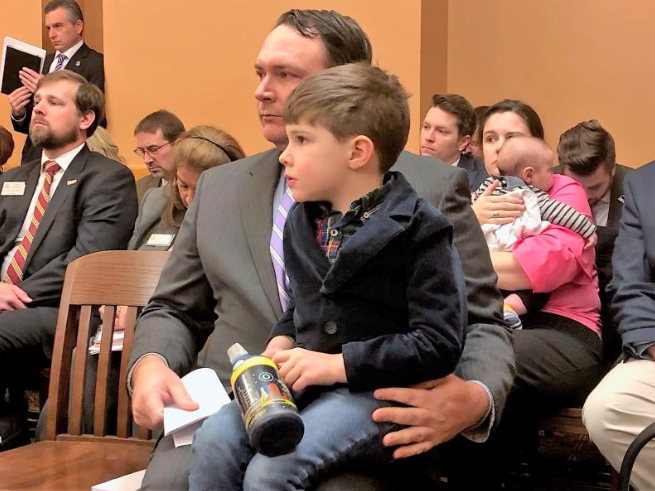
Farmer Tim Franklin, holding his son during a Senate committee hearing, told lawmakers he needs a more affordable health coverage option for his family. JIM MCLEAN / KANSAS NEWS SERVICE
It’s either a bold and daring move. Or, it’s presumptuous, bordering on brazen.
The powerful ag lobbying organization is petitioning lawmakers for what amounts to carte blanche authority to develop and market health coverage free of state and federal oversight.
Opponents are warning of dire consequences for consumers if lawmakers okay the proposal.
But Terry Holdren, CEO of the Kansas Farm Bureau, said the failure of traditional insurers and government to address the plight of farm and ranch families left the organization with little choice but to step forward with a potential solution.
“Had current providers in the marketplace taken the initiative to… develop more affordable solutions, we wouldn’t be here today,” Holdren said Wednesday in testimony to the Kansas Senate committee considering the Farm Bureau’s bill.
Most farmers and ranchers make too much to qualify for federal subsidies that help low-income people purchase individual coverage in the ACA marketplace, Holdren said. Still, many can’t afford the rapidly rising cost of non-group coverage.
In his testimony, Holdren cited a national survey in which 65 percent of farmers identified the cost of health insurance as the “most significant threat” to their livelihood.
It’s a big worry for Tim Franklin, who grows corn and wheat on a fourth-generation family farm near Goodland. Testifying in favor of the Farm Bureau bill, Franklin told lawmakers that he’s paying nearly $24,000 in premiums this year to cover his family. Out-of-pocket expenses could amount to another $10,000.
“To say that providing workable and affordable health coverage for our family is challenging is a bit of an understatement,” Franklin said.
Insurance that isn’t
The bill under consideration would allow the Farm Bureau, which already sells property and casualty insurance, to market health coverage that isn’t technically insurance.
That technical distinction would exempt the organization from federal rules that, among other things, require insurers to offer coverage to anyone regardless of the health status.
“This legislation… would give us the ability to say ‘no’ to folks if they don’t meet our underwriting standards,” Holdren said when briefing members of the Legislature’s Rural Caucus.
In addition to rejecting people with costly, life-threatening conditions such as heart disease and cancer, Farm Bureau could deny coverage to those with chronic ailments like diabetes and high blood pressure.
The ability to screen policyholders — a standard insurance company practice prior to enactment of the ACA — would help keep the cost of Farm Bureau plans relatively low, Holdren said.
“We believe that we can offer products to our members that are 30 percent or lower than the cost of Affordable Care Act products,” he said.
The ACA requires insurers to cover “10 essential benefits.” In addition to hospitalization and preventive office visits, they include maternity care, emergency services and prescription drugs.
Exactly what the Farm Bureau plans would cover hasn’t been decided, Holdren said. But, he told lawmakers, it was safe to assume they would include many but not all of the ACA-mandated benefits.
Playing by different rules
Blue Cross Blue Shield of Kansas, the state’s largest insurer, is urging lawmakers to reject Farm Bureau’s proposal.
“We think the whole concept is unfair,” BCBS lobbyist Brad Smoot told the Senate insurance committee.
Unfair to both consumers and other insurers because it would allow the Farm Bureau to set prices based on its ability to reject potentially costly applicants.
“Nobody else can do that,” he said.
Likewise, Smoot said, the Kansas insurance commissioner would have no authority to review the Farm Bureau’s rates or resolve consumer complaints.
“I just wonder who they’re going to call,” he said. “If they can’t call the insurance department, they may have to call you (lawmakers).”
Rising health care costs are pushing up the cost of coverage, Smoot said. Allowing a single player in the marketplace to suspend the rules and return to practices that exclude those who most need coverage won’t solve that problem, he said.
Medica, a nonprofit Minnesota-based insurance company that competes with BCBS in Kansas’ ACA marketplace, is also fighting Farm Bureau’s entry into the market.
Noah Tabor, a lobbyist for the company, said allowing the ag organization to “siphon” healthy people out of the insurance pool would force costs up for everyone else and leave people with preexisting conditions fewer affordable options.
“What about the farmer with cancer?” Tabor asked members of the committee. “Who is going to stand for him or her?
“We encourage the committee to look at options… that include all Kansans,” he said.
Those options include several bills under consideration that would make it easier to establish and participate in association health plans, which Tabor said would be subject to state and federal rules.
Medica is working with the Nebraska Farm Bureau to gain legislative approval for such a plan, he said. The Iowa Farm Bureau is also seeking legislative approval to market plans exempt from state and federal rules.
The Tennessee Farm Bureau has sold coverage since the mid-1990s similar to what its Kansas counterpart is proposing. It provides similar levels of coverage to traditional health plans at lower costs because it can exclude applicants with preexisting conditions.
BARTON COUNTY — Law enforcement authorities continue their investigation involving the death of a baby girl in Barton County and are waiting for the result of an autopsy.
On January 28, emergency crews responded to an apartment in the 1300 block of Cherry Lane in Great Bend in reference to an unresponsive 5-month-old, according to a media release.
The infant was then transported to the emergency room at the hospital in Great Bend. Life saving measures were attempted on scene and at the hospital.
The infant was then transferred by air ambulance to Wesley Medical Center in Wichita where she remained in critical condition.
On Thursday, the baby died as a result of her injuries. Detectives expect to receive the result of an autopsy this week, according to Great Bend Police Chief David Bailey.
The Kansas Bureau of Investigation is assisting with the investigation.
Ruth Anne “Susie” Krug, 93, La Crosse, Kansas, died Friday, February 1, 2019, at her home.
Mrs. Krug was born September 19, 1925, in rural Bison, Kansas, the daughter of Everett O. Edwards, Sr., and Frances (Bitter) Edwards. She was a lifelong resident of Rush County. A 1944 graduate of Bison High School, Bison, Kansas, she was the Rush County Treasurer for many years before her retirement.
She was a member of the United Methodist Church, and the VFW Ladies Auxiliary, both of La Crosse, Kansas.
On September 11, 1949, she married Melvin “Pete” Krug at the United Methodist Church, Bison, Kansas. He preceded her in death April 3, 2009.
Survivors include: her son, Mark Krug, La Crosse, Kansas; her daughter, Michelle Keogh (Jerry), Wichita, Kansas; one granddaughter, Wendy Bublitz (Erich), Lawrence, Kansas; two great granddaughters, Mikala Bublitz, and Sofie Bublitz; and one sister, Holly Brack, Spearman, Texas.
She was preceded in death by her parents; her husband; six brothers, Robert Edwards, Everett “Peck” Edwards, Jr., Thomas Edwards, Forrest Edwards, Zane Edwards, and Elbert “Bert” Edwards; and five sisters, Ladine Peterson, Lois Edwards, Elma Edwards, Hazel Stump, and Minetta Smith.
Visitation will be Friday, February 8, 2019, from 4:00 P.M. to 8:00 P.M. at the Janousek Funeral Home, La Crosse, Kansas, with the family receiving friends from 6:00 P.M. to 7:00 P.M.
Funeral service will be Saturday, February 9, 2019, at 1:30 P.M. at the Janousek Funeral Home, La Crosse, Kansas, with Pastor Norma McNair officiating. Interment will be in the La Crosse City Cemetery, La Crosse, Kansas.
The Hays Police Department reports it is no longer looking for the silver pickup from the Colby gas station.
“There is an arrest warrant for Tre M. Carrasco and we are still actively searching for him,” the HPD said in a release Monday. “Carrasco is to be considered armed and dangerous.If anyone has information on the whereabouts of Tre M. Carrasco please contact the Hays Police Department at (785) 625-1011.”
—————
UPDATE: 4 p.m. Sunday:
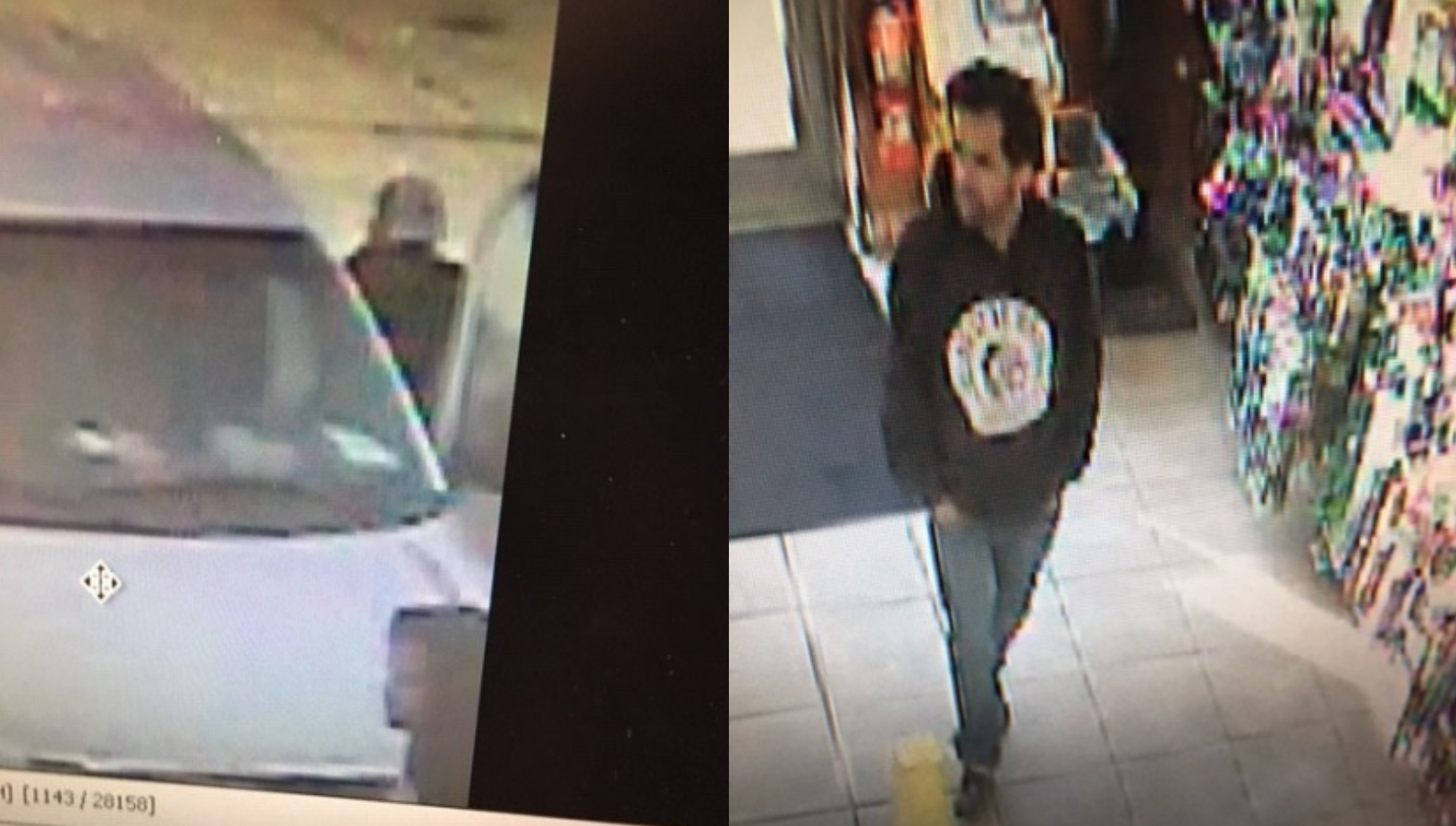
Wanted sexual assault suspect, Tre M. Carrasco was observed getting into the below silver pickup at 10:08 a.m. Sunday at a Colby gas station. The pickup was observed leaving the truck stop heading south toward Interstate 70.
The photograph is of Tre Carrasco at the gas station and he was wearing a hoodie that says “HUSTLE” on the front of it.
Carrasco is to be considered armed and dangerous. If anyone has information on the whereabouts of Tre Carrasco please contact the Hays Police Department at (785) 625-1011. Carrasco is innocent until proven guilty in a court of law.
At 5:42 a.m. Sunday, the Hays Police Department received a report that a female had been sexually assaulted in the 400 block of west 7th Street in Hays, according to a media release.
The suspect has been identified as 23-year-old Tre Miekale Carrasco. He is described as a light skinned black male who is 5-foot-8 tall, weighs 173 pounds, has brown eyes, and black curly hair that is in a short afro. Carrasco may have facial hair and be wearing a red shirt.
Carrasco should be considered armed and dangerous.
Carrasco reportedly stole a 2011 four-door navy blue Chevy Malibu with tinted windows from the scene which has since been located.
Carrasco has three previous convictions that include aggravated sexual battery and aggravated battery, according to the Kansas Department of Corrections.
If anyone has information on the whereabouts of Tre Carrasco, contact the Hays Police Department at (785) 625-1011.
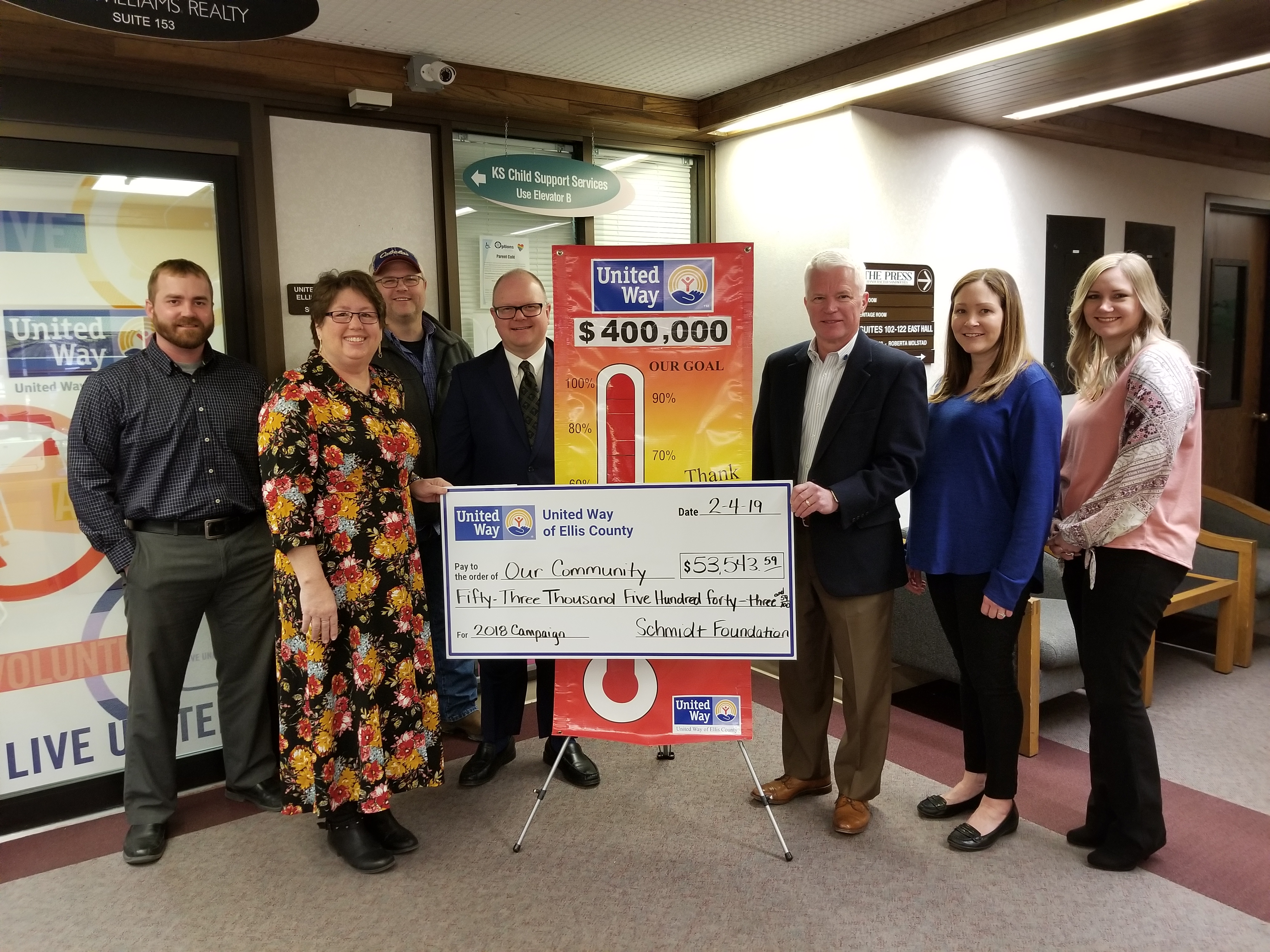
Gary Shorman, president of the Schmidt Foundation, presents a check to the United Way of Ellis County to bring it to its 2018 campaign goal. Pictured are Josh Dreher, former UWEC board member; Sherry Dryden, UWEC executive director; Scott Boomer, UWEC campaign chairman; Phil Smith-Hanes, UWEC board member; Gary Shorman, president of the Schmidt Foundation; Kara Denton, UWEC board president; and Kelly Lewis, UWEC board vice-president.
Submitted
The United Way of Ellis County announced the close of its 2018 campaign with a donation of more than $53,000 from the Bob and Patricia Schmidt Foundation to meet its $400,000 goal.
Sherry Dryden, executive director of the United Way, said she is appreciative of the volunteers, donors and businesses who give every year; however, there has been a continued decline in donations. This donation will help solidify the importance of the United Way and challenge the agency to re-align their vision for the future as they just completed a new strategic plan.
The United Way evolved from the Hays United Fund, which was founded in 1953 by Bob Schmidt.
Gary Shorman, president of the Schmidt Foundation said, “Bob and Pat not only helped start the United Way in Ellis County, but believed fully in the mission of supporting the people and agencies tasked with helping our friends and neighbors in need.”
Through the years, a CARE Council was created in 1992 to review applications and give funding recommendations for potential partner agencies who applied for United Way Funding. The CARE Council is made up of community volunteers who also give recommendations for city and county funding to human service agencies.
United Way funding helps those partner agencies from having to do as much individual fundraising so staff can provide direct services to individuals, youth, and families. One of the many new goals for the United Way is to build on their Endowment Project for a goal of moving administrative expenses completely out of the campaign fund.
Additionally, the United Way applies for grant dollars and sponsorships to fund Community Impact projects ensuring donations for the campaign go directly to the partner agencies. The United Way accepts donations throughout the year at www.liveunited.us, Facebook at “United Way of Ellis County,” or at their offices at 205 E. Seventh St., Suite 111.
SALINE COUNTY — A Kansas high school police resource officer was arrested early Sunday morning after a traffic stop.
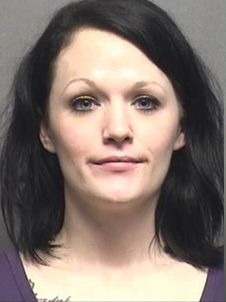
Amanda Londono. Photo Saline County Sheriff’s Office
Just before 2a.m. a Saline County deputy traveling southbound on Interstate 135 noticed the car in front of him attempt to pass a car.
The white 2018 Honda Accord pulled into the passing lane and then kept moving left, driving on the inside shoulder, according to Saline County Sheriff Roger Soldan.
The deputy stopped the car, which was occupied by four people, near the Crawford exit. The deputy detected the odor of alcohol in the vehicle, according to Soldan.
The car was driven by Amanda Londono, who Soldan said was a Salina Police Department school resource officer at Salina High School Central.
The deputy tried for 20 minutes to get Londono to step out of the car, but she refused, so she was arrested on suspicion of interference with a law enforcement officer, Soldan said.
Salina Police Captain Paul Forrester said Monday that the department was aware of Londono’s arrest and was conducting an internal affairs investigation.
The other three occupants of the car were not arrested and made arrangements for someone to pick them up, according to Soldan.
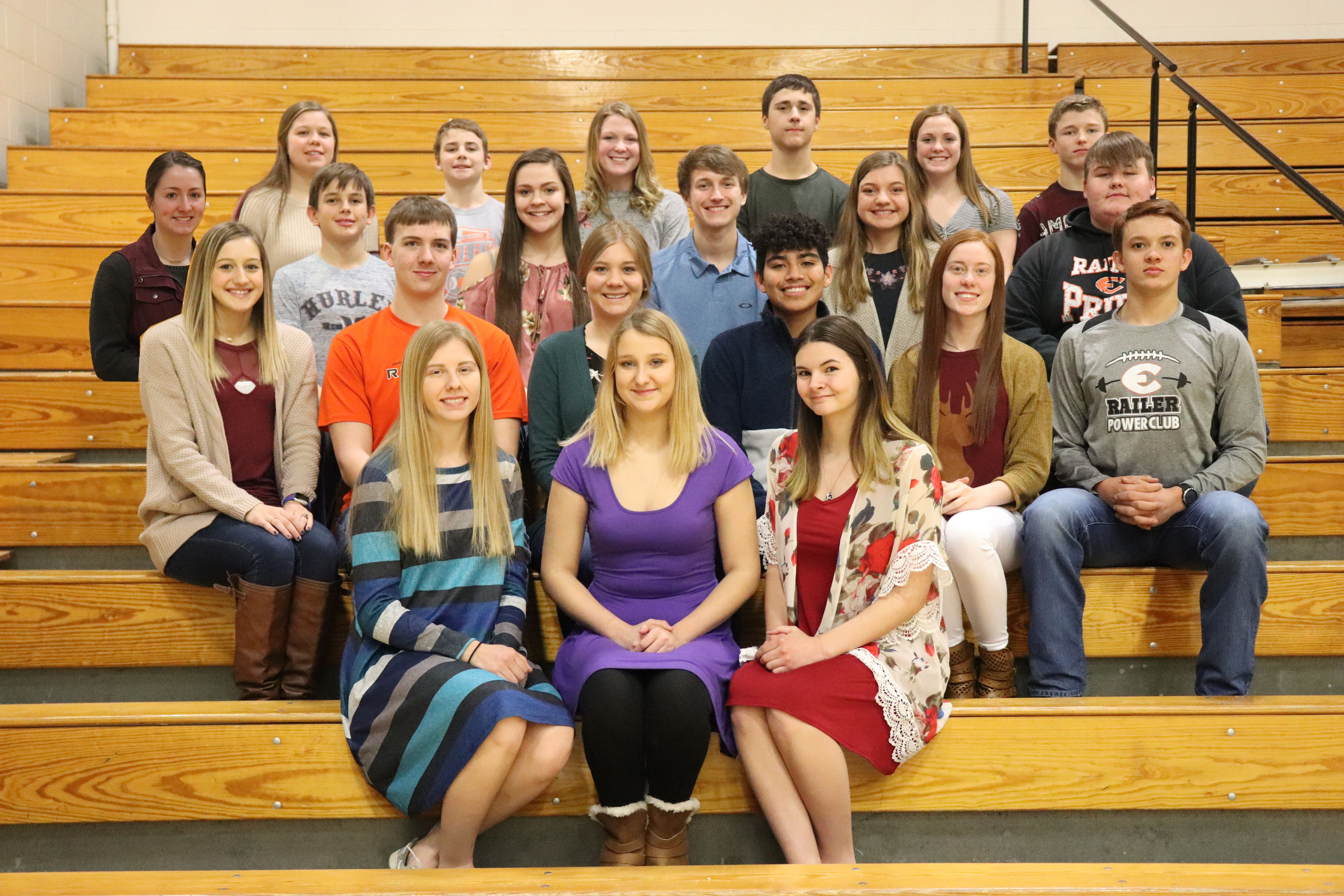
Top Row (L-R, Freshmen):Lakyn Fischer, daughter of DJ and Julie Fischer; Easton Burton, son of Corey and Amy Burton; Madison Gottschalk, daughter of Dean and Julie Gottschalk; Sam Honas, son of Randy and Wendy Honas; Michelle Gottschalk, daughter of Dean and Julie Gottschalk; and Tyson Jimenez, son of Javi and Jessica Jimenez.
2nd Row (L-R, Sophomores):Grace Eck, daughter of Mark and Sarah Eck; Zach Schiel, son of Jared and Beth Schiel; Morgan Bittel, daughter of Brady Bittel and Tammy Rudd; Brady Frickey, son of Brad and Stacy Frickey; Abigail North, daughter of Travis and Ava North; and Trace Patee, son of Terry and Dena Patee.
3rd Row (L-R, Juniors):Rylee Werth, daughter of Rodney and Cristi Werth; Noah Lohrmeyer, son of David Lohrmeyer and Amy Hudson; Breonna North, daughter of Travis and Ava North; John Gamez, son of Domingo and Martha Gamez; Abigail Mattheyer, daughter of Dustin and Mara Mattheyer; and Jake Eck, son of Geoff and Mindy Eck.
Front Row (L-R, Seniors):Cameryn Kinderknecht, daughter of Tim and Rhonda Kinderknecht; Kennedy Burgess, daughter of Justin Burgess and Christina Burgess; and August Sinclair, daughter of Mark Sinclair and Katie Armstrong.
The annual KAY Snowball Dance will be on Saturday, February 9. Promenade will be at the Ellis Good Samaritan Nursing Home from 6:00 to 7:45 p.m. Pictures start at 7:30 p.m. & the dance begins at 8:00 p.m. Crowning for Snowball Royalty will be at approximately 10:00 p.m.
Hello from Topeka! Happy 158th Birthday Kansas! On Tuesday January 29th, the Kansas House joined citizens across the state in celebrating the 158th birthday of our great state. Representatives raised their voices in the singing of our state song, Home on the Range. Home on the Range has its origins in the poem, “My Western Home,” written by Dr. Brewster M. Higley in 1871 near Athol.
This week begins the budget hearing process. In Higher Education Budget Committee we will hear from the regent universities, community colleges and technical schools over the next two weeks.
Last week, the Commerce Committee, the Department of Commerce presented an overview of the state’s economic incentive programs. They highlighted their 2018 top successful projects: Geico in Lenexa, Spirit AeroSystems in Wichita, Great Plains Manufacturing in Abilene, and Hopkins Manufacturing Corp. in Emporia. Additionally, they reviewed the state’s various incentive programs including Promoting Employment Across Kansas (PEAK), High Performance Incentive Program (HPIP), Rural Opportunity Zones (ROZ), Sales Tax Revenue (STAR) Bonds, Angel Investor Tax Credit, and the Job Creation Fund. Per the department, during the 2018 calendar year there were 138 successful tax credit projects, which generated 11,548 jobs, with a total capital investment of $1.7 billion. The committee did express a desire to improve transparency with data concerning economic incentives.
The Commerce Committee also heard testimony on HB 2006, a bill that would require the Department of Commerce to establish a database for publishing information on economic development incentive programs. This database must be easily accessible digitally to the public, and would be managed and updated by the department, and would include any tax credits, locally-granted property tax exemptions, and other various programs. This bill is an exact duplicate of 2018 HB 2572, which passed the House with a vote count of 114-7 last year, and also passed the House 119-0 in the form of 2018 SB 449.
Proponents including Rep. Kristey Williams (R-Augusta), the Kansas Policy Institute, and Johnson County Commissioners Michael Ashcraft and Mike Brown (both of whom were testifying as private citizens). They asserted that a public database that is easily accessible would improve transparency efforts, and the state needs to ensure that there is a tangible return and mechanism of accountability with these programs. Opponents to HB 2006 included the Kansas Chamber of Commerce and the Kansas Economic Development Alliance. They contended that the Kansas Legislative Research Department ought to conduct an independent review of each tax credit, rather than placing taxpayer information online. This would also allow the Legislature to make informed decisions on whether to continue each economic development incentive program. Taxpayer confidentiality was also a concern of the opponents. No action has taken place on this bill.
On Tuesday, Wichita State University’s Center for Economic Development and Business Research (CEDBR) presented their Kansas Economic Outlook report to the committee. Chiefly their research found that a recession is looming, with a 30% chance of occurrence in 2020, and a 50% chance of one taking place in 2021 or later. Jeremy Hill, Director of CEDBR, expressed serious concern for the Kansas economy, specifically the aerospace industry—a decline of aerospace production in the past couple of years and civilian aircraft exports have remained flat. However, he remains optimistic as aerospace employment has increased recently, and also expansion of national defense spending is likely. Hill also highlighted crude oil production in Kansas, which has been steadily declining since the 1980s, but also stressed how Kansas has avoided overproduction, and related issues.
Another issue which is seeing a lot of attention is sports betting. Last week, the Federal and State Affairs Committee heard testimony on HB 2032, which would require that any sports gambling authorized by the Kansas Lottery be conducted exclusively at racetrack gaming facilities. This bill was sponsored by Rep. Stan Frownfelter (D-Kansas City), who was also the sole proponent. Additionally, testimony was presented on HB 2068, a bill that would create the Sports Wagering Act. Essentially, this would legalize sports betting through the Kansas Lottery. The Lottery would able to conduct and operate sports betting itself and would be allowed to do so by entering into a contract with lottery vendors and racetrack facilities. As the bill is written, 0.25% of the total amount wagered is paid to the appropriate “sports governing body” (MLB, NBA, NFL, etc.). 6.75% of the total amount wagered minus what is paid to the governing body will then be deposited into either the Sports Wagering Receipts Fund, or the Lottery Operating Fund. No action has taken place on either of these bills.
Chairman John Barker (R-Abilene) appointed a subcommittee to study sports wagering, specifically to examine the logistics of sports betting mobile apps, and to also assess how much governing bodies ought to receive from sports betting earnings. Dates for this subcommittee have yet to be determined.
This past week there were several folks from the district in Topeka: Tim Driggs, City of Phillipsburg; Bret Greenwood from Plainville and many folks from Prairieland, Wheatland and Midwest Energy who were in town for meetings. It was a busy weekend with an appearance on “Kansas Week” on Wichita Public TV on Friday, then Saturday began in Hays for a chamber legislative update, on to the Phillipsburg Chamber and Main Street annual banquet and then Norton Community Foundation Gala. The week was complete by attending the annual Ground Hog Day pancake feed in Agra. It is always great to see so many folks and have the opportunity to meet one on one, so they can share concerns or ask questions on pending legislation.
If you come to Topeka during the session, my office is in Room: 149-S. My phone number is (785) 296- 7463 and email is: [email protected] and you can always try my cell number is (785) 302-8416.
I look forward to seeing you around the 110th District. It is my honor to by your representative.
Rep. Ken Rahjes (R-Agra), is the 110th state representative and chairman of the Higher Education Budget Committee. House District 110 includes Norton and Phillips counties as well as portions of Ellis, Graham, and Rooks counties.
Last week Kansas Farm Bureau appeared before our Senate committee on Financial Institutions, Insurance, Benefits and Pensions providing testimony to seek authority for the largest farm organization to develop member health care benefit coverage.
SB32 will allow Kansas Farm Bureau to establish health care benefits that offers coverage specifically and solely for Farm Bureau members in Kansas. One of the most expensive items in a farm family’s budget is health care cost. Farm Bureau testified that “at times 30% to 40% of the annual budgeted expenses” goes towards health care cost. Many of these farm families do not qualify for Affordable Care Act subsidized products. The purpose of the program is to reduce the number of uninsured Kansans and offer coverage with lower premiums. This bill will offer Farm Bureau members another health care option and our committee hopes to work this bill this coming week.
It was great to see Farm Bureau family members travel to Topeka to testify in favor of this legislation, including Tim Franklin and family from the 40th Senate district.
Our Ways and Means committee passed out SB 9 last week. This legislation will be debated on the Senate floor this Monday, February 4th. SB 9 is a KPERS bill, which will make a $115 million payment that was not made at the end of 2016. At that time revenues were lagging behind and the committee was not sure if the revenue was sufficient to make the payment. At that time the legislature promised to make the payment with interest. The $115 million includes accrued interest from 2016. In next week’s newsletter I will let you know how the Senate votes on this bill.
SB 22, the Tax Windfall Bill, was passed out of the special tax committee last week. This bill would allow Kansans to deduct interest on their mortgage, property taxes, charitable contributions and health care expenses.
The three groups affected by this bill are: 1. Those who don’t have enough deductions to itemize at the Federal or State levels. 2. Those whose deductions now make it better to take Federal standard deductions, but would still like to itemize at the State level. 3. Those who have enough deductions to itemize at both the Federal and State levels.
The first group will see no changes and will benefit from the larger Federal standard deduction and should see larger refunds. The third group who currently itemize and have sufficient expenses to deduct will continue itemizing at the State and Federal level and will see no change. The group that will benefit from this legislation is group two which are currently itemizing at the State and Federal level. With the changes at the Federal level and the change to a larger standard deduction many in this group will be better off taking the larger standard deduction than itemizing. This is where the problem begins. Kansas law mirrors Federal law and if you take the standard deduction at the Federal level you are also required to take the standard deduction on your Kansas tax return. This bill changes Kansas’s law to allow small businesses and individuals to continue to itemize even though they will take the standard deduction at the Federal level.
It was a pleasure to see many people from Senate District 40 last week, including people from the Kansas Electric Cooperatives, Rural Telephone, Nex-Tech and S&T, Kansas Farm Bureau, Kansas Highway Patrol and Sheriff’s Association, County Clerks and Appraisers, Kansas Title Insurance Agents, High Plains Mental Health, Kansas Family Physicians, Public Accountants, KEDA, Sunflower State Trails and the City of Hays.
Middle school and high school students (12 years of age or older) are invited to come to our Kansas State Capitol, in order to be my sponsored Senate Page for a day. The dates available are February 11th, 18th, 25th and March 11th. Please contact my office if you know a student who may have an interest in being a Senate Page.
I am honored and grateful to represent the 40th Senate District in Kansas. Please do not hesitate to contact or call me with your questions and concerns, my office number is 785-296-7399 or my cell is 785-899-4700. If you are in Topeka stop by my office at 236-E.
Sen. Rick Billinger, R-Goodland, is the Kansas state senator for the 40th District, which includes Cheyenne, Decatur, Ellis, Gove, Graham, Logan, Norton, Rawlins, Sheridan, Sherman, Thomas, Trego and Wallace counties as well as portions of Phillips county.