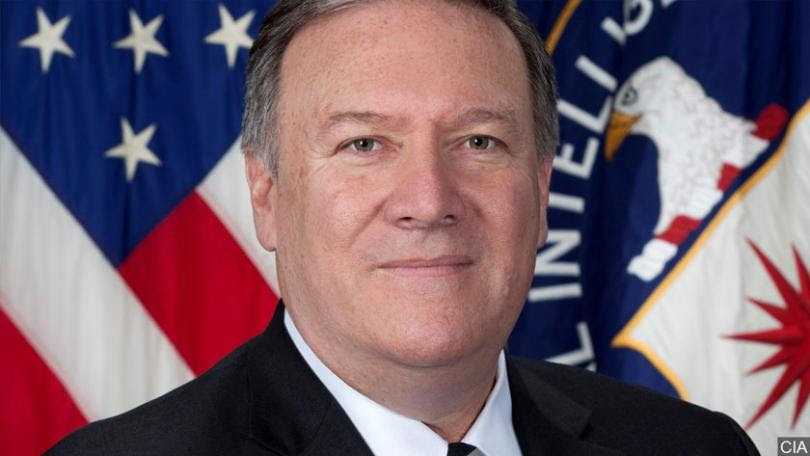
WASHINGTON (AP) — President Donald Trump says Secretary of State Mike Pompeo is “absolutely not leaving” the Cabinet even as top Republicans make a pitch for him to run for the Senate in Kansas.
Pompeo served four terms in the House and was Trump’s CIA director before moving to the State Department.
The decision by longtime Republican Sen. Pat Roberts to retire has prompted an effort by other GOP senators to recruit Pompeo for 2020. He’s said that push has included a call from Senate Majority Leader Mitch McConnell of Kentucky.
Trump tells CBS’ “Face the Nation” that McConnell may have spoken to Pompeo but “I asked him the question the other day. He says he’s absolutely not leaving. I don’t think he’d do that. And he doesn’t want to be lame duck.”
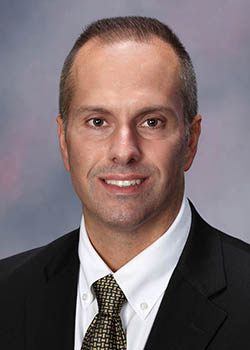
Dr. David Snow, director of entrepreneurship at Fort Hays State University, was recently elected as the vice president of development for the Small Business Institute, headquartered in Clinton, Miss.
The mission of SBI is to be the premier provider of professional development for those engaged in experiential student team consulting and related entrepreneurship education research and activities. SBI is the link between business, education and community.
SBI has been in operation for over 40 years and is continuing to see growth in membership.
Snow will serve a three year term. He will be formally installed during the annual conference in February.
“I am honored to serve on the board of the SBI,” said Snow. “This organization does tremendous work in entrepreneurship education and assisting small businesses with student consulting. It is my pleasure to contribute to the continuation of their mission.”
A Hays City Commission Retreat is scheduled for February 9-10, 2019 at the Courtyard by Marriott in Salina, Kansas.
The session will begin at 8:00 a.m. on Saturday, February 9 and will end by 5:00 p.m. If needed, the meeting will resume at 8:00 a.m. on Sunday, February 10 and end by noon.
Nicole Nesmith’s voice shakes a little when she recalls the night her child, Phoenix, revealed a painful secret.
“Phoenix got really quiet and was like, ‘I have something to tell you and I’m really sorry I didn’t tell you sooner, but I’ve been cutting for about a month now.’”
Nicole Nesmith shows a picture of her child, Phoenix, from when the two went to see the musical “Rent” in Omaha, Nebraska. Earlier that school year, the Nesmiths had been denied psychiatric residential treatment for Phoenix. MADELINE FOX / KANSAS NEWS SERVICE
Nesmith was working on a social work degree, so she was familiar with self-harming — she just hadn’t expected to deal with it so close to home.
Phoenix’s confession started a cycle familiar to families who have kids with severe mental illness — therapy, crisis hospitalizations, medication, more therapy, new meds when the old ones stopped working well, more hospitalizations.
But in the fall of Phoenix’s freshman year of high school, even that exhausting pattern wasn’t enough.
“There was a two-week period when I really didn’t leave the house at all,” said Phoenix.
When kids are chronically in distress — suicidal, self-harming, harming others, running away repeatedly — there had been a place for them: psychiatric residential treatment facilities.
That’s where the community mental health center treating Phoenix sent the Nesmiths when the care it could offer no longer kept Phoenix stable.
Residential treatment centers take children for long periods of time — weeks, sometimes months — to do more than talk kids down from crisis. They work to get at the root causes of their distress and help patients develop coping mechanisms to better manage the stressful things that set off a crisis.
Cost-cutting measures
In 2011, the state decided Kansas was sending too many kids to residential facilities for too long. At $500 a day or more, it cost too much. The state pushed to divert kids from residential care and bring down the length of their stays.
That loss of business prompted many treatment facilities to close some or all of their beds, resulting in a sharp drop from nearly 800 spots for care to the current 282.
More changes swept through with Kansas’ privatization of Medicaid in 2013. Under KanCare, community mental health centers no longer decided whether kids needed residential treatment, as they had for Phoenix. Instead, that decision passed to the private companies managing Medicaid under KanCare.
In 2015, the Nesmiths sought a third residential stay for Phoenix. After years of struggling with depression, anxiety, and thoughts of suicide, the looming milestone of a 17th birthday, college and a future prompted the Nesmiths to seek another round of longer-term intensive care.
“I was trying to figure out a future I never thought I’d have,” Phoenix said. “And that was just another source of stress.”
But the Nesmiths say Phoenix’s insurance company denied residential treatment. Instead, it pointed Phoenix to group therapy. But the family had already tried that and was no longer eligible.
Two of the state’s Medicaid providers, Sunflower Health Plan and United HealthCare, declined to comment on how they authorize residential stays, deferring comment to the state.
Even as it got harder to access, the need for residential treatment didn’t go away.
In fact, with shorter lengths of stay, kids might get stable but didn’t have the time to develop good coping mechanisms and trauma management to stave off future crises. They’d often end up referred back to a treatment facility when suicidal, aggressive or self-harming tendencies returned. But now, there weren’t enough beds available.
In 2019, that means 150 kids in urgent need of treatment languish on a waitlist. That means foster kids who land at facilities with less intensive care, youth residential centers, show up with behavior more extreme than those residential centers are equipped to handle.
Headline-grabbing problems, but little change
The overflow of kids needing beds in residential treatment facilities has served as an underlying cause of what’s driven headlines over the past year.
Kids who are suicidal — an epidemic so troubling that the state has convened a task force to deal with it — land in a mental health system stretched beyond capacity. And substance abuse by parents or kids can push children into needing intensive inpatient care.
Recommendations this year from a child welfare tax force to fix the overload of the residential treatment system echoed similar results from previous years.
Whether their focus is mental health, children’s care or foster care, panels have found time and again that psychiatric residential treatment facilities don’t have enough space and aren’t given enough time to treat kids properly.
Kids are discharged, but problems persist
The people who run residential treatment facilities say that shortening kids’ length of stay pushes the facilities more into a stabilization role, which they say is supposed to fall to hospitals and crisis centers. Residential facilities often don’t see kids until they’ve had multiple hospital stays, when it becomes clear crisis behavior is becoming a chronic pattern.
“We are a part of changing that child’s trajectory in their life,” said Cheryl Rathbun, who oversees a residential treatment facility run by St. Francis Community Services. “It needs to be more about treatment, and not just about simple stabilization.”
But providers say they’re sometimes pushed to release kids who haven’t yet made progress on the deeper issues driving harmful behavior. That happens, providers say, because insurance companies haven’t seen enough improvement to justify paying for additional treatment.
Dana Schoffelman, who runs a residential facility in Topeka, said she sometimes hears from the insurance providers that kids are at their “baseline” and need to be moved out of her facility because residential care isn’t able to move them past what’s become the kids’ new normal.
“The youth is actually here because that’s their baseline,’’ she said. “You can’t use the definition of what got you into services as the reason to stop services.”
The Kansas Department for Aging and Disability Services doesn’t track how frequently kids cycle back through residential care, but providers and mental health advocates say it’s gotten more common since the lengths of stay got shorter.
A struggling mental health ecosystem
The direct hits to residential treatment facilities — shorter and fewer stays — came amid other changes to mental health services and treatment that weakened the continuum of mental health care.
Cuts to Medicaid reimbursements in 2016, though they were restored the next year, made it even harder for residential facilities to stay open.
And some have pointed to juvenile justice reforms passed in 2016 that divert kids out of the justice system as a driver of more high-needs kids into foster care, and particularly into residential treatment.
Some residential facilities were already taking kids in the juvenile justice system. But Schoffelman, who runs Florence Crittenton in Topeka, said the shortage of beds has made it harder for kids who are particularly aggressive or high-needs to get treatment.
With beds mostly full, the people caring for them are stretched to the limit. That makes it hard for those residential centers to take on kids who need even more supervision while making progress with less severe cases.
Providers also talk repeatedly about the continuum of care. They say residential treatment needs to be part of a system that includes therapeutic care in the community, options for short-term hospitalization, and other mental health services.
When Kansas took the decision-making about who needs residential care out of the hands of community mental health centers, officials at those facilities say, it made it harder for kids to stay on that continuum.
Now that community mental health centers aren’t calling the shots, the first time the centers hear a kid was in residential care might be when they’re expected to put therapy services in place immediately after the child’s discharge.
Then, it’s a scramble to get the right services in place to keep that child from needing to go right back in, said Jessie Kaye, president of Prairie View Inc. mental health center.
Providers’ wish list
The people who run community mental health centers and residential facilities want to see a return to the pre-2011 model: stays approved by the community centers, not insurance providers; and more days in care.
That means more money for residential providers. Cheryl Rathbun told lawmakers in 2017 that it can cost $500 to $700 per night for children to stay in St. Francis’ facility. But providers say that funds the kind of therapy, round-the-clock staffing, and time to work with the kids’ families that means long-term improvement for kids.
Tara Wallace, a social worker and therapist for foster kids who used to work in a residential treatment facility, said short stays put impossible pressure on therapists and social workers who are trying to get as much done as possible to help the kids in their care before their time is up.
And Kyle Kessler, who heads Kansas’ association of community mental health centers, said adding more beds isn’t the only solution. It needs to be balanced with more front-end services, as well, so kids who can be served closer to home, are.
“I don’t think it’s an ‘either-or,’ ” he said. “I think it’s an ‘and.’”
Some have been encouraged by Gov. Laura Kelly’s interest in residential treatment. Kelly was an outspoken critic of long waitlists and shorter stays while she was a state senator. As governor-elect, she sent members of her transition team to meet with the heads of residential facilities to talk solutions.
But Kaye said changes can also be disruptive.
“Established relationships now have been severed,” she said. “It’ll be another year lost because we’ll have to start over with so many things.”
So many news stories these days are centered on the difficulty families across the country are having making ends meet. From home foreclosures to longer than usual lines waiting for public assistance, it is easy to see that the effects of economic problems are everywhere you turn. The good news is K-State Research and Extension has many publications that can guide people through some hard times.
At one of my recent educational programs I shared the activity titled, “Does Your Money Have Wings?” This worksheet has around 25 items that money could be spent on. Things like eating out, cell phone charges, snacks and soda, or magazine subscriptions are among the choices. After the participants mark the ones they use they determine how much money is spent each year for each item. Many times I will hear a gasp from a participant. Then I know that the activity is working; raising their awareness about how money is being spent. My goal is to help participants see the amount of money that is spent on “extras” each year. I like to ask them about what needs they have in their life that they could use the money spent on “extras” for.
Feel free to call me or drop by either the Hays or Great Bend Extension offices to pick up your copy of the worksheet. Some of the budgeting materials are available in Spanish as well. Other publications which are also helpful in the area of money management include a series titled, “Making Ends Meet.” If you have children ages 3 – 14 the publication “Helping Children Learn to Manage Money” is well done. All of the publications I have listed are available free of charge. Get your year off to a great start by getting your spending under control.
Donna Krug is the Family and Consumer Science Agent and District Director with K-State Research and Extension – Cottonwood District. Contact her at (620)793-1910 or [email protected]
TOPEKA – Applications are now being accepted for companies seeking investment through the Kansas Angel Investor Tax Credit (KAITC) program for 2019.
The program offers Kansas income tax credits to qualified individuals who provide seed-capital financing for emerging Kansas businesses engaged in development, implementation and commercialization of innovative technologies, products and services.
The KAITC Program is administered by the Kansas Department of Commerce and designed to bring together accredited angel investors with qualified Kansas companies seeking seed and early stage investment. The purpose of the Kansas Angel Investor Tax Credit act is to facilitate:
The availability of equity investment in businesses in the early stages of commercial development.
Assist in the creation and expansion of Kansas businesses, which are job and wealth creating enterprises.
Applications for certification will be accepted only for Kansas businesses in the seed and early stage rounds of financing.
Companies must meet the following criteria to be certified as a Qualified Kansas Business:
The business has a reasonable chance of success and potential to create measurable employment within Kansas.
In the most recent tax year of the business, annual gross revenue was less than $5,000,000.
Businesses that are not bioscience businesses must have been in operation for less than five years; bioscience businesses must have been in operation for less than 10 years.
The business has an innovative and proprietary technology, product, or service.
The existing owners of the business have made a substantial financial and time commitment to the business.
The securities to be issued and purchased are qualified securities.
The company agrees to adequate reporting of business information to the Kansas Department of Commerce.
The ability of investors in the business to receive tax credits for cash investments in qualified securities of the business is beneficial, because funding otherwise available for the business is not available on commercially reasonable terms.
Each applicant must sign a Qualified Company Agreement with the Kansas Department of Commerce.
Certification of companies must meet mandates established by Kansas statute to allow accredited Angel Investors to receive the Kansas Angel Investor Tax Credit. This year, the application fee has been reduced from $750 to $500.
Applications for companies seeking investment are accepted from February 1st, 2019 through August 31st, 2019.
Veteran Service Representative Schedule for February 2019
1st Tuesday 2/5/2019 Stockton Courthouse, 9:30 – 11:30 AM
2nd Tuesday 2/12/2019 Ness City Library, 10:00 AM – 12:00 PM
3rd Tuesday 2/19/2019 Osborne Veteran’s Building, 9:30-11:30 AM; Russell City Hall , 1:00 – 3:00 PM
4th Tuesday 2/26/2019 Phillipsburg – EMS Building, 9:30 – 11:30 AM; Smith Center Courthouse, 1:00 – 3:00 PM
The Kansas Commission on Veterans Affairs assists veterans and authorized family members, free of charge, in matters pertaining to their VA claims and benefits.
All itinerants are on a first come first served basis. No appointment needed.
For more information, contact:
Douglas Storie, VSR
Douglas Storie, VSR
Kansas Commission on Veterans’ Affairs
Veteran Service Representative
205 E. 7th Suite 107
Hays, KS 67601
Phone: 785-259-0364
FAX: 785-650-0392
E-mail: [email protected]
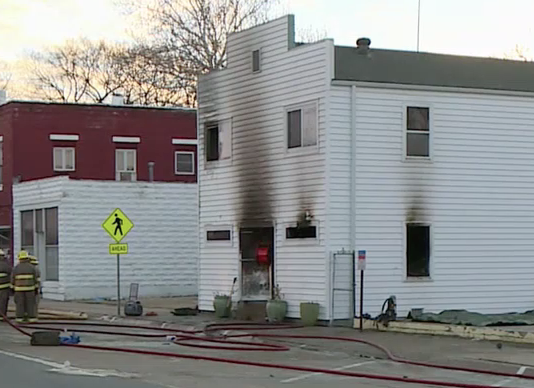
RILEY COUNTY — Authorities have confirmed the identity of those who died in Thursday’s fire in Riley County.
According to Riley County Police, the autopsy confirmed them as Rodger D. Harris Sr., 72; Rea E. Harris, 72; Roger D. Harris Jr., 50; and Rocky Newell, 55.
Scene of Thursday’s fatal fire in Ogden -photo courtesy WIBW TV
The autopsy revealed there was no foul play, and all had evidence of inhalation of toxic fire gasses as the probable cause of death.
Fire Chief Pat Collins reported that the origin of the fire remains on or around the end of a couch on the first floor. The Fire District report will show that the cause of the fire is unknown. Careless smoking is suspected but cannot be positively confirmed from the team that investigated the fire.
The Fire District officials thanked those paid and volunteer fire personnel who endured the elements on the morning of the fire as well as the dispatchers, police officers, EMS personnel and city workers who performed their tasks during the incident. The call came in at 3:43 a.m. Thursday for the fire at 208 Riley Avenue in Ogden.
Hays played their third game of the week as they opened with games on each of the first two days of February. The Indians hosted Garden City in a game that was snowed out back in January.
Girls
#10 Hays – Garden City
Garden City jumped out to the first lead of the game scoring four points on a pair of Hays High turnovers. Hays scored the next six points and pushed their lead as high as five in the first quarter after a 6-1 run at 12-7. Hays entered the second quarter leading by five and kept their lead at 22-20 into halftime.
Highlights
The Indians dominated most of the third quarter to expand their lead up to ten twice at 32-22 and 34-24. Part of that third quarter was a 10-2 run over the five minute stretch. Garden City hit what seemed to be a harmless three pointer late in the third quarter but that basket began a 13-0 run with 10 of those points coming in the fourth quarter. The run put Garden City on top 37-34. After the Indians took a 34-24 lead in the third quarter Hays didn’t score for the next 9:30 and did have a field goal for 10:08. But the field goal would be huge. Mattie Hutchison buried a three pointer to tie the game at 38 with :12 left. Garden City turned it over on the next possession setting up a game winning opportunity for Brooke Denning who buried a three pointer as time expired. The basket sent Hays to a 41-38 victory. Garden City missed four of five free throws in the final ninety seconds to leave the door open for the Indians.
Coach Alex Hutchins
Brooke Denning scored 15 to lead the Indians to a 10-4 record and a 3-1 mark in the WAC. Garden City falls to 8-7 and 1-3.
Boys
Garden City 50 – Hays 39
Garden City used an 11-0 run to blow open a tight first quarter against Hays. Down 19-7 early in the second quarter Hays went on a 8-0 to get within four at 19-15. The Indians had the ball two more times at the score but did come away with any points. Garden City increased the lead to nine once again with a 6-1 spurt before Hays closed the gap down to five at 25-20. A Garden City inbound basket put the Buffaloes up at half time 27-20.
Highlights
Hays opened the second half on an 8-0 run to take a 28-27 lead with 3:50 left in the third quarter. Garden City didn’t score for almost five minutes in the third quarter but when they did Buffaloes took the lead back at 29-28. The basket was the first of six straight points and a 33-28 lead for Garden City. After trailing 35-30 early in the fourth quarter, Hays closed within three at 35-32 and had the basketball but turned it over.
Garden City scored on back to back possessions to put Hays down 39-32 and Hays was never within one possession for the rest of the game. Garden City made seven of their final eight free throw attempts in the final minute of the game to secure a 50-39 victory.
Coach Rick Keltner
Hays falls to 7-7 on the year and 2-2 in the WAC. Garden City takes the lead in conference play with a 3-1 mark and is 11-4 overall.
Hays will host Great Bend on Tuesday and Liberal on Friday.
STILLWATER, Okla. (AP) — Kansas State’s Dean Wade didn’t know he had a perfect shooting night going from the field until assistant coach Chris Lowery told him.
“Honestly, I had no idea,” Wade said. “I didn’t really know until the very end, when coach Lowery said something to me about, ‘Oh, you just don’t want to shoot, don’t want to mess up your percentage.’ I was like, ‘What are you talking about?'”
Wade scored a season-high 24 points on 9 of 9 shooting to help Kansas State defeat Oklahoma State 75-57 on Saturday night. It was just the seventh time in school history that a Kansas State player had a perfect shooting night with at least nine attempts. He also made three 3-pointers.
Barry Brown scored 18 points and Cartier Diarra added 10 for the Wildcats (16-5, 6-2 Big 12), who entered the night tied for the conference lead.
The Wildcats were ranked seventh out of 10 Big 12 teams in 3-point percentage during league games and 10th in all games before Saturday. They made 16 against Oklahoma State, the most in school history for a conference game and the second-most overall.
“I’ve said all among we could be a good shooting team,” Kansas State coach Bruce Weber said. “We should be. The ball movement was really spectacular. Kind of what we’d hoped all year.”
In a building where Oklahoma State has pulled numerous upsets the past two seasons, the Wildcats were unusually comfortable.
“I think a lot of the credit has to go to the coaching staff,” Wade said. “The scouts — they put so much time into the scouts, and it gives us just a great base of how we’re going to play. We went out tonight and executed.”
Curtis Jones scored 14 points and Lindy Waters added 12 for the Cowboys (9-12, 2-6).
Oklahoma State hung tough for a while, but a putback dunk by Kansas State’s Makol Mawien put the Wildcats ahead by 13 late in the first half. Brown hit a 3-pointer at the halftime buzzer to give Kansas State 43-27 advantage. Kansas State shot 61.5 percent before the break.
Oklahoma State didn’t score for more than six minutes to start the second half as Kansas State pulled away. The Wildcats led by 34 at one point, and Oklahoma State went on a 13-0 scoring run late in the game to make the game seem closer.
“They shot the ball better than what they have all season, and a team that’s that good defensively shooting the ball that well offensively — you’re in for a tough game then,” Oklahoma State guard Thomas Dziagwa said.
BIG PICTURE
Kansas State: The Wildcats won their sixth straight conference game, and their fourth straight by double digits. Other than a loss to Texas A&M in the SEC/Big 12 challenge, the Wildcats have been dominant lately and could make their way into the Top 25.
Oklahoma State: The Cowboys were scrappy for a while, but they were simply overmatched. It was Oklahoma State’s fourth straight conference loss. The long-term effects of four players leaving the program or being kicked off the team this season are taking effect.
WADE’S WORLD
Wade has rounded into form since returning from a foot injury. He scored just two points in his first game back, but has been on a tear since then. In his past five games, he’s averaging 18 points on 58 percent shooting, including 53 percent from 3-point range.
STAT LINES
Oklahoma State made just two of nine free throws, making just one in each half. Kansas State made 7 of 12.
HE SAID IT
Oklahoma State forward Cameron McGriff: “It’s a bad loss. It’s just one loss.”
SHAWNEE MISSION, Kan. (AP) — A Shawnee Mission School District principal has resigned after police say he hit a car and left the scene while driving under the influence.
Strathman -photo courtesy Rosehill Elementary
34-year-old Cory Strathman submitted his resignation after the crash last week. The Shawnee Mission school board approved the resignation at a meeting Thursday.
Police arrested Strathman after they say he hit another vehicle the afternoon of Jan. 25. Police say he had been drinking and taking medication at the time of the crash and was also driving with a suspended license and had no proof of insurance.
Strathman had been had been principal of Rosehill Elementary since 2014 and had worked in the school district since 2008.
ATLANTA (AP) — Patrick Mahomes’ breathtaking breakthrough season earned him the NFL’s Most Valuable Player award.
The Chiefs quarterback landed a pair of honors at NFL Honors on Saturday night, taking The Associated Press 2018 MVP and Offensive Player of the Year awards. In his second pro season, Mahomes led Kansas City to its first AFC title game since 1993 with some of the most creative and clutch plays the league has seen in years.
“I’m so humbled,” he said. “This is just the beginning. We’ve got a long ways to go.
“It is an honor. It’s a hard award to win. The next award I hope I can get is the Super Bowl.”
Mahomes received 41 votes from a nationwide panel of media members who regularly cover the league. New Orleans quarterback Drew Brees got the other nine.
With only one previous start, Mahomes entered the season as something of a curiosity in Kansas City after the Chiefs traded veteran Alex Smith to open up the job. It didn’t take long to erase any doubts as Mahomes led the Chiefs to their first AFC title game since the 1993 season, throwing for 50 touchdowns, 5,097 yards and had a 113.8 QB rating, trailing only Brees.
Mahomes’ ingenuity — the guy can throw from all angles and make plays inside and outside the pocket — energized the Chiefs’ fan base and excited fans across the league.
“The play is never dead. He can find new ways to get you the ball,” Chiefs All-Pro tight end Travis Kelce said. “It may look like a screwball, a slider here or there, but it’ll get to you eventually.”
Mahomes is the sixth straight quarterback and 11th of the past 12 years to win MVP. No Kansas City player had won the award since the Chiefs joined the NFL in 1970.
Earlier, he was selected as the top offensive player, beating Brees 30 votes to 16.
“Yeah, I mean, it’s awesome … I got put into a great situation,” he said. “I got to learn behind a great quarterback in Alex Smith. I got to be on a team with a lot of playmakers who helped me excel my game and make me look really good on a daily basis. And, then, to be able to go out there and win football games in front of a passionate fan base is something I get the luxury of doing.”
Rams defensive tackle Aaron Donald, who will play in Sunday’s Super Bowl against New England, took his second straight Defensive Player of the Year award.
Donald, the only unanimous All-Pro this season and the first Rams player selected for top defensive honor, joins Lawrence Taylor and J.J. Watt as players to win the award in back-to-back seasons. Donald led the NFL with 20½ sacks.
“Any time you put a body of work into it and then it pays off,” Donald said, “and you’re rewarded for it, it means a lot. It’s a blessing.”
Chicago’s Matt Nagy, in his first season with the Bears, was voted Coach of the Year.
Nagy has overseen the development of quarterback Mitchell Trubisky, who blossomed in his second pro season, and saw a defense befitting the “Monsters of the Midway” dominate opponents at times. He is the fifth Bears coach to win the award, joining team founder George Halas (1963, 1965), Mike Ditka (1985, 1988), Dick Jauron (2001) and Lovie Smith (2005).
“It’s crazy to think this is one person, so for me, it’s being a part of this organization and for our players,” Nagy said. “Just being able to believe in what we wanted to do with our culture and then follow through with it.”
Colts quarterback Andrew Luck was chosen the Comeback Player of the Year, following a lost 2017 season to a shoulder injury with a sensational 2018 campaign.
“I truly believe there are players on every team, every roster that could be Comeback Player of the Year in their own ways,” he said. “Honestly, the best part was playing football again — having fun playing football and being pain free.”
Giants running back Saquon Barkley was the top offensive rookie, while the defensive rookie award went to Indianapolis linebacker Darius Leonard.
Described by some as a “generational running back,” Barkley rushed for 1,307 yards and 11 touchdowns behind a weak New York offensive line. He drew 26½ votes and edged Baker Mayfield. The Cleveland quarterback who was selected first overall in the draft, one spot in front of Barkley, earned 21½ votes.
Barkley also made a team-high 91 receptions for 721 yards, and his 2,028 yards from scrimmage led the NFL.
For his work as defensive coordinator of the Chicago Bears, Vic Fangio got the head coaching gig in Denver. He also won The Associated Press 2018 NFL Assistant Coach of the Year Award on Saturday.
Philadelphia Eagles DE Chris Long won the Walter Payton Man of the Year Award for community service.
“I don’t know, I’m very humbled,” Long said. “It’s hard to feel deserving with those guys on stage and, obviously, this guy right here on the statue. It’s a very heavy statue and it makes sense because his legacy is immense. I’m just honored.”
KEARNEY, Neb. – Fort Hays State shot only 37-percent from the floor including 5-for-20 from beyond the arc and lost 59-56 at Nebraska-Kearney Saturday afternoon at the Health and Sports Center. It’s the second straight loss for the Tigers (13-7, 7-4 MIAA) who lose back-to-back games for the first time since falling to Sioux Falls and Southwestern Minnesota State to start the season.
Aaron Nicholson scored on a layup to start to give the Tigers a 2-0 lead but they would trail the rest of the first half and were down six at the break.
They opened the second half on a 10-3 run and took the lead back on a Brady Werth jumper with 14:24 to play but UNK (7-13, 2-9 MIAA) would answer with a 17-6 run over the next 10 minutes to go up 10.
Nicholson hit three of the Tigers five 3-pointers and led them with 15 points while dishing out a team-best four assists. Brady Werth and Devin Davis both scored 11 and Kyler Kinnamon added 10. All of Werth’s points came in the second half.
The Lopers who were the worst free throw shooting and worst rebounding team in the MIAA outrebounded the Tigers by six and went 14 of 17 from the free throw line.