We have a brand new updated website! Click here to check it out!

Extension schedules workshops on burning, winter ranch management

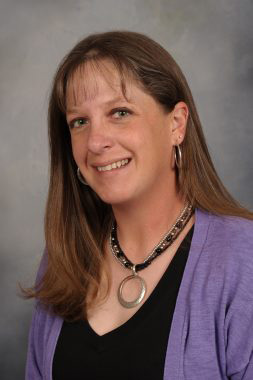
Alicia Boor

There are two programs that are coming up in February I wanted to highlight this week. Registration deadlines are coming up fast, so call 620-793-1910 or email me at [email protected] if you would like to attend either program or both.

Winter Ranch Management

Kansas State University will host a series of meetings to help beef producers focus on management and profit strategies for the new year.

Bob Weaber, a K-State Research and Extension cow-calf specialist, said this year’s Winter Ranch Management series is titled “Production strategies to mitigate environmental factors impacting conception and pregnancy.”  The meetings will be held at four sites in Kansas and will feature presentations and comments by extension educators on profit-enhancing strategies.

The meetings will also feature a popular ‘town-hall’ style question-and-answer session between Kansas’ cattle producers and extension specialists. Weaber said the series has a history of being a successful stretch of meetings.

Weaber, along with other state, district and local extension staff, will take part in the series to help answer producers’ questions. The specialists will answer a wide range of questions on beef cattle issues including animal health, nutrition, management, and reproduction.

Meeting topics include forage quality and availability impacts on beef cow-nutrition during late gestation and pre-breeding and also environmental factors affecting conception rates.

There will be a meeting on February 19th at the Township hall, 220 Union Street in Rush Center starting with registration at 5:30. Participants are asked to RSVP by either calling the Great Bend office of the Cottonwood District at 620-793-1910 or the Lacrosse office of the Walnut Creek District at 785-222-2710.

Burn Workshop

The past several years we have received a better than average amount of precipitation in the fall creating a large amount of grasses late in the season. These forages are now dry and have the ability to create the perfect storm for a wildfire. Prescribed burnings can reduce the amount of fuel that a fire has access to and help mitigate a massive wildfire.

K-State Research and Extension, the Midway District and the Cottonwood District are hosting a burn workshop on February 20th at Dole-Specter Conference Center, 1430 South Fossil in Russell, Kansas to help educate producers on burning. The program will begin with registration at 9 and will run until 2:30.

Participants will learn the basics of burning, and be able to run through scenarios to gain experience and confidence for creating their own burn plan to implement on their land. 

This workshop is designed to help with the understanding of the nature and behavior of fire. Some of the topics that will be covered are reasons for burning, wildlife and prescribed burning, local and state regulations, fire weather, safety, liability, use of burn contractors, planning and conducting a burn. The workshop is designed to either prepare the participants to begin using prescribed burning or to update their knowledge and abilities.


To enroll for this workshop or for more information, please contact either the Midway District at 785-483-3157 or email Clint Laflin at [email protected] or the Cottonwood District at 620-793-1910 or email Alicia Boor at [email protected].

Alicia Boor is an Agriculture and Natural Resources agent in the Cottonwood District (which includes Barton and Ellis counties) for K-State Research and Extension. You can contact her by e-mail at [email protected] or calling 620-793-1910

Western Kansas Manufacturers Association awards scholarships

DODGE CITY — Western Kansas Manufacturers Association, sponsor of the 3i SHOW, is proud to continue their support of western Kansas students furthering their education at area community colleges, technical colleges and universities through their annual scholarship program. The scholarships are for freshman students who are residents of western Kansas, have graduated from a western Kansas high school and are U.S. citizens. Preference is given to students enrolling in Agri-Business, Industrial or Mechanical Engineering, Pre-Engineering or Business Administration.

WKMA would like to congratulate the following 2018-2019 school year scholarship recipients: Thomas Potter, a Hoisington High School graduate, was awarded a $500 scholarship to Barton Community College; Gerardo Ortiz-Chavez, a Wichita County High School Graduate, was awarded a $500 scholarship to Colby Community College; Cora Tasset, a Spearville High School graduate, was awarded a $500 scholarship at Dodge City Community College; Jace Laswon, a Pawnee Heights graduate, was awarded a $500 scholarship to NCK Tech; John Gower, a Phillipsburg High School graduate, was awarded $500 to Northwest Kansas Technical College; Manuel Aguero, a Liberal High School graduate, was awarded a $500 scholarship at Seward County Community College; Emily Cranwell, an Ellis High School graduate, was awarded a $700 scholarship at Fort Hays State University; Britta Beesley, a Hugoton High School graduate, was awarded a $700 scholarship at Kansas State University; and Conner Lebeau, a Scott Community High School graduate, was awarded a $700 scholarship at the University of Kansas.

One scholarship remains available at Garden City Community College.

WKMA scholarships are partially funded each year by the sale of limited-edition belt buckles commemorating the 3i SHOW. Buckles will also be available for purchase at the 65th Annual 3i SHOW on March 21-23, 2019 in Dodge City at the Western State Bank Expo Center. Visit www.3ishow.com for a buckle order form.

Elder law attorney elected board secretary of national network

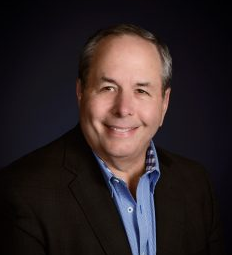
Randy Clinkscales

Randy Clinkscales with Clinkscales Elder Law Practice, P.A. was recently elected to serve as secretary on the Life Care Planning Law Firms Association Board of Directors for the 2019-2021 term.

The Life Care Planning Law Firms Association is a national network of holistic law practices that offer legal services, care coordination and advocacy support to help elderly clients and their families respond to the challenges of aging, long-term illness and disability. The mission of the LCPLFA is to support life care planning law firms as they help aging adults find, get and pay for the care they need.

Randy Clinkscales is an elder law attorney in Hays and is a 2006 founding member of the Life Care Planning Law Firms Association. For more information or to schedule an appointment, call toll free at (877) 325-8040 or visit www.elderlawkansas.com.

— Submitted

Electricity costs remain low in Hays area despite concerns about rates statewide

By CRISTINA JANNEY
Hays Post

Kansans are paying more for electricity than other states, according to a recent report from the Kansas Corporation Commission.

However, Hays-area customers who receive power from Midwest Energy pay more favorable rates than customers served by the state’s largest power provider, Evergy. Evergy was formed by the merger of Westar and Kansas City Power and Light last year.

“Midwest Energy’s electric rates are competitive statewide, with investor-owned utilities and against the average for co-ops in Kansas. Against electric co-ops in Kansas, our rates on average were 19 percent below those of the average Kansas cooperative,” said Mike Morley, director of corporate communications for Midwest Energy.

A 2018 study compared the electric rates of three electric providers in the state — Empire, Westar and Kansas City Power and Light.

Between June 2016 and June 2017, monthly bills based on average residential consumption of 916 kWh were $121.40, while the national average was $120.56. An equivalent Midwest Energy bill would have been $105.52These numbers were calculated without taxes.

Special interest groups, especially business and industry, are calling for a legislative review of electric rates in the state, saying the high rates are making it difficult for them to stay competitive.

Chuck Caisley, KCP&L and Westar Energy senior vice president of marketing and public affairs, spoke before the Kansas Senate Utilities Committee on Wednesday. He also defended the power company in a press release issued last week.

“We are ahead of our peers in providing renewable energy, meeting federal and state environmental regulations and ensure our transmission system is modernized and reliable,” Caisley said in the press release. “Our prices are competitive with the national average. As utilities in neighboring states continue to invest in their infrastructure, they are asking to increase prices to recover those investments.”

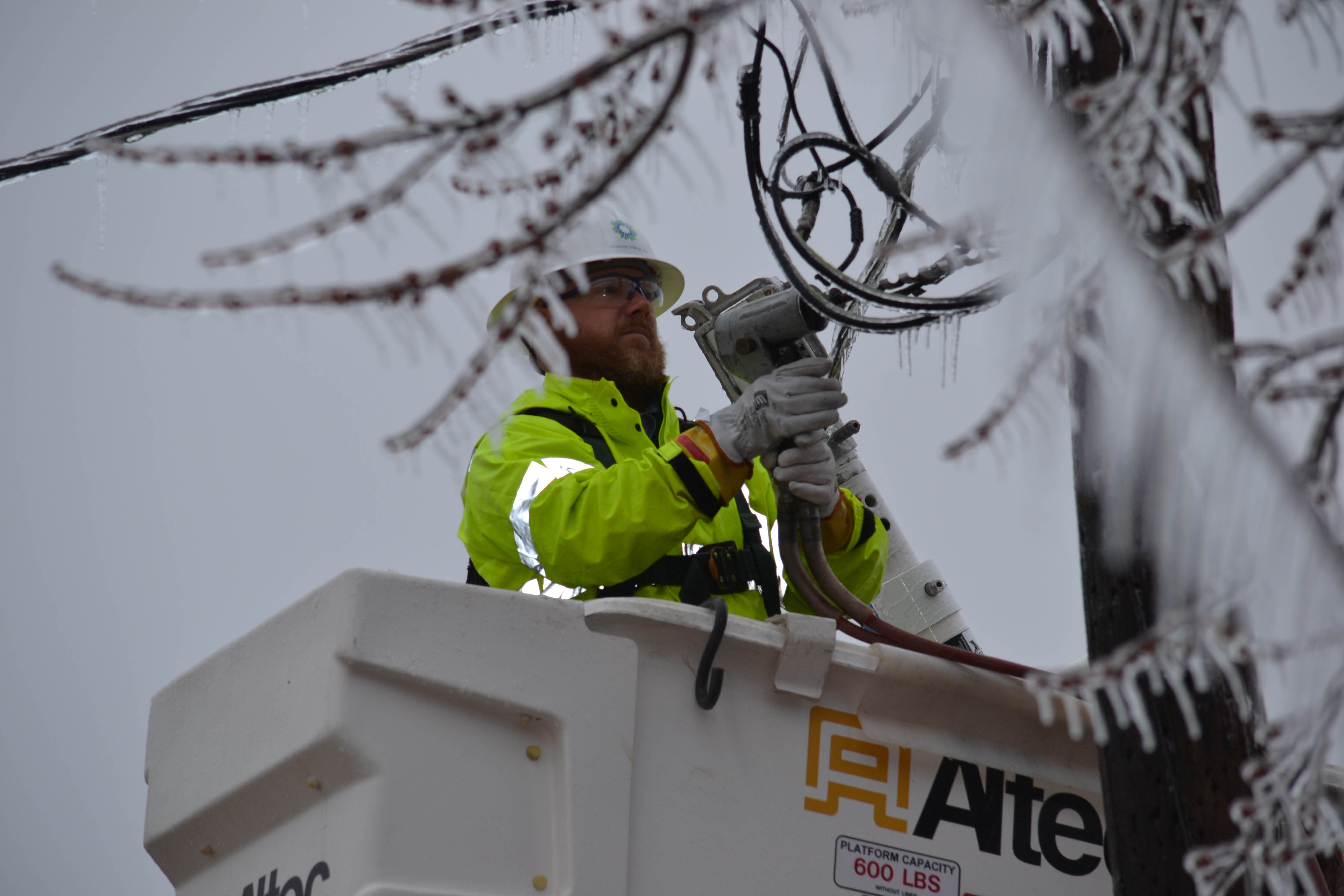
Several of the factors that have resulted in an increase in power rates for Evergy customers are not affecting Midwest Energy.

In its report, the KCC noted installation of emissions-reducing equipment at coal-fueled power plants was one factor that led to utility rate increases.

Midwest Energy was not directly affected by the changes at the coal-fired plants, Morley said. Although Midwest Energy purchases power from Evergy, which has coal-fired power plants, Midwest Energy does so via long-term energy supply contracts, and the costs of any environmental upgrades are contained in those contract prices.

Both Evergy and Midwest Energy have seen the cost effects of improving infrastructure to accommodate the use of wind energy.  In 2008 Midwest Energy signed a purchased power agreement to purchase 49 MW of wind energy from the Smoky Hill Wind Farm. In 2017 Midwest Energy signed a purchased power agreement for an additional 57 Megawatts from the Kingman Wind Farm As a result, roughly one-third of its electricity comes from Kansas wind. 

Transmission charges for Midwest Energy have outpaced inflation, increasing from .0033 cents per kWh in 2009 to .0088 cents per kWh in 2018.

Morley said transmission charges are hard to compare between utilities because of differences in how they are applied to customers’ bills.

Regulation

Morley said he thought the Kansas regulators can take action to keep Kansas electric rates low.

Morley said he would like to see the Legislature address utility property taxes.

Utilities have real property assessed at a rate of 33 percent in Kansas, which is higher than agriculture (30 percent), commercial/industrial (25 percent) and residential (11.5 percent). In 2018, Midwest Energy paid $8.2 million in property taxes to 43 counties, and those costs flow back to the customer. 

Morley also said he would like to see out-of-state power customers pay a greater share of infrastructure costs when power is exported out of state. Midwest Energy has spent tens of millions of dollars over the last decade upgrading and improving its transmission system to allow wind interconnections, even though most of that electricity is sold to far-away markets, Morley said.

Historically, one-third of those costs have been spread regionally through the Southwest Power Pool, with Midwest Energy customers picking up two-thirds of those costs. Discussion is taking place at the Southwest Power Pool to revise that cost-sharing formula and make these transmission projects less costly to local customers.

“One other idea worth considering might be some type of excise tax or fee on wind energy that’s exported out of the state,” he said. “Having that fee offset utility property taxes would directly benefit electric customers, who have had to pay the majority of the cost of building these transmission ‘highways’ for that wind energy to leave the state.”

Smaller utilities have challenges

Despite lower rates, Midwest Energy does have its own challenges. A high ratio of residential customers puts Midwest Energy at a disadvantage when it comes to rates.

“Generally speaking, the more large commercial customers a utility serves, the more positive effect on rates,” Morley said. “This is because large commercial loads (factories, manufacturing) are the most economical to serve, as they have a high “load factor” – they consume a lot of electricity at a consistently steady rate over time.”

Midwest Energy’s customer breakdown is below.

Residential: 59.8 percent of meters; 21 percent of kWh sales
Small commercial and oil:  34.9 percent of meters; 47 percent of kWh sales
Large commercial: .1 percent of meters; 27 percent of kWh sales
Irrigation: 5.2 percent of meters; 5 percent of kWh sales

Customer density is another factor. Utilities in more urban areas often have customers-per-mile ratios of 25 or more, Morley said. Midwest Energy has 4.4 customers per mile of line. All other factors equal, lower customer densities mean higher rates.

Although Hays benefits from lower electric rates, it needs other resources to bring new businesses into the region.

“Our commercial and industrial rates are competitive with those throughout the region,” Morley said. “While there are many challenges in recruiting industrial customers to the region (labor force availability and housing are often cited, as are proximity to markets), we work hard to minimize costs, keeping our rates as low as possible and competitive within the region.”

Change in rate structure

In 2018, Midwest Energy requested a change in rate structure, but it should result in a $0 increase in revenue for the utility.

Midwest Energy bought its W system from Westar in 2003. M system customers were often paying more for electricity than W system customers. The rate structure changes bring rates between the two systems closer together over three years.

The changes also simplify rate designs. For years, Midwest Energy had “inclining block rates” during the summer months. As usage moved up through the blocks, your per-kWh rates would also increase. The new rates bring a lower, year-round per kWh rate for all customers. 

If you are interesting in better understanding your residential bill, click here. You can also see a Q & A about the change in the rate structure by clicking here.

“I can only speak for Midwest Energy, but generally speaking, we predict rates to be fairly stable in the intermediate term (next three years), with modest rate increases approximating inflation over the next 10 years.  We will examine all opportunities to control costs and keep rates affordable,” Morley said.

Corrected to reflect accurate per-kWh charges.
Sunny, mild Friday

Friday Sunny, with a high near 56. South wind 5 to 11 mph.

Friday Night Patchy fog between 10pm and 1am. Otherwise, mostly clear, with a low around 31. South wind 7 to 10 mph.

SaturdayMostly sunny, with a high near 58. South southwest wind 8 to 11 mph.

Saturday NightMostly clear, with a low around 38. South wind 7 to 9 mph.

SundayMostly sunny, with a high near 63.

Sunday NightMostly clear, with a low around 34.

Kansas man with only 1 known relative honored at military service

JUNCTION CITY, Kan. (AP) — About 100 people responded to public pleas to attend the funeral of a 63-year-old Junction City veteran.

Photo by Scott Oklesky

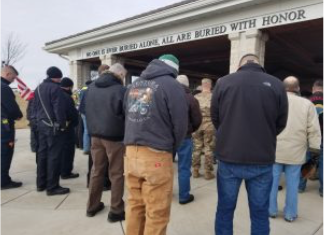
Army soldiers and members of the public braved frigid weather Wednesday to attend services for Servando “Kiko” Silva-Jimenez, who served as a medic in the U.S. Army. He died Jan. 15 at Geary Community Hospital in Junction City.

Officials with the Johnson Funeral Home tried for days to find Silva-Jimenez’s relatives. Social media posts began circulating asking that people attend Silva-Jimenez’s services at the Kansas Veterans Cemetery.

However, at the last minute, cemetery manager Cecelia Shellnute said officials found Silva-Jimenez’s brother in Puerto Rico and he was able to get to Manhattan for the funeral.

Copyright Eagle Radio | FCC Public Files | EEO Public File