JEFFERSON CITY, Mo. (AP) — Regulators have reversed course and given the go-ahead to one of the nation’s largest renewable energy projects.
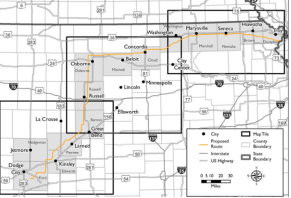
The overview map on this page depicts the route of the Grain Belt Express Clean Line in Kansas- Image Clean Line Energy Partners.- click to expand
The Grain Belt Express power line approved Wednesday would carry wind power from Kansas on a 780-mile path across Missouri and Illinois before hooking into a power grid in Indiana that serves eastern states.
The Missouri Public Service Commission had rejected the project twice previously, but it reconsidered following a ruling last year by the state Supreme Court.
In November, Chicago-based Invenergy announced it was buying the project from Houston-based Clean Line Energy Partners. That deal should bolster the financing, but the sale still needs regulatory approval.
The transmission line also would need regulatory approval in Illinois, where a state appeals court overturned the state’s previous approval.
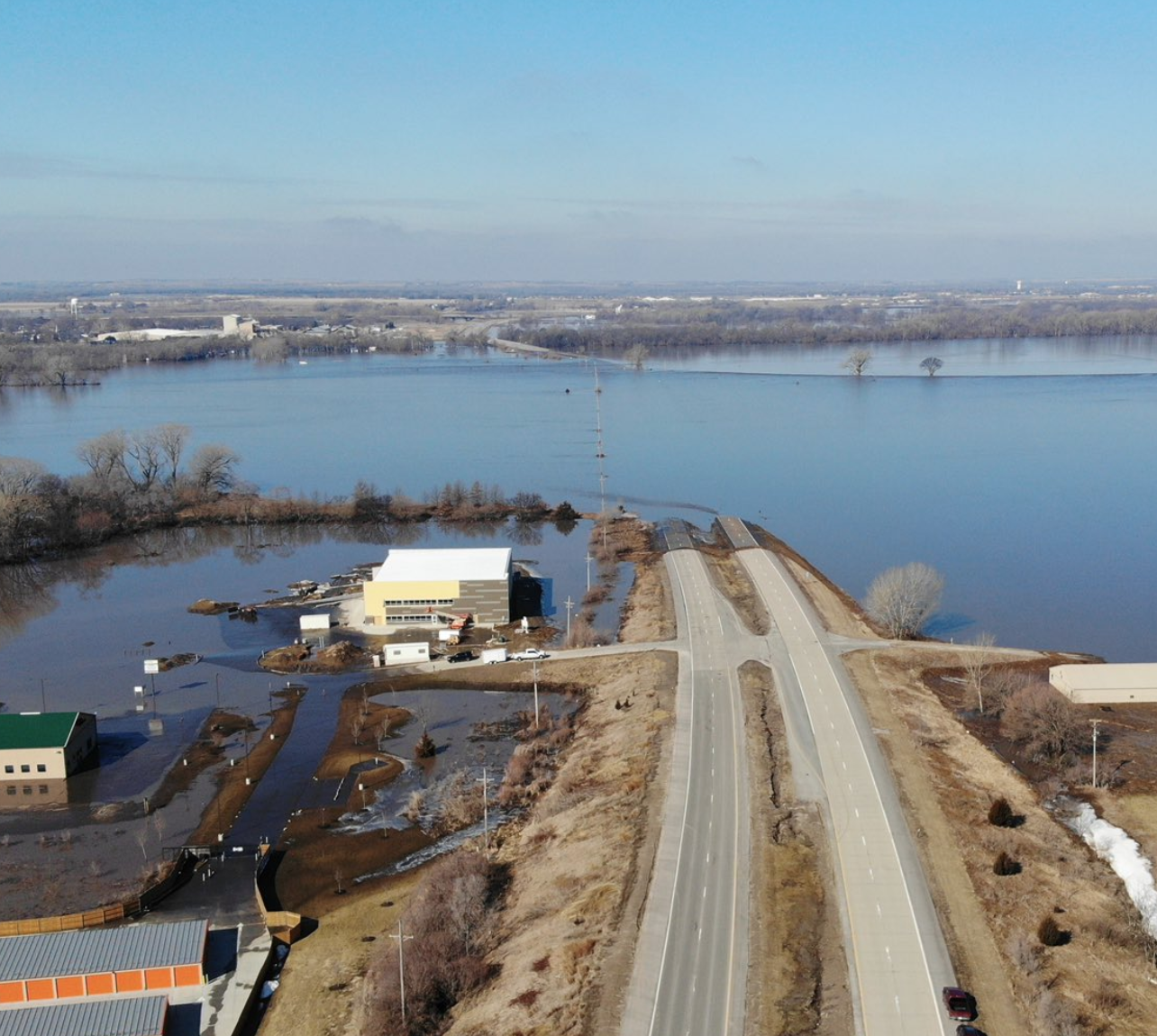
As Nebraska residents continue to recover from the devastating flooding, area residents are collecting donations in an effort to lend a hand.
Adam Brobst, a farmer and rancher in north-central Kansas, is leading an effort to collect and deliver donations to central Nebraska.
As of Tuesday evening, Brobst said he had a load of hay and a second and possibly third trailer full of donations ready to deliver to the Lincoln, Neb., area. Brobst said they will deliver they items to Davey, Neb., and then from there the items will then be packed back onto trucks and delivered to the region that needs them.
Brobst said he decided to put together the effort because many Nebraska farmers and ranchers lent a hand just a couple of years ago when many Kansans were in need during a string of wildfires.
“It thought it was our duty, and we needed to return the favor,” Brobst said. “because I know a lot of hay from Nebraska came down for the Kansas wildfires and Oklahoma wildfires.”
Brobst said anyone wanting to donate items in the Phillipsburg area can drop their items off at the Farmers & Ranchers Outlet in Phillipsburg. He will also pick up items at the co-op in Stockton and Midland Marketing in Plainville if anyone wants to leave donated items at either location.
They are currently collecting items to leave Phillipsburg at 8 a.m. Thursday and are planning a second trip to take a another round of supplies to the region next week.
Officials in Nebraska said they are currently in need of bottled water, non-perishable food, hygiene products and bedding, among other items. Farmers and ranchers are also in need of calf milk replacer, vet supplies, electric fence supplies and feed.
“They are going to send all the ag supplies to the west out of Davey, more toward central Nebraska where the majority of the ag stuff is affected and then north toward Columbus will go the household stuff,” Brobst said.
Brobst said he has friends in Nebraska who have been affected already by the flooding and others down river that could be affected in the coming days as floodwaters continue to move down river but said this disaster is going to hurt the agricultural industry across the board.
“There is a big area that’s been affected and its going to hurt the ag economy this year because you are talking billons of dollars of loss,” Brobst said.
Brobst said anyone wanting to make a donation can get in contact with him at 785-302-0621.
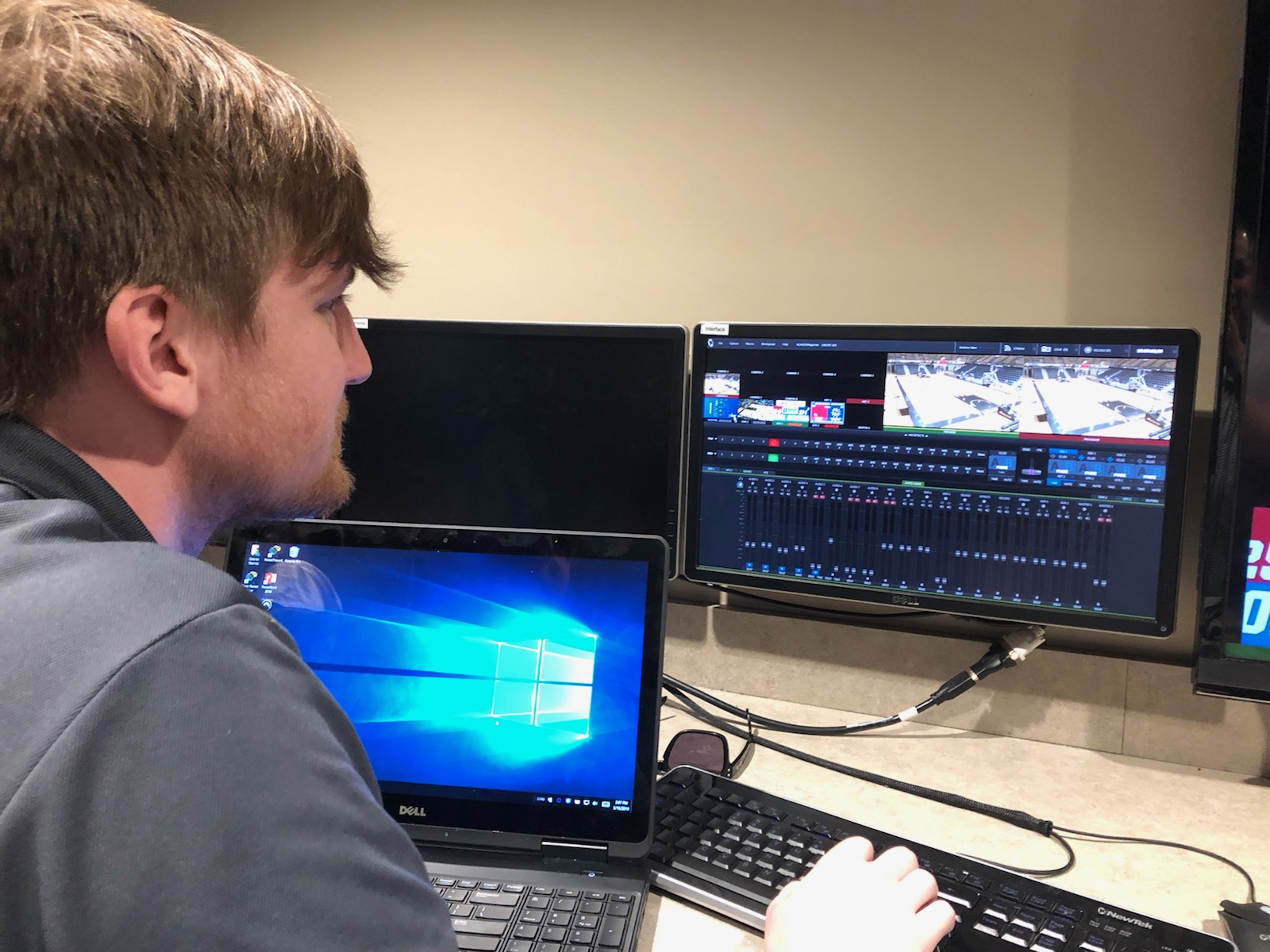
Fort Hays State University’s Gabe Warrick, a senior from Larned, imports graphics and video content for a broadcast during last weekend’s NCAA Division II Central Region Women’s Basketball Championships at Gross Memorial Coliseum.
By DIANE GASPER-O’BRIEN FHSU University Relations and Marketing
Fort Hays State University students Gabe Warrick and Matt Hastings have been helping record Tiger athletic events for several years.
Last weekend’s NCAA Division II Women’s Central Region Basketball Championships might have topped them all.
Warrick is a senior from Larned, majoring in informatics with an emphasis in media studies. He is a member of the sports production crew for Tiger Media Network, FHSU’s convergent media hub.
Hastings, a native of Topeka, is working on a master’s degree in sport management and works as a graduate assistant in the FHSU Sports Information Office.
They are just two of hundreds of Fort Hays State students who helped make the regional tournament a success.
Warrick’s duties included camera operation, replay, directing, technical directing and graphics work, while Hastings put to good use his expertise in recording statistics, running the video board and generally making sure everything was running smoothly.
Some students returned to campus early from spring break week to work in several areas: concession stands, taking tickets, as parking lot attendants and ushers and with the maintenance crew. Also participating in the event were members of the Tiger pep band; the university’s dance team, the Tiger Debs; and the FHSU cheer squad.
“We rely heavily on student support for all of our operations. We simply wouldn’t have the manpower without them,” FHSU Athletic Director Curtis Hammeke said. “Not only is this necessary for our ability to put on these events, it also serves as great experience for these students moving into their future.”
And then, of course there were the students who returned from spring break in time to help cheer on the Tigers in Monday’s regional championship game. They added to the raucous crowd of 5,000-plus fans as FHSU battled Southwestern Oklahoma State University, which came out on top of the 88-77 score.
“Hosting an event like the NCAA Central Regional once again brings to light the tremendous community support we have here in Hays,” Hammeke said. “Visiting institutions and representatives from the NCAA are in awe of our crowd sizes and the support we have for facilitating such events.”
Warrick and Hastings are two students who felt privileged to help facilitate the regional tournament. They both are transfer students who chose Fort Hays State to continue their education following graduation from community colleges.
“This was a bigger production than what I was used to,” said Warrick, who came to FHSU in 2017 after two years at Hutchinson Community College. “I got a good start at Hutch, but when you have a building like Hammond Hall here at FHSU, where you have two studios and three different sets, it was really cool to come and see. It was a step up, and I was excited.”
Warrick was particularly intrigued with FHSU’s TriCaster, a product that merges live video, graphics, special effects, etc., into one polished production for viewers.
“The technology we have here is unrivaled,” he said. “Our production team and live-streaming I’d put up against any in the country.”
Warrick said he would even put FHSU up against Division I schools, where underclassmen have to wait their turn for hands-on experience.
“That’s the great thing about Fort Hays State,” he said. “You can come in as a freshman and start working with a camera right away. And it doesn’t matter what your major is. We have some in political science, geoscience, music, among others. If they want to come and help, we will teach them. We are here to help them learn.”
Warrick was one of 14 TMN students who helped with the three-day tourney, putting in approximately 25 hours while broadcasting seven games. All that came less than a week after many of the same students worked a six-day shift producing the MIAA tournament at Municipal Auditorium in Kansas City, Mo.
The students involved in the sports production elements of TMN are under the guidance of Russell Heitmann, news and sports director for the organization.
“The work these kids do is amazing,” Heitmann said. “Our crew comes from multiple academic backgrounds, majors and interests. However, they have been able to come together and put on numerous quality productions throughout the year. I am incredibly proud of the growth from the first home football broadcast to putting on an NCAA regional broadcast event.”
Hastings echoed Warrick’s thoughts on the real-life opportunities available for FHSU students early on in their college careers.
“As a D-II SID worker, I’ve been more exposed to all the sports,” said Hastings, who began working with SID Ryan Prickett during his junior year as an undergraduate student. “In D-II, I’m the guy who does a little bit of everything.”
A big share of Hastings’ duties are performed behind-the-scenes. He is responsible for accumulating statistics and writing stories for men’s soccer, men’s cross country, wrestling and baseball.
But when it comes to Game Day in GMC, Prickett calls on several student workers to help out.
For the Central Region Championships, Hastings could be seen working all around the coliseum, from running the video board to making sure the teams had everything they need, and everything in between.
“I want to make sure everything goes right,” he said, “so I become vested in it.”
Although FHSU lost the regional title game, the Tiger women will no doubt remember the tournament experience for a long time. So, too, will fellow FHSU students who had the opportunity to be a part of the event.
“Events like this are a great opportunity for kids to see what it takes to put on a high level tournament weekend,” said Brian Flax, an employee in the Athletics Department who is in charge of concessions. “It takes a lot of pieces falling into place, and the students are a big part of that. Besides getting to see their fellow athletes do well, they get the chance to be involved, too.”
After five years of working as a student under Prickett as an undergrad and graduate student, Hastings is set to graduate in May and hopes to continuing working in sports information at the D-II level. He said he is glad he attended FHSU because it gave him a completely different outlook of working at a D-II school than what he had growing up.
“Being from the Topeka area, I’m used to the big city, and a lot of people don’t know much about Washburn,” he said of Washburn University, a D-II school and a fellow MIAA member with FHSU.
“In Hays, everybody is fully vested in this university,” Hastings continued. “Farmers from around the whole area and people around town, everyone knows Fort Hays State. That’s one thing I really love about Hays. The community is so involved in the university and its athletic teams.”
Grow Hays invites the public to the 1st annual Ellis County Youth Entrepreneurship Challenge (YEC) today at BriefSpace, 219 W. 10th in Hays.
Ellis County High Schoolers were invited to enter the Network Kansas YEC event earlier this year. There are 24 entries from Hays High and TMP-Marion competing for $2,400 in prize money.
First place receives $900 and will go on to compete at the KansasEntrepreneurship Challenge (KEC) State Championship.
Additionally, Midwest Energy, Nex-Tech and Sunflower Electric are awarding $200 prizes for Best Trade Show, Ready to Launch and People’s Choice. Judging started this morning and winners will be announced at 1:30 p.m. The public is encouraged to attend the event.
During the 2018-2019 academic year, there have been more than 40 YEC events throughout Kansas. The winner of each event is invited to participate in the KEC State Championship, April 30 in Manhattan Kansas. The YEC series gives Kansas students hands-on experience thinking entrepreneurially.
If you have questions, you can reach Grow Hays at 785-628-3102 or at [email protected].
The Hays Area Chamber of Commerce in Hays, Kansas, a vibrant city of 21,000 and a regional center for education, health care, professional services and retail, is recruiting for the position of President/CEO.
The successful candidate will provide collaborative leadership with the staff of three, the Board of Directors, 500-strong membership and other community organizations. Applicants should have executive management leadership experience in business, non-profit or chamber association, and experience leading an organization through growth and change to achieve strategic objectives. Bachelor’s degree in the area(s) of association management and/or business is required. Personal computer and excellent communication skills are required.
Occasional travel outside of Hays is required. The Hays Chamber offers a competitive salary and excellent benefits package. Please email cover letter and resume to [email protected] by March 22 for priority consideration. Resumes will continue to be accepted until the position is filled.
Marrida J. Ribeau, 86, of Osborne, KS passed away on Sunday, March 17, 2019 at the Parkview Care Center. She was born on May 25, 1932 to Lloyd & Grace (Martens) Coop in Osborne County.
Marrida graduated from the Osborne High School in 1950. She married Paul Ribeau and to this union, one son was born.
She was a professional gardener, raising plants and vegetables.
Marrida was preceded in death by her parents, her husband, Paul, a son, Joe in 2012 and a grandson.
She is survived by her sister, Millie Spears of Osborne.
The city of Hays Fire Department will be inspecting and flow testing fire hydrants on March 20, 2019 in the area of Vine St. to Canterbury Dr. between 13th St. and 22nd St. This is part of a coordinated effort by the city of Hays to inspect all fire hydrants in the city and flush all water mains annually.
Inspecting fire hydrants ensures that the valves operate properly and that there is no damage or obstructions that will prevent or interfere with the prompt use of fire hydrants in an emergency. Firefighters are also checking the pressure and volume of water mains in each neighborhood for firefighting purposes.
The associated flushing of water mains allows chlorine to be distributed throughout the system to eliminate bio-filming in the water mains.
Slight discoloration of the water supply may be encountered although there will be no health risks to the consumer.
All reasonable efforts will be taken to minimize the inconvenience to the public.
Drivers are asked to avoid driving through water discharging from a fire hydrant during the short flushing period.
For more information please contact the Hays Fire Department at 785- 628-7330.
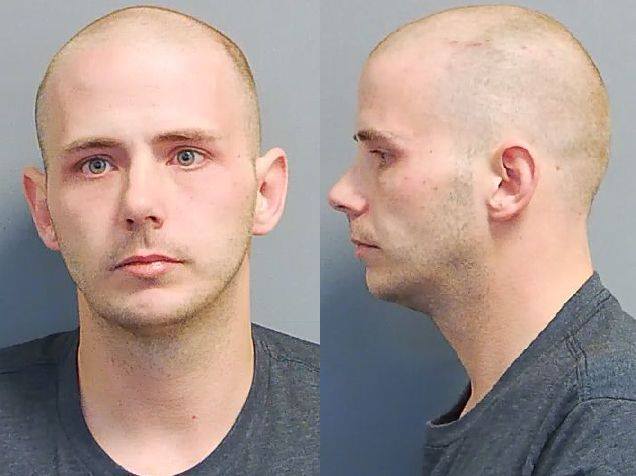
A 34-year-old Ellis man has been charged with premeditated first-degree murder in the fatal shooting of a Hays man last month.
According to Ellis County Attorney Tom Drees, Ryan Paul Thompson was charged Tuesday in Ellis County District Court with allegedly shooting 26-year-old Diego Gallaway on Feb. 27 in the 2700 block of Indian Trail.
Thompson is alleged to have shot Gallaway in the back of the head while having him in a chokehold, according to Drees.
If convicted, Thompson faces a minimum of 50 years in prison for intentional and premeditated first degree murder.
Thompson was also charged with possession of methamphetamine with the intent to distribute. He allegedly possessed 23.9 grams of the drug. If convicted, he would face between 92 and 144 months in prison.
At preliminary hearing will be scheduled at a later date. Thompson is being held in the Ellis County jail in lieu of $750,000 bond.
The filing of criminal charges are merely allegations of criminal wrongdoing, Drees said. The defendant maintains a presumption of innocence unless and until they are proven guilty in a court of law.
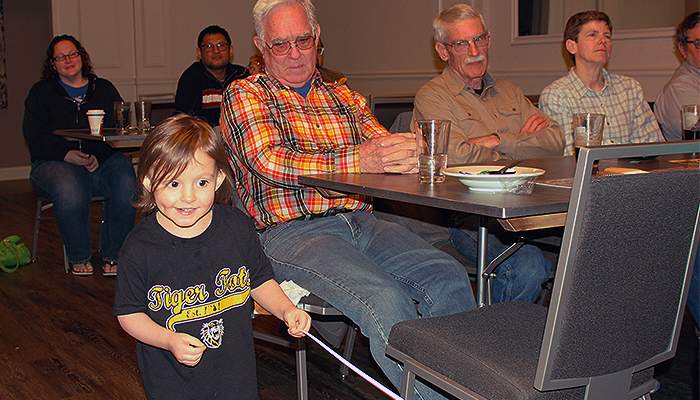
A little girl helps to measure the size of a dinosaur during Monday night’s FHSU Science Cafe lecture on dinosaur growth.
By CRISTINA JANNEY Hays Post
Attendees at the monthly FHSU Science Cafe learned Monday night how an egg that could fit in a easter basket could grow into a gigantic dinosaur.
Cat Sartin, FHSU instructor of biological sciences, presented “The Bare Bones About Dinosaur Growth.”
Sartin’s research has focused on the growth patterns found in fossilized dinosaur bones. Sartin studied hadrosaurs, which were a family of dinosaurs that are commonly known as duck-billed dinosaurs. They were herbivores, which meant they ate plants, and among the most common dinosaurs living during the late Cretaceous Period.
Cat Sartin, FHSU instructor of biological sciences, presented “The Bare Bones About Dinosaur Growth” Monday night at The Venue.
Sartin choose the hadrosaurs in part because they lived in herds with individuals of varying ages.
The eggs of a hadrosaurs were about the size of a potato, but the adults grew to up to 20 feet long.
Even the titanosaurs that grew to be 120 feet long started out from an egg that is only about 18 inches long.
“If dinosaurs were up and running around today, we could go out and measure them. We could look at what they were eating. We could put trackers on them. It would be great, but they’re not around,” she said.
Although researches can look to modern birds and reptiles for clues to how dinosaurs may have lived and grown, these animals don’t grow to near the sizes the dinosaurs did.
“We can’t go out and study them because all we have are the bones, and they are not even really bones. They are fossils, which means the bone material has been largely replaced by rock, so it is just a snapshot in time for each individual animal,” Sartin said. “Fossils don’t grow. They don’t exhibit behavior.”
Sartin analyzed thin sections of hadrosaurs bones under a microscope to evaluate their texture. Young individuals have an open or lacy texture to their bones to allow for more blood vessels to feed the rapid growth of the bones. As an individual ages to equivalent of elementary school child, its bone structure has more order. The collagen fibers in the bone lay down in layers almost like plywood.
Skeletally mature individuals bones are the most organized. These individuals have osteons, which are bone canals. These structures are good at stopping stress fractures in older creatures.
“When you are young, you do a lot of stupid things. We all do. It’s OK. Across the animal kingdom, animals do a lot of stupid things and take a lot of risks. They need really strong bones for all the stupid things they do,” Sartin said.
“As you get older, you get into a routine. You are doing the same things over and over again whether you are a human or a dinosaur. That means you are more likely to have stress fractures from that repetitive motion. That is what this is helping to stop.”
The texture, however, will not tell the age of the animal.
Dinosaurs lay down lines in their bones called lines of arrested growth. These lines can be counted like tree rings to determine age. The amount the animal grew each year can also be estimated by the amount of bone between each line.
Researchers used captive populations of animals, such as alligators and king penguins, to determine what triggered the animals to lay down the rings. They suspected the rings were laid down annually.
They turned to a small primate, commonly called a mouse lemur, that they housed in a lab. They changed the mouse lemur’s light cycles to 18-hour days instead of 24-hour days. After 365 of these 18-hour light cycles, the mammal laid down a bone ring.
Specifically of the hadrosaurs, Sartin choose to focus on a group of eolambia fossil that were found in Utah at the site where a river likely flooded.
The curators who held the eolambia fossils were not all that excited to have Sartin slice up their specimens, so she found isolated bone shafts that weren’t likely to be used for display in museums. She ended up with 20 some specimens to study.
By measuring the lines of arrested growth, Sartin determined these dinosaurs grew quickly for 10 to 12 years, and then their growth slowed.
“It makes good sense, because there are things out there that might want to eat you,” Sartin said, “and it might be helpful to grow a little quicker.”
From analyzing the texture of the bones, she also determined the group of individuals found in the Utah deposit were not skeletally mature. Sartin theorized that some of the teenage dinosaurs might be sexually mature and reproducing.
She also determined the first growth ring in the bones was fairly large, which meant they went from an egg the size of a baked potato to a middle schooler in one year.
Sartin again looked to modern animals to help her with her research. Ostriches go from an egg to a full-grown adult in 18 months.
“It is completely reasonable to think a little eolambia could go from a baked potato to yeah high in a year,” she said.
Eolambia did not have spikes or armor or plates for defenses, so growing quickly and living in herds were their defenses against predators.
Other herding herbivores have also shown similar rapid growth patterns.
Apatosaurus, which we used to know as brontosaurus, grew to adult size in 10 years. They had an average length of about 75 feet and weight of 16 to 22 tons. Most of the plant-eaters’ growth came in three years. Researchers are trying to determine how the animals could consume enough food to support that type of growth.
Theropods (meat-eating dinosaurs) also had quick growth spurts, but they were delaying their spurts to a little later in their youth.
“Theropods hang out as small little guys for the first three to five years of their lives. It is kind of cool and groovy to be little, and then they decide to go gangbusters and get really big, really quickly,” Sartin said.
Researches believe the meat eaters did not have to grow quickly for protection. This allowed them to learn hunting techniques from the adults in their family groups. They also may have been learning social cues from the others in their family groups or packs, Sartin said.
Based on these growth patterns and the family groups in which the meat-eaters’ fossils have been found, researchers believe the meat-eating dinosaurs parented their young, she said.
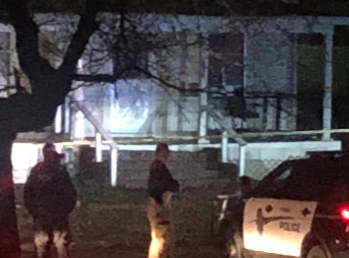
SHAWNEE COUNTY —Law enforcement authorities are investigating after an explosion on the front porch of a home early Wednesday in Shawnee County.
First responders on the scene of Wednesday morning investigation -photo courtesy WIBW TV
Just after 12:30a.m., fire crews and police responded to a home in the 300 Block of SW Harrison in Topeka, according to Fire Chief Michael Martin.
An investigation revealed some type of explosive device was used. The explosion caused approximately $2000 damage to the home at 306 SW Harrison. Flying debris caused an additional $500 damage to the home at 302 SW Harrison, according to Martin. The Topeka Police Department bomb squad assisted at the scene to search for additional explosive devices.
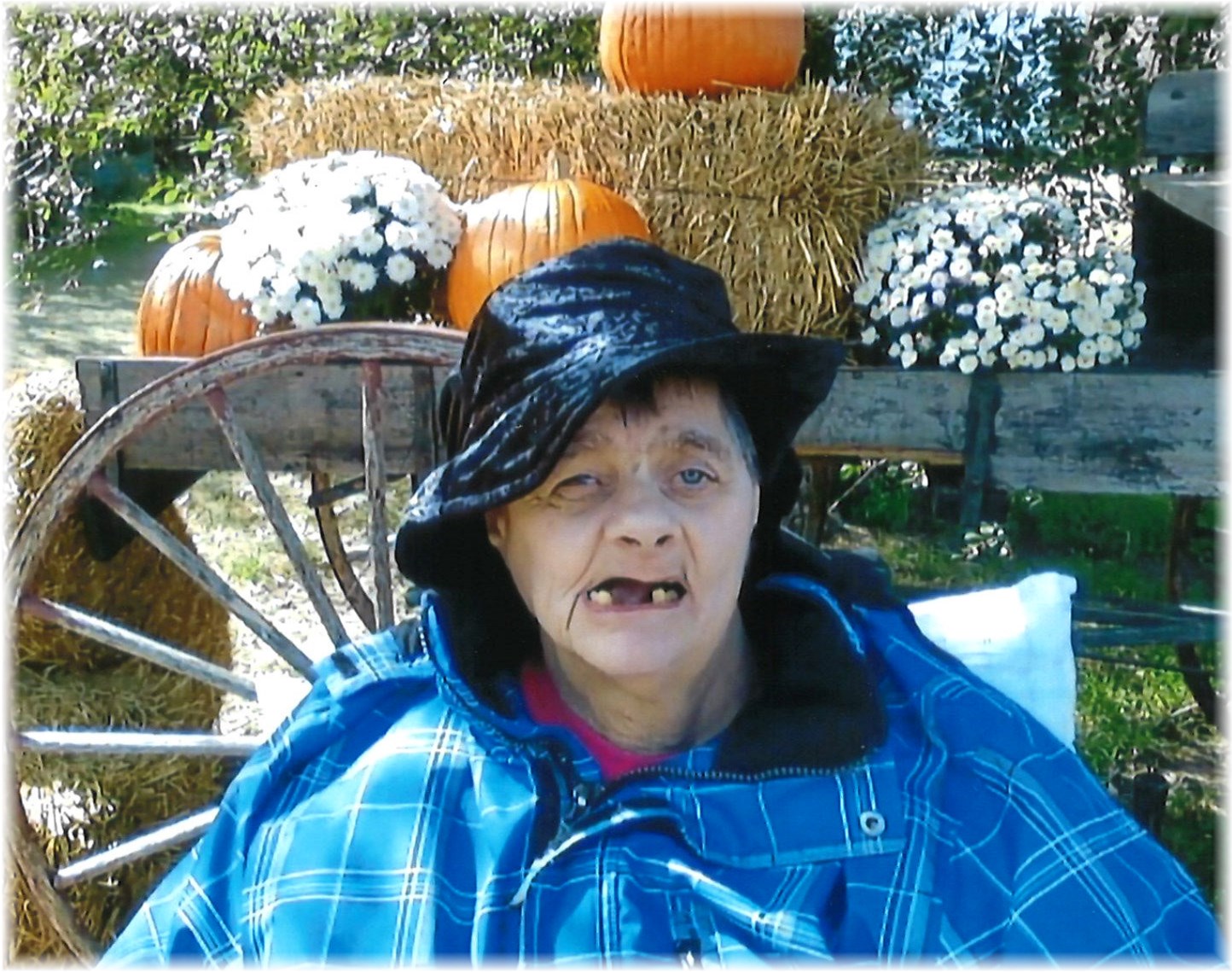
Billy Jean Wahl, 78, of Russell, Kansas passed away on Thursday, February 21, 2019 at Hays Medical Center.
Billy was born on on November 7th, 1940 in Denver, Colorado. She spent most of her childhood and all of her adult life in Kansas. For the last 29 years, Billy lived in Russell, served by Developmental Services of Northwest Kansas. Billy enjoyed dancing and singing to music, shopping for new clothes, wearing big sunglasses, hats and jewelry, and spending time with friends. Billy will be deeply missed by many loving friends and staff.
A memorial service to celebrate Billy’s life will be held at 1:00 pm on March 28, 2019 at the Pioneer Developmental Center at 15 N Maple in Russell, KS. Memorials can be given to help with the funeral and can be made and sent to the mortuary. Burial of cremains will take place after the service at the Russell Catholic Cemetery.
Pohlman-Varner-Peeler Mortuary of Russell, Kansas is in charge of the arrangements.
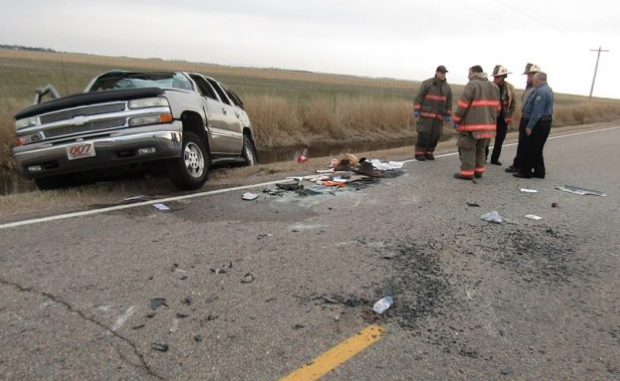
BARTON COUNTY— One person died in an accident Tuesday in Barton County.
Scene of Tuesday fatal rollover accident -photo courtesy Barton Co. Sheriff
A 2002 Chevy Tahoe driven by Michael T. Kern, 58, Ellinwood, was eastbound on SE 50 Road near SE 20th Avenue, according to a social media report from the Barton County Sheriff.
The Tahoe traveled off the road toward the south ditch. The driver overcorrected. The SUV overturned as it came back onto the road and rolled.
Kern was pronounced dead at the scene. The accident remains under investigation, according to the sheriff’s office office.