KANSAS CITY – Three men have been sentenced in federal court this week for their roles in a drug-trafficking conspiracy that led to the kidnapping and torture of an Independence, Mo., man.
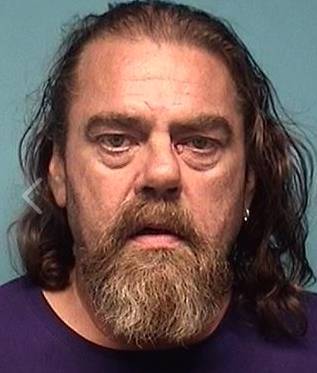
According to a media release from the United State’s Attorney, Randal G. Holmes, also known as “Peckerwood” or “Wood,” 54, of Kansas City and Michael C. Borrusch, also known as “Birdie,” 43, of Lakewood, Colo., were sentenced last week in separate appearances before U.S. District Judge Greg Kays. Holmes was sentenced to 15 years in federal prison without parole. Borrusch was sentenced to 3 years and 10 months in federal prison without parole.
Jeremy R. Bond, 40, of Independence, was sentenced on Wednesday, March 13, 2019, to two years and six months in federal prison without parole.
On July 10, 2018, Holmes pleaded guilty to one count of conspiracy to commit kidnapping, one count of kidnapping, one count of conspiracy to distribute 50 kilograms or more of marijuana and one count of brandishing firearms in furtherance of a drug-trafficking crime. Borrusch and Bond pleaded guilty to their roles in the drug-trafficking conspiracy.
Holmes’s son and co-defendant Gerald L. Holmes, also known as “Jerry” or “Joker,” 27, and co-defendant Richard M. Phoenix, also known as “Snake,” 77, both of Kansas City, Mo., have also pleaded guilty and await sentencing.
During the conspiracy, which lasted from May 1 to Sept. 13, 2016, Bond invested $10,000 into the marijuana operation. In return, he received $1,000 a week as interest and free marijuana until the entire principal investment was repaid in full. This investment allowed Gerald Holmes and a co-conspirator, identified in court documents as “C.H.” (who had made four trips to Colorado with Gerald Holmes), to purchase greater quantities of marijuana per trip. Once it reached the greater Kansas City metropolitan area, the marijuana was then resold by Gerald Holmes and C.H.
Conspirators purchased at least 120 pounds of marijuana from Borrusch, for which they made more than a dozen trips between Colorado and Kansas City. Gerald Holmes paid Borrusch between $1,600 to $2,400 per pound, depending on the type and quality of marijuana available. Randal Holmes received $100 for every pound of marijuana brought back to Kansas City because of his prior connection to Borrusch, who was previously his supplier.
On Sept. 12, 2016, Randal and Gerald Holmes agreed to kidnap C.H. because he stole money that was intended for the purchase of marijuana.
They arrived at the Independence, Mo., residence of the victim’s father, identified as “W.H.,” on Sept. 12, 2016. During their conversation, Gerald Holmes removed a firearm from his waistband and placed it on a table in front of W.H. They told W.H. to call C.H. and tell him he was being held at gunpoint and that C.H. needed to come to the residence right away. When C.H. arrived at the residence, Randal Holmes pointed a firearm at him and told him to get into his vehicle. While in the vehicle, Gerald Holmes struck, punched and choked C.H. as Randal Holmes drove away.
They took C.H. to Randal Holmes’s residence, where they were met by Phoenix. C.H. was taken to the basement, where he was assaulted with fists, a hammer and tin snips/clippers. During the assault, Holmes repeatedly demanded that C.H. disclose where the duffle bag containing the money was located. Randal and Gerald Holmes left to retrieve the duffle bag while Phoenix held C.H. at gunpoint.
Randal Holmes later drove C.H. to a rural residence near Edwards, Mo. As Randal Holmes drove them to the residence, Gerald Holmes continued to strike C.H. with fists and the butt of a firearm. When they arrived at the residence, C.H. was told to call his father and to tell him that he was okay, that he had taken a beating, that he would be home in a couple of days and that he deserved what had happened.
Law enforcement officers were able to trace the telephone call and on Sept. 13, 2016, officers were able to locate C.H. and arrest the conspirators. Officers observed that C.H. had suffered multiple, visible injuries to his face, head, hands and feet. Officers noted that C.H. had trouble walking, that his face was black and blue, as well as swollen with traces of dried blood. Upon receiving medical treatment, it was determined that C.H. had also suffered a fracture in his left hand.
Officers found a Jimenez Arms 9mm pistol in Randal Holmes’s vehicle and a Hi-Point 9mm pistol in the residence where C.H. had been held. Officers also found an FN Herstal .40-caliber pistol, a Remington .270-caliber rifle, an RG .22-caliber revolver, a Ruger .22-caliber rifle, a Mossberg .20-gauge shotgun, 36.4 grams of marijuana and drug paraphernalia in another residence.
Michael Walker, director of the Docking Institute at Fort Hays State University, and Dr. April Terry, assistant professor of criminal justice, will present a collaborative research project at the 22nd Annual Crime Victims’ Rights Conference in April.
The collaborative team is comprised of Walker, Terry, and members from Kansas State University.
The presentation is titled “Our Town, Our Kids: Blurred Boundaries and Working With Youth in Non-Metro Communities.”
March 17 – 23 is noted as National Poison Prevention Week. It is the perfect time to raise awareness among families to reduce unintentional poisonings, and promote poison prevention in our corner of the world. When our kids and grandkids were quite young I probably paid more attention to this important topic. It is interesting to note though, that people of all ages are in danger of poisonings.
A few years ago an Extension Agent in a neighboring county shared the educational program titled, “Dangerous look-a-likes.” That information has stuck in my mind, so I will share a few of the things I remember.
Many household cleaners are the color of Kool-aid or sports drinks. Some even smell like citrus, so it could be very dangerous to have these cleaners left in a space that is accessible by young children. Another important rule here is to make sure you leave cleaners in their original container. If you do put them in another spray bottle, make sure it is clearly marked.
Look inside your medicine cabinet. Many pills look so much like red hots or other small candies. Children do not know the difference so make sure medicines and supplements are kept far out of reach of young children. Do not refer to medicine or vitamins as candy and do not involve children as helpers with your medication.
If a person of any age ingests something that is poisonous contact the Poison Control Center at this number (1-800-222-1222) The phone number is manned 24 hours a day.
More than 2 million poisonings are reported each year to the 57 poison control centers across the country. More than 90 percent of these poisonings occur in the home. The majority of non-fatal poisonings occur in children younger than six years old. If a product label says, “Keep out of reach of children” there is a reason. Keep those dangerous things up high and in a locked cabinet. Almost half of poison exposures for children under the age of 5 are caused by medicine. Children have faster metabolisms than adults so anything they ingest will be absorbed into the bloodstream very quicly.
Take a few minutes and do a visual check around your house to make sure you have any poisons out of reach of young children.
Donna Krug is the Family and Consumer Science Agent and District Director for the Cottonwood Extension District. You may reach her at: (620)793-1910 or [email protected]
BROWN COUNTY — The Kansas Bureau of Investigation has cancelled an endangered person for a missing Brown County girl. According to a media release, Gianna Hazelton, 11, Horton, was found safe and is on her way home. Authorities release no additional details.
—————
BROWN COUNTY – The Horton Police Department has requested that the Kansas Bureau of Investigation (KBI) issue an endangered person advisory for a missing Kansas girl.
photo courtesy KBI
The whereabouts of Gianna Hazelton, 11, Horton, are unknown, according to a KBI media release.
Hazelton is a white female, 4 ½ ft. tall and approximately 125-135 pounds.
She has black hair and brown eyes. Hazelton was last seen Saturday night between 7 p.m. and 9 p.m. at 1640 Euclid Ave in Horton, Kan. Hazelton is believed to be accompanied by the non-custodial parent, Casey Hazelton.
The Horton Police Department asks anyone who comes in contact with Hazelton, or has any other information known about this case, including past sightings, to immediately call 911 or Horton Police Department at 785-486-2694.
A new $12 million waterpark. A shiny new craft brewery — not far from the new whiskey distillery. And, yes, that trendy new downtown cafe.
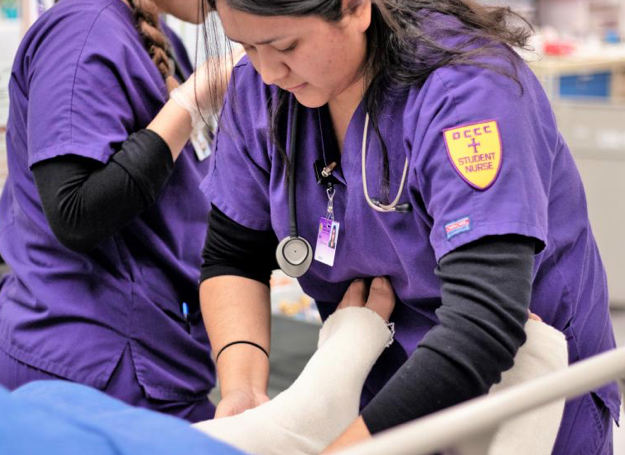
Dodge City officials want students at the local community college, such as these nursing students, to have more options for pursuing bachelor’s degrees without leaving town. BETHANY WOOD / FOR THE KANSAS NEWS SERVICE
A nearly $6 million addition to Boot Hill Museum just kicked off last fall. That’s about when Dodge City wrapped up $86 million in renovations and expansions to its schools.
Much of rural Kansas is withering. Not Dodge City. It offers a growing anchor in the state’s southwest, grounded in the meat industry and energized by the thousands of people who work at its slaughterhouses.
But the town’s success story risks hitting a 21st century ceiling. It lacks a four-year college.
That complicates upward mobility for blue-collar workers, costs the town services it sorely needs and hinders efforts to diversify the local economy.
Some residents leave the region to chase the schooling that leads to higher-paying jobs. Others can’t afford to. Meanwhile, plenty of middle-class jobs in the region go unfilled, such as teaching positions and better-paying health care work.
That’s why community leaders dream of bringing four-year college to this icon of the Old West.
“It’s the only way,” said Joann Knight, head of economic development, “to really address our health care issues and the lack of education out here.”
Dodge City has become west Kansas’ biggest city, at the heart of a 28-county region that lacks any state university.
Give southwest Kansas a satellite campus, they propose, where universities based elsewhere offer bachelor’s degrees that build on the region’s community college programs. Make four-year degrees a realistic option for more students. Keep down costs of the project by reviving classrooms at a local Catholic college that closed decades ago.
“If we drop the ball,” Knight said, “I’d hate to see what our health care access is going to be in 10 years.”
In many southwest counties, you can’t get a tooth filled or help for a child’s anxiety attacks. There’s no dentist or mental health provider in sight.
Even in bustling Dodge City, residents express frustration with difficulty making appointments and with turnover.
“I’ve gone to the doctor quite a few times,” Dodge City High senior Jacquelyn Martinez said, “And I swear, like every time I go, it’s always a different person.”
Martinez wants to be a physician’s assistant — just one of the many kinds of health workers that nurse practitioner Jacque Kemmerer says the region urgently needs.
Patients requiring more specialized care have it the worst, says the founder of a women’s health clinic in Dodge City that’s now part of Pratt Regional Medical Center. Thyroid problems? Seizures? Diabetes? All those can mean long car trips.
“If the diabetes becomes uncontrolled,” she said, “they have to go two-and-a-half hours to Wichita to see an endocrinologist.”
A Wichita State University report prepared for Dodge City scrutinized health outcomes in southwest Kansas and surveyed hundreds of health experts and community leaders.
People die younger in southwest Kansas than the rest of the state and nationwide, researchers found. They’re hospitalized more often with conditions like diabetes and asthma that regular primary care can help keep in check.
The survey’s respondents said population decline across west Kansas has worsened the care shortage — but so has the surging cost of college and the absence of a close-to-home campus.
In the region’s three biggest counties, where Dodge City, Liberal and Garden City lie, around 10 percent of adults work in health care. Elsewhere in Kansas 14 percent do.
An education desert, too
Dodge City High School senior Leslie Rodela doesn’t know yet whether she should aim to become a nurse practitioner or a family physician, but she knows either path will take her away from here for several years at least.
“I like this town,” she said. “I’m kind of sad that I would have to move away.”
Southwest Kansas parents with college-bound kids pack them off and hope some, at least, will bring those coveted bachelor’s and graduate degrees back — as Rodela hopes to do.
“Unfortunately,” said Bud Estes, a state senator from Dodge City, “much of the time they do not.”
Three of his four children didn’t return. Estes the parent doesn’t begrudge anyone that. Estes the senator needs a solution to fill his district’s demand for degrees.
Nationally, most freshmen enroll in college within 50 miles of home. People who live farther away are less likely to go. Dodge City sits 105 miles from Fort Hays State, the closest state university. Wichita State lies 160 miles away.
Kansas has seven public universities. None of them has a campus in the state’s 28 southwestern counties — Kansas’ only quadrant without that. Barclay College, a Christian school of about 250 students and the region’s only four-year campus, lies 60 miles east of Dodge City in tiny Haviland.
Neither that nor the community colleges in Dodge City, Liberal or Garden City provide the broad access to four-year degrees that University of Wisconsin-Madison professor Nick Hillman says open a critical level of economic opportunity.
“That’s where the big jumps are going to happen,” he said, “with that four-year credential.”
On average, Kansas adults add about $4,500 to their annual earnings if they study beyond high school and get a year or two of college under their belts. A four-year degree is a nearly $20,000 jump.
Many educators hope the age of online learning can fill the void. But Hillman says studies suggest distance learning isn’t producing widespread success. For viable, broader access, he thinks states need to find other ways to fit into the lives of the students they hope to serve.
That could mean testing a mix of in-person and web-based instruction, or rethinking the mission of community colleges to help students earn four-year degrees.
Otherwise, many people eyeing bachelor’s degrees will continue either to leave the area or simply miss out. Comparatively few will go wholly online.
Xiomara Garcia enrolled in Dodge City Community College to earn an associate’s degree in nursing. Ultimately, she wants bachelor’s and graduate degrees, and to become a nurse practitioner.
She has doubts about online options for those higher credentials.
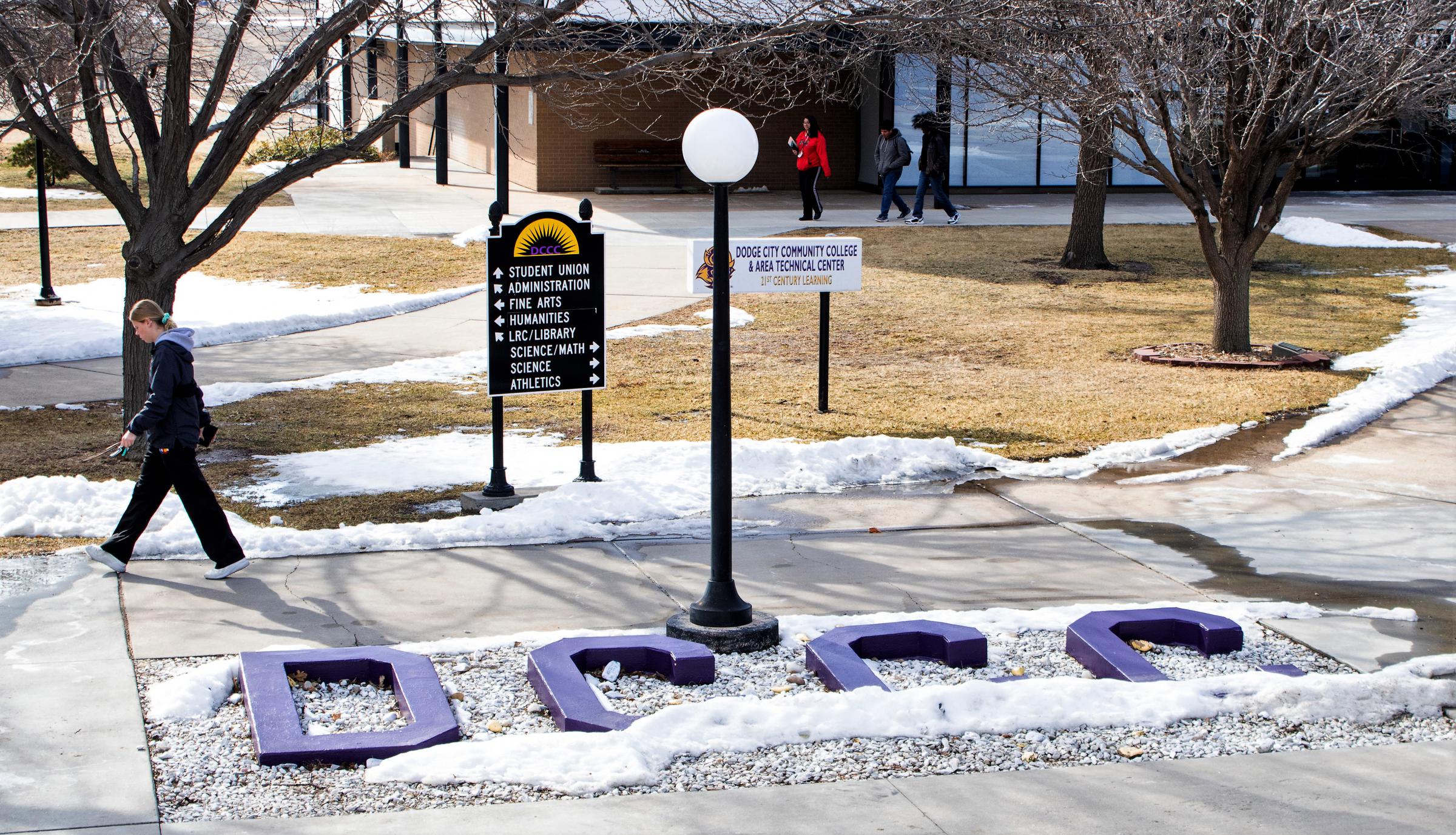
Dodge City Community College and other community colleges in the region offer two-year degrees that city officials see as the starting point for rolling out bachelor’s programs.
CREDIT BETHANY WOOD / FOR THE KANSAS NEWS SERVICE
“When you’re together with your professor, they teach you more,” she said. “Their doors are open. You’re more than welcome to ask questions after class.”
So Garcia has thought about moving instead, but she says if state universities offered a satellite campus in her region, that option would suit her well.
“This is where I’m from,” she said. “I have my family here, all the resources I need are here. The only thing missing is the actual education.”
‘University centers’
Some states eager to expand access let community colleges offer bachelor’s programs. Others have created collaborative, multi-college satellite campuses — sometimes called “university centers.”
Educators and civic leaders in Dodge City, Liberal and Garden City want a university center — a partnership among local community colleges and state universities that could start with a focus on health care and expand from there.
Only in Garden City do students go on to college at rates akin to the rest of Kansas, tallies from the state education department indicate. Fewer than one-third of teens in Liberal and Dodge City graduate and continue to college within a few years.
“There’s the financial barrier,” said Annie Martinez, who teaches anatomy and other sciences at Dodge City High School. “But also, just — we have a lot of kids who are very connected with their families.”
A university center could let her students earn an associate’s degree in nursing at Dodge City Community College, for example, and top it off with a bachelor’s without leaving town.
Professor Mechele Hailey directs the community college’s nursing program and encourages all her graduates to keep studying.
Hospitals, clinics and nursing homes crave those higher degrees. Research shows links to healthier patients, and graduate-level nursing degrees can help doctor’s offices serve more people.
“The more education we can get,” Hailey said, “the better nursing is in general.”
‘The more education we can get, the better nursing is in general.’
Students say a university center could let them live at home during their studies, sparing them thousands of dollars in dorm fees on the way to earning a bachelor’s degree.
“I would have my family to help me throughout the entire process,” said Alexandra Garcia, a Dodge City high school senior who wants a bachelor’s and, eventually, a physician’s assistant master’s degree from Wichita State. “That would help a lot.”
Gauging demand
Over the past decade, the Kansas Regents set urgent annual targets to get thousands more students earning two or four-year degrees.
Without those degrees, they worry, businesses will struggle to hire and grow. Kansans will struggle to reach or stay in the middle class.
But the state hasn’t come close to hitting its goal. Doing so would require enrolling many more of the students who often face greater hurdles to higher education. Black and Hispanic students, and those from low-income families or families with no college history, remain less likely to study beyond high school.
Thousands of students from those groups live in Dodge City, Liberal and Garden City.
Their schools bring together a mix of stunningly diverse heritages — the product of the region’s many agricultural jobs. Dozens of languages from around the world are spoken in southwest Kansas homes, ranging from Spanish and Congolese French to Guatemalan K’iche’, Somali and Burmese.
Think of the social and economic implications of failing to open doors to college, says Terri Mujica-McLain. She’s a Kansas City consultant who hails from southwest Kansas and is helping with the push for a university center.
“If you’re not educating your minority population,” she said, “you’ve totally missed the bus.”
Think big, start small?
Posters hanging at the library of Dodge City High School. CREDIT CELIA LLOPIS-JEPSEN / KANSAS NEWS SERVICE
Yet Southwest Kansas faces a bit of a chicken-and-egg situation.
Calculating the costs of a satellite campus depends on how many students would enroll. Pinning down demand is difficult for programs that don’t yet exist.
But Dodge City leaders pursue the concept doggedly, with help from federal and foundation grants, and are gaining momentum. At least three universities have visited to gauge the prospects. Fort Hays State will soon finish a feasibility study on rolling out a few bachelor’s programs as early as next fall.
“It needs to be a win-win for the institution, for the local community and obviously for the student,” said Shane Bangerter, a Dodge Citian and vice chair of the Kansas Board of Regents. “What I would like to see happen is to get some of these programs started and then we can better judge.”
Wichita State economists think west Kansas will keep losing residents in the coming decades. But they predict two of the west’s four main population centers will continue to grow: Hays (which already has a university) and Dodge City.
At around 35,000 people today, Dodge and surrounding Ford County may reach nearly 50,000 by the mid-2060s.
Liberal and Seward County, researchers predict, will hold steady. Garden City and Finney County could shrink as much as a third.
Dodge City officials suggest a satellite campus there could serve Liberal and Garden City, too, with courses potentially offered at all three locations.
The project could keep costs down by teaming up with the community colleges in all three towns — and using the ample space at Hennessy Hall.
A hulking yet elegant structure built in the 1950s, Hennessy once housed St. Mary of the Plains College. Today, Dodge City puts it to a wide range of uses. A Catholic college in Wichita — Newman University — already offers a small program for aspiring teachers there. Dodge City officials see that as one piece already in place for its satellite campus vision.
St. Mary closed in 1992. A press release from that year pins blame for the Catholic college’s demise largely on a “disastrous” deal-gone-awry with an out-of-state trucking school that sunk it into deep trouble with the U.S. Department of Education.
Until then, 160 faculty and staff served more than 800 students a year, churning out young professionals.
Business, education and nursing ranked among the most popular majors, says Tim Wenzl, archivist for the Catholic Diocese of Dodge City. Many of the graduates stayed.
R.C. Trotter co-owns a five-physician family medical practice in Dodge City with mental health counseling and a nurse practitioner.
“Everyone in my office grew up out here,” he said.
“Come to the product,” he urged Kansas universities. “Come to where the kids are if you really want to make a difference in education down the road.”
Celia Llopis-Jepsen is a reporter for the Kansas News Service. You can reach her on Twitter @Celia_LJ.
BUNKER HILL – Smoky Hills Public Television’s Traveling Kansas will highlight Bird City on Thursday, March 21 at 7:00 p.m.
On this episode of Traveling Kansas, we celebrate rural heritage with a visit to Bird City. From their July 4th Celebration to the 65th Annual Tri-State Antique Engine & Threshers Show, we also take a look at the Bird City Dairy and learn why Bird City is a great place to live and work.
“We are excited to roll out another great production of Traveling Kansas,” said Les Kinderknecht, Smoky Hills Public Television Senior Producer and Director. “I want to thank the Bird City Century II Development Foundation and the community of Bird City for their support and allowing us to come and capture the beauty of their community. I also want to thank KS Department of Wildlife, Parks & Tourism for their continued support. Without them, we would not be able to continue bringing these Traveling Kansas shows.”
The Smoky Hills Public Television YouTube Channel will premiere this episode on March 22nd at 7 p.m., where you can stream this Traveling Kansas episode on any device. (https://www.youtube.com/user/SmokyHillsPBS)
Traveling Kansas is a Smoky Hills Public Television production that highlights Kansas communities, events and natural wonders. Previous episodes can be viewed at shptv.org. Smoky Hills Public Television is the Kansas Association of Broadcasters Non-Metro Station of the Year.
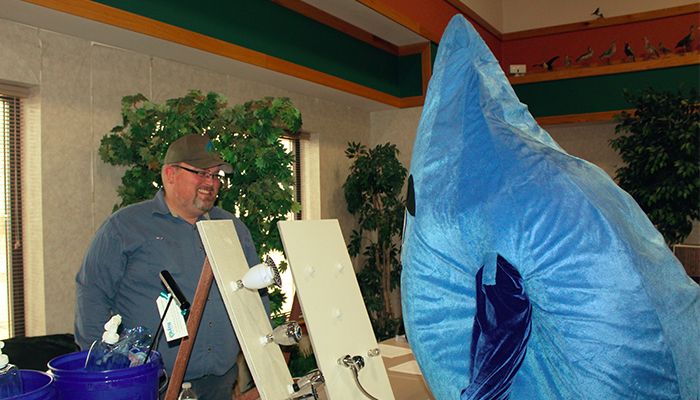
Left to right: Hattie, 3, Skyler, 5, and Summer, 8, Simpson of Hays use cereal and marshmallows to construct edible soil layers Thursday at the Water Fun Fest at the Sternberg Museum.
The Hays Water Resources Department hosted hundreds of children and their parents Thursday during the second-annual World Water Day Fun Fest at the Sternberg Museum of Natural History.
Attendees learned about low-flow shower heads, the water table, where to find water in the environment and how to prevent water pollution.
The Water Resources Department gave away shower timers and offered crafts and a coloring contest to remind children to conserve water. Water conservationists urge people to take a five-minute shower or less.
Free jar openers reminded water consumers to avoid sending fats, oils and greases down water drains, because they clog pipes.
Christine Albrecht helps her daughter, Lauren, 7, complete a water droplet craft at the World Water Day Fun Fest Thursday at the Sternberg Museum.
Jeff Crispin, Hays director of water resources, was also giving away toilet dye tabs. You place the tabs in your toilet tank, and if the dye shows up in the toilet water, you have a leak that needs to be fixed. About 1,500 of these packets will soon be going out to local students. You can also pick up packets for free at the city of Hays offices.
“We are trying to bring kids out and parents out to educate them about the importance of saving water and doing everything they can to save water at home, or anywhere for that matter, and how important water resources are,” Crispin said.
The youth and parents were also able to see a tower of 91 gallons of water jugs, which is representative of the per capita water usage of a Hays resident per day.
Crispin said Hays residents use less water than any other city in the state, but we still need to and can do better.
Holly Dickman, water conservation specialist, said the event has been a good opportunity to reach both children and adults with the messages of water quality and conservation.
A volunteer with the watershed district demonstrates how contaminants can make their way into the water table.
“From little on up, it is amazing when I do school programs how much those little kids who live here in Hays already know because they have heard it for awhile,” Dickman said. “Any time we can reiterate that it is best to conserve and it is best to be conscience of water usage and what we are doing with our water is a good thing.”
Stacie Minson, KSU watershed specialist, was also on hand to offer activities and demonstration centers based on water conversation. She said she was trying to educate kids about how dynamic their water system is.
The watershed had a display of different types of pollutants that can get into the watershed, including pet waste, herbicides, soil sediments, chemicals and fertilizers.
The children used cereal and marshmallows to build edible soil layers.
Water$mart Wally and others stand in front of a display of 91 gallon bottles, representing the per capita water usage of Hays residents each day.
“They eventually will become adults who have to pay the utility bills and have to make sure when they turn a faucet on they have a clean, safe water supply. ” Minson said of the children.
A.J. Hill, water plant operator, was available to inform attendees about some of the many rebate programs the city offers.
The city offers rebate programs for high-efficiency wash machines, low-flow toilets , turf conversion and preferred and acceptable trees. Local officials also offered information about xeriscaping, which uses native, drought tolerant plants to conserve water in landscaping.
You can learn more about water conservation, city rebate programs, water-smart landscaping and city water rules on the city of Hays website.
MANHATTAN — The Kansas Department of Agriculture is accepting applications for the 2019 Specialty Crop Block Grant Program. Funds for the program are awarded to the agency by the U.S. Department of Agriculture’s Agricultural Marketing Service. The funds are in turn granted to projects and organizations that promote the competitiveness of specialty crops.
The purpose of the Specialty Crop Block Grant Program is to enhance the competitiveness of specialty crops. Specialty crops are defined by the USDA as “fruits, vegetables, tree nuts, dried fruits, horticulture, and nursery crops, including floriculture.”
Each state that submits an application that is reviewed and approved by the Agricultural Marketing Service is to receive an estimated base amount of $201,973.63 plus an amount based on the average of the most recent available value of specialty crop cash receipts and the acreage of specialty crop production in the state. In 2018, Kansas received $348,848.12 for the grant program. In 2019, it is expected that Kansas will receive approximately $373,500.
Applications will be evaluated by a team of external reviewers. The team will rate proposals on their ability to successfully promote specialty crops in Kansas and make a positive impact on the Kansas economy. Those recommendations will be submitted to the Kansas Secretary of Agriculture, who will make the final awards.
Applications are due to KDA no later than 5:00 p.m. on April 19, 2019. For more information about the Specialty Crop Block Grant program or to complete the 2019 application, go to the KDA website at agriculture.ks.gov/SpecialtyCrop or contact Peter Oppelt, KDA economist, at 785-564-6726 or [email protected].
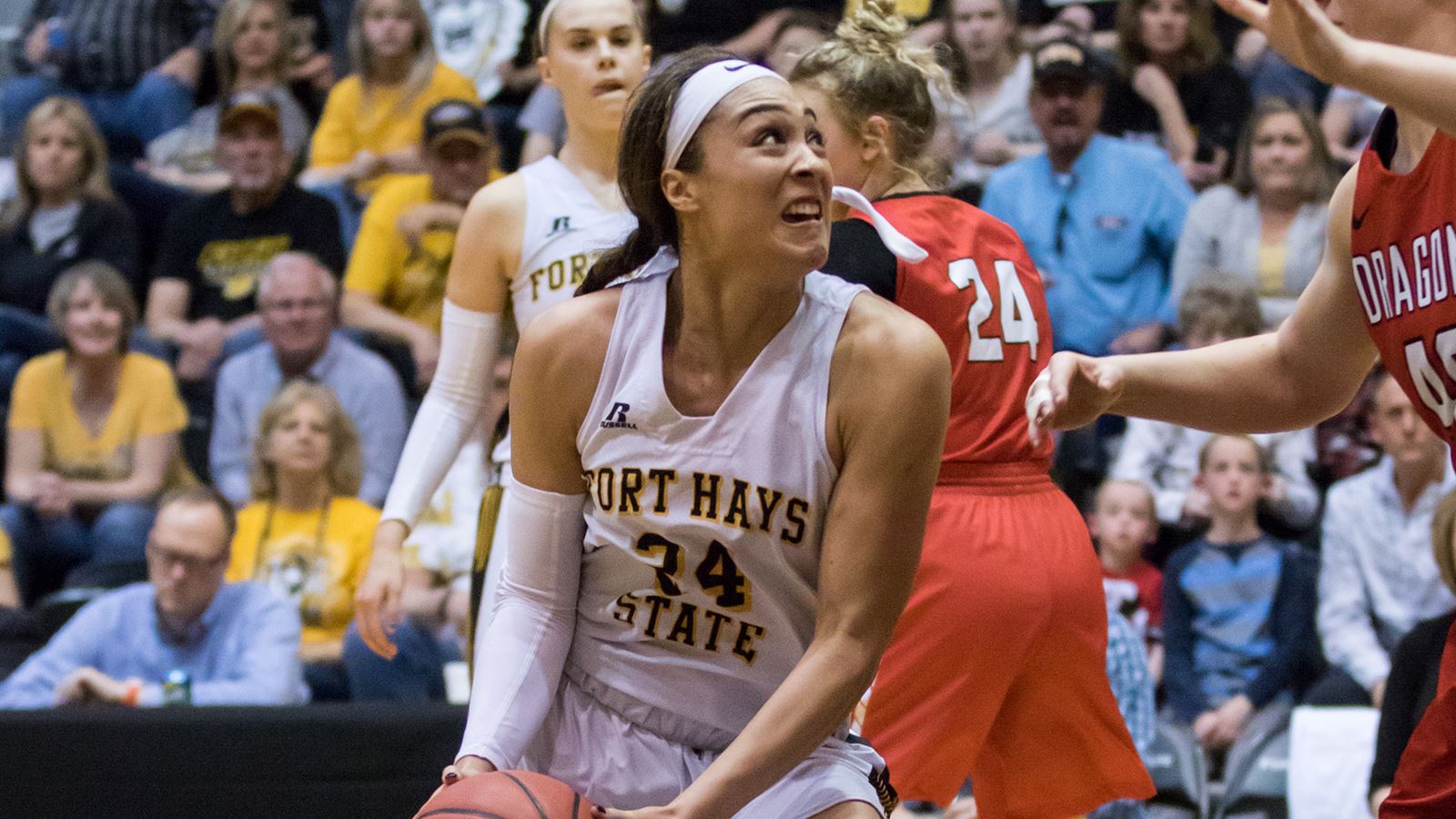
HAYS, Kan. – The third-ranked Fort Hays State women’s basketball team built a 14-point third quarter lead then held on down the stretch to fend off MSU Moorhead 71-60 Saturday in front of a raucous Gross Coliseum crowd of 3,725. The Tigers (32-1) advance to Monday’s NCAA II Central Region championship game where they will play seventh-ranked Southwestern Oklahoma State, the second seed in the regional. The Bulldogs hit a last second 3-pointer to knock off defending national champion Central Missouri 78-75 earlier in the day.
The win was Fort Hays State’s 18th at home this season and extends their home court win streak to 25 straight, both matching program records.
FHSU Postgame Press Conference
Game Highlights
The Tigers got off to their second straight slow start and trailed by three early on after hitting just three of their first 13 shots. A put-back layup from Kacey Kennett with just over three minutes left in the opening quarter sparked a run of five-straight makes for the Tigers that stretched into the second quarter. Tatyana Legette tied things up at 14 with a layup before a left wing three-pointer from Madison Mittie put the Tigers in front for good.
Lanie Page splashed in a three early in the second frame before Belle Barbieri added two points on a layup to put the Tigers in front by nine following an 11-0 run. The lead hovered between four and nine for the rest of the half before MSUM went into the locker room down six thanks to a buzzer-beating three-pointer from Kiley Borowicz.
Fort Hays State used a 12-2 run in the middle of the third stanza to go in front by 14, 50-36, aided by back-to-back three-pointers from Kennett and Mittie. But the Dragons would not go away without a fight, scoring the next eight points to cut within six. MSUM hit another three at the buzzer to wrap up the third quarter, trimming the Tiger lead to seven with 10 minutes to play, 54-47.
The Dragons were within one possession on two occasions in the fourth quarter, but three-straight makes from Taylor Rolfs, Kennett and Barbieri pushed the Tiger lead back to nine with just under five minutes to play. Solid defense down the stretch helped the Tigers secure the win, limiting MSUM to just four made shot in their final 14 attempts.
The Tigers made the most of their size advantage, getting to the line 25 times (19-of-25, 76 percent) compared to just four free throw attempts for MSUM. Fort Hays State held a slight edge in rebounding, grabbing 37 boards compared to 34 for the Dragons.
After scoring 12 points in the first half, Legette finished the contest with a game-high 21 points, adding four assists, two big blocks and five rebounds. Kennett added 13 points while Barbieri added her sixth double-double and fifth in the last nine games thanks to 12 points and 10 rebounds despite playing only 18 minutes due to foul trouble. Page put up 10 points while Mittie added six after a 2-for-3 effort from behind the arc.
Notable:
The Tigers are now 15-2 against NSIC programs under head coach Tony Hobson
FHSU moves to 5-4 all-time in the NCAA Tournament
KANSAS CITY, Mo. (AP) — Lindell Wigginton found his way to Iowa State from Canada, Marial Shayok took a detour through the University of Virginia, and Michael Jacobson started his career at the University of Nebraska.
Three players from three very different backgrounds now have something in common: a title.
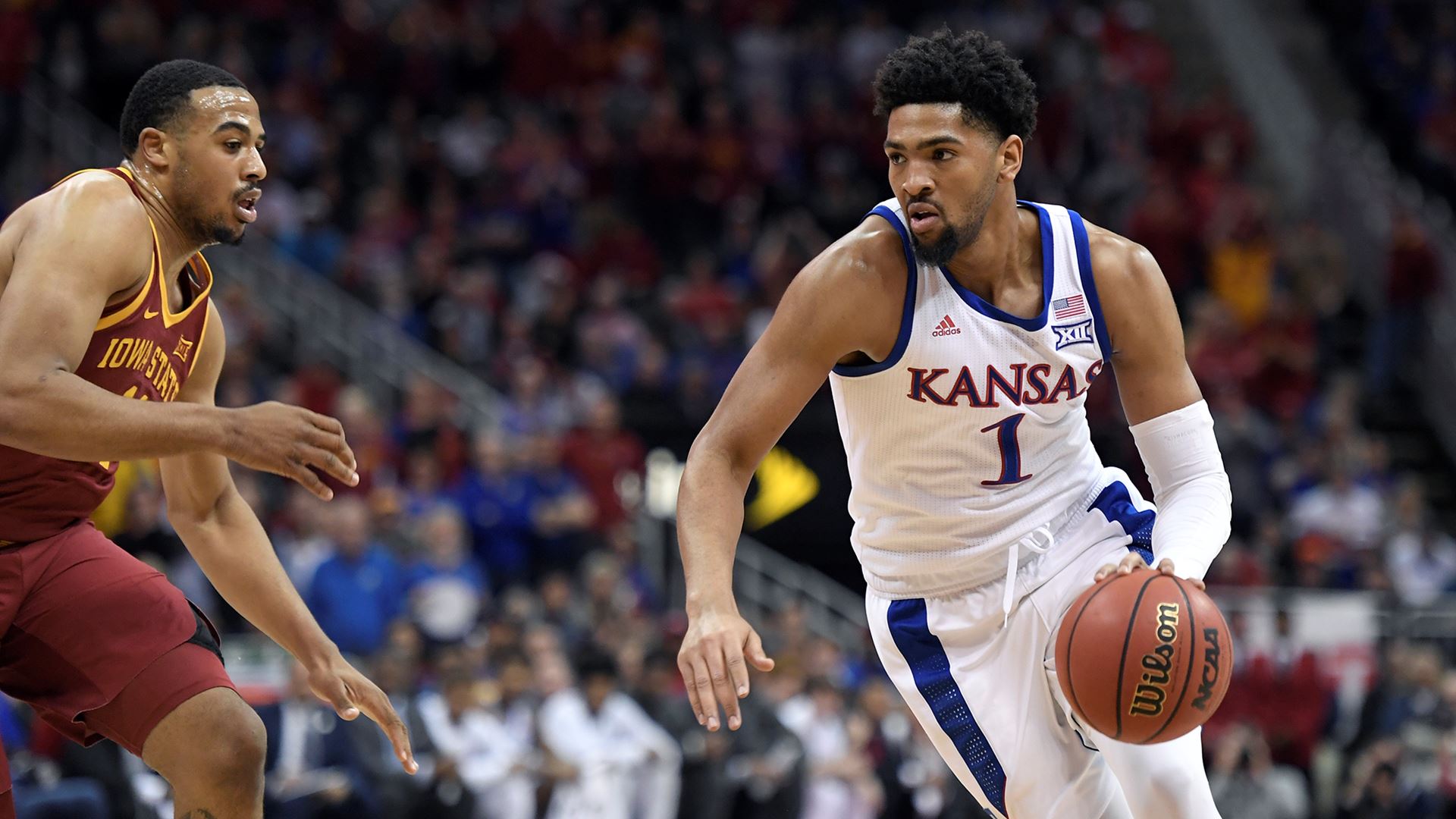
The trio helped the fifth-seeded Cyclones race to a big early lead against No. 17 Kansas on Saturday night, then contributed to enough crucial stops down the stretch, preserving a 78-66 victory over the Jayhawks in the Big 12 Tournament finale at Sprint Center.
“When you do something special, you win a championship, you got a connection for the rest of your life,” said Cyclones coach Steve Prohm, who brought together his team from far and wide.
“Hopefully this is just step one. We’ll enjoy this for a while, figure out where we’re going for the NCAA Tournament and then we’ll focus on that.”
Wigginton finished with 17 points, Shayok had 15 on his way to winning tournament MVP, and Jacobson finished with 14 for the Cyclones (23-11), who became the lowest-seeded team ever to win the conference tournament. They also improved to 2-0 against Kansas (25-9) in the finals.
“I think it was our best team win of the year because it was gritty,” said Shayok, who like Jacobson sat out last season after transferring. “Everybody stepped up.”
Dedric Lawson had 18 points and Devon Dotson added 17 for the third-seeded Jayhawks, whose last chance to win some hardware will be the NCAA Tournament. Their run of 14 consecutive regular-season crowns ended last weekend, and they failed to defend their Big 12 Tournament title.
“The way we competed, we showed some signs where we really wanted to win this game,” Dotson said. “But they hit some tough shots. We were missing some of our easy shots we usually make.”
Meanwhile, the Cyclones made a tremendous about-face during their stay in Kansas City.
They arrived having lost five of their last six regular-season games, and looked rudderless in losses to Texas and lowly West Virginia. But beginning with a blowout of Baylor and continuing with a quarterfinal win over regular-season champ Kansas State, the Cyclones found their stride.
The Jayhawks, still looking for their own, were fortunate to trail 32-22 at halftime.
Lawson, who had 24 points in the semifinals, was 2 of 11 from the field. Marcus Garrett was 0 for 6 from the floor and 1 of 4 from the foul line. Quentin Grimes was 0 or 4 from beyond the arc after hitting five 3-pointers in their win over the Mountaineers on Friday night.
All told, the Jayhawks shot 27.8 percent from the field and missed all nine of their 3-point attempts in the first half. They also were just 2 of 8 from the free-throw line.
“Just one of those nights,” Grimes said. “Every one of the shots we put up was a good shot.”
Iowa State had its own trouble on the offensive end of the floor, getting five shots swatted into the seats. But the Cyclones were effective at getting to the rim, and easy layups by Wigginton and Tyrese Haliburton allowed them to take control.
Their lead swelled to 41-24 early in the second half. And even when the Jayhawks managed to nip into it, they would inevitably miss an open layup or throw the ball away.
Or, Jacobson would knock down an unlikely 3-pointer.
That was the case when the Jayhawks trimmed the deficit to 45-35 with 14 minutes to go. Iowa State’s big man calmly drained one from the top of the arc — all Kansas coach Bill Self could do was smile in disbelief — and Steve Prohm’s squad promptly ripped off seven straight points.
“We just didn’t make those plays that you need in order to put some real game pressure on them,” Self said. “They were better than us, make no mistake.”
Frustration eventually set in for the Jayhawks down the stretch.
After cutting their deficit to single-digits on several occasions, including 72-63 with 1:21 to go, the Cyclones kept answering. And after Grimes was called for a foul on Wigginton, Lawson spiked the ball under the basket and was whistled for a technical foul.
Shayok made the two technical foul shots, Wigginton made two more, and the chants of “Let’s Go Cyclones!” began to reverberate throughout Sprint Center in celebration of another title.
“This is a special night. Kansas is a tremendous program,” Prohm said, “and you can talk about Coach Self forever. But our guys answered the bell We came down here and won each game in different ways. We showed our toughness. We showed our togetherness.
BIG PICTURE
Iowa State has leaned on Shayok and Talen Horton-Tucker much of the season, but Wigginton and Haliburton shined in Kansas City. Wigginton is averaging more than 15 points over his last five games while Haliburton continues to lead the Big 12 in assist-to-turnover ratio.
Kansas started freshman center David McCormack, but the Cyclones’ guard-oriented lineup forced the Jayhawks to match their personnel. Charlie Moore and the rest of their guards struggled shooting the ball, and they were unable to get crucial defensive stops down the stretch.
UP NEXT
Both teams will learn their NCAA Tournament destinations Sunday.













 Today
Today