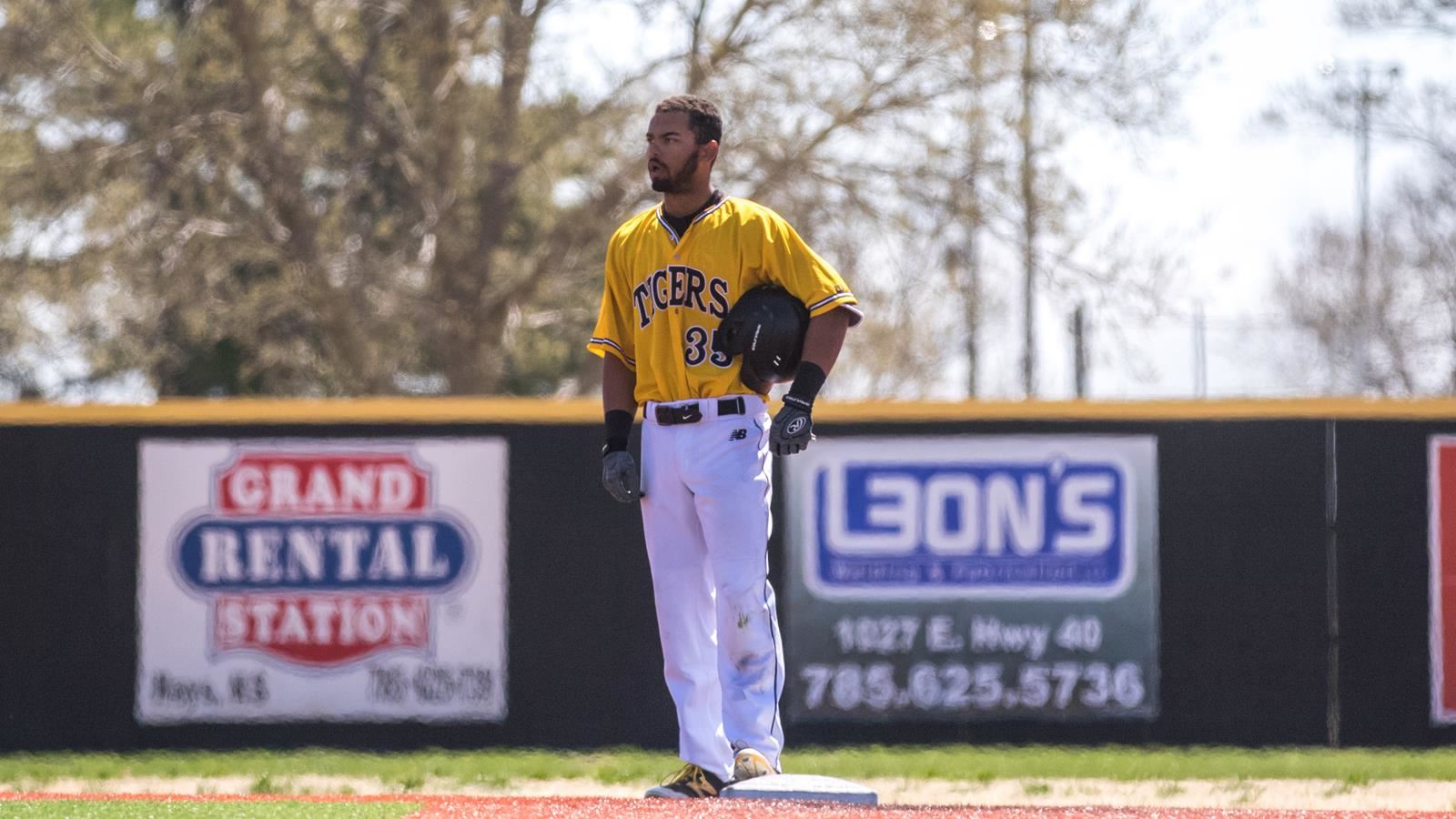
HAYS, Kan. – The Fort Hays State baseball team couldn’t capitalize on a couple of bases-loaded situations and drop their series finale with Washburn 13-2 Sunday afternoon at Larks Park. The Tigers have now lost 10 straight and fall to 3-31 overall and 2-22 in MIAA play. Washburn has won five straight and six of seven and improve to 18-17 on the season and 11-13 in conference action.
Jerod Goodale Postgame Interview
Game Highlights
After Washburn took advantage of two infield hits to score two runs in the top of the first inning, the Tigers came back to load the bases with one out in the bottom of the inning but managed only one run a Jared Manath sacrifice fly to left field.
Trailing 9-1 in the seventh, the Tigers again loaded the bases but only scored once on Marcus Altman’s bases-loaded walk.
The Ichabods scored four in the second then like they did all series, scored their final seven runs in the final four innings. Washburn scored 27 of their 36 runs on the weekend after the fifth inning.
FHSU produced 10 hits on the day and had three hitters with multi-hit days. Landon Erway, Taylan Mullins-Ohm and Bryce Baumwart each had two hits. Tyler Olson, Ryan Stoecklein, Marcus McDaniel and Caleb Egan (as a pinch hitter) tallied the other four hits for the Tigers.
Starter Tanner Smith (0-4) pitched a season-high 6.0 innings for the Tigers , allowing seven runs on 10 hits with five walks and four strikeouts. Jake Vieira, Wyatt Schumacher and Cody Starkel all pitched an inning of relief with each reliever allowing two runs.
FHSU will begin a six-game road trip next weekend when they make their way to Edmond, Okla. to face the Central Oklahoma Bronchos (April 18-20). The series is ahead one day due to the Easter holiday on Sunday. First pitch on Thursday is scheduled for 7 p.m. inside Wendell Simmons Field.
TOPEKA, Kan. (AP) — A Shawnee County jury has convicted a man of second-degree murder in the July shooting death of another man.
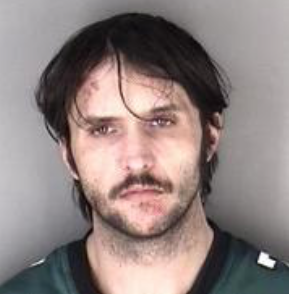
Foster -photo Shawnee Co.
The Topeka Capital-Journal reports that 33-year-old Tony Lee Foster was convicted Friday of second-degree murder and a weapons count in the July 9 fatal shooting of 36-year-old David Payne, of Topeka.
Officers responding to report of a shooting at a home in the northern part of the city found Payne with a gunshot wound to his torso. He was rushed to a hospital, where he later died.
Foster will be sentenced at a later date.
He has six previous convictions for drugs, burglary and assault, according to the Kansas Department of Corrections.
TOPEKA – The Kansas Department of Commerce is excited to announce 2019 Small Business Procurement Day.
A celebratory event will be held on Tuesday, May 7, 2019 from 9:00 a.m. – 3:00 p.m.at the Capitol Plaza Hotel in Topeka.
This free event will provide an opportunity for small businesses to connect with federal agency buyers and contracting officers to determine contracting and procurement opportunities. There will also be a one-on-one Agency-Vendor Engagement Session and training session to learn about resources that will be helpful to the growth and development of small businesses in the procurement market space, including Contracting 101 and FedBid/GSA Purchasing.
Lieutenant Colonel Robert Bartruff, Commander of the 923rd Contracting Battalion (CBN)/Mission and Installation Contracting Command (MICC) will lead the morning welcome. Secretary of Commerce David Toland will join him in providing welcoming remarks.
“Small businesses are the heart and soul of the Kansas economy,” Secretary Toland said. “The Department of Commerce is thrilled to be able to help this state’s small business community grow. Entrepreneurship is alive and well in Kansas, and we’re proud to help foster that spirit across the state.”
Organizations planning to attend the event include Ft. Riley Contracting Command, Whiteman Air Force Base 509th Contracting Squadron, Kansas Army and Air National Guard, McConnell Air Force Base, the Kansas Department of Commerce, MICC Office of Small Business Programs, City of Topeka, U.S. Department of Agriculture, GSA Department of Small Business and the Small Business Administration. Agency participation from Federal, State and local entities is currently still available.
If your organization would like to be included, please contact Kristi Dunn at [email protected] for further information.
The Lead Agency for this event has been the 923rd CBN/MICC-Fort Riley office headquartered at Fort Riley, KS. Other partners and co-sponsors include the Kansas Procurement Technical Assistance Center (KS PTAC), Greater Topeka Partnership, GO Topeka-Entrepreneur Minority Business Development (EMBD), the Kansas Department of Commerce, Office of Minority and Women Business Development and Wichita State University. This is a regional event that is open to all small businesses and contracting organizations.
All categories of small business are invited to attend. To register for Procurement Day, visit this link.
NEW YORK (AP) — Hembert Figueroa just wanted a taco.
So he was surprised to learn the dollar bills in his pocket were no good at Dos Toros Taqueria in Manhattan, one of a small but growing number of establishments across the U.S. where customers can only pay by card or smartphone.
Cash-free stores are generating a backlash among some activists and liberal-leaning policymakers who say the practice discriminates against people like Figueroa, who either lack bank accounts or rely on cash for many transactions.
Figueroa, an ironworker, had to stand to the side, holding his taco, until a sympathetic cashier helped him find another customer willing to pay for his meal with a card in exchange for cash.
“I had money and I couldn’t pay,” he said.
The issue got some high-profile attention this week when retail giant Amazon bowed to pressure from activists and agreed to accept cash at more than 30 cashless stores, including its Amazon Go convenience stores, which have no cashiers, and its book shops. Amazon declined to say when the change would happen.
There is no federal law that requires stores to accept cash, so lawmakers are working on the issue at the state and city level.
Earlier this year, Philadelphia became the first city to ban cashless stores, despite efforts by Amazon to dissuade it. New Jersey passed a statewide ban soon after, and a similar ban is working its way through the New York City Council. Before this year there was only one jurisdiction that required businesses to accept cash: Massachusetts, which passed a law nearly 40 years ago.
SHERMAN COUNTY — Three people were injured in an accident just before 3:30a.m. Sunday in Sherman County.
The Kansas Highway Patrol reported a 2015 Chevy Silverado driven by Nicole Weber, 27, Sebastian, Florida, was eastbound on Interstate 70 eight miles east of Goodland.
The pickup rear-ended a 2010 Dodge 350 driven by Jeremy Ty Severe, 48, Medford, Oklahoma, and continued to travel entering the south ditch and came to rest.
The Dodge continued eastbound crossing the median into the westbound lanes and came to rest in the north ditch.
Weber, Severe and a passenger in the Chevy David Michael Bragg, 26, Fellsmere, Florida, were transported to the hospital in Goodland, Bragg and Severe were not wearing seat belts, according to the KHP.
WASHINGTON – U.S. Senator Jerry Moran (R-Kan.) has joined a bipartisan group of colleagues in calling on Amtrak to continue service to rural communities in Kansas and across the United States by investing in long-distance and state-supported routes, including the Southwest Chief.
“We are writing in strong support of Amtrak’s national network, including the long-distance and state-supported routes,” the senators wrote. “These routes serve small, midsize, and rural communities in our states and provide essential connections to jobs, tourism, and family that are critical to the people and places we represent. As you develop Amtrak’s plan for the long-term viability of the company, we urge you to recognize the critical importance of the entire national network, which includes the long-distance and state-supported routes. Once again, we seek your firm commitment that Amtrak will abide by its statutory purpose – maintaining a truly national network for our rail system.”
“Congress purposely created a national network of long-distance and state-supported train service throughout the nation, in recognition of the importance of a transportation system that reaches every community – regardless of how rural it may be,” the senators continued. “Amtrak is more than a collection of individual train routes; it is a web of essential connections that bind our country together and link rural communities with major markets and economic opportunities.”
The letter requests responses to questions about Amtrak’s budgeting process and their future plans regarding long-distance train routes and their interest in introducing new short distance routes. The letter also addresses the changes Amtrak made to long-distance routes last year, such as the removal of ticket agents at stations across the country, and asks when Amtrak plans to restore the services it previously provided passengers.
Sen. Moran has led a bipartisan push to make certain Amtrak maintains train services along the established, long-distance passenger rail route of the Southwest Chief, which runs daily between Chicago and Los Angeles, connecting towns and cities across the western United States and providing train and long-distance passenger service, particularly through rural areas.
The Southwest Chief stops in several Kansas communities, including Lawrence, Topeka, Newton, Hutchinson, Dodge City and Garden City.
The letter was also signed by Senators Tom Udall (D-N.M.), Martin Heinrich (D-N.M.), Michael Bennet (D-Colo.), Pat Roberts (R-Kan.), Cory Gardner (R-Colo.), Catherine Cortez Masto (D-Nev.), Joe Manchin (D-W.Va.), Dick Durbin (D-Ill.), Jon Tester (D-Mont.) and Kyrsten Sinema (D-Ariz.).
We are writing in strong support of Amtrak’s national network, including the long-distance and state-supported routes. These routes serve small, midsize, and rural communities in our states and provide essential connections to jobs, tourism, and family that are critical to the people and places we represent. As you develop Amtrak’s plan for the long-term viability of the company, we urge you to recognize the critical importance of the entire national network, which includes the long-distance and state-supported routes. Once again, we seek your firm commitment that Amtrak will abide by its statutory purpose – maintaining a truly national network for our rail system.
Amtrak’ recent appropriation clearly demonstrates Congress’ strong, bipartisan support for the network. In making this investment, Congress chose to ensure the continued viability of Amtrak’s entire system, including the National Network’s long-distance and state-supported routes. These funds should be used to operate the entire existing system and, where possible, expand the system to grow both revenue and ridership.
Congress purposely created a national network of long-distance and state-supported train service throughout the nation, in recognition of the importance of a transportation system that reaches every community – regardless of how rural it may be. Amtrak is more than a collection of individual train routes; it is a web of essential connections that bind our country together and link rural communities with major markets and economic opportunities. It provides residents of these communities with transportation options on which families, seniors, and businesses rely to access jobs, create economic opportunities, see our beautiful country, and visit family. The federal investment in Amtrak ensures the small, midsize, and rural communities served by Amtrak’s long-distance and state-supported routes continue to receive this essential service. The long-distance and state-supported routes of the national system are no less important than the Northeast Corridor (NEC), another critical aspect of Amtrak service.
The long distance and state supported trains generate more ridership than the NEC and similar levels of revenue. Many long-distance sleeper cars are regularly sold out. The entire national network helps cover Amtrak’s fixed corporate costs such as police, facilities and capital expenditures, particularly when the route shares trackage with the NEC. Continuing and expanding the entire national system of long-distance and state-supported routes is both good for Amtrak’s business, and our national economy.
We look forward to working with you and receiving assurances of your commitment to the national network. For these reasons, we request your response to the following questions by April 29, 2019.
Amtrak customers have already experienced a deterioration in service as Amtrak pursues efficiencies. A recent report in Trains Magazine[1]indicated that Amtrak utilizes accounting mechanisms to inflate costs associated with the national network, by charging long-distance and state-supported routes for costs which may be more appropriately charged to the Northeast Corridor. We are concerned that Amtrak’s accounting is intentionally obscure and is causing a false inflation of costs of lines outside of the Northeast Corridor. Please provide the accounting methods used to determine the costs referenced.
Does Amtrak plan to truncate or otherwise alter any of the long-distance train routes? If yes, then:
Which routes are under consideration for alteration?
Would any of these routes be altered in such a way that they would fall under the definition of State Supported routes, requiring states to find local operating funds for existing service? What discussions has Amtrak had with states, if any, that lead it to believe states would be willing to assume this financial obligation?
Amtrak says it wants to introduce new short distance routes with daytime service and multiple frequencies. What specific routes is Amtrak considering? What discussions—if any—has Amtrak had with host railroads, stakeholders, or government officials regarding these additional frequencies?
Amtrak claims that public demand for its long-distance interstate service is declining. Yet the number of passengers using the total long-distance network in FY 2017—the last year without major service interruptions—was 10.6% higher than it was eight years earlier in FY 2010. It was also higher than in all but three of the last eight years. This growth occurred in spite of worsening on time performance, capacity reductions and other changes to service levels. On what basis does Amtrak claim that demand is declining for long-distance trains?
Amtrak has made a number of changes impacting long-distance routes in 2018 that may reduce revenues and services, such as the removal of ticket agents at a number of stations across the country. Why did Amtrak calculate ridership totals based on weekly boardings on routes that do not run daily? When will Amtrak restore or otherwise alter assistance it provides passengers at stations based on Congressional directives in the Fiscal Year 2019 Appropriations Act?
Amtrak has expressed concern at how the dispatching practices of some host railroads has led to deteriorating on-time performance (OTP). Does Amtrak have a strategy to improve OTP and better interface with the host railroads? Are there policies that would assist Amtrak in this endeavor?
Sleeper cars provide approximately 40-50% of the revenue on many long-distance trains. Please provide us with an update on the 25 sleeper cars that were scheduled to be delivered in 2015 and 2016. Please provide a timeline for completing this order and putting the new cars into service?
Our constituents – in both large and small communities rely on Amtrak service. We look forward to continue to work with you to preserve and expand the long-distance and state-supported routes, and to reviewing your response to our questions.
One of the greatest resources we have in this nation is access to a quality, public education. By teaching our children well, they can go out and improve the world, innovate, and do things differently than they’ve been done before.
That’s why it was disappointing to see the Legislature resist a new and innovative solution, instead gravitating toward the same style of school finance plan that has mired our state in litigation for over a decade.
The Gannon case began in 2010 after the Legislature was unable to keep its promises, failing to fund its school finance plan in the wake of the 2008 recession. Now, here we are again – on the verge of what financial experts predict is another impending recession – attempting to resolve the litigation with another unsustainable plan.
Kids First Plan
Recognizing that the plan proposed by the Governor and the Senate (Senate Bill 16) would repeat the mistakes of those who came before us, the House began conversations with school leaders and the Governor about how to build a sustainable plan – one that would fully fund our schools, not just for a year or two, but for the long haul.
That solution – known as the Kids First Plan – would have:
Followed the court’s directive to pay $126 million in inflation,
Recession-proofed the plan by escrowing $243 million so the state could meet its obligations to our schools in the event of an economic downturn.
Added an estimated $17 million for early childhood programs, recognizing that investments in early childhood education are one of the most effective ways we can close the achievement gap identified by the court.
Added $27 million to expand a children’s mental health pilot program that is seeing results in our schools by identifying young people in need and preventing teen suicide.
Unfortunately, a few days before the Legislature was set to adjourn, the Governor backed away from negotiations on the Kids First Plan and opted instead to push for SB 16, the plan that was ultimately passed by the Legislature. It was a plan that the majority of House Republicans could not support.
Senate Bill 16
Senate Bill 16 contains an often-overlooked provision that commits taxpayers to an automatic annual inflation increase – not just during the life of this plan, but for the rest of our lives and our children’s lives. That means an estimated $100 million more will come due every year – funds that will have to come from our highways, mental health, foster care, our colleges, our nursing homes and other essential services. These areas of the budget will be made to suffer even more because of SB 16.
Make no mistake: This plan is a promise the Governor and the Legislature cannot keep. According to the budget analysts, sustaining SB 16 relies on six assumptions:
The Supreme Court rules in favor of funding not based in their opinion.
Taxes are raised.
The food sales tax is not lowered.
Money continues to be swept from the highway fund.
The state does not make its KPERS payments, and
There is not a recession.
I’m not willing to take that gamble.
Legislators on both sides of the aisle care about public education, and are committed to ensuring that every kid has every opportunity to succeed. Our shared priority for funding our schools is evident in the fact that many of us – myself included – have voted for $3.13 Billion in new funding over the past two years. The vote on SB 16 was not about who loves schools and who doesn’t. It was about whether we want to make promises we can keep.
As parents, we serve as role models for our kids. Repeating the mistakes of those who came before us is not the right example to set. As legislators, we have a responsibility to think beyond what is politically expedient in the short-term, and to be disciplined enough to form long-term, sustainable solutions that will carry our schools and our state forward. Senate Bill 16 is not the long-term, sustainable solution that our children and our teachers deserve. As Kansans, we can do better.
TOPEKA, Kan. (AP) — A Kansas legislator is suggesting that the state treasurer should drop his bid for the U.S. Senate because he “needs to be at home, helping to raise his young children.”
State Treasurer Jake LaTurner responded Friday that state Sen. Gene Suellentrop’s comments were “cowardly.”
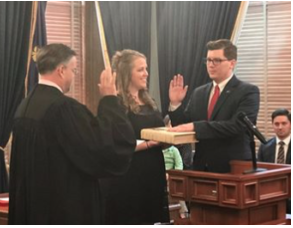
Jake LaTurner was sworn in April 2017 as the 40th Kansas State Treasurer-Photo office of Kansas Governor
LaTurner is a Republican running for the seat held by four-term GOP U.S. Sen. Pat Roberts, who is not seeking re-election in 2020. LaTurner is the only candidate to have filed so far, but at least seven other Republicans are considering the race.
The 31-year-old LaTurner has four young children.
Suellentrop is a 67-year-old Wichita Republican and made his comments about LaTurner in a tweet responding to a news report about the race.
LaTurner replied that Suellentrop should “be a man” and talk to him personally.
Bronc Rumford has become a pro at improvising over the years.
So the Fort Hays State University rodeo coach didn’t give it a second thought when he realized that Easter would fall on the same weekend as the FHSU Rodeo this year.
The rodeo is annually scheduled for the third weekend of April at Doug Philip Arena. To accommodate for the Easter holiday, the 2019 NIRA event will be shortened from three days to two.
“We’ve had rain, wind, snow and 26 degrees,” Rumford said. “One year we had to cancel Friday’s events because of rain and mud, but we were able to get it all in on Saturday and Sunday. We are used to making adjustments.”
Rumford stressed that all the traditional events will still be held at the 53rd annual rodeo, including crowning the Fort Hays State Rodeo Queen during Friday night’s performance.
“We will just have more kids in the two days of slack,” Rumford said of the overflow number of contestants in certain events. “We’re even going to still have Cowboy Church.”
The church service, ordinarily held on Sunday morning of the rodeo weekend, is scheduled for 5 p.m. Saturday this year. Public performances begin at 7 p.m. both Friday and Saturday.
Events for the nearly 500 competitors from 22 schools in the Central Plains Region are: bareback bronc riding, bull riding, calf roping, cowgirls barrel racing, cowgirls breakaway roping, saddle bronc riding, steer wrestling, team roping and tie-down roping.
CORRECTION: A news release distributed Friday contained incorrect information on student admission for the Fort Hays State University Rodeo the weekend of April 19 and April 20.
Admission this year is $5 for Fort Hays State students with Tiger ID, which is a change from past practice.
Public performances begin at 7 p.m. both Friday, April 19, and Saturday, April 20. The Cowboy Church service, ordinarily held on Sunday morning of the rodeo weekend, is scheduled for 5 p.m. Saturday this year to accommodate Easter celebrations.
Events for the nearly 500 competitors from 22 schools in the Central Plains Region are: bareback bronc riding, bull riding, calf roping, cowgirls barrel racing, cowgirls breakaway roping, saddle bronc riding, steer wrestling, team roping and tie-down roping.
Tickets can be purchased at the Student Service Center in FHSU’s Memorial Union; Orscheln Farm & Home, 2900 Broadway Ave.; and Vanderbilt’s, 2704 Vine. Advance ticket prices are $10 for adults and $5 for children. Prices at the gate will be $12 (adults) and $8 (children).
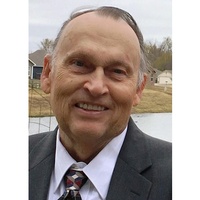
Sherman John Verhoeff, age 80, of Collinsville, Oklahoma and formerly of Grinnell, Kansas, died on Tuesday, April 9, 2019, in Tulsa, Oklahoma, from congestive heart failure. Sherman was born July 6, 1938, in Hays to John and Marie (Ashley) Verhoeff. He was raised in Grinnell and graduated from Grinnell High School in 1956. He was in the Kansas Army National Guard and attended college in Hays, majoring in electrical engineering, and where he met his future wife and lifelong partner, Donnie Regagnon. Sherman farmed with his two uncles and father in Grinnell.
Sherman married Donnie May (Regagnon) on November 7, 1957. Sherman and Donnie moved to Kansas City in 1958 where he received his degree in Electrical Engineering. After his graduation he moved back to Grinnell and eventually had his own farm and ranch where he and his wife, Donnie, raised purebred Charolais cattle under the name Broken Bar Charolais. Sherman was an active member of the Bluestem Charolais Association and attended cattle shows, conferences, and meetings throughout the United States.
Sherman and Donnie were blessed with two daughters, Debbora and Sharon, who also attended school and graduated from Grinnell. Both girls were active in local 4-H and Sherman participated as a 4-H leader.
Sherman was always intrigued with flying and eventually he and Deb received their private pilots’ licenses together in 1976. They and the family often traveled in their Cessna 172 to visit family and friends throughout the Midwest.
Sherman was a member of the Methodist Church in Grinnell, and was baptized and married in the Church of Jesus Christ of Latter Day Saints in Larned, Kansas. He attended the Ranch Creek Ward of the LDS church in Owasso, Oklahoma.
Sherman is survived by his wife, Donnie M. (Regagnon) Verhoeff; daughters, Debbora Verhoeff, of Owasso, and Sharon Verhoeff, of Quinlan, Texas, seven grandchildren: Justin Dawson, Dallas Allen, Savanna Payne, Shawn Dawson, Jacob Allen, Amanda Paul and Garrett Paul; and eight great-grandchildren: Keira and Connor Dawson; Gwendolyn and Roselyn Allen; Colleen, Leah and Danny Marie Payne and Christopher L Bunton.
He was preceded in death by his parents, John and Marie Verhoeff, and uncles: Joseph Verhoeff and Marion Verhoeff, also from Grinnell, Kansas.
Sherman will always be remembered for his warm smile, caring attitude and joyful personality.
Funeral service: 1:00 p.m. Monday, April 15, 2019 at Kennedy-Koster Funeral Home, Oakley. Visitation: 11:00 a.m. to service time, Monday, at the funeral home. Interment in Grinnell Township Cemetery with military honors. Memorials: Grinnell Township Cemetery Fund in care of Kennedy-Koster Funeral Home, P.O. Box 221, Oakley, KS 67748.
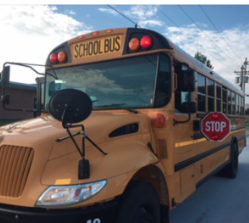
Ray Alvarez remembers the summer he couldn’t make ends meet driving children to school.
“I did qualify for food stamps,” the Olathe school bus driver said. “And yes, I accepted them. My income was so low.”
Alvarez has driven buses off and on for a decade. The financial crisis back then upended his livelihood as a mortgage broker, he says.
He and other drivers urged a panel of state senators recently to consider letting them apply for unemployment during the 70 or so days each year when schools are closed for the summer. The bill stalled in committee.
When Kansas school districts contract with private companies for janitors, food service workers, bus monitors and more, those employees can seek unemployment benefits if they can’t find work during the offseason.
Bus drivers can’t. That’s because of a decades-old carve-out in state law that state officials couldn’t explain. The Kansas Department of Labor checked on 10 nearby states and found eight let privately employed school bus drivers apply for unemployment. Two don’t.
Advocates of dropping the state’s carve-out argue it isn’t fair — nor helpful at a time when bus drivers are in short supply here and nationally, and jobless rates remain exceptionally low.
Mimi Horn has driven for the Lawrence school district for five years and says new employees — who earn less and are less likely to snag a coveted summer school route — struggle especially.
Even during the school year, many drivers can count on only a few hours of work each day, making it hard to cover rent, utilities or other bills.
“Two hours in the morning, two hours in the afternoon.” Drivers, Horn said, “have to not pay something in order to pay the other. Rob Peter to pay Paul.”
Could unemployment benefits help?
Starting pay for Lawrence bus drivers is $15 an hour. Pay at Horn’s level of experience is closer to $16. Raises top out after 13 years at $18.
‘I’ve seen some of them, in the summertimes they go to the food banks. They have to rely on food stamps.’
A Teamsters union representative said the company that Lawrence Public Schools contracts with, First Student, has repeatedly raised pay to entice more applicants.
The question is whether letting drivers apply for unemployment during the summer might help companies hire and retain them in Kansas. (The proposed change wouldn’t affect drivers employed directly by public school districts, who still wouldn’t qualify for reasons related to a federal law.)
Sen. Oletha Faust-Goudeau, a Wichita Democrat, urged her fellow senators to think again if they imagine retirees who don’t want a full-time gig will do the driving.
“More and more individuals who are bus drivers transporting our most precious cargo to and from schools — that is their main livelihood,” she said at a legislative hearing. “I’ve seen some of them, in the summertimes, they go to the food banks. They have to rely on food stamps.”
First Student, which lobbied for the bill, says turnover is higher among its drivers in Kansas than in states where its drivers can seek summertime unemployment benefits.
The company brought more than 20 drivers from Minnesota to pick up routes in Wichita that lacked drivers at the start of this school year in August. It raised starting pay to $16 in September.
That helped, a spokeswoman for the company said by email, but “we do believe the bill would further help.” Right now, drivers who quit when school ends often mention the need for summer work.
The unemployment change faces opposition from the Kansas Chamber, the state’s influential business lobby. Taxes paid by businesses fuel the state unemployment fund.
“How do we ensure parity and fairness with the rest of the business community?” Lobbyist Kristi Brown asked senators at a hearing. “When you’re asking a certain group that you anticipate will be a seasonal position to be able to withdraw from that fund, I think there needs to be an expectation for the company that employs them to be paying in appropriately.”
Brown warned against drawing from a once ailing fund that the state fought to make healthy.
Lawmakers sympathetic to the drivers’ plight argued the state would take that into account.
Companies contribute more or less into the state’s unemployment system based on factors such as the size of their payrolls and how often their employees end up on the benefits.
And when a person seeks benefits, the Kansas Department of Labor considers how they became unemployed, how long they worked, whether they’re actively looking for work or turning down jobs, and other details, before paying out.
What about paying drivers year-round?
A representative for First Student told senators the company spends $3,000 to train each new employee, and more just to find them. For every 10 applicants, only two get hired. Hurdles include earning a specialized license and passing a background check for criminal and traffic violations.
Some senators wondered whether the company should explore other options, such as keeping more drivers on its summer payroll to save on recruiting and training.
‘Have you done the cost analysis, if you just simply paid them for 72 days?’
“Have you done the cost analysis,” Topeka Republican Eric Rucker asked, “if you just simply paid them for 72 days?”
First Student says letting employees apply for unemployment would be cheaper, even given that the company would need to pay higher taxes into the state’s unemployment fund.
Moreover, First Student, said if it compensated drivers year-round, that would show up in the price it charges districts.
Celia Llopis-Jepsen is a reporter for the Kansas News Service, a collaboration of KCUR, Kansas Public Radio, KMUW and High Plains Public Radio covering health, education and politics. You can reach her on Twitter @Celia_LJ.
By RAENEE PATTERSON FHSU University Relations and Marketing
With the opportunity to write about the television show “Doctor Who” and tie it in with historical and political perspectives, one Fort Hays State University professor could not pass up this chance.
Long-time “Doctor Who” fan Dr. Eric Lueschner, chair of the Department of English, was published in the book “Doctor Who Twelfth Night: Adventures in Time and Space with Peter Capaldi.”
Peter Capaldi, a Scottish actor, was the 12th actor to play the title role, holding the role from 2014 to 2017.
“I saw a call-for-papers announcement and proposed the topic to the editor,” said Leuschner. “Although my usual scholarship is related to more traditional topics and more canonical authors, I couldn’t pass up this opportunity.”
Leuschner’s essay was titled “‘Chap with wings there, five rounds rapid’: UNIT and the Politics of Doctor Who,” and focuses on the fictional organization UNIT, which was established to investigate and protect the earth from alien threats and has appeared in the show periodically since 1968.
“Examining the depiction of UNIT from a historical perspective reveals how Doctor Who not only satirizes, but also reflects, the political choices faced today. How one defines ‘political’ and what elements of the text are analyzed, such as the changing depiction of UNIT, may reveal ways in which the Doctor Who does and continues to promote ideological and political work,” said Leuschner.
“In this book, the first to address the Capaldi era in depth, international experts on the show explore Capaldi’s portrayal of the Doctor, and Steven Moffat’s role as show writer and executive producer,” says the publisher’s blurb.
“By detailing how UNIT has changed over the years and interacts with the different personalities of the Doctor, I argue in the essay that we can see how the show comments on political issues such as increased militarism and global organization such as the United Nations,” said Leuschner.
The BBC science fiction television series first aired in 1963 and was on British television continuously for 26 years until 1989. It was then rebooted in 2005 with renewed world-wide popularity.
“I’m a long-time fan of the show, having started watching in the early 1980s, when I was in high school, and public television ran old episodes on weeknights,” he said.
This isn’t the first time Leuschner has used “Doctor Who” for academic purposes. Several years ago, an episode was used in one of his classes. “I think it would be fascinating to teach a “Doctor Who” course some time if there were student interest,” he said.
The book was released in the United Kingdom in October of 2018, and in the United States in January of 2019. It is now available for purchase on Amazon.
This book appeals to a variety of people, from fans to scholars, who are looking to learn more about how “Doctor Who” portrayed and understood society.