We have a brand new updated website! Click here to check it out!

Poor People’s Campaign addresses social injustice during stop in Hays

By CRISTINA JANNEY
Hays Post

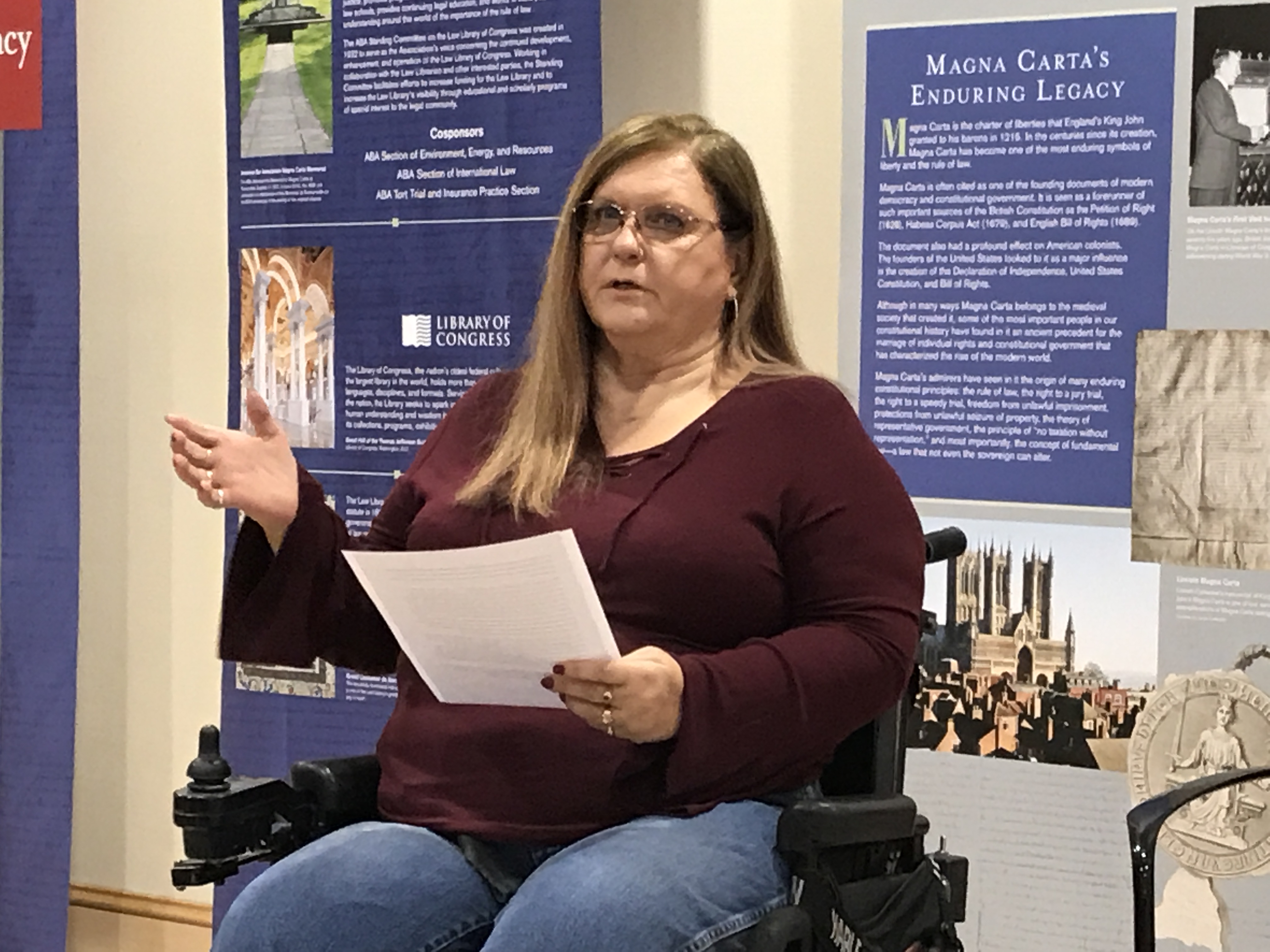
The Poor People’s Campaign made a stop in Hays last Sunday advocating for rights for the disabled, affordable health care and an end to the war economy.

Nathan Elwood, Fort Hays State University librarian and Poor People’s Campaign volunteer, introduced speakers who were local residents and from the national movement.

“We are here to talk about poverty. We are here to talk about economic and social injustice,” he said.

“These aren’t easy comfortable topics to talk about. In fact, from a young age we are taught not talk about these things. We are told it is impolite to talk about money. We are told if we are struggling, we should grin and bare it. We are told not to burden others, but avoiding discussions of the problems we face as a community won’t make those problems go away.”

In Hays, 19.5 percent of residents live below the poverty line, which is higher than the 13 percent national average. Indicators predict the poverty rate will continue to rise despite low unemployment in the area, Elwood said.

Claire Chadwick, a campaign volunteer, is a pastor with a master’s degree, but she is a low-wage worker. She has been poor all of her life. Her father was homeless for a time and they lost their home in the mortgage crisis.

“The reason that I got involved with the Poor People’s Campaign is because it taught me that losing our house in the mortgage crisis — that being a low-wage worker even with a master’s degree — that it wasn’t something that I was doing wrong.

“There isn’t something inherently the matter with me. It is not a character flaw. It is not an accident, but it is a part of a larger system.”

Work can be way out of poverty for disabled

Ellis County resident Lou Ann Kibbee said society needs to give disabled citizens more incentives and support to work.

Ellis County resident Lou Ann Kibbee was disabled 42 years ago. She now works as an advocate for the disabled at the local, state and national levels. She is currently employed at the Skilled Resource Center.

For the first 16 years after her injury, Kibbee received a variety of assistance from government agencies, including Medicare, Medicaid, HUD and Social Security Disability.

“I learned early on that society did not expect me to become employed, because I have a disability” she said.

She was discouraged repeatedly from seeking employment, even by government workers who warned her she would lose her benefits if she got a job. Yet, her disability check was only $570 per month.

Her medical care was not equal to that of private insurance, and although most people on disability also receive food assistance, it is not enough to eat healthy, she said.

Yet, she compared leaving disability for a job to jumping out of a plane without a parachute.

“But I did go to work, because I knew that was my only possibility of getting out of poverty,” she said. “I knew that I needed a pretty good paying job to support myself and a college education to do that and compete with other applicants.”

Today, it takes Kibbee and her husband’s combined income to pay her extensive medical expenses. She pays $14,000 per year alone for attendant care services.

Not surprisingly, as of 2017 only 46 percent of disabled Kansans of working age were employed.

“We try to continue to educate people with disabilities about going to work, but there needs to be more incentives, so that they can afford to make that move,” Kibbee said. “Employers in communities need to be educated more about the capacity of people with disabilities to become employed in integrated competitive employment.”

Thousands of people with disabilities are in nursing homes or institutions waiting for in-home services, because in Kansas in-home services are optional.

“It should be a civil right for anyone with a disability to live in their homes and communities just like anyone else,” she said. “When we live in the community, we are able to earn and spend money, get educated, have families, pay taxes and contribute to our communities.”

Skyrocketing medical expenses

Laura Allen, whose son had to have a heart transplant, said the boy’s medication cost $10,000 for a single month.

Laura Allen, First Call for Help client services specialist, talked about her personal experiences struggling to pay for medication for her son. Allen is a single parent of three children. Two years ago, her son had to have a heart transplant because of a congenital heart defect.

After his last round of rejection, he came home on two kinds of insulin. The bill for less than one month of insulin was $6,500. His anti-rejection medication was another $4,000.

Vera Elwood, a FHSU master’s student, said she and parents planned from the time she was 12 years old and was diagnosed with diabetes to provide for her insulin when she graduated college. The fear was that she would be without health care until she could find a job.

When the Affordable Care Act passed, which allowed young adults to stay on their parents’ health insurance until they are 26, Vera’s whole family cried together. Today, Elwood is covered under her husband’s health insurance. However, she said affordable health care and insulin is still a matter of life or death for her.

“All of these changes that are coming up — getting rid of pre-existing conditions, getting rid of mandatory health care, not expanding Medicaid — these things have real, real impact on 12 year olds who are planning to not die when they graduate college,” Vera said.

Allen added doctors told her if her insurance would not cover the cost of her son’s anti-rejection medication, the doctors were unwilling to do the transplant.

“Because it was a wasted organ without the money and medications to go along with the transplant,” she said.

Working and uninsured

People gathered at the Hays Public Library Sunday to hear speakers from the Poor People’s Campaign.

Twenty-four-year old college student Heather Letourneau is an attendant care worker in Hays. She has no health insurance. It is not provided by her job regardless of the number of hours she works.

“From the outside looking in, it appears that I should have no trouble paying for health care because I make well above minimum wage. When I was working 40 hours a week, I was only getting $1,200 a month, which paid my bills. It did not pay for groceries or gas,” she said.

She noted she cut out all non-necessities and still struggles to pay her expenses.

Letourneau advocated for higher wages and Medicaid expansion to help her and other attendant care worker who do not have insurance.

Veteran against the war economy

Christopher Overfelt served in the Topeka Air National Guard for nine years as an aircraft mechanic and now advocates for a reform of U.S foreign policy and a reduction in military spending.

Christopher Overfelt served in the Topeka Air National Guard for nine years as an aircraft mechanic. During that time, he deployed to Iraq and Turkey.

Overfelt, who is member of Veterans for Peace in Kansas City, spoke about how the U.S. military policy harms poor people in the U.S. and around the world.

“In 2009, I deployed to Turkey and Qatar, and participated in the destruction of two sovereign nations — Iraq and Afghanistan. In Qatar I repaired and maintained the aircraft that refueled the bombers on their way to sew death and destruction in Iraq,” he said.

“Neither of these countries will likely recover from that devastation in my lifetime,” he said. “Nothing I can do will make up for the hundreds of thousands of Afghan and Iraqi men, women and children killed in these wars.”

He said he had no idea when he joined the military that the Department of Defense has never completed an internal audit of its spending despite it being mandated by law.

“It doesn’t know how much money it is spending and how it is spending it,” he said. “It is a black hole for money.”

A 2016 inspector general report indicated the Pentagon could not account for how it spent $6.5 trillion during the last two decades, Overfelt said.

The $600 billion the Pentagon receives does not include additional funding for classified operations by the CIA and NSA. However, Overfelt said insiders estimate this secret budget pushes military spending over $1 trillion per year — a third of the U.S. budget.

“It is no secret there is always enough money for a bigger military and more jails, but never enough for education and the poor,” he said. “Instead of this money going to health care and education for our citizens who so desperately need it, it goes to padding the pockets of weapons manufacturers on Wall Street.”

Overfelt said most of the military funding does not go to fight wars, but to secure American capital across the world.

“Around the world the State Department supports corrupt governments to ensure our access to their resources,” he said. “We take their resources and bring them into our country, and then we build walls to ensure they cannot come here and participate in the wealth we have taken from them.”

Overfelt offered a three-pronged approach to demilitarization including slashing the military budget and reinvesting in health care and other programs, ending the war on drugs, and stopping the war on immigrants.

“The war on immigrants has nothing to do about crime or safety,” he said, “but is purely about ensuring cheap laborers around the world cannot leave the systems they are trapped in. The money flows across international borders, but the workers can’t follow the money.”

For more information on the Poor People’s Campaign, see its website at www.poorpeoplescampaign.org.
Kansas Water Authority to meet in Abilene

KWO

TOPEKA – The Kansas Water Authority (KWA) will meet Thursday, April 18 at the Abilene Civic Center, 201 NW 2nd Street in Abilene, Kansas. The meeting will begin at 10 a.m.

For additional meeting information visit the Kansas Water Office (KWO) website, www.kwo.ks.gov or call (785) 296-3185 or (888) 526-9283 (KAN-WATER).

If accommodations are needed for persons with disabilities, please notify the KWO at least five working days prior to the meeting.

As the state’s water office, KWO conducts water planning, policy coordination and water marketing as well as facilitates public input throughout the state.

The agency prepares the KANSAS WATER PLAN, a plan for water resources development, management and conservation.

Bailey pitches 7 strong innings, Royals beat Indians

KANSAS CITY, Mo. (AP) — Homer Bailey pitched seven innings of two-hit ball and the Kansas City Royals beat the Cleveland Indians 3-0 Saturday night for their second straight win after a 10-game skid.

Ian Kennedy pitched a perfect eighth and Willy Peralta followed in the ninth for his first save to complete the two-hitter.

Ryan O’Hearn homered, and Whit Merrifield and Adalberto Mondesi each had an RBI single for the Royals.

Bailey (1-1), who allowed seven runs, eight hits and two walks in five innings against Seattle on Monday, gave up only a pair of hits to eighth-place hitter Brad Miller. Bailey had won only one of his last 22 home starts, dating to 2016. He went 1-14 with a 7.49 ERA over that span.

Jefry Rodriguez (0-1) gave up two runs and five hits over 5 2/3 innings in his first start with Cleveland. He was acquired in the offseason from Washington in the trade that sent catcher Yan Gomes to the Nationals.

Bailey had not won in an American League ballpark since May 19, 2012, when he won in Yankee Stadium while with Cincinnati.

He suffered a series of injuries beginning near the end of 2014 after pitching a no-hitter in each of the previous two years — Sept. 28, 2012, at Pittsburgh, and July 2, 2013, against San Francisco.

The Royals got on the board in the bottom of the third. Martin Maldonado led off the inning with a double to left center, snapping an 0-for-17 stretch. He moved to third on a flyout to left and scored on Mondesi’s two-out single.

The Royals added another run in the fourth when O’Hearn hit his second homer of the season, 429 feet to right field.

Merrifield had his second hit of the night, a two-out single in the seventh that drove in Hunter Dozier to give the Royals a 3-0 lead.

TRAINER’S ROOM

Indians: SS Francisco Lindor is likely headed to a minor-league rehab assignment as early as Monday. Lindor had a workout on Saturday, running the bases for the second day in a row. Cleveland manager Terry Francona said he’ll go to Louisville to join Triple-A Columbus, if there are “no ill effects, no repercussions of a second-day workout.” Lindor has not played this season due to a right calf strain and a left ankle sprain.

Royals: CF Billy Hamilton was kept out of the lineup for a second straight game with a mild MCL sprain and a bone bruise on his left knee suffered when he crashed into the wall Thursday. Royals manager Ned Yost says he’s about ready. “He seemed a little stiff yesterday but definitely could have played in an emergency,” Yost said. “He feels better today. Let’s see how he feels tomorrow, and we’ll determine where we’re at on the road.”

ROSTER NEWS

Indians RHP Cody Anderson and RHP Rodriguez were recalled Triple-A Columbus. Rodriguez made his first start with the Indians, while Anderson was added to the bullpen. RHP Jon Edwards and OF Jordan Luplow were optioned to Columbus to make room after the bullpen had to throw 7 1/3 innings on Friday.

“Sometimes somebody is a casualty of a game like that,” Francona said. “And I told (Luplow) that. I do think that it’ll be good for him to get at-bats, because he’s young and needs to play. Sometimes there are casualties when a pitcher goes less than one inning. That’s just the way the game is. Sometimes it’s unfair.”

The Indians also are expected to recall OF Carlos Gonzalez from Columbus before Sunday’s game. Gonzalez hit .348 with a home run and three RBIs in six games at Columbus.

UP NEXT

Indians: RHP Corey Kluber (1-2, 3.86 ERA) picked up his first win of the season on April 9 in Detroit, when he gave up two runs (one earned) on seven hits, eight strikeouts and a walk in six innings.

Royals: RHP Jakob Junis (1-1, 5.74 ERA) will go in the finale of the seven-game homestand.

Kansas man faces life in prison for alleged cocaine distribution

KANSAS CITY—A Kansas man has been charged with seven counts of distributing crack cocaine, two counts of unlawful possession of a firearm in furtherance of drug trafficking and one count of distributing 28 grams or more of crack cocaine.

Simpson photo Wyandotte Co.

Lionel Simpson, 21, Kansas City, Kansas, allegedly committed the crimes in February, March and April 2019 in Wyandotte County, according to the United States Attorney. Upon conviction, the charges carry the following penalties:

Distributing crack cocaine (counts 1-5, 7 and 8): Up to 20 years in federal prison and a fine up to $1 million.

Possession of firearms in furtherance of drug trafficking (counts 6 and 10): Not less than five years consecutive to any other sentence imposed and a fine up to $250,000.

Distributing 28 grams or more of crack cocaine (count 9): Not less than five years and up to life imprisonment and a fine up to $5 million.

The Bureau of Alcohol, Tobacco, Firearms and Explosives investigated. Assistant U.S. Attorney Sheri Catani is prosecuting.

Tiger softball hangs on in game two for doubleheader split at Washburn

TOPEKA, Kan. – Fort Hays State bounced back from an 11-2 run-rule loss in game one, hanging on for a 6-4 win in game two to split an MIAA doubleheader with Washburn on Saturday. The Tigers moved to 17-18 overall, 10-10 in the MIAA, while the Ichabods are now 22-20 overall, 13-5 in the MIAA. It was a big win for the Tigers, now in a seventh-place tie in the MIAA standings with Lindenwood with two weeks to go in MIAA play.

Game 1: Washburn 11, Fort Hays State 2
For the third straight game on the weekend, Fort Hays State lost after holding an early lead. Fort Hays State took a 2-0 lead in the second inning only to see Washburn score three runs in the fourth and eight in the fifth to abruptly end the game by run rule. The Ichabods capped their 11 unanswered runs with a grand slam to end the game.

Fort Hays State’s only two hits in the game also produced its only two runs. Sara Breckbill and Allison Jurgensen both hit solo home runs to center field to give FHSU an early 2-0 lead. It was Breckbill’s second homer of the season and Jurgensen’s first.

A triple to lead off the bottom of the fourth inning started the Ichabod rally after Hailey Chapman held them scoreless for three innings. Washburn scored its first two runs of the inning with RBI singles, but benefitted from a Tiger fielding error to set up the third run knocked home in the inning. The Tigers found themselves down by one going to the fifth.

Washburn loaded the bases to open the fifth inning, which ultimately started another big rally. Chapman nearly escaped danger by getting the next two batters out without a run scoring, but the wheels came off when Ashley Ruder drove home two runs with a double. Maddie Stipsits followed that with a two-RBI single. All of the sudden, the Tigers trailed by five. Two more singles loaded the bases once more and then Savannah Moore instantly ended the game with a grand slam.

Chapman took the loss for FHSU, allowing all 11 runs (10 earned) on 13 hits with three walks. She struck out six. Raegen Hamm picked up the win for Washburn, allowing two runs on two hits with two walks and two strikeouts.

Game 2: Fort Hays State 6, Washburn 4
Fort Hays State got out to a lead for the fourth straight game on the weekend, but this time found a way to hang on for its only win of the weekend road trip. Fort Hays State built a 6-0 lead after five and a half innings, but Washburn nearly completed another comeback at the end.

Back-to-back errors by the Washburn shortstop in the second inning turned into the first run of the game for the Tigers. Jeni Mohr reached base by the first error and moved to second on the play. Mohr came into score on another misplay by the shortstop off the bat of Lily Sale.

Elise Capra gave the Tigers a 2-0 lead in the fourth with her team-leading fifth home run of the season, a solo shot to lead off the inning. In the fifth, the Tigers plated two more with an RBI single by Bailey Boxberger and sacrifice fly RBI by Capra. The lead grew to 6-0 in the sixth when Allison Jurgensen delivered a clutch 2-RBI double down the left field line.

Michaelanne Nelson held Washburn scoreless over the first five innings before running into trouble in the sixth. Washburn’s first run of three in the inning came on an RBI single with one out. A throwing error that went into the Tiger dugout allowed Washburn’s second run to score. Washburn drove in the third run on an infield grounder that produced the second out.

Nelson looked poised for a complete game in the seventh, getting the first two batters out. However, the Ichabods had one final push in them. A bloop single followed by a fielding error by the Tigers allowed the tying run to come to the plate in the form of Winter Henry. With two strikes, she laced a well-placed double down the left-field line. All of the sudden, the Ichabods had the game-tying runs in scoring position and a potential winning run at the plate in Taylor Kirk. Adrian Pilkington turned the ball over to Hailey Chapman, who came through in the clutch for the Tigers with a strikeout to end the game.

Nelson moved to 7-9 on the season with the win, while Chapman picked up her third save of the season. Nelson allowed four runs (one earned) on eight hits and two walks. She struck out three.

Bailey Zuniga took the loss for Washburn, allowing four runs (two earned) on seven hits with two strikeouts in 4.1 innings of work. Raegen Hamm pitched the final 2.2 innings for Washburn, allowing two runs on three hits and a walk with three strikeouts.

Tiger Notes
-Allison Jurgensen led the Tigers with 3 RBIs for the day. Her 2-RBI hit in Game 2 was the decisive hit in the Tiger win.
-Michaelanne Nelson produced a 1.08 ERA in her two starts for the weekend. She allowed only one earned run in each contest. Five of the seven runs scored against her for the weekend were unearned.
-Fort Hays State and Lindenwood are tied for seventh in the MIAA, both at .500 in conference play. Pittsburg State, Nebraska-Kearney, and Missouri Southern are all just one game back.

Up Next
Fort Hays State has a midweek non-conference doubleheader with Newman at home on Wednesday (Apr. 17) before heading back on the road for MIAA play next weekend at Central Missouri and Southwest Baptist.

Washburn pulls away in late innings for win over Tigers

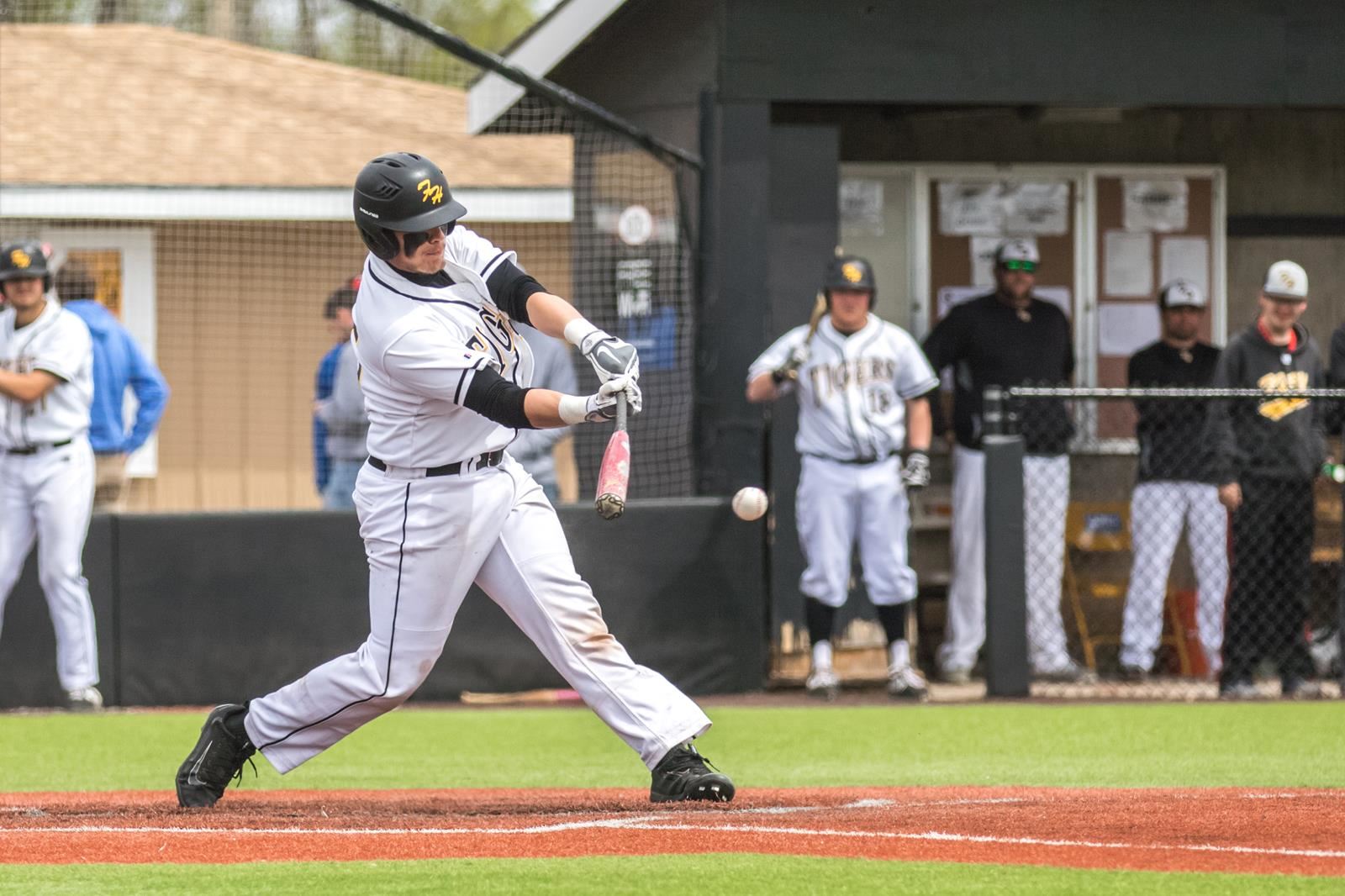
HAYS, Kan. – The Fort Hays State baseball team fell victim to another late Washburn comeback Saturday at Larks Park, falling to the Ichabods 16-8. The Tigers dipped to 3-30 on the season and 2-21 in MIAA play, while the Ichabods moved to 17-17 overall and 10-13 in conference action.

For the second-consecutive game, senior Bryce Baumwart lifted a fly ball over the wall at Larks Park. This time, Baumwart blasted his second home run of the season in the fifth frame with a three-run shot to left field, plating himself, Marcus Altman and Jared Maneth.

FHSU totaled three long balls on the day as Ryan Grasser sent a pitch to the opposite field over the right field wall for a two-run blast in the third inning, scoring Landon Erway and giving the Tigers a 2-1 edge at the time. Tyler Olson joined in on the party with a two-run shot of his own to right field in the fifth frame, plating Erway and pushing the Tigers ahead 4-2 at the time. Baumwart then extended the lead with his long ball, 7-2, after five innings of play.

Tiger starter Jake Taylor tossed 6.0 innings, allowing six runs on four hits, walking two batters and striking out two more. Ryan Brown (1-1) was charged with the loss after relieving Taylor in the seventh inning. Brown threw 1.0 inning, allowing three runs (two earned) on one hit. Cody Rottinghaus finished the game for the Tigers in the final two innings, allowing seven runs (six earned) on seven hits and walking three batters.

Washburn began their comeback bid after the fifth inning, scoring 14 runs in the final four frames.

Jared Maneth led the Tiger offense with a 3-hit game, while Erway, Grasser and Altman produced multi-hit bids on the afternoon. Baumwart totaled four RBI in the contest, with Grasser and Olson picking up two RBI each.

The series will wrap up on Sunday (April 14) at Larks Park. First pitch is scheduled for noon.

Kansas’ stronger beer likely won’t mean bigger buzz

KANSAS CITY, Kan. (AP) — Kansas finally abandoned a Prohibition-era rule that restricted certain stores to only sell beer with up to 3.2% alcohol content, but the stronger beer that’s now allowed doesn’t contain much more alcohol.

Kansas this month ended its law dating back to the 1930s, allowing groceries and convenience stores to stock beer with up to 6% alcohol by volume. Beer drinkers are unlikely to notice a big difference because the outdated law measured alcohol by weight but alcohol is now measured by volume.

Chantel Fletchall, who handles brand registration for the Kansas Division of Alcoholic Beverage Control, said that a 3.2% beer measured by weight contains as much alcohol as a 4% beer measured by volume.

Popular light beers, such as Miller, Coors and Bud Light, are between 4.1% and 4.2% alcohol by volume. For a 12-ounce can of light beer that wouldn’t have been permitted under the old law, it might contain just seven to 14 more drops of alcohol than the 3.2 variety.

Regular beers from the same brands have 5% alcohol by volume, which is roughly three-quarters of a teaspoon more alcohol per 12-ounce can than the 3.2% varieties.

But the change still helps brewers, according to Michael Uhrich, chief economist for the national industry group Beer Institute.

“When you operate a beer business across several states, it’s always easier if you can produce the same products for sale in every state,” he said. “Raising the limit to 6% alcohol by volume won’t mean that every beer will be available in grocery stores, but popular brands will be there, and the brands that will be available will no longer have to be brewed exclusively for Kansas.”

The law change that went into effect this month also allows liquor stores to sell more non-alcoholic products, such as shot glasses, mixers, lottery tickets and tobacco products.

___

FHSU football wraps up spring practice with annual Spring Scrimmage

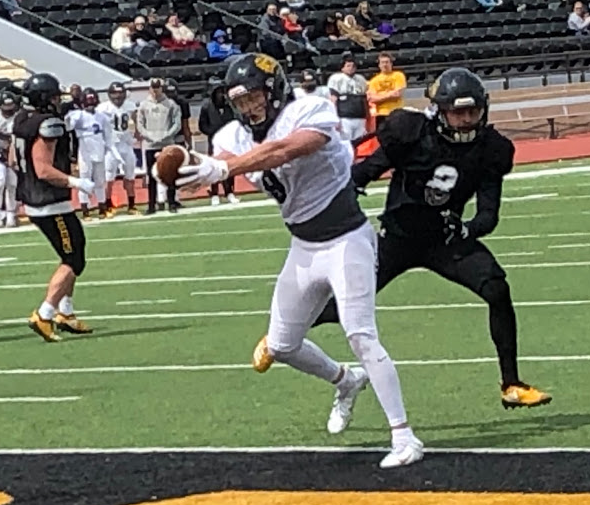
HAYS, Kan. – Last year, Chance Fuller went into the Fort Hays State spring scrimmage as the backup to three-year starter Jacob Mezera. Saturday, he went into the same scrimmage as the Tigers would be starter and he didn’t dissapoint. The sophomore-to-be connected with Harley Hazlett on two long passes setting up a one-yard touchdown strike on the No. 1 offenses first possession. Hazlett hauled in passes of 30 and 34 yards setting up the only touchdown of the day from the first unit.

Coach Chris Brown

QB Chance Fuller

Senior to be kicker Dante Brown made field goals of 28 and 40 yards. The 28-yarder capped a 65-yard scoring drive by the No. 2 offense. That possession was highlighted by a 32-yard completion from redshirt freshman Blake Sullivan to Collyn Kreutzer.

The 40-yarder was with the No. 1 offense and came after an offensive pass interference penalty on Harley Hazlett which took away a potential touchdown. Tight end Jacoby Williams had a 27-yard catch following the pentlty to move the Tigers in field goal range.

Junior college transfter Vashon Waiters, who is battling Sullivan for the backup quarterback spot, engineered a touchdown drive on the final possession of the day but also threw an interception which was returned for a touchdown by redshirt freshman Will White.

Sullivan hit Collyn Kreutzer on an 11-yard touchdown pass but was also picked off in the endzone by Isaiah Creal-Musgray who is returning from an injury that kept him out all of last season. Sullivan also threw an interception to Jordan Starks in the second half.

The Tigers open the 2019 season Thursday September 5th at Central Missouri. They host Missouri Western State in their home opener on September 12th.

MARSHALL: Doctor’s Note April 13

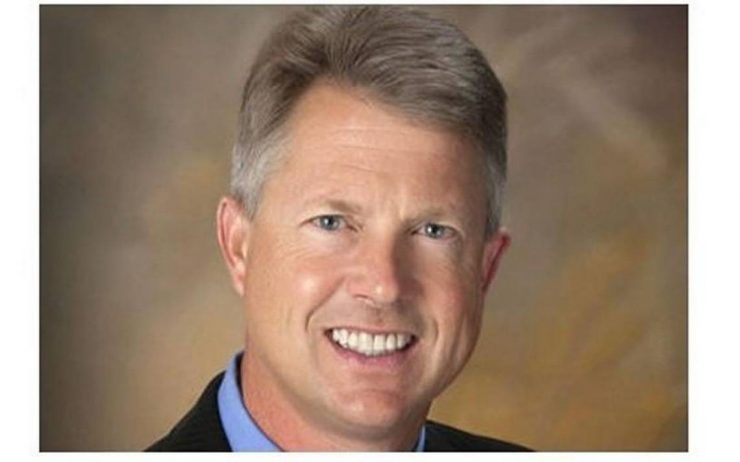
Dr. Roger Marshall, R-Great Bend, is the First District Kansas Congressman.

Friends,

I have long said, in order to fix our broken health care system, we must focus on solutions that prioritize transparency, innovation, and consumerism.

This week I introduced H.R. 2183, The State Flexibility and Patient Choice Act of 2019, this legislation aims to give more power to states so that they have the freedom to develop programs and policies that will focus on cost and patient choice.

As a physician who helped run a hospital for many years, I saw first-hand the hassle that people went through to get the care they needed and the added stress that hospitals and doctors were under doing hours of paperwork for a single patient.

I believe that each state has unique needs and demands and shouldn’t be forced to fit a one-size-fits-all model. This bill lets Kansans make health care decisions for Kansans by eliminating arbitrary guard rails but still mandates that each state possess a plan that will not increase the federal deficit and provide coverage to the same number of citizens in order to get a waiver. This bill also Continues to protect those with pre-existing conditions.

My goal is to help get more people covered and drive down the cost for patients in the process.

ENOUGH!
So far this year I’ve done nearly 20 town halls. At every stop Kansans have told me, ENOUGH of this. Kansans have had it with the Mueller Investigation. I hear you message loud and clear- people are sick of the Russia-mania, Trump tax return pursuit, and all of the Mueller back and forth. I stand with you, I have had enough of it too.

We could accomplish way more if members would focus on actual solutions and solving real problems rather the fantasies. I am embarrassed at how little this Congress has achieved. This week I addressed the House floor to say -ENOUGH- to my colleagues, some I believe need a reminder that we are here to fix problems not create them.

Minister Xu

Talking Trade with China
On Wednesday, I had a productive meeting with Minister Xu of the Chinese embassy. We discussed the US-China relationship and recent progress made by the Trump Administration towards securing a trade deal.

Over the past two years I’ve supported the Trump administration’s efforts to solidify a free and reciprocal trade agreement with China. My conversation with Minister Xu was centered around the high quality beef, grain, and other agriculture exports that hard working Kansans produce every day. Minister Xu expressed her belief that our trade agreement can be a win-win deal for both countries, and to this I absolutely agree.

Looking ahead, I’m hopeful and optimistic that any long-term deal reached with China will include an increase in agriculture purchases. Free trade and access to foreign export markets are vital to our Kansas producers and manufacturers.

It has been made very clear to China that the days of the United States ignoring issues within our trade agreements are over. Congress and this Administration are working around the clock to address the shortcomings in our trade agreements and create better and more efficient deals so that our farmers and ranchers no longer get the short end of the stick.

Susan Schlichting and Jacob Schmeidler, Hays, (at left) pose with Congressman Marshall outside his capitol office. (Photo courtesy Susan Schlichting)

4-H Helping Our Young Leaders Since 1903
I had the great pleasure to sit down with Jacob Schmeidler from Hays, Erin Rose May from Oberlin, Rachel Yenni from Lindsborg, Adelaide Easter from Salina, and Camden Bull from Wichita. We were also joined by Susan Schlichting from Hays, Kansas, who volunteered to chaperone their trip to D.C. for the National 4-H Conference this week.

In our meeting, we talked about the 4-H program and the great work that 4-H does for our young men and women. 4-H was started in 1903 and now has nearly 75,000 members across the state of Kansas. Following our discussion, the 4-Hers joined our team for a night tour of the Capitol.

I was impressed; each of them shared with me their current studies, their goals, and how 4-H has helped them develop life skills and become influential leaders. From examining mental health to promoting entrepreneurship, and ways to end bullying each student presented forward-thinking solutions to improve their communities. This program does an incredible job of developing students leadership and professional skills.
I am excited to see you all succeed and follow your success, and thank you, Susan, for supporting our future leaders!

NASA Selects WSU Professor
In case you missed it, the first ever image of a black hole’s event horizon was released earlier this week. In the wake of this monumental achievement I want to take a moment to congratulate those who accomplished this achievement, and also talk about some of the great space-related work being done in Kansas.

As many of you know I am a member of the House Science, Space and Technology Committee, which has oversight of the National Aeronautics and Space Administration (NASA). Recently, NASA selected Nickolas Solomey of Wichita State University to receive funding for his project to develop a solar neutrino spacecraft detector. The project seeks to build a device that will be able to detect neutrinos in our Sun’s orbit, and eventually this technology will be included on a spaceflight probe. It’s a great opportunity for Wichita State, and this sort of innovation keeps America at the forefront of air and space technology. You can read more about his project here.

Kansas Beer Wholesalers Association

Ice Cold Delicious Beer
The Kansas Beer Wholesalers Association came through the office on Tuesday to give us an update on the work they’re doing not only in my district but across the state. With Congress moving closer toward an infrastructure package, we talked about the importance of road and bridge maintenance not only in their line of work, but also as we work to get other Kansas commodities to market. Our Kansas beer distributors help ensure that products make it from the manufacturer to the retailer, and ultimately (ice cold) into the hands of Royals or Chiefs fans across Kansas for enjoyment during a big game!

Updates from Kansas Housing Authority
Last fall I visited the Salina Housing Authority, there I met with Executive Director Tina Bartlett. Tina and I discussed challenges facing the housing authority and gave me a tour of a couple of their housing properties. It was great to get out and see how the housing authority operates and see firsthand some of the challenges they’re working to address.

Following up on our last visit they dropped by the office this week to give us an update. We had a great conversation about public housing, housing choice vouchers, and community development. Housing is an important part of community and economic development, especially in Kansas. Whether it’s thinking through how to attract new businesses or ways that small towns across my district can maintain safe, reliable and affordable housing is a key part of those conversations. I appreciate the hard work these various housing authorities and others like them are doing across the Big First.

Pharmacists Support Trump’s Plan to Eliminate Unfair Kickbacks
Kansans Pharmacists flew in this past week to discuss the Prescription Drug Price Transparency Act and the Trump Administration’s proposal to get rid of unfair kickbacks to PBMs that harm Medicare beneficiaries, the Medicare Trust, and pharmacists!

Across Kansas, there are 506 chain drug stores and 253 independent community pharmacists and 99 of those local pharmacies are across the Big First. The increase of DIR fees over the last several years has raised out-of-pocket costs for our seniors and put our pharmacies at financial risk, often operating in negative margins. Far too regularly pharmacy benefit managers or PBMs collect DIR fees from pharmacies months and months after the claim. It’s completely unpredictable and unfair… while the benefit all goes to the pocket of the PBM.

The National Community Pharmacist Association and Kansas Pharmacists Association are completely supportive of the Trump’s Administration proposal to stop this from happening. The Trump Administration plan guarantees predictability by standardizing the process and end the disparity between pharmacists, patients and PBMs. It is estimated the beneficiaries could save anywhere from $7 to $9 billion over the span of ten years. Additionally, the government could save $17 billion.

ALSO A HUGE SHOUT OUT TO fellow Kansan Brian Caswell, R.Ph., of Baxter Springs was elected to be the next President of the National Community Pharmacists Association!

Honoring a Fierce Nutrition Advocate and Friend
This week, The Global Child Nutrition Foundation awarded U.S. Congressman Jim McGovern the 2019 Gene White Lifetime Achievement Award for Child Nutrition. This award recognized Rep. McGovern extraordinary contributions in helping to end hunger and improve nutrition around the globe.

Congressman Jim McGovern

In particular, the foundation highlighted his work with Senator Bob Dole on the McGovern-Dole International Food for Education and Child Nutrition Program. The McGovern-Dole, introduced in 2002, supports education, child development and nutritious meals in low-income, food-deficit countries around the world.

Almost 20 years ago, McGovern and Dole called upon our farmers to help improve conditions in more than 20 low-income countries. Today farmers continue to answer their call to help children far and wide receive nutritious meals.

The program provides U.S. agricultural commodities and financial assistance to support, feed, and educate millions of children across the world. As a Physician and now a leader of the Food is Medicine Caucus in Congress, I have always been impressed by the great bipartisan forward-thinking solutions that McGovern has proposed to address hunger.

I was glad to attend the award ceremony this week, honoring my friend, Jim McGovern.

Dr. Roger Marshall, R-Great Bend, is the Kansas First District Congressman. 

Tiger tennis ends regular season with loss to Griffons

HAYS, Kan. – The Fort Hays State women’s tennis team ended their 2019 regular season with a 5-2 loss at home to Missouri Western. With the loss, the Tigers end with an 0-8 conference mark and 3-10 overall. The Griffons improve to 10-12 overall with a 1-7 MIAA mark after picking up their first conference win today.

In singles play, the Tigers picked up two wins as Natalie Lubbers defeated Mireia Birosta in a 6-1, 6-0 win at the No. 2 position. Macy Moyers claimed her win in the No. 5 position over Erica Dunn with a 3-6, 6-1, 10-8 decision. The Griffons claimed three singles wins over the Tigers to help secure their lead.

In doubles play, the Griffons sealed their win as they claimed two of the three, with the Tigers taking one doubles competition. The Tigers lone win in doubles play came in the No. 2 position as Moyers and Ellea Ediger took a 6-2 win over Erica Dunn and Birosta. For the Griffons, in the No. 1 position Joanna Abreu Roman and Karolina Strom earned a 6-1 win over Lindell and Natalie Lubbers. Rounding out doubles play was a 6-3 decision for the Griffons as Federica Salmaso and Bojana Vuksan claimed a victory over Laura Jimenez-Lendinez and Nicole Lubbers.

Demma Jean (Ingram) Diekman-Sammons

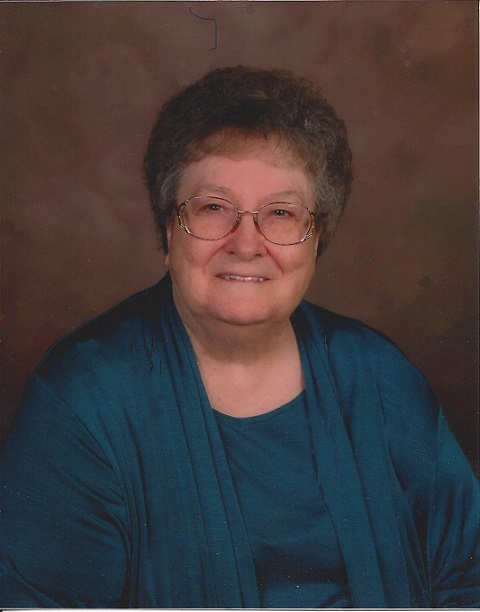
Demma Jean (Ingram) Diekman-Sammons, age 91, died April 4, 2019, at her home in Hays, Kansas.

She was born January 6, 1928, in Goodland, Kansas to Harvey Wootson and Gertie Mabel (Sexson) Ingram. She married Richard Herbert Diekman on December 7, 1952, at Goodland, Kansas. They later separated and he preceded her in death on October 4, 1995. She married Theodore H. “Ted” Sammons on April 20, 1984. He preceded her in death on April 24, 2004.

Demma grew up in Goodland and was a 1946 graduate of Sherman Community High School. In 1949 she received her Associate’s Degree in Education from Graceland College in Lamoni, Iowa. She taught in the rural one-room schoolhouses in Sherman and Logan Counties for a number of years.

She lived in Burlington, Colorado until 1979, then moved to Raytown, Missouri. While living in Burlington, Colorado she was the bookkeeper at the Ben Franklin store and was the primary church organist at the First St. Paul Lutheran Church. She attended the Community Church of Christ in Goodland and Kansas City, Missouri. Demma has lived in Hays since 1984 and was a member of The New Life Center Church. She enjoyed playing the organ, working on jigsaw puzzles, crossword puzzles and many handicrafts.

Survivors include, one son, Rodney Diekman and wife, Debbie, Burlington, CO; four daughters, Susan McFarland and Linda Mayer, both of Hays, KS; Connie Bernath and husband, Paul, Crawford, NE; Reta Diekman and husband, Greg Andrew, San Rafael, CA; nine grandchildren; five great grandchildren and one great great grandchild.

She was preceded in death by her parents; her husbands; three brothers, Howard W., Kenneth P.; W. Keith Ingram; her twin brother and sister,(W. Harley Ingram and Hallie Elizabeth Alford); four sisters, including her twin sisters, (Esther M. Middleton and Eva G. Birt); Dorthea M. H. Graybill and Marian P. Phillips.

A Celebration of Life Memorial Service will at 10:30 A.M. Saturday, April 20, 2019, at the New Life Center Church, 1701 East 22nd Street, Hays, Kansas. A private family inurnment will be at the Goodland Cemetery at a later date.

The family will receive friends from 10:00 to 10:30 A.M. Saturday, at the New life Center Church.
The family suggests memorials to the New Life Center Church and the Humane Society of the High Plains.
Services are entrusted to Cline’s-Keithley Mortuary of Hays, 1919 East 22nd Street, Hays, Kansas 67601.
Condolences can be left by guestbook at www.keithleyfuneralchapels.com or can be sent via e-mail to [email protected]

Wildlife experts, snorkeler free owl trapped in fishing line

SPRINGFIELD, Mo. (AP) — A barred owl caught a lucky break when a snorkeler banded with wildlife officials to rescue the bird from a fishing line tangled in trees above the James River.

Bill Hulsebus was visiting the Springfield Conservation Nature Center last week when he came across the injured owl. Hulsebus tells the Springfield News-Leader that firefighters attempted to release the owl’s wing from the line, but their equipment couldn’t reach.

He says conservation officials had fastened a tree trimmer to a long pole when a snorkeler nearby realized he could help. The man waded into the cold river and used the pole to cut the line, freeing the owl.

Volunteers took the owl to a rehabilitation center, where it was given a feather transplant to repair its damaged wing.

How slow internet hurts rural areas, starting with cattle sales

Many Kansas cattle breeders sell cattle online. (Photo by PIXABAY)


Kansas News Service

In this 21st century, bucolic means slow-moving bits. The put-put of rural internet in a streaming, downloading, real-time, zoom-zoom era is leaving businesses in remote parts of the state at a decided disadvantage.

Cattle sales offer a troubling example. Ranchers trying to offload their livestock online from parts of western Kansas report that auctions just don’t work when you can’t easily upload pictures and videos and the bidding get lost in buffers.

Crawling internet speeds in rural Kansas make trying to sell cattle online exasperating.

Instead of uploading photos and videos of cattle for sale from home, farmer and cattleman Jay Young drives to his parents’ house or into the town of Tribune in far west Kansas where internet speeds are faster.

Young has a broadband connection and says he’s able to create a cattle listing from home, but the slow internet brings on additional work.

“I just can’t post the videos to that listing,” he said. “So, what I’ll do is I’ll email them or I’ll go into town and, and put the photos on there.”

In Kansas, rural internet speeds and spotty mobile phone service generate barriers for business owners like Young, hamstringing their efforts to make a living in an increasingly online world.

A recent study by Amazon and the U.S. Chamber of Commerce analyzed how faster internet and better mobile phone reception could help small rural businesses across the country. In Kansas, slow internet and mobile phone services negatively impacts 66% of rural small businesses.

In April, the Kansas governor’s office released a preliminary broadband map showing the availability of fiber-optic networks, cable and DSL connections in the state. Faster internet speeds are concentrated around the bigger towns and cities, while smaller towns between more populated cities appear to have little or no broadband available.

Sometimes workarounds, like driving to a public Wi-Fi connection, offer an option for taking care of business online. But that can take time and, in some cases, cost business owners money.

Susan Ness and her husband recently went online in their west-central Kansas town of Jetmore to enter some water usage reports required by the state.

“It took us two nights,” she told the Statewide Broadband Expansion Planning Task Force, “to put in all the information.”

The alternative to filling out the information online, Ness said, was submitting a paper form that costs $250.

As online Kansas cattle sales attract more out-of-state buyers, pokey internet connections at auctions can affect how quickly bids are captured and delay the most updated bidding prices.

Steve Stratford is a cattle breeder at Stratford Angus in Pratt in southwest Kansas. He said that during his company’s annual production sale, when a few hundred cattle are on the block, people can bid in person or online.

But Stratford said the internet connection has been an issue the last three out of five years that online bidding has been an option.

“The (internet) capability at the sale barn couldn’t handle it,” he said. “The internet provider went down during a sale.”

Depending on the year, Stratford said he sells between 10 and 20 percent of his cattle online.

Jay Young and his father, Jerry Young, own and operate Young Red Angus. They raise cattle and sell around 100 head every year. Young said says most of his advertising is done online.

“I try to market them online to widen and broaden my buyers,” Jay Young said

Young also bids for cattle online, but he has to consider what his bidding options are ahead of time.

“If I know that there’s a sale going on, that I know I want to be able to bid online for, I will not be at my house,” he said. “I will make sure I go somewhere with better connections.”

If Young can’t attend a sale and can’t bid online, he’ll ask someone he knows at the sale to place a bid for him.

Depending on where he is, Young’s mobile phone connectivity can do what his internet connection can’t. But there are days that mobile phone signal is weak.

In Edgerton, a town just out outside of Kansas City, Melanie Gieringer has unreliable mobile phone reception.

Geiringer and her husband, Frank, own Gieringer’s Orchard, and have seasonal hours when visitors can pick and buy berries and peaches. Two years ago, they upgraded their dial-up internet to satellite, and now they have broadband. But Geringer says it could be faster.

“They work for a little bit and then you get dropped calls all the time,” she said.

That spotty mobile service prevented the Gieringers from using their phones as mobile checkout devices. Because of the faster internet connection, they can use iPads for the job.

Although a fiber optic connection eventually became an option for Gieringer, that isn’t the case for Young, who lives in Greeley County. With a little over 1,200, people, it’s the state’s least populated county.

Young said says because he lives about 20 miles outside of the nearest town, faster broadband is not available.

“It’s just the power of the signal that they have there at that point north and just can’t continue to go that far out,” he said.

Through our Kansas Matters initiative, one reader asked a question that relates to this story: “What is being done to bring better, faster internet service to rural areas? Even in Douglas County, my internet is extremely slow. I own a business and I’d like to work from home, but I can’t do that.”

Corinne Boyer is a reporter based in Garden City for High Plains Public Radio and the Kansas News Service, a collaboration of KCUR, Kansas Public Radio, KMUW and HPPR covering health, education and politics. Follow her @Corinne_Boyer.

Copyright Eagle Radio | FCC Public Files | EEO Public File