We have a brand new updated website! Click here to check it out!

Cattlemen affected by Plainville bankruptcy likely in for long wait

By CRISTINA JANNEY
Hays Post

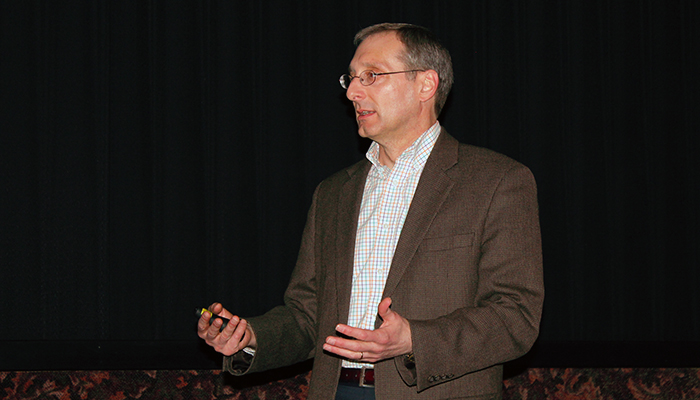
Roger McEowen, Kansas Farm Bureau professor of law and taxation at the Washburn School of Law, talks to cattlemen Friday in Stockton.

Cattlemen affected by the bankruptcy of the Plainville Livestock Commission should receive most of their money back, but it could be months more before they see any of their money.

In early February, the Plainville Livestock Commission issued checks to more than 40 producers for sale of their cattle.

On Feb. 12, Almena Bank froze two of Plainville Livestock Commission’s bank accounts. When the bank froze the accounts, tens of thousands of dollars worth of checks owner Tyler Gillum had written to area ranchers who had recently sold cattle at the Plainville Livestock Commission bounced.

On March 1, the Plainville Livestock Commission filed for bankruptcy.

See related story: Producers try to recoup losses after Plainville Livestock Commission drains account

The Rooks-Phillips County Extension hosted Roger McEowen, Kansas Farm Bureau professor of law and taxation at the Washburn School of Law, Friday in Stockton to talk about the process of recovering funds for cattlemen after the bankruptcy of a livestock market agent.

The cattlemen’s money is protected under the Packers and Stockyards Act.

The market agency is supposed to hold funds from the sale of cattle in a custodial account until all the sellers are paid. Someone allegedly transferred the money in the custodial account into the Plainville Livestock Commission’s general operating account, according to court records.

At that time, the bank holding the funds, Almena Bank, froze the Livestock Commission’s accounts.

McEowen said in a bankruptcy filing the unpaid cattlemen’s claims take priority over other creditors in accordance with the Packers and Stockyards Act.

There are deadlines to file claims under the Packers and Stockyards Act. Cattlemen can bring a reparation proceeding within 90 days of the sale. They need to file the proceedings with Secretary of Agriculture through the Grain Inspection Packers and Stockyards Administration, which is within the USDA’s Ag Marketing Service. There are specific forms available through the GIPSA to file the action.

“This is a process that is going to take months,” he said.

GIPSA does not have enforcement authority. If GIPSA finds a cattleman is owed money, the cattleman has to have the payment enforced by federal court or a district court that has jurisdiction within a year.

“The point is, if you understand the process, you are going to understand how long this is going to take to shake out,” McEowen said. “The cattlemen will get paid, maybe not 100 percent of their claim. They will be paid something, but it is not going to be tonight. It is not going to be tomorrow or next week. It is going to take some time.”

The impact on the community is going to be great. For every dollar that the cattlemen are owed in this case, that equals $3 to $4 that is not available to be cycled through the local economy, he said.

In this case, it equals millions of dollars.

“We don’t want the cattlemen to fail. They are going to get paid. We want them to get back on their feet at some point in time,” McEowen said. “Probably the majority of the funds they are owed they will recover, but what is going to happen in the meantime?”

He encouraged the cattlemen to evaluate their own personal situation, for the cattlemen to work together and the community to support the cattlemen who have been affected.

“The domino effect on this is the potential really bad situation,” he said. “That needs to be avoided so we don’t have a whole community that really suffers because of this.”

The U.S. bankruptcy court in Wichita on Thursday, indicated the cattlemen do have a priority to funds being held by the bank. Judge Roger Nugent ordered the money that is being held at Almena Bank continue to be held there in a segregated account, but he said he needed more time to consider the case.

The bankruptcy case has been continued to 10:30 a.m. May 9.

In the meantime, attorney’s have broad subpoena power under the Packers and Stockyards Act to do a legal “fishing expedition.” The investigation of the finances of Plainville Livestock Commission could draw the case out, McOwen said.
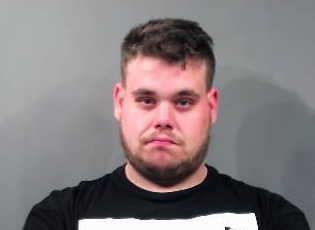
 

Police: 22-year-old arrested for fatal Kansas shooting

SEDGWICK COUNTY — Law enforcement authorities are investigating a fatal shooting and have arrested a suspect.

Brandon Craig -photo Sedgwick Co.

Just after 8:30 a.m. Friday, police responded to a shooting call at a home in the 800 block of south Emporia in Wichita, according to officer Charley Davidson.

Upon arrival, officers located 21-year-old Justin Lane of Grain Valley, Missouri, deceased with a single gunshot wound to the head. Lane was pronounced dead at the scene.

The investigation revealed Lane and 22-year-old Brandon Craig of Independence, Missouri, were visiting a friend who lived at the home.

During the visit, a disturbance occurred between Craig and Lane. Craig fired one shot from a handgun striking Lane in the head, according to Davidson. Police arrested Craig on a requested charge of first-degree murder.

Investigators will present the case to the Sedgwick County District Attorney’s Office.

Student charged in Kansas City over protest at anti-transgender speech

KANSAS CITY (AP) — A University of Missouri-Kansas City student is facing charges after he sprayed a substance toward conservative political commentator Michael Knowles during an anti-transgender speech.

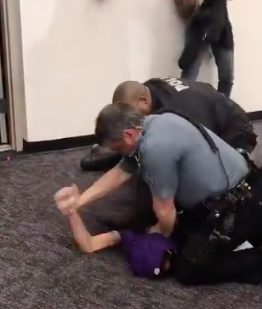
Police arrest protester image courtesy UMKC News

Knowles was giving a speech titled “Men are Not Women” on the Missouri-Kansas City campus Thursday when protesters disrupted the event. Authorities said that during the disruption, student Gerard Dabu used a water gun to spray a substance at Knowles, who was not injured. Police tackled and subdued Dabu with a stun gun near the stage.

Chancellor Mauli Agrawal said in a letter to the campus Friday that police reacted that way because they didn’t know if the substance was dangerous. Tests later determined it was lavender oil and other non-toxic household liquids.

Dabu was charged Friday in municipal court in Kansas City with assault and other violations.

Knowles is a conservative contributor to The Daily Wire and published a book titled “Reasons to Vote For Democrats” with blank pages.

Cut melon sold in Kansas linked to US salmonella outbreak recalled

INDIANAPOLIS (AP) — An Indianapolis-based company has issued a recall for melon products sold in 16 states after being linked to a salmonella outbreak.

CDC Image

The U.S. Food and Drug Administration said Friday that the recall includes cut watermelon, honeydew and cantaloupe produced by Caito Foods LLC. The fruit has been sold under various brands or labels at Kroger, Walmart, Trader Joe’s, Target and Whole Foods.

The affected states are Illinois, Indiana, Iowa, Kansas, Kentucky, Michigan, Minnesota, Missouri, Nebraska, New York, North Carolina, Ohio, Pennsylvania, Tennessee, West Virginia and Wisconsin.

Health officials advise consumers to check packaging to determine if the melon was distributed by Caito Foods, and, if so, not to eat it. They advise stores to pull the products from shelves.

Authorities say 93 people have been sickened, 23 of whom were hospitalized. No deaths have been reported.

Salmonella Carrau is described as rare. Symptoms include diarrhea, fever and abdominal cramps.

NCK TECH offers Career Success Scholarship

NCK TECH

Working to fill industry needs, NCK Tech is offering a scholarship program to help meet these demands. Currently there is space available in a limited number of programs on both the Beloit and Hays Campus.

The Career Success Scholarship is established to encourage students to apply early and ensure a spot in these programs, meanwhile helping meet the need of business and industry.

Offered only during the month of April, certain qualifications will be required. Students must complete a campus tour and the admissions process between April 1 and April 30, 2019.

This scholarship opportunity is only for new students applying during this time.

To qualify, applicants must participate in a campus tour and be accepted into one of the identified programs (listed below) for Fall 2019.

Programs include:

       Beloit Campus

  • Auto Collision Technology
  • Automated Controls Technology
  • Business Management
  • Digital Marketing
  • Electrical Technology
  • Heavy Equipment Operations
  • Practical Nursing

      Hays Campus

  • Culinary Arts
  • Pharmacy Technician


FHSU’s Encore Series to present JigJam: Live from Ireland

FHSU University Relations

JigJam, a multi-award winning quartet from the heart of the midlands in Ireland, will be the final performance of the 2018-2019 Encore Series season at Fort Hays State University.

The performance will be at 7:30 p.m. on Tuesday, April 16 in the university’s Beach/Schmidt Performing Arts Center in Sheridan Hall.

Blending the best of traditional Irish music with bluegrass and Americana in a new genre, JigJam’s energy and musical ability has captivated audiences throughout the world.

“Here’s an Irish band that’s going to impact the world as hard as Clancy Brothers or U2 if they get only half a chance,” said Midwest Records.

Performers Jamie McKeogh, Cathal Guinan and Daithi Melia all hail from Tullamore, County Offaly, with County Tipperary-born Gavin Strappe completing the quartet. All four members grew up with Irish traditional music and culture, which is reflected by the band collectively achieving over twenty All-Ireland titles at Fleadh Cheoil na hÉireann competitions.

They have now developed their own unique style of music influenced by American folk whilst staying true to their Irish roots.

All multi-instrumentalists, JigJam’s members change between banjos, guitars, fiddles, mandolins and double bass onstage, which creates an experience which is pleasing to both the eye and the ear.

JigJam has recorded two studio albums to critical acclaim and have been compared to the Punch Brothers by the European Bluegrass Music Association. They have made a huge impact on the Irish American circuit performing at all major festivals, including the world-renowned Milwaukee Irish Fest as well as touring various parts of the United Kingdom and Europe.

Tickets are available at the Memorial Union Student Service Center, by calling 785-628-5306 or by visiting www.fhsu.edu/encore.

Tickets for the general public are $32 reserved and $28 unreserved; for seniors and children ages 5-17, tickets are $30 reserved and $26 unreserved; and for FHSU students, tickets are $23 reserved and $19 unreserved with a Tiger Card.

Modern Mrs. FCE to celebrate 50 years with Ellis celebration

Submitted

ELLIS — Milestones are meant to be celebrated and an Ellis-based organization, Modern Mrs. FCE, will be commemorating its 50th anniversary with a celebration and reception from 2 to 4 p.m. Sunday at the Ellis Public Library Community Room, 907 Washington.

Memorabilia from the group’s rich history will be on display, as well as video highlights from the variety and talent shows that were held in the 1990s. The community, past members, and especially those who generously helped with the group’s many community projects are cordially invited to attend the celebration.

Cooperative extension units were established in 1914 by a group of rural women. Their mission was to strengthen individuals, families, and communities through education, leadership, and action.

Several determined groups of rural women traveled to Washington D.C. in 1936 when the group was renamed the National Association for Family and Community Education (NAFCE). The_ NAFCE instrumental in backing school lunch programs, immunizations, and bookmobiles to improve home and community life and protect the American family. Through time, the name was changed to Home Demonstration Units (HDU). Now, the current name is Family and Community Education (FCE).

Local groups are formed as outreach programs in association with Kansas State University Extension Service. Berny Unruh is the Cottonwood Extension Family Community Wellness agent that advises the Ellis Modern Mrs. FCE unit that was chartered in the late 1960s.

How could the determined rural women who gathered in our nation’s capital have guessed that today, FCE is the largest, most successful, informal educational organization in the world? Extension programs are funded and guided by a partnership of federal, state, and county governments and are administered at Kansas State University, which is recognized as a land grant university. The educational programs are supported and expanded by thousands of volunteer teachers and community leaders.

Throughout the past 50 years, Modern Mrs. FCE has been a vital link of support to our community. The public is invited to help celebrate their many accomplishments and future endeavors.

WSU Report Rating Major Airlines: Air Travel Is Improving … Really

It’s easy to complain about air travel, but the latest Airline Quality Rating study shows, overall, it’s getting better for passengers.

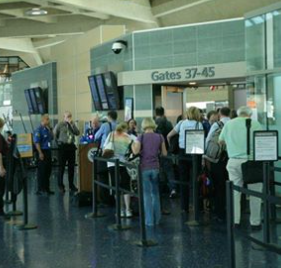
Passengers wait in line at KCI photo courtesy Kansas City International Airport

The 29th annual Airline Quality Rating produced by researchers at Wichita State University and Embry-Riddle Aeronautical University tracks key airline metrics such as on-time arrivals and departures, baggage handling and customer complaints.

The report also shows that airlines bumped passengers less frequently than in any year since the study started. That’s likely due to the backlash from the highly publicized bumping of a man who had to be physically dragged off a United Airlines flight in 2017.

“If the public says something, the airlines just might do something,” said Dean Headley, emeritus professor at Wichita State and co-author of the study. “Which they did in this case, and that made a big difference in this year’s numbers.”

With almost 25,000 flights a day in the United States, Headley said it’s amazing that airlines have an on-time rate of 80%, don’t lose many bags and involuntarily bumped virtually no one in 2018.

It’s a much better performance now than it was a little more than 10 years ago.

As for individual airline performance, Delta came out on top. It accomplished that by having the fewest number of involuntary removals, finishing second for on-time arrivals and third in both baggage service and customer satisfaction.

The complete rankings are:

  1. Delta Airlines
  2. JetBlue
  3. Southwest Airlines
  4. Alaska Airlines
  5. Hawaiian Airlines
  6. United Airlines
  7. Spirit Airlines
  8. American Airlines
  9. Frontier Airlines

Brian Grimmett reports on the environment, energy and natural resources for the Kansas News Service.  Follow him on Twitter @briangrimmett.


Managing workplace conflicts, marketing design workshops offered by FHSU

FHSU University Relations

Two workshops, one on managing conflict and one on design, will be offered by the Management Development Center at Fort Hays State University in May.

The first, Managing Conflict in the Workplace, will begin at 1 p.m. Monday, May 6, in Hansen Hall on the Fort Hays State campus.

This three-and-a-half-hour training will discuss the common roots of workplace conflict and strategies for managing the conflict. Participants will learn about the common causes of workplace conflict, how to assess personal conflict styles, best practices for offering critical feedback, and more. Conflict, properly managed, can contribute to organizational innovation and stronger relationships.

Each person who completes this workshop will receive a completion certificate and earn 3.0 Continuing Education Units. Registration closes on April 29. The cost is $119.

The MDC’s brand-new workshop, Design for Non-Designers, addresses the fact that a person does not have to be wildly creative to make effective designs, which are critical to successful marketing efforts. Design creates meaningful first impressions, differentiates an organization from its competitors, boosts awareness. It is also a great way to connect with customers.

This day-long workshop runs from 9 a.m. to 4 p.m. Thursday, May 9, in the Stouffer Lounge of FHSU’s Memorial Union.

The workshop will explore the elements and principles of design and how can it be used to make a company and its products more appealing to potential customers. Participants will learn why design is important for effective marketing, review great (and bad) logos, and much more.
Topics include using color effectively, communicating with type, tips on designing common marketing pieces, and when to hire a professional or design on your own.

Each person who completes this workshop will receive a completion certificate and earn 7.0 CEUs. Registration closes on May 2. The cost for registration is $219.

A 15-percent discount applies for all Hays Area Chamber of Commerce Members on a single session cost.

Registration is available online through the Registration link in the sidebar on the MDC homepage at www.fhsu.edu/mdc.

To learn more about this workshop or additional upcoming trainings, contact Hannah Hilker by phone at 785-628-4121 or by email at [email protected].


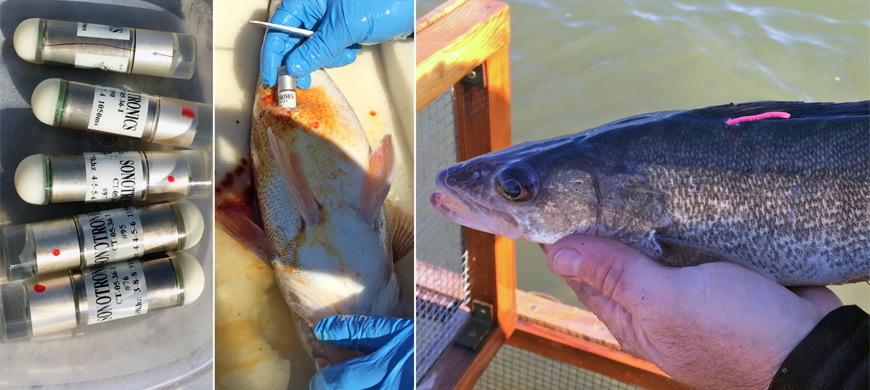
Glen Elder walleye carrying transmitters

Three-year walleye study at Glen Elder Reservoir

KDWPT

CAWKER CITY – The Kansas Department of Wildlife, Parks and Tourism (KDWPT) has embarked on a three-year walleye study at Glen Elder Reservoir, and biologists want anglers to be aware of the project.

Data collected during the study will give anglers and biologists a better understanding of what makes walleye tick in this lake. Throughout the study, KDWPT district fisheries biologist Scott Waters will follow the movements of adult walleye using telemetry to evaluate mortality patterns, movement, home range, and habitat selection.

Ultrasonic transmitters were implanted in 27 walleye last fall and another 33 will receive transmitters in April. An equal number of males and females will be targeted, and not all study fish will be longer than the 18-inch minimum length limit.

The fish are collected using trap nets and gill nets and brought to shore. Each fish is placed in an anesthetic bath for several minutes before surgery. A 1.5-inch incision is made in the abdominal wall, and after the sex is determined, a 22-gram ultrasonic transmitter is placed in the abdominal cavity. Three sutures and glue are used to close the incision and an antibiotic is given to prevent infection. Once the fish regains equilibrium and resumes normal behavior, it is released.

Each fish is also tagged with a pink, 3-inch Floy tag in the dorsal fin to alert anglers who catch them. The tag contains the fish’s identification number, the KDWPT contact number, and a message about the $100 reward given for the return of the transmitter if the fish is kept. Not all tagged fish are of legal size, and short fish should be returned to the water with the tag intact. Anglers are encouraged to carefully measure the fish and report the length and location of catch to the park office. Anglers who harvest legal fish are encouraged to call or stop by the office to return the internal transmitter for the $100 reward. The angler may keep the fish and Floy tag.

Manual tracking will be conducted at least two times each month with more frequent tracking conducted during certain periods of the year. Once a fish is located, water depth and temperature, GPS location, and the identification number will be recorded. Angling mortality will be determined by tag returns, natural mortality will be determined when the transmitter shows no movement over time, and fish emigration will be detected using a stationary receiver. Daily movement patterns will also be studied by following a subsample of fish over a 24-hour period.

KDWPT biologists need anglers’ help with this study, which is unique for the state of Kansas and will provide answers about walleye life history that will help biologists better manage this important sport fish. Updates will be provided throughout the study to help anglers learn more about daily and seasonal walleye movement patterns and habitat preferences.

Gov. Kelly signed 16 bills into law this week

OFFICE OF GOV.

TOPEKA – Governor Laura Kelly signed 16 bills into law this week, bringing the total number of bills signed during the 2019 Legislative Session to 35, with one being vetoed. By law, the Kansas governor has 10 calendar days to sign bills into law, veto bills or allow bills to become law without her signature.

Senate Bill 60

Amends the statutes related to licensing of real estate brokers and the Kansas Real Estate Commission. This legislation will become effective on July 1, 2019.

Senate Bill 68

Prohibits a city from requiring a wireless services provider or wireless infrastructure provider to enter into a franchise ordinance for the provision of wireless services. This legislation will become effective upon its publication in the Kansas Statute Book.

Senate Bill 69

Substitute for SB 69 directs the Legislative Coordinating Council to authorize a study of retail rates of Kansas electric public utilities. The purpose of the study is to provide information that may assist future legislative and regulatory efforts in developing electric policy that includes regionally competitive rates and reliable electric service. The bill requires the first and second parts of the study to be made available on the Kansas Corporation Commission’s website by January 8, 2020, and July 1, 2020, respectively. This legislation will become effective upon its publication in the Kansas Register.

Senate Bill 71

Reauthorizes the Postsecondary Technical Education Authority by eliminating the sunset date of June 30, 2019. The bill also requires the Authority to make an annual report to the Legislature on the performance of its functions and duties. This legislation will become effective on July 1, 2019.

Senate Bill 77

Requires the Department for Children and Families to offer services to children with sexual behavior problems, along with the child’s family. Such services will be voluntary, unless DCF determines there will be a high risk of future sexual behavior problems by the child if the child or family refuses services. This legislation will become effective upon its publication in the Kansas Statute Book.

Senate Bill 82

Amends provisions of the State Banking Code relating to certificate of existence, voting rights for conversion to a state charter, and the method of delivery for certain notices. This legislation will become effective on July 1, 2019.

Senate Bill 97

Authorizes registration of certain rental vehicles in fleets and issuance of permanent license plates to reflect that registration. The bill requires such registration to be submitted electronically. This legislation will become effective on January 1, 2020 and upon its publication in the Kansas Statute Book.

Senate Bill 105

Authorizes a city to determine the start date of a regular term of office for a city officer by resolution of the city. In law regarding city elections, the bill requires the start date be on or after December 1 following certification of the election and no later than the second Monday in January following certification of the election. If the city does not establish an alternative date, the bill specifies such term will begin on the second Monday in January.

This legislation was signed in an official bill signing ceremony on Monday, April 8, and will become effective upon its publication in the Kansas Statute Book.

Senate Bill 128

Amends laws related to the minimum number of safety drills required to be conducted in schools each school year. The bill requires the State Fire Marshal to adopt rules and regulations requiring administrators of public and private schools and educational institutions, except community colleges, colleges, and universities, to conduct at least four fire drills, two tornado drills, and three crisis drills each school year. This legislation will become effective on July 1, 2019.

Senate Bill 199

Establishes the AO-K to Work Program, allowing certain adults to earn high school equivalency credentials by participating in career pathway oriented post-secondary classes. The provisions of the Program apply to all adult education programs in Kansas. This legislation will become effective on July 1, 2019.

House Bill 2101

Makes several amendments and technical updates to the laws governing credit unions and related credit union procedures and designates Article 22 of Chapter 17, Kansas Statutes Annotated, as the State Credit Union Code. This legislation will become effective on July 1, 2019.

House Bill 2125

Requires the holder of a driver’s license who is operating a motor vehicle to promptly deliver, rather than display, the driver’s license upon demand of any officer of a court of competent jurisdiction, any peace officer, or any examiner or officer of the Division of Vehicles, Department of Revenue. The requirement applies when the driver’s license is in the licensee’s immediate possession at the time of the demand. This legislation will become effective on July 1, 2019.

House Bill 2178

Amends the law concerning the duty of an operator to mark the tolerance zone around an underground facility within the Kansas Underground Utility Damage Prevention Act. This legislation will become effective upon its publication in the Kansas Register.

House Bill 2188

Makes the City of Atchison responsible for the maintenance and repair of all watershed lakes, dams, and other projects of the White Clay Watershed District No. 26, on and after January 1, 2020. Additionally, the bill dissolves the District on January 1, 2020, and makes the City the District’s successor.

This legislation was signed in an official bill signing ceremony on Tuesday, April 9 and will become effective upon its publication in the Kansas Statute Book.

House Bill 2191

Amends the law concerning the execution of search warrants. Specifically, the bill states that warrants issued after July 1, 2019, for electronically stored information, electronic devices, or media capable of storing electronically stored information located in Kansas will authorize the transfer of such information, devices, or media for examination and review anywhere within the state or outside the state at any time after the seizure, unless otherwise specified by the warrant. This legislation will become effective on July 1, 2019.

House Bill 2215

Authorizes the Kansas State Fair Board to establish a 501(c)(3) nonprofit corporation. The purpose of the nonprofit corporation is to receive gifts, donations, grants, and other moneys and engage in fundraising projects that benefit the Kansas State Fair. The board of directors of the nonprofit corporation will consist of the members of the executive committee of the Fair Board, the General Manager of the Kansas State Fair, and other directors designated by the Fair Board. This legislation will become effective upon its publication in the Kansas Statute Book.

One in four Kansas public defenders quit last year, leaving agency ‘in crisis’

Former public defender Ruslan Ivanov says he left his job because of the high stress.


Kansas News Service

Ruslan Ivanov loved being a public defender. What he didn’t love was the way his work constantly followed him — at home, with friends and family, even on vacation.

On one trip to Colorado, he stood in front of a breathtaking mountain view. And started thinking about a case.

“I thought about, ‘I need to do something. Is there something that I forgot? Is there something that I’m missing?’” he said. “I still thought about the individuals that I encountered and their life situations … too much of that is maybe detrimental in one’s job as an attorney, but I still thought about it.”

From 2015 to 2018, Ivanov was an attorney for the Kansas State Board of Indigents’ Defense Services, the state agency that provides criminal defense to people who can’t afford their own lawyers.  He worked in Wichita and Topeka, mostly handling drug cases, assaults, thefts and weapons possession.

The job was an invaluable legal education, Ivanov said, but not one he could keep doing forever. He typically juggled between 60 and 90 cases at once and sometimes worked seven days a week.  Often, he had to track down and interview witnesses himself, a task typically performed by an investigator — but his office only had one investigator between two dozen attorneys.

“The caseload is large,” he said. “If you’re preparing for particular hearings, you may be thinking about several of them, all at the same time.”

Ivanov ended up quitting in early 2018, along with 22 of his colleagues who left the agency that fiscal year.

That’s a resignation rate of 24 percent, the highest the Board of Indigents’ Defense Services has seen since its creation in 1982, said the agency’s executive director, Pat Scalia. She declined multiple requests for an interview, but she told state lawmakers in February that several public defender offices had to stop taking new cases because they were so overwhelmed. To hire and retain staff, she argued, the agency desperately needs more money.

“The agency is in crisis,” she said. “I’m asking that the salaries of public defenders be adjusted to match the pay scale that is now in place by our sister state of Missouri.”

Low salaries

Scalia asked lawmakers for an additional $498,547 in next year’s budget to fund public defender salaries, saying the money would “get our current staff close” to Missouri salaries.

Currently, Kansas public defenders with 10 or fewer years of experience make a maximum of $59,850 a year.  When they reach 20 years of experience, they make $68,665.  Chief defenders make $78,750.

Salaries for defenders in Missouri start at $46,992 but increase to more than $70,000 after a few years of experience.

Private attorneys, meanwhile, can charge hundreds of dollars an hour.

Blair Loving, a former public defender now in private practice, said he didn’t feel underpaid while working at the Western Regional Public Defender Office in Garden City. But his new job allows him more control over how much money he makes and when. When he was a public defender at the state’s office in Garden City, he didn’t make any overtime, no matter how long he worked.

“Regardless of how quickly and how successfully I completed the cases, that’s what I was going to get,” he said. “There’s no incentive for public defenders other than their personal conscience and their affinity for their clients.”

Blair Loving quit his job as a public defender in Garden City in November 2017. His office still hasn’t found someone to replace him, instead relying on a contract with a private attorney. (Photo courtesy Blair Loving)

Yet Loving felt under-compensated in other ways, especially compared to prosecutors, who are employed by city and county governments. His state health insurance was so expensive and covered his family of six so poorly that they had to switch to the insurance his wife received working for Garden City.

“The biggest detriment to staying long term was knowing that the benefits were not going to really be improving at all,” he said. “It would be a no-brainer to want to switch to a county or to a city position.”

Large caseloads

At one point, Loving managed 68 cases at once. He remembers a colleague juggling more than 80.

“Continually performing at 100 percent with a 200 percent workload,” he said, “it’s eventually gonna catch up to you.”

There were no measures of performance, Loving said. In an email, the executive director of the agency said she doesn’t keep track of how many cases end in acquittals, plea deals, convictions, dismissals or other types of outcomes.

Nor are there safety checks, Loving said, for possibly missing important information due to distraction or sleep deprivation.

“There is no Department of Transportation that’s going to come down and go, ‘Well, wait a minute, you made this attorney work for 13 hours this day, and so that’s going to decrease his performance level and that’s not safe for his clients,” Loving said. “The court says, ‘tough.’”

To balance their workloads and long hours, public defenders sometimes ask judges for more time between court proceedings, said Rosalie Joy, a vice president of the National Legal Aid and Defender Association.

“The defendants themselves are very much impacted,” she said, “by the fact that there aren’t enough to attorneys to go around.”

It’s common for public defender agencies to rely on contracts with private attorneys to fill in the gaps and to take on cases that might pose conflicts of interest, Joy said.  But those attorneys may not specialize in criminal defense, so they may not have the same skills or resources as a full-time public defender.

“There is a risk and a great concern,” she said, “that they might not either be equipped with the right competencies, or that the system doesn’t give them that opportunity.”

According to an annual report to lawmakers, the Kansas Board of Indigents’ Defense Services assigns cases to private counsel when public defenders have a conflict of interest, or when an area of the state is so sparsely populated “it is not cost effective to open a public defender office.”  A map shows that only 25 of the state’s 105 counties had full-time public defenders available last year.

Out of more than 31,000 cases in fiscal year 2018, the agency handed almost 15,000 to private attorneys who were paid $70 an hour.  The average cost per case was $865.  For full-time, salaried public defenders, the cost per case was $609.

Scalia told lawmakers that so far this fiscal year, 400 cases that normally would have gone to public defenders were instead assigned to private counsel because of heavy workloads, costing the state an extra $130,000.

Open jobs

In an email, Scalia said the state is trying to recruit more defenders by posting the jobs on the state website and on free online job boards.  She said her agency also recruits through the state’s law schools.  Most vacancies are filled within a month.

Offices in Salina and Junction City, however, have still been unable to fill vacancies for many months. The public defender office in Olathe is also struggling, she said. So far this year, 16 out of 93 defenders have resigned.

There isn’t much reason for defenders to stay after the early stages of their career, said Loving, who quit his job at the Western Regional Public Defender office in November 2017.

“I knew that there was really no opportunity for advancement other than punching a clock for a certain number of years,” he said. “I wanted to be able to see the fruit of my labors. And with public defense, you just don’t.”

More than a year after he left, Loving’s old office still hasn’t hired someone new. Instead, it relies on a contract with a private attorney.

“That kind of money is perfect for a brand new attorney with no wife and no kids and no mortgage,” he said. “They’ve got to fix their budget so that it incentivizes people with experience, not just brand-new law students.”

Nomin Ujiyediin is a reporter for the Kansas News Service, a collaboration of KCUR, Kansas Public Radio, KMUW and High Plains Public Radio covering health, education and politics. You can send her an email at nomin at kcur dot org, or reach her on Twitter @NominUJ.

Gordon’s big night carries Royals past Indians to end 10-game losing streak

KANSAS CITY, Mo. (AP) — Alex Gordon homered, doubled twice and singled as the Kansas City Royals stopped a 10-game losing streak, racing to a big lead and beating the Cleveland Indians 8-1 Friday night.

Gordon homered during a six-run first inning against Carlos Carrasco (1-2).

The Royals hit for the cycle in the opening inning — Whit Merrifield led off with a single, Adalberto Mondesi followed with a triple and Gordon homered, with Chris Owings’ two-out, two-run double finishing Carrasco.

Brad Keller (2-1) gave up one run on three hits, striking out a career-high 10 in 6 2/3 innings. He has pitched at least six innings in nine straight starts, the longest active streak in the majors.

Keller’s 118 pitches were the most by a Royals starter since James Shields threw 124 on July 29, 2014.

Tyler Naquin hit a 420-foot home run in the second, snapping a streak of 54 innings in which Keller hadn’t allowed a homer. It had been the longest active string in majors.

Gordon doubled in the second. He added an RBI double in the fourth, but was thrown out trying to stretch it into a triple.

The Royals added a run in the sixth on a double steal.

TRAINER’S ROOM

Indians: SS Francisco Lindor is going to run the bases again Saturday, according to manager Terry Francona. Lindor has not played this season with a right calf strain and a left ankle sprain. “If all goes well, then we’re going to reconnect with the doctor, and see what he thinks the next step is,” Francona said. … 2B Jason Kipnis is on a rehab assignment in Triple-A Columbus. Francona said he’s doing well recovering from a low-grade right calf strain, and he expects to see Kipnis sometime on the current road trip to Kansas City and Seattle.

Royals: CF Billy Hamilton was kept out of the lineup with a mild MCL sprain and a bone bruise on his left knee. He tried to make a game-saving catch with two outs in the ninth inning of Thursday’s loss to Seattle. The Mariners had two runners on, down 6-4, when Mitch Haniger drove one to the wall in left center. Hamilton battled the wind and the sun before crashing into the wall. “When I first did it I thought it was way worse than what it turned out to be,” Hamilton said. “I’m happy about that. It’s too early to be in that situation. I’ll do everything I can to get back in the lineup. I feel a lot better than I did yesterday. I can play through a little pain.”

ROSTER NEWS

Indians RHP Jefry Rodriguez was being called up from Triple-A Columbus after the game. He will make his first start with the Indians after one start with Columbus, where he allowed three runs on seven hits over 5 1/3 innings.

UP NEXT

Indians RHP Jefry Rodriguez will make his season debut for the Cleveland. He was acquired by Cleveland as part of the trade that sent Yan Gomes following the 2018 season.

Royals RHP Homer Bailey (0-1, 9.00 ERA) will be looking for his first victory since May 12 of last season.

Copyright Eagle Radio | FCC Public Files | EEO Public File