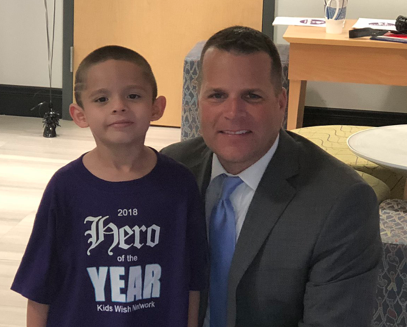
WICHITA, Kan. (AP) — A Wichita boy who was wounded in a road rage shooting last fall has been named the hero of the year at the children’s hospital where he recovered from a stray bullet that shattered his hip bone and lacerated his liver and kidney.Wesley Children’s Hospital held a ceremony Tuesday that honored Andres Arambula as Kids Wish Network’s hero of the year.
“A very special hero, (Andres) is a courageous little boy who has been through the fight of his life,” said Josh Santiago, marketing manager of Kids Wish Network. The national nonprofit serves children with exceptional medical circumstances.
Today @chieframsay had the great opportunity to take part in recognizing Andre Arambula as Kids Wish Network’s 2018 Hero of the Year. Andre suffered a gunshot last year in a road rage incident. He has shown bravery and resilience in his road to recovery!! pic.twitter.com/alAg0uUMNL
Police said Andres was among six children inside a sports utility vehicle that was shot at twice by 19-year-old Tylin Atkinson in downtown Wichita on October 17. Investigators determined that the shooting stemmed from a road rage incident.
Atkinson and Ramonyka Smith, 21, have been charged with criminal discharge of a firearm in the shooting. Atkinson also faces an aggravated assault charge. They both remain in Sedgwick County Jail.
Andres, who was 4 at the time, was taken to the hospital in critical condition and had to undergo surgery to remove the bullet and repair his diaphragm and organs. He also went through pain management and physical therapy to help him walk again.
“Andres is not just a hero, but (also) a miracle, because he survived this and dealt with this pain,” said his mother, Lucero Arambula.
The Kids Wish Network gave Andres gifts and a $5,000 check. The organization also donated a pallet of toys worth $20,000 in his name to the Kansas Children’s Foundation.
We all owe a debt of gratitude to three Kansas law enforcement officers who sacrificed their lives for the safety and protection of others.
National Police Week is May 12 to May 18.
The names of Sedgwick County Sheriff’s Deputy Robert Kunze and Wyandotte County Sheriff’s Deputies Theresa King and Patrick Rohrer will be added to the National Law Enforcement Officers Memorial in Washington, D.C., during a ceremony May 13.
“We must never forget these brave officers,” McAllister said. “We will strive to be worthy of the sacrifices they made for us and to carry on their dedication to law enforcement. I invite the public to join our office in showing support for their families and their fellow officers.”
King and Rohrer were shot to death June 15, 2018, in Kansas City, Kan., while transporting prisoners between jail and court. Kunze was shot to death Sept. 16, 2018, during an arrest in western Sedgwick County.
According to the FBI, 55 law enforcement officers died in 2018 from injuries received during felonious incidents
Victim officer profile:
Average age: 37 years old
Average length of service: 10 year
Gender: 52 male, 3 female
For more information, see of the FBI report Law Enforcement Officers Killed and Assaulted, 2018 at https://ucr.fbi.gov/leoka/2018/.
Stephen McAllister is the U.S. Attorney for Kansas.
CEDAR RAPIDS, Iowa (AP) — A fifth farmer has pleaded guilty to his role in an organic grain fraud scheme that involved at least $140 million in sales of grain.
John Burton, of Clarksdale, Missouri, pleaded guilty Friday to one count of conspiracy to commit wire fraud, as part of a plea agreement with federal prosecutors.
Burton, 52, admitted that grain grown on his non-organic fields was marketed and sold as organic and that unapproved substances were used on fields certified as organic. Federal prosecutors are seeking to require that he forfeit $2.2 million that was traced to the scheme.
Burton’s plea comes months after one of his associates, 61-year-old Randy Constant of Chillicothe, Missouri, pleaded guilty to charges alleging he masterminded the scheme.
Constant made many of the fraudulent sales through an Iowa grain brokerage that he owned. Three other Nebraska farmers have also pleaded guilty in the case.
If a new Mississippi law survives a court challenge, it will be nearly impossible for most pregnant women to get an abortion there.
Or, potentially, in neighboring Louisiana. Or Alabama. Or Georgia.
The Louisiana legislature is halfway toward passing a law — like the ones enacted in Mississippiand Georgia— that will ban abortions after a fetal heartbeat is detected, about six weeks into a pregnancy and before many women know they’re pregnant. Alabamais on the cusp of approving an even more restrictive bill.
State governments are on a course to virtually eliminate abortion access in large chunks of the Deep South and Midwest. Ohio and Kentucky also have passed heartbeat laws; Missouri’s Republican-controlled legislature is considering one.
Their hope is that a more conservative U.S. Supreme Court will approve, spelling the end of the constitutional right to abortion.
“For pro-life folks, these are huge victories,” said Sue Liebel, state director for the Susan B. Anthony List, an anti-abortion advocacy group. “And I think they’re indicative of the momentum and excitement and the hope that’s happening with changes in the Supreme Court and having such a pro-life president.”
For abortion rights supporters, meanwhile, the trend is ominous. Said Diane Derzis, owner of Mississippi’s sole abortion clinic, the Jackson Women’s Health Organization: “I think it’s certainly more dire than it ever has been. They smell blood and that’s why they’re doing this.”
Already, Mississippi mandates a 24-hour wait between an in-person consultation. That means women must make at least two trips to her clinic, often traveling long distances.
Other states have passed similar, incremental laws restricting abortion in recent years, and aside from Mississippi, five states have just one clinic — Kentucky, Missouri, North and South Dakota, and West Virginia. But the latest efforts to bar the procedure represent the largest assault on abortion rights in decades.
Lawmakers sponsoring the bans have made it clear their goal is to spark court challenges in hopes of ultimately overturning the 1973 Roe v. Wade decision legalizing abortion.
Those challenges have begun. Derzis’ attorneys are scheduled to go before a judge on May 21, seeking to prevent Mississippi’s heartbeat law from taking effect July 1.
A judge in Kentucky blocked enforcement of that state’s heartbeat ban after the American Civil Liberties Union filed suit on behalf of the clinic in Louisville.
Similar legal action is expected before bans can take effect in Ohio and Georgia, where Republican Gov. Brian Kemp signed the latest heartbeat bill into law Tuesday. Kemp said he welcomed the fight, vowing: “We will not back down.”
Georgia’s ban doesn’t take effect until Jan. 1. But the impact was immediate.
An abortion clinic operated by The Women’s Centers in Atlanta began receiving anxious calls from patients soon after Kemp signed the law. Many callers had plans to travel from outside the state for abortions. Georgia’s heartbeat ban would have a wider impact because the state has 17 abortion clinics — more than the combined total in the other four Southern states that have passed or are considering bans.
“On a typical day we will see people from North Carolina, Tennessee, Alabama, South Carolina — all over the region,” said Dr. Lisa Haddad, the Atlanta clinic’s medical director. “And my thought is we’re not going to see those people coming here because they assume it’s already illegal in Georgia.”
Dr. Ernest Marshall, co-founder of Kentucky’s last remaining abortion clinic in Louisville, said in an email that banning abortions before most women know they’re pregnant would “have a disproportionate impact on poor women and communities of color throughout the South.”
Advocates for abortion rights expect judges to halt enforcement of any new bans while lawsuits work their way through the courts. That could take years.
“These laws are blatantly unconstitutional,” said Elisabeth Smith, chief counsel for state policy and advocacy for the Center for Reproductive Rights, which also has filed suit over Mississippi’s ban. “But if they were allowed to go into force, they would have devastating consequences for the residents of all of these states.”
If heartbeat bans are upheld, many women who are poor and have limited means to travel would have few options other than to try to terminate their own pregnancies, Haddad said, possibly using abortion drugs purchased online.
Others would have to drive or fly across multiple states, said Elizabeth Nash, a state policy analyst for the Guttmacher Institute, a research group that supports abortion rights.
“People would go to Florida, people would continue to go to Memphis,” Nash said. “How many states do you have to cross before you can access abortion services? It exacerbates all the issues we’ve already seen around taking time off from work and having the money to travel.”
Proposed heartbeat bans failed to pass this year in several Republican-led states, including Texas. There, GOP lawmakers lost ground to Democrats in the 2018 elections, and some abortion foes were wary after courts struck down prior abortion restrictions in the state. Such efforts also fell short in Florida, South Carolina, Tennessee and West Virginia.
Alabama lawmakers postponed until next week a vote on a proposal that would make performing nearly all abortions a felony. The measure has passed the state House, and the Senate suspended debate Thursday amid a heated dispute over whether exemptions for rape and incest should be stripped from the bill.
“You can’t put a price on unborn life,” Eric Johnston, president of the Alabama Pro-Life Coalition, said Wednesday, as a legislative committee heard testimony on the state’s proposed ban. “What you have to do is protect the people that live in this state and that includes unborn children.”
But Jenna King-Shepherd told Alabama lawmakers she believed the abortion she had at age 17 allowed her to finish college. She said her father, a part-time Baptist preacher furious about her pregnancy, drove her to the abortion clinic because he trusted her to make the right choice.
“I’m not asking you to support access to abortion,” King-Shepherd said. “I’m only asking you to let women, their families, their physicians and their God make this decision on how they want to start their families in private and trust them to do that.”
Dennis Biel, passed away May 9, 2019 at his home after a long illness. Dennis was born on July 19, 1953, the son of Eugene and Billie Biel and was raised in Leoti, KS. He graduated from Wichita County High School in 1971. Before his retirement, Dennis worked as an electrical lineman at various locations across the United States.
Dennis is survived by his wife, Dorothy “Jean” Kipp-Biel, two sons, Cameron and Aaron Biel, Pleasanton, CA; step daughter, Andrea Petit, Colchester, United Kingdom; three grandchildren; his parents, Eugene and Billie Biel, Leoti, Kansas; his sisters, Geri Appel of Wichita, KS, Jeannine Ross, Leoti, KS, and Rebecca Carter, St. Johnsville, NY; his brother, Paul Biel (Anita), Hutchinson, KS; sister in law, Carol Biel, Wichita, KS and brother in law, Mark Swift, Ferandino Beach, FL. Dennis was predeceased by a brother Dale Biel, in 2011, a sister, Tina Swift, in 2012, and a brother in law, Kenneth Lerman, in 2014.
A graveside service will be held on Saturday, May 18, 2019 at 1:00 pm at St. Mary’s Cemetery in Marienthal, KS.
In lieu of flowers, donations can be made to St. Anthony’s of Padua in Leoti or the Wichita County Amusement Association.
Karen M. (Herrman) Williams, 64, Liebenthal, Kansas, died Thursday, May 9, 2019, at Locust Grove Village, La Crosse, Kansas.
Karen was born May 24, 1954, in Great Bend, Kansas, the daughter of Elmer F. Herrman, Sr., and Dolores G. (Burgardt) Herrman. She was a lifelong resident of Rush County, Kansas. A 1972 graduate of La Crosse High School, La Crosse, Kansas, she was an assembly line worker at Travenol, Hays, Kansas, for several years.
She was a member of St. Joseph’s Catholic Church, Liebenthal, Kansas.
She married Ray D. Williams, they divorced.
Survivors include: three brothers, Kenny Herrman (Kathy), Liebenthal, Kansas, Jerry Herrman (Cindy), Liebenthal, Kansas, and Elmer Herrman, Jr. (Sandy), Timken, Kansas; and one sister, Connie Stewart (John), La Crosse, Kansas.
She was preceded in death by her parents.
Visitation will be Sunday, May 12, 2019, from 4:00 P.M. to 8:00 P.M. at the Janousek Funeral Home, La Crosse, Kansas. A vigil service and rosary will be at 7:00 P.M.
Church visitation will be Monday, May 13, 2019, from 9:30 A.M. to 10:20 A.M. at St. Joseph’s Catholic Church, Liebenthal, Kansas.
Funeral service will be Monday, May 13, 2019, at 10:30 A.M. at St. Joseph’s Catholic Church, Liebenthal, Kansas, with Father Eric Gyamfi officiating. Interment will be in St. Joseph’s Cemetery, Liebenthal, Kansas.
Memorials are suggested to St. Joseph’s Catholic Church, Liebenthal, Kansas.
Condolences or remembrances may be left for the family at www.charterfunerals.com/locations/janousek-lacrosse.php.
Arrangements were by Janousek Funeral Home, 719 Pine Street, P O Box 550, La Crosse, Kansas 67548, 785/222-2517.
The KBI reported Sunday evening 71-year-old Michael Stamm had been found and is safe.
————–
Stamm
SHERMAN COUNTY – The Goodland Police Department has requested that the Kansas Bureau of Investigation issue a statewide Silver Alert for a missing Goodland man.
The whereabouts of Michael Stamm, 71, are unknown, and the public’s assistance is requested to help locate him. Stamm is a white male with grey hair and a ponytail. He has hazel eyes and wears glasses. He is 5 ft. 9 in. tall and weighs approximately 265 lbs.
See the below press release from the Goodland Police Department with additional details regarding this missing man.
If you see Stamm or his vehicle, please immediately contact the Goodland Police Department at (785) 890-4575.
—————-
Goodland Police Department
Press Release
On May 11th, 2019, at approximately 8:30 p.m. Goodland Police officers initiated an investigation into the whereabouts of Michael Stamm, 71, of Goodland. Mr. Stamm was last seen by his wife on My 11th at approximately 1:00 p.m. Officers were able to locate surveillance footage of Mr. Stamm leaving the local Wal-Mart Superstore in Goodland at approximately 5:11 p.m. driving a white Chevrolet Venture van bearing a Kansas “In God We Trust” license plate, number AE740. The van only had a half or quarter tank of gas when it was last seen.
According to family members, Mr. Stamm has been diagnosed with Parkinson’s disease, diabetes, and does have cognitive memory function disabilities. Mr. Stamm did not have any money or credit cards in his possession before leaving home. Law enforcement as issued a nationwide bulletin attempting to locate Mr. Stamm.
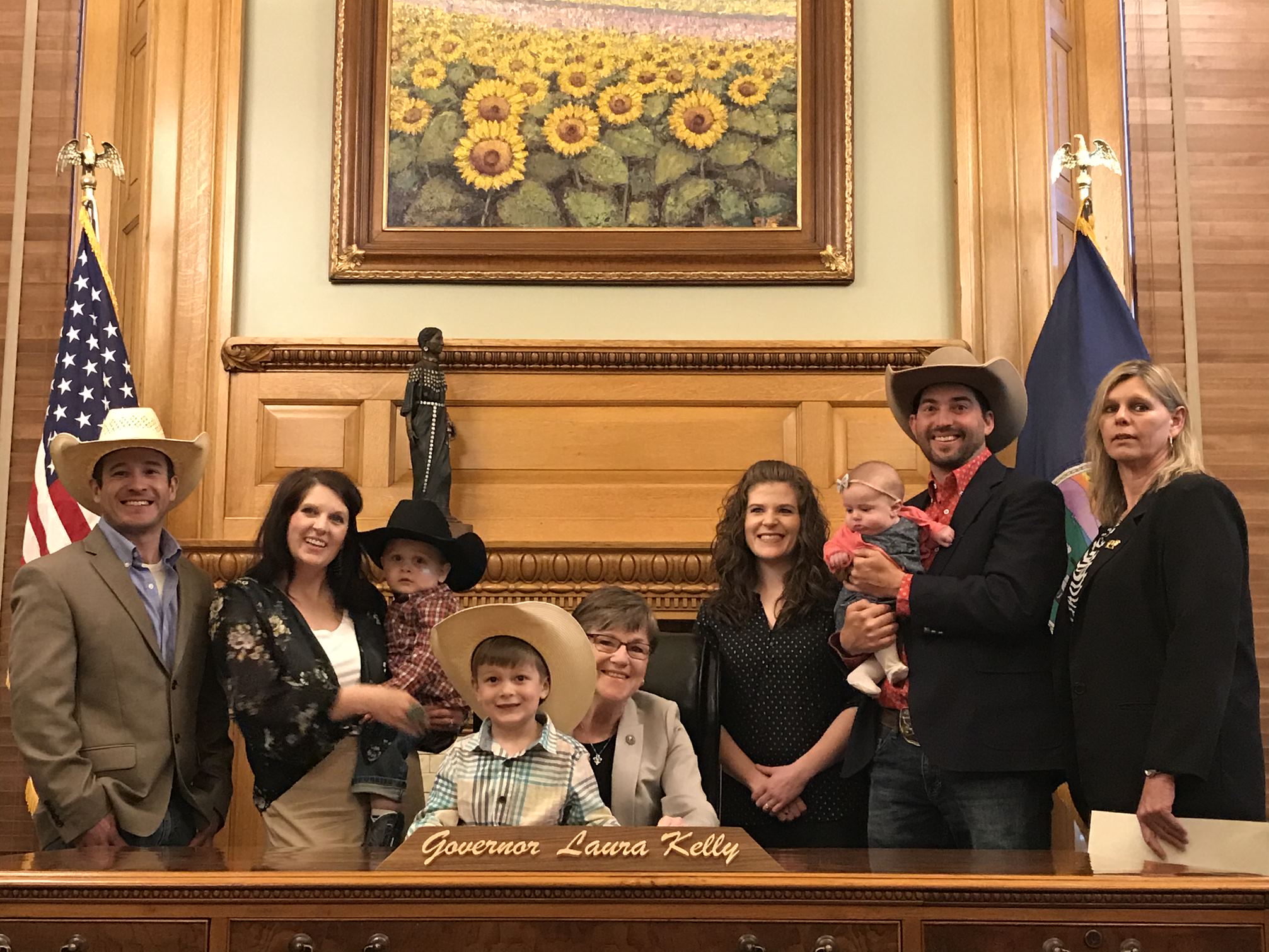
TOPEKA – Many products get publicity and special recognition during the year. But in Kansas, if any product deserves its own month, it’s beef. That is why Kansas Governor Laura Kelly has declared May as Beef Month in the state. This declaration makes the 35th consecutive year beef has received this honor.
According to Kevin Thielen, executive director of the Kansas Beef Council, the value of beef to the economy and social fabric of the state is remarkable.
“With more than 6.35 million cattle on ranches and in feedyards in the state, Kansas ranks third in the country,” says Thielen. “That’s more than twice the state’s human population. Kansas cattle producers are proud of the nutritious, delicious beef they help bring to tables in this state, across the country and around the world.”
Kansas has about 46 million acres of farm ground. Not all of this land can be used to grow crops, however. Grazing cattle is an ideal technique for efficiently utilizing grasses and plants growing on nearly 15 million acres of Kansas pasture and rangeland. These acres would be wasted if not for ruminants like cattle that can turn these resources into essential protein and nutrients for humans.
Kansas ranked second in fed cattle marketed, with 4.9 million in 2017. Beef cattle and calves represented 52.8% of the 2017 Kansas agricultural cash receipts.
The effect of the beef industry on employment is significant as well. According to the American Meat Institute, Kansas companies that produce, process, distribute and sell meat and poultry products employ as many as 19,502 people, while generating an additional 48,070 jobs in supplier and associated industries. These include jobs in companies supplying goods and services to manufacturers, distributors and retailers, as well as those depending on sales to workers in the meat industry.
The product they help bring to market is one that contributes substantially to the human diet. Lean beef provides 10 essential nutrients, including zinc, iron, protein and B vitamins. It does all this for only 170 calories per 3-ounce serving. In fact, a serving of beef provides the same amount of protein as two servings (1 ½ cups) of cooked black beans – which have 341 calories.
Kansas ranchers and feeders are committed to producing beef responsibly and sustainably, Thielen says. But beef production refined over many generations is only part of the story. Producers also keep consumer needs and wants top of mind.
“While all aspects of beef raising and processing are important, producing beef that is delicious, safe, wholesome and nutritious is ‘job one’ for our industry,” Thielen says. “After all, producers of beef are also consumers of the beef they produce. They’re proud of their role in supplying this terrific food that so many people enjoy.”
WICHITA, Kan. (AP) — A man charged in a crash that killed an off-duty Wichita police officer and his young son is set to stand trial.
Dalrymple -photo Sedgwick Co.
James Dalrymple was in Sedwick County Court on Friday for a preliminary hearing on charges of two counts of involuntary manslaughter and failing to yield the right of way. A judge found there was enough evidence for Dalrymple to stand trial. Dalrymple’s arraignment is set for June 25.
The April 2018 crash killed 37-year-old Stacey Woodson and his 9-year-old son, Braedon. Woodson was a 16-year Wichita police veteran who worked in the motorcycle unit.
Authorities say Dalrymple pulled out in front of the Woodsons’ motorcycle. Stacey Woodson died at the scene. His son died later at the hospital.
MANHATTAN, Kan. — The harsh conditions in Kansas this past winter have prompted one of the state’s leading weather agencies to develop a tool that will help cattle producers in the future.
Officials with the Kansas Mesonet, a Kansas State University-based network of weather monitoring stations across the state, has announced the release of the Cattle Comfort Index, a tool that they say will help cattle producers better monitor the needs of their herds during normal and extreme weather conditions.
“We’ve already had a lot of negative impacts on the cattle industry because of the cold temperatures this winter,” said Mary Knapp, the assistant state climatologist with Kansas Mesonet. “This tool will also look at extreme high temperatures.”
The Cattle Comfort Index compiles such climatological factors as weather, humidity, solar radiation, wind speed and more to help producers determine the level of stress their animals may be experiencing at any given time.
“The index is driven by our five-minute data that is available from Kansas Mesonet,” Knapp said. “It will be calculated real-time and updated on a regular basis so that producers can see how that will change during the day.”
The climate information is gathered from each of the Mesonet’s 61 reporting stations in Kansas. For each, the system reports the perceived comfort level of cattle in that area, from no stress, to mild, moderate and severe.
Knapp said, “the actual animal response to temperature stress will be dependent on a number of factors not accounted for in the index,” including age, hair coat, health, body condition, micro-environment, and acclimatization.
“The index shown may start off at a reasonable comfort level in the morning, but as you get into the afternoon when that heat starts developing and the humidity hasn’t abated, that’s when you can get some of the heaviest stress on the livestock,” she said. “A chart will show the level over time, but historical data is limited to the week, ending with the current day.”
The tool was developed from research conducted at the University of Nebraska. The Kansas Mesonet website includes a map that shows conditions across the state and how that might play into risk for cattle.
For more information, interested persons may visit the Kansas Mesonet website, or call 785-532-7019.
Have you ever wondered how to make a meal faster? Have you ever wished you were a master of Excel? If you have said yes to one or both of these questions, the next Women on the Farm program is for you!
Women on the Farm of Barton, Pawnee, and Rush counties invites all people that are interested in either learning more about electric pressure cookers and/or Excel or our next program. This program will take place on Tuesday, May 21, at the Haas Building in Larned. Registration will begin at 10:30 and there is a small fee to cover the cost of lunch. The morning will be spent learning to cook different items in an electric pressure cooker. While you don’t have to bring a cooker, please feel free to do so!
If you are just wanting to attend the Mastering Excel portion of the day, there is no cost and it will start at 1:00 p.m. You are welcome to bring your own computer to work on, but there will be computers available for use.
You are welcome to attend one or both programs, but we you will need to RSVP so that we have enough materials available. Please RSVP to the Pawnee County Extension office by 5:00 on May 17th by calling 620-285-6901.
Alicia Boor is an Agriculture and Natural Resources agent in the Cottonwood District (which includes Barton and Ellis counties) for K-State Research and Extension. You can contact her by e-mail at [email protected] or calling 620-793-1910.
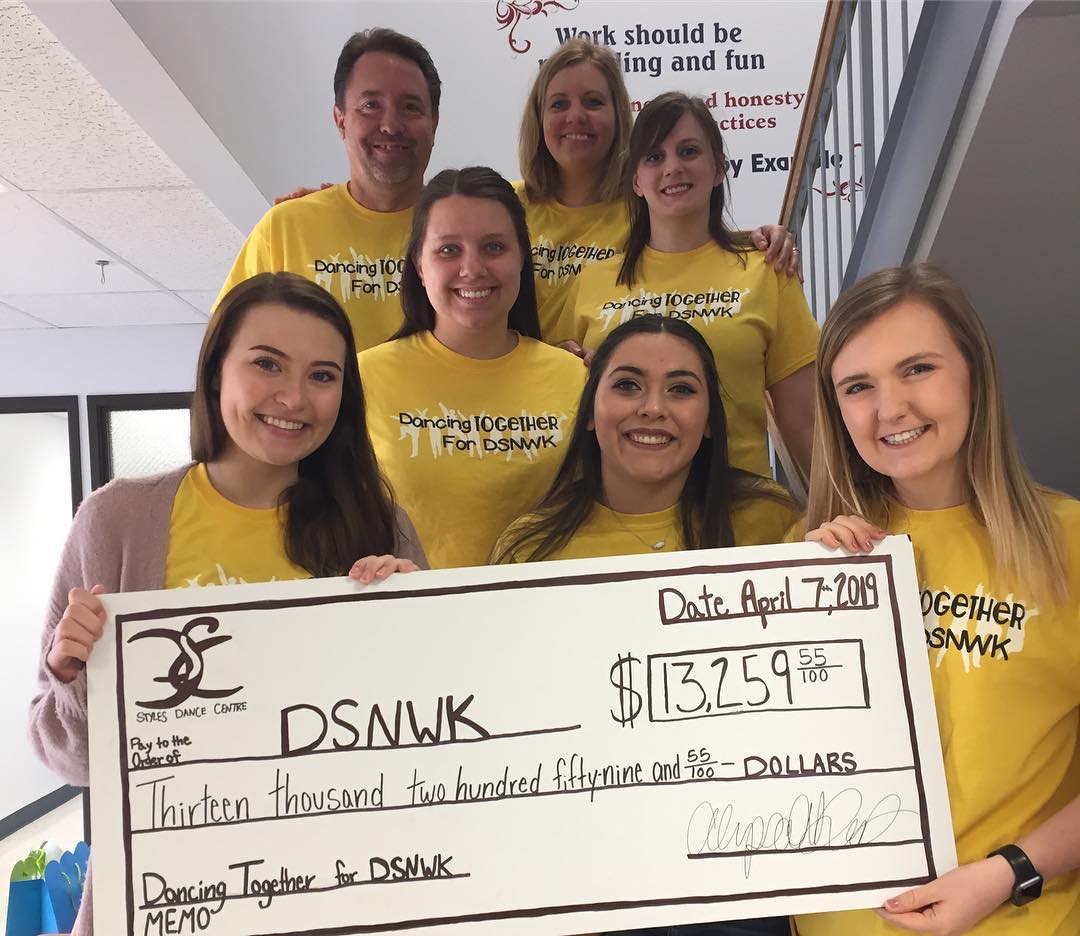
Members of Fort Hays State University’s Leadership 310 team that raised a record $13,000-plus for the “Dancing Together with DWNSK” fundraiser are, front row, left to right, Brenna Erdman, Claudia Castro and Tyra Hayden. Middle row is Macey Pfeifer, instructor, Styles Dance Center. Back row: Steve Keil and Sara Biggs, DSNWK, and Styles owner Alyssa Dechant.By DIANE GASPER-O’BRIEN FHSU University Relations and Marketing
Caden Frank came to Fort Hays State University planning to focus on pre-engineering coursework.
After one class in the Department of Leadership Studies, Frank changed his mind.
“I got involved with the leadership certificate program,” Frank said, “and I realized this is something I felt passionate about, not just as a hobby but as a career.”
Frank and the other three members of his team are part of a record-breaking group in LDRS 310: Fieldwork in Leadership Studies.
The two sections of this spring’s 310 class – as it is commonly referred to – raised a staggering $35,000 for the Hays community through their social change projects. That’s the largest amount raised in one semester since the start of the 310 class more than 15 years ago.
Ironically, Frank’s team project took more of a human relationships route than that of a fundraiser.
Nonetheless, “Breathe Out” and others like it were still impactful, said Dr. Seth Kastle, assistant professor of leadership studies.
Take for example, the “Hansen Entrepreneur Marketing Consultants.” The five-student team helped fill the Dane Hansen Scholarship Hall with an entrepreneurship mindset for fall 2019. It will be the first time that all 32 residents will be involved in entrepreneurship activities. The residence hall was built in 2016 targeted for entrepreneur-minded students.
“This service learning class is about executing a social change project, so it’s teaching people to take ownership in the communities they live in, no matter what that might be,” Kastle said. “We educate these students how to do this now, so when they move on from Fort Hays State, when they see a need, they can address it.”
“Breathe Out” took a couch from Breathe Coffee House to several locations in town and just visited with people, “having intentional conversations with people about how to get involved in their community,” a team spokesman said.
“We want people to be radically changed by their community and to radically change something in their community,” Frank said during his team’s demonstration. He said he has already been radically changed by Fort Hays State and the city of Hays, whose population of 25,000 is considerably smaller than his hometown.
“This town is amazing,” said Frank, who grew up in Omaha, Neb. (population 466,000). “It’s obviously smaller than Omaha but large enough that no matter what your skill set is, it will align with something in town.”
From his initial plan of attending FHSU for three years as a physics major, then transferring to an engineering school in Nebraska, Frank now has his sights set on graduating from FHSU with an organizational leadership degree and working with a nonprofit.
Community partners visit the 310 class early in the semester, and the students then choose a project, write strategic plans and then execute those plans.
Students learn a variety of lessons in the 310 class: planning, organization, teamwork and collaboration, creating awareness, sustainability and even reflecting on what they might have done differently during the project.
“Hindsight is 20-20,” Kastle said. “That purposeful reflection is how the learning takes place. It’s about reflecting about what might have gone wrong and what they might have done different.
For Kensington junior Tayler Petersen, it was tackling a tough project. She and her team, “In Defiance of Cancer,” partnered with the Cancer Council of Ellis County and raised about $3,000. While sponsorship made up most of that total, Petersen said she learned that the smaller amounts (from T-shirt sales and a raffle) added up, too.
“Paula told us not to choose something easy but to do something that would be a challenge and it would mean more, and that really stuck with us,” Petersen said of Paula Flesher, executive director of the local cancer council. “As college students, we kind of just do our thing – do our homework and go to class – and don’t think so much about the community at-large. This has definitely changed my perspective on the impact we can all have on a community.”
Petersen is a criminal justice major who currently works as a corrections officer in Norton and hopes to become a counselor someday. She said she realized early on in her college career that leadership would be a complementary minor to her major.
Like Frank, Petersen was hooked on leadership after one class.
“I just loved it,” she said, “and I knew then what I wanted to minor in.”
The “ARC Park” team raised nearly $10,000, and the top team – another record breaker – was $13,259.55.
That was turned in by “Dancing Together for DSNWK,” which sponsored a fundraiser that featured dancers from Styles Dance Centre in Hays and clients from DSNWK in a public dance recital.
The fundraiser was originally created two years ago by Macey Pfeifer, a Styles instructor who was part of a 310 class at the time. The project was continued by a 310 team last year and this year as well.
“There’s a balance there because the idea is that 310 is going to support the community projects,” Kastle said. “Part of their assignment is to figure out sustainability. This one definitely displays sustainability. Others blaze new trails and take some bumps and bruises along the way. But what a great way to learn.”
During these projects, Keil said, students get the chance to give back to the community that supports Fort Hays State in so many ways.
Ditto for the community partners, said Steve Keil, director of development for DSNWK.
“Being a non-profit, we’re always looking for the community to help and support our activities,” he said. “Fort Hays State has always stepped up to the table, and we appreciate everything FHSU has done for us.”
Keil has been witness to partnerships between the Hays community and Fort Hays State since the 1980s. He graduated from FHSU with a bachelor’s degree in communication in 1986 and earned his master’s in organizational leadership in 2005.
“We get a lot of support from Fort Hays State in a variety of different ways,” he said. “We are all very lucky to have this university in Hays.”
There was once a gal who could rhyme.
But she simply did not have the time.
Although limericks are funny,
They don’t earn much money,
And she died with nary a dime.