Month: May 2019

Midwest Energy awards grants to HHS
USD 489
Midwest Energy for provided several grants to Hays High School activities.
Helping Hands received $1,000 to have electrical work completed at their work site.
Teacher Sue Ann Tebo and her students received a $500 grant to be used in conjunction with Safe Relationships Week.
Jessica Roe was awarded a grant to purchase new vision screening protocols for USD 489.
Jerett Pfannenstiel received a $50 contribution to Project Graduation.
Former Kansas senator billed travel, food from home office
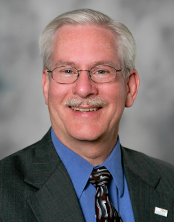
TOPEKA, Kan. (AP) — A published report says a regulatory ombudsman hired by former Gov. Jeff Colyer billed Kansas taxpayers thousands of dollars for travel and food after his official workstation was quietly switched from a state office building near the Capitol to his Salina home.

Former Republican senator Tom Arpke was chosen by Colyer last year to serve as a link between nine state agencies, the governor’s office and Kansas businesses.
Documents obtained by the newspaper through an open records request show his annual salary was about $80,000. One month after starting the job, officials in the Colyer administration changed his office location to his residence.
That designation was used to justify Arpke’s monthly claims that taxpayers should pay him extra every time he drove to Topeka for work.
Kansas school district approves transgender student guidelines

MANHATTAN, Kan. (AP) — The Manhattan-Ogden School Board has approved guidelines for transgender students in the school district.
The board voted 6-1 Wednesday to approve the guidelines, after discussing the issue since December.
The guidelines give students the right to be addressed by the name and pronoun they choose. It also allows students to use the restroom that corresponds to their gender identity, and it allows students to play for sports teams of their gender identity.
The board heard comments from 21 people expressing both support and opposition.
Some opponents cited religious reasons and others criticized allowing students to play for teams of their gender identity.
Board members who supported the policy said they wanted to do what they thought was best for the students.
Still time to enlist Angel Investor assist

 KDC
KDC
TOPEKA – The window for accepting Angel Investor Tax Credit Applications has reached its halfway point.
Applications for companies seeking investment through the Kansas Angel Investor Tax Credit (KAITC) program for 2019 will be accepted through Aug. 31. The program offers Kansas income tax credits to qualified individuals who provide seed-capital financing for emerging Kansas businesses engaged in development, implementation and commercialization of innovative technologies, products and services.
The KAITC Program is administered by the Kansas Department of Commerce and designed to bring together accredited angel investors with qualified Kansas companies seeking seed and early stage investment. The purpose of the Kansas Angel Investor Tax Credit act is to facilitate:
- The availability of equity investment in businesses in the early stages of commercial development.
- Assist in the creation and expansion of Kansas businesses, which are job and wealth creating enterprises.
Applications for certification will be accepted only for Kansas businesses in the seed and early stage rounds of financing.
Companies must meet the following criteria to be certified as a Qualified Kansas Business:
- The business has a reasonable chance of success and potential to create measurable employment within Kansas.
- In the most recent tax year of the business, annual gross revenue was less than $5 million
- Businesses that are not Bioscience businesses must have been in operation for less than five years; bioscience businesses must have been in operation for less than 10 years.
- The business has an innovative and proprietary technology, product, or service.
- The existing owners of the business have made a substantial financial and time commitment to the business.
- The securities to be issued and purchased are qualified securities.
- The company agrees to adequate reporting of business information to the Kansas Department of Commerce.
- The ability of investors in the business to receive tax credits for cash investments in qualified securities of the business is beneficial, because funding otherwise available for the business is not available on commercially reasonable terms.
- Each applicant must sign a Qualified Company Agreement with the Kansas Department of Commerce.
Certification of companies must meet mandates established by Kansas statute to allow accredited Angel Investors to receive the Kansas Angel Investor Tax Credit. This year, the application fee has been reduced from $750 to $500.
Kansas man who fled to Florida sentenced for child sex crimes
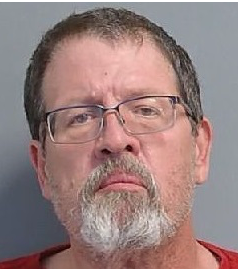
HUTCHINSON, Kan. — A Kansas man who entered a guilty plea to one count of aggravated indecent liberties with a child was sentenced Friday to life in prison with no chance of parole for 25 years.

Charles Richmond, 57, extradited to Kansas from Florida, was originally charged with rape, aggravated criminal sodomy and aggravated indecent liberties with a child. As part of a plea agreement, he entered a plea for the aggravated indecent liberties charge and the other two charges were dropped.
The crimes occurred over a period from Jan. 1, 2013, to Dec. 31, 2017. The child told investigators she had been molested by Richmond more than 100 times.
The life sentence was given because the single charge falls under Jessica’s Law statutes.
Girl Scouts paint narwhals at The Niche

A group of area Girl Scouts participated in a painting class Sunday at The Niche in Hays. The girls painted Sparkles the Narwhal, which was the mascot for this year’s cookie sales. Each of the girls also earned a painting badge.


Now That’s Rural: Rosslyn Schultz, Post Rock Limestone Coalition

By RON WILSON
Huck Boyd National Institute for Rural Development
Is it a post or is it a rock? In central Kansas, it might be both. A unique limestone formation in central Kansas has given rise to the name Post Rock country. Now a dedicated group of community advocates is launching a new coalition to attract visitors to the Post Rock region.
Last week, we learned about the Russell County Area Community Foundation, which is supporting the new Post Rock Limestone Coalition. The coalition is co-chaired by Rosslyn Schultz of the Grassroots Arts Center in Lucas.
As we have shared before, Rosslyn went to K-State and met and married a Lucas-area wheat farmer. Her interest in wheat weaving led her to become involved in folk art. She eventually became director of the Grassroots Arts Center which specializes in outsider, self-taught art environments across Kansas and the Midwest.
Lucas is in the heart of a unique region known as Post Rock country. It takes its name from the pieces of stone which were used as fence posts by inventive pioneers more than a century ago.
When settlers came to the mostly treeless plains of central Kansas, they solved their fencing problems by quarrying and shaping slabs of limestone for use as fence posts and other purposes. Homes, barns, churches, bridges, caves, and water towers were constructed from the honey-colored stone as well.

In 1975, the book Land of the Post Rock was published. Kansas designated Highway 232 from Wilson to Lucas as the Post Rock Scenic Byway, but the underground stone formation went well beyond that highway.
For years, tourism leaders in the area had thought about working together as a region. When the Russell County Area Community Foundation offered a new grant program, it stimulated action to make this a reality.
In August 2018, Rosslyn Schultz and others started working on a grant proposal. This involved a detailed application and an oral presentation before a review board. “It felt like we were gearing up for a master’s thesis,” Rosslyn said.
The Russell County Area Community Foundation ultimately made a $25,000 grant to develop the Post Rock Limestone Coalition. This coalition represents 17 counties which cover this underground limestone formation. In March, 23 individuals representing 20 different organizations and 10 counties in the Post Rock area attended the second organizational meeting.
The region is located along a diagonal line from north central Kansas toward southwest Kansas. Russell County, including Lucas, is in the heart of this region.
The Grassroots Arts Center is located in three historic stone buildings in downtown Lucas. In back of these buildings is the Postrock Limestone Courtyard, a landscaped area highlighting what can only be described as examples of native stone artistry. Lucas is a rural community of 394 people. Now, that’s rural. Many historic stone buildings can be found in rural communities throughout the Post Rock region.
“Our group has a passion for limestone architecture,” Rosslyn said. “This layer of stone is found nowhere else in the world,” she said. “We want to educate about these stone buildings and the people who built them.”
“We need to get people off the interstate,” Rosslyn said. “A study showed that if we can get current visitors to stay one more night and eat two more meals, that is a $2.5 million benefit to the region.”
Eventually, the group hopes to have a visitor’s center or gateway, mobile apps for guided and self-guided tours, and an artist-in-residence program. “We also need masonry people to restore these buildings,” Rosslyn said. The coalition is seeking more partners to expand this effort. For more information, search for the Post Rock Limestone Coalition on Facebook.
Is it a post or is it a rock? In one unique region of our state, we find both. The limestone which served the pioneers as fence posts also became beautiful homes, stores and churches, and now serves as an iconic symbol for the region. We commend Rosslyn Schultz and all those involved with the Post Rock Limestone Coalition for making a difference by preserving and promoting these historic artifacts. I think I will post that this idea rocks.
May events from the Hays Convention and Visitors Bureau

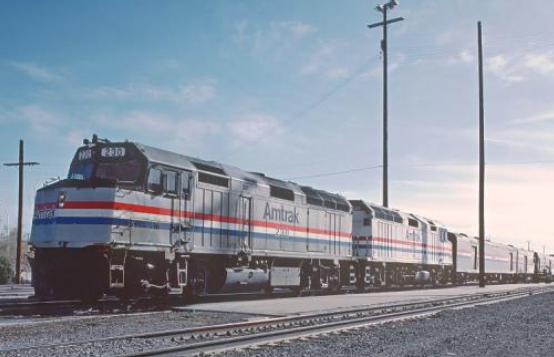
Senate to Amtrak: Explain What You’re Doing To Rail Passenger Service In Kansas
By CORINNE BOYER, Kansas News Service
Long-running frustration about Amtrak’s willingness to keep a rail passenger line running through remote parts of the country has politicians threatening to block new directors to the agency.

WIKIMEDIA COMMONS
A handful of U.S. senators demanded specifics by this week about how Amtrak plans to spend an added $50 million to keep the Southwest Chief line running from Chicago, through Kansas, to Los Angeles.
Hoping to force Amtrak to make long-term promises of keeping the Southwest Chief line, U.S. Sen. Jerry Moran of Kansas had already used the power each senator holds to put a legislative block on the appointment of three nominees waiting to join the passenger rail agency’s board of directors.
Amtrak still has not specified when it will answer the pending questions from the Senate. A spokeswoman from Moran’s office said Amtrak has made contact, but not with answers about how it plans to alter long-distance routes or how the rail service calculates what states must chip in to support service.
“(Moran) will maintain those holds (on the nominations until he gets) assurances from Amtrak that it will continue to fund the Southwest Chief and funds that rail service,” said Moran spokeswoman Morgan Said.
Moran and other senators have criticized Amtrak for proposals to replace train services with buses along some parts of the route.
Amtrak officials did not respond to requests for comment for this story.
In February, Congress gave $50 million for upkeep of the route to Amtrak to keep the line working through September. Last year, Amtrak proposed replacing service from Dodge City to Albuquerque with buses, but the federal budget prohibits the use of buses to replace long-distance train service along the route.
In early April, a group of 11 senators sent Amtrak a letter demanding more detail about its plans for the Southwest Chief and how, more broadly, it decides which long-distance routes are worth operating.
The Senate letter also addressed Amtrak’s claims that ridership is down. The most recent data provided by Amtrak says more than 52,000 passengers boarded the Southwest Chief line in Kansas in 2017, up 5.7 percent from 2016.
With 2 a.m. and 3 a.m. departures, Newton, the busiest station in the state, saw nearly 16,000 passengers in 2017. Erin McDaniel, communications director for the City of Newton, says the town supports the Southwest Chief and partners with other cities to fund it.
“We know many of our residents use it to get to Chicago as well as the Southwest,” McDaniel said.
Keeping the Southwest Chief running is important to Newton because preliminary efforts looking at establishing train service to connect Newton to the Heartland Flyer route, which runs from Oklahoma City to Fort Worth, Texas, are underway.
“There used to be a train route that went there years ago,” McDaniel said, “but if the Southwest Chief goes away, dreams of extending the Heartland Flyer would go away with it.”
Over the last year, Amtrak has removed ticket agents from many stations. But Assistant City Manager for Dodge City Melissa Mccoy said the city employs staff at its train depot.
“We have few options in terms of public transportation,” McCoy said. She said ridership jumps with tourists in the summer.
Without the Southwest Chief route, McCoy says some Dodge City residents wouldn’t be able to travel long distances.
“We have a lot of working class folks, and they have limited income,” she said. “Amtrak provides them a way to visit family and go on vacation and without that they might not have it all.”
An earlier version of this story incorrectly attributed the reason a hold was placed on Amtrak directors’ appointments. U.S. Sen. Jerry Moran took that action to secure a pledge to keep the Southwest Chief line running.
Corinne Boyer is a reporter based in Garden City for the Kansas News Service. Follow her @Corinne_Boyer.
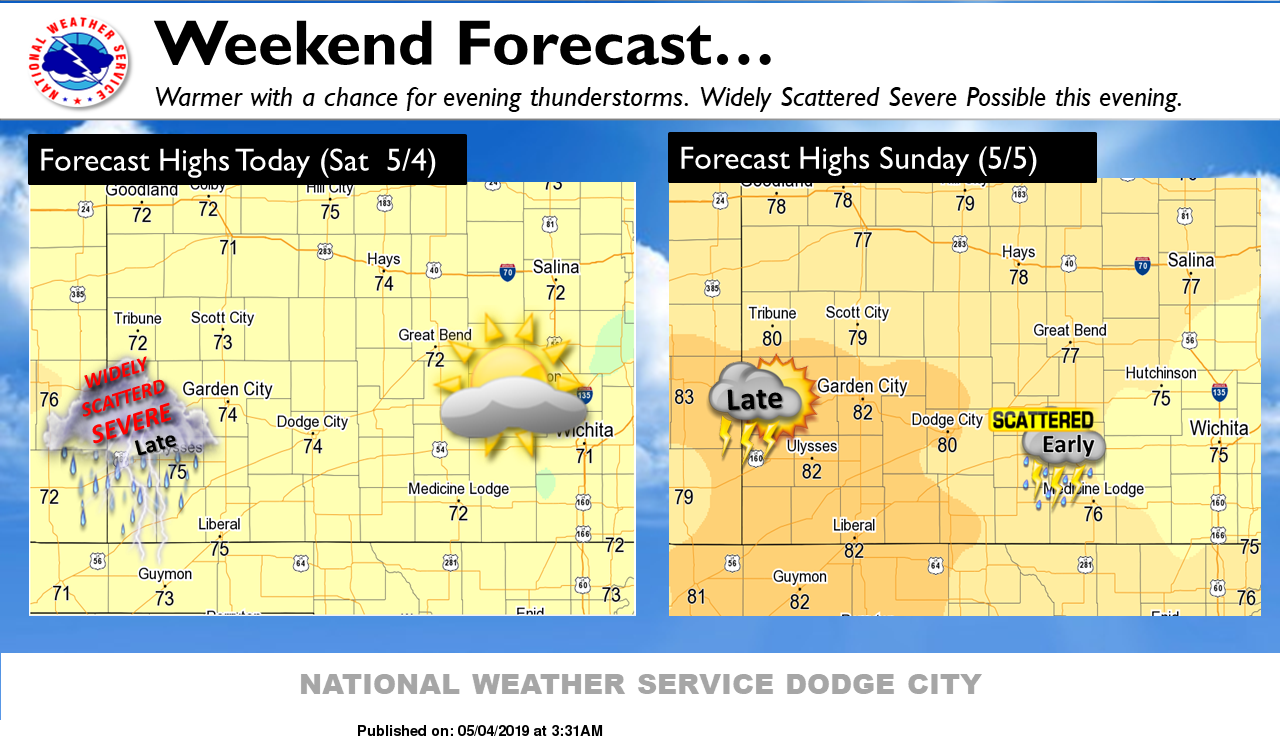
Sunny, mild Saturday chance of storms late
 Today
TodayMostly sunny, with a high near 73. Light southwest wind becoming south 10 to 15 mph in the morning.
Tonight
A 20 percent chance of showers and thunderstorms after 9pm. Mostly cloudy, with a low around 51. South wind 9 to 14 mph.
Sunday
A 20 percent chance of showers and thunderstorms before 1pm. Mostly sunny, with a high near 78. South wind 9 to 13 mph.
Sunday Night
A 20 percent chance of showers and thunderstorms. Increasing clouds, with a low around 56. South southeast wind around 8 mph.
Monday
A 20 percent chance of showers and thunderstorms. Partly sunny, with a high near 79. South southeast wind 8 to 13 mph becoming east northeast in the afternoon.
Monday Night
Showers and thunderstorms likely. Mostly cloudy, with a low around 54. Chance of precipitation is 60%. New rainfall amounts between a quarter and half of an inch possible.
Tuesday
A 40 percent chance of showers and thunderstorms. Mostly cloudy, with a high near 68.
Tuesday Night
A 50 percent chance of showers and thunderstorms. Mostly cloudy, with a low around 51.
Wednesday
Showers and thunderstorms likely, mainly after 1pm. Mostly cloudy, with a high near 64. Chance of precipitation is 60%. New rainfall amounts between a tenth and quarter of an inch, except higher amounts possible in thunderstorms.
St. Mary’s fifth-grader wins 2019 Hays Arts Council Famous Figures contest
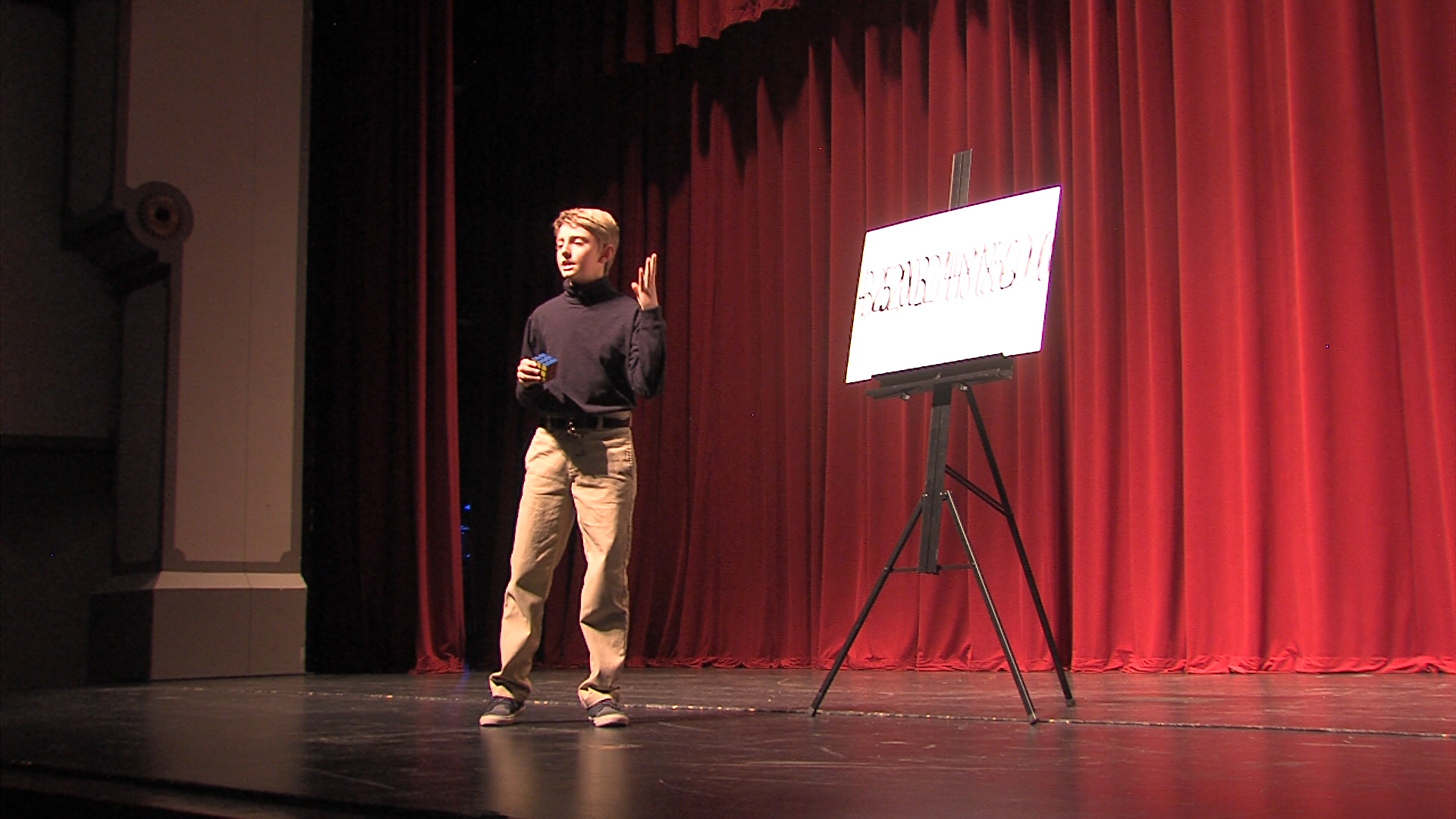
The Hays Arts Council again sponsored its Famous Figures competition for Ellis County fifth-grade students.
Thirty-five finalists were selected to perform Friday at Beach/Schmidt Performing Arts Center. They portrayed figures such as Ruth Bader Ginsburg, Jackie Robinson, George Washington and Roy Rogers. The top three winners were
1.Will Eck of St. Mary’s Grade School as Erno Rubik, inventor of the Rubik’s Cube
2.Kaliyah Bannister of Roosevelt Elementary School as Michelle Obama, First Lady of the United States
3.-tie Johanna Jones of O’Loughlin Elementary School as Dolly Parton, singer and philanthropist
3.-tie Erin Ruder of Roosevelt Elementary School as Ruth Handler, inventor of the Barbie doll
A complete list of participants will be posted at the Hays Arts Council website.
Medicaid expansion backers in Kansas block next state budget
TOPEKA, Kan. (AP) — Kansas lawmakers who support expanding Medicaid blocked passage of the next state budget Friday in a high-stakes standoff designed to force the Legislature’s conservative Republican leaders to allow an expansion plan backed by Democratic Gov. Laura Kelly.

Kelly’s election last year raised hopes that Kansas would join 36 other states that have expanded Medicaid or seen voters pass ballot initiatives. But, like North Carolina Gov. Roy Cooper and Wisconsin Gov. Tony Evers, two other Democrats pushing to expand Medicaid, she faces a GOP-controlled Legislature.
The Kansas House voted 63-61 against an $18.4 billion spending blueprint for the budget year that begins in July. House and Senate negotiators hashed out details Thursday night that were favorable for Kelly, fellow Democrats and moderate Republicans, with extra money for higher education, the prison system and state employee pay raises.
Democrats and moderate Republicans praised the proposed budget but saw the vote as their chance to pressure the Senate’s GOP leaders into relenting on plans to delay an expansion vote until next year.
But Republican leaders didn’t relent. The budget negotiators drafted a new, less generous spending blueprint — that removed extra funds for hospitals, whose association has advocated expansion — and put it to a vote in the House, only to see it fail by a wider margin, 81-42 against it.
“We’re going to do everything we can to get Medicaid expansion,” said House Minority Leader Tom Sawyer, a Wichita Democrat. “If we fail, we haven’t lost anything.”
The Senate has yet to debate a Medicaid expansion billapproved by the House in March, and top Republicans argue that lawmakers need more time to get the details right. Kelly has called it a “stall tactic” and is pushing lawmakers to go ahead now, so that expanded Medicaid health coverage can start in January.
The move thwarted top Republicans’ plans to wrap up lawmakers’ business for the year Friday, well ahead of the traditional 90-day mark on May 17.
GOP leaders wanted to pass a bill providing relief to individuals and businesses paying higher state income taxes because of changes in federal tax laws at the end of 2017, a smaller plan than one Kelly vetoed in March. The Senate approved it Thursday night, and supporters needed only a favorable House vote to send it to Kelly.
But lawmakers aren’t finished until they pass a budget because state government can’t operate past June or distribute $4 billion to its public schools without one. That created an opportunity for expansion supporters if they can hold up the spending blueprint long enough — but also a risk that spending they wanted would be at risk.
“I said exactly what was going to happen,” said Appropriations Committee Chairman Troy Waymaster, a conservative Republican and the House’s lead budget negotiator. “They were forewarned.”
Some expansion supporters accused GOP leaders of retaliation and even bullying. The change in funding for hospitals proved a provocative move. It removed $14 million in state funds, and it could have cost hospitals $250 million in federal funds.
Expansion advocates have been frustrated by their inability to get a bill out of committee in the Senate. The measure has bipartisan support in both chambers, but GOP conservatives who oppose it hold key leadership jobs. Top Republicans argue that an expansion plan is likely to prove more costly to the state than Kelly’s administration projects and want to consider alternatives, including work requirements.
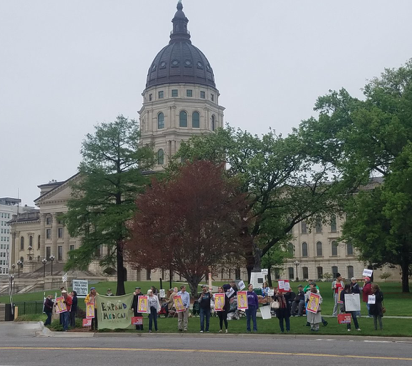
About 15 expansion supporters dropped several thousand leaflets in the Statehouse rotunda Friday morning, each depicting a past-due hospital bill spattered with blood. The leaflets said hundreds of Kansas residents will die needlessly each year without expansion and each had the picture of a GOP senator on one side.
“When there’s extreme behavior coming out of the Senate leadership, that requires us to try to force their hand,” said Logan Stenseng, a 20-year-old University of Kansas public administration student who participated in the brief protest.
The protest didn’t move prominent Medicaid expansion opponents. Senate health committee Chairman Gene Suellentrop, a conservative Wichita Republican, noted that a leaflet with his photo contained another senator’s quote on the other side and he said the mismatch suggest the protesters “probably know very little about Medicaid expansion.”
“They need to go back to college,” Suellentrop said.
Advocates have pushed for Medicaid expansion in Kansas since 2012 and passed a bill in 2017, only to see it vetoed by then-Republican Gov. Sam Brownback. Democrats in North Carolina are hoping to include expansion in their state’s budget, but they face resistance from GOP legislative majorities and are suggesting that a veto by Cooper is ahead, with potentially protracted negotiations to follow.
___
TOPEKA, Kan. (AP) — Kansas lawmakers who support expanding Medicaid promised Friday to try to block passage of the next state budget in a high-stakes standoff designed to force the Republican-controlled Legislature’s conservative leaders to allow an expansion plan backed by Democratic Gov. Laura Kelly.
The House planned to vote Friday on an $18 billion-plus spending blueprint for the budget year that begins in July. House and Senate negotiators hashed out details Thursday night that were favorable for Kelly, fellow Democrats and moderate Republicans, with extra money for higher education, the prison system and state employee pay raises.
The Senate has yet to debate a Medicaid expansion billapproved by the House in March, and top Republicans want to postpone a vote until next year, arguing that they need more time to get the details right. Kelly has called it a “stall tactic” and is pushing lawmakers to go ahead and expand Medicaid health coverage to as many as 150,000 more people this year.
Top Republicans wanted lawmakers to wrap up business for the year Friday after passing a bill providing relief to individuals and businesses paying higher state income taxes because of changes in federal tax laws at the end of 2017, a smaller plan than one Kelly vetoed in March. The Senate approved it Thursday night, and supporters needed only a favorable House vote to send it to Kelly.
But lawmakers aren’t finished until they pass a budget because state government can’t operate past June without one. That created an opportunity for expansion supporters if they can hold up the spending blueprint.
“That’s the plan right now,” said House Minority Leader Tom Sawyer, a Wichita Democrat. “Right now, it looks like it’s holding pretty firm.”
Expansion advocates have been frustrated by their inability to get a bill out of committee in the Senate. The measure has bipartisan support in both chambers, but GOP conservatives who oppose it hold key leadership jobs. Top Republicans argue that an expansion plan is likely to prove more costly to the state than Kelly’s administration projects and want to consider alternatives, including work requirements.
About 15 expansion supporters dropped several thousand leaflets in the Statehouse rotunda Friday morning, each depicting a past-due hospital bill spattered with blood. The leaflets said hundreds of Kansas residents will die needlessly each year without expansion and each had the picture of a GOP senator on one side.
“When there’s extreme behavior coming out of the Senate leadership, that requires us to try to force their hand,” said Logan Stenseng, a 20-year-old University of Kansas public administration student who participated in the brief protest.
The protest didn’t move prominent Medicaid expansion opponents. Senate health committee Chairman Gene Suellentrop, a conservative Wichita Republican, noted that a leaflet with his photo contained another senator’s quote on the other side and he said the mismatch suggest the protesters “probably know very little about Medicaid expansion.”
“They need to go back to college,” Suellentrop said.
Blocking the budget held risks for Democrats and moderate Republicans. If the spending plan failed, budget negotiators could reopen talks and rethink an extra $35 million for the prison system, $33 million for higher education or 2.5 percent pay raise for state employees included in it.
“I would say they don’t get a better budget than this,” said Rep. Kyle Hoffman, a conservative Coldwater Republican. “If we go back, things start getting stripped out.”
___