We have a brand new updated website! Click here to check it out!

FIRST FIVE: Let’s get ‘mad as hell’ about vital information we won’t get to see

Gene Policinski

The U.S. Supreme Court last month said we can’t see certain kinds of information we may well need to participate in democracy as self-governing citizens. To paraphrase a line from “Network,” the movie and play recently on Broadway, we should be “mad as hell” about it.

The court ruled, 6-3, in Food Marketing Institute v. Argus Leader Media, the that the Freedom of Information Act (FOIA) does not provide the public with access to records from private companies given to a federal agency if the agency obtained the information with a promise to keep it secret.

In the decision, the court voided a decades-long practice — supported by lower court decisions — that such “confidential” information could be released unless it caused “substantial harm” to the business, with an eye to toward disclosures in the public interest related to safety concerns, or to the exposing of waste, fraud or abuse, among other points.

Justice Neil Gorsuch wrote in the majority opinion — agreeing with a grocery trade group — that current law provides that agencies and private companies don’t even need to have a specific reason for secrecy — just a company tag on records it considers “confidential” justifies denial of an FOIA request.

The decision is likely to decrease public access to vital records, such as information about private companies that receive federal funds. It will hamper — if not stymie — the obtaining of information the public can use to determine things like fraud, overcharging and the quality of work. The decision also comes as it’s ever more likely a private company will be contracted to carry out government projects or duties.

In the case at hand, the Sioux Falls, S.D., Argus Leader newspaper sought information in 2011, through an FOIA request, on the number of in-state stores participating in the federal food stamp program, as well as store-by-store data on the amount of purchases made using food stamps.

Argus Leader news director Cory Myers said after the decision that “this is a massive blow to the public’s right to know how its tax dollars are being spent, and who is benefiting.”

Justice Stephen Breyer disagreed with the decision, saying the “the whole point of the Freedom of Information Act — first signed into law in 1966 — is ‘to give the public access to information it cannot otherwise obtain.’”

Breyer said that given public and private sector tendencies to treat all information as private if not required to be disclosed, “the ruling … will deprive the public of information for reasons no better than convenience, skittishness or bureaucratic inertia.”

Whatever the reason the Supreme Court saw for supporting non-disclosure under FOIA based on a company’s self-designation, a democratic republic based in the ultimate authority of an informed and engaged electorate requires the highest degree of government openness and transparency.

We cannot decide how our government is doing if we don’t know what our government is doing — and that holds true for those places where government intersects with business.

Gene Policinski is president and chief operating officer of the Freedom Forum Institute. He can be reached at [email protected], or follow him on Twitter at @genefac.
Grow Hays housing rehab program getting up to speed

By JAMES BELL
Hays Post

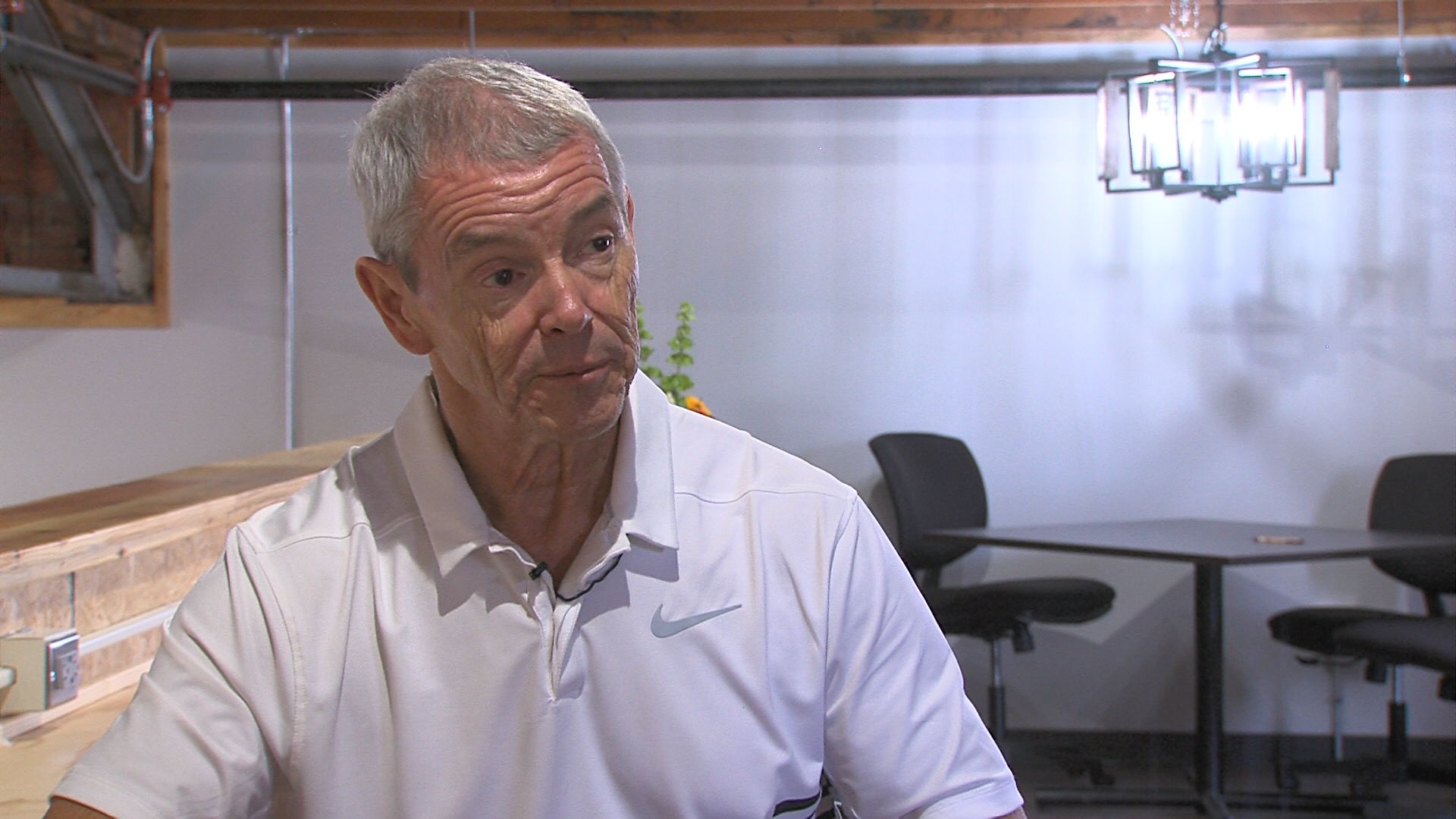
After about a year of redevelopment, the Grow Hays housing rehabilitation program is getting up to speed, according to Grow Hays Executive Director Doug Williams.

The program was started in 2016 when the organization was named the Ellis County Coalition for Economic Development.

“It has been a really good program, we have done five completions so far,” Williams said. “We actually have three going right now, one in Hays, one in Ellis and one in Victoria.

“Our attempt is to have three or four going at one time,” he added. “We have a limited amount of funds, so we can’t do any more than that at any given time.”

Funding for the program comes from the Dane G. Hansen Foundation.

Williams said the organization hope to complete five rehabs a year and the program is an asset for the community with the main goal of providing more affordable housing in Ellis County.

The effect on the neighborhood and the local economy is important as well.

“It turns a blighted home, perhaps, and turns it into something nice for the neighborhood,” he said, which creates increased tax revenue along with the purchase of construction materials that benefit local retailers. “A lot of people win in this program.”

The program includes all of Ellis County and is open to anyone with experience with home rehabilitation, including contractors and real estate agents.

Getting into the program is similar to a regular home purchase.

An interested party finds a home in need of rehabilitation, will secure a sale contract subject to financing from the Grow Hays rehab program — just like financing from a bank — and then submits an application to Grow Hays.

That application provides Grow Hays with the information needed to decide if the home is eligible for the program.

“Which includes some information about what they want to do with the property, what their anticipated budget is for the rehab costs, then a market analysis,” Williams said.

Homes sold through the program are capped at a sale price of $145,000 after the rehab, Williams said, but have few other limitations, including age or condition.

“We have primarily homes that are older,” he said, generally because of limitations to the final price.

“Most have been purchased in the $70 to $80 thousand price range in Hays,” Williams said.

Homes in the program are also limited to a nine-month window from contract to final sale.

Money loaned from Grow Hays for rehabilitation is interest-free, but a $2,500 fee is assessed at the time of sale.

For more information about the program visit the Grow Hays website here.

Colby coach takes over dance program at Kansas Wesleyan

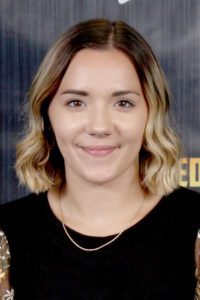
Bailey Brenn, Photo courtesy of KWU Athletics

KWU

Kansas Wesleyan University has selected Bailey Brenn to serve as the new competitive dance coach for the Coyotes.

Brenn takes over for Kelsey Kieborz, who left KWU in April to focus on her dance studio, Revolution School of Dance.

“Our committee was impressed with Bailey’s experience at Colby Community College and her vision for the program,” said Mike Hermann, vice president and director of athletics. “With her background, I’m confident she’ll continue the momentum within our dance program.”

“I’d like to thank Mr. Hermann, (KWU President) Dr. (Matt) Thompson and members of the search committee for giving me this opportunity to lead the Kansas Wesleyan Dance program,” Brenn said. “My goal is to continue building the team to be one of the top competitive programs not only the conference, but in the region.”

Brenn comes to Kansas Wesleyan after serving as an assistant for the Colby Community College cheer and dance programs for the last two years. While at Colby, she was responsible for team choreography and had a significant role in recruiting.

“I am excited to be part of a new team, learning what each member of the team and what they have to offer and how we can make that a part of the performances,” Brenn added. “I am excited to see the bond between the team members and to see them become more of a family.”

She also served as a dance instructor for Ashly’s Dance Center in Colby for the last three years.

The native of Junction City was a member of the Junction City High School cheer and dance teams. She also was a member of the Colby CC Trojans cheer and dance teams and the Kansas State University Classy Cats dance team. She was a member of the 2016 NJCAA Region 6 championship teams at Colby.

RODEO HEROES: Three Phillipsburg competitors are featured on T-shirts

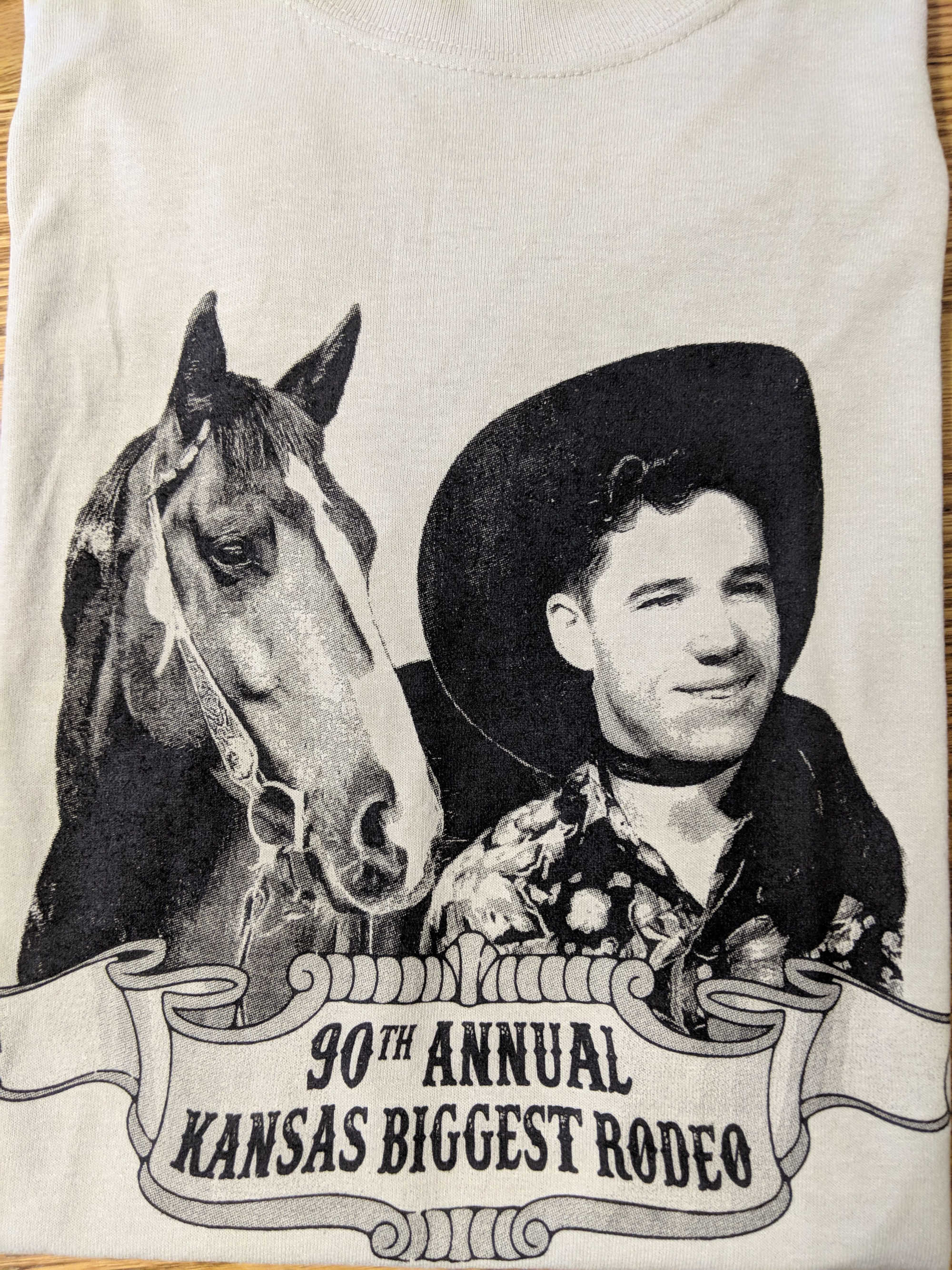
Nat Berney is pictured on a 2019 Kansas Biggest Rodeo commemorative t-shirt. The Phillipsburg man competed at the rodeo and served as rodeo secretary.

PHILLIPSBURG – Three people with ties to the Phillipsburg Rodeo are immortalized on rodeo T-shirts.

Nat Berney, Bud Forell and Wanda Bandt are all pictured on the fronts of t-shirts produced by the Phillipsburg Chamber-Main Street office.

All three have competed at the Phillipsburg rodeo.

Nat Berney, who was born in 1921, was a bareback rider, calf roper and bull rider who competed in Phillipsburg and across the Great Plains. He was a Phillipsburg Rodeo Association shareholder and served as rodeo secretary. After he quit competition, he worked as a rodeo judge for Little Britches and pro rodeos. Berney passed away in 2002. His wife Betty lives in Phillipsburg; the couple had three children.

Bud Forell, born in 1931, competed in every event in rodeo: steer wrestling, saddle bronc riding, bareback riding, calf roping and bull riding, but steer wrestling was his forte.

After graduating from Phillipsburg High School in 1949, he served in the U.S. Army in Germany from 1951-1953.

He competed at Kansas Biggest Rodeo numerous times and was a committee member, helping with maintenance and welding.

He and his wife Artyce married in 1954 and had two sons and four daughters. Eldest daughter, Deb Christy, who is a barrel racer, remembers her dad’s outlook on life. There were “never any excuses,” she said. “You had no excuses, and you never gave up. He had a tremendous work ethic.”

Forell died in 2005 at the age of 74.

Bud Forell, who passed away in 2005 at the age of 74, competed in every event in rodeo and worked rodeos across the Great Plains, including the Phillipsburg rodeo.

Barrel racer Wanda Bandt was raised on her family’s farm near Kensington and won the barrel racing at the Phillipsburg rodeo in 1971 and 1974. She grew up riding horses, and as a young woman, worked as an airline stewardess. But after a time, she tired of it and quit. She was in Minnesota and had no way to get home, so she and two girlfriends sold all they had and bought horses, which they rode all the way back to Kansas.

Bandt was known for riding without using her stirrups, and daughter Tamra Griffey wonders how her mom stayed in the saddle. Polyester pants were in style then, and Bandt would have had trouble staying in the slick saddle with polyester on.

The two times Bandt won the Phillipsburg rodeo, she was riding her famous horse Copper. Competing at the regional level, Bandt and Copper won 51 consecutive rodeos in the late 60s and early 70s.

Bandt was also skilled at sewing and leather tooling and was an artist, talents her daughter Griffey uses in her work. Bandt sewed nearly all her own clothes, making bright colorful outfits like blue jumpsuits, in style at the time, with western belt loops, and a red jumpsuit, paired with a red hat and red checkered boots. Griffey said her mom sewed without patterns.

Bandt died in 1983 at the age of 46 of a brain tumor, and Griffey’s daughter, who never knew her grandmother, has a motto that conceptualizes her grandma’s gumption and talent: “If Wanda can do it, I can do it.” Bandt’s husband Layton served on the Phillipsburg rodeo committee for three years.

Barrel racer Wanda Bandt won her event twice at the Phillipsburg rodeo. On the t-shirt, she rides her famous horse Copper, who won 51 consecutive barrel races at a variety of rodeos. Bandt often kicked her feet out of the stirrups as she rode.

Berney, Forell and Bandt have connections to each other. Berney’s wife Betty traveled with Bandt to rodeos, keeping her company. Forell’s daughter Deb Christy babysat for Bandt’s children at rodeos, and as a teenager, was mentored by Bandt as she competed alongside the older woman.

T-shirts are available for sale through the Phillipsburg Chamber of Commerce/Main Street, Blossoms and Butterflies, White’s Foodliner, and Curly Willow II, all in Phillipsburg.

The Phillipsburg rodeo runs August 1-3 beginning at 8 pm each night. Tickets start at $11 for children and $15 for adults. They can be purchased at Heritage Insurance in Phillipsburg (785.543.2448).

Thursday, August 1 is Family Day at the rodeo; all children ages 10 and under are free with the the purchase of an adult ticket.

For more information, visit www.kansasbiggestrodeo.com.

Now That’s Rural: Don Whitten, Beecher Bible and Rifle Church

Ron Wilson is director of the Huck Boyd National Institute for Rural Development at Kansas State University.

BY RON WILSON
Huck Boyd National Institute for Rural Development

Where do bibles and rifles connect? That unlikely combination can be found in the history of Kansas, and particularly in one historic rural community church. This church is continuing to serve its members and its historic legacy.

Don Whitten is a member of the Beecher Bible and Rifle Church in Wabaunsee. He told me this remarkable history. It all began in the 1850s era of Bleeding Kansas, when the people of the territory were involved in a vicious debate over whether Kansas would become a slave state or a free state. Advocates for both sides flooded Kansas territory. For example, abolitionists in Connecticut raised money to send a group of free-state colonists west.

A famous New York preacher, Henry Ward Beecher, raised money for the cause and sent crates of rifles and bibles to the colonists. According to legend, the rifles were covered with bibles so as to get through the pro-slavery state of Missouri.

In 1856, the Connecticut colonists came to Wabaunsee. In the following year, they organized the First Church of Christ there. A new stone church was dedicated in 1862. This became the site of one of the most influential Congregational churches in Kansas.

By the 1930s, population had fallen, church membership dwindled and the church closed. In 1950, it re-opened. Today, the Beecher Bible and Rifle Church is an independent, non-denominational church which still meets in the original but remodeled stone building. Services are held each Sunday at 9:45 a.m. with Pastor Lynn Roth officiating.

Local residents George and June Crenshaw actively supported the church. Friends of theirs named the Thompsons donated funds for a new building and education center next to the old stone church building. The new building was dedicated in 1993.

Don Whitten has compiled the history of the church. He is a career military man who retired from Fort Bliss, Texas and moved to Wabaunsee, Kansas. He and his wife arrived in Wabaunsee in 1971 in the middle of a big snowstorm. When a neighbor, Inez Drake, learned of their situation, she thoughtfully alerted a snowplow crew to clear the streets before the Whitten’s moving truck arrived the next day.

Another neighbor, Mrs. Morgan, came over and invited them to her church at Wabaunsee. “We turned her down because we didn’t even have our clothes here yet,” Don said. Mrs. Morgan persisted in following weeks. “After the third or fourth time, I told my wife, `Let’s go to that church and get that old lady off our back,’” Don said. “We came to that church the next Sunday and we’ve come ever since.”

The Whittens appreciated the warm welcome of the congregation and the preaching, fellowship, and rich history. It was the first inter-racial Congregational church in Kansas. The late Mrs. Morgan herself was African-American and a long-time member. Her picture is displayed inside the church entrance.

Another long-time tradition at the church is Old Settler’s Day, held annually on the last Sunday of August. On Sunday, Aug. 25, 2019, a potluck lunch will be held at the church, followed by a historical program. This year, that program will be presented by me. The public is invited to attend at no charge.

This church and the community and region which it serves are rich in history. The building is listed on the National Register of Historic Places. It is located along the Native Stone Scenic Byway and along the route of the Underground Railroad which ran through the Kansas River valley.

That’s a lot of history to be found in a rural community. Wabaunsee is an unincorporated town with a population of perhaps 100 people. Now, that’s rural.

For more information, look for Beecher Bible and Rifle Church HERE.

Where do bibles and rifles connect? In this case, they connect with Kansas history in a rural community church. We commend Don Whitten, Lynn Roth, and all those involved with the Beecher Bible and Rifle Church for making a difference by serving the community and honoring this history. I hope both the bibles and the rifles hit their mark.

Audio and text files of Kansas Profiles are available at https://www.kansasprofile.com. For more information about the Huck Boyd Institute, interested persons can visit https://www.huckboydinstitute.org.

————————————————
The mission of the Huck Boyd National Institute for Rural Development is to enhance rural development by helping rural people help themselves. The Kansas Profile radio series and columns are produced with assistance from the K-State Research and Extension Department of Communications News Media Services unit. A photo of Ron Wilson is available at https://www.ksre.ksu.edu/news/sty/RonWilson.htm. Audio and text files of Kansas Profiles are available at https://www.kansasprofile.com. For more information about the Huck Boyd Institute, interested persons can visit https://www.huckboydinstitute.org.

Hot, breezy Sunday, chance of storms late

Today
Isolated showers, then a chance of showers and thunderstorms after 1pm. Mostly sunny, with a high near 94. South wind 10 to 16 mph. Chance of precipitation is 30%.
Tonight
A 30 percent chance of showers and thunderstorms, mainly before 11pm. Mostly clear, with a low around 65. West southwest wind 5 to 11 mph becoming north after midnight.
Monday
Sunny, with a high near 93. North wind 7 to 9 mph becoming east in the afternoon.
Monday Night
Mostly clear, with a low around 63. East wind 3 to 8 mph.
Tuesday
Mostly sunny, with a high near 94. Southeast wind 5 to 14 mph, with gusts as high as 28 mph.
Tuesday Night
Partly cloudy, with a low around 69.
Wednesday
Mostly sunny, with a high near 97.
Wednesday Night
A 20 percent chance of showers and thunderstorms before 1am. Mostly cloudy, with a low around 69.
Thursday
Mostly sunny, with a high near 95.

Kansas man, 15-year-old dead after SUV rollover crash

WILSON COUNTY — Two people died in an accident just before 11p.m. Saturday in Wilson County.

The Kansas Highway Patrol reported a 1995 Ford Explorer driven by Monica Rader, 38, Delta, Co., was northbound on Kansas 39 fifteen miles west of Chanute.

The driver swerved to miss an animal in the roadway. The SUV rolled multiple times, entered the east ditch and the three passengers were ejected from the vehicle.

Ronald A. Hudson, 35, Thayer, and Malachi Hill, 15, Chanute, were pronounced dead at the scene. Rader and Keishawn Valenzuela, 14, Chanute, were transported to Wesley Medical Center. None of occupants were wearing seat belts, according to the KHP.

Meet the well-meaning pioneer behind a vegetarian ‘fairy land’ in Kansas

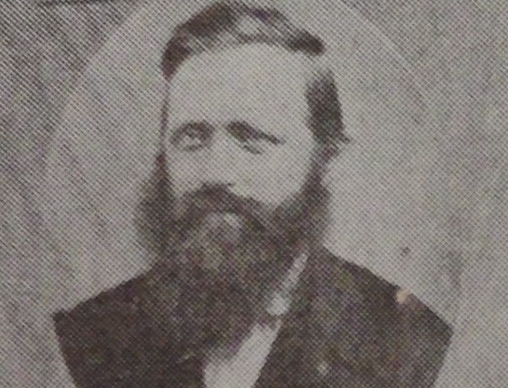
Henry S. Clubb was an Englishman at the forefront of the vegetarian movement in the mid-1800s. He attempted to establish a vegetarian settlement in Kansas in 1856.
(Photo public domain)

 
Kansas News Service

Vegetarians have their reasons for not eating meat. But “I am an optimist” doesn’t have a regular spot on lists more typically focused on health and environmental benefits.

Optimism was, however, the Englishman Henry Clubb’s rationale more than 100 years ago, when he enticed dozens of people to move to the radical territory of Kansas to start a vegetarian settlement in what is now Allen County.

“Now we all have come! have brought our fathers, our mothers, and our little ones, and find no shelter sufficient to shield them from the furious prairie winds, and the terrific storms of the climate!” wrote a woman from New York named Miriam Colt.

Colt and her family were among those who had given money to Clubb based on his promise that the settlement would be habitable by the time they got there. It took the Colt family more than a month to make the trip. They arrived exhausted, soaked from a spring storm, and were greeted with a meal of hominy, stewed apples, and tea in a wet tent.

“Can any one imagine our disappointment this morning, on learning from this and that member, that no mills have been built,” Colt wrote, “that the directors, after receiving our money to build mills, have not fulfilled the trust reposed in them, and that in consequence, some families have already left the settlement.”

In 1862, Miriam Colt published an account of her participation in the failed vegetarian settlement in what became Allen County, Kansas.
(Photo public domain)

Colt published her account of the experiment in 1862, under the extraordinary title “Went to Kansas; Being a Thrilling Account of an Ill-Fated Expedition to that Fairy Land, and its Sad Results.”

“I think it’s way too easy, when you look back on previous times, to kind of laugh and say, ‘What were they thinking, all packing off to Kansas where there wasn’t even a railroad and thinking they could subsist as a vegetarian colony?'” says Kansas City writer Aaron Barnhart.

Barnhart and his partner, Diane Eickhoff, have published several books about the region’s history. They’re now working on the story of Henry Clubb’s settlement; their initial research was based on Colt’s book.

The two have visited the site of Clubb’s outpost just south of what is now Humboldt, Kansas. Barnhart acknowledges that, yes, the town failed, but so did thousands of other pioneer settlements all founded with similar optimism.

“Going to the place where history happened humbles you, and makes you realize that these people were intelligent beings who wanted to change their world and the world around them, and you’ve got to respect that.”

In the mid-1800s, Clubb was certain that vegetarianism was the path to physical and social reform, and hopeful that humans could attain a divinity that carnivorous animals never could.

And Kansas made so much sense as the American epicenter of vegetarianism.

As a journalist, Clubb covered the passing of the Kansas-Nebraska Act of 1854, which allowed residents of a state to determine whether that state would be free or allow slavery.

He saw abolitionists and slavers alike flood the territory in order to shore up their side of the cause before Kansas became a state and declared itself one way or the other.

At the same time, Clubb knew the women’s suffrage movement was strong in Kansas.

The territory was the fulcrum of social change in the center of the nation in the middle of the century. The vegetarian movement fit right in.

Clubb’s settlement was in Osage territory on the banks of the Neosho River. The first intended residents arrived in the spring of 1856 and left that same fall.

Aaron Barnhart and Diane Eickhoff at the site of the 1809 Bible-Christian Church in Salford, England, where Henry Clubb dedicated himself to vegetarianism before moving to the U.S. (Photo courtesy Aaron Barnhart)

At its core, Barnhart says, the movement was not a health or lifestyle decision Clubb and his followers were making, it was an ethical decision.

“When (Clubb) was trying to convey this to small children in the publications he edited over the years, he really boiled it down to these three words: Do Not Hurt,” Barnhart says.

These words are the working title of Barnhart and Eickhoff’s book on the subject. Clubb and his followers might not have harmed animals in the attempted establishment of their settlement, but the people ended up in a whole world of hurt.

Aaron Barnhart spoke with KCUR on a recent edition of Central Standard. Listen to the full conversation here.

Larks open NBC World Series play with shutout over Missions

WICHITA – Nick Goza threw seven shutout innings and the Larks made a couple of first inning runs stand up as they beat the Waco (TX) Missions 4-0 on the first day of the 85th National Baseball Congress World Series at Eck Stadium.

The Larks improve to 33-10 on the season and will close out First Week pool play in Sunday’s feature game at 7 p.m. You can hear the game on KAYS (94.3-FM, 1400-AM) and the KAYS app.

Frank Leo Postgame Interview

Game Highlights

Goza, who was one of nine players added to the Larks depleted roster following the KCLB Post-Season Tournament, struck out six without issuing a walk while scattering three singles. It was Goza’s 20th career win in a Larks uniform after playing four seasons with the team from 2011-2015.

Ryan Ruder struck out all three batters he faced in the eighth. Chris Rodriguez, who played for the Boulder Collegians during the regular season, got the final three outs in the ninth.

George Sutherland drove in Jimmy DeLeon and Grand Lung with a single in the first inning. Lung’s base hit to center in the second drove in Jarrod Belbin to push the lead to 3-0. It would stay that way until the sixth when DeLeon singled home Taylor Daniell who reached earlier in the inning on an infield single.

The Missions best scoring chance came in the fourth when Cullen Mahew singled to start the inning and Jeremy Jackson was hit by a pitch. The Larks forced out Jackson at second on Chris Harrison’s ground ball to DeLeon. Th shortstop then snagged a grounder up the middle to just throw out Jack Ayedolette to end the inning.

Former Kan. school band instructor sentenced for having nude pics of student

WELLINGTON, Kan. (AP) — A former Wellington High School band instructor has been sentenced to 16 months in prison for sexual exploitation of a child.

Olson photo KBI offender registry

Thirty-year-old Ben Olson was sentenced Thursday in Sumner County District Court. He pleaded guilty in March after admitting that he had a nude photo of a 17-year-old girl.

Olson apologized in court for his actions. He said he was recently admitted to a center to address his mental health.

The victim and the mother also spoke in court. They said Olson had betrayed their trust after the girl looked up to him as a friend and “father figure.”

Olson was suspended from the Wellington district in November and fired in April.

As part of his guilty plea, Olson must register as a sex offender.

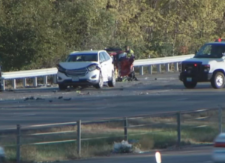
1 dead, 4 hospitalized after wrong-way Kansas crash

FINNEY COUNTY — One person died in an accident just after 11:30a.m. Saturday in Finney County.

The Kansas Highway Patrol reported a 2000 GMC Sierra driven by Mariano,Rodriguez, 22, Wichita Falls, TX, was eastbound on U.S. 50 one mile west of Chmelka Road in the westbound lane.

The pickup struck a westbound 2006 Pontiac G6 driven by Saine Taw, 37 Garden City, in the passenger side.

Lay, Par Lay, 47, Garden City, was transported to St. Catherine’s Hospital where he died.
Taw and a passenger in the pickup Ricardo Alvardo, 12, Wichita Falls, TX., were transported to Wesley Medical Center.

Rodriguez and another passenger in the pickup Luz Huerta Perez, 21, Wichita Falls, TX., were transported to St. Catherine’s Hospital.

All five were properly restrained at the time of the accident, according to the KHP.

Ex-KC officer charged in fatal crash outside Arrowhead stadium

KANSAS CITY (AP) — A former Kansas City police officer has been charged months after he was involved in a fatal crash outside the stadium where the Kansas City Chiefs play.

Fatal crash scene photo courtesy KCTV

34-year-old Terrell Watkins has been charged with first-degree involuntary manslaughter, two counts of second-degree assault and a misdemeanor count of careless and imprudent driving.

Court records say Watkins was off-duty and driving a Kansas City Police Department Ford E350 van on Interstate 435 when he slammed into the back of a car on Oct. 21. The driver of the car, 17-year-old Chandan Rajanna, was killed, and his father and sister, who were passengers, were seriously injured.

Witnesses told police the van had been speeding and making numerous lane changes as it passed other vehicles. Investigators say at the time of the crash, Watkins was late for a moonlighting job as a security officer for Chiefs.

Governor reappoints member to State Board of Technical Professions

OFFICE OF GOV.

TOPEKA – Governor Laura Kelly reappointed Carisa Lyn McMullen to the State Board of Technical Professions.

“We need qualified individuals overseeing engineering, architecture, geology, land surveying and other practices that have a far-reaching impact on our everyday lives,” Kelly said. “Carisa has been a real asset on this board with her extensive knowledge and experience.”

McMullen, Olathe, is a landscape architect and currently serves as the principal at Landworks Studio. She has worked in both municipal and private sectors. McMullen received a bachelor’s degree in landscape architecture from Kansas State University. She has worked on numerous projects including: University of Kansas West Campus Master Plan in Lawrence, the Dwight D. Eisenhower National Airport in Wichita, The Labette Community College Pedestrian Corridor in Parsons, and the Vision Iola Community Master Plan in Iola.

The board registers and licenses engineers, architects, surveyors and landscape architects. The group works to provide maximum protection of the health, safety, and welfare of Kansans by assuring their practice of engineering, architecture, land surveying, landscape architecture and geology in the state is properly carried out.

Per K.S.A 74-7005, each member of the State Board of Technical Professions must be a resident of the state of Kansas. Each term is four years with a limit of three successive terms.

All 13 board members are appointed by the governor. Four members must be licensed engineers, two must be licensed surveyors, three must be licensed architects, one must be a licensed landscape architect, one must be a licensed geologist, and two must be from the general public.

Copyright Eagle Radio | FCC Public Files | EEO Public File