Iva Mae Triplett, 83, of Wakeeney KS, passed away July 5, 2019 at Hays Medical Center, Hays, KS. She was born in Ellis County on January 7, 1936 to Jacob and Ella (Schumm) Massier.
Iva was a 1954 graduate of Ellis High School. She was united in marriage to Leslie Eugene (Gene) Triplett on August 11, 1955 in WaKeeney, KS. They were married 43 years.
Iva worked as a laundry worker in Ransom, KS until the family moved to WaKeeney, KS in 1983. She then worked at the WaKeeney Hospital as a Certified Nurses Aide and Physical Therapy Aide until her retirement. She enjoyed gardening, puzzles and spending time with her family.
Iva was preceded in death by her father and mother Jacob and Ella Massier, her husband Gene Triplett and son Rick Triplett. She is survived by her four daughters, Debbie Schmale (Roger) of Salina, KS, Sandy Bostick and Karla Ghumm (Michael) of WaKeeney, KS and Dara Noll (Kip) Ness City, KS; ten grandchildren, Chanda Lunn, Chrissy Delimont, Sonya Lovesee, Tyson Triplett, Chelsea Dail, Matt Noll, Josh, Cody, Cameron and Devon Ghumm; fourteen great-grandchildren, Torrance, Taytum,and Tinley Lovesee, Rylee,Ansley,Breyer and Harper Delimont, Hudson and Walker Lynn, Addison and Josiah Lopez, Landyn Dail, Brantleigh and Briggs Ghumm; sister Betty Cain; and daughter-in-law, Korene Triplett.
Memorial service will be held 10:30am July 23, 2019 at Schmitt Funeral Home WaKeeney. Pastor Randy Gibbs of Bethlehem Lutheran Church will be officiating. Cremation has been chosen.
The family will receive friends the day of service, from 9am – 10am.
Memorial contributions may be given to the American Cancer Society and the American Heart Association in care of Schmitt Funeral Home, 336 N. 12th WaKeeney, KS 67672.
Charles “Chuck” G. Arnold passed away Tuesday, July 16, 2019. The second of nine children to Simon “Sam” and Aldea (Plante) Arnold. Charles started his journey in rural Graham County on November 1, 1933. He was a farmer, house mover, military guided missile instructor, production man, gardener, and custodian. Through the years Charles wore many hats, but his favorite was being Grandpa/Uncle Chuck. Chuck also belonged to the Knights of Columbus and the Sacred Heart Catholic Church.
Charles married Jonnie C.L. Sledge on November 21, 1959 in Colby, Kansas. Chuck and Jonnie had four children; Anita (Ed) Sabatka, Loretta (Dave) Studer, Jeff (Cindy) Arnold, and Brian (Casey) Arnold. He had nine grandchildren and nine great grandchildren.
Family gatherings with his sisters Darlene (Gerald) Hutfles, Donna (Ron) Sis, Pat (Jim) Prochazka, Bertha (Kenny) Brungardt, Paulette (Ray) Gerver, Pauline (Kenny) Micek, Geralda (Jim) Keith, and brother Jim (Adeline), were always a favorite time.
Chuck was happily coerced into many shenanigans by his grandchildren who will miss him dearly.
He is survived by his sons Brian (Casey) Arnold of Plainville, KS, Jeff (Cindy) Arnold of Staplehurst, NE; daughter, Loretta (David) Studer of Atwood, KS, sisters, Donna (Ron) Sis of McCook, Pat (Jim) Prochazka of Atwood, Bertha (Kenny) Brungardt of Victoria, Paulette (Ray) Gerver of McCook, Pauline (Kenny) Micek of Atwood, and Geralda (Jim) Keith of Hill City; brother Jim (Adeline) Arnold of Colby.
Chuck is preceded in death by his parents Simon and Aldea (Plante) Arnold, his wife Jonnie, daughter Anita, and sister Darlene Hutfles.
Mass and Christian Burial will be at 10:30 a.m. Saturday, July 20, 2019 at Sacred Heart Catholic Church in Plainville. Visitation will be on Friday from 2:00 p.m. until 5:00 p.m. at the funeral home and from 6:00 p.m. until 8:00 p.m. at the church with a Parish Vigil and Rosary Service at 7:00 p.m. Memorials are suggested to the Sacred Heart Catholic School and may be sent in care of Plumer-Overlease Funeral Home, 320 SW 2nd, Plainville, Kansas 67663.
BERKELEY, Calif. (AP) — There will be no manholes in Berkeley, California. City workers will drop into “maintenance holes” instead.
Nothing will be manmade in the liberal city but “human-made.” And students at the University of California, Berkeley, will join “collegiate Greek system residences” rather than fraternities and sororities.
Berkeley leaders voted unanimously this week to replace about 40 gender-specific words in the city code with gender-neutral terms — an effort to be more inclusive that’s drawing both praise and scorn.
That means “manpower” will become “human effort” or “workforce,” while masculine and feminine pronouns like “she,” ″her,” ″he” and “him” will be replaced by “they” and “them,” according to the measure approved Tuesday by the City Council.
The San Francisco Bay Area city is known for its long history of progressive politics and “first of” ordinances. Berkeley was among the first cities to adopt curbside recycling in the 1970s and more recently, became the first in the U.S. to tax sugary drinks and ban natural gas in new homes.
Berkeley also was the birthplace of the nation’s free-speech movement in the 1960s and where protests from both left- and right-wing extremist groups devolved into violence during a flashpoint in the country’s political divisions soon after President Donald Trump’s election.
Rigel Robinson, who graduated from UC Berkeley last year and at 23 is the youngest member of the City Council, said it was time to change a municipal code that makes it sound like “men are the only ones that exist in entire industries or that men are the only ones on city government.”
“As society and our cultures become more aware about issues of gender identity and gender expression, it’s important that our laws reflect that,” said Robinson, who co-authored the measure. “Women and non-binary people are just as deserving of accurate representation.”
When the changes take effect in the fall, all city forms will be updated and lists with the old words and their replacements will be posted at public libraries and the council chambers. The changes will cost taxpayers $600, Robinson said.
Removing gendered terms has been slowly happening for decades in the United States as colleges, companies and organizations implement gender-neutral alternatives.
California Gov. Gavin Newsom’s wife, Jennifer Siebel Newsom, changed a Sacramento political tradition by adopting the unofficial title “first partner” instead of “first lady,” saying it’s more inclusive. The change reflected Siebel Newsom’s experience as an actress and filmmaker focused on gender politics and inequality.
But formalizing the shift in the sweeping way that Berkeley is doing is “remarkable and sends a message,” Rutgers University linguistics professor Kristen Syrett said.
“Anytime you’re talking about something where gender is not the issue but you use a gendered term, that immediately sends a message of exclusion, even if it’s a dialogue that has nothing to do with gender,” said Syrett, who recently spearheaded an update to the guidelines on inclusive language for the Linguistic Society of America.
For Hel Baker, a Berkeley home caregiver, the shift is a small step in the right direction.
“Anything that dismantles inherent bias is a good thing, socially, in the grand scheme of things,” the 27-year-old said.
“I don’t, by any means, think this is the great championing for gender equality, but you gotta start somewhere,” Hel added.
Lauren Singh, 18, who grew up in Berkeley, approved of the move, saying, “Everyone deserves to be represented and feel included in the community.”
Not everyone agreed with the new ordinance. Laramie Crocker, a Berkeley carpenter, said the changes just made him laugh.
“If you try to change the laws every time someone has a new opinion about something, it doesn’t make sense. It’s just a bad habit to get into,” Crocker said.
Crocker, 54, said he would like city officials to focus on more pressing issues, like homelessness.
“Let’s keep it simple, get back to work,” he said. “Let’s figure out how to get homeless people housed and fed. He, she, they, it — they’re wasting my time.”
KANSAS CITY (AP) — The morning of July 19, 2018, had that feel Midwesterners are familiar with: That still, sticky air hinting a stormy day ahead.
The National Weather Service would confirm it when it issued a severe thunderstorm watch for southwest Missouri at 11:24 a.m., stretching until 9 that evening. About five minutes later, a weather monitoring service would share the information with Branson Ride the Ducks, the popular attraction that took tourists on land and water.
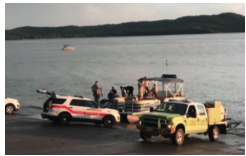
First responders on the scene of the July 2018 Duck Boat accident -photo courtesy KYTV
What happened over the next eight hours will be at the heart of determining who — if anyone — is responsible for the tragedy that claimed 17 lives that night. But this much is clear: Court documents, as well as other reports and interviews, when laid side by side, capture a terrifying night on Table Rock Lake.
This account is based on a timeline built in lawsuits, indictments, a report from the National Transportation Safety Boardand witness interviews at the time.
At 3 p.m., Charles Baltzell showed up for his shift as Ride the Ducks’ sole manager working that night. Baltzell, 77, was described as an operations supervisor and manager on duty. That involved making sure the duck boat tours ran on time, acting as a dispatcher to communicate over handheld radio with the drivers, who steered the vessel on land, and captains, who took the helm on water.
He was also to keep an eye on the weather.
A couple of hours into Baltzell’s shift, a nasty storm was popping up over Barton and Vernon counties, both along the Missouri-Kansas border and north of Joplin. The National Weather Service would issue a warning to that effect at 5:06 p.m.
The storm didn’t appear to go unnoticed by workers at Ride the Ducks. Shortly before 6 p.m., general manager Curtis Lanham checked on weather radar to try to figure out how far away the storm was and its timing. A duck boat tour was about to start at 6 p.m., and Lanham was going on board. Before heading out he told Baltzell to keep an eye on the radar, according to federal prosecutors.
Around the time the tour was taking off, the storm was moving over Christian and northern Stone counties, northwest of Branson. The National Weather Service said it carried winds in excess of 60 miles per hour and told people they should move to an interior room of a building.
The 6 p.m. tour wouldn’t be the last one that day. Just days before, Branson Ride the Ducks had added a 6:30 p.m. tour.
As folks readied for the last tour of the day, Baltzell checked the weather service, according to an indictment. There was lightning in Springfield.
At 6:27 p.m., Kenneth McKee, the duck boat captain for the final tour, stepped on Stretch Duck 07 with a road driver, Robert Williams. The road driver sat behind the wheel while McKee took his place on a side-facing seat to the right.
Alicia Dennison, 12, waited to get on Stretch Duck 07 with her grandmother, Leslie Dennison of Sherrard, Illinois. They had just gotten into town in enough time to drop their luggage off at the hotel and make it to Ride the Ducks for a boat tour.
They would be among 29 passengers to get on the boat for the 6:30 p.m. tour. Also on board: a couple from St. Louis, another couple from Higginsville, an Arkansas man with his son and daughter. Tia Coleman of Indianapolis was with 10 of her relatives, including her three children and two nephews.
The Coleman family, who made annual summer trips together, liked the idea of going on the duck boats; Tia’s 9-year-old son, Reece, who was on the autism spectrum, loved the water.
Duck boat involved in the fatal accident- Photo courtesy NTSB
Alicia Dennison recalled hearing another passenger mention a Weather Channel report, wondering what it would mean for their upcoming tour.
As McKee readied the boat, Baltzell came by and told McKee and the driver that they should change up the tour, prosecutors say in a criminal indictment against McKee, Lanham and Baltzell. (Each has pleaded not guilty; Tom Bath, an attorney for Lanham, said the government’s account is incomplete and not accurate.)
Do the water part first, Baltzell told McKee. There was a storm on the way.
Just before the driver began counting passengers, the National Weather Service issued a warning for a large area that included Table Rock Lake from 6:32 to 7:30 p.m.
At 6:33 p.m., McKee began narrating the tour, according to a National Transportation Safety Board account of the day.
Five minutes after the tour began, according to prosecutors, Baltzell was getting started on closing out the business for the day — counting cash in a first floor room in the Ride the Ducks facility, away from a room where weather screens displayed information.
At 6:46 p.m., Baltzell and Lanham spoke. They talked about how the last tour of the day was switched up so that it would go on the water first.
“Good,” Lanham said, according to an indictment. “It’s dark right now.”
By 6:50 p.m., the duck boat was near the water ramp and McKee was going over safety precautions.
“Above you are your life jackets,” Tia Coleman recalled McKee saying. He pointed out there were three sizes.
“I’m going to show you where they are,” McKee said, according to Coleman. “But you won’t need them.”
If they needed them, he added, he would let them know.
About this same time, Lanham got off the boat from the 6 p.m. tour, where the captain had mentioned seeing lightning. He spotted a dark thundercloud to the northwest.
At 6:55 p.m., McKee announced that Stretch Duck 07 was about to hit the water, which was calm at that point.
Calm enough that for the next four minutes, McKee invited a few children to sit in the captain’s seat.
Also on the lake, Jennie and Jeff Carr were on the Showboat Branson Belle to celebrate 15 years of marriage.
But the weather was nagging at them. They are close watchers of weather reports, having lived through the deadly Joplin tornado in 2011.
At 7 p.m., five minutes after the duck boat had pulled away from the entry ramp and entered calm waters, the leading edge of the storm started whipping up whitecaps on the lake. McKee ushered the kids away from his captain’s seat and started looking for ways to shorten the tour. He was heard telling passengers that “they had attempted to beat the storm.”
Carr, from the safety of the showboat, took the video of the duck boat struggling against churning waters that would go viral the next day. The lake was starting to behave the way she imagined the ocean would look.
She said a prayer as she watched the duck boat get helplessly battered in the storm with winds exceeding 70 miles per hour.
“Oh Lord, please help those people,” Carr said. “Be with them. Please let them be OK.”
Others on the Branson Belle were noticing and gathered near the Carrs.
On Stretch Duck 07, it would only take four minutes after the storm arrived for a bilge alarm to sound, signaling that the boat was taking on water.
Alicia Dennison reached for a life jacket, but it was stuck. She couldn’t get it free.
Pam Smith of Arkansas later told CBS News that she was shopping in Branson while her husband, Steve, was on the boat tour with their children, Lance, 15, and Loren, 14. The last time she spoke to her husband was before the boat sank.
“It’s not good, Pam,” she remembered him saying.
She asked him to take care of the kids.
On the Branson Belle, Carr eventually stopped recording. There wasn’t much she could see; thunderclouds darkened the lake and intensifying rain obscured the view. But she didn’t need to see to know what would happen next.
As the storm was churning, McKee wasn’t talking to the passengers.
The passengers were panicking.
The first call to emergency dispatchers arrived at 7:09 p.m. The boat had started sinking.
“You need to respond to the Branson Belle,” a dispatcher for Stone County said, “for a duck that has sunk.”
The urgency and fear can be heard as dispatchers and deputies describe the storm, debris swirling in the summer air, their voices captured on Broadcastify.com. They often sound tense and frantic as they radio for help.
It’s not clear what Lanham and Baltzell, back on land, were up to between the time Stretch Duck 07 hit the water and when it began to sink to the bottom of the lake. Court records say there was no communication between them and McKee during that time.
Passengers were trapped. An overhead canopy was pulling them down. Plastic window curtains were keeping them from escaping out the side.
“When the water filled up the boat, I could no longer see,” Tia Coleman said at a news conference two days after the disaster. “I couldn’t feel anybody, I couldn’t see. I just remember, ‘I gotta get out, I gotta get out.’”
McKee at one point managed to release the overhead canopy. For all the mistakes that led passengers into the middle of the tempest, that decision may have saved some lives.
“They were all stuck in there until that top came off,” recalled 15-year-old Gillian Keller from Texas, who was with her father and seven other members of his family. They all survived.
Alicia Dennison survived, she said, because her grandmother pushed her to the surface. Her grandma did not make it.
Coleman wasn’t sure how she got out.
“And when I got out into the water, it was ice cold,” Coleman said. “And I remember as we were going into the water, they said that the lake stays pretty warm, like in the 80s. So I know for it being so cold that I’m close to the bottom, not close to the top.
“And I just remember kicking and swimming, swimming up to the top. And as I was swimming up, I was praying. I said, ‘Lord, please let me get to my babies.’”
As Coleman and others came up for air, pontoon boats were making their way out onto the water to reach the victims.
“There’s a mass casualty going on by the Branson Belle, multiple people in the water,” a Missouri Highway Patrol dispatcher said.
At 7:39 p.m., half an hour after Stretch Duck 07 started sinking, divers began the last-ditch effort to find survivors.
Five minutes later, the grim news started to emerge.
“We’re going to need the Stone County coroner,” said a dispatcher.
The Ellis County Sherriff’s office was warning of a phone scam from someone claiming to be from their department Friday afternoon.
“The scammer scares the call recipient into believing they’ve missed a court appearance and needs to send them money for bond,” the announcement said.
The department said anyone receiving similar calls should hang up and can check with the department at 785-625-1040 to see if they have outstanding warrants.
“To see it come to fruition is really, really exciting,” Kansas governor Laura Kelly told the large crowd that gathered in Cecil Bricker Park for the event.
She said it was her hope legislation allowing industrial hemp production in Kansas would lead to economic development like what is happening in Russell.
“(Producers) can further grow and prosper with the pursuit of new opportunities in value-added agriculture,” Kelly said. “Today’s event came about because our state is moving forward in creating another option for diversification for Kansas farmers.”
“We are excited to bring Mechanized Concepts to town to help our ag-related businesses and help the town grow,” said Aaron Steinert, Russell county commissioner. “It’s nice to bring something in that brings a different avenue of revenue to the city and the county and employees of Russell.”
The company has been working on getting the plant ready with teams from other locations, but now the local hiring process has started and limited production is beginning at a smaller building near the main facility using repurposed equipment.
“This is the start of the opening of the plant,” said Matt Colledge, Mechanized Concepts founder and CEO.
“We are ramping up right now to move into production,” he said, with a goal of being fully operational within two years.
Once the facility is fully operational Colledge expects to employ 200 people as they try to meet the demand for products.
“In five or 10 years out, that facility could ramp up to 900 jobs to be able to meet the demand that our merchandizing performers have shown, and independent studies have shown, as the industry grows,” he said.
Potential job creation has excited area residents that have seen job loss as oil production in the area has declined in recent years.
“It means a great deal to the community,” said Mike Parsons, staff member at Russell County Economic Development and CVB.
He hopes the plant will help retain younger residents that otherwise may leave the area after college.
“These guys are really working to bring the young people back, and I think that is an awesome step for our future,” Parsons said.
As exciting as the plant is locally, it may be just the beginning as industrial hemp production moves into a more fully realized crop in Kansas.
“Mechanized Concepts Kansas,” Kelly said, “stands ready to work with farmers that will be producing industrial hemp.”
“It will be rewarding to see the crop turned into products such as composite lumber, plywood, roofing tiles and shingles. At the same time this business is delivering new jobs and economic benefits right here in Russell,” she said.
While Kelly was hopeful rural development would occur with hemp production, the local community is what drew the company to Russell.
“Russell is a special place,” Colledge said. “When we came here, we knew right away that the people here are different, that they cared about their community.”
“We had five other states, five other locations that were pursuing us,” he said. “Honestly we had better offers at the table. Really the reason we came to Russell is because of the sense of community.”
That sense of community, he said makes Russell sacred.
A facility in the center of the U.S. allows for faster expansion as demand for industrial hemp increases, Colledge said, making Russell a prime location for the facility.
“That’s what we are doing, we are setting up Russell, Kansas, to be on the map for hemp. From education to seed, all the way up to a product,” he said.
While area producers continue adding sources of revenue to the farms, the facility is viewed as another piece of the ever-expanding amount of agricultural diversification happening throughout Kansas.
“Manufacturing and other value-added opportunities are vital to the Kansas agricultural industry,” Kelly said. “Industrial hemp is another promising addition in our state where our producers have a knack for learning about different crops and growing them successfully.”
“The potential is really unlimited,” said Rep. Ken Rahjes, R-Agra, 110th Dist. “What we have found agronomically, the best place to grow hemp is central Kansas.”
“I think today’s announcement is one that gives that extra boost to move forward.”
Rahjes pointed out as a new crop in Kanas, regulation and transportation concerns need to be fully ironed out. However, the crop should work well as another option for local producers just as canola and sunflowers have, he said.
“I really think the sky is the limit, and with the innovation of Kansas farmers, I think it is going to be very interesting and very exciting to see what happens over the next two, five and even 10 years,” he said.
TOPEKA – The Kansas Department of Health and Environment, in conjunction with the Kansas Department of Wildlife, Parks and Tourism , has issued public health advisories for Kansas lakes.
Warnings:
Big Eleven Lake, Wyandotte County (unchanged)
Jerry Ivey Pond, Saline County (unchanged)
Marion County Lake, Marion County (unchanged)
Gathering Pond near Milford (Hatchery Supply Pond), Geary County (unchanged)
Hiawatha City Lake, Brown County (unchanged)
Lovewell Reservoir, Jewell County (unchanged)
South Lake, Johnson County (new 7/18)
When a warning is issued, KDHE recommends the following precautions be taken:
Lake water is not safe to drink for pets or livestock.
Lake water, regardless of blue-green algae status, should never be consumed by humans.
Water contact should be avoided.
Fish may be eaten if they are rinsed with clean water and only the fillet portion is consumed, while all other parts are discarded.
Do not allow pets to eat dried algae.
If lake water contacts skin, wash with clean water as soon as possible.
Avoid areas of visible algae accumulation.
Watches:
Lake Shawnee, Shawnee County (unchanged)
Marion Reservoir, Marion County (unchanged)
Keith Sebelius Reservoir, Norton County (unchanged)
Rock Garden Pond (Gage Park), Shawnee County (unchanged)
A watch means that blue-green algae have been detected and a harmful algal bloom is present or likely to develop. People are encouraged to avoid areas of algae accumulation and keep pets and livestock away from the water.
During the watch status, KDHE recommends the following precautions be taken:
Signage will be posted at all public access locations
Water may be unsafe for humans/animals
Avoid areas of algae accumulation and do not let people/pets eat dried algae or drink contaminated water.
Swimming, wading, skiing, and jet skiing are discouraged near visible blooms
Boating and fishing are safe. However, inhalation of the spray may affect some individuals. Avoid direct contact with water, and wash with clean water after any contact.
Clean fish well with potable water and eat fillet portion only.
KDHE samples publicly-accessible bodies of water for blue-green algae when the agency receives reports of potential algae blooms in Kansas lakes. Based on sampling results, KDHE reports on potentially harmful conditions.
Kansans should be aware that blooms are unpredictable. They can develop rapidly and may float around the lake, requiring visitors to exercise their best judgment. If there is scum, a paint-like surface or the water is bright green, avoid contact and keep pets away. These are indications that a harmful bloom may be present. Pet owners should be aware that animals that swim in or drink water affected by a harmful algal bloom or eat dried algae along the shore may become seriously ill or die.
The news that a Kansas legislator is resigning mid-term for health reasons presents a good opportunity to think about the process that Kansas uses to fill legislative vacancies. This is probably not an enthralling topic to most, but it matters because that process is a rotten anachronism that unnecessarily mutes average voters.
Patrick R. Miller is an Assistant Professor of Political Science at the University of Kansas.
When Kansas legislators leave before their terms are completed, local precinct chairs from the same party as that politician choose their replacement. The governor approves their choice as a formality. This happens fairly frequently. Nearly a fifth of legislators in the 2017-2018 session, for example, originally entered the legislature by appointment.
Only three states use this same process. Most others fill vacancies via special elections, though others also use appointments of some type.
Voters elect precinct chairs in party primaries, but most chair slots are vacant and there is no competition for most who are elected. Thus, a few party activists who are likely unrepresentative of their districts can select new legislators.
Some recent examples illustrate concerns with this process.
When Governor Laura Kelly left the legislature, the Wichita Eagle reported that 100 of 166 Democratic precinct committee positions in her district were vacant, leaving just 66 activists to select her replacement for a district of over 70,000 residents.
As a moderate Republican, Insurance Commissioner Vicki Schmidt represented a swing legislative district that voted Democratic for governor and Congress in 2018, but narrowly went for Donald Trump in 2016. Rather than replacing her with another moderate who likely would have fit district voters better, activists chose a far right replacement.
In 2015, western Kansas Republicans rejected a local mayor and instead appointed someone who was serving as a school board member in Nebraska until days before his selection.
Beyond the fact that voters are competent enough to select legislators themselves, this process is troublesome for how it can decrease political competition. Most Kansas legislative races are already relatively uncompetitive given voter party preferences, the quality of campaigns, and widespread uncontested elections.
Politicians often get appointed to the Kansas legislature and subsequently face few, if any, electoral challenges, primary or general. Incumbency itself can discourage challengers, but once appointed, legislators can use the advantages of incumbency—fundraising, media coverage, and official party support, for example—to deter challengers.
Take, for example, former Representative Adam Lusker. Once appointed, the southeast Kansas Democrat served five years with no opponents before losing in 2018 when challenged for the first time. That’s a long time with zero electoral accountability.
Yes, legislators often win seats through the normal process and go years without opposition, but appointments discourage competition for voters when a seat is initially open, which is exactly when competitive elections are most likely to occur.
This is not a critique of parties per se. I firmly subscribe to E.E. Schattschneider’s famous quote that democracy is “unthinkable” without parties. Despite their flaws, parties organize government, structure elections, and promote electoral accountability. And yes, there is a role for party precinct chairs in ensuring strong local parties.
But in filling legislative vacancies, the party “middleman” and “middlewoman” should not intrude between voters and their elected officials. The process as is only serves activists and insiders with the right connections to the select few who make these appointments.
Absolutely, it is far cheaper to have these activists select our policymakers than to hold special elections. And it saves local election officials from having to organize these elections—even though that is their job. You get the democracy that you pay for, though, and easy democracy on the cheap is not necessarily democracy at its best.
Patrick R. Miller is an Assistant Professor of Political Science at the University of Kansas.
MCCRACKEN — The McCracken Public Library will host guest speaker Dr. James Kenyon, DVM, and author of several books including Golden Rule Days, A Cow for College, and The Art of Listening to the Heart, on Sunday, August 4 at 3 p.m. at the McCracken city building, McCracken.
Everyone is welcome. Desserts and beverages will be available after the presentation with a free will donation.
James Kenyon was born and raised on a third generation family grain and livestock farm. He grew up caring for cattle, pigs, chickens and horses near the small town of Bogue, Kansas, population 300. It was natural for James to record the histories of small town schools and thus the life and times of communities. It took the whole town to raise a child. There were 6 students in his high school graduating class.
James served his community as a veterinarian for 35 years in a mixed animal practice in a beautiful Iowa college town. Through his mentoring, 18 students that worked for him went on to become veterinarians. He is a seven-time veterinarian for the Alaska Iditarod Dog Sled Race. He was named Iowa Veterinarian of the year and was the state president of the Iowa Veterinary Medical Association. He was the chairman of the Iowa Veterinary Medical
Examining Board.
Today, James continues the family tradition with 24 years of service on his community’s school board (President and Vice President). This made him the fourth generation (spanning three different centuries) of his family to serve as a school board member. The importance of team work and leadership learned in school have guided him through his adult years.
Dr. Kirk Potter, plastic and reconstructive surgeon, has recently joined the medical staff at HaysMed, part of The University of Kansas Health System.
Dr. Potter received his medical degree from the University of Health Sciences, College of Osteopathic Medicine in Kansas City.He completed a residency in general surgery and fellowship in plastic and reconstructive surgery at Philadelphia College of Osteopathic Medicine.
Dr. Potter will be performing plastic and reconstructive surgeries at the hospital.
He will be maintaining a private practice in Hays.
KANSAS CITY (AP) — A man has been fined $500 for pointing a laser at New England Patriots quarterback Tom Brady during the AFC championship with the Kansas City Chiefs in January.
Laser pointer used by a fan during the AFC championship game -image courtesy WIBW TV
Dwyan Morgan pleaded guilty Wednesday to a misdemeanor, disturbing the peace. He will pay the fine with no jail time.
Footage of the game showed a green light flashing on Brady late in the Patriots’ 37-31 overtime win on Jan. 20 at Arrowhead Stadium. Prosecutors say Brady was unaware of the laser.
Laser pointers are banned from sports events and other activities because even a short burst of the light can damage the retina.