
Members of 4H talk about projects entered in this year’s fair.
Month: July 2019
🎥 Russell County Fair 4H Interviews 2019

The 2019 Russell County Fair 4H interviews with Mike Koerner.
KZ Country Cheesy Joke of the Day 7/18/2019

 Types Of Bears
A couple were vacationing in a national park. The wife expressed her
concern about camping because of bears and said she would feel more
comfortable in a motel. The husband said that he’d like to camp and to
calm her concerns, they’d talk to the park ranger to see what the
likelihood of a bear encounter would be.
The ranger told them, “Well, we haven’t seen any grizzlies in this area
so far this year, or black bears, for that matter.”
The wife shrieked, “There are TWO types of bears out here? How can you
tell the difference? Which one is more dangerous?”
The ranger replied, “Well, that’s easy, see, if the bear CHASES you up a
tree and it comes up after you, it’s a black bear. If it SHAKES the tree
until you fall out, it’s a grizzly.”
The motel room was quite nice.
Join fans of 99 KZ Country on Facebook: https://www.facebook.com/99KZCountry
Hays Sister Cities representatives visit China Sister City
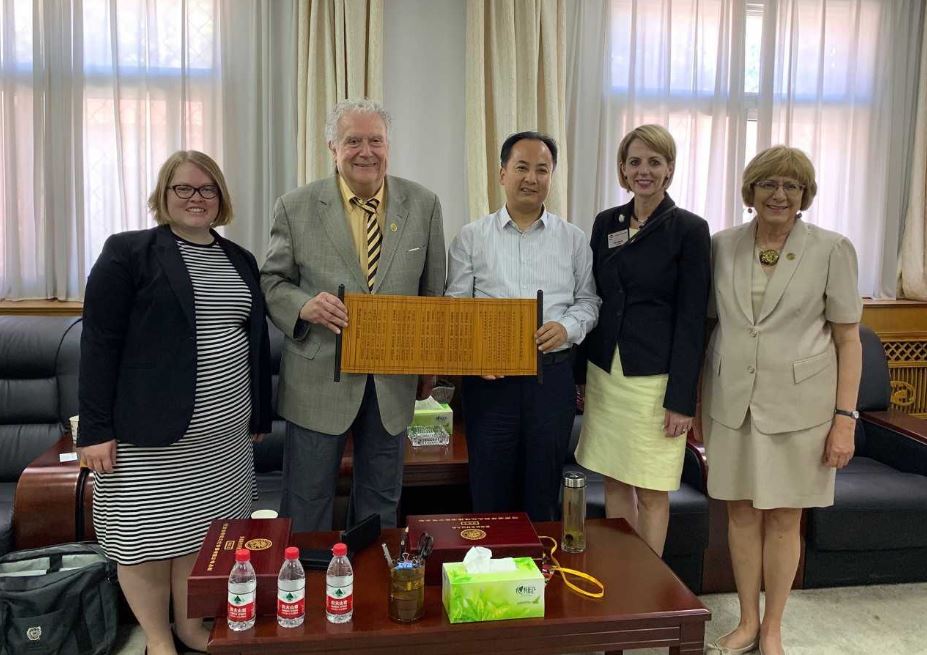

In May 2019, two representatives from the Sister Cities of Hays, Kansas board joined the Fort Hays State University delegation on a trip to China. Sister Cities of Hays is a member of Sister Cities International, the oldest and largest organization of citizen diplomats in the nation. Hays’ sister cities include Santa Maria de las Misiones, Paraguay, and Xinzheng, China.
The purpose of this trip was to participate in the annual commencement ceremonies for Fort Hays State University’s partner institutions. This year marked a major milestone as the delegation celebrated 20 years of partnership with Sias International University.
Mehran Shahidi, director of intercultural integration at FHSU and Brittney Squire, Forsyth Library outreach specialist at FHSU represented Sister Cities and the city of Hays on this trip. During the visit, Shahidi and Squire, along with FHSU President Tisa Mason, and Cindy Elliott, FHSU Assistant Vice President for Global Partnerships and board member for Sister Cities International, met with members of the Xinzheng Municipal Government in the Henan Province of China.
There they met with the Mayor of Xinzheng, Mr. Zhifeng Ma. During this meeting, there was an exchange of information about the city of Hays, FHSU, and the city of Xinzheng. In a discussion about possible collaboration opportunities between the two cities, several items of interest were presented including cultural exchange programs, economic development, telemedicine prospects and artificial intelligence.
“Through this meeting and a previous one with Mayor Ma, I have really noticed the purpose of establishing friendships through one on one relationship — one individual and one community at a time. The conversation and the enthusiasm among all of us once again reminded me of President Eisenhower’s belief that friendship through individuals and communities would make the difference,” said Shahidi.
Shahidi and Squire also presented Mayor Ma with a proclamation from Hays Mayor Henry Schwaller. The proclamation reinforced the desire to maintain a positive relationship and cultural exchange between Hays and Xinzheng. Gifts were exchanged by both parties including items which are native to both areas.
“We were given such a warm welcome in China from our very first stop in Xinzheng. I was so impressed by the Chinese hospitality, and I only hope Hays, Kansas can return the favor one day soon by showing off our own Midwestern charm,” said Squire.
Mayor Ma was invited to bring a delegation to Hays. The Sister Cities board will continue to maintain communication with Xinzheng representatives in order to arrange a visit in the future.
Hays Sister Cities is a committee of local citizen volunteers with a passion for international collaboration. For information on Hays Sister Cities, email [email protected] or find the group on Facebook.
– SUBMITTED –
Science Café to present ‘Footprints on the Moon: A celebration of the 50th Anniversary of Apollo 11’


Muslim group in Kansas wants city councilman to resign for “racist comments”
 INDEPENDENCE, Mo. (AP) — The Kansas chapter of a Muslim civil rights group is calling for the resignation of an Independence, Missouri, city councilman who said during a meeting that Middle Eastern owners of discount smoke shops will “sell anything out the back door.”
Councilman Curt Dougherty made the comment Monday while discussing a proposal to regulate medical marijuana facilities in Independence. He was arguing that the city had rules restricting several types of businesses, including smoke shops run mostly by Middle Easterners.
The Kansas chapter of the Council of American-Islamic Relations said in a statement Wednesday that Dougherty should resign. CAIR-Kansas Board Chairman Moussa Elbayoumy said the comment showed Dougherty couldn’t represent a diverse constituency.
Dougherty did not immediately respond to an email or phone message seeking comment.
Low wages hamper DSNWK’s search for care staff
By CRISTINA JANNEY
Hays Post

Nathan Young works three jobs to support his family.
Even at full-time, he does not make enough at his job at Developmental Services of Northwest Kansas to get by. He also works another 16 hours per week aiding another disabled individual as well as a semi-professional gamer.
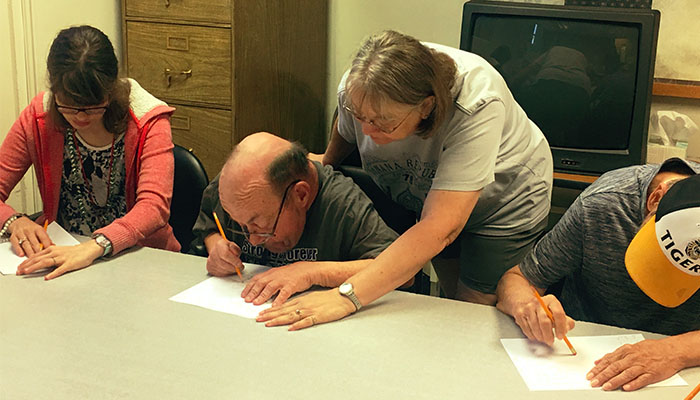
Young, lead paraprofessional at the Reed Development Center, works with lower-functioning individuals. He helps his clients with basic care like feeding themselves, toileting and keeping themselves clean.
He said he loves his job, but he wishes he was paid more.
“The thing I like the most is not just the smiles I get everyday with everyday interactions. I am able to help someone to the fullest of my abilities. It just brightens their heart,” Young said.
Young, 31, as a direct support professional, is not alone in his struggles to make ends meet. He is one of many workers at DSNWK who work physically and mentally demanding jobs for low wages.
Jerry Michaud, DSNWK president, said because of state-set reimbursement rates, the wages DSNWK can offer direct care workers is low. This, coupled with low unemployment in northwest Kansas, means it is difficult for DSNWK to recruit and retain employees. The agency constantly has vacancies.
DSNWK has about 345 employees across its 18-county coverage area. As of the end of June, DSNWK had 27 open positions — mostly direct support professionals.
The overall unemployment rate for DSNWK’s coverage area is 2.84 percent, which is very low.
“It means there are not a lot of individuals out there in the workforce, so that is one challenge right off the bat,” Michaud said. “It is a challenge in all our communities, so I think that is something all employers are up against.”

How much DSNWK is reimbursed for caring for disabled individuals is complicated. The state assigns disabled individuals to a tier system based on their needs, and then the state reimburses DSNWK based on that tier system. DSNWK serves people on all tiers.
The bottom reimbursement rate is $7.68 per hour. Minimum wage is $7.25. DSNWK recently raised its direct support professional starting pay to $9 an hour.
Michaud acknowledges $9 is not a high wage, but DSNWK still has to make up the difference between $9 an hour and the state reimbursement.
“I will tell you that the rates that are paid don’t cover the cost,” Michaud said. “That is in part of why we approach our counties to help us to fill the gap.
“What we ought to be paying is something different,” he added. “That is part of the equation we haven’t even broached. What is a prevailing wage in this community versus the next community? That is where it become more complicated to try to figure out what that is.”
Turnover is directly tied to wage, Michaud said.

“How do you live on a $9 a hour wage?” he said. “Can you find housing? Can you pay for your housing on $9 an hour alone? I am saying these things knowing it is a hard reality.”
The answer, in Young’s case, is you don’t.
Not only is Young working extra jobs, he has also had to reach out for state assistance.
DSNWK offers health insurance benefits to its employees. Young is able to purchase health insurance for himself through DSNWK, but he can’t afford the family plan that would cover his children. They are covered by state insurance.
Young said turnover can be a problem. He sees fellow employees come and go. It is a tough job for not much pay. He said the people who stay are like him — committed to the people who they serve.
“I would like more pay,” he said. “It would definitely financially aid me, but it is not about the money there. I love seeing my friends every day. I know I work for them. They are so much fun to hang out with and help them grow.”
Turnover definitely has an effect on the quality of care that the people DSNWK serve receive.

“Let us assume for a moment that I am the person who receives services, let’s just say I require personal services — using the restroom, toileting, showering, and those kind of things,” Michaud said. “If you have new people coming and going all of the time, helping you in some of those most personal times, that would be hard. I can’t sugarcoat that.
“It really solidifies making a change or making a difference so we can slow that revolving door and have greater stability. That is why we are doing what we are doing.”
Not only does turnover have ramifications on care, constantly training new employees is costly and time-consuming.
“When you go through that process and a person stays for a month or a few months, that is not necessarily a good thing,” Michaud said.
DSNWK employs university students in Hays. Although those students might not leave due to wage, they usually eventually leave due to graduation.
DSNWK has a capital campaign to address in part some of its employment challenges. However, long-term, Michaud said the reimbursement rates for care need to increase in order to deal with the direct support professional pay issue.
Michaud said increases in reimbursement rates have not kept up with inflation and neither have wages. From 2008 until a couple of years ago, state reimbursement rates remained flat.
“As a state, we’ve got to find a way to have a realistic funding structure that is practical as far as the ability to hire, recruit and retain a workforce that can provide these vital services. I think the state understands this,” Michaud said.
The state has had to increase wages on the institutional side at facilities, including Larned State Hospital and Osawatomie.
On a related issue, the state has tried to reduce the number of disabled individuals waiting for Medicaid-funded services. There are 107 people on that list in DSNWK’s coverage area and more than 4,000 people on the list statewide.
The Legislature this spring allocated more funding to decrease two of the Medicaid waiting lists. One-hundred seven people were removed from the wait list statewide with that funding. Only one of those people was from northwest Kansas.
Although the state needs to reduce the waiting list, it also needs to address the wage issue., Michaud said. If more people come into the system without increasing wages, DSNWK and other agencies like it in the state will have capacity problems, he said.
DSNWK is taking steps internally to fill its need for employees. This includes recruiting employees human resources believe will feel fulfilled working with people and tapping untraditional markets, such as retirees.
The agency is also engaged in a capital campaign it hopes will partially address the wage gap, Michaud said.
But for every step forward, there seems to be a step back. Due to a budget shortfall in Ellis County, the county cut $25,000 in funding for the DSNWK and another $10,000 in funding from ACCESS, general transportation, which DSNWK manages.
The ACCESS cuts also mean a loss in KDOT matching funds. The total loss to the agency will be $57,000 for the coming budget year.
Michaud said the DSNWK has limited means to address those funding cuts, and it definitely does not help its struggle to increase wages.
For those interested in employment with DSNWK, you can visit its website. If you are interested in donating to DSNWK click here.
🎥 Sternberg staffer replicates ‘Star Wars’ creatures in name of science

Sternberg Museum of Natural History
Since its premiere in 1977, “Star Wars” has become a staple in many cultures.

It has connected people all over the world, making it one of the most successful franchises. Not only has it impacted our culture, but our science as well.
The connection between science fiction and actual science has not only helped people have a better understanding of science, but has given them an appreciation for it.
Sternberg outreach coordinator Ian Trevethan has found this connection to be a useful teaching tool to get people excited about science. This summer, Trevethan has been working on a project to show people the connections between “Star Wars” animals and real animals.
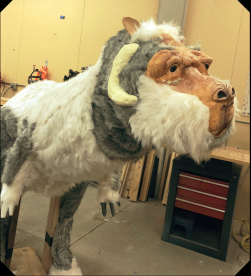
The project has led Trevethan to get creative. To help show off the marvelous animals of the “Star Wars” Universe, he has created a Vulptex (crystal fox), seen from “Episode VIII: The Last Jedi,” and a Taun-Taun, seen in “Episode V: The Empire Strikes Back.” The fox in the story lives on a mineralized planet.
“The minerals on this planet, the salt, basically crystalize on this animal’s fur, and you have a crystal critter,” Trevethan told Mike Koerner in a Discover Under the Dome video interview.
It took Trevethan six months of work using thousands of crystals to hand make the creature.

In June, Trevethan took his creations to Smallville Con 2019 in Hutchinson and participated in a Zoology of Star Wars panel.
His future plans for these fictional critters is to use them for his outreach programs this summer, teaching the public how to look for the correlations between them and the real animals that inspired them.
He wants people to start thinking critically, asking questions like, “How is the environment affecting the animal?” “Why did the fox get crystals on its fur?” “What helps the Taun-Taun move so quickly over the snow?”

By exercising this critical thinking skill, people can start to understand how to apply it to real animals and the environment we live in today. To see if Trevethan will be in a town near you, follow Sternberg social media or contact your local library to see if they will be hosting Ian Trevethan this summer.
Kansas inmate hospitalized after fall while working at fairgrounds
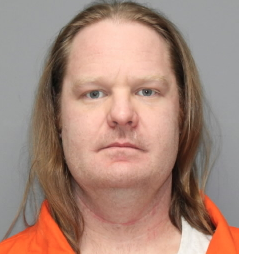
HUTCHINSON, Kan. — A Hutchinson Correctional Facility inmate was taken to a Wichita hospital after he fell while working on the Kansas State Fairgrounds.

Christopher Boothby, 38, was on some type of hydraulic lift working on a flag pole when he fell about 15 feet and hit his head, according to Hutchinson Police.
He was first taken to Hutchinson Regional Medical Center then transported to Via Christi St. Francis in Wichita.
He has been at the Hutchinson Correctional Facility since March after a move from the El Dorado Correctional Facility.
New U.S. 50/U.S. 281 roundabout is taking shape

By TIM POTTER
KDOT
On a summer day, the intersection of U.S. 50 and U.S. 281 looks and sounds like a busy place for a remote spot.
Just beyond the intersection, in Stafford County, it’s wide-open country – 3 miles south of St. John, 48 miles west of Hutchinson, 28 miles south of Great Bend. It’s a quilt of tree lines and crops, cattle and cattails. For stretches, the only movement on the hot pavement is tiny toads trying to hop from one side to another.
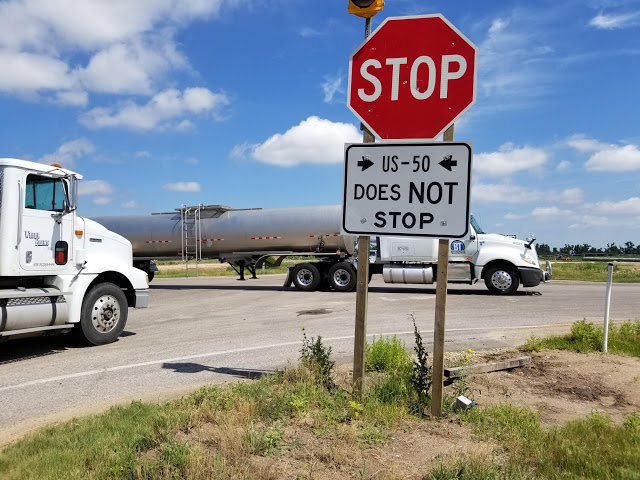
At the intersection of the two highways, traffic across a wide expanse of south-central Kansas converges, engines whirring, gears shifting. Big rigs rumble straight through without having to stop, blowing east and west on U.S. 50, while north and south traffic on U.S. 281 is signaled to stop before rolling on. At times, several vehicles line up before east-west traffic clears.
But everything about that key intersection is about to change in a big way: Around four weeks from now, the first key temporary change will be that traffic in all directions will have to stop before proceeding. That’s so construction can continue on a roundabout interchange.
The Kansas Department of Transportation is overseeing the project. Venture Corp., of Great Bend, is the primary contractor for the $5.2 million project.
The roundabout is designed to improve safety – with less chance of a high-speed, T-bone collision – and to ease the way for oversized trailers carrying, for example, huge wind-farm parts. Now, big loads have a hard time maneuvering through the square interchange.

Roundabouts help improve safety because they cause traffic to slow down, said James Middleton, a South Central Kansas Construction Engineer based in Pratt. The 15-year KDOT veteran is overseeing inspection of the interchange project. The project coordinator is Doug Coates, Engineering Technician Specialist has more than 30 years of field experience.
The roundabout will be composed of two spheres: a diamond-shaped outer road for the largest loads and a separate circular road inside the diamond for regular vehicles. Vehicles enter the circle by yielding to the left.
Crews are building legs of the diamond now. For a while, drivers will be using temporary roadway at the intersection. Traffic will be shifted around as the roundabout gets constructed in phases.
For visibility, the completed roundabout will be illuminated with 16 street lights – four at each approach.
The contractor’s schedule has a completion date of Dec. 13.
Check out our drone video of the project below:
Learn more about roundabouts and why KDOT uses them HERE.
MASON: HCI helps connect Hispanic students with America’s promise

One of my favorite summer activities is meeting the students and families who participate in Fort Hays State University’s Hispanic College Institute (HCI). For the past several years we have intentionally focused on initiatives which enhance opportunities, access, and support for Hispanic students to succeed in college. HCI is our most valuable contribution to fulfilling our promise.
Why is this timely? Ten counties in the southwest corner of Kansas have more than twice the percentage of Hispanic population than the state average. This past year, some of the regional high school senior classes were comprised primarily of Hispanic students: 81 percent in Liberal; 77 percent in Ford County; 65 percent in Garden City. Clearly, the education of this population is critical to the success of our state.
We are leading the way in meeting the higher educational needs of this growing population in Kansas and across the Midwest. HCI has already engaged over 275 Hispanic high school juniors and seniors from across the states of Kansas, Colorado, Missouri, Nebraska, and Oklahoma.
The HCI is a free, four-day residential program that prepares Hispanic high school students to enter and succeed in higher education. It is designed to bring in Hispanic educators and community leaders from all over the Midwest to build confidence in HCI students. The majority of the curriculum provides opportunities to get connected with Hispanic community leaders, college students, and university leaders who can relate to the students’ experiences and challenges. All students go through the college application process, learn about scholarship opportunities and financing college, and participate in mock classes and academic programs. They also take part in community service projects and create an issues-to-action presentation to cultivate our institutional mission to build engaged citizen-leaders.
The Institute is also valuable for the Hispanic students who are already Tigers and who serve as HCI Tiger Team leaders. Many were participants in the Institute when they were in high school, and now they help guide, support and inspire the students who will come after them. At the same time, they gain real-life experience as leaders and mentors, and practice the joy of “paying it forward.”
Each year, the university also brings in a dynamic keynote speaker and role model. This year’s students had the opportunity to learn from Oscar Rodriquez Jr., a 2005 FHSU graduate. Oscar, a native of Liberal, played football at Fort Hays State as a safety while earning his bachelor’s degree in physical education and health. He has just started his first season as the Zips’ secondary coach at the University of Akron. In 2015, Bruce Feldman from Fox Sports highlighted his heroic comeback from cancer to resume his coaching career.
Oscar was an NFL Bill Walsh Fellowship participant in 2018 with the Chicago Bears, and he has coached and mentored seven student athletes who are playing in the NFL. As an engaged citizen-leader, Oscar founded the Coaches Against Cancer Foundation and is involved in the Big Brothers Big Sisters program.
Of course, my absolute favorite part of the HCI is listening to student stories. I was captivated by the students’ honesty about what they were learning and the deep friendships they were forming. Grace Johnson (Wichita), a rising junior at Bishop Carroll High School, spoke with great enthusiasm and affection about the value of experiencing college life from living in a residence hall, being in a classroom, and touring a college town. I was especially pleased with how the Institute incorporates the city of Hays, because I know our close-knit community fuels the success of students through a deep and sincere connection.
I smiled as Grace described the late night conversations with her HCI roommate and the lasting friendships she formed with her small group – called a familia. She talked about the confidence she gained in her leadership, communication, teamwork, problem solving and conflict management skills, and about how she felt more prepared for college life. Grace shared: “I didn’t know coming into HCI how to deal with conflict. Now, I know not only how to avoid it, but to work through it with others.”
Most importantly, I loved listening to students capture the essence of why we invest so much into programs like the HCI: “I am more compelled than ever to go to college, succeed, and graduate” said Grace.
The education of students matters to us. We get to know students and help them discover their talents and their dreams. With each conversation, we see their potential and are inspired to walk with them and to challenge them. We provide access to the opportunity to learn and to thrive. The HCI is just one of many examples of how we deliver on America’s promise to help people and communities prosper.
Three-day weather outlook


Junior Monarchs, Junior Eagles both fall to Great Bend in Zone play


GREAT BEND – Neither the Hays Junior Eagles or the TMP-Marian Junior Monarchs could beat Great Bend Wednesday night. The Braves beat the Eagles 10-5 then knocked off the Monarchs 16-10 to secure the second spot out of their own Zone Tournament to the Class A American Legion state tournament next week in Topeka.
The Braves scored five runs in the bottom of the sixth inning after the Monarchs had rallied with four in the top of the inning to pull within two. Great Bend scored six in the bottom of the third to take the lead for good then added two in the fourth and another run in the fifth to go up 11-5.
Jacob Pfeifer had three of the Monarchs 12 hits. Jace Wentling added two RBIs. Kade Harris pitched three innings and suffered the loss.
In the first game of the night against the Junior Eagles, the Braves scored three in the second and three in the third to go up 6-2 but the Eagles answered with three in the bottom of the third to pull within one. They had the potential tying run thrown out at the plate on a double steal attempt.
Keatyn Barnett wiggled his way out of bases loaded jams in the fifth and sixth without giving up a run but the Braves got a three-run double an inning later to blow the game open.
Dawson VonFeldt and Dominic Bainter both had two of the Eagles eight hits with Bainter driving in two runs.
The Junior Monarchs end their season with a 13-10 record while the Junior Eagles finish 14-17-1.