It was a wet spring in Hays and that’s generally meant less water use by city water customers.
Even though water revenues for the city were down by 22 percent in April, as reported by Hays Finance Director Kim Rupp, city commissioners are “OK” with that.
Vice-Mayor Shaun Musil gave “kudos to the community” for using less water during the commission’s June 27 meeting.
During that meeting, Rupp reported a 17 percent increase in water consumption for May, which translates into an increase of 14.5 percent in water revenues and a 79 percent increase in water conservation revenues.
Still, the year-to-date total water consumption at the end of May was down 4 percent with revenue up 2.5 percent.
The consumption increase in May “kind of surprised” Commissioner Eber Phelps, who noted the cool temperatures and recent rains.
Mayor Henry Schwaller said he thought the information “got a little confused in public.”
“We’re happy when people don’t use water,” Schwaller said with a smile. “So when we heard last month that usage and water revenue were down, none of us were concerned. We’re happy when people conserve.
“We [were] a little shocked when it [went] up, but if people don’t use it, we’re OK with that.”
Musil agreed.
“I had many people saying we were complaining about it [less water consumption],” Musil said. “It’s actually just the opposite. We’re all very excited when it’s down because people aren’t using it.”
Phelps, who has twice previously served as a city commissioner, added that “all our efforts for years now have been directed for decreased water usage or we wouldn’t have given away 10,000 low-flow showerheads.”
City Manager Toby Dougherty said the report was “simply a statement of fact by the finance director and we’re not complaining either.”
Rupp pointed out to commissioners the May receipts may include part of April.
“We bill each week, so we have four cycles. So we might be catching a little of the tail end of April,” explained Rupp.
The water use average for Hays residential and business customers is a minimum of 500 cubic feet (c.f.) per month and is billed at the Base Tier rate.
As water consumption increases, so does the rate.
Usage exceeding the average by up to 1,000 c.f. is billed at the Conservation Tier 1 rate. Exceeding 1,000 c.f. usage in one month moves customers to the higher Conservation Tier 2 rate. If a customer exceeds 1,000 c.f. during official Water Warning or Water Emergency periods, the rate is even higher.
The city of Hays is the only municipality in Kansas with a population greater than 15,000 that is not located near a sustainable source of water. Water conservation programs were started in the early 1990s.
ATLANTIC CITY, N.J. — The federal government is warning Americans to brace for a “floodier” future.
Government scientists predict 40 places in the U.S. will experience higher than normal rates of so-called sunny day flooding this year because of rising sea levels and an abnormal El Nino weather system.
A report released Wednesday by the National Oceanic and Atmospheric Administration predicts that sunny day flooding, also known as tidal flooding, will continue to increase.
“The future is already here, a floodier future,” said William Sweet, a NOAA oceanographer and lead author of the study.
The report predicted that annual flood records will be broken again next year and for years and decades to come from sea-level rise.
“Flooding that decades ago usually happened only during a powerful or localized storm can now happen when a steady breeze or a change in coastal current overlaps with a high tide,” it read.
The nationwide average frequency of sunny day flooding in 2018 was five days a year, tying a record set in 2015.
But the East Coast averaged twice as much flooding.
The agency says the level of sunny day flooding in the U.S. has doubled since 2000.
Nationwide, the agency predicted, average sunny day flooding could reach 7 to 15 days a year by 2030, and 25 to 75 days a year by 2050.
“We cannot wait to act,” said Nicole LeBoeuf, acting director of NOAA’s Ocean Service. “This issue gets more urgent and complicated with every passing day.”
Global sea levels are rising at a rate of about 3 millimeters a year, or about an inch every eight years, according to Rutgers University researchers, who predict that by 2050, seas off New Jersey will rise by an additional 1.4 feet.
The study noted floods interfering with traffic in northeast states, swamping septic systems in Florida and choking Delaware and Maryland coastal farms with saltwater over the past year.
Baltimore experienced 12 days of high-tide flooding from 1902 to 1936. Within the last 12 months, it experienced an additional 12 days.
Robert Kopp, a leading climate scientist with Rutgers University, who was not involved in the study, said it confirmed many well-established trends.
“It’s simple arithmetic: If you have higher sea level, you will have tides causing flooding,” he said. “We’re not talking about disaster flooding. We’re talking about repetitive flooding that disrupts people’s lives on a daily basis. It’s sometimes called ‘nuisance flooding,’ but it has real impacts and costs.”
The report cited the disruption of commerce in downtown Annapolis, Maryland, where parking spaces are lost to flooding. A 2017 study put the price tag on lost economic activity at as much as $172,000. The water table has risen to ground level and degraded septic systems in the Miami region, and farmlands in the Delmarva Peninsula in Delaware and Maryland have been damaged by salt water encroaching into planted areas.
High-tide flooding is causing problems including beach erosion, overwhelmed sewer and drinking water systems, closed roadways, disrupted harbor operations, degraded infrastructure and reduced property values — problems which “are nearly certain to get much worse this century,” the report read.
The report’s statistics cover May 2018 through April 2019.
The agency forecasts sunny-day flooding this year in Boston at 12 to 19 days (it had 19 last year). It predicted sunny-day flooding this year in New York (8 to 13 days, compared with 12 last year); Norfolk, Virginia (10 to 15 days; compared to 10 days last year); Charleston, South Carolina (4 to 7 days, compared to 5 last year); Pensacola, Florida (2 to 5 days compared with 4 last year); Sabine Pass, Texas (6 to 13 days compared with 8 last year) and Eagle Point, Texas (29 to 40 days, compared to 27 last year).
West coast predictions included San Diego (5 to 9 days compared to 8 last year); Los Angeles (1 to 4 days compared to 5 last year); Humboldt Bay, California (6 to 12 days compared to 12 last year); Toke Point, Washington (9 to 21 days compared to 12 last year) and 2 to 6 days in Seattle, compared to 2 last year.
The report documented that 12 locations broke or ties their record of sunny day flooding last year, including 22 in Washington, D.C., 14 in Wilmington, North Carolina; and 12 each in Baltimore and Annapolis.
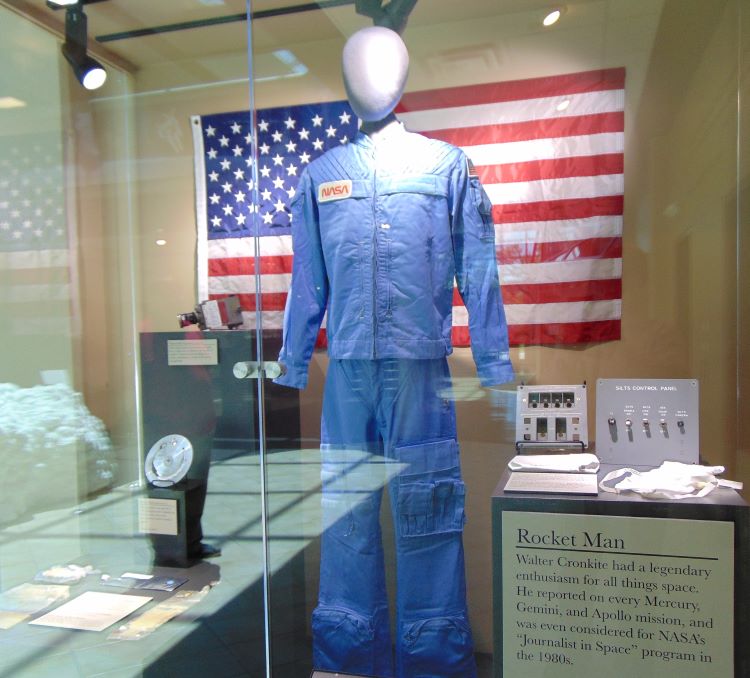
One of the Apollo 11 displays at the Walter Cronkite Memorial / Photo by Brent Martin
By BRENT MARTIN St. Joseph Post
ST. JOSEPH, Mo. — A special exhibit at the Walter Cronkite Memorial on the Missouri Western State University campus commemorates the 50th anniversary of the moon landing.
University curator Amanda Morrow says it’s appropriate for the Cronkite Memorial to focus on the Apollo 11 mission which first landed a man on the moon.
“He was a big proponent of space travel and he spent a lot of time learning about the principles of space travel so he could communicate those principles to the public,” Morrow tells St. Joseph Post.
The special Apollo 11 exhibit features recreations of the flag planted on the moon as well as Neil Armstrong’s footprint on the lunar surface. The Cronkite Memorial also has displays of artifacts which actually flew in space, loaned it by Cosmosphere Space Museum in Hutchinson, Kansas.
Artist in residence, Eric Fuson, says the exhibit has already evoked special memories for those who have viewed it.
“The whole mission of making it to the moon and competing with the Russians was so cohesive to the nation,” Fuson says. “We all came together to make this happen and it was such a point of pride within the country. Even the kids wanted to be part of it; it was like, I want to be an astronaut. So, it was just very, very cool.”
Morrow says she has observed various generations of families interact at the exhibit with grandparents explaining what it was like to see Neil Armstrong take his first step on the moon.
“A lot of these things are human experiences and so regardless of your age, you can find a way to connect to them, which is great for school groups, but also great for families, too.”
The Apollo 11 exhibit is on display now at the Cronkite Memorial, located on the Missouri Western State University campus in St. Joseph. It will run through August.
The Hays Police Department’s fourth annual Community Night Out will be from 5 to 8 p.m. Thursday, Aug. 1, at the Hays Aquatic Park.
The HPD will provide free admission to swim and free hotdogs and hamburgers for the first 1,000 people in attendance.
The event is sponsored by the City of Hays, Walmart, Hays Recreation Commission, Pepsi, Heartland Building Center, Fraternal Order of Police Hays Lodge 48, Phaze 2 and Nex-Tech.
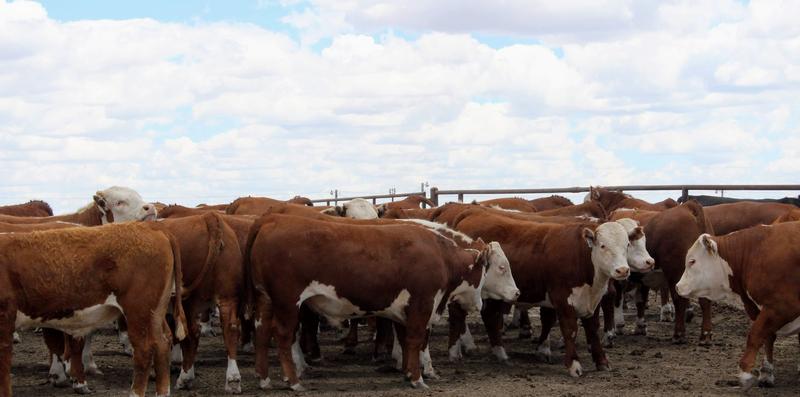
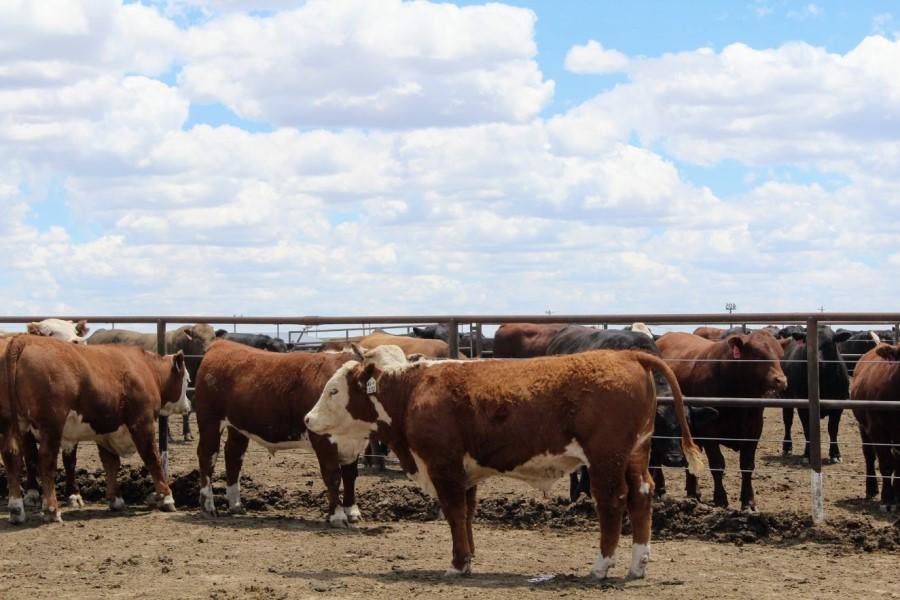
Hereford cattle at the Finney County Feedyard. Corinne Boyer / Kansas News Service
By CORINNE BOYER Kansas News Service
GARDEN CITY — Nearly all American cattle spend their final months in massive feedlots, munching on feed designed to fatten them for slaughter.
But not all that goes into the beasts transforms to beef.
Their four-chamber-stomach digestive systems continually seep all forms of gasses, including the powerful greenhouse gas methane they burp up silently and constantly.
Cattle herds also produce ammonia. By the ton. It’s in their manure and especially in their urine. Because that pungent ammonia is a compound of nitrogen and hydrogen, it can form nitrous oxide and pump more greenhouse gas into the atmosphere.
But more immediately, ammonia poses a threat to our air and water.
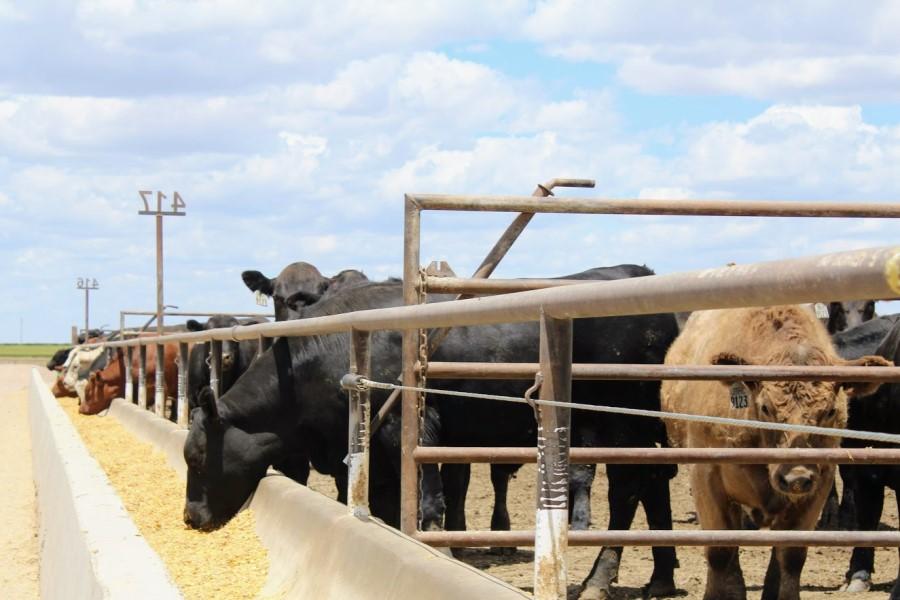
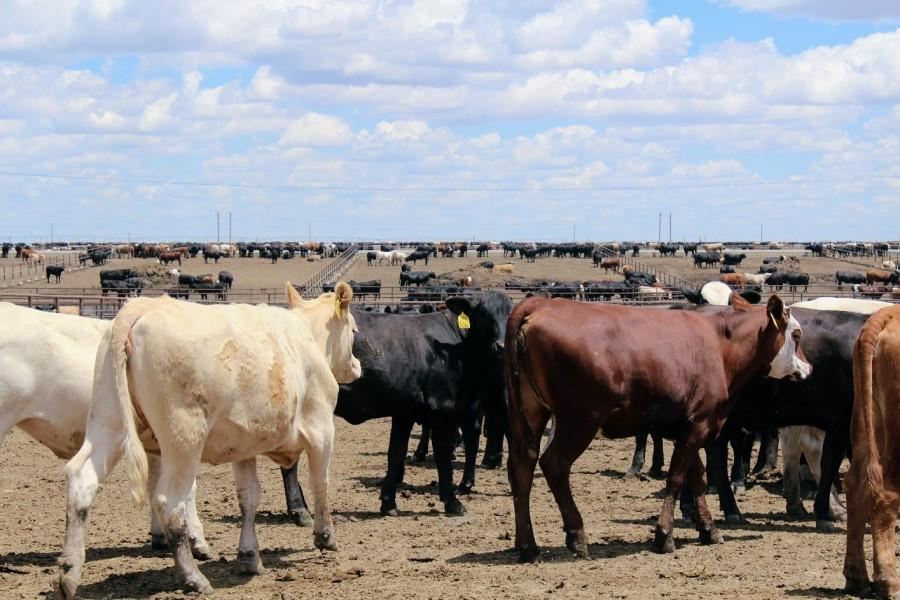
The Finney County Feedyard feeds cattle three times a day. Credit Corinne Boyer / Kansas News Service
What if you could add something to animal feed that changes the chemistry within cattle, that converts more of what they eat into weight and less in ammonia-heavy poop and pee? Turns out there’s a new drug for that. And one that, maybe, could help cattle put on weight.
It’s not yet on the market. Its manufacturer, Elanco, isn’t saying when Experior will be for sale or how much it will charge.
Ammonia can foul air quality so much that it contributes to potentially deadly respiratory diseases. Ammonia-heavy water runoff from cattle operations contributes to the nitrogen overload in lakes and rivers that trigger algae blooms. Those, in turn, ultimately suck oxygen from waterways and create dead zones, including a massive swath in the Gulf of Mexico.
Elanco won approval in November from the U.S. Food and Drug Administration for lubabegron as a way to cut ammonia in cattle waste. Research showed that, in particular conditions, adding Experior cut ammonia gas from cattle by 14% to 18%.
That’s a fraction of a reduction. But in Kansas alone, about 2.4 million cattle can be found in feedlots on a given spring day.
“When you multiply it out by a lot of animals … that can be pretty significant in terms of reducing ammonia emissions,” said Sara Place, the senior director for sustainable beef production research at the National Cattlemen’s Beef Association. “We’ll never be able to totally eliminate those emissions, so it is more about those incremental reductions.”
At the Finney County Feedyard near Garden City, some 34,000 cattle fill pens lined with concrete feed bunks that stretch for hundreds of feet. Angus, Charolais and Hereford cattle retreat from those feed troughs as feedlot manager Jeff George drives by.
Three times a day, trucks drive back and forth delivering food, typically a mixture of corn, corn silage or other forage and vitamins.
Feedlots dot western Kansas because so much grain is grown nearby and because meatpacking plants across this corner of the state exist to slaughter and cut up cattle into hamburger and steak.
George says he would use Experior if the new drug could help him make more money, but he’d need to see trial data to make a decision.
Cattle urine and manure excrete nitrogen, which leads to ammonia gas formation. Credit Corinne Boyer / Kansas News Service
“It’s not that farmers and ranchers aren’t concerned about the environment or it’s not that they don’t want to do anything to improve the environment,” George said. “(But) the profit margins in the livestock business, in general, are really thin. So anything that we do has to have a financial benefit.”
That sentiment doesn’t surprise Kevin Kedra, a research analyst at G.research. For a cattle operator running a business, Kedra says there’s little reason to justify an additional expense that’s all about improving air and water quality.
“If the incentive is, ‘OK, I want to be a good steward for the environment,’ you know, it’s a bit of a tougher sell given that the data, it’s not like this thing of wipes (ammonia) out 100%,” Kedra said. “It’s a reduction, but not a complete reduction of the release of the gas.”
Once cattle get moved to a feedlot, their waste, primarily their urine, contributes to ammonia gas formation.
“They’re consuming nitrogen and then the ammonia can be produced” on the ground in a feedlot pen, said Justin Waggoner, a beef systems specialist at Kansas State University.
Yet Experior retains more nitrogen within the body of a steer or heifer. That not only decreases the potential formation of ammonia gas, it could potentially help increase the weight of the animal. Yet in approving the drug, the FDA found no evidence that adding the drug to feed makes the animals put on more pounds.
“The evidence (found no) performance advantage in beef cattle, such as weight gain or feed efficiency, as a result of receiving Experior, although no negative effects were noted,” the agency said when it approved the drug.
Elanco might have more success if it can show that Experior fattens cattle more efficiently. If it could, ranchers and feedlot operators might see a way to improve their profits, not just the environment.
“So I am pretty certain that’s going to be a part of this post-approval project or projects that the company does as well in terms of actually looking at animal performance more in-depth,” said Place of the National Cattlemen’s Beef Association. “Because … if you can justify feeding the compound because you’re going to be more efficient, then it makes a heck of a lot of sense.”
That’s a benefit George sees. He says it could catch on within the feedlot industry.
“If it did not provide a monetary benefit for the business, our profit margins are thin enough that I would be greatly surprised if anybody would feed it just to reduce cattle emissions,” George said.
The Finney County Feedyard feeds approximately 34,000 cattle every day. Credit Corinne Boyer / Kansas News Service
The only way Kedra sees the drug being used is if the U.S. Environmental Protection Agency begins requiring cattle producers to cut ammonia emissions.
“A lot of talk about what is the impact of large-scale factory farming … (is about) should EPA get involved?” Kedra says. “This product could actually have material benefits.”
Corinne Boyer covers western Kansas for High Plains Public Radio and the Kansas News Service. You can follow her on Twitter @corinne_boyer or ror email cboyer (at) hppr (dot) org.
The Kansas News Service is a collaboration of KCUR, Kansas Public Radio, KMUW and High Plains Public Radio focused on the health and well-being of Kansans, their communities and civic life.
The Kansas Bureau of Investigation, the Kansas Highway Patrol, the Ford County Sheriff’s Office, the Hays Police Department and the Ellis County Sheriff’s Office coordinated efforts to arrest a Hays man for suspected distribution of methamphetamine.
On Sunday, July 7, at approximately 1 a.m., Fernando Amezquita, 43, Hays, was arrested along U.S. Highway 56, west of Dodge City, after authorities reported finding approximately 6 pounds of methamphetamine in his vehicle.
Amezquita was arrested for distribution of methamphetamine, and three counts of child endangerment, since his three young children were passengers in the vehicle at the time of his arrest. He was then booked into the Ford County Jail. Bond was set at $150,000.
This operation represented a coordinated law enforcement effort to combat drug violence and reduce the accessibility of illegal drugs impacting western Kansas.
— HPD
An assistant professor of education and colleagues at Fort Hays State University have been awarded a $476,015 grant from the National Science Foundation to develop an online professional development learning platform that will solve a continual challenge facing teachers who work in rural schools.
Dr. Brooke Moore, interim chair and assistant professor of the Advanced Education Programs department, will be the principal investigator on a three year research project that will take a successful face-to-face (in person) professional development program that trains and supports high school biology teachers and integrate it into an online format.
“We’re doing this because teachers in rural areas, particularly in Kansas, may not always have the opportunity to get high-quality, face-to-face, professional development training,” said Moore.
In the more traditional face-to-face format, teachers travel to a central location to attend a workshop and then return to their classrooms and try out the techniques covered. After an interval, the teachers gather again to share their stories of what worked and what didn’t and offer their suggestions for improvement.
“In an urban setting, this works,” said Moore, “but in rural schools there may only be one science teacher per school, teaching multiple grade levels.”
This makes it economically challenging for the teachers and for the school district to cover the costs of travel for professional development or for the professional development providers, such as FHSU, to send people to conduct the training in rural schools.
Moore will be working with Dr. Arvin Cruz, Earl Legleiter and a team directed by Dr. Andrew Feldstein, assistant provost of the Office of Teaching Innovation and Learning Technologies to develop, evaluate, and then compare the online platform with the traditional face-to-face professional development with high school science teachers.
The grant is budgeted for a three-year project. In the first year, Moore and her team will develop the online platform, adapting the “Towards High School Biology” curriculum to an innovative online learning modality.
For the second and third years, the researchers will test the online platform against a face-to-face setting. To do this, they will recruit 48 rural middle-school science teachers from Southwest Kansas who will be assigned randomly to the online or in-person professional development program.
“If it works for science,” said Moore, “it can work for any content – math, reading, history, even music.”
EDITOR’s NOTE: This essay on a topic in agriculture was researched and written by a student as part of a project in a senior animal science class at Fort Hays State University. The project director is Dr. Brittany Howell, associate professor of agriculture.
By MAKENNA FRITTS Ness City junior
We can sometimes hold on to something way past when we should have let it go. Many ranchers and cow/calf operators are guilty of holding on too long to cows that need to be culled. Perhaps it’s a young replacement heifer for the herd, a favorite cow that lost a calf or didn’t breed back, or that mean-tempered cow that’s put you over the fence at least once or twice. Whatever the reason, she’s costing money (feed, pasture rent, vaccine, or medical bills) without a return of income.
Culling cows comes down to a few basic issues such as age, health, breeding history, udder soundness, and mothering ability. Having good records on every cow makes the culling decision less of a guessing game and more about hard facts.
There’s a decline in the reproduction of a cow at 8-10 years of age and an even steeper decline at 12 years of age or older, according to a Drovers article titled “Proper Cow Culling Is Important to Your Business.” At 12 years of age the cow will also wean 25-percent less in a calf’s weaning weight than the previous year, said Dr. Kurt Vogel, DVM for Heritage Veterinary Services, Utica. Harlan Hughes in a recent Beef Magazine article referenced CHAPS (Cow Herd Analysis Performance System) and suggested 2.3 percent of cows are culled due to old age.
When it comes to the health of the cow, keep a close eye on the soundness of hooves, legs and eyes. A cow with foot rot infection, arthritic, or stifle joint issues won’t travel a pasture like they should, and their body condition score (BCS) is going to go down because of these mobility issues that reduce their capability to graze and travel to a water source.
Also according to Drovers, cancer eye is a big health problem due to the fact that it’s a leading cause for condemning beef carcasses. If the cow is culled when the cancer growth is small, before it engulfs the eyeball and invades the lymph nodes, the carcass can be used for a beef product and not be condemned as unfit for human consumption.
Some ranchers or cow/calf operators put less culling pressure on the breeding history of the cow. Vogel says a cow needs to raise a calf every year, or she needs to be sold. Pregnancy checking will eliminate feeding an animal that doesn’t have a calf at the end of the calving season.
CHAPS suggested that 5 percent of the cows culled are culled due to them being open (not pregnant), said Hughes. Depending on the rancher or cow/calf operator, a cow might be culled if she loses her calf, has calving difficulties, or if she aborts her calf. At the end of the day, if the cow isn’t producing and raising a calf, she’s not paying her way and she’s costing the operator time and income.
Udder soundness is important when it comes to weaning weights in the calves. A cow with big teats makes it difficult for new born calves to suck and get valuable colostrum needed for a healthy immune system, and cows with large, funnel shaped teats might indicate a previous case of mastitis (inflammation of breast tissue that sometimes involves an infection) and renders the quarter milk production, said Drovers. A cow with one bad udder quarter is going to wean 30 pounds less in calf weight, said Vogel. A cow with good udder health and good milk production makes for a healthy calf.
It’s vital that a cow displays good mothering ability. You don’t want a cow that gives birth to a calf and walks away, leaving it to get chilled during winter conditions or become vulnerable to predators. Inadequate mothering ability makes the rancher or cow/calf operators’ life just a little more difficult, because more man hours are required to get the cow/calf pair into a barn or corral and make sure the cow and calf bond. However, if the cow is too aggressive, the rancher or cow/calf operator has to determine if she’s too great a risk to the operator’s safety.
When culling any cow, make the most income. While a cow/calf producer’s yearly focus may be on annual calf sale revenue, 15-30 percent of a cow/calf operators’ yearly gross revenue comes from the sale of culled cows from the herd, according to Greg Henderson, in another Drovers article. Those percentages really put into perspective how important it is to cull the cow herd at the best time when the market is high.
Over the last 30 years, the best time to take cull cows to market is March through May, and the least opportune time to market them is November through January, said Drovers. Therefore, holding onto fall cull cows and selling at a later date might realize a higher profit by allowing the cows to gain weight and additional fat. Watching local cattle markets and timing sale decisions could make a difference in revenue for any size operation.
There are no annual revenue guarantees for ranchers and cow/calf operator. Every day has its challenges, but keeping accurate records on each cow in any operators’ herd is the key to making good culling decisions. Cows that fall short of culling management criteria should be considered for culling.
Makenna Fritts, a 2016 Ness City High School graduate, is a junior majoring in agronomy at Fort Hays State University. She is the daughter of Aaron and Stephanie Pavlu, Ness City.
A chase that began near Hays led to the arrest of two individuals and the recovery of a stolen vehicle following a high-speed pursuit that ended in Ness County.
At 1:57 p.m. Tuesday, a Kansas Highway Patrol trooper attempted to pull over 2009 Chevy Impala on Interstate 70 near the Highway 183 Alternate exit, according to Kansas Highway Patrol Trooper Tod Hileman.
The Impala was clocked at 99 mph, and when the trooper ran a check on the license plate, it was found to have been stolen.
Initially, the driver of the Impala, Ian M. Sinnett, 39, Salina, stopped the vehicle on U.S. 183 Alternate. However, neither Sinnett nor a passenger in the vehicle, Valerie Jo Waggoner, 37, Salina, would comply with officer commands, and Sinnett again started driving south.
Waggoner
They traveled on U.S. 183 to County Line Road then began turning west and south on various county roads while being pursued until around 2:30 p.m. when the vehicle came to a stop at the intersection of GG Road and Kansas Highway 4, Hileman said.
After stopping, the suspects complied with officers and were taken into custody.
Sinnett was found to have two active warrants from Reno County and has a criminal history that includes theft and burglary dating to 2014.
In 2017, he was convicted of felony theft stemming from two separate felony cases that were charged against him after he tried to sell automotive parts that he had stolen to the brother of the victim.
He was released on parol on March 25, according to Kansas Department of Corrections records.
Along with the 2017 convictions, Sinnett was also found guilty of falsely reporting a crime in 2015 and theft in 2014.
The police pursuit is expected to lead to Sinnett being charged with allegedly fleeing and attempting to elude law enforcement, along with several traffic and speeding violations, according to Hileman.
“Two subjects, one male and one female that I met earlier in the day on the northeast side of Topeka, were staying at the Days Inn in Lawrence,” the report said.
“While I was in the bathroom, the female subject yelled that they were taking my car to go to McDonald’s. Before I was able to tell them no, they grabbed my keys from a table in the room and left with my car and did not return.”
The victim believed at the time they might be heading to Portland, Ore.
“The car was a gift from my father who passed away a little over two years ago,” the report said. “It was his pride and joy. I’m a disabled man with congestive heart failure.”
Rural Water District No. 1 Ellsworth County, Kansas (a/k/a Post Rock Rural Water District) is hiring a full-time Water Treatment Plant Operator.
To apply for this position, please submit a cover letter, resume and three professional references to Ms. Leslee Rivarola at [email protected] or by mail to Post Rock Rural Water District, 103 N. Douglas, Ellsworth, KS 67439.

 By BECKY KISER