Q: Why did the boy bring a ladder to class?
A: He wanted to go to high school.
Join fans of 99 KZ Country on Facebook: https://www.facebook.com/99KZCountry
Q: Why did the boy bring a ladder to class?
A: He wanted to go to high school.
Join fans of 99 KZ Country on Facebook: https://www.facebook.com/99KZCountry
 By BECKY KISER
Hays Post
The public hearing for the proposed 2020 budget for the city of Hays will be held Thursday during the regular meeting of the city commission.
The balanced budget of $41,966,419 keeps the mill levy at 25.000, where it’s been for several years. Total assessed valuation for the city is up 1.6% from 2019.
Immediately following the public hearing, the commission is expected to adopt the budget which must be sent to the Ellis County Clerk by Aug. 23.
Also on the Aug. 8 agenda are recommended amendments to the National Electrical Code and the International Residential Building Code.
Local electricians and city staff have determined certain requirements in existing homes for arc fault circuit interrupters, smoke detectors, and carbon monoxide detectors are too burdensome, according to Jesse Rohr, public works director.
The meeting begins at 6:30 p.m. in Hays City Hall, 1507 Main.
 “You can’t live with them, but you can’t live without them.” This is often what I hear from homeowners when referring to their pine trees.
The needle and pine cone clean-up is monotonous, but the aesthetic they can provide for a lawn or break from the wind makes it all worth it. This summer our Pines have struggled to stay alive because we have gone from one extreme (rain) to another (hot temps). Now to add to that mix, I am starting to see a lot of pine trees fall to Pine Wilt. This is not a new disease to Western Kansas, but some may think it went “dormant” over the last several years because we haven’t seen it as often. If you are unfamiliar with Pine Wilt I have provided adequate information about the disease below including how to prevent the disease.
Pine Wilt is a very serious disease that is considered to be a problem in Scots pine trees in landscape settings, windbreaks, Christmas tree farms, and recreational plantings. Pine wilt has also been reported on Austrian and white pines.
In Kansas, the symptoms for pine wilt usually appear from August through December. In general, the trees wilt and die rapidly within a short period of time. Occasionally, trees may survive for more than one year. The needles turn yellow/brown and remain attached to the tree. The early stages of the disease are subtle and may vary. The pinewood nematode is transmitted from pine to pine by a bark beetle, the pine sawyer beetle.
Needles initially show a light grayish-green discoloration, then turn yellow and brown. The disease may progress uniformly through a tree or branch by branch, depending upon the size of the tree and the environmental conditions during the growing season. The needles remain attached for up to six to twelve months after the tree has died. The rapid death of a tree contrasts with other pine problems such as fungal diseases, insects, or environmental stresses.

There is one option to potentially save unaffected Scots, Austrian, and white pine trees from Pine Wilt. According to Colorado Extension two compounds are labeled for the prevention of pine wilt. These products are directed towards killing/immobilizing the nematode and not for killing the pine sawyer beetle vector. They are not effective if the tree is symptomatic or once the PWN has colonized the tree. Several commercial injection systems are available, but pine injections are almost always done by professional arborists. Yearly injections provide the greatest protection, but the cost and potential damage associated with the injection process are issues to consider.
It is important to confirm the presence of the pinewood nematode if pine wilt is suspected to be the cause of a tree death. Early confirmation will allow the owner to act quickly to prevent the spread of the pinewood nematode to nearby pine trees. In established pine plantings such as landscape settings, windbreaks, and Christmas tree farms, the only control measure is to remove affected trees and burn, bury or chip the wood before April 1. Trees should be removed to ground level. No stumps should be left. This prevents further spread of the nematode and its vector before they emerge from the trees in the spring.
If you have further questions regarding Pine Wilt please reach out to Lauren Walz, the Cottonwood District Horticulture Extension agent by calling 785-628-9430 or by e-mail [email protected]

By CRISTINA JANNEY
Hays Post

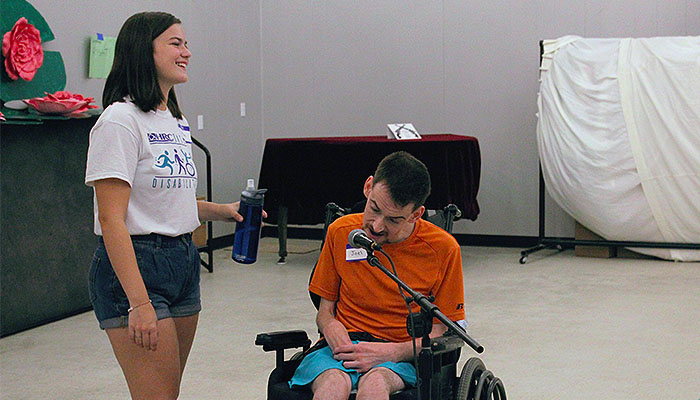
The Hays Community Theatre was filled with music and laughter during a special theater camp organized by a Thomas More Prep-Marian junior this week.
What is unique about this camp is that all 20 campers are developmentally disabled adults.
Annie Wasinger, 16, has been working to pull the camp together for about a year. She has been actively involved in community theater from the tender age of 3. However, she noted her older brother, Joel, who has cerebral palsy, could only listen to her belt out show tunes and run lines, but never participate himself.
When the HCT installed a handicap accessible bathroom at its new venue on Eighth Street, the idea struck her to organize the camp.
“I was really excited about it, because I thought he could finally come to shows. That would be so good. I thought more about it, and thought if he can come to shows, he has always wanted to perform. But in all 13 years I have been with Hays Community Theatre, we have only had one person in a wheelchair, and it wasn’t my brother. I thought it would be really cool to create a camp for everybody in the community,” she said.

“Since it is Hays Community Theatre, I think we should branch out and be here for any individual whether they have a disability or not.”
Students at TMP have special time during their school day called “20 time” during which the students are encouraged to work on a community service project or learn a new skill. Wasinger chose to use that time to organize the Center Stage camp. She wrote grants, sought donations, organized a presentation to the HCT board and found a curriculum from an online company, Fourth Wall, specially geared for adults with disabilities.
Her mother, Becky, who is also her brother’s limited license provider, said she has been impressed with Annie’s commitment and efforts to organize the camp.
The camp runs Monday through Friday this week, culminating in a free hour-long public performance at 6 p.m. Friday at Celebration Community Church.

“I really want to press we need the community to support this and come to the show,” Annie said. “Each [camper] is so very excited to have their chance on stage and feel the way you do when you get audience reaction.”
The campers are participating in a variety of games to help them learn about acting, theater and stage directions.
“We teach them there are three aspects of theater — singing, dancing and acting,” Wasinger said. “So we are going to do three acting pieces. We have one where everyone is a superhero, and that is a little skit. Then we have one where everyone is a detective. Then we have an actual script that is 20 minutes long, and it is called ‘The Princess and the Dance Crew.’ ”
“Princess and the Dance Crew” is a variation of “Snow White and the Seven Dwarfs.” Also on Friday, one camper will also sing “What a Wonderful World” as the rest of the campers sign the words.
So far this week, the campers have played four corners using stage directions. They played Pass the Hat on Tuesday. Each person put on a police hat and had to say something a police officer would say. Pictures were projected on a screen for a game called Act it Out, and the campers had to act out a scene based on the image. The campers had to pretend they were eating spaghetti or pretend they were a bunny, etc. The campers will also do a variety of improv exercises.
Annie has been concluding the camp sessions daily with a game, A Minute of Fame. Each camper comes in front of an audience of other campers, care staff and volunteers, and they can sing, dance or tell a story. On Tuesday, the campers chose to sing.
Annie worked with DSNWK to hand pick about half of the campers from the Reed Center. The others came from the community. She said the campers from the Reed Center spend most of their time in a classroom setting.

“They don’t usually get time to truly display all their talents and do stuff individually,” Wasinger said, “So when we do stuff like One Minute of Fame, they are so excited to get the chance to go up in front of everybody and sing. I think acting is escapism. I think everybody needs that. I think it has been really nice for them to come everyday and know that they are going to have fun. …
“For me, it has been really cool because I have known most of these people all of my life through Joel, and I have seen them break out of their shells.”
One of the campers, David, wanted to talk about his horse, so he got up in front of the audience and neighed.
“I have been so impressed by going over scripts and seeing how they inflect lines,” Wasinger said. “The stuff they have done there — it has just been really important. … I think it is just good to see what they can do, since it is something they have never been given the opportunity to do.”
Staff from the Reed Center have accompanied their clients, and the camp has about 40 additional volunteers. Annie said everyone seems to be having fun.
“I think people my age are benefiting so much because they are volunteers … I am fortunate that I have had the background that I have with people with disabilities, but a lot of these people are coming from my youth groups or church or I know them from school and theater or I know them from another background. I think it is so cool for them to interact with people with disabilities because they never have before. I have been really proud of my volunteers for how they have worked together.”
Wasinger said she hopes the Center Stage camp can become an annual event.
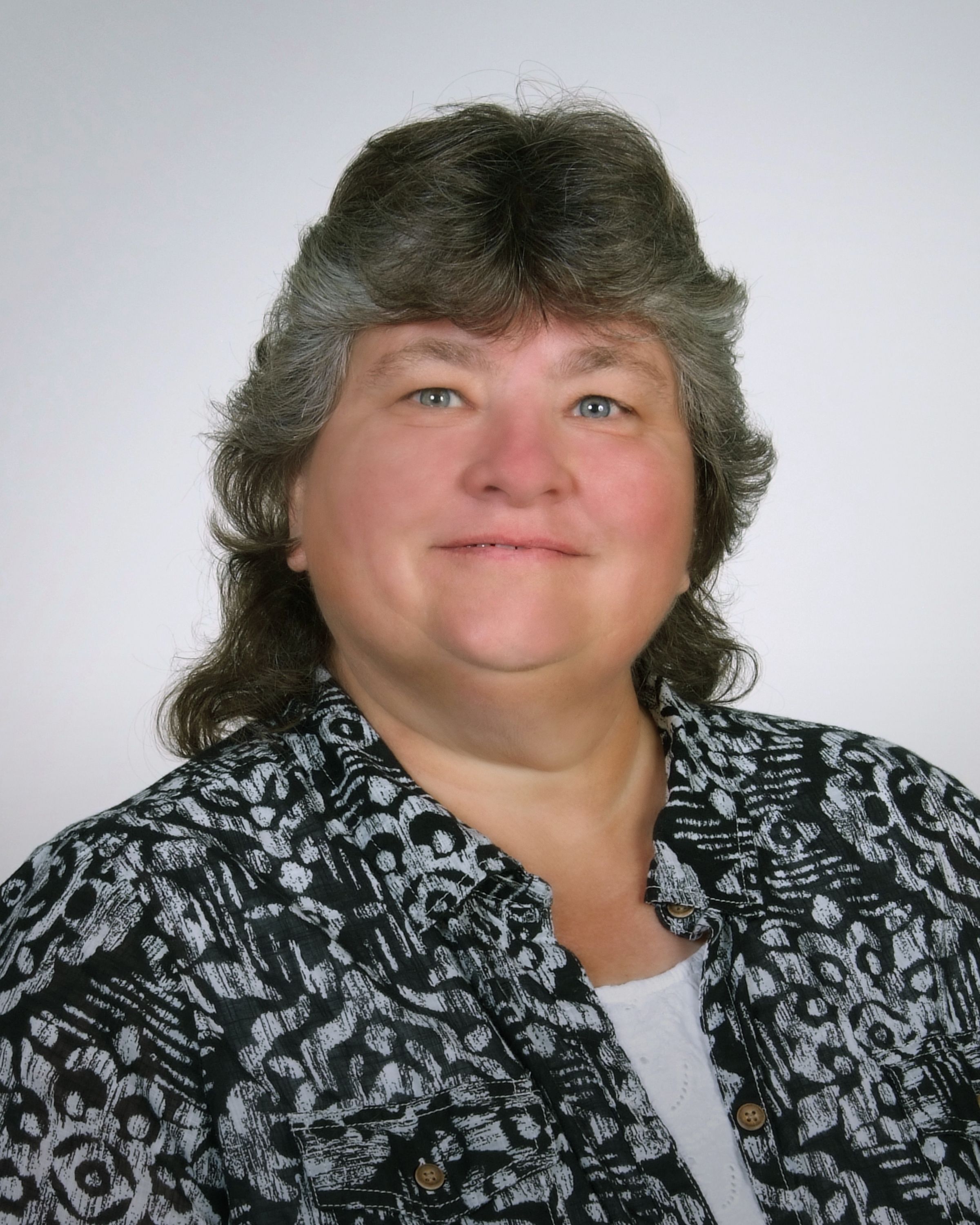
 Luann Evert, APRN, has joined the staff of HaysMed, part of The University of Kansas Health System, seeing patients at the DeBakey Heart Clinic.
Evert graduated from Fort Hays State University with a bachelor’s degree in nursing, pre-med classes and also a master’s in nurse practitioner and nursing education.
“We are very happy to have another provider to accommodate the increasing number of heart patients we are seeing at the DeBakey Heat Clinic,” said Dr. Jeffery Curtis, cardiologist and administrative director of cardiology. “It’s exciting that our program continues to grow every year.”
To make an appointment, call 785-623-4699 or go to www.haysmed.com/debakey-heart-institute/
— HaysMed
JACKSON COUNTY — Law enforcement authorities are investigating a suspect after a Tuesday chase and crash.

Just before 2 p.m., a Jackson County Deputy Sheriff attempted to stop the driver of a Pontiac Grand Prix later identified as Jesus Emanuel Chatmon, 39, Kansas City, Mo., for allegedly committing traffic violations and suspicious activity near 126th and US 75 Highway, according to Sheriff Tim Morse.
The vehicle failed to yield to the deputy and a vehicle pursuit ensued.
The Pontiac continued into Shawnee County to I-70 and then onto the Kansas Turnpike and headed east from Topeka.
Law enforcement deployed stop sticks disabling the vehicle, which subsequently crashed just east of the toll plaza at Topeka.
Chatmon sustained minor injuries and was transported to a Topeka Hospital then booked into the Jackson County Jail. The Sheriff’s office has not released possible charges in the case.

By JACKIE MUNDT
Pratt County farmer and rancher
If you turn on the news, you will find one story after another about murder, drugs, theft and other crimes. These incidents are not only happening in big cities; rural areas and small towns are dealing with an increasing amount of crime.
Our young professional group recently toured the offices of our police, sheriff and county jail. The visit was eye opening because I have almost no interaction with law enforcement. An important takeaway was the officers’ request for our participation in public safety and community vigilance. Law enforcement officials often rely on community informants and private security footage to capture criminals.
There is a lot of truth to the saying nothing goes unnoticed in a small town. If crime or anything else is happening in your neighborhood, someone knows about it, and they will probably tell you about it. Unless they don’t know you.
Growing up in a very small community, I knew almost everyone in the whole town. In adulthood, that has not been the case. My education and career took me from coast to coast through several big cities over the course of a decade. During that time, I can count on one hand the number of neighbors I met.
Honestly, I avoided them. I was busy, tired from work, had enough people in my life, I felt safer not knowing them and any other excuse that came to mind. None of my neighbors ever knocked on my door either. We were all content in our isolated lives.
This seems to be a trend even in small communities. How many people actually take the time to welcome new neighbors or go door-to-door to meet people if they are new to the neighborhood?
The technology and culture of our connected world have negated the need to interact with others because of their proximity. The unintended consequence of this is our neighborhoods are now filled with strangers who have no loyalty or reason to care.
The problems this causes are deeper than just an occasional awkward interaction. Not knowing our neighbors is eroding communities.
A podcast on the subject, featuring a crime prevention specialist Stephanie Mann, made me realize this unwillingness to meet neighbors is part of the reason crime is seeping into our neighborhoods.
Mann says fixing community’s problems begins by the small step of meeting your neighbors. Simply knock on their door, ask what concerns they have about the neighborhood and if they are willing to help.
She highlighted multiple examples of this simple step working to bring neighbors together to stop vandalism by supporting the family of troubled teens. Another community documented license plate numbers for visitors to a known drug house while getting the mail and walking their dogs.
Crime is not inevitable. Each one of us has the ability to help protect our family, friends and neighbors. Going outside our comfort zone to get to know our neighbors can create relationships and shared commitment to the goal of a achieving a safe and healthy community.
“Insight” is a weekly column published by Kansas Farm Bureau, the state’s largest farm organization whose mission is to strengthen agriculture and the lives of Kansans through advocacy, education and service.

FHSU University Relations
Businesses and organizations in northwest Kansas can now apply for a fall, spring or summer intern from Fort Hays State University through the FHSU/Dane G. Hansen Internship program.
FHSU students may apply for a fall internship beginning Sept. 9.
A grant from the Dane G. Hansen Foundation made 30 paid internships possible for the 2019-20 academic year, including the summer 2020 term.
Aug. 30 is the deadline for employers to apply for a fall intern. Applications for spring and summer interns will be accepted through Oct. 1.
Eligible employers must be located in the Hansen Foundation’s 26-county service area: the block of counties stretching from the Cheyenne-Wallace County area east to include the Republic-Saline County area, including Ellsworth County. Students do not have to be from the northwest Kansas area.
A participating employer invests $500 toward the student intern’s wages, and the remaining funding is through the Hansen Foundation grant. Each internship is for one semester. Fall and spring interns will work 240 total hours, and summer interns will work 300 total hours.
The interns are paid $10.31 per hour. In addition, five of the students whose internships are outside Hays will also receive stipends to assist with short-term housing costs.
“We appreciate the generosity of the Hansen Foundation in creating these opportunities for FHSU students and area employers,” said Lisa Karlin, career advisor and internship coordinator.
Interested employers should go to the Career Services page on the FHSU website (fhsu.edu/career/employers/hansen-internship-program) to learn more about the program and complete the application. The employer must also provide a detailed job description for the internship.
Beginning Sept. 9, students may apply for a fall internship through their Handshake account at fhsu.joinhandshake.com. The internships will be posted under the Jobs tab and can be found by selecting Employers and then searching the keywords “Hansen Internships.” The application deadline for students is Sept. 30.

BOSTON (AP) – Jorge Soler didn’t have to wait for the question about the Green Monster to be finished before breaking into a wide smile.
Soler hit a pair of long two-run homers over the Monster, Jakob Junis pitched six effective innings and the Kansas City Royals snapped their seven-game losing streak by beating the Boston Red Sox 6-2 on Tuesday night.
“When (I) get to a park like this, it feels little bit more comfortable obviously because the park is smaller,” he said through a translator after breaking into his smile. “You can mis-hit balls and they end up leaving the yard.”
Soler was standing at his locker after the game with an ice pack on his left shoulder, but it certainly didn’t affect his power on the two shots that totaled nearly an estimated 800 feet.
“He hits ’em a long way,” Kansas City manager Ned Yost said.
Ryan O’Hearn also homered for Kansas City, which had lost eight in a row to the Red Sox – its longest slump ever against Boston.
Christian Vazquez had two hits with an RBI double for Boston, which halted its eight-game skid a night earlier.
The Red Sox also were held without a home run, ending a club-record stretch of at least one homer in 18 straight games in Fenway Park.
Junis (7-10) escaped a couple of early jams and gave up one run on seven hits, striking out four with one walk. He went at least six innings for the 12th time in his last 15 starts.
“You definitely want to be the one to put a stop to it,” Junis said of the team’s skid. “You want to be the guy that goes out and throws a strong game.”
Andrew Cashner (10-7) gave up six runs on seven hits – three of them homers – over 5 1/3 innings, dropping his record to 1-4 since being traded from Baltimore to the Red Sox.
“I thought I had good stuff,” he said. “Made three mistakes, they hit three home runs. Kind of the way it goes, but they’re a team that we’ve got to beat. I’ve got to be better.”
A night after the Red Sox got a solid start from Rick Porcello to snap their longest losing stretch since dropping eight straight in 2015, Cashner was chased with Boston trailing 6-1 in the sixth.
Soler’s first homer, his 30th of the season, left Fenway completely, making it 2-1 in the fourth.
Two innings later, he hit a drive that caromed off a billboard in left center to make it 6-1 after Hunter Dozier’s RBI single. Soler is seven homers from tying the club record for a season, set by Mike Moustakas in 2017.
O’Hearn’s drive went into the seats in deep right, next to the Royals bullpen.
The Red Sox stranded seven runners over the first four innings.
“I think we swung at a lot of pitches that were out of the zone or pitches at the end of the zone that we can’t do damage with it,” Red Sox manager Alex Cora said.
Kansas City center fielder Bubba Starling struck out swinging in all four at-bats but made a nice catch to save at least one run.
CASHING OUT
Cashner has given up at least six runs in three of his five starts after he was acquired from the Orioles in mid-July. He’s allowed seven homers in 28 innings and has a 7.53 ERA with the Red Sox.
During the eight-game skid, Boston’s starters had a 10.95 ERA.
RUNS SAVER
Starling made a leaping catch on Vazquez’s fly ball at the wall to end the third inning and likely saved two runs.
Boston had already taken a 1-0 lead on Andrew Benintendi’s RBI single and had runners on first and third when Starling drifted back to the wall before jumping to make the grab.
HOW ABOUT THAT
Red Sox 2B Michael Chavis made a nice over-the -shoulder catch in shallow center off Dozier before tumbling to the ground.
TRAINER’S ROOM
Red Sox: Cora said knuckleballer Steven Wright is traveling to Florida to see Dr. James Andrews on Wednesday to get a second opinion on his pitching elbow. … Cora also said that RHP Heath Hembree received a platelet-rich plasma injection near his right elbow. SS Xander Bogaerts got the day off.
UP NEXT
Royals: RHP Glenn Sparkman (3-7, 5.58 ERA) is scheduled to pitch the series finale Wednesday. He’s 0-4 with a 10.16 ERA in seven road starts this season.
Red Sox: LHP Eduardo Rodriguez (13-5, 4.19) is slated to go for Boston. The Red Sox are 17-3 in his last 20 starts.


 The Hays Area Chamber of Commerce (HACC) is seeking qualified applicants for the full-time position of Vice President of Marketing and Communications.
This position reports to the President/CEO and works closely with the rest of the HACC staff, Board of Directors, Chamber members and other stakeholders. This position is responsible for effectively marketing the Chamber, its businesses, and the Hays area.
The Vice President of Marketing and Communications will maintain the Chamber’s social media accounts, photograph and video record events, assist in website maintenance, create advertisements and ads, send weekly correspondence to the membership, and write and design the monthly newsletter and annual Community Guide.
Applicants must be proficient in Word, Excel, PowerPoint, Publisher, InDesign, and Photoshop. Preference will be given to candidates who possess strong written and oral communication abilities.
Candidates should be highly energetic, organized, self-motivated, and pay strong attention to detail, as well as understand, assist, and promote the Chamber in achieving its mission. Please send cover letters and resumes to:
Sarah Wasinger
Hays Area Chamber of Commerce
2700 Vine Street
Hays, KS 67601
[email protected]
Resumes will be accepted until position filled.
RILEY COUNTY —Law enforcement authorities are investigating a wanted Kansas felon arrested after a search in Riley County.

Just after 12:30p.m. Tuesday, the Riley County Police received a call concerning an individual with active warrants nearby, according to a media release.
Officer responded to the area near Deep Creek Road and Pillsbury in Riley County in attempt to locate 33-year-old Jessie Sexton of Manhattan.
Approximately two hours after the initial call, officers located and arrested Sexton about a mile away. He is being held on a felony probation violation, according to the release. Additional charges are expected. In July, the RCPD had issued an alert to the public in an effort to find him.
Sexton has five previous conviction that include flee and attempt to elude law enforcement, battery of a law enforcement officer, obstruction and for drugs, according to the Kansas Department of Corrections.
The U.S. Marshal’s Service and Kansas Highway Patrol assisted with the arrest.
By JOHN HANNA and ELLEN KNICKMEYER
TOPEKA, Kan. (AP) — A federal employees union charged Tuesday that recent comments by acting White House chief of staff Mick Mulvaney confirm the Trump administration’s “grand strategy” to cut the federal workforce by relocating agency offices out of Washington.
Mulvaney said last week that the U.S. Department of Agriculture’s plan to relocate several hundred of jobs from Washington to the Kansas City area is “a wonderful way to streamline government.” Speaking to a group of fellow Republicans in his home state of South Carolina, he said it’s “nearly impossible” to fire federal workers but added that many will not move to “the real part of the country.”
Within days of taking office, President Donald Trump declared a hiring freeze, and within months, Mulvaney, as director of the Office of Management and Budget, outlined a plan for reducing the civilian workforce. But he said in his South Carolina remarks that he’s tried to fire workers and “you can’t do it.”
The USDA said in June it would move most of the employees of the Economic Research Service and National Institute of Food and Agriculture partly to bring the two agencies closer to farmers and agribusinesses. The Interior Department has offered a similar rationale for breaking up the Bureau of Land Management’s headquarters and putting employees in 11 western states.
Mulvaney said “the quiet parts out loud,” said Aaron Weiss, deputy director of the Center for Western Priorities, a Denver-based nonprofit critical of the Trump administration’s Interior Department. Weiss sees an “intentional brain drain” to “get rid of expertise across the government.”
“This is part of their grand strategy,” said Dave Verardo, president of the American Federation of Government Employees local that represents the USDA workers. “Reduce government so that people can come into power and do whatever they want without any checks and balances.”
Spokesman John Czwartacki defended Mulvaney’s comments Tuesday as “commentary through a political lens at a political event.” He noted that U.S. Agriculture Secretary Sonny Perdue has said relocating the two agencies’ employees will save money on rent and employee costs, freeing up more money for research.
“If some career bureaucrats would rather quit or retire than move closer to the people they serve, despite knowing that the relocation will allow USDA to spend less money on rent and more on research, then that is indeed a wonderful way to streamline government,” Czwartacki said.
U.S. Interior Secretary David Bernhardt described the Bureau of Land Management move as a “realignment” to “better respond to the needs of the American people.”
“Under our proposal, every Western state will gain additional staff resources,” Bernhardt said in a statement Tuesday. “This approach will play an invaluable role in serving the American people more efficiently.”
Officials in Kansas and Missouri and their congressional delegations were delighted with the USDA’s plans, believing the research agencies to be a good fit for the region. Kansas Gov. Laura Kelly, a Democrat, said she understands that USDA employees are hesitant to uproot their families but they will find advantages in the Kansas City area such as “a reasonable cost of living and strong public schools.”
The Economic Research Service examines issues including the rural economy, international trade, food safety and programs that provide food assistance to poor Americans. The National Institute of Food and Agriculture provides grants for agricultural research. The USDA said nearly 550 of the agencies’ roughly 640 jobs would move by the end of September.
The USDA says it is not cutting research. Deputy Undersecretary Scott Hutchins said the department has an aggressive hiring plan to fill vacancies.
“Universities have contacted us and asked us, ‘We can help support you and so forth,'” he said. “A lot of groups at this point are starting to rally together to see how we can make sure we do this.”
The agency’s own inspector general’s office concluded this week that the USDA may have violated federal law by moving forward on the relocation without advancing funding approval from Congress. The agency disputed that, contending that the department’s internal watchdog was misinterpreting federal law.
U.S. House Majority Leader Steny Hoyer, a Maryland Democrat who has criticized the relocation plans, said Tuesday in a statement that Perdue “must halt” them. He also said Mulvaney’s comments signal the Trump administration’s “true intentions.”
“This administration’s continued assault on federal employees is part of a broader pattern to undermine the government agencies that serve the American people every day,” Hoyer said in a statement.
Verardo said at least 55% of the affected USDA workers — some 330 of them — won’t move. And Laura Dodson, an Economic Research Service employee and union steward, said the USDA’s plans force people who spent years studying agricultural economics to decide between pursuing their careers or uprooting their lives to move to a location that may not be final.
“Morale has never been lower,” she said.
Chad Hart, an economics professor and crop-markets specialist at Iowa State University, said he worries about the loss of institutional knowledge. He said the agencies being moved don’t tend to interact with individual farmers so, “it doesn’t matter if they are 10 miles or 1,000 miles from farmers.”
“You’re losing that expertise you can’t just buy back,” he said.
Jim Myers, a professor at Oregon State University who studies vegetable breeding and genetics, said research grants from the National Institute of Food and Agriculture have done “amazing things” to support his research into new varieties of organic vegetables.
“This is a move to cripple an institution that’s vital to the researchers in the U.S. and ultimately U.S. agriculture,” he said. “It just hollows it out and weakens it.”
___