SHAWNEE COUNTY— Law enforcement authorities are investigating a stabbing and have a suspect in custody.
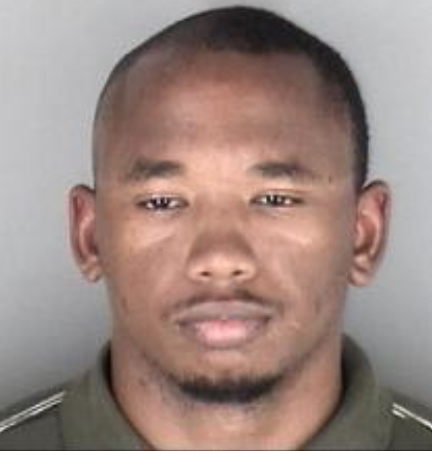
Keeling photo Shawnee Co.
On Tuesday, police were called 401 SW Jackson, the regional American Medical Response headquarters, where a 27-year-old woman had arrived seeking treatment for what appeared to be serious stab wounds to her back, according to Lt. Andrew Beightel.
AMR staff attended to the victim and she was quickly transported to an area hospital and is expected to survive. Based on information gleaned from the investigation, offices established that the suspect of this crime was a Joshua Keeling, 26, of Topeka.
Officers and investigators followed numerous leads that ultimately led them to Keeling’s location and he was apprehended near 7th and SW Topeka Blvd without further incident.
Keeling was then booked into the Shawnee Co Department of Corrections on requested charges of Attempted 2nd degree murder. Keeling has two previous convictions for aggravated battery and aggravated assault, according to the Kansas Department of Corrections.
KANSAS CITY, Mo. (AP) – In Kansas City’s first game after manager Ned Yost announced he will retire after the season, the lowly Royals burst to a six-run lead in the first three innings and beat the NL East champion Atlanta Braves 9-6 Tuesday night behind three hits and two RBIs from Nicky Lopez.
Yost, who turned 65 last month, was hired by the Royals in May 2010 and led Kansas City to consecutive AL pennants and the 2015 World Series title, the second in team history and first since 1985. The Royals are 58-100 in their third straight losing season.
Atlanta, assured it will start the NL Division Series at home on Oct. 3, is 96-62. The Braves need to win all four of their remaining games to reach 100 victories for first time since 2003.
Danny Duffy (7-6) allowed three runs and five hits in five innings, improving to 2-1 in his last six starts.
Julio Teheran (10-11) gave up six runs and six hits in 2 1/3 innings. He has lost three straight starts, giving up 14 earned runs in 11 1/3 innings.
Hunter Dozier hit a sacrifice fly in the first, and the Royals broke open the game with a five-run third that included Alex Gordon’s RBI single, Ryan O’Hearn’s sacrifice fly and a two-run double by Bubba Starling, who went to third on the throw home and scored when catcher Brian McCann’s throw to third went into left field for an error.
Francisco Cervelli and Ozzie Albies homered for the Braves.
Atlanta center fielder Ronald Acuna Jr. was removed after two innings as a precaution because of left hip tightness. Acuna leads the Braves with 41 homers and is three steals shy of 40.
TRAINER’S ROOM
Braves OF Ender Inciarte, out since Aug. 10 with a right hamstring strain, is expected to test his leg by running the bases Wednesday.
UP NEXT
Braves RHP Mike Soroka (13-4, 2.60 ERA) starts Wednesday’s finale of the two-game series against LHP Mike Montgomery (3-9).
HAYS – A big win for the TMP-Marian volleyball team Tuesday at Al Billinger Fieldhouse. The Monarchs knocked off previously unbeaten Smith Center in three. They won the first set 25-22, lost the second 12-25 then won a thrilling third 28-26.
Smith Center scored five early points and led the final set most of the way but failed to secure a pair of match points up 24-22.
The Monarchs then swept Oakley 25-10, 25-13 to run their win streak to nine straight matches. They are now 18-5 on the season.
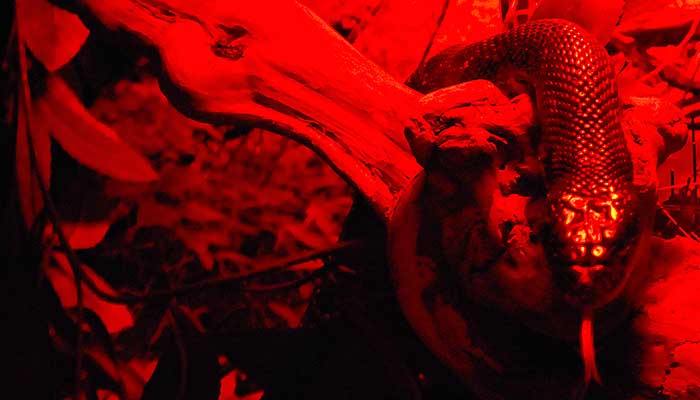
A western rat snake in its new habitat in the Nature at Night exhibit in the Sternberg Discovery Room.
By CRISTINA JANNEY
Hays Post
New habitats in the Sternberg’s Discovery Room.
The creatures in the Sternberg Museum have new homes thanks to a grant from McDonald’s.
The renovated space opened to the public Saturday.
The tanks were custom built for the animals they are holding.
The old tanks lids had to be secured with bricks. All of the new tanks have secure lids, which has allowed the staff to add a venomous copperhead to the main Discovery Room display area. Copperhead venom is used to study and treat breast cancer, Alicia Gaede, Sternberg naturalist, said.
Mice and a big brown bat, Buffy, were added to the Nature at Night exhibit. The main Discovery Room exhibit is focused on animals found on the prairie. Buffy was captured in a motel in Hays and could not be returned to the wild. Buffy has regular opportunities to fly in one of the Sternberg rooms that has no outlets for her to escape, Gaede said.
Gaede said she was hoping to add more small Plains mammals to the exhibit soon.
“It is a nice way for people to see what we have here in Kansas,” Gaede said.
A copperhead that is now on display in the Sternberg Discovery Room peaks its head out from underneath a leaf.
The staff used grant money to add photographs in the backgrounds of the tanks that resemble the native prairie habitats in which the animals live. New faux plants were also added.
New lights were added to the main exhibit areas, so the animals receive the correct UVB light.
New red lighting was added to the Nature at Night exhibit, which is better for the animals. The animals in the Nature at Night exhibit are nocturnal. They can’t see the red light. The crew at the Sternberg turns on the regular lights in that exhibit area at night. This switches the animals’ activity cycle, so they are active during the day when visitors are at the museum and are not active at night.
Alicia Gaede, Sternberg naturalist, holds a Great Plains rat snake at a Sternberg open house on Friday.
The most important aspect of the renovation is that the habitats are better for the animals.
“So far, they are loving it,” Gaede said of the animals. “They have been so active. They are rearranging stuff, digging holes and making new hiding spots.”
She added, “I think it is definitely better for the creatures, especially because they are getting bigger cages and good light that is going to keep them warm during the winter. They are also getting proper light to help them grow, which is sometimes an issue for animals in captivity.”
In the new configuration, some of the snakes have “roommates.”
“You wouldn’t really think of them needing social interaction, but it is one of those enrichment things. They smell each other, and it makes them react more, so it doesn’t stress them out as much. … If it is it is the opposite sex as well, they like that even if they are not mating. It is still just the pheromones that help them out to thrive better in captivity.”
Friday night the Discovery Room renovation was unveiled to museum members. Several animals were available for hands-on meet and greets. This included hissing cockroaches; pretzel, a Great Plains rat snake; Oreo, a California king snake; and Red, the American toad.
David Wolfe, volunteer, holds Red, the American toad, at a Sternberg open house on Friday.
The American toad and Great Plains rat snake are both native to Kansas.
“I hope people enjoy it,” Gaede said of the renovation. “We put a lot of work into it. It took us about a month to get them done. We did it seeking that our animals had a better life.”
Further renovation of the Discovery Room are planned using the rest of the $10,000 McDonald’s grant. Gaede said she hoped to divide the room into sections based on what lives underground, in a river and in the trees of the Plains.
Future additions may include a tree display, fish tank and ant farm.
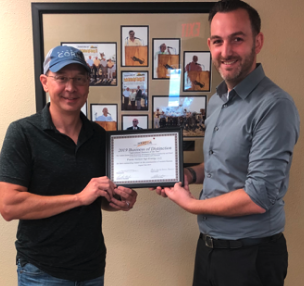
From left: Nick Poels, Executive Director Phillips County Economic Development, and Joe Kreutzer, Prairie Horizon CEO
PHILLIPSBURG — The western Kansas Rural Economic Development Alliance (wKREDA) awarded local ethanol plant, Prairie Horizon Agri-Energy, with the Agricultural Business of the Year award early this month. The annual Business of Distinction award program, is an initiative that commends western Kansas businesses of excellence.
Prairie Horizon Agri-Energy, established in 2006, produces over 40 million gallons of ethanol and grinds 14 million bushels of grain annually. In 2018, the ethanol plant added Fiber Separation Technology to the process, producing 38% Hi-Protein dry distillers, wet distillers grain and corn oil for livestock feed. A new 470,000 bushel steel bin was added to the existing two concrete silos allowing for more direct farmer purchases. Prairie Horizon’s USA Clean Fuels on East Highway 36 in Phillipsburg, KS offers higher blends of ethanol with options of E10, E15, E20, E30, and E85 along with clear diesel. “It was a great privilege to receive this award highlighting our role in the ag community,” said CEO, Joe Kreutzer.
wKREDA is a coalition of organizations and individuals across 55 counties in western Kansas who collectively pool their resources to work together for the common good of the region. Originally formed as a grassroots organization in 1994, wKREDA’s members maintain a collaborative affiliation with each other so that they are able to achieve both individual, and collective rural development goals.
Prairie Horizon Agri-Energy is a limited liability corporation, founded in November 2003 in the rural community of Phillipsburg, Kansas. The company is owned by 300 area investors and employs 36.
There may be something subtle going on here, that first meeting in several years in which the Kansas Board of Regents sat down with the Kansas State Board of Education for, well, just a little chatting.
That meeting brought together the nine Regents, who are appointed by the governor and subject to Senate confirmation, and the 10 members of the State Board of Education, who are elected to their offices.
While the overall responsibility of both groups is to provide a good education for Kansas students, it has generally in the past been sharply divided. The Regents works on everything after high school graduation, the State Board of Education nearly everything before that.
But they have rarely worked closely together on the entire concept of education in Kansas, producing young people who are ready for more education or who are learning job and social skills that will make those students just who we want walking down our streets, competing for parking spaces and living next door.
Last week’s meeting, in which the State Board of Education members were guests, produced some of the most identifiable indications that the two boards are interesting in working together, and some new members of each wondering why the boards haven’t been working more closely together.
That’s something we don’t often see between state agencies, which generally look after their own duties and cooperate only when two agencies find their duties overlap.
One of the more interesting discussions among Regents/Board of Education members was over allowing high school students—for free—to take a few college-level courses while in high school. Big interest in English/literature skills, but the concept generally comes down to letting middle and high school students get a taste of college-level classes to explore possible interests and eventually careers.
That dab of higher education at high school is both a confidence-builder for students who are from families without parents and other relatives with higher education experience and a way for those students who are interested in, say, teaching or construction or working in some other specialized industry a chance to see what is actually involved, and whether that is the way those kids whose drivers licenses are still new can look into their future.
Nothing like early focus, is there?
Oh, that cooperation between the State Board of Education and Regents is going to be a little tricky. Sorta like a first date.
Regent money generally is state aid plus tuition, while public schools are a mix of state aid and local property taxes. That local property tax is a major issue for public schools and casts its shadow on nearly everything that is considered by the State Board of Education and the Legislature that deals with public schools.
But the possibilities? Well, let’s see what would happen if the Regents and State Board of Education could come to a common ground for proposed legislation. We have the groups that oversee multiple school districts in each legislative district binding with Regents and other higher education institutions that aren’t universally present in all districts. That produces a statewide interest group that can appeal and lobby to every legislator in the state.
Pretty good potential political muscle…
Now it’s going to take time and formation of committees and such that education leaders tend to generate like weeds in a garden, but if there becomes an “educational establishment” that can reach out to every lawmaker and every Kansan…well, it’s likely we’ll see more interest in education from kindergarten to college degrees.
Interesting to see whether this cooperation actually takes place and what it yields…
Syndicated by Hawver News Company LLC of Topeka; Martin Hawver is publisher of Hawver’s Capitol Report—to learn more about this nonpartisan statewide political news service, visit the website at www.hawvernews.com
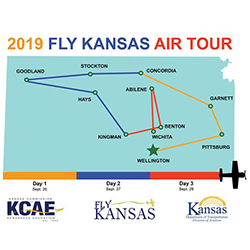
TOPEKA — The Kansas Department of Transportation’s Division of Aviation will host the sixth annual Fly Kansas Air Tour on Thursday through Saturday.
KDOT has partnered with the Kansas Commission on Aerospace Education to promote aviation and economic growth. Over 40 pilots have signed-up to fly the Kansas Air Tour this year. Participants will visit 11 communities across Kansas during the three-day tour, including Hays, Stockton and Goodland.
“Every Air Tour brings heightened enthusiasm as we celebrate the heartbeat of innovation that is so obvious across the aviation industry of Kansas,” said Bob Brock, KDOT Director of Aviation.
The tour focuses on STEM (Science, Technology, Engineering and Math) education. Highlights for this year include opportunities for students to learn from pilots, tour through aviation museums and local business fairs and view historic aircraft participating in the tour and on static display.
“Aviation is a profession we will cherish for a lifetime and we believe there is no higher calling than to share the spark of excitement that inspires hope for a bright future in all our Kansas youth,” said Lindsey Dreiling, President of Kansas Commission on Aerospace Education,
This year’s events take place in Wellington, Pittsburg, Garnett and Concordia on Thursday; Rooks County, Goodland, Hays and Kingman on Friday; and Benton, Abilene and Wichita on Saturday.
“Local airports improve the health of communities around the state of Kansas through vital emergency services and important economic development roles to residents,” said Julie Lorenz, Kansas Secretary of Transportation. “KDOT is pleased to work in tandem with its aviation partners to show the importance as well as the fun side of aviation with this annual air tour.”
WASHINGTON — House Speaker Nancy Pelosi Tuesday launched a formal impeachment inquiry against President Donald Trump, yielding to mounting pressure from fellow Democrats and plunging a deeply divided nation into an election year clash between Congress and the commander in chief.
Members of the Kansas congressional delegation have released statements on Pelosi’s move.
Democrats will stop at nothing to impeach our President. If only they devoted the last three years and energy to helping make American’s lives’ better…
I have long said that I trust my colleagues on the relevant House Committees as they conduct oversight and continue their investigations into the President, and I support this process continuing unimpeded. We must proceed down a path of finding the truth, regardless of politics.
Since the day after the 2016 election, Democrats have vowed to impeach President Trump and have spent more than two years searching for a reason to do it. Instead of impeachment, Congress should focus on priorities like the USMCA and accomplishing results for the American people.
The speaker put the matter in stark terms: “The actions of the Trump presidency revealed dishonorable facts of the president’s betrayal of his oath of office, betrayal of his national security and betrayal of the integrity of our elections.”
I love watching hawks hunt and I love observing how they’ve learned to interact with farm equipment as it rolls across fields and stirs up rodents and small birds that scurry about and often end up as a snack for the hawk.
Our raised deer blind overlooks a grass waterway that grows up in giant sunflowers and pigweed by summer’s end, becoming a nice secure travel way for deer, but making them hard to spot during hunting season. Today I mowed that area and as I mowed the last standing weeds and sunflowers, fat field mice scurried in every direction. “Man could the hawks be feasting here,” I thought.
A couple years ago I happened by a nearby field of soybeans being cut. What caught my eye was the enormous number of hawks all around the field; I counted to thirty-some then lost count. I rolled into the field and talked with one of the combine drivers about the hawks. He said they had suddenly appeared as if from nowhere when they started cutting and had been there since. The soybean plants were extra tall and thick that year, and as they ripened and dropped their foliage, it left several inches of duff covering the ground between the rows; perfect cover for field mice and rats looking for warm concealment. As the combines lumbered through the field, they forced all those rodents from their cozy quarters and the hawks were feasting.
Soon we will again be seeing an extraordinary number of hawks of all varieties as they migrate south toward warmer climates. The extent of our Kansas winter will largely determine whether they stay here for a spell or move on south, and our milder-than-normal winters of late have been a huge draw to migrating hawks. The hawks I observed hunting the soybean stubble field that year were obviously migrants that were getting a good meal whether they stayed or not. The vast acreages of new wheat fields will be a huge draw too, as mice, voles and insects become vulnerable to the hawk’s keen eyes in the short new wheat. Another plus is the type of air currents and thermals that blow through the plains states. North winds coming down from Canada are utilized by all types of hawks, saving them precious energy by being able to soar. So in summary, the mild winters, the open fields and the beneficial wind currents all make Kansas a popular place to see hawks of many varieties this time of year.
One common hawk we see here every winter is the Northern Harrier. They are large hawks with broad, square tails and are often seen gliding effortlessly mere feet above CRP fields and pastures. We also get an influx of Red Tails from northern states as they come here for our milder winters. Swainson Hawks on their way to Argentina stop in Kansas by the thousands. Rough-Legged Hawks migrate from Canada to the western US, including Kansas. Ferruginous Hawks may be seen here as they travel from Western Kansas to parts of the South Eastern US and to Florida. All these truly make for a kaleidoscope of raptors in our Kansas sky.
This article could not be complete without emphasizing the important role raptors play in our agricultural environment. Raptors get blamed for everything from low pheasant and quail populations to stealing chickens and everything in between. Yes we all know that hawks and especially owls will steal a chicken or two given the chance, but in actuality, hawks prey on mice, rats, snakes and possums that eat quail and pheasant eggs and newly hatched young.(FYI, feral and stray cats are the worst predators alive for killing young game birds and song birds.) Owls are huge rat and mice hunters and also eat skunks that carry rabies. If not for these raptors in our midst, rodent populations would devastate farmer’s crops and our environment as a whole. And for the record, killing a raptor of any kind is illegal in Kansas!
You can’t go afield this time of year without spotting hawks silently hunting low over patches of CRP and milo stalks, waiting patiently atop power poles for prey to reveal themselves or putting on shows of acrobatic excellence as they soar above us on the fall breezes. I once overheard a raptor rehabilitator tell someone “We as humans have encroached on them, so the least we can do is let them live with us.” Continue to Explore Kansas Outdoors!
Steve Gilliland, Inman, can be contacted by email at [email protected]
As October starts to arrive, our thoughts naturally turn towards crop harvest. But don’t forget, it’s also thistle time again. Even if they are hard to see, this is the time to control them.
Timing is everything. That’s particularly true with thistle control. And October to early November is one of the best times to use herbicides.
Did you have thistles this year? If so, walk out in those infected areas this week. Look close. I’ll bet you find many thistle seedlings. Most thistle seedlings this fall will be small, in a flat, rosette growth form, and they are very sensitive now to certain herbicides. So spray this fall and thistles will not be a big problem next year.
Several herbicides are effective and recommended for thistle control. Several newer herbicides like ForeFront, Milestone, and Chaparral work very well. Two other very effective herbicides are Tordon 22K and Grazon. Be careful with all these herbicides, but especially Tordon and Grazon, since they also can kill woody plants, including trees you might want to keep. 2,4-D also works well while it’s warm, but you will get better thistle control by using a little less 2,4-D and adding a small amount of dicamba to the mix.
Other herbicides also can control thistles in pastures – like Redeem, Cimarron, and Curtail. No matter which weed killer you use, though, be sure to read and follow label instructions, and be sure to spray on time.
Next year, avoid overgrazing your pastures so your grass stands get thicker and compete with any new weeds or thistle seedlings.
Give some thought now to thistle control during October and November. Your pastures can be cleaner next spring.
Alicia Boor is the Agriculture and Natural Resources agent for Barton County K-State Research and Extension. You can contact her by e-mail at [email protected] or calling 620-793-1910
The sculpture missing from downtown Salina has been located, according a facebook post from SculptureTour Salina. Authorities released no additional details.
————-
The sculpture Child’s Play is missing. Photo courtesy SculptureTour Salina
SALINA—A sculpture is missing from downtown Salina and SculptureTour Salina wants to know what happened.
According to a news release, Child’s Play, a bronze sculpture, went missing sometime between Sept. 13-16. It was last seen leaning against the building on the northwest corner of Iron Avenue and Santa Fe Avenue.
SculptureTour Salina was made aware that the sculpture was missing on Monday afternoon.
Child’s Play had been on exhibit in front of Wells Fargo since early May and was installed on a large concrete pedestal. The sculpture is 35 inches tall and weighs approximately 90 pounds. It is valued at $10,500.
SculptureTour Salina is offering a monetary reward for information that leads to the arrest of the person or persons who took the sculpture and to the recovery of the sculpture. Persons with information about this crime are urged to call the Salina Police Department at 785-826-7210.

 You Need a New Fortune Teller If