The Center for Health Improvement at HaysMed, part of The University of Kansas Health System, is offering a special Pre-K Kids in Motion for children ages 3-5.
Session 1 will be held from September 9 through October 23. Session 2 will be held from November 4 through December 8. Both sessions are on Mondays and Wednesdays from 11:30 a.m. to 12:15 p.m. and are held at The Center for Health Improvement’s Gymnasium at 2500 Canterbury Drive in Hays.
The program provides age appropriate indoor and outdoor activities designed to keep children active in a fun environment and develop and improve motor skills. Participants will enjoy time with friends and learn about health and fitness.
The fee is $48 for each session. Drop ins are welcome with a $4 fee per class. To register go to https://haysmed.clubautomation.com or call 623-5900. Registration is limited to 12 children.
For more questions or more information call 785-623-6309 or email [email protected].
WICHITA, Kan. (AP) — Hundreds of superstar hopefuls have auditioned in Wichita to appear on the television show “American Idol.”
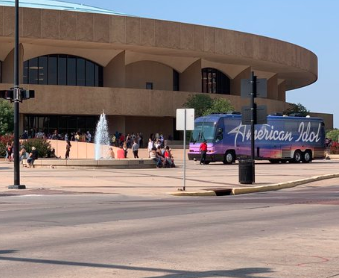
American Idol’s bus outside Century II in Wichita Wednesday-photo courtesy American Idol
The stop Wednesday in Wichita was the show’s first scouting visit to the city since it started 17 years ago.
Among those in line were hopefuls from Wichita, like Zephaniah Moore, an aspiring R&B singer who polled friends and family on Facebook about whether he should audition for “Idol.” They said he should.
Also in line was Sharane Calister, a 26-year-old singer from Des Moines, Iowa, who in the spring of 2018 placed 11th on another singing competition, NBC’s “The Voice.”
Those given the green light in Wichita will have to survive several more rounds before they get a chance to sing in front of the celebrity judges.
WICHITA, Kan. (AP) — Wichita plans to join a massive lawsuit against opioid makers, distributors and pharmacies.
The city council approved a law firm Tuesday to represent it in federal litigation in Ohio, where the flood of cases over the opioid epidemic is being handled. Attorney Andrew Hutton says the city’s complaint could be filed by the end of the week.
Hutton said in a statement that opioid manufacturers used deceptive marketing to maximize profits. He says doctors were convinced to prescribe opioids, not just for cancer patients or those recovering from surgery, but also for chronic-pain sufferers, despite the risk of addiction.
The city wants to be compensated for costs such as opioid-related emergency calls. At the county level, the Wichita area had 148 opioid-related deaths last year.
DECATUR COUNTY — Law enforcement authorities are investigating a suspect on drug charges after a traffic stop.
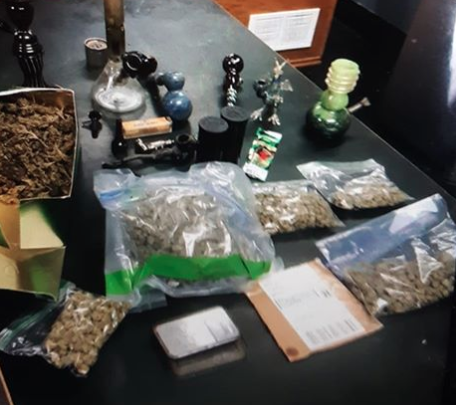
Photo Decatur County Sheriff
On Wednesday, the Decatur County Sheriff’s office reported they received information about a shipment of marijuana coming to a residence on west Sappa Street in the city limits of Oberlin, according to a social media report.
Surveillance was conducted over a 48 hour period on the residence. A search warrant was obtained and signed. The sheriffs office then conducted a controlled buy from the residence of 14 grams of marijuana and then conducted a felony car stop on the property owner’s car after leaving the residence.
Deputies recovered another 12 grams of marijuana during the search of the vehicle.
Upon conducting the search of the residence, deputies seized a large amount of drug paraphernalia, a pound and a half of marijuana and a scale used in the transactions.
Deputies arrested the owner of the residence. Charges are pending upon completion of the investigation, according to the sheriff’s department.
TOPEKA – Governor Laura Kelly announced the Governor’s Council on Medicaid Expansion Wednesday afternoon. This Council of legislators, policy experts, advocates, stakeholders and community leaders will spearhead the Medicaid expansion efforts in the 2020 legislative session.
The members of the Council and their current positions are listed below:
Tom Bell – President and CEO, Kansas Hospital Association
Sen. Ed Berger – State Senator, District 34
Rep. Susan Concannon – State Representative, District 107
Denise Cyzman – CEO, Community Care Network of Kansas
Ximena Garcia M.D., Community Health Advocate
Cathy Harding – President and CEO, Wyandotte Health Foundation
Rep. Don Hineman – State Representative, District 118
April Holman – Executive Director, Alliance for a Healthy Kansas
Dave Kerr, former president of the Kansas Senate
Kyle Kessler – Executive Director, Association of Community Mental Health Centers
Sen. Carolyn McGinn – State Senator, District 31
Rep. Monica Murnan – State Representative, District 3
Dr. Lee Norman – Secretary, Kansas Department of Health and Environment
David K. Livingston – CEO, Aetna Better Health of Kansas
Sen. Pat Pettey – State Senator, District 6
Rep. Jason Probst – State Representative, District 102
Jerry Slaughter – Interim Executive Director, Kansas Medical Society
Kevin Sparks – CEO, United Health Community Plan for Kansas
Michael Stephens – President and CEO, Sunflower Health Plan
Sen. Gene Suellentrop – State Senator, District 27
Suzanne Wikle – Senior Policy Analyst, Center for Law and Social Policy
Rep. Kathy Wolfe Moore – State Representative, District 36
SIDNEY, Neb. (AP) — Authorities say a Wyoming man died after his car collided with tanker truck on Interstate 80 in western Nebraska.
The crash occurred around 3 p.m. Tuesday, about 7 miles west of Sidney. The Nebraska State Patrol says 20-year-old Chance Seivley of Cheyenne, Wyoming, was headed west when his car ran off his lane and onto rumble strips. The patrol says Seivley overcorrected and crossed the median, striking the eastbound tanker truck driven by Monte Larson, 57, Salina.
Seivley was pronounced dead at the scene. Larson suffered only minor injuries, according to the Nebraska State Patrol.
A college freshman called up his mother and asked her for some money, because he was broke. His mother said, “Sure, sweetie. I will send you some money. You also left your calculus book here when you visited 2 weeks ago. Do you want me to send that up too?”
“Uhh, oh yeah, O.K.” responded the student.
So his mom wrapped up the book and mailed it. Dad asked, “Well how much did you give him?”
“Oh, I wrote 2 checks, one for $20, and the other for $500.”
“That’s $520!” said dad, “Are you crazy?”
“Don’t worry honey,” mom said. “I taped the $20 check to the cover of his book, but I put the $500 one somewhere in chapter 19!”
TOPEKA – The following remarks are from Kansas Governor Laura Kelly delivered Wednesday, September 4 at the press conference on Medicaid expansion:
“Good afternoon.
“It’s hard to believe, but in just four months, another legislative session will be upon us. Every legislative session offers its own unique set of challenges and opportunities, and 2020 will be no different.
“For the last several months I’ve been working with my administration to begin planning for the year ahead.
“Many of those plans are still in development, but one piece of my 2020 agenda is a certainty:
“I am going to do everything in my power to ensure this will be the year we will finally expand Medicaid in Kansas.
“When I traveled around the state last fall, Kansans made it clear that this is a high priority. They want as many Kansans as possible to have access to affordable, high-quality health care. They want our hospitals supported, and they want the jobs Medicaid expansion will bring.
“Medicaid expansion isn’t just a matter of smart health care policy. It is smart fiscal policy. It is smart economic policy. It is smart public policy.
“I’ve stood at this podium many times over the last year explaining why Medicaid expansion makes sense for Kansas. I won’t repeat those arguments again today.
“Instead, I’m here to talk about how we can finally bring this over the finish line.
“As you all are aware, I put forward a proposal to expand Medicaid on Kansas Day last year. I continue to believe that proposal was the simplest, most commonsense path forward – a plan that includes measures that promote self-sufficiency, a plan that includes safeguards to protect against exorbitant spending, and a plan that can be implemented effectively without undue costs or administrative burden.
“The House also took a position and passed a bill very similar to the one I offered, with very few amendments.
“And this fall, the Senate will finally begin its work on the interim committee to start drafting its own plan.
“This is finally a step in the right direction.
“But one thing concerns me as this work gets underway.
“Although Medicaid expansion has been at the top of voters’ minds for several years, the issue has received no formal committee review or vetting process in well over two years. Much has changed in that time, both federally and at the state level.
“For starters, we have a new President and, therefore, a new Centers for Medicare & Medicaid Services Administrator. The CMS administrator gets the final say on how states can amend their Medicaid systems.
“Obviously, we have a new governor, in addition to many recently-elected legislators who are diving into this issue for the first time. Several additional states have implemented expansion, with varying degrees of success, and an abundance of new data have been collected.
“The landscape has undeniably shifted. And the one benefit Kansas can leverage as a late-expansion state is the lessons learned from those who went before us. It is critical that we do this.
“To that end, today I will sign Executive Order 19-10, creating the Governor’s Council on Medicaid Expansion.
“The Council will bring together both new and veteran voices on Medicaid expansion and will be charged with supporting legislative efforts to find the best version of Medicaid expansion for Kansas.
“This Council will not develop or endorse new legislation. Rather, I’ve asked them to study the costs and benefits associated with expansion models in other states.
“It will be facilitated by a national, nonpartisan policy expert from the National Governors Association, and they will meet three times before the end of the year to explore these issues.
“By studying other state models for expansion, I am hoping we can avoid repeating some of the expensive, unnecessary mistakes made in other states.
“While I hope the Council will be able to identify 3 to 5 guideposts or goals for responsible expansion in Kansas, it will not develop new legislation.
“This Council will serve solely as an educational, transparent forum for public discussion, in a broader setting than can be achieved in an interim committee.
“These discussions will be an important supplement to legislative work that is already underway. The experiences of the 36 other states that already moved forward with expansion varied widely depending on what shape each state plan took – particularly in the early phases of implementation.
“That’s why this Council is necessary.
“We know not all models for expansion are created equal. We must carefully study other state approaches and outcomes so that our final Kansas plan balances our unique needs with evidence-based best practices.
“I want to thank every legislator, policy expert, advocate and community leader who has accepted our invitation. We want to hear everyone’s voice.
“We want a thorough, honest discussion.
“I am deeply committed to working with the Legislature to find a bipartisan solution. I want these Council members to ask the hard questions … to come up with a plan that works for all Kansans.
“It’s the only way to get things done, and done right.
“Let’s work together to figure out how we can best serve Kansans, get them the access they need to affordable health care, and bring Kansas dollars back to Kansas.
“I look forward to collaborating with this Council and to, finally, bring Medicaid expansion to Kansas.”
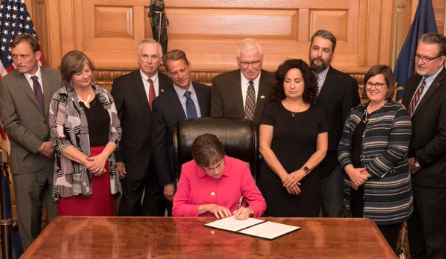
TOPEKA — Governor Laura Kelly announced the Governor’s Council on Medicaid Expansion Wednesday.
Governor Kelly signs the executive order Wednesday photo courtesy office of Kansas governor
This Council of legislators, policy experts, advocates, stakeholders and community leaders will spearhead the Medicaid expansion efforts in the 2020 legislative session.
The members of the Council and their current positions are listed below:
Tom Bell – President and CEO, Kansas Hospital Association
Sen. Ed Berger – State Senator, District 34
Rep. Susan Concannon – State Representative, District 107
Denise Cyzman – CEO, Community Care Network of Kansas
Ximena Garcia M.D., Community Health Advocate
Cathy Harding – President and CEO, Wyandotte Health Foundation
Rep. Don Hineman – State Representative, District 118
April Holman – Executive Director, Alliance for a Healthy Kansas
Dave Kerr, former president of the Kansas Senate
Kyle Kessler – Executive Director, Association of Community Mental Health Centers
Sen. Carolyn McGinn – State Senator, District 31
Rep. Monica Murnan – State Representative, District 3
Dr. Lee Norman – Secretary, Kansas Department of Health and Environment
David K. Livingston – CEO, Aetna Better Health of Kansas
Sen. Pat Pettey – State Senator, District 6
Rep. Jason Probst – State Representative, District 102
Jerry Slaughter – Interim Executive Director, Kansas Medical Society
Kevin Sparks – CEO, United Health Community Plan for Kansas
Michael Stephens – President and CEO, Sunflower Health Plan
Sen. Gene Suellentrop – State Senator, District 27
Suzanne Wikle – Senior Policy Analyst, Center for Law and Social Policy
Rep. Kathy Wolfe Moore – State Representative, District 36
The Governor delivered the following remarks Wednesday on Medicaid expansion:
It’s hard to believe, but in just four months, another legislative session will be upon us. Every legislative session offers its own unique set of challenges and opportunities, and 2020 will be no different.
For the last several months I’ve been working with my administration to begin planning for the year ahead.
Many of those plans are still in development, but one piece of my 2020 agenda is a certainty:
I am going to do everything in my power to ensure this will be the year we will finally expand Medicaid in Kansas.
When I traveled around the state last fall, Kansans made it clear that this is a high priority. They want as many Kansans as possible to have access to affordable, high-quality health care. They want our hospitals supported, and they want the jobs Medicaid expansion will bring.
Medicaid expansion isn’t just a matter of smart health care policy. It is smart fiscal policy. It is smart economic policy. It is smart public policy.
I’ve stood at this podium many times over the last year explaining why Medicaid expansion makes sense for Kansas. I won’t repeat those arguments again today.
Instead, I’m here to talk about how we can finally bring this over the finish line.
As you all are aware, I put forward a proposal to expand Medicaid on Kansas Day last year. I continue to believe that proposal was the simplest, most commonsense path forward – a plan that includes measures that promote self-sufficiency, a plan that includes safeguards to protect against exorbitant spending, and a plan that can be implemented effectively without undue costs or administrative burden.
The House also took a position and passed a bill very similar to the one I offered, with very few amendments.
And this fall, the Senate will finally begin its work on the interim committee to start drafting its own plan.
This is finally a step in the right direction.
But one thing concerns me as this work gets underway.
Although Medicaid expansion has been at the top of voters’ minds for several years, the issue has received no formal committee review or vetting process in well over two years. Much has changed in that time, both federally and at the state level.
For starters, we have a new President and, therefore, a new Centers for Medicare & Medicaid Services Administrator. The CMS administrator gets the final say on how states can amend their Medicaid systems.
Obviously, we have a new governor, in addition to many recently-elected legislators who are diving into this issue for the first time. Several additional states have implemented expansion, with varying degrees of success, and an abundance of new data have been collected.
The landscape has undeniably shifted. And the one benefit Kansas can leverage as a late-expansion state is the lessons learned from those who went before us. It is critical that we do this.
To that end, today I will sign Executive Order 19-10, creating the Governor’s Council on Medicaid Expansion.
The Council will bring together both new and veteran voices on Medicaid expansion and will be charged with supporting legislative efforts to find the best version of Medicaid expansion for Kansas.
This Council will not develop or endorse new legislation. Rather, I’ve asked them to study the costs and benefits associated with expansion models in other states.
It will be facilitated by a national, nonpartisan policy expert from the National Governors Association, and they will meet three times before the end of the year to explore these issues.
By studying other state models for expansion, I am hoping we can avoid repeating some of the expensive, unnecessary mistakes made in other states.
While I hope the Council will be able to identify 3 to 5 guideposts or goals for responsible expansion in Kansas, it will not develop new legislation.
This Council will serve solely as an educational, transparent forum for public discussion, in a broader setting than can be achieved in an interim committee.
These discussions will be an important supplement to legislative work that is already underway. The experiences of the 36 other states that already moved forward with expansion varied widely depending on what shape each state plan took – particularly in the early phases of implementation.
That’s why this Council is necessary.
We know not all models for expansion are created equal. We must carefully study other state approaches and outcomes so that our final Kansas plan balances our unique needs with evidence-based best practices.
I want to thank every legislator, policy expert, advocate and community leader who has accepted our invitation. We want to hear everyone’s voice.
We want a thorough, honest discussion.
I am deeply committed to working with the Legislature to find a bipartisan solution. I want these Council members to ask the hard questions … to come up with a plan that works for all Kansans.
It’s the only way to get things done, and done right.
Let’s work together to figure out how we can best serve Kansans, get them the access they need to affordable health care, and bring Kansas dollars back to Kansas.
I look forward to collaborating with this Council and to, finally, bring Medicaid expansion to Kansas.
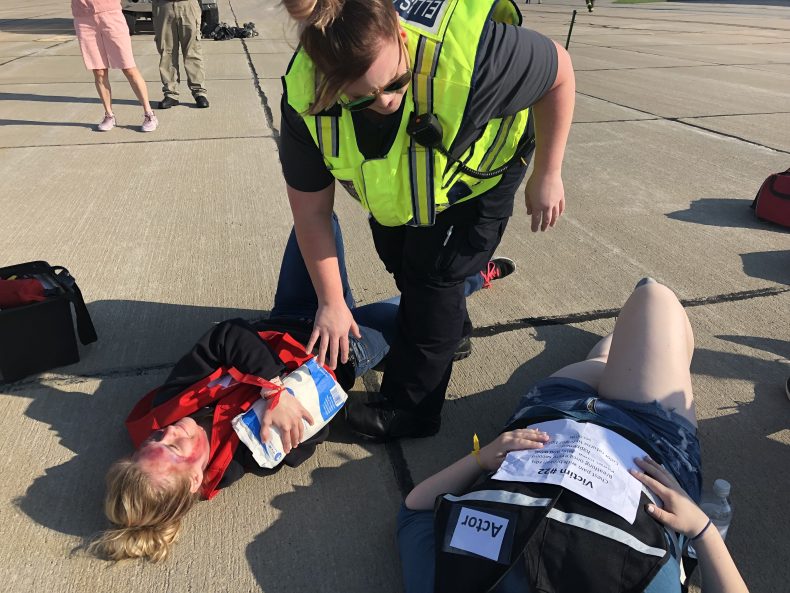
Ellis County EMS personnel triage volunteer plane crash victims during Wednesday’s drill at the Hays Regional Airport.
By BECKY KISER Hays Post
A drill for the emergency response to an airplane crash at the Hays Regional Airport won’t replicate such an incident exactly, but it comes close.
Emergency responders from throughout Ellis County participated in a full-scale exercise Wednesday morning at the airport.
Darin Myers, Ellis County Emergency Manager and Rural Fire Chief, along with Ryan Hagans, Hays Fire Chief, were the exercise directors.
Overall, things went well, Myers said.
“You can only have a pretend fire for so long before the pretend fire goes out. Then you move on to the next phase of evacuating the fuselage.”
The drill started at 9 a.m. and took a little more than 90 minutes. An actual airplane crash response would likely take longer.
“It may have taken us only 10 to 15 minutes down there, but in real life to move patients who are unable to walk like we did today, they would have to be carried out or drug out,” Myers said. “That would take a lot more time.”
Approximately 30 volunteers from the NCK-Tech College nursing program portrayed the injured passengers.
Each person wore a vest identifying them as an actor and also had a piece of paper with their symptoms written on it. Most actors were wearing red makeup to resemble blood flowing from their injuries. Some patients also had moulage kits applied to simulate wounds.
After they were triaged by Ellis County EMS personnel, four passengers were declared dead.
“I had no visible injuries,” said Kylie Watson, Topeka, “but I had a blank stare, couldn’t feel air movement and had no color to my fingertips. So they had to decide whether I was dead or not, which I was.”
Tyra Younie, Hays, portrayed a victim who had been decapitated.
“I wasn’t wearing any special makeup to indicate that. I just kind of slumped over and hid my face,” Younie said.
Alexa Brull, Catherine, had a head injury. “I was not responsive, not breathing, so I was tagged ‘black.’
The NCK-Tech students have been working with hospitalized “patients” in their classrooms. They found the response to casualties at an airplane crash to be quite different.
“It was very interesting to see how they coded each one of us and who they responded to first,” Watson said.
“We were all on the aircraft. They got to us pretty quick and were really good about prioritizing each victim and getting us off the plane.”
There were also individuals inside the airport terminal portraying distraught family members.
In yesterday’s exercise, a Hays USD 489 yellow school bus served as the airplane. Hays and Ellis County firefighters poured water on the simulated fire and smoke visible at the crash site off the south end of the airport apron.
The Hays airport is required by the Federal Aviation Administration to conduct such emergency exercises every three years.
Following the drill, all the participants gathered near the airport fire station and submitted their feedback in written form to Myers. Then each agency, observer and evaluator talked about what went well and what could have been done better.
Airport manager Jamie Salter and Hays Public Works Director Jesse Rohr
This was the first such exercise for airport manager Jamie Salter, who was appointed to the position in late February. “I felt like she did a great job,” said one observer.
In her series of contacts, Salter first notified Jesse Rohr, Hays public works director, then city management followed by the city’s Public Information Officer. Rohr was one of the on-site observers.
Hays Fire Department Captain Aaron Dome talked about the incident command post.
“We had a pretty good unified command between medical branch, law branch, and the airport. We were all face-to-face. It went pretty smooth on our end,” Dome said.
Site security was evaluated by Toby Prine, the Kansas Regional Emergency Management Coordinator for northwest Kansas who is based in Hays.
Toby Prine (left), NWKS Emergency Management Coordinator, evaluated site security during the Hays airport drill.
“About 9:04 a.m., Hays police started blocking access to the airport. At 9:16 a.m. they brought in mutual aide units like the sheriff’s department and Kansas Highway Patrol,” Prine reported.
“Later on they identified the hospital as a possible critical area with internal security at the hospital (HaysMed). The discussion was we need to keep that in the forefront in case they need additional law enforcement out there. Overall, they did a very good job,” he added.
Don Scheibler, Hays police chief, agreed.
“In this type of event, law enforcement’s primary job is to provide a safe and secure environment for you guys to do what you need to do,” Scheibler told the participants.
Ellis County EMS reported they were on scene for 40 minutes with all the critical patients transported within 20 minutes. SkyWest Airline personnel provided information to EMS on the number of passengers and crew which EMS used to determine whether they needed to request out-of-county ambulances.
A couple of concerns were noted by firefighters.
All the county’s fire trucks are paired with supplies according to the vehicles’ engine capability. “On scene we can split the crew, but we need to keep the equipment together,” said one rural firefighter.
Hays firefighters assist a patient into an ambulance.
“In that transition period when we went from operations fire-wise to EMS-wise on our end, we kind of ditched a crew down there. I knew Justin (firefighter Choitz) had it under control,” said Tyler Brungardt, HFD lieutenant. “I feel like that probably could have gone a little bit smoother.”
HaysMed Security Manager Mike Filley evaluated the performance of EMS and health support. “I’m going to talk to Kerry (McCue-Ellis County EMS/Health Services Director) a little more about it but, overall it was pretty good.”
An after-action report will be compiled and distributed with a summary of key information related to the evaluation along with plans for improvement.
Participating agencies were Hays Public Works, Fire, and Police Departments, Ellis County EMS, Fire and Emergency Management, and Sheriff Departments, Kansas Highway Patrol, Hays Aircraft, SkyWest Airlines, TSA, Hays Medical Center, EagleMed, and NCK-Tech College.
Contestants play weekly to earn points that culminate in a grand prize winner. Each week, the highest point total wins the weekly prize, Fort Hays State University football tickets.
The national grand prize winner will win a trip for two to Hawaii.