We have a brand new updated website! Click here to check it out!

Kansas first responders deployed to Florida for hurricane Dorian response

Multiple Kansas agencies are deploying first responders to Florida for Hurricane Dorian response efforts

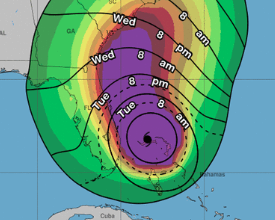
TOPEKA, Kan. – An Urban Search and Rescue (USAR) team comprised of members from multiple Kansas agencies has been deployed to Florida for Hurricane Dorian response efforts.

Kansas Task Force 1 (KS-TF1) has rostered a team of 42 first responders from across the state to assist with operations in Florida as catastrophic Hurricane Dorian makes its way closer to the east coast of the US.

The team left Sunday evening for an expected 14-day deployment in Florida. KS-TF1 will be taking qualified Emergency Management Accreditation Program (EMAP)-equivalent Type 3 USAR equipment, which includes floodwater/swiftwater equipment and full collapse rescue cache.

“History has shown us how important an immediate and effective emergency response is during catastrophic weather events when it comes to saving lives and property,” Governor Laura Kelly said. “We are sending an extremely trained and qualified group of Kansas first responders to assist the State of Florida as it faces this monstrous storm. It is my sincere hope that this team will provide the assistance needed in the safest way possible, and that they all return to Kansas as quickly and safely as possible.”

The team is prepared to search for and transport any people and animals stranded by rising storm surge and flood waters. They are also ready to provide basic life support and medical care, while supporting any other urban search and rescue efforts.


Full-scale emergency exercise will be Wednesday at Hays airport

A full-scale emergency exercise will be conducted at the Hays Regional Airport on Wednesday from approximately 9 to 11 a.m.

The intent of the exercise is to provide an assessment of the emergency response to an aircraft accident at the Hays Regional Airport.

Many entities within the community will participate in the exercise including the City of Hays Public Works, Fire, and Police Departments, the Ellis County EMS, Fire and Emergency Management, and Sheriff Departments, Kansas Highway Patrol, Hays Aircraft, SkyWest Airlines, TSA, Hays Medical Center, EagleMed, and NCK Tech College.

— City of Hays

Kan. man held on $1M bond for alleged sex crimes at home daycare

SHAWNEE COUNTY– Law enforcement authorities are investigating a Kansas man for sex crimes that are alleged to have occurred at a home daycare.

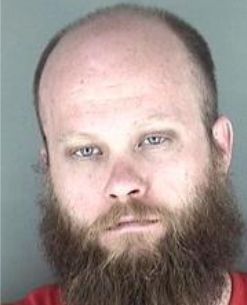
Kyle Scott photo Shawnee Co.

On Tuesday criminal charges were filed against Kyle Scott, 35, Topeka, for alleged sex crimes against a child, according to Shawnee County District’s office.

A three-year-old attending daycare at a home in the 5500 block of SW 18th Terrace in Topeka on August 21, reported the incident to family members who contacted police.

On August 22, police arrested Scott in Topeka on requested charges of aggravated indecent liberties with a child and lewd and lascivious conduct, according to the county attorney.

He is being held on a bond of $1 million and is scheduled for court on September 5, according to the county attorney.


Kansas City-area schools innovate to fill teacher vacancies

KANSAS CITY, Kan. (AP) — Kansas City-area schools are trying to remedy a critical teacher shortage looming as the new school year begins, including by placing unqualified educators into some classrooms.

Some school districts have been rehiring retired teachers, or training counselors and coaches to teach.

The profession’s infamous low pay combined with fewer people pursuing a teaching career have school districts scrambling to find qualified candidates, according to Paul Katnik, an assistant commissioner at the Missouri Department of Education.

About 11% of Missouri teaching positions are vacant every year. Last October, the Kansas Department of Education logged a 19% increase in teacher vacancies from a year earlier.

Some districts responded by filling slots with teachers who may be certified, but not to teach the subject they have been assigned. In Kansas, the state last year issued 333 “restricted licenses,” which allow more unqualified teachers into the classroom. The state issued 266 such licenses in 2017 and 162 in 2014.

“In special education, for example, school districts can’t find teachers, so they may have to hire paraprofessionals who don’t have full qualifications,” said Mark Tallman, an associate executive director with the Kansas Association of School Boards. “The No. 1 concern we hear is the staffing shortage. … Some districts literally can’t find anyone for a position.”

The challenge to find teachers is particularly daunting in special education, speech, math, science and music. The most severe shortage is in urban and rural districts, but some suburban areas have also been affected.

Missouri’s average starting teacher salary is one among the lowest in the nation at $31,842, according to the state education department. In Kansas, the average starting salary is $34,883. Both states’ average overall teacher salary is around $48,000.

In the tight labor market, Kansas schools have failed to offer competitive salaries, or salaries that keep up with inflation, Tallman said.

Teachers’ varied skills are in high demand and can land them higher-paying jobs, said Ann Jarrett, director of teaching and learning for the Missouri National Education Association.

Last year, Kansas lawmakers approved a $500 million increase in school funding. The Kansas Supreme Court ordered lawmakers to adjust the plan for inflation. And earlier this year, a bill added another $90 million per year for the next four years.

Lawsuit settled days before Kansas trial for man accused of terrorist gathering

WICHITA, Kan. (AP) — A court notice shows the federal lawsuit filed by a Muslim aerospace engineer has been settled days before the trial over allegations of discrimination stemming from a party at a Kansas lake.

The flag of Malaysia

The filing Friday in U.S. District Court does not detail settlement terms between Munir Zanial and the Spirit Boeing Employees Association. The trial that had been scheduled for Tuesday is cancelled.

The Malaysian national of Indian ancestry rented a pavilion at the group’s lake in 2017 to celebrate Malaysian Independence Day. The lawsuit alleges the association suspended his rental privileges and reported him to authorities.

It alleged an American flag had been desecrated by Islamic State group symbols. But the flag was actually a Malaysian flag and the guests included people of Malaysian Indian ancestry, some wearing hijabs.

Style show will stress fashion on a budget

Women wanting tips on how to dress stylishly on a limited budget won’t want to miss the “Second-Hand Rose Style Show” on Monday, Sept. 9, at the Hays After 5 Christian women’s meeting.

Models will feature the latest in fashions that they purchased for a fraction of the original cost at thrift shops, Goodwill, and garage sales. The fun evening will begin at 7 p.m. at the Rose Garden Banquet Hall, 2350 E. Eighth.

Local journalist Becky Kiser will emcee the style show. Kiser, who works for Eagle Communications, produces news for the Hays Post website and five Hays radio stations. She has also taught broadcast journalism classes at Fort Hays State University.

Also on the program will be inspirational speaker Donna Roth Hillis of Wichita. Hillis, a former corporate flight attendant and retired nurse, is now the board chair of the West Wichita YMCA.

In her talk titled “Shattered But Not Broken,” Hillis will share how an ordinary life can be transformed into something extraordinary.

All teachers in attendance at the program will be recognized.

Cost of the dinner program is $12.50. Reservations are required by Thursday, Sept. 5, to [email protected] or to (785) 202-1036. Hays After 5 is affiliated with Stonecroft Ministry of Overland Park.

– SUBMITTED –

TMP-M invites community to submit homecoming parade entries

TMP-M

The TMP-Marian Alumni Association invites the community to share in our Sept. 20, 2019  homecoming celebration with any entries they would like to add to further enhance our parade.

Any groups that are interested in participating in the parade need to contact the Alumni Office at TMP-Marian prior to September 13, 2019 at (785) 625-9434 or [email protected].

As a preventative safety precaution, candy will not be allowed to be thrown from any motor vehicle. All candy that is handed out must be done by participants that are walking along the parade route. This is a requirement by the Hays Police Department and it will be enforced beginning this year. Please comply with their request and help keep our children safe.

Kansas Sees A Path To Prosperity By Getting More Kids Into Child Care, Preschool

COFFEYVILLE, KANSAS — Preschool was a logistical boon for Delice Downing and an educational bonanza for her son, Adrian.

The head volleyball coach and director of student life at Coffeyville Community College had ruled out day care when she heard the price: several hundred dollars a week.

Then Adrian reached preschool age. Coffeyville offers something most Kansas communities don’t: free attendance at a preschool with room for nearly all kids in town whose parents want it.

About 200 3- and 4-year-olds attend the school district’s Early Learning Center either half or full-day.

About 200 children have access to preschool for free in Coffeyville, a town where one in five kids lives in poverty.
CREDIT CELIA LLOPIS-JEPSEN / KANSAS NEWS SERVICE

“I’m a coach. It’s impossible — we travel all the time,” Downing said. “So having him here these past two years has helped. … I know that he’s in good hands. He is safe.”

Quality options that keep kids safe and nurtured run in short supply in Kansas — and often break the bank. A run-of-the-mill day care can cost more than college. Preschools like Coffeyville’s require staff, space and money that many districts don’t have.

State officials want a solution.

Better access to child care and preschool would help more parents balance work and family, they say, maintain steady incomes and learn parenting skills. Kids would get the extra nurturing that strengthens their academics in the short-term and cuts crime and poverty down the road.

Some communities have forged ahead by splicing together school and Head Start funds, child care subsidies, grants, and gifts from philanthropists and local businesses. How many towns and cities can find similar paths?

Cornelia Stevens leads The Opportunity Project in Wichita, or TOP. It serves 600 mostly low-income kids ages one through five, largely for free.

“If you don’t have a safe place to take your child, you can’t work,” Stevens said. “And that’s a reality.”

Children practice writing their names at Coffeyville’s preschool.
CREDIT CELIA LLOPIS-JEPSEN / KANSAS NEWS SERVICE

Yet even TOP, one of the state’s most celebrated models for increasing early childhood education, can’t serve all the families that need it.

“We actually have conversations almost annually about, ‘OK, do we expand?’” Stevens said. “We’re trying to make sure first that we can really provide the level of support that’s needed to serve the children and families.”

Quality versus ‘nothingness’

During his two years at preschool, Adrian blossomed from a shy, quiet toddler into a talkative 5-year-old toting books home from the mini library and bubbling with stories for mom about teacher praise for his excellent napping skills.

“He says, ‘Mom, I’m the best sleeper,’” Downing chuckles. “I said, ‘OK, that’s good, son!’”

By the time he finished last May, Adrian had begun learning “sight words,” common written vocabulary.

Coffeyville’s Early Learning Center has a small library where preschoolers can borrow books to read with their parents.
CREDIT CELIA LLOPIS-JEPSEN / KANSAS NEWS SERVICE

“It’s a blessing,” Downing said. “It’s just been awesome.”

Coffeyville preschoolers learn how to open milk cartons and pick up lunch trays. At storytime, they explain to their teachers what words like “author” and “illustrator” mean.

At playtime, pouting and fits over who gets which toy dissipate when kids tick through their list of options with teachers. They can ask to trade toys, or to share. They can ask to use it next time.

“Is it OK to be angry?” teacher Aleisha Weimer prompted her 3- and 4-year-olds last May. “Yeah,” several replied. “We can’t scream,” one little boy added.

This is what early childhood researchers like to see: teachers who “scaffold,” helping children connect mental dots without doing all the work for them.

Don’t underestimate how much these social and emotional lessons pay off for academics, fellow teacher Lianakay Wilson said.

“If you’re mad, you’re not going to want to sit down and listen to a teacher talk ‘one, two, threes’ and ‘A, B, Cs,’” she said. “You’re stuck on whatever you’re mad about.”

Coffeyville preschoolers practice opening milk cartons. Meals are just one way they pick up motor skills.
CREDIT CELIA LLOPIS-JEPSEN / KANSAS NEWS SERVICE


To critics who say early childhood risks becoming too academic, the founder of the National Institute for Early Education Research at Rutgers University says the opposite remains true. Most facilities fall short of giving kids the stimulating surroundings where they thrive best.

“What we see is vast hours of nothingness,” Steven Barnett said. “Playtime that’s not engaged.”

Sure, children can spend a morning happily stacking blocks, he says. But they flex more social, analytical and vocabulary muscles if they chat with teachers about what they’re building, how and why.

Happy children, healthy brains

A stressed-out early life can hinder healthy brain development, researchers at Harvard say.

Maybe there’s violence at home or crime down the street. No decent grocery stores or doctor’s offices around. Mom and Dad live paycheck to paycheck. An eviction notice shows up on the door.

Good child care and preschool can boost baby brains even in tough conditions. Home-visit programs hone parenting knowhow to reinforce the effect.

But libertarians wary of ever-bigger and more costly government remain skeptical. They point to disappointing results in some studies that check preschoolers years later for academic gains, and call others unrigorous. The picture remains too fuzzy, they argue, to pour major public money into broad access to early childhood education.

Toys help kids learn letters and their sounds at the preschool in Coffeyville.
CREDIT CELIA LLOPIS-JEPSEN / KANSAS NEWS SERVICE


The U.S. Department of Education’s What Works Clearinghouse reviewed 40 studies on Head Start and tossed out 39 for falling short of its research standards.

But longitudinal studies have shown ample returns that transform people’s lives.

A famed Ypsilanti, Michigan, preschool project from the 1960s continues to spark fresh research and inspire interest from a new generation of academics still scrutinizing the lives of participants who are now in their mid-50s, and even the lives of their now-adult children.

“This program has helped in lifting multiple generations out of poverty — for sure,” said Ganesh Karapakula, a doctoral student in economics at Yale University who co-authored recent papers on the topic with Nobel laureate James Heckman at the University of Chicago Center for the Economics of Human Development.

The pair applied a “worst-case scenario” statistical analysis to see whether flaws in the Ypsilanti experiment — including small sample size and possible randomization errors — would explain away remarkable long-term outcomes that range from reductions in violent crime to more stable marriages and healthier bodies.

CREDIT CELIA LLOPIS-JEPSEN / KANSAS NEWS SERVICE

It didn’t.

“I did not expect that we would find these results,” Karapakula said. “That they would survive the worst-case analyses.”

Earlier this year, the Learning Policy Institute released a review of the most rigorous studies on early childhood programs. Overall, they showed benefits for early reading, math skills and more. Cost-benefit analyses consistently find preschool pays off.

Savings can come in the form of kids not repeating grades or needing special education. Or they finish high school, go to college. They stay out of jail and pour bigger paychecks better lives for their kids.

Policymakers should move past the question of whether early childhood programs work, the institute says, and focus instead on the difference between good and bad ones.

Supply, demand and more demand

Last year, Kansas scored a $4.4 million federal grant to pin down the state’s early childhood needs and chase down ideas for increasing quality and access.

Coffeyville businesses helped raise money for the town to offer more full-day preschool spots. Community leaders say preschool helps with economic development.
CREDIT CELIA LLOPIS-JEPSEN / KANSAS NEWS SERVICE


Officials from four state agencies that deal with early childhood health and education fanned out to hear from parents and others at scores of townhall-like meetings.

Over and over, parents and businesses described a dearth of options, or a fragmented patchwork of public programs that are difficult to navigate and stigmatized.

Tallies from the Rutgers institute suggest about one in 10 Kansas 3-year-olds get spots at public preschools, and about half of 4-year-olds do.

By contrast, Oklahoma serves slightly more of its 3-year-olds, and offers universal preschool for 4-year-olds.

Don’t expect Kansas to follow that recipe ⁠— and not just because of the money it would take. Child advocacy groups and state officials worry a state-funded statewide preschool program would sink day care centers that make ends meet by watching over babies and young kids.

Infant care could become harder to find, they fear, in a state where most counties already lack enough day care spots to serve kids whose parents work.

If not the Oklahoma way, then what?

The town of Coffeyville, population 10,000, lies just minutes by car from Oklahoma, which offers universal preschool.
CREDIT CELIA LLOPIS-JEPSEN / KANSAS NEWS SERVICE


Melissa Rooker made a name for herself spearheading efforts in the legislature to increase funding for public schools. Now she heads the Kansas Children’s Cabinet.

“We can’t depend on an answer coming entirely from the state budget or federal budget,” she said. “The idea is to embrace what we call ‘the mixed-delivery system.’”

Kansas aims to have a draft strategic plan in October, followed by more public meetings and a finalized list of recommendations by the end of the year.

What to expect? Officials want to blur the line between day care and education by promoting best practices for early learning wherever adults work with babies and kids.

“It doesn’t matter where,” Rooker said. “Every single environment that they are in is a learning environment.”

Though state-funded universal preschool is off the table, the plan could call for more funding, streamlined regulations, tweaks to statutes or program eligibility. It could highlight towns that raised money locally and coaxed matches out of foundations and businesses.

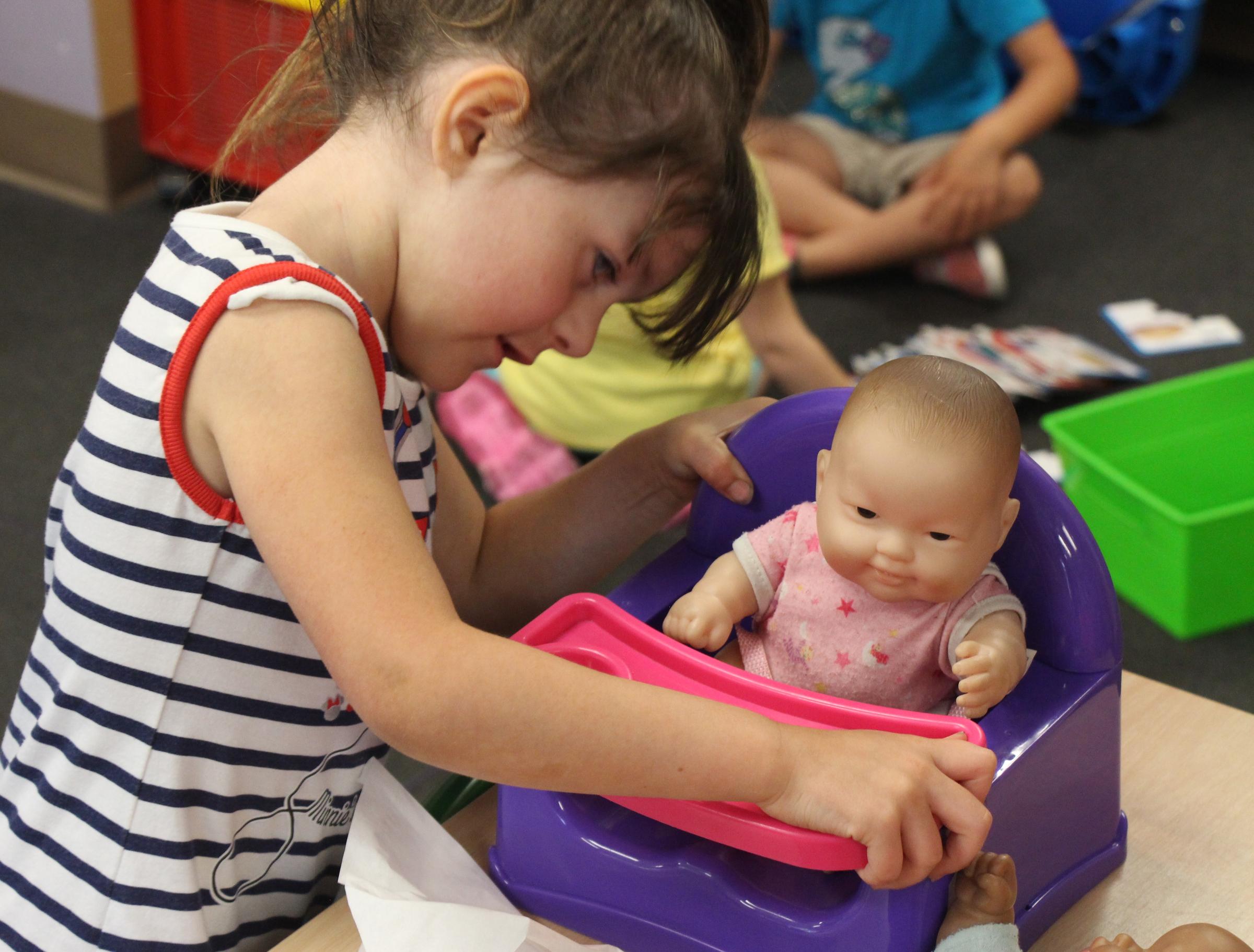
A Coffeyville preschooler pretends that a doll is feeling sick and that she is caring for it.
CREDIT CELIA LLOPIS-JEPSEN / KANSAS NEWS SERVICE


Scrutinizing how the state administers its myriad public early childhood programs and funding sources would reflect a national movement along similar lines.

Funders each set their own rules that can flummox parents and school districts alike. For preschools that mix and match, it can mean extra safety inspections or keeping at least a few kids on waitlists at all times, even when their goal is not to.

The Bipartisan Policy Center ranks Kansas one of the worst states in the country at integrating early childhood programs and other measures meant to improve options for families.

And child advocates have long faulted the state for questionable use of tobacco settlement dollars, welfare funding and other pots of money meant to help families. That’s ranged from leaving federal resources untapped to diverting family aid to plug state budget holes.

This month Kansas canceled a contract with a private company that it says spent welfare dollars flagged for childhood literacy on its owners instead.

Still, reviewing and streamlining programs may only get Kansas so far.

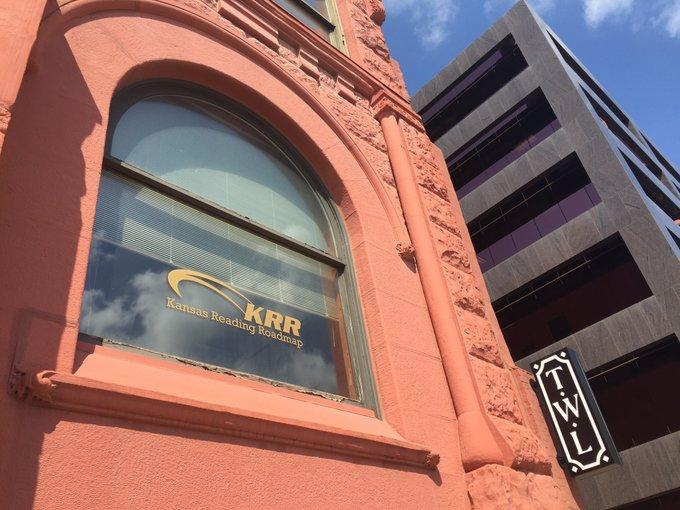
The Kansas Reading Roadmap office in Topeka. A company that runs the program lost its contract over alleged inappropriate spending of welfare dollars.
CREDIT CELIA LLOPIS-JEPSEN / KANSAS NEWS SERVICE


“People somehow think that there’s a lot of duplication … and that if we somehow blended and braided, we could serve more kids better,” he said. Maybe it could serve kids better, but serve much more of them? “That’s just wrong.”

For now, if Kansas doesn’t have the money to expand early childhood education significantly, he suggests focusing on communities with the most at stake. They offer the biggest bang for the buck.

In other words, don’t just tie help to low family incomes and spread limited dollars thin across Kansas. That leaves elementary schools without enough better-prepared children to revamp kindergartens and later grades. Preschoolers can end up rehashing what they’ve learned, and losing their gains.

Aim instead for critical masses of kindergarten-ready tykes in the poorest neighborhoods.

“It makes sense,” Barnett said. “Where are the highest concentrations of poverty? Let’s just knock them off (the list) one at a time as we can.”

Celia Llopis-Jepsen reports on consumer health and education for the Kansas News Service. You can follow her on Twitter @Celia_LJ or email her at celia (at) kcur (dot) org. 
Dust in the wind? KU prof develops methods to predict dust storms

Bing Pu, assistant professor of geography & atmospheric science at KU, has developed a long-range dust-prediction method her team used to accurately predict dustiness in the southwestern and central United States. (Credit: NOAA)

KU News Service

LAWRENCE — Southwestern Kansas in the 1930s saw some of the worst dust storms ever recorded in the U.S., when apocalyptic clouds of heavy dust terrified and even killed people, livestock and wildlife.

Long ago, farmers phased out the kinds of practices that brought about the Dust Bowl, but dust still can harm health, agriculture and transportation while exacerbating environmental problems. Indeed, dust storms may increase as climate change causes drier conditions. (The National Oceanic and Atmospheric Administration asserts windblown dust storms increased 240% from 1990 to 2011 in the southwestern United States.)

Today, a researcher at the University of Kansas has developed an advanced technique for forecasting dusty conditions months before they occur, promising transportation managers, climatologists and people suffering health issues much more time to prepare for dusty conditions. By contrast, common methods of predicting dust in the air only give a few days of advance warning.

Bing Pu

Bing Pu, assistant professor of geography & atmospheric science at KU, is lead author of a new paper in Geophysical Research Letters detailing a long-range dust-prediction method her team used to accurately predict dustiness in the southwestern and central United States.

“We use a statistical model constrained by observational data and the output of a state-of-the-art dynamic seasonal prediction model driven by observational information on Dec. 1,” Pu said. “We found using our method, we actually can give a skillful prediction for the dustiness in springtime, one of the dustiest seasons in the U.S., over the Southwestern and Great Plains regions — two of the dustiest areas in the U.S.”

Pu and her colleagues, Paul Ginoux and Sarah Kapnick of the NOAA Geophysical Fluid Dynamics Laboratory, and Xiaosong Yang of NOAA and the University Corporation for Atmospheric Research, were able to predict “variance,” or days when there was more or less dust in the air than average.

“Over the southwestern U.S., our model captured the variance of the dustiness over the time period from 2004 to 2016 by about 63%,” Pu said. “Over the Great Plans, about 71% of the variance is explained.”

Pu said factors influencing amounts of dust in the air can include surface winds, precipitation and amount of bareness of the landscape. These kinds of data were incorporated as key variables into the prediction model.

According to Pu and her collaborators, high levels of airborne dust can affect individual people, transport systems and agricultural production.

(a) Climatology (2004‐2016) of dust event frequency (%) in March‐April‐May (MAM), and anomaly (with reference to the climatology; %) in 2010 from (b) Moderate Resolution Imaging Spectroradiometer (MODIS), (c) prediction with En1 ensemble, (d) prediction with En2 ensemble, and anomalies averaged between 2011 and 2013 from (e) MODIS, (f) prediction with En1, and (g) prediction with En2. The dotted area indicates that at least eight out of the 12 ensemble members show the same sign as MODIS anomalies. Missing values are shaded in grey. The black boxes denote the averaging areas over the southwestern United States (box 1) and northern (box 2) and southern Great Plains (box 3). Pattern correlations (uncentered) between the predictions and MODIS over the southwestern United States (first) and the Great Plains (second) are shown in bottom left in blue. (Credit: Pu, et al )

“Small dust particles are very easily taken into your breathing system and then could cause lung diseases like asthma — and some studies suggest there might be some connection with lung cancers,” Pu said. “There’s a study finding dust storms are related to valley fever in Arizona as fungi can attach to dust particles. And when there’s a severe dust storm, visibility is reduced so it can increase car accidents on the highways. In 2013, there were severe dust storms in western Kansas that reduced visibility and caused problems for local traffic. In Arizona, when there’s a strong dust storm usually called a ‘haboob,’ the dust wall goes up to a few kilometers high, and this can affect airports —airports have to close due to the dust storms. Fortunately, these storms are moving quickly and dissipate after a few hours.”

Beyond safety for people, Pu’s team detail in their study how high dust levels can sway the environment as a whole.

“Dust particles absorb and scatter both solar and terrestrial radiation, thus affecting the local radiative budget and regional hydroclimate,” they wrote. “For instance, dust is found to amplify severe droughts in the United States by increasing atmospheric stability, to modulate the North American monsoon by heating the lower troposphere, and to accelerate snow melting and perturb runoff over the Upper Colorado River Basin by its deposition on snow.”

Pu said she hopes someday an organization or government agency could run the model she’s developed and issue seasonal dust predictions months in advance, especially if the potential for high levels of dust cause concern.

“Traffic systems and human health would benefit most from this long-term prediction ability about dust and air quality,” she said. “I think it would be great if an institute would try to give regular predictions of dustiness variations that could be helpful for airports or road traffic or transportation managers. Facilities could plan for times when there could be a lot of dust in the local area. It could even affect the plans of local farmers.”

For the time being, Pu aims to continue to refine the dust-prediction model to include atypical weather influences and human activity that could contribute to dust patterns.

“We want to continue to understand what other factors haven’t been explored in the seasonal variation of the dust,” she said. “For instance, those large-scale factors such as the El Niño-Southern Oscillation, and also anthropogenic factors, how people’s influence through agriculture or construction projects, might affect dust emission in the future. Of course, we want to also keep collaborating with people at NOAA GFDL to give dust predictions.”

Labor Day holiday changes trash collection schedule

CITY OF HAYS

Due to the observance of the Labor Day on Monday, September 2, 2019, refuse/recycling route collection schedules will be altered as follows:

Monday, September 2, 2019 and Tuesday, September 3, 2019 will be collected on Tuesday, September 3, 2019.

There will be no changes to Wednesday, September 4, Thursday, September 5, and Friday, September 6 routes.

Although collections may not occur on your normal day, collections will be completed by the week’s end. It is anticipated that heavy volumes of refuse/recyclables will be encountered around the holidays. Please make sure your polycarts and recyclables are out by 7:00 a.m., and keep in mind that the trucks have no set time schedule.

Hays customers that may have any questions regarding this notice should contact the Solid Waste Division of the Public Works Department at 628-7350.

Haag to join FHSU’s TILT program as training specialist

Haag
FHSU University Relations

Latisha Haag joined the Teaching Innovation and Learning Technologies staff at Fort Hays State University as the new faculty development training specialist.

Haag brings nearly 20 years of experience in professional development from a variety of educational settings and topics, ranging from public to private schools.

Recently she served as a teacher, librarian, and professional development committee chair for Thomas More Prep-Marian High School.

Haag earned her Bachelor of Science in education from Kansas Newman College and her Master of Science in communication studies from FHSU.

She has also taught as an adjunct virtual professor in communication studies for five years.

Copyright Eagle Radio | FCC Public Files | EEO Public File