We have a brand new updated website! Click here to check it out!

Housing costs, lack of local services leave mentally ill in nursing home ‘warehouses’

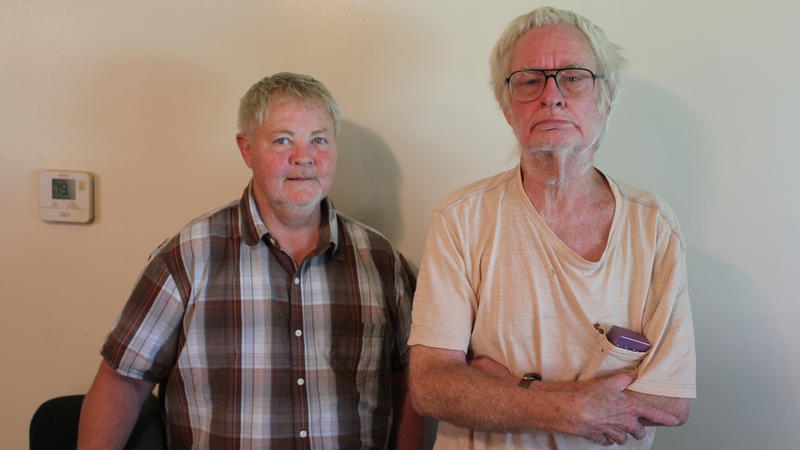
Dennis Ritchey, right, and the attorney who helped him find his way out of a mental health nursing home and on to a life of independent living. (Photos by Stephen Koranda)


Kansas News Service

VALLEY FALLS — Dennis Ritchey stands in the kitchen of his modest apartment. He calls it efficient, but likes that it has plenty of cabinets.

Most importantly, that kitchen and the rest of the one-bedroom place are his, and his alone. Much like his life more broadly.

His life now stands in sharp contrast to the six years he spent in one of the state’s 10 nursing facilities for mental health. He couldn’t set his own schedule or typically come and go as he pleased.

Now, things are different. He tends to bird feeders outside his apartment window and has freedoms he didn’t enjoy before.

“Eat what I want. Watch what I want on TV. Go to bed when I want to. Get up when I want to,” he said. “I’ve been doing great ever since I left.”

The nursing homes serve as sort of a midpoint between state mental hospitals for people with the most serious problems and community mental health centers for those who need far less help.

Those mid-way outposts in state’s mental health care system — privately owned, taxpayer-funded — have long been a source of concern. That’s partly because the job of looking after people dealing with bipolar disorder, schizophrenia and a range of other problems is inherently difficult. It’s balancing treatment with giving patients a chance to thrive on their own.

A recent report from the Disability Rights Center of Kansas suggests the nursing homes are failing the state’s mentally ill, essentially warehousing people rather than giving them what they need to move on to more independent lives.

The report argues that more people could be living at home and using community-based services. State officials and the nursing home industry see room for improvement but say it will take a more significant remake of the state’s mental health system.

Ritchey isn’t sure what diagnosis sent him to the nursing home in 2011. He’d hit a rough patch and landed in a homeless shelter and mental facility in Lawrence before going to the nursing home. At first, he thought his stay would be short.

“Ninety days went by. Six months. A year. Two years,” he said. “Nobody said nothing to me.”

He got out of the facility in 2017 with the help of Kip Elliot, an attorney with the Disability Rights Center of Kansas. Elliot serves on the board of the local animal shelter, and he helped Ritchey start volunteering and later working there.

Elliot knew that the nursing facility wasn’t the right place for Ritchey.

“When I met Dennis and started seeing him more,” Elliot said, “(there was) absolutely no reason for him to be there.”

Getting Ritchey out wasn’t easy. Elliot said some of that was difficulty working with the facility and the state. But the challenges included lining up the services Ritchey would need, such as an apartment and care for his diabetes.

“That’s one of our biggest issues,” Elliot said. “Community supports, what people need, housing. It’s just not there.”

An attorney for the company that owns the facility where Ritchey lived, Midwest Health, did not respond to a request for comment. The administrator of the Valley Falls facility initially agreed to show the home and comment on the report, but later didn’t respond.

‘Warehouses’

The Disability Rights Center of Kansas published the report calling the nursing homes warehouses. The group surveyed around half of the more than 600 residents of the homes, and 70% wanted to leave and find what support they needed on the outside.

Rocky Nichols

“It’s just a lack of imagination (that) has caused this to happen,” said Rocky Nichols, executive director of the center. “People go to these places. They get stuck in these institutions, and it becomes very difficult for them to get out.”

The report also argues the state is violating the law by institutionalizing people who could live on their own if they received services in the community.

“That’s the textbook definition of unnecessary institutionalization,” Nichols said.

But the head of the advocacy group that represents the mental health nursing homes contends the report doesn’t paint a fair picture.

Cindy Luxem

“These are not warehouses. These are people’s homes,” said Cindy Luxem, president and CEO of the Kansas Health Care Association. “They have no place else to go.”

There simply aren’t enough community-based services right now to take on people in the nursing homes, Luxem said.

She also wasn’t surprised by the survey results, because people often don’t want to live in nursing homes. But she said that doesn’t mean caregivers and family members would always agree that other places offer better results.

“Some of these are tied with not only mental health, but substance abuse issues,” she said. “They don’t have the wherewithal to be safe in the community.”

An alternative

Patrick Schmitz

Patrick Schmitz walks through mural-filled hallways at the Bert Nash Community Mental Health Center in Lawrence, where he’s the chief executive officer. The multi-colored paintings depict grassy rolling hills and colorful night skies. They’re meant to make the section for children more welcoming.

This facility offers a variety of treatments for conditions including depression, anxiety and childhood behavioral issues. They have about 20 spots in a long-term residential program, but most of the 5,000 people they serve annually are on an outpatient basis.

“The vast majority of people we treat are everyday people out in our community who come here for an hour of service,” he said. “(They) go back to work, go back to home.”

Schmitz calls those community-based facilities the front door to the mental health care system. They evaluate people in crisis and help route them to the correct services. They offer treatment as well as assistance with life skills and help navigating government programs.

The Disability Rights Center argues more people should be removed from the nursing homes and instead served at facilities like this one.

Funding for the state’s 26 community mental health centers dropped almost by half over a decade before creeping up in recent years, the report shows.

Even when budgets for those community facilities got cut deeply, funding for nursing homes went up.

“The disparity in how Kansas supports institutions versus community-based services is downright shocking,” the DRC wrote in the report.

A broader approach

There’s a common theme when talking to people about this issue. Community-based mental health services exist, but there’s a lack of availability in certain areas and a persistent shortage of housing needed for people leaving the nursing homes.

“This has to be tackled from a system-wide perspective,” said Shawn Sullivan, a former official in the administration of governors Sam Brownback and Jeff Colyer. Sullivan is now vice president at Mission Health Communities.

Mission Health oversees five of the nursing facilities in Kansas, and he agrees improvements are needed. They need to focus more on discharge planning and preparing residents with life skills so they can leave. But, there must be places for them to go.

“The number one challenge is a lack of affordable housing,” he said. “It’s just not there in a lot of parts of the state. And the places where there is affordable housing, then there may not be the services.”

Tight funding for community mental health centers in recent years has led to longer waits to see patients. It’s also sometimes meant cuts to programs or trouble recruiting and retaining staff.

The centers are ready to take part in a larger change to the mental health system, said Kyle Kessler, executive director of the Association of Community Mental Health Centers of Kansas. However, they can’t take on patients from the nursing homes without additional funding to go with it.

“To do anything within existing resources would mean we were taking from some other need,” Kessler said. “We need to identify additional funding.”

Kessler said expanding Medicaid is one of those steps. It would bolster the budgets of community mental health centers because they’d treat fewer uninsured people. Expansion supporters so far haven’t advanced an expansion bill through the Legislature.

The state is pursuing a waiver that would allow for Medicaid funding to flow to the mental health nursing homes. That could, in turn, jumpstart programs that offer job assistance or other services to help people move out of the facilities. In addition, recent changes mean Medicaid funding could be used for needed housing services.

Laura Howard, the secretary of both the Department for Children and Families and the Kansas Department for Aging and Disability Services, said the state needs to make progress on changes that make it easier for people to live somewhere besides nursing homes.

“The last thing that I would want to do,” she said, “is encourage us to move too quickly and not have the services and supports in place for the individuals.”

Stephen Koranda is Statehouse reporter for Kansas Public Radio and the Kansas News Service, a collaboration of KCUR, Kansas Public Radio, KMUW and High Plains Public Radio covering health, education and politics. Follow him on Twitter @kprkoranda or email [email protected].

FHSU’s Robbins Ambassador scholarship recipients announced

FHSU University Relations

The W.R. and Yvonne Robbins College of Business and Entrepreneurship at Fort Hays State University has selected Abbie Schneider, Chappell, Neb., and Avary Huff, Topeka, as the recipients of the 2019-2020 Robbins Ambassador Scholarship awards.

“This is the second time we’ve awarded this scholarship, and it is proving to be a great example of investing in students that pay dividends,” said Dr. Melissa Hunsicker Walburn, interim dean of the Robbins College.

“Prospective students relate to the stories and experiences of current students in powerful ways.”

The scholarships are for any Robbins College of Business and Entrepreneurship undergraduate student exemplifying leadership, academic excellence, extracurricular involvement and a desire to serve FHSU.

Schneider is a junior majoring in human resource management. She is involved in Alpha Kappa Psi, and the Society for Human Resource Management and sits on the executive board of both organizations. Schneider plans to earn a Master of Professional Studies in human resource management. After college, she would like to work in training and development.

Huff is a junior majoring in tourism and hospitality management. She is a member of Delta Zeta sorority and serves as historian and lamp editor. Huff is a student ambassador in the Admissions Office and will be a VIP Ambassador for the 2019-2020 school year.

“FHSU has become my home, giving me opportunities to grow personally and professionally,” said Huff. “I am excited to share about the growth occurring and opportunities available at FHSU.”

Robbins Ambassadors may represent students and the college at events including Tiger Friends and Family Day, student recognition programs, college dinners with alumni and at the annual Robbins College Scholarship Reception.

Ambassadors will attend, participate and network in approximately 12 to 15 events during the academic year.

“The Robbins Ambassadors understand the questions and viewpoints of prospective students, or new FHSU students, because not long ago they were in the same position of evaluating their higher education choices and how to make the most of their educational experiences,” said Hunsicker Walburn.

These awards are possible through the continued support of W.R. and Yvonne Robbins, for whom the Robbins College of Business and Entrepreneurship is named. W.R. Robbins is an alumnus of Fort Hays State.

“I am so excited about our two students selected for these honored scholarships,” said W.R. Robbins. “They will be a positive representation of our university.”

“We congratulate Avary and Abbie in their selection, and we’re excited for their commitment to serve this important role in the upcoming year,” said Hunsicker Walburn.

To learn how to establish a scholarship at Fort Hays State, contact the FHSU Foundation at 785-628-5620 or [email protected]. Learn more about the FHSU Foundation by visiting https://foundation.fhsu.edu.

Hays youth orchestra to begin season

Shawn Demuth

FHSU University Relations

The Hays Youth Orchestra’s fall season will start up at 10:30 a.m. on Saturday, Sept. 7, in Fort Hays State University’s Malloy Hall for an orientation meeting.

All students between sixth and eighth grade who play the violin, viola, cello or bass are welcome to attend.

Younger students are also welcome to participate with the approval of the director. Older students are invited to participate as assistants and mentors.

Shawn Demuth will serve as this year’s conductor. He is a graduate of the FHSU Department of Music. He plays the violin and piano, composes music and teaches music at USD 388 in Ellis.

“We’re looking at doing fun but challenging music,” said Demuth. “My goal is to bring young musicians together to help build relationships and to increase their passion for music.”

Rehearsals are on Saturday mornings starting in September, with performances scheduled for December and May.

Students interested in playing are should contact Demuth at [email protected] for an application form or additional details.

The Hays Youth Orchestra Program is supported in part by the Hays Symphony Guild, which believes that nurturing the joy of musical performance in today’s youth is critical to developing strong and skilled performers for tomorrow.

1-year-old Kansas boy dies after struck by a minivan

CALDWELL COUNTY, Mo. — One person died in in an accident just before 6:30p.m. Saturday in Caldwell County.

The Missouri State Highway Patrol reported a 2018 Chrysler Pacifica driven by Caitlyn Galloway, 32, Overland Park, was eastbound in a driveway on private property on Southwest Ore Road eight miles east of Lathrop.

The vehicle struck 1-year-old Elijah J. Galloway of Overland Park. Caldwell County EMS transported the boy to Liberty Hospital where he died.

Authorities released no additional details late Saturday

FIRST FIVE: Back to school — and religion is on the syllabus?

Benjamin P. Marcus

By BENJAMIN MARCUS
Freedom Forum Institute

When children return to school over the next few weeks, should they find religion on the syllabus? It may surprise some, but a significant majority of Americans — including public school teachers — say yes.

Seventy-five percent of teachers believe public schools should offer a comparative religion elective, with 69 percent of parents saying the same. There is no meaningful political or ideological gap in support of such courses.

Fifty-four percent of teachers think public schools should offer a Bible studies elective; 61 percent of parents agree.

Those findings — from the 2019 PDK (Phi Delta Kappan) poll, a well-respected annual survey of public opinion about K-12 education — should encourage Americans concerned about religious illiteracy in this country.

Religious literacy advocates now have the law, educators and public opinion on their side. The U.S. Supreme Court went out of its way in 1963 to affirm that the study of religion is constitutional. Leading education organizations have affirmed the court’s sentiment that a “complete” education requires students to learn about religion and its relationship with social, political and cultural life. And now PDK shows that more than three-quarters of Americans want religious studies courses in schools.

So why aren’t more schools teaching about religion? The PDK poll provides a clue: fear of indoctrination. Thirty-eight percent of Americans are very or somewhat concerned that “Bible studies classes might improperly promote Judeo-Christian religious beliefs.” Notably, while 82 percent of evangelicals and 78 percent of Republicans favor such courses, only 51 percent of Democrats and 43 percent of liberals support Bible studies.

Fears are somewhat less pronounced for comparative religion classes. Twenty-seven percent of Americans are very or somewhat concerned such courses “might improperly encourage students to change their religious beliefs.” Concerns are highest among evangelicals, 37 percent of whom fear that a comparative religion course might lead a student to “question their family’s faith.”

Yet evidence shows teaching about religion, when done well, will not make students more or less religious; it will make students more likely to support the rights of others, including those with whom they strongly disagree.

We do not have to imagine what it means to teach about religion well. Over the past decade, education and religious studies groups have offered concrete guidance. The National Council for the Social Studies released national guidelines in 2017 for the study of religion. Earlier this year, the organization released a new book solely dedicated to the study of religion in the social studies classroom. Before that, the American Academy of Religion and the Society of Biblical Literature — the largest professional associations for scholars of religion and the Bible — published recommendations for teaching about religion and sacred texts without preaching. And the Religious Freedom Center offers written resources and online professional development modules for teachers and administrators focused on the practical application of religious studies and the First Amendment in the classroom.

We even have examples of strong, standalone religious studies courses in practice. For example, John Camardella, a teacher at Prospect High School in Illinois, has received national attention for his incredibly popular and well-respected religious studies courses for high school students. (In fact, the courses became so popular in the community that parents demanded that Camardella offer a parent-only version of the course once a month in the evening.)

Despite strong guidance and encouraging course models, Americans are wary of required religious studies courses. Again, fear of indoctrination may play a role. The PDK poll shows that only 12 percent of teachers and 7 percent of parents would favor a required comparative religion course. Even fewer teachers and parents — 4 percent and 7 percent, respectively — favor a required Bible studies course.

But religious literacy is necessary, not optional, for the health of our democracy. The American Academy of Religion has argued compellingly that religious illiteracy can reinforce bigotry and prejudice that fuel violence against marginalized communities.

Given today’s increasingly diverse religious landscape and rising religion-related hate crimes, we need to ensure that all children learn about religion in school. Schools without the capacity to offer a required standalone course about religion should integrate the study of religion into social studies and literature courses. Indeed, how can educators teach about history or literature well without some mention of religious individuals’ and communities’ roles in shaping the world around them?

Of course, mandatory religious literacy education would require better training for teachers. Right now, teachers receive very little, if any, training in religious studies. It’s a problem that can lead to unconstitutional or unsound lessons, which further stoke fears of indoctrination.

To ensure educators teach about religion without violating the First Amendment, education institutions should require all teachers-in-training to learn about religion before they set foot in a classroom. We would not let a physics teacher lead a physics class without some knowledge of math. Why would we let a history teacher offer a history course without some knowledge of religion?

Thanks to the PDK poll, we know that public opinion supports elective education about religion. Let’s take it one step further. Put religion on the syllabus — for students and teachers alike.

Benjamin P. Marcus is religious literacy specialist at the Religious Freedom Center of the Freedom Forum Institute. His email address is: [email protected].

Copyright Eagle Radio | FCC Public Files | EEO Public File