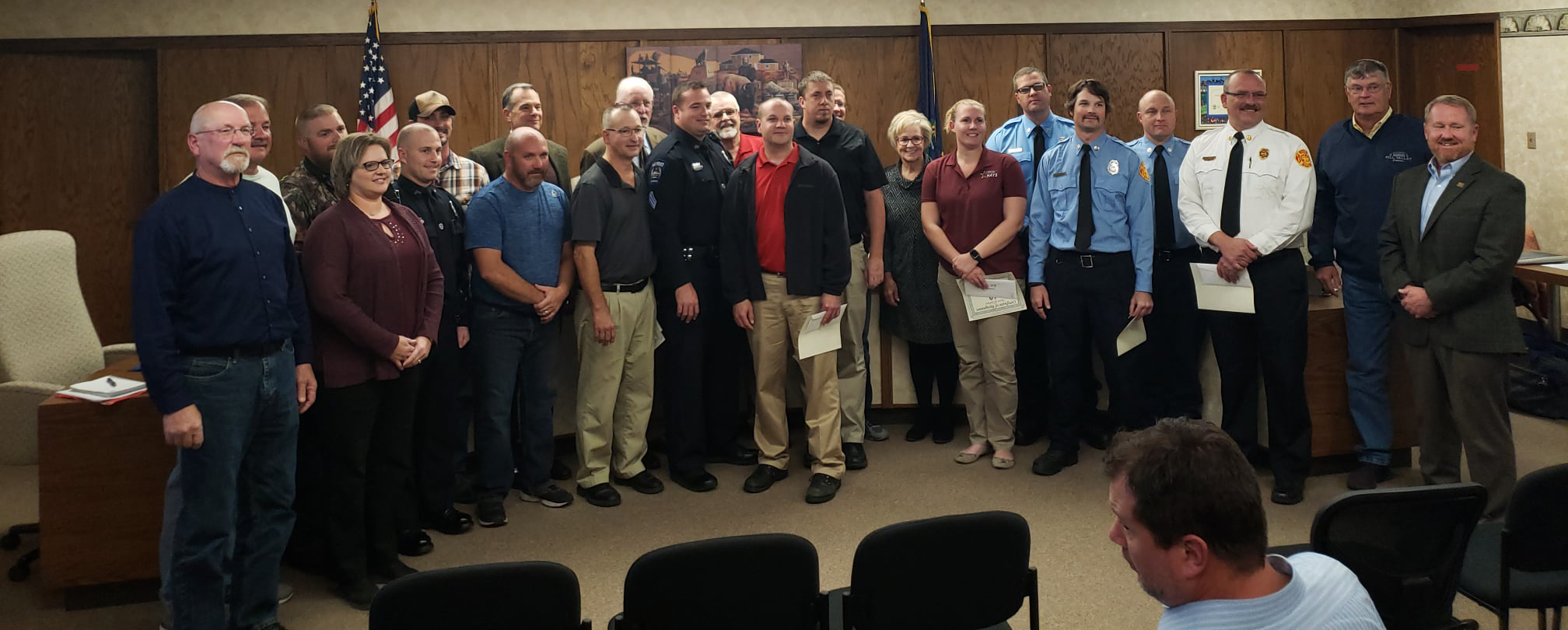
Employee service awards were presented Thursday evening by Hays Mayor Henry Schwaller to city employees who have been employed for 5, 10, 15, 20, or 25 years.
The employees were also thanked by city commissioners and City Manager Toby Dougherty.
City of Hays 2019 Employee Service Awards
5-Year Awards Dave Gillan – Dave started his career with the City as a Police Officer. Two years later, Dave was promoted to Police Corporal. Jason Riegel – Jason first joined the City as the Water Conservation Specialist. In 2017 he was promoted to his current position of Water Reclamation and Reuse Superintendent. Jayson Dinkel – Jayson rejoined the City as a Dispatcher in 2014. He was later promoted to Lead Dispatcher. Kevin Kamphaus – Kevin has served his five years with the City as the Superintendent for the Golf Course. Matt Schmidt – Matt is currently a Part-Time Maintenance Worker for Water Resources. Stefan Gildemeister – Stefan began his employment as a Hays Police Officer. In 2019 he was promoted to a Master Police Officer. Tanner Pabst – Tanner started as a Volunteer Firefighter and became a FullTime Firefighter two years later.
10-Year Awards Chris Hancock – Chris began his career as a Part-Time Police Officer with the City. One month later, he was promoted to a Full-Time Police Officer. In 2014, he was once again promoted to Police Corporal and took his newest title as Police Sergeant in 2016.
Code-enforcer Chris Rorabaugh is congratulated by Sandy Jacobs, Hays city commissioner. (Photo by Hays Post)
Chris Rorabaugh – Chris has served the City the last ten years as a Part-Time Code Enforcer. Clayton Unruh – Clayton has worked his ten years at the Chetolah Creek Water Reclamation & Reuse Facility. He started as a Plant Operator and moved up to his current role, Senior Plant Operator. Dustin Anderson – Dustin started his career as a Maintenance Worker I for the Service Division. Dustin continues to work for the Service Division and is currently a Senior Maintenance Worker. Kelli Sprague – Kelli joined the City as a Dispatcher. Two years later she became a Records Clerk with the Hays Police Department. Kolleen Dome – Kolleen began employment with the City as a Records Clerk for the Hays Police Department. In 2019 she took on a new role as the Municipal Court Clerk. Mike Windholz – Mike was hired by the City as a Maintenance Worker I for the Parks Department. He was promoted to Maintenance Worker II in 2011 and then to Park Technician in 2014. Tom Mai – Tom has served the City as an Information Technology Technician for the last 10 years.
15-Year Awards Brandon Zimmerman – Brandon began as a Volunteer Firefighter for the Hays Fire Department. A year later he moved to a Full-Time Firefighter position. In 2019 he was promoted to Senior Firefighter. Justin Choitz – Currently a Senior Firefighter, Justin started with the Hays Fire Department as a Volunteer Firefighter. In 2005 he joined the department full time as a Firefighter. Linda Bixenman – Linda has served the Planning, Inspection, and Enforcement Division for the last 15 years as their Administrative Assistant.
Hays Fire Lt. Luke Scoby with Mayor Henry Schwaller (Photo by Hays Post)
Luke Scoby – Luke was hired by the City as a Volunteer Firefighter. He became a Full-Time Firefighter in 2005. In 2011, Luke was promoted to his current role of Fire Lieutenant. Myron Dreiling – Myron began his career with the City in 2004 as a Firefighter. In 2019 he was promoted to Senior Fire Fighter. Ryan Hagans –Over the course of Ryan’s 15 years with the Hays Fire Department, he has served as a Fire Lieutenant, Fire Captain, Deputy Fire Chief, and his current position, Fire Chief.
20-Year Awards Mark Lang – Mark was hired by the City as a Plant Trainee for the Wastewater Division in 1999. During his tenure, he was promoted to Plant Operator I in 2000 and Senior Plant Operator a year later. Aaron Larson – Aaron joined the Hays Police Department as a Dispatcher. A year later he was promoted to a Police Officer and has held multiple roles as a Law Enforcement Officer for the City of Hays including, Uniformed Investigator, Detective, and his current role, Detective Sergeant. Tessa Scheck – Tessa started with the City as an Office Clerk for the Water Resources Department. She currently serves as that department’s Administrative Assistant. Steve Schmidtberger – Steve was employed by the City 20 years ago as a Plant Trainee in the Water Plant. Shortly after he was promoted to Plant Operator I and two years later was promoted to his current position Senior Plant Operator.
25-Year Awards Steve Dreiling – Steve began his career as a Refuse Collector in 1994. He has also served as a Maintenance Worker I for the Service Division, a Truck Driver for the Solid Waste Division and a Refuse Equipment Driver which was reclassified to his current position Solid Waste Senior Maintenance Worker.
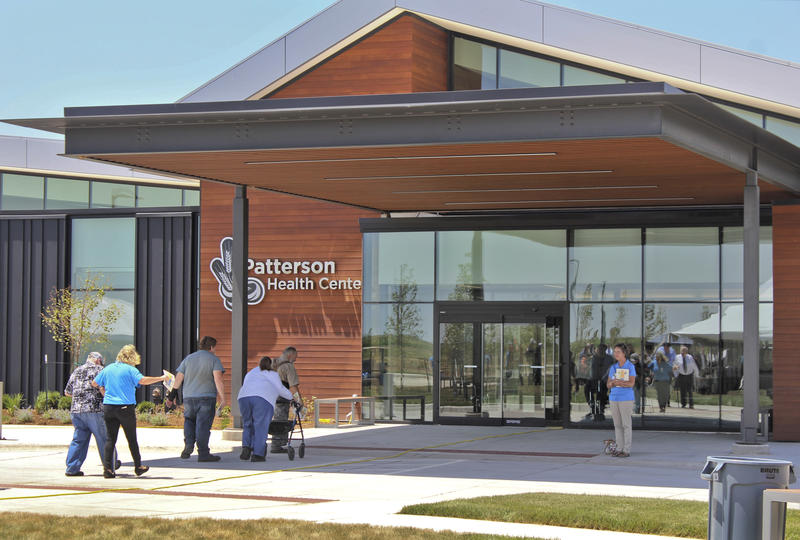
The Patterson Health Center opened only after the surrounding communities decided to shut down their competing, failing hospitals. And only with a large grant that insisted the communities team up. Chris Neal / For the Kansas News Service
ANTHONY — Few things signal a rural community’s decline more powerfully than the closure of its hospital.
Like shuttered schools and empty Main Streets, an abandoned hospital serves as a tangible reminder of the erosive power of decades of population loss and unrelenting economic trends.
“Our rural communities are challenged and, because of that, our small hospitals are challenged as well,” said Tom Bell, the head of the Kansas Hospital Association. “It’s sort of a chicken-and-egg thing.”
More than 80% of the state’s rural hospitals run at a loss, said Brock Slabach, a senior vice president of the National Rural Health Association.
“The operational difficulties (for rural hospitals) in our state are particularly problematic,” he said in a presentation to Kansas lawmakers earlier this year.
Shrinking populations mean fewer patients. Those who remain are typically older, poorer and sicker, making them more expensive to treat. Many people in rural areas also lack health insurance.
In some southwest Kansas counties, the uninsured rate approaches 19%, more than twice the statewide rate of 8.5%, according to the Kaiser Family Foundation.
Mismanagement along with state and federal policies also figure in the mix. Congress ordered cuts in Medicare payments in 2011 to trim the federal deficit and Kansas lawmakers have rejected the expansion of Medicaid the last several years.
People who run small hospitals argue expansion would provide coverage to thousands of low-income rural Kansans who now can’t afford to pay their medical bills.
Facilities known as Medicare Critical Access Hospitals are particularly vulnerable. Limited to 25 patient beds, they were designed in the 1990s to survive in remote areas. Kansas has more of them — 82 — than only Texas and Iowa.
Until recently, two of the state’s endangered small hospitals sat in the neighboring towns of Anthony and Harper in south-central Kansas.
Federal rules restrict the location of those specially designated hospitals, requiring them to be at least 35 miles apart. But the hospital districts in Anthony and Harper got waivers allowing them to establish competing facilities just 10 miles apart.
In 2014, with both hospitals in serious financial trouble, consultants proposed a merger. A long-simmering rivalry triggered by a fight over the county seat in the 1870s made that a tough sell, said Martha Hadsall. She headed the Anthony hospital board.
Martha Hadsall played a key role on getting people in Anthony and Harper to join forces for a new hospital, and abandoning hopes for keeping one solely for their own town. Credit Chris Neal / For the Kansas News Service
“I would describe one of our first joint board meetings as a junior high dance,” Hadsall said. “We sat on opposite sides of the room and stared at each other.”
Then came a windfall. With strings attached.
The late Neal Patterson was a native of Harper County. He went on to make millions after founding Kansas City-based digital medical recordkeeper Cerner Corp. He promised to pay much of the cost of a new, state-of-the-art hospital — if the two towns agreed to share a single facility.
Hadsall, a resident of Anthony and a longtime elementary school teacher in Harper, used Patterson’s offer and trust she had built in both communities to keep the boards talking. It took about a year, but the rival sides agreed that a merger was the only way to keep any hospital going.
Still, the idea remained a tough sell with residents of both communities.
In a 2015 interview with the Kansas News Service, Harper resident Bonnie June Day said the people pushing for a merger should just “leave Harper alone.”
“Our hospital is doing fine without being consolidated with them (Anthony),” she said.
To move public opinion, Hadsall said, the boards called residents of both communities to a meeting at the high school they had shared since consolidation in 1971.
They shared the hospitals’ balance sheets and provided an estimate of how much property taxes would need to go up to fill the gap between revenue and expenses.
By the end of the meeting, Hadsall said, most of those in attendance were nodding “‘yes’ to what the boards had chosen to do.”
Shortly after that, Harper voters dissolved their hospital district.
On a scorching day this past July, the communities came together to celebrate the opening of the Patterson Health Center, a $41 million facility built between Anthony and Harper next to Chaparral High School.
People from the sometimes-rival towns of Anthony and Harper got together to celebrate the opening of a hospital they now share. Credit Jim McLean / Kansas News Service
Lindsey Patterson Smith, Neal Patterson’s daughter and the head of the Patterson Family Foundation, acknowledged that most communities with struggling hospitals don’t have a millionaire to rescue them. Still, she said, “we’ve learned a lot” that could benefit other towns looking for ways to collaborate.
“We want to take some lessons from it and go out and see what is going to work in another community,” she said.
Bell, the head of the state hospital association, said he thinks the ongoing threat to rural hospitals has made rural Kansans open to new ideas. That included, he said, the possibility of rethinking, maybe even shrinking, those critical access hospitals that Kansas has so many of.
“What that hospital looks like in the future may not be exactly what it looks like today,” Bell said.
The hospital association wants federal regulators to let Kansas experiment in rural areas, perhaps with something between a clinic and a hospital. Those facilities might offer emergency and out-patient care, but not the kind of around-the-clock care needed by critically ill patients.
Small hospitals, many of which average fewer than two patients a day, can no longer afford to maintain wings of rarely used in-patient beds, Bell said.
Rural hospitals rely heavily on Medicare. Often, more than half of their patients are 65 or older. Without special waivers from Washington, Medicare money wouldn’t be available to subsidize that niche between a doctor’s clinic and an multi-bed hospital.
A room in the Patterson Health Center, where a millionaire’s grant and a compromise of two towns came together. Credit Chris Neal / For the Kansas News Service
Kansas hospital administrators are also among the biggest advocates for Medicaid expansion. It could draw in nearly $1 billion a year in additonal federal tax dollars to the state. Most of that would flow to the state’s urban and suburban hospitals. Still, some rural hospitals could benefit even more because the dollars they received would constitute a bigger share of their budgets.
“It would play a very important role in stabilizing the finances of those rural hospitals,” said April Holman, director of the Alliance for a Healthy Kansas, a pro-expansion lobbying group funded by several Kansas-based health foundations, including those that help support the Kansas News Service.
Research, Holman said, shows that hospitals in the 36 states and the District of Columbia that have expanded Medicaid eligibility are six times less likely to close than hospitals in non-expansion states.
Two legislative committees and a task force appointed by Democratic Gov. Laura Kelly are working on expansion plans ahead of the 2020 session that begins in January.
At least one of those approaches is being crafted to appeal to conservative Republicans who — fearing they no longer have the votes to stop expansion — want a less costly plan to consider.
Among other things, it would restrict Medicaid enrollment to Kansans who make too little to qualify for the federal subsidies that all-but-cover the cost of private coverage in the Affordable Care Act marketplace. But it would create state subsidies to cover those in the gap.
The effort to save struggling rural hospitals is as much about the economies of small towns as it the health of people who live in them.
Research offers a mixed picture on the impact of hospital closures on health. Some studies say when people are forced to travel longer distances, they often fail to get care that prevents nagging health problems from becoming more serious. Lack of ready access to emergency and obstetric services can also put people at risk.
But broadly speaking, studies haven’t found that the closure of a hospital leads to a measurable decline in people’s health.
However, the economic impact can be profound. Rural economists at Kansas State University recently calculated that every dollar of hospital income generates 59 cents for other businesses in a community..
So, when a hospital shuts down, towns get poorer. Per-capita income goes down and unemployment rates go up.
This is the fourth in a series of stories investigating the decline in rural Kansas and efforts to reverse it.
Support for this season of “My Fellow Kansans” was provided by the United Methodist Health Ministry Fund, working to improve the health and wholeness of Kansans since 1986 through funding innovative ideas and sparking conversations in the health community. Learn more at healthfund.org.
Jim McLean is the senior correspondent for the Kansas News Service, a collaboration of KCUR, Kansas Public Radio, KMUW and High Plains Public Radio covering health, education and politics. You can reach him on Twitter @jmcleanks or email [email protected].
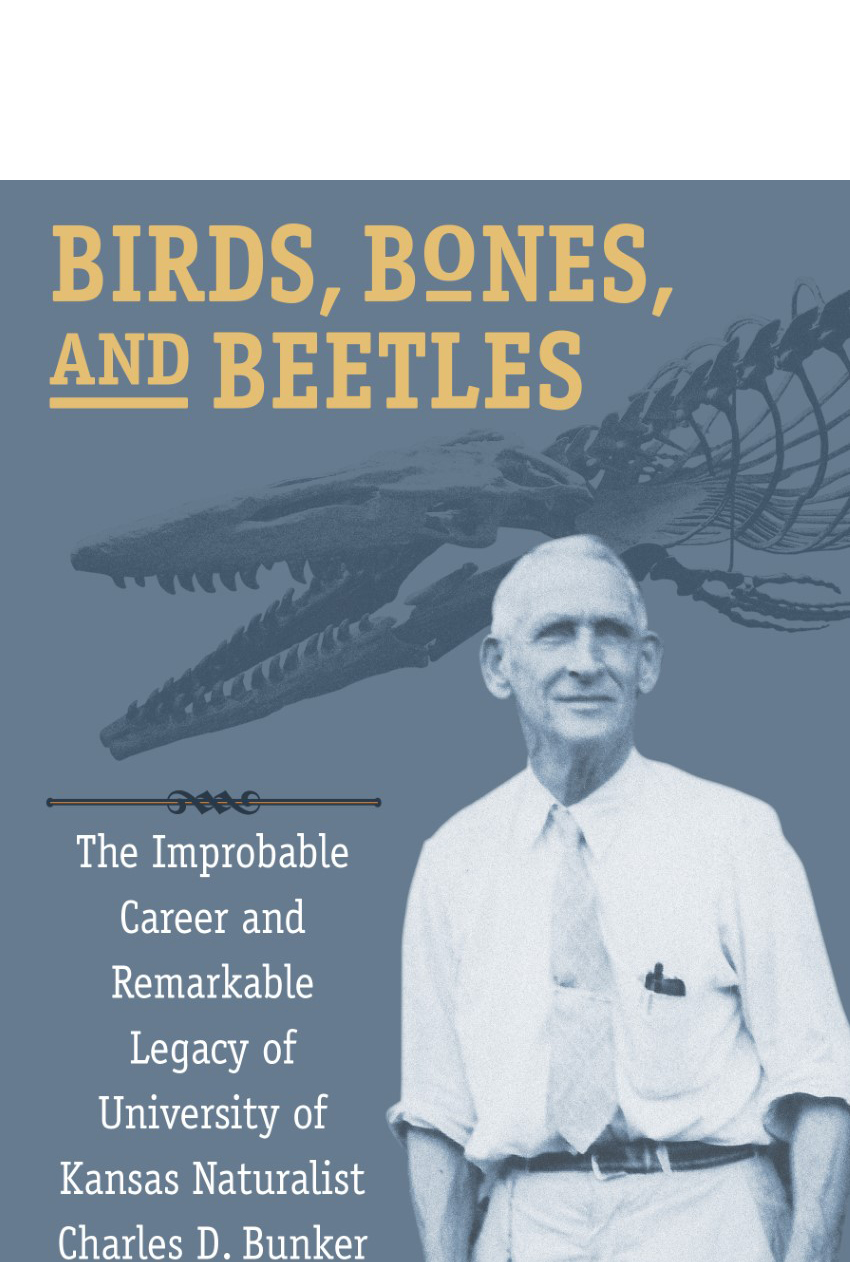
Come out to the Sternberg Museum of Natural History on Sunday, Nov. 3 at 1:30 p.m. to meet Chuck Warner. He will be discussing his new book “Birds, Bones, and Beetles: The Improbable Career and Remarkable Legacy of University of Kansas Naturalist Charles D. Bunker.”
The book spans the life and accomplishments of an early pioneer and naturalist at the University of Kansas Natural History Museum, who had important ties to the fossil fields of western Kansas.
Following Bunker’s field notes and university and community records, Chuck Warner wrote “Birds, Bones, and Beetles” about the extraordinary life of his grandfather, Charles Bunker. Bunker’s long career at the KU Natural History Museum began in 1895 as a lowly taxidermist.
Despite being naturally shy and possessing only an 8th-grade education, he went on to serve as the curator of the collections of birds and mammals for 35 years. His contributions include extensive work on the original installation of Panorama at the museum, developing a process to utilize beetles to efficiently clean skeleton for the museum collection, and training generations of students who went on to highly successful careers at prestigious institutions across the country.
This book was published by the University Press of Kansas in May of 2019 and has already received a recommendation from the Association of College and Research Libraries, a division of the American Library Association. This review will be published in the November 2019 CHOICE Connect and will recommend the book as “a valuable resource for those interested in the history of science.”
GRANT COUNTY — Two people died in an accident just before 12:30p.m. Saturday in Grant County.
The Kansas Highway Patrol reported a 2007 Kenworth truck was westbound on Grant County Road 10 three miles north of U.S. 160. The driver failed to yield right of way to a southbound 2012 Chevy Silverado driven by Kevin Jay Coyle, 57, Turpin, Oklahoma, at the uncontrolled intersection. The Kenworth entered the intersection directly into the path of the Silverado.
Coyle and a passenger Gerald Lee Coyle, 81, Turpin, Oklahoma, were pronounced dead at the scene and transported to Garnands Funeral Home. They were not wearing seat belts, according to the KHP. The KHP has not released the name of the Kenworth truck.
LAWRENCE – Those on the political left who play fast and loose with the term “hacked,” as in “Russia hacked the 2016 presidential election,” are aiding the Kremlin in its mission of undermining Americans’ faith in the democratic process, two University of Kansas researchers write in a new scholarly paper.
This dispiriting discourse threatens to discourage voting in 2020, contend the co-authors, Brett Bricker, assistant specialist and assistant director of debate in the Department of Communication Studies, and Jacob Justice, doctoral student and fellow debate coach.
Their article titled “Hacked: Defining the 2016 Presidential Election in the Liberal Media” was published in the fall edition of Rhetoric & Public Affairs. In it, Bricker and Justice cite the intelligence community consensus that while Russia hacked into Democratic National Committee computers and used that information in its 2016 influence campaign against Hillary Clinton, no electronic ballots were changed by computer hacking.
Definitional arguments have great salience going forward, they wrote.
“Our country is having a debate about how to define what Russia did in the 2016 election,” Justice said. “On the one side, we’ve got conservatives, who would probably define it as not very much at all — that the 2016 election was not about Russia as much as it was about Trump winning because of a smart campaign. Then we’ve got an intelligence community that says Russia intervened in the election in these very specific ways … And then on the left end of the spectrum, there’s a vocal and influential group of people who define what Russia did as a hack — that they hacked our election or they hacked American democracy.”
Defining social-media disinformation campaigns as hacking “introduces further haziness into a debate that is already rife with misinformation,” Bricker and Justice wrote.
“If we adopt this broad definition,” Justice said, “not just that the Democratic Party was hacked, but that the entire nation or our democracy was threatened by Russia — that could do Putin’s work for him by convincing the public that our democracy has been irreparably harmed, or that their votes not going to be counted because the Russians can change voting results with the push of a button.”
The authors lay the blame for this problem at the feet of the liberal media, which they define as media that liberals consume, including the Washington Post, CNN and MSNBC.
They wrote, “We demonstrate that the insular nature of much of the liberal media … enabled the spread of this misleading definition. Through a rhetorical analysis of texts defining Russia’s influence campaign as ‘hacking,’ we demonstrate that Twitter and the publications produced by the liberal media were highly influential in creating the widespread notion that Russia ‘hacked’ the election.”
The authors cite Malcolm Nance’s book, “The Plot to Hack America,” published just days before the 2016 election, as “influential in shaping popular understandings of the Russian influence campaign” ever since.
Bricker and Justice assert four negative consequences of defining Russian behavior broadly as hacking.
“First, this definition contributes to the already endemic problem of misinformation about the issue,” they wrote. “Second, defining Russia’s interference as a ‘hack’ has the potential to unduly limit the range of policy remedies considered to address the problem of electoral interference. Third, broad definitions of Russia’s interference as an attack on the nation risks militarizing dialogue on the issue, with dangerous consequences for United States-Russia relations. Fourth, such wanton declarations that the election was ‘hacked’ may discourage electoral participation by leading voters to conclude that the system of democracy itself is illegitimate and broken.”
The authors cite polls showing that large minorities of Democratic voters believe that Russians actually changed voting-machine tallies to help elect Donald Trump. It is widely recognized that conservatives circulate conspiracy theories in the Trump era, but what is alarming, according to the authors, is that a similar dynamic is present among liberals.
“If progressive forces aim to be champions of reasoned decision making,” the authors wrote, “they must avoid engaging in the very behavior that they criticize by propagating the misleading notion that ‘Russia hacked the election.’ The willingness of trusted figures in the liberal media and elected officials to participate in the perfunctory spread of this definition is disturbing.”
They wrote, “Without rebuke, conspiratorial thinking may become increasingly mainstream” and that “(s)uch a development has deleterious effects on democracy in the United States, raising the prospect that politics could become a permanently ‘fact-free’ affair as both sides of the political spectrum prioritize short-term political benefits over the long-term health of the nation’s public discourse.”
LAWRENCE, Kan. (AP) — Douglas Coleman fumbled on a blocked field goal return with two seconds to go and Liam Jones capitalized with a 32-yard field goal to give Kansas a 37-34 win over Texas Tech on Saturday night.
Nick McCann blocked Jones’ 40-yard attempt and the ball landed in the hands of Coleman, who ran to his left before attempting a lateral that did not touch another Tech player. Kansas regained possession and Jones sealed their first Big 12 win of the season.
Kansas (3-5, 1-4 Big 12) overcome an early three-possession deficit — and the ejection of team captain Bryce Tornedon for targeting.
Trailing 17-0 midway through the second quarter, the Jayhawks rallied heading into halftime, cutting the deficit to 17-14 as Carter Stanley rushed into the end zone to get Kansas on the board and then connected with Stephon Robinson for a 48-yard touchdown the following drive.
Stanley fueled the Jayhawk victory with 415 yards passing and four total touchdowns. Stephon Robinson Jr. caught six passes for 186 yards and two touchdowns.
Jett Duffey and Sarododrick Thompson were the main contributors in the Red Raiders’ 483 yards of total offense. Duffey connected on 23-of-34 attempts for 271 yards while Thompson rushed for 80 yards for Texas Tech (3-5, 1-4).
THE TAKEAWAY
Texas Tech: The Red Raiders’ hopes for bowl eligibility dwindle. In search of at least three wins through its final four matchups, Texas Tech finds West Virginia, TCU, Kansas State and Texas on the docket.
Kansas: The Jayhawk offense produced 527 yards in Brent Dearmon’s second matchup as offensive coordinator after 48 points and 569 yards of offense against then-No. 15 Texas. The switch at offensive coordinator appears to be paying off for previously-struggling offense.
UP NEXT
Texas Tech: Following a bye week, the Red Raiders will travel to Morgantown, West Virginia, to take on the Mountaineers on Nov 9.
Kansas: The Jayhawks will return to David Booth Kansas Memorial Stadium to host Kansas State in the 117th Sunflower Showdown next Saturday.
HAYS, Kan. – Chance Fuller threw for a career-high 435 yards and had a couple of key third down conversions to run out the clock as Fort Hays State ran their win streak to six games with a 37-31 win over Nebraska-Kearney Saturday afternoon at Lewis Field. The now 6-2 Tigers have won eight straight over the Lopers who have a three-game win streak snapped and fall to 5-3.
The Tigers never trailed, building a 23-7 lead before the Lopers got a field goal late in the second quarter to trim the lead to 23-10 by halftime. Charles Tigner scored two of his three touchdowns in the first half, scoring on a 17-yard touchdown run and then a 15-yard touchdown reception in the first quarter. A Dante Brown field goal and Layne Bieberle touchdown reception covered the Tiger scoring in the second quarter.
The Tigers had to hold off three surges from the Lopers in the second half to secure the game. The Lopers scored a touchdown on their first possession of the half to trim the Tiger lead to 23-17. FHSU had an answer with an 88-yard touchdown pass from Fuller to Manny Ramsey on 3rd and one toward the end of the third quarter to push the lead to 30-17.
The Lopers pulled within six once more on a TJ Davis 4-yard touchdown run early in the fourth quarter, but the Tigers responded with a 12-play, 73-yard touchdown drive, capped by a two-yard touchdown run by Tigner.
The final Loper threat came on the ensuing possession when UNK drove 75 yards on 11 plays and scored on a one-yard Darrius Webb touchdown run. It was Webb’s second rushing touchdown of the day to close the gap to 37-31.
Fuller hit Ramsey on a 10-yard strike on 3rd-and-nine 9 then completed a 10-yard pass to Harley Hazlett on 3rd-and-six to seal the game.
Fuller completed 28-of-38 passes and three touchdowns. Ramsey had a career-best 169 receiving yards on six catches, Layne Bieberle had 127 receiving yards on seven catches, and Hazlett had a team-high nine catches for 81 yards.
It’s the ninth 100-yard receiving game in Bieberle’s career, one shy of the record held by Lance Schwindt. Hazlett now has 167 career receptions, one shy of the FHSU record held by Eric Busenbark.
Tanner Hoekman led the Tiger defensive effort with 11 tackles, while Kolt Trachsel added 10. The Tigers held the nation’s third-best rushing offense to 287 yards on the ground, about 35 yards under their season average.
Fort Hays State travels to Jefferson City, Missouri next week for a meeting with Lincoln University (1-7). Kickoff is set for 1 pm.
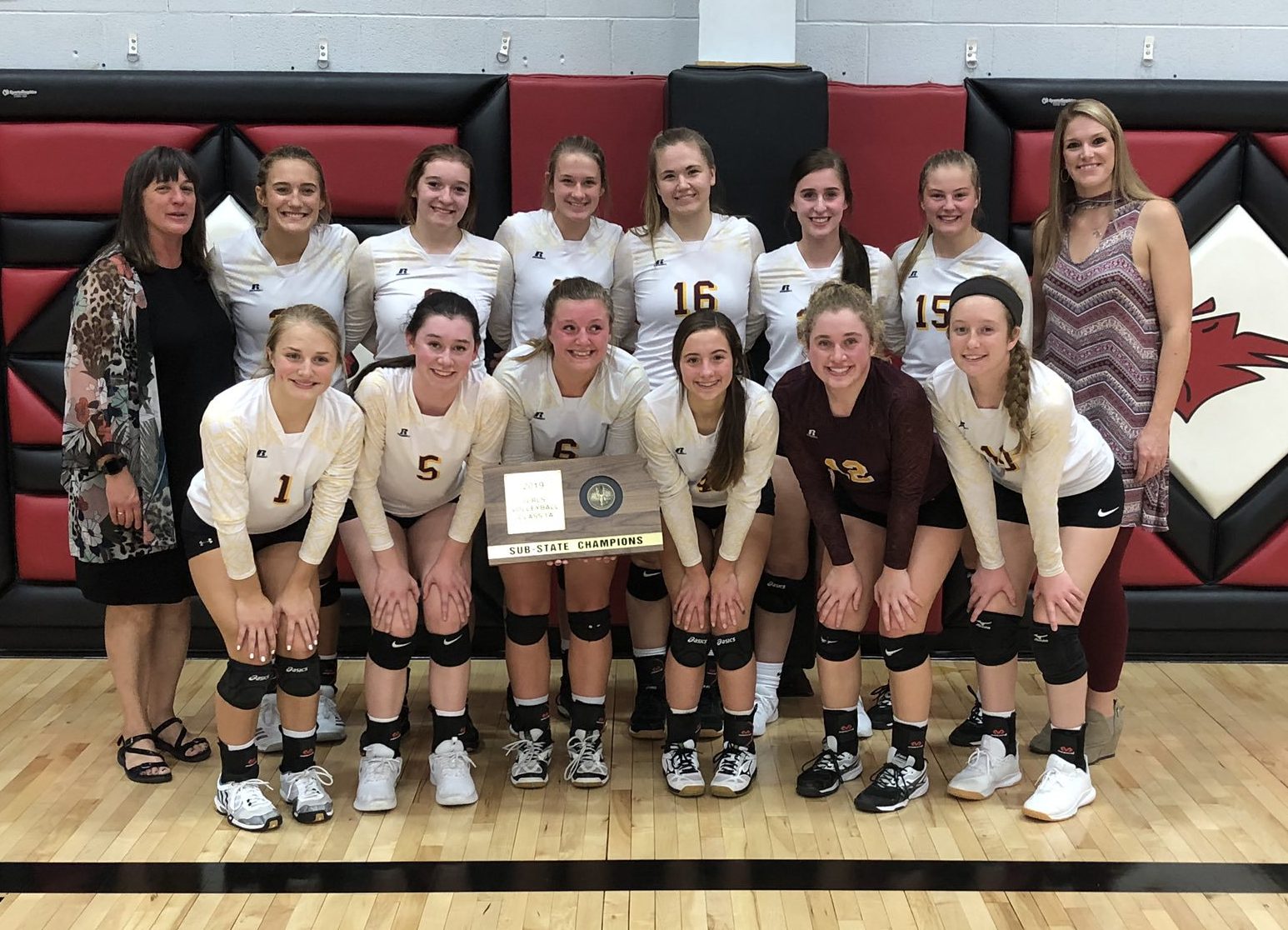
RANSOM – After finishing runner-up at the regional tournament, Victoria went 2-0 Saturday to win the Ransom 1A Sub-State and advance to 1A State Tournament.
The Knights (23-13), who were the No. 8 seed, upset top-seeded Rexford-Golden Plains (25-22, 25-17) in the semifinals then beat the five-seed Wallace County 25-19, 25-22 in the finals.
Victoria will play Friday at United Wireless Arena in Dodge City
MAIZE, Kan. – The Hays High volleyball team won their first match over Wichita Northwest to advance the Maize South 5A Regional Volleyball Tournament only to lose to the host team to end their season.
The Indians beat the Grizzlies 28-26, 25-20 before losing to Maize South 12-25, 13-25. Tasiah Nunnery had 10 kills and nine assists while Brooke Denning and Brooklyn Schaffer both recorded 10 digs against Northwest. Nunnery had five kills in the finale.
HOISINGTON – The TMP-Marian volleyball team advanced to the Hoisington 3A Regional finals where they lost 25-20, 25-20 to the Trojans to end their season.
The Monarchs (33-7) opened the tournament with a 25-21, 25-20 win over Russell then beat Lyons 25-23, 25-19 to advance to the finals.
SEDGWICK COUNTY —Law enforcement authorities are investigating an aggravated battery and have made an arrest.
Just after 3p.m. Thursday, police were alerted to a video on social media that included a male punching a female, according to according to officer Charley Davidson. Several citizens also contacted police about the video. Investigators were able to identify the individuals involved and arrested a 16-year-old boy at his home on South Patty in Wichita.
On Friday, police also arrested a 15 and a 16-year-old girl in connection with the attack.
Police also contacted the 15-year-old victim. She sustained serious but non-life-threatening injuries, according to Davidson. He said the boy and the victim are acquainted and the battery stems from an ongoing dispute.
Police booked the youths into juvenile detention on requested charges of aggravated battery.
EDMOND, Okla. – After dropping the opening set to Central Oklahoma, the Fort Hays State volleyball team fought back to level the match with a well-played second set Saturday. But the Bronchos regained control in the next two sets, taking down the Tigers in four, 23-25, 25-21, 13-25, 17-25. The Tigers move to 6-16 overall and 3-11 in conference play, while the Bronchos are now 16-8 overall and 8-6 in MIAA action.
The teams traded points early in the first set before Fort Hays State opened up a four-point lead, 12-8. UCO captured 10 of the next 13 points to go in front, 18-15, before the Tigers battled back to regain the lead after four consecutive kills. Central Oklahoma responded by scoring four of the next five points to provide enough cushion to hold off the Tigers, 25-23.
The Tigers tightened things up in the second set, recording just two errors while outhitting the Bronchos, .292-.231. Fort Hays State trailed as late as 17-16 before rattling off four-straight points to take the lead for good. Morgan West and Emily Ellis both recorded kills before combining for a block to put FHSU in front, 20-17. UCO later closed the gap to 22-21, but a pair of Broncho errors and a kill from Tatum Bartels allowed the Tigers to level the match with a 25-21 win.
Fort Hays State opened the third set with an 8-4 lead, but a 13-1 run fueled by 10-straight points gave the Bronchos a commanding lead. The Tigers then led as late as 11-10 in the fourth set before UCO rattled off six-straight points to go in front for good.
Delaney Humm recorded a double-double for the Tigers, totaling 14 kills, 12 digs and two assists. Bartels added 10 kills, two service aces and one block. Abbie Hayes led the team with 21 digs with Taylor White and Paige Baird adding 17 digs each. Katie Darnell totaled 23 assists while White added 15. Ellis was the lone Tiger with multiple blocks (two) while chipping in seven kills.
After playing eight of 10 matches on the road in October, the Tigers will return home for three matches in a five-day stretch beginning Friday (Nov. 1) when Central Missouri comes to town. First serve is set for 6 p.m. from Gross Memorial Coliseum.