We have a brand new updated website! Click here to check it out!

Exploring Outdoors Kansas: Just a chip off the old rock

Steve Gilliland

At the recent Kansas Fur Harvester’s convention, I strolled past a booth where several dozen beautiful flint-blade knives were displayed for sale. The owner and creator of those knives was Chris Yackle from Paola, Kansas who told me “As a young boy I was absolutely fascinated by the large collection of Native American artifacts, tomahawks, knife and lance points and arrowheads collected by my great grandfather George from Hillsdale.”

The artifacts were displayed on the wall in front of his great grandfather’s favorite chair, and as punishment when they got into trouble at great granddads house, Chris and his siblings would be forced to stay in the house and sit in that chair. Chris says he actually looked forward to that punishment so he could look at all the artifacts. When Chris was still very young his dad got a job with a pipeline crew and because of his job they moved every three years from the time he was in sixth grade until he graduated from high school. That sounds brutal for a kid, but Yackle told me he didn’t mind because that made for a huge area on which to hunt for Native American artifacts, and the cool part was that when he was along with his dad on the pipeline, he had permission wherever they went.

When Chris was fifteen, they moved to a home near Ft Scott, Kansas. On a trip to Ft Scott’s annual festival called Good Old Days, Yackle met Dennis Croffland from Haysville, Kansas who had a vendor booth there at the festival. Croffland was a flint knapper, making knives with stone blades, and Yackle decided on the spot he had to learn flint knapping. Chris had been experimenting with making stone knives for years so with Croffland as a mentor; flint knapping was easy for him to learn.

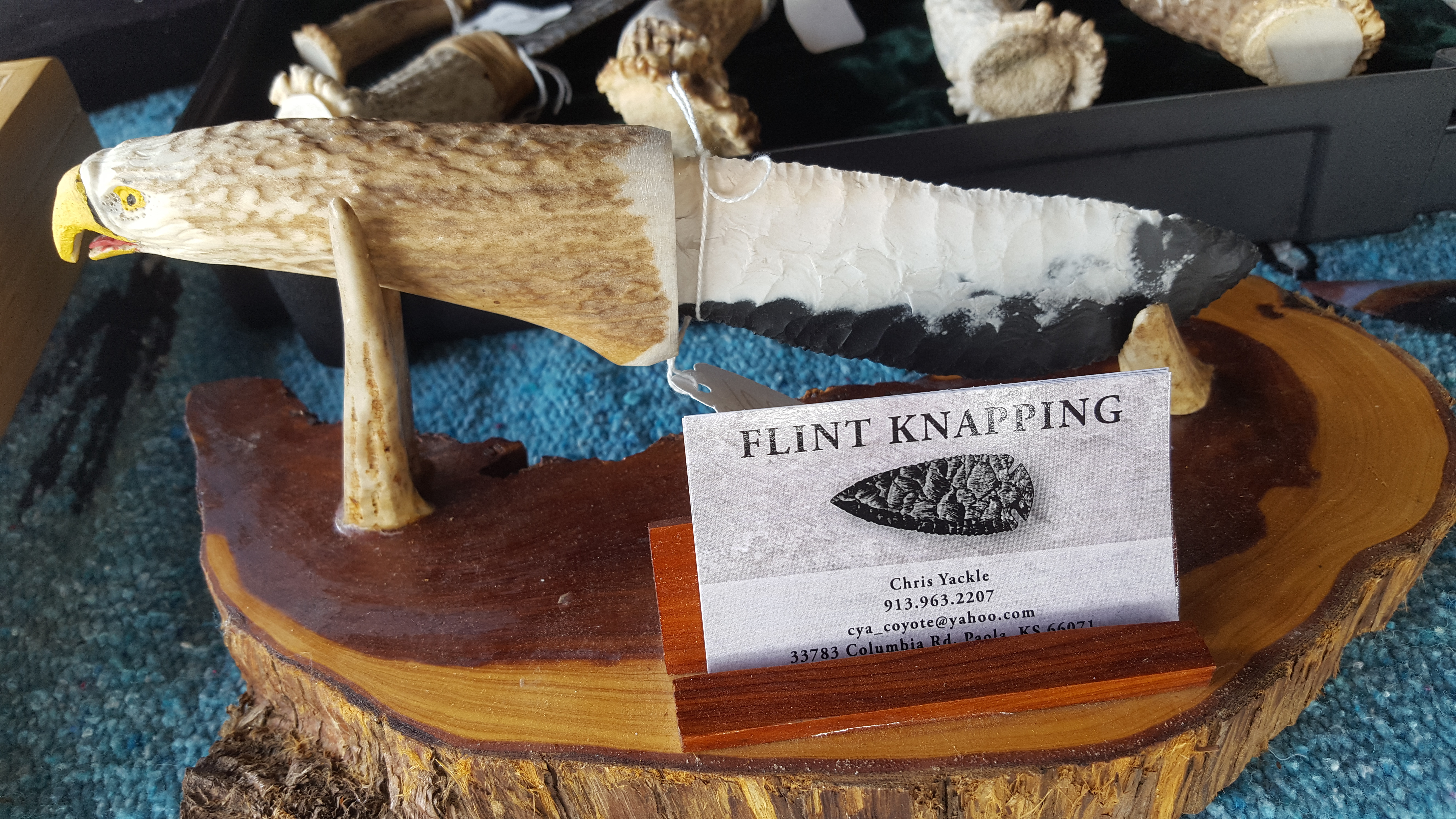
A picture of Chris Yackle’s favorite knife.

Flint knapping came about in England as a way to make flints for flintlock rifles. Yackle says that although some stone here in America is called flint, the only true flint comes from England where the process originated. Chris says that in school, he had no use for physics or geometry and couldn’t see how he would ever use either in life. Now however, he finds flint knapping to be all about physics and geometry.

He says “Flint knapping at its core is simply shaping and sharpening a rock. You first decide what you want to get out of a particular rock, and then look the rock over to see how that can be achieved. Look for flaws and cracks you’ll need to work around, figure out where the blade edge can be gotten, then once you’ve pictured and planned the blade or whatever you choose to make from the rock, simply remove all the stone that shouldn’t be there.” He buys most of his stones already precut into slabs from a man known as Bear Carpenter in Wellsville, Kansas, who also became a second mentor to him.

Yackle says the ultimate tool for removing material from the rock is antler, but he usually uses a “billet,” a round wooden piece with a hard copper cap on one end. A piece of heavy leather or other material is laid over his thigh, then the rock is held there with one hand while he slowly and meticulously removes small chips by striking just the right place with the billet until what is left is the finished knife blade.

Nearly all the rock he works with is some variety of agate or jasper; some is from Kansas but most is not. He prefers to use antler for knife handles, but a few are wooden. Once the blade is complete, a slot is cut into the selected handle and the blade is inserted into the slot and held in place with a two-part epoxy.

Yackle’s favorite knife has an antler handle and a blade made from Arkansas Novaculite, the same hard stone used to make Arkansas whetstones which are well known for their ability to sharpen knives. The handle is head of a bald eagle, and the blade has the perfect color and markings to look like an eagle feather. Chris said he had the handle for over a year before finding just the right stone for the blade.

I’m sure Chris Yackle’s great grandfather would be very proud to know that he passed his love for rocks and Native American artifacts down to Chris; sort of a chip-off-the-old-block you could say…or maybe a chip-off-the-old-rock….Continue to Explore Kansas Outdoors!

Steve Gilliland, Inman, can be contacted by email at [email protected].

Supreme Court takes up cases about LGBT people’s rights

WASHINGTON (AP) — The Supreme Court is set to hear arguments in two of the term’s most closely watched cases over whether federal civil rights law protects LGBT people from job discrimination.

The cases Tuesday are the court’s first on LGBT rights since Justice Anthony Kennedy’s retirement and replacement by Justice Brett Kavanaugh. A decision is expected by early summer 2020, amid the presidential election campaign.

The issue is whether a key provision of the Civil Rights Act of 1964 that bars discrimination in employment because of sex covers LGBT people.

A ruling for employees who were fired because of their sexual orientation or gender identity would have a big impact for the estimated 8.1 million LGBT workers across the country because most states don’t protect them from workplace discrimination. An estimated 11.3 million LGBT people live in the U.S., according to the Williams Institute at the UCLA law school.

Kennedy was a voice for gay rights and the author of the landmark ruling in 2015 that made same-sex marriage legal throughout the United States. Kavanaugh generally is regarded as more conservative.

The Trump administration has changed course from the Obama administration and now supports the employers in arguing that the civil rights law’s Title 7 does not prohibit discrimination because of sexual orientation or transgender status.

People have been waiting in line outside the court since the weekend to try to snag the few seats the court makes available to the public for arguments.

The justices will first hear appeals in lawsuits filed by Gerald Lynn Bostock, who claims he lost his job working for Clayton County, Georgia, after he began playing in a gay recreational softball league. He lost his case in federal district court and at the 11th U.S. Circuit Court of Appeals in Atlanta.

Skydiving instructor Donald Zarda was fired shortly after telling a woman he was preparing to take on a dive that he was gay. Zarda, who worked for Altitude Express on New York’s Long Island, said he would sometimes reveal his sexual orientation to allay concerns women might have about being strapped together during a dive.

Zarda initially lost his lawsuit, but the 2nd U.S. Circuit Court of Appeals ruled for him. Zarda has since died.

The other case involves fired transgender funeral home director Aimee Stephens. She lost her job when she told Thomas Rost, owner of the Detroit-area R.G. and G.R. Harris Funeral Homes, that she had struggled with gender identity issues almost her whole life. She was planning to exchange the dark suit and tie she had worn to work for nearly six years as an embalmer and funeral director for a conservative dress or skirt that was required for women who worked for Rost.

Rost told Stephens her plan wouldn’t work and let her go. The federal Equal Employment Opportunity Commission sued on her behalf and, after losing in a district court, won a ruling in the 6th U.S. Circuit Court of Appeals in Cincinnati.

During the Obama years, the EEOC had changed its longstanding interpretation of civil rights law to include discrimination against LGBT people. The law prohibits discrimination because of sex, but has no specific protection for sexual orientation or gender identity.

The Trump administration and the employers say Congress could easily settle the matter by amending Title 7 to include LGBT people. Legislation to that effect is pending in Congress, but is not likely to pass the Republican-controlled Senate.

But the workers contend, and the lower courts that have ruled for them have reasoned, that the law as it stands plainly covers sexual orientation and gender identity because discrimination against them is based on generalizations about sex that have nothing to do with their ability to do their jobs.

They also argue that they were fired for not conforming to sex stereotypes, a form of sex discrimination that the Supreme Court recognized 30 years ago.

The Latest: Son of sheriff’s captain charged with killing his father

Arnold photo Johnson Co.
Captain Chris Arnold photo Wyandotte Co. Sheriff

KANSAS CITY, Kan. (AP) — The son of a Kansas sheriff’s captain has been charged with fatally shooting his father.

Twenty-two-year-old Zachary Arnold was charged Monday with second-degree murder in the death of 57-year-old Chris Arnold. He was a captain with the Wyandotte County Sheriff’s Office, but was off-duty when he was killed Saturday at his home in Kansas City, Kansas. No details have been released about what led up to the shooting.

Zachary Arnold is being jailed without bond in neighboring Johnson County, Kansas. No attorney is listed for him in online records.

Wyandotte County Sheriff Don Ash said that Chris Arnold was “a man of integrity who loved his family, especially his son Zach, and served his community and his agency and we should honor that and we will.”

___


WYANDOTTE COUNTY — Law enforcement authorities are investigating a fatal shooting and have made an arrest.

The sheriff’s office in Wyandotte reported Sunday that Sheriff’s Captain Chris Arnold was shot and killed   Saturday night at his residence, according to a social media report.

This was not a line of duty death, according to the sheriff’s department. 

Just before 8p.m., officers responded to the shooting at a home in the 2800 block of 76th Street, according to a media release.

A suspect, Arnold’s 22-year-old son, has been taken into custody and is being held in Johnson County on requested charges of premeditated first degree murder, according to online jail records.

Chris Arnold would have been 59-years old Monday, according to the sheriff’s department.  The  department asked the public to “Please keep us and his family in your prayers as we work through this tragedy.”

Authorities have released no additional details.

What’s your idea for creating long-term prosperity in Kansas?

KDC

TOPEKA – Kansas Governor Laura Kelly and Secretary of Commerce David Toland announced today they have kicked off the development of the “Framework for Growth” – a robust strategy to accelerate economic growth in the state of Kansas.

The announcement comes after a months-long search for a professional consulting services firm to help research and analyze the Kansas economy and deliver a comprehensive economic development blueprint for the state.

“The economic challenges facing Kansas require innovative solutions and a well-coordinated approach,” Governor Kelly said. “It’s been more than 30 years since the state had a formal strategy to accelerate economic development. The creation and implementation of a new economic growth strategy, along with other initiatives such as tax reform, will help ensure Kansas remains an attractive place for individuals and businesses alike.”

In coordination with members of Kansas businesses and economic development organizations, the Commerce team will develop the first economic development strategy for the state of Kansas since the Redwood-Krider report was issued in 1986.

“Kansas’ lack of a strategy has resulted in our state lagging in some key economic indicators such as GDP growth, population growth and labor participation. Under the leadership of Governor Kelly, I’m excited to announce that we have now embarked on a necessary journey to bring Kansas back to best in class,” Secretary Toland said. “To be competitive in today’s global economy, we must identify and pursue new, nimble economic best practices. It’s past time that we develop a thoughtful, strategic plan to guide Kansas forward.”

A steering committee consisting of economic development professionals, Kansas business leaders and Commerce staff has been created to guide the team through the planning process and the development of the Framework for Growth.

“Our local and regional economic development partners and business stakeholders are critical to our success as a state, so as we put together the team who would guide this process, it was important they were represented in the steering committee,” Toland said. “We also want to ensure that all interested stakeholders have the opportunity to be involved in this process and have created an online survey to capture feedback and allow individuals to share their ideas of how to create long-term prosperity for Kansas.”

The Department of Commerce selected McKinsey and Company as its partner for this important initiative. The work over the next several months will be broken into three phases: assessment and benchmarking, recommendations and best practices, and implementation planning. Each of these phases will be underpinned by ongoing stakeholder and public engagement, and the Department of Commerce will provide progress reports upon the completion of each phase.

For more information on the Kansas Framework for Growth, visit www.kansasgrowth.com.


Kansas City area man illegally sold guns to undercover agents

KANSAS CITY – A Kansas City area man pleaded guilty in federal court to illegally selling firearms without a license, some of which have been seized during arrests at several crime scenes, according to the United State’s Attorney.

Hedden photo Wyandotte Co.

Frank E. Hedden, 25, waived his right to a grand jury and pleaded guilty before U.S. District Judge Roseann Ketchmark to engaging in the business of dealing firearms without a license.

By pleading guilty, Hedden admitted that he sold 21 firearms to an undercover special agent with the Bureau of Alcohol, Tobacco, Firearms and Explosives for a total of $11,155 between Feb. 26 and July 16, 2019.

On May 7, 2019, investigators served Hedden with a warning notice. Investigators explained to Hedden that several firearms he purchased from licensed firearms dealers had been recovered in crimes within a relatively short amount of time after Hedden purchased them.

This indicated Hedden could be re-selling them, thereby dealing in firearms without a license. Investigators further explained to Hedden that he could be prosecuted if he was buying firearms with the intent to resell them. Hedden signed an acknowledgement receipt for the Warning Notice of Unlicensed Firearms Dealing in Violation of Federal Law.

A few days later, however, Hedden met again with the undercover agent and illegally sold the agent two pistols for $1,200. During that meeting, which was recorded, Hedden told the undercover agent about the warning notice. “I don’t know if it’s anything, you know, of your or somebody else,” he said, “they said I had several firearms show up in crime scenes lately.” Hedden then added, “I knew this would happen eventually.”

The undercover agent told Hedden the firearms he purchased were going to Mexico and asked Hedden if he could obtain more AK-47 type pistols, to which Hedden responded “Yeah. So, I’ll have to figure out something … I’m going to try to figure something out cause like I said, I like doing the business, it’s nice to come into a little extra money.”

Hedden subsequently sold three more firearms to the undercover agent on two separate occasions.

On July 17, 2019, law enforcement officers executed a search warrant at Hedden’s residence and seized 33 firearms (which must be forfeited to the government). Officers also seized a red binder that contained 100 bills of sale for firearms; 18 of the documents were for firearms sold to the undercover agent, 72 of the documents were for firearms that Hedden sold to other individuals, and 10 of the documents were for firearms that Hedden purchased from other individuals.

Under federal statutes, Hedden is subject to a sentence of up to five years in federal prison without parole. The maximum statutory sentence is prescribed by Congress and is provided here for informational purposes, as the sentencing of the defendant will be determined by the court based on the advisory sentencing guidelines and other statutory factors. A sentencing hearing will be scheduled after the completion of a presentence investigation by the United States Probation Office.

Kansas governor launches design of economic development strategy

TOPEKA, Kan. (AP) — Kansas Gov. Laura Kelly says she’s launching the state’s first formal strategy in 30 years to strengthen economic development.

Gov. Kelly and Sec. Toland during an August ribbon cutting in Edgerton, Kansas-photo courtesy Kansas Sec. of Commerce

Kelly pledged Monday to work with industries and economic development specialists to write a comprehensive plan to speed economic growth. A report is expected by March 2020.

The project will be coordinated by the Kansas Department of Commerce and the McKinsey consulting firm.

Secretary of Commerce David Toland says the state has lagged in key economic indicators such as GDP growth, population growth and labor participation.

Toland said the goal of the project is to make Kansas “best in class.” Economic development professionals, business leaders and Department of Commerce staff will make up a steering committee that will guide the planning and development of the plan, called the “Framework for Growth.”

Kroger, Walgreens to stop selling e-cigarettes in US

NEW YORK (AP) — Two major retailers say they will no longer sell e-cigarettes in the U.S. amid mounting health questions surrounding vaping.

Supermarket chain Kroger and drugstore chain Walgreens announced Monday they would discontinue sales of e-cigarettes at their stores nationwide, citing an uncertain regulatory environment.

The vaping industry has come under scrutiny after hundreds of people have fallen ill and at least eight have died after using vaping devices.

Walmart announced last month that it would stop selling e-cigarettes at its stores nationwide.

Kroger said it would stop selling e-cigarettes as soon at its current inventory runs out at its more than 2,700 stores and 1,500 fuel centers. The Cincinnati-based company operates the Ralphs, Harris Teeter and other stores.

Walgreens, based in Deerfield, Illinois, operates more than 9,500 stores in the U.S.

News From the Oil Patch, Oct. 7

By JOHN P. TRETBAR

Kansas Common crude at CHS in McPherson gained a quarter per barrel on Friday and starts the week at $43 per barrel. The Kansas benchmark had ups and downs last month. CHS reports the average for the month of September for Kansas Common was $46.91 per barrel, although it ended the month at $44.25, down a dollar from the first of the month.

Baker Hughes reported a drop of three oil rig and two gas rigs in its weekly Rotary Rig Count for a total of 855 active rigs across the U.S. New Mexico added four rigs while Texas dropped four. Oklahoma was down three rigs. Canada reported 144 active rigs, up 17 on the week.

Operators are about to spud a new well on a lease in Barton County, and drilling is underway at one site each in Barton, Ellis and Russell counties. Independent Oil & Gas Service reports eleven rigs in eastern Kansas that are moving in, rigging up, drilling or relocating, up one for the week. There are 26 active rigs west of Wichita, which is down three.

The government reported U.S. crude production for July at 365 million barrels, an increase of about 3.5 million barrels over the month before. Total production nationwide through July of this year topped 2.5 billion barrels. EIA said July production in Kansas totaled at 2.81 million barrels in July, or about 90,000 barrels per day.

Oil-by-rail traffic increased by one percent, marking one of only two freight categories to show a weekly increase. During the week that ended September 28, operators moved 12,245 rail tanker cars carrying petroleum or petroleum products, according to the latest report from the Association of American Railroads. Amid declines in total rail traffic, oil-by-rail last week posted its first year-on-year decline in recent memory.

The government reported U.S. crude-oil production last week of 12.38 million barrels per day, down about 92,000 barrels per day from the week before but well ahead of the 11 million barrels produced during the same period last year.

Crude oil inventories increased last week by 3.1 million barrels, but remain at the five-year seasonal average at 422.6 million barrels. The Energy Information Administration reports imports are down 87,000 barrels per day from the previous week. The four-week average for imports is more than 15% below the same period last year, at 6.6 million barrels.

A small lizard found among the dunes straddling New Mexico and West Texas in one of the nation’s richest oil basins is at the center of a legal complaint filed in federal court in Washington Tuesday. Environmentalists want the U.S. government to add the dunes sagebrush lizard to the endangered species list. It’s part of a fight that stretches back to the Bush and Obama administrations and could affect part of the multi-billion dollar energy industry in the Permian Basin.

The merger-and-acquisition frenzy in the oil patch continues. The Daily Oklahoman reports on three mega-deals last week, including the sale of Roan Resources to Citizen Energy Operating. That deal is worth a reported one billion dollars, and includes the assumption of about $780 million of Roan’s debt. Analysis from Austin, Texas-based Enverus notes that the industry’s merger and acquisition activity topped $17 billion in the third quarter and reached more than $85 billion through the first three quarters of this year.

The oil and natural gas industry in New Mexico last year provided more to the state’s annual budget than any other industry, nearly $2.2 billion, or 32% of the $6.88 billion in state funding for schools, infrastructure, health care and public safety. The CEO of the American Petroleum Institute says contributions from oil and gas to New Mexico through leases and royalties grew by $465 million from the year before.

Research into the treatment and possible recycling of oil-and-gas wastewater in New Mexico got a $100 million boost from the U.S. Department of Energy. According to reporting from the Carlsbad Current Argus, the Governor enacted a memorandum of understanding with New Mexico State University last month to begin studying how to treat and recycle produced water in the desert state. The school then announced its College of Engineering was awarded a five-year federal grant to create what’s being called the Energy-Water Desalination Hub.

Joyce L. Lofland

Joyce L. Lofland, 88, died October 5, 2019, at home with her family by her side. She was born February 10, 1931, in Great Bend, the daughter of Carl and Zoe (Hull) Mohr. On June 18, 1949, she married James R. Lofland in Wichita. He survives.

Joyce was a life time resident of Great Bend and a member of Central Baptist Church. She graduated from Great Bend High School, and later worked at Komarek Jewelry store and the Courthouse Appraisers office. She was very involved in Girl Scouts as a leader, a Sunday School teacher and a member of the Central Baptist Women’s Group and the Great Bend Women’s Temperance League.

Joyce is survived by her husband, James R. Lofland of the home; her children, Janna Huschka and husband Kurt of Hutchinson, Jill Hopper and husband Derrel of Arvada, Col., Jerry Lofland and wife Paige of Great Bend, and Jackie Goosen and husband LoWayne of Freeman, S.D.; her brothers, Jimmy Mohr of Woodbine, Richard Mohr and wife Nita of Great Bend, and Tommy Mohr of Topeka; her sisters, Rosie Kruckenberg and husband Larry of Great Bend, and Marilyn Kae of Nashville, Tenn.; 14 grandchildren and 12 great grandchildren. Joyce was preceeded in death by her parents and her children, James Lofland and Julia Barnes; her brothers, Carl Mohr, Robert Mohr and Douglas Mohr; and her sister, Gini Sharp.

There will be no visitation, as cremation has taken place. Memorial services will be held 10:00 a.m. Thursday, Oct. 10, 2019, at Central Baptist Church, with Pastor Daniel Dugas, followed by a meal in the fellowship hall. A private family inurnment will be held at a later date.

Memorials may be made to Central Baptist Memorial Fund, in care of Bryant Funeral Home.

WKHRMA meets Nov. 13

Western Kansas Human Resource Management Association will hold its monthly meeting on Wednesday, November 13 at the Fort Hays State University Robbins Center (Eagle Communication Hall), One Tiger Place.

Registration is from 11:15 a.m. to 11:30 a.m., with a short business meeting starting at 11:30 a.m.

The program for the November meeting will be “Who Cares…About Organizational Development,” presented by Ruth Bealer with Midwest Energy.

The program will be submitted for SHRM continuing education credits. WKHRMA members can RSVP at wkhrma.shrm.org. The deadline to RSVP is noon on November 8.

WKHRMA is an affiliate chapter of SHRM (Society for Human Resource Management), a local professional organization for persons engaged in personal or human resource management.

For more information on WKHRMA, visit wkhrma.shrm.org.

Man held in brothers’ disappearance near KC enters not guilty plea

By BRENT MARTIN
St. Joseph Post

A northwest Missouri man being held in connection with the disappearance of two Wisconsin brothers has entered a “not guilty” plea to tampering with a motor vehicle.

The only charge prosecutors have filed against 25-year-old Garland Nelson is motor vehicle tampering. Nelson is accused of taking the pick-up rented by Nick and Justin Diemel. The Diemels, who are cattle brokers in Wisconsin, drove that truck to Nelson’s farm near Braymer in July to discuss a cattle deal.

No one has seen the brothers since.

Garland Nelson photo Caldwell Co.

Authorities say video cameras caught Nelson driving the truck to a commuter lot in Holt, where it was found.

An intense search of the Nelson farm began shortly after Nelson was brought into custody. Human remains reportedly have been found, but not details have been released. No additional charges have been filed.

Copyright Eagle Radio | FCC Public Files | EEO Public File