Fort Hays State (2-2. 2-2 MIAA) at Central Oklahoma (2-2, 2-2 MIAA) Saturday, October 5 – 1 pm Wantland Stadium – Edmond, Okla.
Fort Hays State Football returns to action on Saturday (Oct. 5) at the University of Central Oklahoma in Edmond. Kickoff is set for 1 pm at Wantland Stadium between the two teams, both entering at 2-2 on the season. The Tigers are looking for their third straight win after victories over Washburn and Missouri Southern in the two previous weeks, while also looking to run their win streak over UCO to five games after winning each meeting since 2015.
Fort Hays State will need to be ready for a battle on Saturday. The Bronchos finished 8-4 overall each of the last two years, claiming bowl wins each season. The last two meetings between the teams in Edmond have been nail biters for the Tigers, winning 31-24 in 2017 on a touchdown pass with 42 seconds remaining and 30-29 in 2015 on a field goal as time expired. Last year, FHSU defeated Central Oklahoma 15-0 in Hays on five field goals by Dante Brown. It was FHSU’s first shutout of an opponent since 2008.
The Tigers continue to thrive in the passing game, averaging 313.5 yards per game this season through the air to rank ninth in NCAA Division II. However, the rushing offense has established a presence in each of the last two games, averaging 171.5 per game in that span. Chance Fuller ranks seventh in NCAA Division II for passing yards per game (298) and fifth in passing touchdowns (12). Harley Hazlett has been his top target, averaging 97 receiving yards per game with 28 catches for 388 yards. Hazlett ranks fifth in NCAA Division II for receiving touchdowns with six. Charles Tigner leads the FHSU rushing attack, averaging 80.2 yards per game.
Defensively, the Tigers held each of their last three opponents to less than 400 yards of total offense. Last week they allowed 344 to Missouri Southern, the lowest of any opponent so far this year. Tanner Hoekman leads the Tigers in tackles with 34. Drew Harvey is right behind with 33, while leading the team in tackles for loss (5.0) and sacks (2.0). The Tigers have seven interceptions, which ranks 12th in NCAA Division II, all within the last two games. Hoekman, Hayden Kreutzer, and Isaiah Creal-Musgray all have two passes picked off so far this year.
Dante Brown continues to produce field goals at a high rate for the Tigers, making 9-of-12 attempts so far this year. His 2.25 field goals per game average ranks second in NCAA Division II. He ranks 16th in the nation in scoring, averaging 10 points per game.
Central Oklahoma is coming off a 59-10 loss at Northwest Missouri State this past week. UCO is 1-1 at home so far this year with a close 37-35 loss to Pittsburg State, a team now ranked No. 15 in the nation, and a 63-0 win over Lincoln.
Listen as the ‘Voice of the Chiefs’ Mitch Holthus recaps last week’s gritty win at Detroit and previews Sunday nights prime time home game at Indianpolis.
The Holthus Hotline airs Saturday mornings on your home for Chiefs football, KFIX (96.9-FM), at 8 a.m. during the Chiefs season.
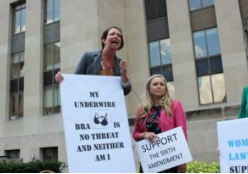
After the Jackson County Sheriff, the County Counselor’s Office and attorneys reached an agreement, attorneys no longer have to remove their underwire bras to see their clients in the county jail. Photo courtesy Andrea Tudhope / KCUR 89.3
By ANDREA TUDHOPE Kansas News Service
Underwire bras may still be setting off the metal detectors at the Jackson County, Mo., jail, but the standoff over the issue, nicknamed “bra-gate,” has ended — at least for attorneys.
A new security protocol quietly rolled out in May caused some uproar after female attorneys complained they had to remove their bras to clear screening. At the time, Jackson County Sheriff Darryl Forté tweeted, “No one was asked to take off underwire bras.” However, the rules required that everyone clear the detector.
At the time, the Legislature urged a quick fix and a mediated meeting. But the issue remained at a standstill. Attorneys set a meeting with Forté a few weeks later, but they said he didn’t show up.
But, at the start of September, the two sides reached a compromise with little fanfare. Now, if an attorney sets off the metal detector, she is wanded or patted down.
“All we ever wanted was to be able to meet with our clients the same way as men, and now we have been able to accomplish that,” said attorney Tracy Spradlin.
Spradlin commended the County Counselor’s Office and the sheriff for their work in resolving the issue, and she said she was thankful they didn’t have to bring a lawsuit against Jackson County. Spradlin said it was “no secret” that they would have gone that route.
“I’m thankful it didn’t come to that,” she said. “I think that would have been another waste of our time that we could have been meeting with clients and a waste of the county’s time for something that could be so easily resolved.”
Forté declined an interview with KCUR, but in a statement, he said the jail and the sheriff’s office “are forward-focused with no time to dwell on past issues.”
However, the issue remains for jail employees. Attorney Katherine Myers told KCUR the resolution does not apply to jail employees. Myers represents Charlotte Hardin, a jail employee who worked for the county for 20 years. She was placed on indefinite leave after removing her bra and sending it through the X-ray machine. Hardin has yet to return to work.
The new protocol for attorneys is still technically operating on a trial basis, but Spradlin said neither party has indicated any issues with the agreement.
Ellis County has organized a group of 17 community members who want to make sure everyone in the county is counted in the 2020 census.
The response rate for the state of Kansas in 2010 was 73 percent. Ellis County was about 82 percent. The census would like to see a count rate above 90 percent.
Complete Count Committees are nonpartisan groups set up by states to make sure everyone in their state is counted on April 1, 2020. Hays Mayor Henry Schwaller is on both the state Complete Count Committee and the Ellis County Complete Count Committee.
Some of the people on the Ellis County Complete Count Committee, include HaysMed’s Edward Herrman, Hays City Manager Toby Dougherty, Ellis County Administrator Phillip Smith-Hanes, USD 489 Superintendent Ron Wilson, and Ellis County Commissioner Dustin Roths.
Other organizations represented include Grow Hays, United Way of Ellis County, First Call for Help, City of Ellis, City of Victoria, Ellis County Ministerial Alliance, Hays Public Library and the Hays Area Chamber of Commerce.
“We wanted to create a body to cover every single pocket of people in Ellis County,” Schwaller said, “particularly those who have been hard to count.”
Schwaller said the census is an economic and social issue.
Although the census is used to establish representation in both Topeka and Congress, census numbers are also used to determine funding for a slew of federal program.
Schwaller gave the example of the Northwest Business Corridor project. The city and county are currently seeking federal grant funds for road improvements on 230th Avenue north of Interstate 70. If the county’s population is not counted correctly, that funding could be in jeopardy.
Funding for transportation, hospitals and education facilities are also determined by census numbers.
“(For) every individual in Ellis County who is not counted, we will lose over $2,000 per non-counted person per year for the next 10 years,” Schwaller said. “That could really hamper our efforts to, again, build roads, assist Fort Hays in getting proper financial aid for students and help the medical center.
“The federal funding is key to keeping the community alive.”
Accurate population counts are also important in recruiting new businesses.
“As we talk about recruiting new businesses, either retail or tech firms, they look at whether a community is growing or not and whether we have the population to support them,” Schwaller said.
The census has determined certain populations are hard to count. These can include older residents, who might not have access to technology, college students and children ages birth to 5.
Students who are living in Hays as of April 1 need to count themselves in the census as Hays resident, Schwaller said. FHSU will have its own Complete Count Subcommittee to target the student population.
The committee can look at data on the census site, not only who was counted in 2010, but what areas may be being underreported in 2020.
“In the past, the census counts in Ellis County have been questioned,” Schwaller said. “In the 2000 census, we were a little short after having some growth in the ’90s. That really hurt the community — the City of Hays and Ellis County — because it meant we couldn’t unlock some federal programs to help us with our airport, maintain major streets in the city and get funding for programs. We just didn’t qualify.
“Their participation not only benefits the community as a whole, but it benefits them because they are counted and they are shown as living here. They’ll have better roads, better access to better services.”
Between now and the end of 2019, the committee will develop a plan to get the word out about the census. In late January, the committee will begin to promote that message, including notification that local residents will receive information on how to log on to the census website and complete their census surveys. This is the first year you will be able to complete the census online.
Schwaller said the committee hopes to have personnel at the Hays Public Library and Forsyth Library who can help residents log on to the site census website.
He emphasized the census website is encrypted and secure, and none of your personal information will be released to businesses or other government agencies. When the census data is released, it is released as aggregate data, which omits details such as your name.
Other states provide funding to promote the census — Kansas does not. The Kansas Health Initiative is providing funding to the Kansas League of Cities to promote the census. Ellis County’s committee plans to apply for a grant through that program, Schwaller said.
The Ellis County Strategic Doing Re-Start drew approximately 100 people to Hays on Sept. 9.
At a followup meeting on Oct. 8, “we’ll begin uncovering needs, wants, visions, dreams and plans of the great group of folks who attended,” said Sandy Jacobs, executive director of the Heartland Community Foundation.
Jacobs encouraged any interested Ellis County resident to attend next week’s meeting.
“We need you to participate whether you attended the first meeting or not. Your input is extremely important to the process of defining Ellis County now and in the future,” she said.
The overriding theme last month was the senior community, according to Jacobs.
A number of attendees organized themselves into a specific group to address issues for seniors. They talked about retirees moving into Hays from rural areas, intergenerational childcare, neighborhood community centers, and memory care units available outside of medical care facilities.
Others talked about the need for a larger domestic and sexual violence center, regional transportation, especially for seniors and youth, and recreational activities for middle and high school age students.
An entire wall was papered with sticky notes on which project suggestions were written by the participants.
Facilitator Betty Johnson has compiled the information into themes and will return with them Tuesday. Johnson’s position is funded by the Dane G. Hansen Foundation in Logan.
“We will share the six to eight themes and people can pick one they want to be a part of. That’s when the groups will actually form again,” explained Jacobs.
A project doesn’t have to be grandiose.
She points to last year’s “The Neighbor Project” as an example, which came from the theme of becoming a more inclusive community.
“I think the group was first looking at a grand outcome. Then they understood it’s a step at a time.
“Rather than creating new events to bring people together, they would take themselves into an existing event and bring conversation cards and a table for people to sit around and talk. Bringing people together who had never met each other or reaching out and inviting different ethnicities to be a part of what they’re doing.”
Jacobs says she gets goose bumps thinking about what “The Neighbor Project” is doing.
“Just one step at a time, they’re quietly taking care of business and I’m really proud of them.”
After meeting recently with Johnson, the group is working on a new project called “Donuts on the Drive.” They’ll provide the donuts and coffee, set up in a neighborhood yard, and invite all the nearby residents to join together.
“I think it’s a wonderful idea. It’s all about gathering people.”
Strategic Doing Re-Start begins at 6 p.m. Tuesday at the Rose Garden Banquet Hall, 2350 E. 8th St. A meal will be served. RSVP to [email protected] or call 785-621-4090.
“If you have or know of a project that has stalled, is needing to uncover resources or just wants more participants , come join us,” urges Jacobs. “Let us help find what you need.”
Ron Wilson is director of the Huck Boyd National Institute for Rural Development at Kansas State University.
By RON WILSON Huck Boyd National Institute for Rural Development
Would you like corn flakes for breakfast? Cows would like corn flakes for breakfast, too. Today we’ll learn about an innovative Kansas farm family that is utilizing a steam flaking technology to improve feed quality for their livestock operation and others around Kansas.
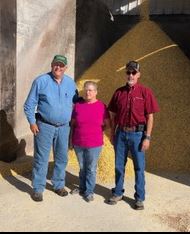
Phil and Sharron Knox farm in northwest Kansas. Phil is a native of the Brewster area. He went to Kansas State and majored in agricultural economics. While attending a Farm Bureau scholarship dinner, he met Sharron who was studying dietetics. The two married and began a long life together.
Phil went on to earn a master’s and Ph.D. in agricultural economics from the University of California at Berkeley, where Sharron earned her master’s in public health nutrition. She worked as a consulting nutritionist and Phil took a position as assistant professor at Colorado State before moving back to his family farm near Brewster.
Today, the family farming operation consists of no-till corn and wheat on 9,000 acres of which 1,800 acres are irrigated. They also have a 200 head cow and calf operation on 2,100 acres of pasture land. The cattle are finished, along with purchased calves, in a 2,500-head feed lot. The fed cattle are marketed through the Knox’s membership in U.S. Premium Beef.
Phil and Sharron Knox and Don Allen, AgSun manager
“You have to do things a little better, you have to change,” Phil said.
“He does research, he has ideas,” Sharron said. “I’m a detail person.”
One of Phil’s ideas was to improve the feed efficiency of his cattle feeding operation. “I talked to a friend who was working in feed technology,” Phil said. That led to the creation of a steam flaking enterprise in 2004.
Feed corn is converted into flakes by processing in a steam chamber. This breaks down the cell walls and gelatinizes the starch. The result has proven to be a highly desirable cattle feed. In fact, the feed worked so well that the Knoxes not only feed the flakes to their own cattle, they market the flakes to other feedlots and dairies in western Kansas.
The flaking business is known as AgSun LLC. The company’s flakes have been shown to be a better source of energy than rolled or ground corn because cattle digest and utilize the flakes better. For feeder cattle, the flakes allow up to a 15 percent improvement in energy values.
For dairy cattle, starch availability is also improved, giving cows a better source of energy. This produces more energy for more milk production.
AgSun LLC has the capacity to process 2.5 million bushels of corn a year, with one third of that coming from the Knox’s own production. Their son Daniel, an industrial engineering graduate of K-State, helped design the automated controls and programming for the equipment. It is a state-of-the-art, computer-operated facility. The production from the plant could feed up to 40,000 to 50,000 head per day.
“The staff at AgSun is hard-working, friendly and always willing to help us,” said one customer. “The flakes are the best quality for our cattle.”
Another customer commented: “The quality of the product is second to none and is always very consistent. AgSun produces what they advertise and they do things the right way the first time. Our production is always good with AgSun’s cornflakes in our ration. We appreciate their service.”
Sharron is a board member of the Northwest Kansas Farm Management Association. Phil has served on the Northwest Kansas Groundwater Management Board. They are members of Kansas Farm Bureau and Kansas Corn Growers.
“We felt called to do more,” Phil said. He also serves as the volunteer pastor at the local Lutheran church.
“We enjoy living here, it’s like a big family,” Sharron said. Brewster is a rural community with a population of 305 people. Now, that’s rural.
For more information about the steam flaking business, see www.agsunllc.com.
Would you like corn flakes for breakfast? So would your cattle. We commend Phil and Sharron Knox for making a difference with agricultural entrepreneurship. Corn flakes can help make a better breakfast, better beef, and better business.
O-Mok-See – the name means “riding big dance,” which originated with the Blackfoot Indian Tribe. It was a war ceremony that was meant to get courage for battle. The warriors would wear costumes and decorate their horses, ride a distance away from camp, then ride together at a great speed back to the camp circle where the rest of the tribe sang songs and beat drums. The horsemen would ride their horses to the rhythm of the singers and drummers. At various times during the “big dance,” the warriors would dismount and dance on foot. If anyone fell off their horse during the ritual, it was a sign of bad luck.
The Kansas Omoksee, this being the fourth year, was held Sept. 7 and 8 in Lyons. Riders from all over participated in events such as Keg Bending, Top N’ Turn, and Western Relay, among others. The two-day show was a competition among the participants to earn points that would be totaled at the end of the competition. There were various age groups with the highest scorer of each age group winning a saddle. Awards were given to the top 10 riders of each age group.
Also, during the Kansas Omoksee, the first ever Kansas Omoksee Royalty Contest was held. Contestants had the responsibilities of keeping their horses clean, fed, watered, as well as keeping their stall clean. A dress code where long sleeved, collared shirts, western boots and belt, jeans, and a western hat were to be worn at all times during the competition. The contestants were also responsible for a fundraiser of their choice, donating an item to a live auction, helping in the arena, and making everyone feel welcome and at home at the Kansas Omoksee. The contestants were being judged all day Saturday by two secret judges, as well as an interview judge and a horsemanship judge.
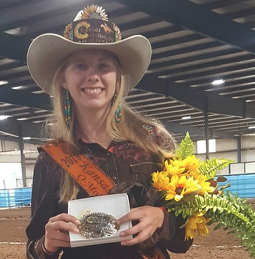
Cameryn Kinderknecht, Ellis, was the winner of the Kansas Omoksee Queen. This was her first royalty competition and she welcomed others as well as offered arena workers, judges, and audience members bottled water and a good conversation over the joys of horses and friendly competition. Her responsibilities during this next year include appearances in a variety of events, fundraising for Kansas Omoksee, and raising awareness for the sport of Omoksee. This was Kinderknecht’s second year at the Kansas Omoksee. She and her horse, Kita, placed 5th out of over 20 women in the competition portion over the weekend.
Kinderknecht is a freshman at Fort Hays State University.
Join the Fort Hays State University Astronomy Club at the Kansas Wetlands Education Center from 8 p.m. to 10 p.m. on Friday, Oct. 18, for an evening of night sky observations and astronomical activities.
Led by Dr. Jack Maseberg, associate professor of physics, and Dr. Paul Adams, dean of the College of Education, the Astronomy Club will bring their telescopes to KWEC and educate participants about different cosmic objects.
That night, Saturn, Jupiter, and Messier Galaxy Objects will be in view. Messier Objects include nebulae, globular and open clusters, and galaxies discovered by Charles Messier in the 1770’s as he was searching for comets.
KWEC will also provide refreshments, a galaxy craft and other activities inside the center.
KWEC is located at 592 NE HWY K156 in Great Bend. For more information call 877-243-9268.
The certified public accounting firm of Adams, Brown, Beran & Ball, Chartered recently announced the addition of Baron Green to their professional team.
Green joins ABBB as a staff accountant and will work in the firm’s Hays office. He completed an ABBB internship in 2018 and subsequently served as a student worker for the firm.
“We are pleased that Baron decided to establish his career with ABBB,” said Brian Staats, CPA, CGMA, managing partner of ABBB. “We got to know him well during his time as an intern and student worker, and we look forward to witnessing his continued growth as an accounting professional.”
A recent graduate of Fort Hays State University, Green holds a Bachelor of Business Administration in Accounting. Raised on a farm in Oberlin, Kansas, he now lives in Hays.
Adams, Brown, Beran & Ball, Chartered provides a wide range of traditional and non-traditional CPA and consulting services to clients throughout Kansas, including agriculture organizations, construction companies, feed yards, financial institutions, governmental and not-for-profit organizations, manufacturers, medical practices, oil and gas companies, professional service firms, real estate companies and small businesses. Founded in 1945, today the firm maintains 13 office locations throughout the state. For more information about Adams, Brown, Beran & Ball, please visit www.abbb.com.
TOPEKA – The Kansas Department of Commerce’s Office of Minority and Women Business Development will host its 35th Annual Minority and Women Business Awards Luncheon. The luncheon will be held in the Capitol Plaza Hotel’s Emerald Ballroom in Topeka on October 10, 2019, with doors opening at 11:20 am. The event will take place during Kansas Minority Enterprise Development (MED) Week and will recognize 12 minority- and women-owned companies, three individuals and one corporation from across the state for their support and efforts to create new opportunities.
Winner of the Women-Owned Business Service Industry category is Rose
“Minority and women-owned businesses are an integral part of the Kansas economy,” said David Toland, Secretary of the Kansas Department of Commerce. “We greatly value the contributions these businesses and advocates provide to our state, from the jobs they create to the way they enrich communities and lives,” Toland said. “On behalf of Governor Kelly, the Department of Commerce and citizens across the state, thank you for keeping our economy strong and vibrant.”
Brooke Lennington from Topeka’s KSNT will emcee the event and the Washburn Rural High School Jazz Band will provide live music for attendees. Top sponsors of the luncheon include Evergy and Textron Aviation.
Registration for the luncheon is $45 per person or $360 for a table of eight. This event is open to the public, but registration is required and must be submitted by October 1. Please visit KansasCommerce.gov/MEDWeek to register or contact Rhonda Harris, Director of the Office of Minority and Women Business Development, at (785) 296-3425 or [email protected].
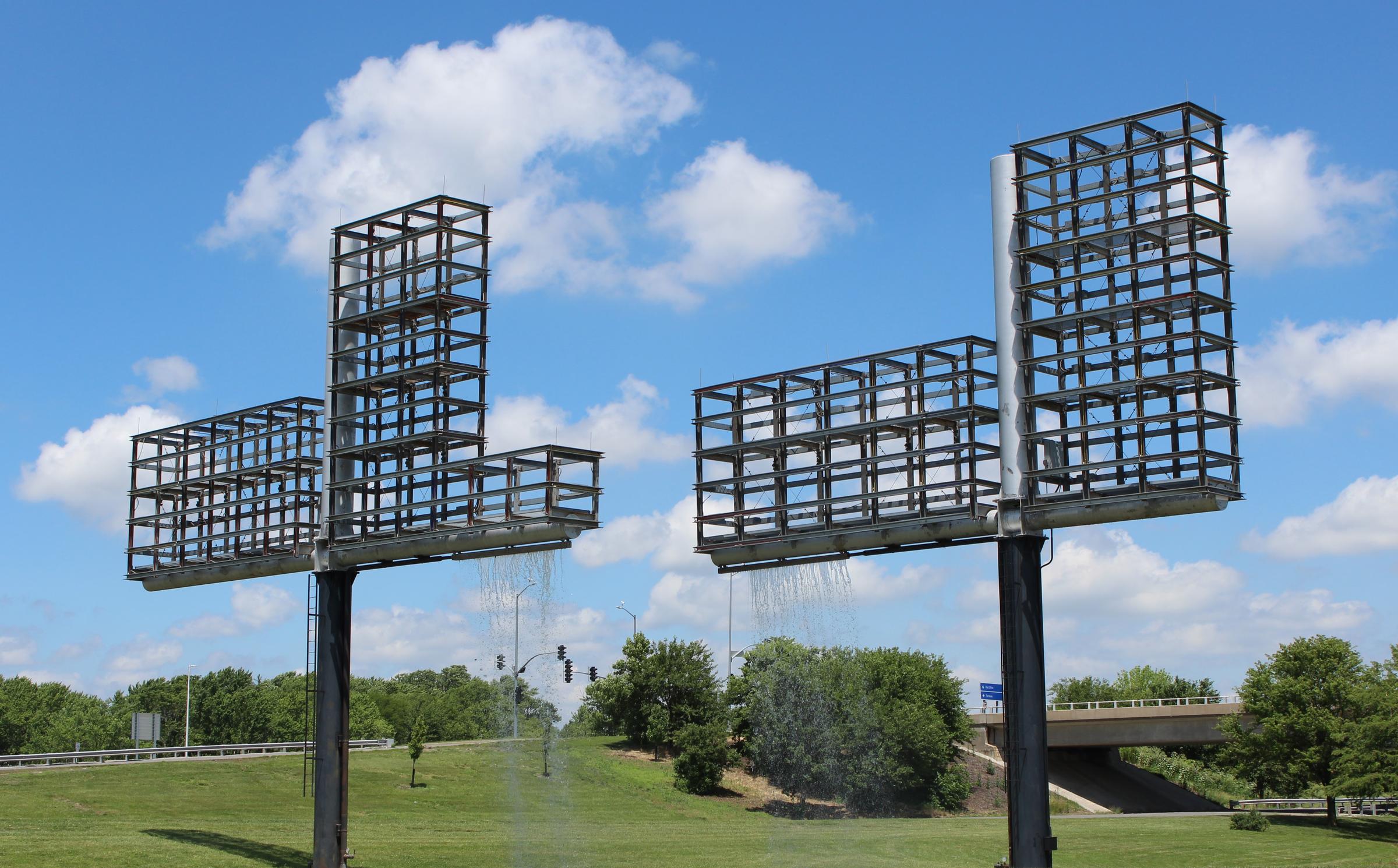
Keith Sonnier’s ‘Double Monopole’ (2005) is located near the entrance to the Kansas City International Airport. Laura Spencer / KCUR 89.3
By LAURA SPENCER Kansas News Service
Preparing for the largest public art project in Kansas City’s history is proving to be a challenge.
Controversy often surrounds pieces commissioned under the city’s One Percent For Art Program, which sets aside 1% of city construction costs for public art. But when it comes to the construction at Kansas City International Airport – where a new $1.5 billion single terminal project at KCI budgets $5.6 million for public art – tensions have begun to rise long before any artists have submitted proposals.
Ultimately, the Kansas City Council will give final approval for the artwork inside or outside the new terminal.
Before that happens, however, the process appears to be increasingly contentious. And the airport project is on a fast track, without a public art master plan.
Here’s what we know so far.
A view of Keith Sonnier’s ‘Double Monopole’ at KCI at night. Credit courtesy of the artist
1. Currently, there’s confusion about who’s in charge.
The Municipal Art Commission consists of about a dozen unpaid volunteers, most with a background in art or architecture, who meet the first Monday of every month at 3 p.m. on the 26th floor of City Hall. Typically their agenda items are straightforward and mundane (such as approving awnings for storefronts or requests from developers restoring historic properties).
The city charter says the commission is responsible for administering the city’s One Percent For Art Program, among other duties, but commission members have expressed uncertainty about their responsibilities when it comes to the airport art.
“How can we have an impact?” commission chair Kathy Achelpohl, of PGAV Architects, wondered at a meeting in July. “We have at times felt like we’re brought to the table at such a late date that we’re rubber stamping our approval. And there’s not much else that we can do.”
“It’s a big project, a generational project,” added commission member Babette Macy, who’s worked in the architectural, construction, and engineering industry for more than two decades. She also serves as Plan Commission chair. “And to me it’s unclear. What is our role?”
Ordinarily, there would be a paid staffer at City Hall – a public art administrator – who handles communication between the city council, the city manager’s office, and artists on various contracts. But this position has been vacant since April 2018.
The job was posted on July 1, and, according to city officials, a new hire is expected to be announced in the next few weeks.
Meanwhile, in May, the owner’s representative for the airport, Paslay Management Group (PMG) contracted with a Kansas City-based consulting artist, Holly Hayden through 2019. It’s a $10,000 contract funded by the aviation department with an option of three one-year renewals.
Jade Liska, deputy director of the aviation department, in June, described Hayden’s role as working with all the stakeholders: “Holly will be that conduit, and will be that voice for us as we move the process.”
Hayden, a Kansas City Art Institute graduate, specializes in graphic design and marketing. This project would be the first time she’s managed anything on this scale. And Paslay consulted with Hayden without informing the members of Kansas City’s Municipal Art Commission.
“I will reinforce arts and culture,” Hayden told commissioners at the June meeting, “as an invaluable enhancement to the Kansas City experience.”
Alice Aycock’s ‘Strange Attractor for Kansas City,’ is installed near the economy parking lots at KCI. Credit Mike Sinclair
2. Artists and other observers are concerned.
Kansas City artists and others in the creative community have been watching the process closely for months. And they’ve raised significant questions.
“Do you want this to be an airport that is astounding, amazing, magnificent?” asked Julia Cole, an artist and educator who coordinates Charlotte Street Foundation’s Rocket Grants program. “Or do you want it to be mundane and comfortable and happen quickly?”
“As a citizen and taxpayer of the city of Kansas City, Missouri,” added business lawyer David Oliver, “this is a once in a lifetime opportunity to demonstrate to the world what art can do as a gateway to our community.”
Cole and Oliver were among those who spoke up at a Municipal Art Commission meeting in June. With extended public testimony, the meeting lasted for three hours.
The city’s aviation department organized an additional meeting for stakeholders later that month. As a result of that conversation, the department scheduled monthly airport updates during the arts commission’s monthly Monday meetings.
In July, representatives from Skidmore, Owings & Merrill, or SOM, the international architecture firm that is part of the team designing the new terminal at KCI (which has worked on other aviation projects in cities such as San Francisco and Toronto), shared design slides. In August, they discussed a “heat map” of potential places for art at the new terminal.
The Kansas City-based architecture and design firm BNIM is expected to discuss more design plans in October.
But there are a lot of decisions to make – and there’s no master plan for art.
“I still think there’s value in identifying what the overall plan is for art at the airport,” Municipal Art Commissioner Jan Mulkey said at the July meeting, “whether it’s one piece that’s $5.6 million dollars, or whether it’s three pieces in the garage that are $500,000 each and then spend the rest of it in the rest of in four places in the terminal. And whether it’s performing art or visual art.”
The terrazzo flooring of ‘Polarities’ is underfoot at KCI. This photo from 2013 pictured Terminal A, which is now demolished, but the terrazzo was salvaged. Credit Julie Denesha / KCUR 89.3
And commissioners want to make sure that public art is integrated into the terminal’s design, not just tacked on at the end.
“The piece that’s missing is the curatorial vision — there isn’t one,” commissioner David Dowell, a principal with el dorado architects, said in July. “And I hope it’s not too late.”
Jordan Pierce of SOM reassured Dowell that it wasn’t too late. “Certainly from our standpoint, this is not late in the process,” he said. “This is fairly typical.”
But, as Achelpohl told KCUR this week, “The terminal building is becoming fully formed. We wish we could have been talking about it much sooner.”
The design phase for KCI is expected to be wrapped up by the end of the year.
Artist Jim Woodfill created ‘Deuce’ in the parking garage stair towers in each of the terminals. Here, it’s pictured in Terminal C. Credit courtesy of the artist.
3. The City might need national help.
Municipal Art Commission members voted at their July meeting to recommend hiring a national public art curatorial consultant to “lead and implement the city’s vision for public art” at the new airport. (This follows a precedent set by the Commission when it hired a consultant for the next largest One Percent for Art project: the Sprint Center.)
A portion of the One Percent For Art budget would pay for the consultant.
Aviation department officials introduced a resolution requesting approval for that expense to the City Council on August 29.
“Without the Curatorial Consultant to guide the City’s most significant investment in public art, the Commission believes our world-class public art reputation and ambitions are at risk,” Achelpohl wrote in a Sept. 4 letter to the mayor and councilmembers.
Achelpohl pointed out that other cities around the country, such as Chicago, Dallas, San Diego and San Francisco “have hired national consultants for public art planning and implementation” for similar projects.
The resolution was expected to go before the Council’s Transportation, Infrastructure and Operations Committee on September 18, but the Committee didn’t meet. Without any discussion, it was put on hold until October 23.
Art Commission members were “told by the aviation department that the resolution will be held in committee for approximately one month and will be dealt with formally at that time,” Achelpol tells KCUR. Councilwoman Katheryn Shields, who represents the city’s 4th district at-large and played an instrumental role in getting the city’s One Percent for Art Program up and running in the early 1990s, reportedly put the issue on hold.
Shields declined to comment.
So, for now, the commission is waiting for an arts administrator and for a public art curatorial consultant — roles that can’t be filled soon enough for the volunteers on the Municipal Art Commission.
And, in addition to these vacancies, some could be their own. With the arrival of a new mayor, in accordance with standard operating procedures, commissioners were asked to submit undated resignation letters and to indicate if they would like to continue to serve.
“We carry on,” commissioner David Dowell told KCUR. “We’re not slowing down, not changing what we’re doing at all. Everyone that’s left is pretty committed.”
“I’m, in a way, optimistic that the public art administrator is almost in reach,” said chair Achelpohl. “I do believe that that person has a big challenge.”
Their next meeting is scheduled for October 7.
Laura Spencer is an arts reporter at KCUR 89.3. You can reach her on Twitter at @lauraspencer.
The Phillipsburg Panthers were able to hold off the TMP-Marian Monarchs and pick up a 21-7 win Friday night at Lewis Field in Hays.
Jay Harris interview
Game highlights
TMP took the opening kickoff and put together a 13-play drive deep into Phillipsburg territory only to end on a Kade Harris interception by Tyler Martin at 16 yard line.
After the Monarchs took more than six minutes off the clock Phillipsburg was forced into a three and out on their first possession. TMP forced the Panthers into a pair of three and outs on their first two possessions of the game.
Phillipsburg was finally able to break the scoreless tie with just over three minutes left in the second quarter with a 21-yard touchdown pass from Ty Sides to Kagen Keeten. They led 7-0 at halftime.
The Panthers opened the second half with a nine-play 57 yard drive that was capped by a one-yard Zeb Lemon touchdown run. Lemon carried it six times from 40 yards on the drive.
Trailing 14-0 through three quarters TMP got on the board early in the fourth quarter with a 10-play 64 yard drive capped off with a 12-yard touchdown pass from Kade Harris to Jace Wentling on fourth down.
Down by one score TMP had a pair of chances in the fourth quarter but had one drive end on an interception and another end on a turnover on downs.
TMP drops to 1-4 for the second year in-a-row while Phillipsburg is 2-3.
Colby Dreiling led the Monarchs with 86 rushing yards.