If you have a concern that your child may have a developmental delay or be in need of special education services, call for a free developmental screening. Children from ages birth to school age who live in Ellis or Rush counties are eligible to be screened.
Speech, language, vision, hearing, thinking, self-help, behavior and motor development will be checked.
The screenings will be held on Friday, October 18.
Call Hays Area Children’s Center at 785-625-3257 to set up a free developmental screening appointment for your child. These developmental screenings are offered monthly and sponsored by the Hays Interagency Coordination Council and USD 489.
BARTON COUNTY – Law enforcement authorities are investigating two suspects on drug charges after stopping bicyclists for traffic violations.
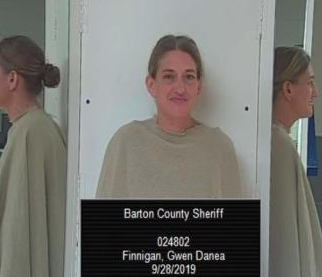
Robert Rodriguez photo Barton Co.Finnigan photo Barton Co.
Just after 11:30 p.m.Monday, an officer from the Great Bend Police Department initiated a traffic stop on a bicyclist in the 1900 block of 9th Street in
Great Bend for a traffic infraction.
During the contact with the subject, identified as Robert Rodriguez, 48, the officer learned Rodriguez had a no bond warrant out for his arrest out of Rice County.
Rodriguez was placed under arrest, and was found to be in possession of methamphetamine and paraphernalia as well. Rodriguez was transported to the Barton County Jail where he was booked and confined.
Just after midnight Saturday, a Great Bend Police Department officer initiated a traffic stop on a bicycle at 7th and Washington for a traffic violation.
During the stop, the officer located methamphetamine and drug paraphernalia in her property and arrested Gwen Finnigan, 37, for a narcotics violation. Finnigan was booked into Barton County jail with a $10,000 bond.
ELLIS COUNTY — A 25-year-old northwest Kansas woman was hospitalized after a single-vehicle accident at approximately 8:30 a.m. Tuesday.
According to the Kansas Highway Patrol, a 2016 Jeep Cherokee driven by Skylar A. Stephen, Phillipsburg, was eastbound on Interstate 70 in eastern Ellis County when the vehicle hydroplaned. The driver lost control, spun through the media and westbound lanes of traffic before coming to rest in the north ditch.
Stephen was transported to Hays Medical Center for treatment of possible injury. She was wearing a seat belt, according to the KHP.
OMAHA, Neb. (AP) — At eight months pregnant, government food inspector Rosalie Arriaga was scheduled in March 2018 to handle twice her normal workload at the meat processing plants she was assigned to cover.
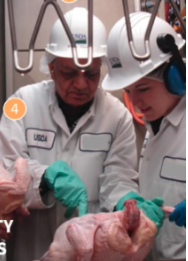
USDA Image
It was her third straight week of double coverage, according to agency schedules given to the Midwest Center for Investigative Reporting.
A few weeks earlier, one of Arriaga’s coworkers had sent a concerned email to their supervisor: “Are they trying to make something happen to Rosalie carrying her child the last couple of weeks!!” the coworker asked.
Arriaga, a consumer safety inspector at the United States Department of Agriculture’s Food Safety and Inspection Service, had been put in charge of food safety at six corporate slaughterhouses around Omaha.
When Arriaga finally called in sick that Friday, there was no one available to replace her.
During that shift, those meat-packing plants went hours without someone overseeing the complicated logistics of food safety.
Arriaga declined to comment for this story, though she confirmed the account. And her story of scrambling to complete too much work in too little time is not uncommon.
Inspectors say that due to long-standing problems that have gotten worse in recent years, adequate oversight of meat processing has become all but impossible.
The Food Safety and Inspection Service’s mission is “protecting the public’s health by ensuring the safety of meat, poultry, and processed egg products,” according to its website. Though without proper inspection inside these plants, food safety experts say the risk of foodborne illness for millions of Americans increases sharply.
Each plant has a veterinarian who inspects animals prior to slaughter, and at least two types of inspectors inside each facility: The first are slaughter line inspectors who examine each carcass to make sure the meat is safe for consumption, and who are mandated to be present in order for a plant to operate.
The second are consumer safety inspectors, who oversee a plant’s food safety plans and perform sanitation checks at multiple facilities during any given shift.
Consumer safety inspectors also routinely take over slaughter line inspections in order to give those employees breaks or to fill in for short-term staffing shortages, such as an employee calling in sick or quitting unexpectedly — a job duty that many of these federal employees say has become more common in recent years due to vacancies in those positions.
A nine-month investigation by the Midwest Center for Investigative Reporting found dozens of similar situations at the USDA’s Food Safety and Inspection Service, with routine vacancies that leave the remaining federal food inspectors vulnerable to burnout, work overload and other job hazards.
In several cases, employees in other roles are oftentimes forced to abandon their own job duties to cover the slaughter line inspections mandated for plants to operate.
USDA representatives reiterated during a phone interview that every carcass on the line is inspected without fail — if they weren’t, private slaughterhouses could not operate.
Administrators on the call disputed that the public has seen any increase in risk due to other employees filling in for vacancies on the slaughter line and said staffing for all positions is adequate.
Officials did acknowledge their recent work to hire more meat inspectors, including a recent move to reclassify a number of positions to make them more attractive for entry level applicants.
“I cannot speak to any anecdotes,” Food Safety and Inspection Service Administrator Carmen Rottenberg said. “But I can say that we work really hard to keep our vacancy rates low.”
Agency representatives also suggested that criticism of the meat inspection system was generated by unions and pro-union lobbyists, while dismissing incidents of insufficient inspection as isolated incidents that do not properly represent the agency’s successful effort to keep America’s food supply safe.
But a review of internal documents, hundreds of pages of public records and interviews with more than a dozen current and former food inspectors, as well as more than 30 food safety experts and industry representatives, reveal the extent to which key agency duties are going unfulfilled.
As of March 2019, in some districts, up to one in every seven federally funded meat and poultry inspection positions were sitting vacant — a total of nearly 700 nationwide.
The shortage has created situations in which some inspectors are forced to cover double and triple the number of meat processing plants for which they would be normally scheduled.
In some cases, facilities go entire shifts without supervision from consumer safety inspectors, who enforce important sanitation policies, oversee facilities’ food safety plans and the production of processed meat products.
Internal emails show that leadership at the agency sometimes notifies plants of the gaps in inspection by consumer safety inspectors, which both agency employees and experts say gives companies increased opportunity to avoid food safety rules.
Multiple consumer safety inspectors said their superiors asked them to seek permission each time they marked down a task as incomplete in the agency’s internal tracking system, creating a “chilling effect” and encouraging the underreporting of incomplete assignments.
Such a task might be inspecting the facility for mold, or improperly stored chemicals, or even checking that a plant is following the proper allergen labeling rules.
The Food Safety and Inspection Service currently manages about 7,800 total inspector positions. This roughly mirrors the agency’s staffing levels in 1980, although the amount of meat and poultry consumed in the country has increased dramatically during the same period, from 193.7 pounds per person in 1980 to a record 219.5 pounds in 2018, according to USDA data.
Despite the agency’s stagnant number of jobs, it’s had trouble in recent years even filling the positions that already exist. According to agency data obtained via Freedom of Information Act request, the total vacancy rate for all Food Safety and Inspection Service inspector positions in March was 8.75%.
The situation is especially bad in the Midwestern districts encompassing parts of Iowa, Missouri, Nebraska and Colorado, which supply most of the country’s meat. As of this March, more than 17% of all slaughter line inspection positions in the Denver and Des Moines Districts were vacant.
And when there are too few slaughter line inspectors working in a plant, consumer safety inspectors working in those districts say they must also shoulder the line-inspection duties, thus failing to complete more of their own tasks.
“We don’t believe we are short-staffed,” Rottenberg said.
She also noted the agency looks at staffing more holistically: public health veterinarians, relief inspectors and “other resources” provide the agency with the manpower it needs to fill any vacant positions, and accomplish its mandate: a safe supply of meat and poultry for American consumers.
“We’re always going to have the resources to ensure we are inspecting every single carcass that goes through a slaughter facility,” said Dr. Philip Bronstein, assistant administrator for the Food Safety and Inspection Service’s department of field operations.
Although Food Safety and Inspection Service leadership agreed to a phone interview, representatives declined to respond to a written list of questions.
Just a few weeks after Arriaga called in sick, another consumer safety inspector in the same Nebraska circuit was scheduled for five straight days of 16.5-hour shifts.
Schedules from June 2019 show yet another consumer safety inspector in Jacksonville, Florida, was slated to visit 18 plants in one day. It’s a job that his coworkers said would require between five and six hours of driving, even with favorable traffic. Forgoing bathroom breaks or time to eat, an inspector in the same circuit said that would still only leave roughly six minutes in each facility — not nearly enough to perform a proper inspection, which multiple agency employees said should take at least an hour or more.
Employees at the Food Safety and Inspection Service have a name for the hours spent driving hundreds of miles between work sites only to walk inside and almost immediately walk back out: “windshield duty.” And those are the best days, when there are enough employees to staff every plant.
“I can say with certainty these are not isolated incidents,” said Stan Painter, a 30-plus-year veteran of the agency and a chairman of the American Federation of Government Employees’ food safety inspectors’ union.
“It’s only a matter of time before there’s a big outbreak of something, and I’m of the opinion that the consumer is already being affected,” said Painter. “The agency has ostrich syndrome. Everyone’s head is in the sand.”
Rottenberg dismissed these instances as “anecdotes” and said the agency has been working hard in recent months to keep vacancy rates for field inspectors low.
After the Midwest Center began reporting this story, the Food Safety and Inspection Service announced the plan in August 2019 to reclassify a number of its consumer safety inspector positions down one level — lowering employment qualification standards and potentially reducing pay for some employees in the process.
The goal is to “improve flexibility in addressing staffing challenges” and “make the CSI position more attractive to recent college graduates who may seek to work for FSIS immediately upon graduation,” according to an email about the changes sent by the agency to congressional staff at the House Agriculture Appropriations Subcommittee.
Representatives from the USDA also said the United States’ supply of meat and poultry is the safest in the world — largely due to the agency’s mandate to visually inspect every animal slaughtered in every facility.
“Every carcass is inspected — 100%,” said USDA Program Analyst Roxanne Lane. “No slaughterhouse can operate without us being there. We are there, we have to be there, and we are.”
Consumer safety inspectors are not required to be in every plant 100% of the time, according to agency policy, but each facility must be visited by a consumer safety inspector at least once per shift — typically between eight and 12 hours. It’s a mandate employees say has become increasingly difficult to accomplish.
Indeed, Tyson Foods filed a $2.4 million lawsuit against the USDA in May over insufficient inspections, alleging an agency employee lied about checking thousands of hogs for contamination and illness at the company’s plant in Storm Lake, Iowa. The company said it was forced to throw out more than 8,000 hog carcasses as a precaution, according to court documents filed in the Northern District of Iowa.
In the suit, Tyson alleges video footage from the facility shows USDA veterinary medical scientist Yolanda Thomson signing inspection cards from the front seat of her car without ever entering the facility, in what would be a clear falsification of the documents.
But Thompson’s normal assignment was a nearby turkey plant, and she was working the extra shift because the USDA’s Des Moines district is continuously short-staffed, according to Paula Schelling, a food safety inspector’s union representative.
Multiple district employees said they had also been pushed well into overtime, including one consumer safety inspector who shared 2018 paystubs with the Midwest center showing at least four instances of consecutive work weeks of more than 70 hours each.
In August, Tyson and the USDA had begun working towards a settlement, according to court filings. Tyson and its legal counsel did not respond to requests for comment on the lawsuit.
“We have consumer safety inspectors pulled out of assignments and double or triple staffed to cover all the vacancies in the country. These inspectors can only do so much,” Eric Rothell, an 18-year veteran of the agency and president of his union’s local in Nebraska, wrote in a letter to USDA leadership last year.
Since then, he said the agency has shrugged off his repeated attempts to bring these problems to light.
“Establishments continue to produce products that are bought and consumed by Americans with the USDA seal when, in reality, little to no inspection has occurred at all,” Rothell wrote. “I don’t feel like I’m crying wolf here. I’ve been in this agency for a long time, seen the best of the best and the worst of the worst. How we are protecting the consumer right now is lacking.”
A January 2019 report from the Public Information Research Group, a non-partisan federation of nonprofit organizations in the United States and Canada, found that since 2013 the most dangerous kind of meat and poultry recalls — Class 1 — have increased by more than 80%. This accounts for the vast majority of the 10% increase in total food recalls over that same period, according to USDA data.
Some of this jump can be attributed to a more conservative system of recalls, including new rules surrounding allergen labeling that a USDA spokesperson pointed to as a major contributor to the increase. But, as the report notes, “there is still a clear trend of more meat and poultry being recalled due to contamination.”
The report’s author, Adam Garber, as well as other food safety experts say inadequate inspections by the USDA also likely deserve some of the blame.
“Either there’s always been a problem and we’re just discovering it now, or things are getting worse,” said Garber. “That’s a bad thing for the consumer either way.”
In a 1991 Pulitzer Prize-winning investigation into issues within the USDA, the Kansas City Star found the Food Safety and Inspection Service was “poorly supervised, inadequately trained and plagued by work-related injuries.”
Steve Cockerham, a source for the Star’s reporters and a USDA food inspector at the time, appeared in front of a National Academy of Sciences committee that year to testify on the deteriorating state of meat safety. He brought with him a plastic bag of packaged beef, riddled with shotgun pellets: “100% USDA-approved buckshot,” he said.
Today, he’s the manager of a hardware store in Grand Island, Nebraska. He resigned from the agency in 2015.
“It absolutely got worse,” Cockerham said of the agency’s staffing problems prior to his departure. “I left it in the rearview mirror. I just had to get out of there and get a new life.”
In response to a Midwest Center inquiry for current vacancy rates, the Food Safety and Inspection Service said the agency had improved its staffing numbers and as of July 2019 was operating with a 6.89% vacancy rate for all “in-plant” positions, which includes line inspectors, consumer safety inspectors, public health veterinarians and other agency employees.
Additionally, the agency said the July vacancy rate for all consumer safety inspector positions sat at 5.57%. The Food Safety and Inspection Service declined to provide the raw data used to calculate current vacancy rate totals.
The government shutdown earlier this year didn’t help the situation, said Tony Corbo, a senior lobbyist at consumer watchdog nonprofit Food and Water Watch.
Corbo has studied the agency full-time for almost 20 years and consults with both sides of the aisle in Congress on regulatory issues involving agriculture and food production.
For their part, USDA representatives argued that Corbo is not purely a consumer advocate because of his involvement in negotiations between the inspectors’ union and the USDA over several agency programs — a contention Corbo denies.
Staffing reports obtained by Food and Water Watch show that 75 inspectors — who, as essential employees, were not subject to furlough but were also not being paid — quit during the month-long shutdown. Although that number only constitutes about one percent of the agency’s total workforce, it is one more contributor to staff shortages.
Corbo has been filing Freedom of Information Act Requests for the agency’s monthly staffing numbers for more than a decade, and says the current situation constitutes a “crisis.”
“Work is not being done in these plants, period,” he said. “Something is clearly out of whack.”
On the day Rosalie Arriaga called in sick, leaving six plants without coverage for 39 combined hours, a district supervisor wrote to another consumer safety inspector: “Please give all plants my info. Also let them know there will be no coverage after you are gone.”
“There will be no coverage past your coverage,” the same supervisor wrote to several other inspectors on the same day. “I will be available for emergencies.”
Announcing there will be no consumer safety inspector visiting a plant on a given day creates an opening for companies to skirt food safety rules, several inspectors said.
The USDA Inspector General’s office acknowledged as much in a 2012 audit of the Food Safety and Inspection Service, writing about inspectors who physically cannot make it to every plant on their schedule: “the lack of mitigating procedures increases the risk that unsafe meat and poultry products will reach the public.”
The audit was originally intended to “evaluate the impact of inspection personnel shortages on the agency’s ability to accomplish its mission of protecting consumers,” but the inspector general ultimately said it could not make a determination due to a lack of data.
In its response to the report, the agency said that when inspectors missed certain tasks, the person working the next day would look over company records to ensure safety rules were followed.
But inspectors who spoke with the Midwest Center said little has been done to prevent the underlying problem of overscheduling and hours-long production shifts without a consumer safety inspector scheduled to work in the first place.
“I haven’t been able to do my job for some time due to understaffing and having to fill in for line inspectors,” said another consumer safety inspector who requested anonymity to preserve his employment at the USDA.
“It’s getting worse,” he said. “I don’t remember it ever being this bad.”
In addition, several current consumer safety inspectors cited pushback from their supervisors when trying to document incomplete assignments as reason to be skeptical of the official USDA data being used to measure their effectiveness.
Agency emails given to the Midwest Center from January show a supervisor in the Memphis circuit emailing an inspector to ask that the employee gain official approval from upper management before recording missed tasks.
“Failure to meet this goal will be reflected and documented,” the supervisor wrote in the email. “Dereliction of duties is unacceptable.”
Multiple inspectors said they encountered similar in-person requests from supervisors that weren’t recorded through email. They worry that this practice, which is not official agency policy, creates an unnecessary extra step that could make data less reliable.
“It has a real chilling effect,” Painter said.
And as food recalls continue, the agency’s former Chief Public Health Veterinarian, Dr. Pat Basu, worries the increased chances of a major outbreak may soon become a reality.
“If we continue to wait to act, by then it will be too late,” he said. “(The people in charge) don’t have the qualifications to understand the danger of the situation.”
Inspectors say they feel like an afterthought, asked to work long hours under immense pressure to protect their fellow consumers from foodborne illness and death.
“Why is it so hard for management to just listen to the field inspectors?” Rothell said. “Does it actually take someone becoming ill or dying before we quit making excuses and staff the vacancies?”
KANSAS CITY– A passenger aboard an Alaska Airlines flight diverted to Kansas City International Airport was charged in federal court with interfering with a flight attendant, according to the United States Attorney.
Jwan Curry photo Platte Co.
Jwan Curry, 40, of Hamburg, New Jersey, was charged in a criminal complaint filed in the U.S. District Court in Kansas City. Curry remains in federal custody, according to online jail records.
According to an affidavit filed in support of the criminal complaint, Curry was a passenger on an Alaskan Airlines flight that was scheduled to fly nonstop from John F. Kennedy Airport in New York to Los Angeles International Airport. Approximately one and a half to two hours into the flight, the affidavit says, Curry became agitated after not being able to use the bathroom in the front of the aircraft. Curry engaged in a verbal altercation with the attendants because they told him he could not use the forward lavatory, which was being used by crew members at that time.
Curry began screaming, yelling and using foul language, the affidavit says. He was swinging his arms and walking up and down the aisle. While waiting in line for the bathroom at the rear of the aircraft, he began swearing loudly around other passengers in line. He entered one of the rear lavatories and stayed there for an extremely long time. When he returned to his seat, he continued to be unruly.
The flight captain announced that all passengers should return to their seats and stop interfering with the flight attendants. The attendants notified the captain that Curry became increasingly physically dangerous. Curry was punching the seat and punching himself, the affidavit says, and threatened to “blow up” the plane. Passengers reported that Curry stated he was going to “kill everyone.”
Based on this information, it was decided to divert the flight. Four passengers were given flex cuffs and helped restrain Curry, who remained restrained in his seat for the remainder of the flight. After the plane landed at Kansas City International Airport, police officers arrived and took Curry into custody.
Under federal law, it is illegal to interfere with the performance of the duties of a flight crew member or flight attendant by assaulting or intimidating the crew member or attendant.
The charge contained in this complaint is simply an accusation, and not evidence of guilt. Evidence supporting the charge must be presented to a federal trial jury, whose duty is to determine guilt or innocence.
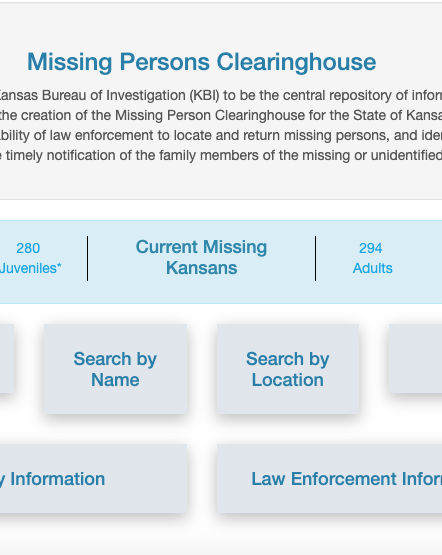
TOPEKA – The Kansas Bureau of Investigation (KBI) revealed a new website Tuesday aimed at increasing the public’s involvement with Kansas missing persons cases.
The new missing persons website can be viewed at www.kbi.ks.gov/missingpersons. Unlike several national or non-profit missing person sites, the search tool is specific to missing person cases that originated in Kansas. The website provides a current and comprehensive listing of all those reported missing throughout Kansas.
The new site allows for searches by a missing person’s name, or by Kansas county. You can also search based on demographics such as name, gender, age, or the date the missing person was last seen. When using the site, individuals are able to submit tips, information, and sightings directly to the KBI. Anonymous tips are encouraged as well. Once information is reported, the KBI will either evaluate and investigate the information, or forward the lead to the law enforcement agency that is investigating the missing person case.
“We know from experience that tips from the public provide a great advantage to law enforcement in locating missing Kansans, and we hope this website increases our interactions with citizens who wish to help,” said KBI Director Kirk Thompson.
Also featured on the new website are recommendations for how to report someone who has gone missing, and valuable safety information and resources. The site also has links to the Kansas AMBER Alert and Silver Alert websites.
Law enforcement agencies are allowed greater access to additional features of the website so they can update missing person cases in their jurisdictions, compare case profiles, and upload photographs of the missing. When creating the website the KBI worked with law enforcement agencies to ensure it would be a useful resource in missing persons cases, and to teach them how to update the profiles of those missing from their communities.
“Currently missing in Kansas are 295 adults and 280 juveniles. Behind each missing person is a family with unanswered questions. It is our hope that this website will become a valuable tool that aids law enforcement in answering the many questions that arise when an individual goes missing,” said Thompson.
Mona Grimsley-Hett, 71, of Topeka, passed away of natural causes Friday, September 27, 2019 in her home.
She was born February 18, 1948, in Garden City, Kansas. The daughter of Ben and Ramona (Neil) Grimsley. She graduated from Garden City High School in 1966 and she received a Bachelor’s Degree in Radio, Television and Film from the Journalism School at the University of Kansas in 1971.
Mona was employed at the Manager of Corporate communications at Wolf Creek Nuclear Power Plant in Emporia for 12 years, retiring in 1997. Prior she was employed as Manager of Corporate communication for Sunflower Electric in Hays.
Ms. Grimsley was a member of the P.E.O. in Garden City and the American Nuclear Society.
Mona married Robert Hubert in 1966 and had a daughter together, Monica Hubert. Mona then married Max Hett in 1995.
Survivors include a Daughter, Monica Hubert, 3 Grandchildren; Veronica Miller, Vanessa Miller and Cameron Miller and Sister-In-Law, Nancy Grimsley. She was preceded in death by her Ex-Husband, Robert Hubert; Ex-Husband, Max Hett and Brother, Vern Grimsley.
Mona was known for her gift of writing, sharp wit, free spirit and unique perspective on the world.
A Memorial Service will be 10:00 am., Tuesday, October 1, 2019 at the Dove Cremations & Funerals – Southwest Chapel, 3700 SW Wanamaker Road, Topeka. In lieu of flowers a gift can be made to the School of Journalism at Kansas University at https://bit.ly/2oxtgUI.
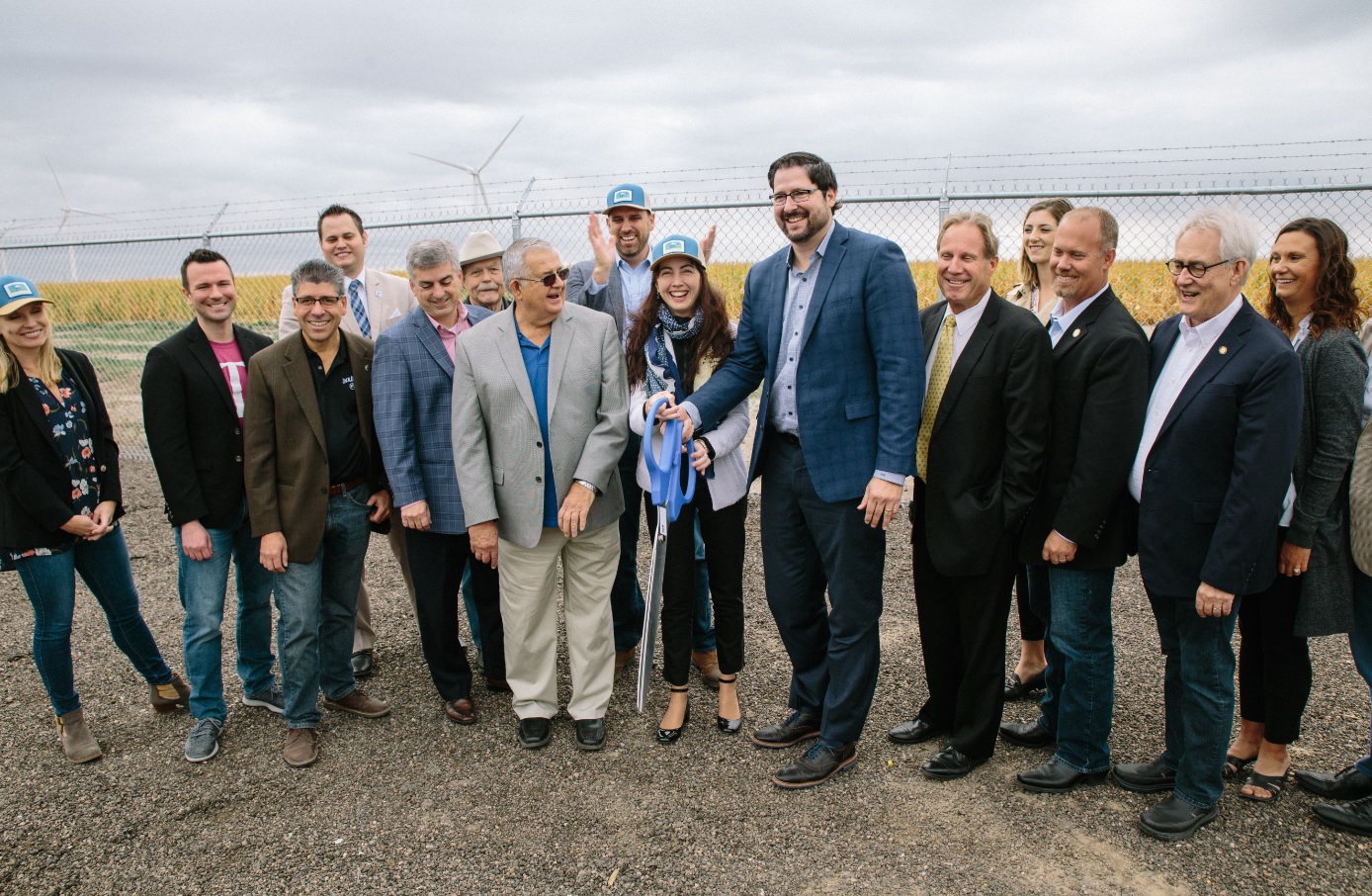
THOMAS COUNTY – Residents, business leaders, and government officials joined ENGIE North America September 26 to mark the grand opening of the Solomon Forks Wind Project, as well as to celebrate the East Fork Wind Project scheduled to become operational in the spring of 2020.
Both projects are located in Thomas County, near the city of Colby, in northwest Kansas and together represent $650 million of investment.
ENGIE is proud to serve T-Mobile US, Inc., Target Corp., Brown-Forman, and Allianz Global Corporate & Specialty through these projects.
With 105 wind turbines capable of producing 276 MW of clean energy, Solomon Forks is currently the largest wind farm in ENGIE North America’s portfolio.
Now in commercial operation, the project will generate significant benefits to the local area for years to come, with lease payments to landowners under land easements, local jobs to operate and maintain the facility, purchases of local goods and services, donations to Colby Unified School District No. 315, and a scholarship fund established by Solomon Forks with Colby Community College.
The East Fork wind project, meanwhile, also has substantial generation capacity at 196 MW from 72 turbines.
Similar to Solomon Forks, the East Fork project is enabling new economic and educational opportunities to the local area, with lease payments to landowners under land easements, local job creation during construction and commercial operation, purchases of local goods and services, donations to local schools, a scholarship fund established by East Fork with Colby Community College, and annual PILOT (payments in lieu of taxes) payments to Thomas County.
“ENGIE, Target, T-Mobile, Brown-Forman, and Allianz Global Corporate & Specialty now know what we have known in Kansas for years – our resources, whether they be our farm ground, our transportation infrastructure, our wind in this case, or most importantly the communities and people of Kansas – are second to none. I applaud ENGIE, Target, T-Mobile, Brown-Forman, and Allianz Global Corporate & Specialty for the success of these projects, ENGIE’s investment in the local community college, and what all this means for Thomas County and all of Kansas,” said Kansas Speaker of the House Ron Ryckman.
“It’s entirely fitting to celebrate the power of wind here in Kansas, a state whose name stems from the Native American word that means ‘south wind,’” said Colby Mayor Gary Adrian. “For businesses and cities, we need to look at the future as an opportunity not a challenge. I’d like to thank ENGIE for the economic and clean energy engine it has become for our community here in Kansas today and for the future.”
“We’re thrilled to become a part of the community here in Kansas and want to thank all who have gathered with ENGIE today for your support,” said Gwenaëlle Avice-Huet, President and CEO, ENGIE North America and Executive Vice President in charge of ENGIE’s Global Renewable Business Line. “We’re proud to make clean, renewable energy a positive catalyst for our customers in their sustainability goals and to enable new economic and educational opportunities within Thomas County.”
Both the Solomon Forks and East Fork projects reinforce ENGIE’s strategy to lead the zero-carbon transition for companies and local authorities. They contribute to ENGIE’s rapid expansion in renewables, with an ambition to build approximately 9,000 MW of new renewable energy projects from 2019-2021 globally, including 2,500 MW of new renewable capacity in North America. The company has an additional 10,000 MW of wind and solar projects in its broader development pipeline in the U.S. and Canada.
About ENGIE North America
ENGIE North America Inc. offers a range of capabilities in the United States and Canada to help customers decarbonize, decentralize, and digitalize their operations. These include comprehensive services to help customers run their facilities more efficiently and optimize energy and other resource use and expense; clean power generation; energy storage; and retail energy supply that includes renewable, demand response, and on-bill financing options. Nearly 100% of the company’s power generation portfolio is low carbon or renewable. Globally, ENGIE is the largest independent power producer and a leading energy efficiency services provider in the world, employing 160,000 people. For more information on ENGIE North America, please visit our Instagram, LinkedIn, Twitter, or Facebook pages or www.engie-na.com.
Mix together a batch of fruitcakes, three dozen Christmas trees, 10,000 outdoor Christmas lights, a chicken pox epidemic, two southern spinsters, an estranged old man, a lost cat named Tutti Frutti and a Christmas hog named Buster and you’ve got the recipe for a fun-filled and touching evening of holiday cheer.
Hays Community Theatre needs actors age 8 to adult. Roles for at least 21 actors plus more. They also need stage crew and lighting crew people!
DIRECTOR’S NOTE: HCT WILL BE PERFORMING THIS SHOW AT 12TH ST. AUDITORIUM IN HAYS ON DEC 6, 7, 8 AND AT THE GRAINFIELD OPERA HOUSE ON DECEMBER 14, 2019. YOU MUST BE ABLE TO BE IN ALL PERFORMANCES.

 If you have a concern that your child may have a developmental delay or be in need of special education services, call for a free developmental screening. Children from ages birth to school age who live in Ellis or Rush counties are eligible to be screened.