AXTELL, Neb. – The Fort Hays State women’s golf team placed eighth overall and seventh among league competition at the MIAA Fall Preview this week (Sept. 24-25). Nebraska-Kearney hosted the event at Awarii Dunes Golf Course, a par-72, 5,845-yard links style layout.
The Tigers improved by 10 shots from round one to round two, posting a 309 on Wednesday after opening the tournament with a first round 319. Kira Mestl and Taylor DeBoer finished tied for 17th after recording a 7-over 151 for the week. Mestl signed for a 7-over 79 in the opening round before finishing at even par 72 in round two, while DeBoer fired scores of 78 and 73.
Madison Roether placed 34th after rounds of 78 and 80, finishing at 14-over 158. Kate Peterka posted consecutive rounds of 84 to finish in a tie for 51st at 24-over 168, while Katie Brungardt (84-90—174) finished in a tie for 56th.
Central Missouri took the team title with rounds of 296 and 291 after placing four individuals in the top 11. Sioux Falls’ Lexi Hanson (74-67—141) took the individual title thanks to a final round 5-under 67.
Fort Hays State continues its fall schedule next week (Sept. 30-Oct. 1) when the Tigers travel to Edmond, Okla. for the UCO RCB Classic, hosted at the Golf Club of Edmond.
John Richard Schrock is a professor at Emporia State University.
More Kansas students will now qualify for admission at Emporia, Fort Hays, Pittsburg and Wichita State Universities. The more rigorous high school academic curriculum was jettisoned for an average high school grade point average (GPA) and a minimal score on the ACT. The rationale for lowering standards focuses on making the process simpler and increasing the number of students who go to college.
The ACT score remains the same as in prior standards. Required high school GPA is now 2.25, except for K-State (3.25) while the University of Kansas will require either an ACT score of 21 and a GPA of 3.25, or an ACT score of 24 and a GPA of 3.0.
The more rigorous Qualified Admissions (QA) high school curriculum, as well as being in the top third of your graduating class, was eliminated across all universities.
While nearly all KBOR discussion was focused on admissions to regents universities and comparisons with a few other state’s requirements, the major impact will be a drop in rigor of high school math and science curricula taught in Kansas high schools.
While I have been a severe critic of better-education-through-paperwork because qualified teachers and not written plans are the answer, Qualified Admissions (QA) standards that went into effect in 2001 were effective. QA caused an immediate shortage of science teachers. Any biology teacher who could add a chemistry or physics endorsement moved to teaching those courses that were mandated by QA. Those shortages continue today. QA also contributed to re-defining teacher licensure, elimination of home economics and shop classes as a “science,” and eliminated a watered down high school “general science” class.
QA also required four high school math courses (or ACT score) rather than three under KSDE requirements for a high school diploma. That fourth math requirement was not widely met. So the Kansas chief academic officers got an end run approved so students could take the fourth math at college. This was but one of many actions that diluted academic rigor in Kansas.
The regents recently forced higher education bachelors programs to reduce down to 120 credit hours. Civilization moves ahead in education requirements over the years (a medical doctor in the 1850s only required two years of college). So academic faculty had good reason to require more education. But the regents first requested and then demanded a reduction of bachelors degrees to 120 credit hours. If any other similar program in Kansas was just 120 hours, all must drop to that level.
This race to the bottom continued over many years as the regent’s committee on transfer and articulation pressured universities to accept transfer courses that had the same name but varied greatly in prerequisites and mode of delivery.
Now high school GPA will be critical. But there has no mention made about how high school GPA, while previously the best predictor of college success, has been rapidly and miraculously increasing, raising high school graduation rates from under 70 percent to over 85 percent, while scores on NAEP, SAT and ACT remain flat or fall. This “Lake Wobegone Effect” (where all children are above average) is making high school GPA less predictive.
The Board of Regents functions much like a corporate board. Unlike the Kansas State Board of Education, KBOR has not held open public forums for over a decade, an avenue where the impacts of QA on K–12 coursework and teacher training could have been discussed. And Kansas presidents and provosts appear more focused on sustaining tuition than defending academic rigor.
These Kansas actions mirror similar actions across other states where higher education bodies or legislatures are likewise lowering requirements to attend state colleges and reducing academic rigor. Many states have followed California in removing the college requirement for college algebra (except for math and science majors) because that course is a factor in many students not completing college. Some states are removing algebra from high school requirements for the same reason.
For decades, American families who host overseas K–12 students from Europe and Asia have noted how those visiting students are several grades ahead of U.S. students in math and science, and likewise how difficult it is for American students to survive at the same grade level in foreign schools. However, there has historically been more equivalency between American and foreign students at the university level, particularly when American creativity is pitted against rote memorization. However, No Child Left Behind teaching-to-the-test has reduced that American advantage at the university level.
Actions being taken by higher education governing bodies across the United States, primarily to feed more students into a university system now more reliant on tuition dollars, ensure that many future American students will lag behind foreign students at the collegiate level. International education conferences already see hallway discussions of concern about the value of the American undergraduate college degree from our non-selective public universities and online diploma mills.
Hopefully, with the Qualified Admissions curriculum gone, Kansas will not return to offering science credit for home economics. But this action does dismiss any need for chemistry and physics in the many small Kansas schools that barely offer a 1930s curriculum and should be consolidated. This regents’ action in Kansas is a symptom of America’s widespread educational race to the bottom.
John Richard Schrock is a professor at Emporia State University.
FINNEY COUNTY— One person died in an accident just after 8:30p.m. Wednesday in Finney County.
The Kansas. Highway Patrol reported a 1997 Ford F150 driven by Rafael Marino-Ortiz, 54, Schuler, NE., west bound on U.S. 50 six miles east of Garden City.
The pickup had tire damage. The driver lost control of the vehicle. It left the roadway to the north, rolled and a passenger was ejected
Adame-Leon, Guadalupe, 72, Schuyler, NE, was pronounced dead at the scene.
Marino-Ortiz, Rafael and passenger, Cristina Solache-Tellez, 45, Lexington, NE., were transported to the hospital in Garden City. The two passengers were not wearing seat belts, according to the KHP.
LEAVENWORTH – A Kansas woman has been found guilty of Medicaid fraud and committing a computer crime, according to Kansas Attorney General Derek Schmidt.
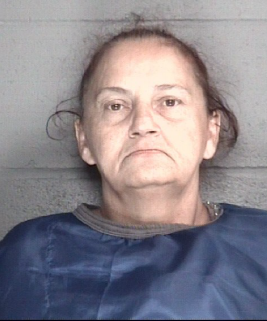
Mathis photo Leavenworth County
Ena Louise Mathis, 53, Leavenworth, pleaded guilty in Leavenworth County District Court to one felony count of Medicaid fraud and one felony count of committing a computer crime.
The case stemmed from an investigation by the Attorney General’s Office Medicaid Fraud and Abuse Division, which revealed Mathis submitted false claims to the Medicaid program to pay for in-home assistance for a Medicaid beneficiary during times when the beneficiary was in a hospital or a resident in a nursing facility.
In total, Mathis falsely billed the Medicaid program for $6,425 over an interactive computer system used by the Medicaid program. The crimes occurred between July 28, 2016, and January 31, 2017.
HUTCHINSON, Kan. (AP) — A Kansas man is suing the city and a police officer after he was stopped while riding a bicycle and subsequently spent time in jail for a drug conviction that was later overturned.
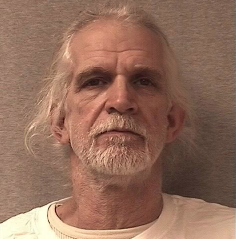
Jon Heter has three previous drug convictions and one for driving while suspended, according to the Kansas Dept. of Corrections
Jon Heter, 55, Hutchinson, was stopped in November 2016 for not having a headlight on his bike. When Heter gave a false name to the officer and refused to give his birthday, officer Josh Long arrested him.
Long later discovered Heter had an outstanding warrant and also found methamphetamine in a container on the bike. Heter was convicted of drug charges and spent three months in prison before the conviction was overturned.
In a lawsuit filed Monday, Heter argues his constitutional rights were violated and the arrest was unlawful. Heter is seeking more than $75,000 in damages.
OVERLAND PARK, Kan. (AP) — The federal government has accused Sprint Corp. of failing to provide service to low-income subscribers after accepting millions of dollars in subsidies to do so.
Federal Communications Commission Chairman Ajit Pai said Tuesday he’s asked the agency’s enforcement bureau to investigate.
KCUR reports Sprint said it had used government funds to provide monthly subsidies for about 885,000 subscribers to the program, called Lifeline. Under the program, low-income consumers are given a $9.25 monthly subsidy toward phone and broadband service
FCC spokesman Mark Wigfield said it’s unclear how much money Sprint received for the program. But Sprint collected at least $8.2 million a month for some period of time.
Sprint said in a statement that it made an error in July 2017 while implementing changes to the Lifeline program that the FCC had approved. Sprint said it would reimburse federal and state governments for subsidy payments collected because of the error
With respect to your right to make these decisions on behalf of all the citizens of the District which you represent, please consider the following regarding naming the buildings recently purchased by us.
The naming of a public building or improvement should serve at least two purposes: clearly identify the purpose and use of the building and encourage respect for the mission of your governmental subdivision.
In the case of the 2501 E. 13th building complex, the purpose and use of the facility is to house the early childhood education programs of the District. The opportunity to engender respect for the mission of giving our students an early and effective start in the lengthy education process is obvious — find someone who exemplifies that and put their name on it. Tell the public where it is.
Please refer to my earlier letters regarding this, and please recall that you asked the public for suggestions. To name the building complex the East 13th Street Kolb Early Childhood Education Center or some variation of that accomplishes all of the core purposes of naming the buildings.
Teachers, patrons, students, taxpayers, government leaders and the thousands of other people whose lives Emma Kolb affected in all-positive ways will appreciate knowing that this School District remembers its heroes and honors them.
This weekend is Hays High School Homecoming. Take a moment to ask the Classes of 1969, 1979, 1989, 1999 and others if they remember Emma Kolb. Ask your faculty if they have heard of her. She gave all of her adult life to the children of western Kansas and particularly Hays and I know of dozens of your current teachers who went into the profession at least partly because of her.
Adding 13th Street to the name will let the general public know where this place is.
When they enter the building they will see that you had the foresight and heart to name it after a teacher who devoted herself to early
childhood education. We will know that you listened to the people you asked to give you public input, which will help this District with its own credibility when it asks us to support new infrastructure and programs.
Respectfully,
John T. Bird
Lincoln School Class of 1960
Hays High School Class of 1966
Hays
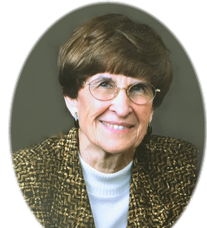
Betty Lou Kessler, 89, long time Kansas resident, passed away on Friday, September 13, 2019, at Atria Senior Living Residence in Virginia Beach, Virginia. She is dearly missed by family and friends.
Betty was born on August 11, 1930, in Ransom, Kansas, the daughter of Harold Schuyler and Alma Rosetta (Grisell) See. She grew up in Ransom, sister to brothers Billie Joe and Charles, where she was Valedictorian of her senior class.
Twice receiving National 4-H honors, she was accomplished as a seamstress, woodworker, high school athlete, and multi-talented musician. She attended Fort Hays State College in Hays, Kansas, where she pursued a Bachelor’s Degree in music education, was a member of the Alpha Pi chapter of Sigma Alpha Iota music fraternity, met her future husband, and was featured in 1952 “Who’s Who in American Colleges and Universities.”
Soon after graduation, on June 07, 1952, Betty was joined in marriage with Richard Sam Kessler in Ransom, Kansas. From this union they raised three children, Charles, Jolene and Brenda. Betty and Richard remained in Kansas and shared a life rich with common interests throughout their fifty-three year marriage. They resided in McCracken, Russell, Hays, and Lawrence before moving to Wichita in 1976, where they lived for more than thirty-five years.
Betty was a dedicated music teacher in her local schools for thirty years, and had a passion for creating individualized learning opportunities for students. In Hays, she completed a Master’s Degree in Music Education and an Education Specialist Degree at Fort Hays State College. In Lawrence, she served as an enthusiastic and dedicated president of the Lawrence Education Association.
After thirty years, Betty retired from teaching in 1982, and redirected her energy and love of working with people into a second career in real estate. Joining Anita Frey, then Plaza Del Sol Realty, she became a highly successful real estate agent in Wichita. For twenty-five years she loved to help families find the perfect home and made many lasting friendships in the process.
She and Richard shared interests in photography, gardening, musical theater, the Kansas City Chiefs, KU sports teams, and traveling to pursue genealogical research and to visit family in Las Vegas, Hawaii, Boston, Italy, and Virginia. She particularly loved spending time with family and friends.
Old family photos sparked a passion in Betty for family history and genealogy. She inherited her grandfather’s diary, written while he served as a White House guard for President Lincoln during the Civil War. Always a history buff, Richard was a willing travel companion while they researched pieces of the story ‘on the road,’ often one tiny cemetery at a time. Following Richard’s death on May 05, 2005, Betty remained an active member of the First United Methodist Church and the Midwest Historical and Genealogical Society. She worked to complete a transcription of her grandfather’s diary begun by a cousin, and donated it to the Soldier’s Home, a museum in Washington D.C. dedicated to Abraham Lincoln, where she was honored in a public reception when the conserved diary was placed on view.
Several years after Richard’s death, Betty moved nearer to family in Las Vegas, Nevada; then to Virginia Beach, Virginia, where she remained until her death.
Surviving family include her son Charles (Chuck) Kessler and wife Becky of Las Vegas, Nevada and daughters Jolene Kessler of Boston, Massachusetts and Brenda McCanon and husband Brian of Lexington, Virginia; ten grandchildren and fifteen great-grandchildren.
Betty was preceded in death by her parents, husband Richard, and two brothers, Charles Herman and Billie Joe See.
Betty’s love for Kansas and her desire to return never wavered. Though we are sad at her passing, we are happy to welcome her back home.
A celebration of Betty’s life will be held at 10:30 A.M. on Monday, September 30, 2019, at the Pohlman-Varner-Peeler Mortuary in Russell, Kansas. Burial will follow at the Russell City Cemetery. Family will greet guests the day of the service.
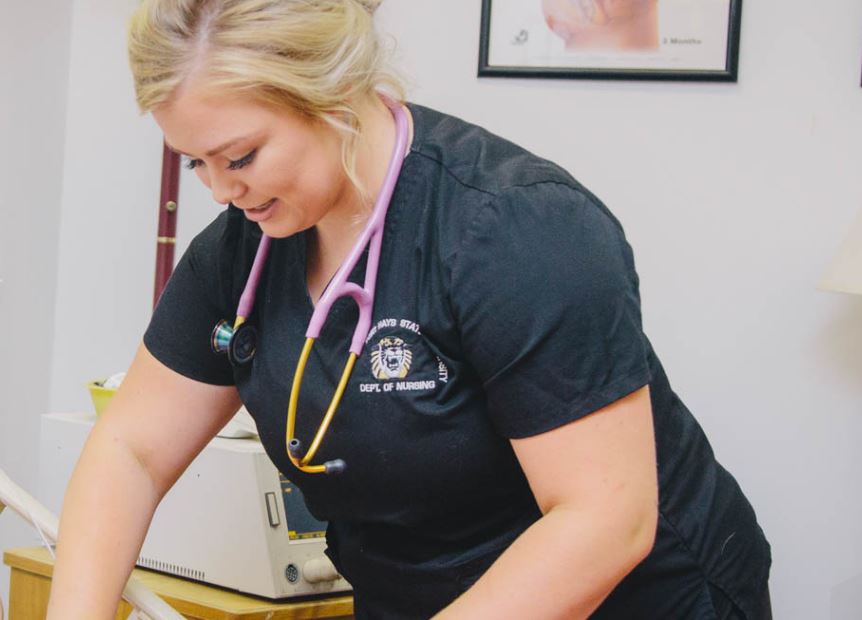
A program and a goal of increasing the number of advanced nursing practitioners in rural Kansas communities have helped the Department of Nursing at Fort Hays State University win the largest individual grant ever at Fort Hays State University.
The program is called the BSN to DNP track. It is a pathway for nurses who have the Bachelor of Science in Nursing to earn the Doctor of Nursing Practice, an advanced practice family nurse practitioner degree without having to leave home. The grant is $2,796,398 from the Health Resources and Services Administration of the U.S. Department of Health and Human Services.
Dr. Jenny Manry, chair of FHSU’s Department of Nursing, said the project has two goals: to increase the number and quality of nurse practitioners in rural areas of the state, and to increase collaboration with clinical sites and on-site professional mentors (called preceptors) to recruit, train and educate the program’s students.
“The BSN to DNP program at FHSU focuses on preparing students to care for populations from the newborn to the elderly,” she said. “Students perform clinicals with both physicians and family nurse practitioners across Kansas, with many students coming from rural and frontier areas.”
The grant covers four years. The program requires 75 credit hours of coursework and, over two years, 900 clinical hours. About half of the grant will go to students as stipends. The aim, said Manry, is to cut down on the hours students have to work to sustain themselves and to provide travel money. “I have some students who drive an hour or an hour and a half every day to go to their clinical sites,” she said.
Jayda Edgar, who is in her third year of the DNP program, has a passion for rural America,
“I hope to continue working in small, rural areas as these are the communities that are struggling to find providers,” she said. “I love the personal connection with the patients and communities.”
The stipend, she said, has been very welcome.
“This stipend has lightened my financial burden tremendously and allows me to focus on my schoolwork,” she said. “I do not think I can put into words my gratitude for this.”
Manry said Edgar is just one of the students who has been positively impacted by the grant. She said she hopes that the funding will impact rural communities by giving students a slight reprieve from financial burdens and allow them to complete the DNP program, which may not otherwise have been possible.
About 50 students are currently working toward their degrees in the BSN to DNP track.
About the grant:
This project is supported by the Health Resources and Services Administration (HRSA) of the U.S. Department of Health and Human Services (HHS) as part of an award totaling $2,796,398 with zero percentage financed with non-governmental sources. The contents are those of the author(s) and do not necessarily represent the official views of, nor an endorsement, by HRSA, HHS or the U.S. Government.
WASHINGTON — It’s vaping week on capitol hill. House Committee on Oversight and Reform heard from officials at the CDC Tuesday.
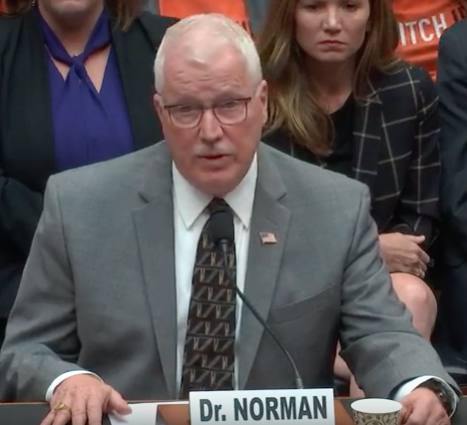
KDHE Secretary Dr. Lee Norman during Wednesday’s testimony image courtesy Energy and Commerce Committee
On Wednesday, Kansas Department of Health and Environment Secretary Dr. Lee Norman addressed the subcommittee in Washington. The hearing “Sounding the Alarm: The Public Health Threats of E-Cigarettes.” Kansas has had two confirmed deaths related to vaping.
Chair DeGette, Ranking Member Guthrie, and distinguished subcommittee members thank you for the opportunity to appear before the House Energy and Commerce Oversight and Investigations Subcommittee today to discuss the need to the public health emergency regarding e-cigarettes, or as the industry has termed it, vaping.
We greatly appreciate your attention to this issue of critical importance to the health of the population. As the State Health Officer of Kansas, a US Army Lieutenant Colonel and the State Surgeon of Kansas, and as a recently-deployed 35th Infantry theater medical commander in the Middle East, I have personally witnessed the deleterious impact addiction to any substance, whether it be nicotine, alcohol or illicit substances has on the citizens of Kansas and the economic costs to our entire health care system. I am now witnessing an outbreak of lung diseases impacting our state and recently claim the life of one Kansan. Our youth were poised to be the generation that ended smoking.
That legacy is now in jeopardy. Youth usage of e-cigarettes, along with outbreak of lung diseases that continue to be investigated, is alarming. As a physician, public servant, military serviceman, father and grandfather,
I owe it to the troops I work with, the staff I support and the Kansans I serve, to do what I can to win this battle for our youth. In Kansas, we currently have eight probable/confirmed vaping related cases with one of those being a death. Of the cases, four are male and four are female and range in age from 17-57 years old. All were hospitalized, five have been released from the hospital and two remain hospitalized. Regarding the types of vaping products used, three of the patients reported using only nicotine, two reported only THC, one reported using CBD, and two reported using both THC and nicotine.
According to the Centers for Disease Control and Prevention (CDC) e-cigarettes typically contain nicotine, most also contain flavorings and other chemicals, and some may contain marijuana or other substances. They are known by many different names and come in many shapes, sizes and device types. E-cigarettes can contain harmful or potentially harmful substances, including nicotine, heavy metals (e.g., lead), volatile organic compounds, and cancer-causing chemicals.
Additionally, some e-cigarette products are used to deliver illicit substances; may be acquired from unknown or unauthorized (i.e., “street”) sources; and may be modified for uses that could increase their potential for harm to the user.
Youth, young adults, pregnant women, as well as adults who do not currently use tobacco products should not use e-cigarettes. E-cigarettes containing nicotine have the potential to help some individual adult smokers reduce their use of and transition away from cigarettes.
However, e-cigarettes are not currently approved by the Food and Drug Administration (FDA) as a quit smoking aid, and the available science is inconclusive on whether e-cigarettes are effective for quitting smoking.1 E-cigarettes are the most commonly used tobacco product among youth.
Forty-four percent of Kansas high school youth who use e-cigarettes also currently use conventional cigarettes. Nationally, 96.1 percent of youth who initiated e-cigarette use between 2016 and 2017 did so with a flavored e-cigarette product. Preliminary findings from the 2019 National Youth Tobacco Survey (NYTS) were reported. They found over one quarter of U.S. high school students report using an e-cigarette product in the past 30 days, an increase from 2018 when the rate of past 30-day use was 20.8 percent. Most teens who are vaping never smoked cigarettes.
Vaping is how they are initiating inhaling substances into their lungs. In Kansas, the top reasons why youth report using e-cigarettes include: a friend or family member uses, its availability in different flavors; and they perceive it as being less harmful than other forms of tobacco. We must work diligently to stop youth from acquiring and using e-cigarettes or vaping devices.
States are taking a leading role in implementing strong action to protect consumers from the harms of ecigarette product use. New York has also banned most flavored vaping products but will allow mint and menthol flavorings to remain on the shelves. California announced a crackdown on illegal and counterfeit vaping products and allocated funds into a public awareness campaign on vaping harms. Kansas is committed to combating the issue.
We are actively reviewing policy options to address this epidemic, which includes options to ban of flavored e-cigarette products through executive action or passing of legislation as the federal government moves ahead with its own regulatory plan. To increase education regarding e-cigarettes and what the tobacco industry has termed as “vaping,”
KDHE and the Kansas Department of Education partnered to develop a Vape-Free Schools kit. Schools are urged to adopt the kit and parents and caretakers are encouraged to have conversations with their children. I recognize this to be a public health emergency of considerable importance. As Chief Medical Officer of large health systems for over 25 years,
I have served as incident commander for H1N1 pandemic influenza, Ebola, the ongoing opioid epidemic, and now this. We are currently losing the battle against e-cigarettes and vaping, and we do not even understand the cause. We need a diligent and consistent approach to solving this, including thoughtful policy-making and regulatory changes, in the name of consumer protection and the public’s health. I am happy to participate in the effort.
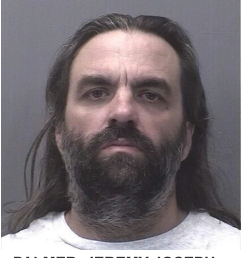
Preliminary autopsy results indicate Norton Correctional Facility Central Unit offender Jeremy J. Palmer died as a result of a cardiac event on Sept. 16.