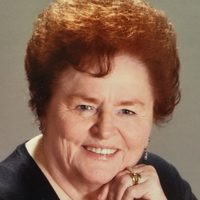
Trella Ann Berscheidt, 75, passed away September 12, 2019, at Clara Barton Hospital, Hoisington. She was born February 29, 1944 in Alexander, KS to Glenn C. & Hazel M. (Swartz) Scheuerman. She married Paul Berscheidt June 23, 1962, at Ellinwood, KS. He survives.
A lifetime Great Bend resident, Trella worked as a Clerk at the Barton County Courthouse. She was a member of Prince of Peace Parish at St. Rose of Lima Catholic Church. She enjoyed helping people and performed volunteer work. Trella loved people, her family and always took care of her husband.
Survivors include, her husband Paul of the home; one son, Michael Berscheidt of Gardner, KS; one daughter, Kimberly Schenk and husband Greg of Great Bend; two brothers, Terry D. Scheuerman and wife Naomi of Tecumseh, OK, and Clifford E. Scheuerman and wife Lynne of Great Bend; 7 grandchildren, Craig Berscheidt, Matthew Schenk, Aaron Berscheidt and wife Kayla, Jason Berscheidt and wife Liz, Jessica Kelly and husband Cody, Sarah Smith and husband Jace, and Blake Berscheidt; and 4 great grandchildren, Colson Kelly, Chloe Kelly, Emma Smith, and Layla Smith. She was preceded in death by her parents.
Visitation will be held from 1:00 to 9:00 p.m., Sunday, September 15, 2019, at Bryant Funeral Home, with Altar Society Rosary at 4:00 p.m. and Vigil service at 7:00 p.m. Mass of Christian Burial will be held at 10:30 a.m., Monday, September 16, 2019, at St. Rose of Lima Catholic Church, with Father Don Bedore. Interment will be in the Lakin-Comanche District Cemetery, Ellinwood.
Memorials have been designated to the Central Kansas Association for the Visually Impaired, Golden Belt Memorial Park Veterans’ Memorial and Golden Belt Humane Society, in care of Bryant Funeral Home.
TOPEKA – Jobs for America’s Graduates-Kansas (JAG-K) announced that for the fifth consecutive year it has earned the Jobs for America’s Graduates 5 of 5 Award. The 5 of 5 Award is bestowed upon those JAG programs that meet or exceed the performance measures in five categories: graduation rate, successful outcomes, employment, post-secondary enrollment and job placement.
JAG has a 12-month follow-up period with all seniors as part of its successful evidence-based, data-driven national model. Seven JAG-K regions and 35 JAG-K programs also earned the 5 of 5 Award. JAG-K students had a graduation rate of 98 percent for the Class of 2018.
“The JAG model has proven that all students, regardless of barriers, can be successful leaders and reach their full potential,” said JAG-K President and CEO Chuck Knapp. “The 5 of 5 Award is important because it shows our JAG-K students are meeting and exceeding goals. While a 98 percent graduation rate is impressive, we are also pleased that 90 percent of our graduates are on a successful career path.”
JAG-K is a nationally accredited in-school program that teaches students career and leadership development skills, requires community service, provides time for academic remediation and ensures students master a minimum of 37 core life-skill competencies. The learning strategies of the national JAG model are primarily introduced through Project Based Learning. JAG-K has been a leader within the national organization for implementing Project Based Learning.
JAG-K is a 501(c)3 not-for-profit organization that partners with students facing various barriers to success, helping them graduate high school and pursue a successful career path. JAG-K currently has 79 programs in 41 Kansas school districts, serving approximately 4,000 students.
The organization starts the 2019-20 school year with new programs in Colby, McPherson and Russell. Knapp indicated there is currently a waiting list of school districts requesting a JAG-K program.
Funding for the program primarily comes from a Temporary Assistance for Needy Families (TANF) grant, administered by the Kansas Department for Children and Families (DCF).
JAG-K is an affiliate of the national Jobs for America’s Graduates program that started in 1980 and has 35 affiliate organizations across the country. In addition to school districts, JAG-K partners with DCF and the Kansas State Department of Education. JAG-K also receives private funds from contributors including Taco Bell Foundation, AT&T and John Deere Coffeyville Works.
JAG-K partners with public schools to offer an elective class that provides academic and other positive supports to ensure students earn their diploma. By exploring career opportunities and practicing soft skills, students are prepared to successfully transition to post-secondary education, military service, or into the workforce following their graduation.
TOPEKA – With the goal of providing vulnerable families access to strong evidence-based programs, Governor Laura Kelly Friday announced new grantees for the state’s family preservation program.
“At the beginning of my administration I canceled previously awarded family preservation grants because of the lack of transparency,” Kelly said. “Today, I am pleased to say that the Department for Children and Families with assistance from the Department of Administration have chosen well qualified partners to assist in our efforts to strengthen families.”
“I am excited that these new grantees include familiar faces and new partners,” Department for Children and Families Secretary Laura Howard said. “DCF looks forward to working together to reduce risk and safety concerns for children and keep Kansas families together.”
Family preservation is a voluntary service provided to families with a child at risk of entering foster care. It includes both short term case management services and intensive in-home services. The program also may serve pregnant women using substances to help the mother find and maintain substance use treatment.
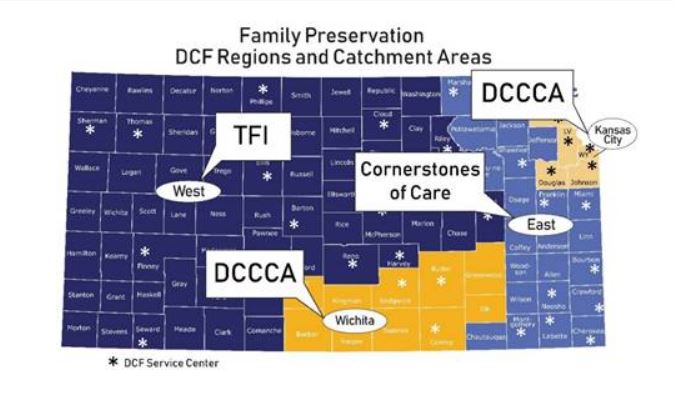
Beginning Jan. 1, three grantees will manage the four DCF regions.
· DCF awarded DCCCA the contracts in the Kansas City and Wichita Regions. DCCCA has 12 years of experience providing family preservation services in Kansas. The agency also has more than 30 years as a prevention services provider and more than 43 years as substance use disorder and addiction provider.
“Given DCCCA’s experience with family services, expertise in substance abuse programming, ability to engage communities and our mission of improving lives, these family preservation grants allow us to combine our strengths,” DCCCA CEO Lori Alvarado said. “Our ultimate goal is to strengthen families and support them to nurture their children, which helps reduce the number of children in care.”
· DCF awarded TFI Family Services the contract for the West region. TFI previously provided family preservation services in Kansas from 2005 to 2009. The agency also has provided recruitment, training, retention and support of foster families across Kansas since 1996.
“TFI Family Services is honored to be selected as the provider for family preservation services in the west region,” TFI CEO Michael Patrick said. “We are excited that our TFI caseworkers and therapists will have the opportunity to serve some of our most at-risk families and ensure they remain safely together as a family.”
· Cornerstones of Care of will manage the contract in the East region. Cornerstones provides intensive in-home services in several Missouri counties including the Kansas City area. The agency also is providing family services for the DCF Kansas City region and functional family therapy for the Kansas Department of Corrections.
“We’re beyond honored and grateful to grow our partnership with the State of Kansas across the DCF East region,” Cornerstones of Care president and CEO Denise Cross said. “We strongly believe in prevention services and will work closely with children, families and community partners through a trauma-informed philosophy. Together, we can keep children safe and families together.”
In order to maintain transparency throughout the process, DCF partnered with the Department of Administration to use a traditional request for proposal process that included:
· DCF grant review teams representing each region and administrative staff
· Technical review for evidence-based practice models, child welfare experience, staffing ratios, accreditation and letters of support.
· Cost proposal review by fiscal staff
In total, DCF received two proposals for the west region, three proposals for the east region, four proposals for the Kansas City region and five proposals for the Wichita region.
The contract term awarded is Jan. 1, 2020 through June 30, 2024.
To report child abuse or neglect or to request services, please call the Kansas Protection Report Center at 1-800-922-5330.
TOPEKA – Every day in America, millions of parents and caregivers take to the road with children in their vehicles. While many children are buckled up in the right car seat for their ages and sizes – nearly half (46 percent) are not, and some aren’t buckled up at all.
Child Passenger Safety Week is September 15-21, 2019, and Safe Kids Kansas, the Kansas Department of Transportation and Kansas Highway Patrol want to ensure children ride as safely as possible—every trip, every time.
“Every 32 seconds in 2017, a child under 13 was involved in a motor vehicle crash,” said Colonel Herman T. Jones, Kansas Highway Patrol. “Using a car seat that fits your child and your vehicle is the best way to keep your children safe.”
According to NHTSA, motor vehicle crashes are a leading killer of children. While fatalities and injuries declined from 2016 to 2017, there is still work to be done to completely eliminate these preventable tragedies. Car seats, booster seats, and seat belts can make all the difference. “In 2017, there were 312 children under the age of 5 saved because they were using restraints,” said Col. Jones. “Car seats matter.”
Too often, parents move their children to the front seat before they should, which increases the risk of injury and death, even if they are buckled up. The safest place for all kids under 13 is in the back seat.
“As parents and caregivers, we have a long list of things we do for our children to show our love. One of the simplest and most important things on the list should be to make sure they are in the right car seat for their age and size,”said Cherie Sage, Safe Kids Kansas. “Get your car seats checked. Make certain they’re installed correctly, and that your kids are in the right seats and are buckled in correctly. Even if you think your child’s car seat is installed correctly, get it checked with a certified Child Passenger Safety Technician, so you can be sure that your child is the safest he or she can be while traveling.”
According to a 2018-19 observational survey, if the driver is belted, about 97% of the observed children are belted too. If the driver is not belted, about 30% of the observed children are belted.
“Drivers play an important role in not only getting to a destination safely, but ensuring all passengers are buckled up,” said Julie Lorenz, Kansas Secretary of Transportation. “Seat belts are for everyone because your life and your passenger’s lives depend on it.”
For optimal safety, it is recommended to keep children rear-facing as long as possible, up to the top height or weight allowed by their particular seats. Once a child outgrows the rear-facing-only “infant” car seat, he/she should travel in a rear-facing “convertible,” or all-in-one car seat. Once your child outgrows the rear-facing size limits, the child is ready to travel in a forward-facing car seat with a harness (always use the tether). After outgrowing the forward-facing car seat with harness, children should be placed in booster seats until they’re the right size to use seat belts safely. And if children are under 13 years old, they should always sit in the back seat.
Remember to register your car seat or booster seat with the seat manufacturer so you can be notified in the event of a recall. Parents and caregivers can find more information on how to choose and use car seats safely at www.ultimatecarseatguide.org.
A group walks during the Out of Darkness Walk Saturday in Hays to bring awareness to suicide.
By CRISTINA JANNEY
Hays Post
You are not alone — that was the message many of the walkers had at the annual Out of Darkness Walk in Hays had on Saturday.
About 70 people gathered at Municipal Park to remember friends and loved ones who have died as a result of suicide or to find support as they or someone they care for struggles with depression.
The Kelly Center, one of the sponsors of the event, provided colored beads that walkers could wear to show how they have been affected by suicide.
One woman, who did not wish to give her name, said not only has she struggled with depression, but she lost both her mother and grandmother to suicide. She was only 18 when her mother died. She said she felt as if her mother abandoned her.
“… that she didn’t care enough and didn’t love us enough to stick around,” she said, “but at that time, I didn’t understand that has to do with suicide like I do now. I am more understanding now, and I don’t have any anger toward her. If anything, I want to give back.”
A desire to be here for her family has helped her resist acting on thoughts of suicide. She also leans on her friends, some of whom also struggle with depression and anxiety. She also goes to therapy regularly and takes medication.
“It is weird with people who have never been suicidal. It’s hard to explain. It is easier for them to say, ‘Get over it’ or ‘I’ll get you something that will make you feel better.’ There is always some easy solution. … ” she said. “A lot of people who commit suicide have a lot of things we don’t even know about as far as what they have gone through and their traumas.”
She added, “It is not any select group. It happens to the rich. It happens to the poor. It happens to people who have everything and people who have nothing.”
Jess Bieker, 30, also struggles with depression. She attempted suicide and survived. She also lost a friend in high school to suicide.
In her darkest time, she struggled to care for herself even to eat because of her depression. For almost a year, she almost never left her house.
“Taking a shower was like running a mile,” she said. “I could hardly get myself to do that.”
She was constantly hearing a voice that told her to kill herself. She was convinced nobody wanted her around.
“Suicide victims are not selfish,” she said. “When they are doing that act, they think they are doing everybody a favor. I thought by sacrificing myself, I thought I was going to help my family, not be a burden.”
To deal with her depression and anxiety, she goes to therapy regularly and changed her diet.
“I was isolating myself in my bedroom in big cycles, so I forced myself to get out and get sunshine,” she said. “I did a lot of self-worth talk. That was a problem. I thought I was worthless and everybody’s lives would be easier without me. I learned to love myself because I learned I couldn’t help anyone else until I helped myself.”
Bieker has a bachelor’s degree in psychology and has worked as a recovery specialist. She hopes to return to school and study for her master’s degree in social work and work with others who have struggled with mental illness.
Bieker encouraged people who also may be struggling with depression to reach out.
“There are people who care. Your brain tricks you. You are going to think nobody loves you at all. That is never true. There is at least one person that will listen. Please just talk to somebody.”
Emma Vredenburg, 17, of Hays said it was a friend physically pushing her into her school counselor’s office that led to her getting help for her depression and anxiety.
“It was really rough in the beginning. I didn’t feel anything in the beginning and then I felt all of these emotions,” she said. “I didn’t know where they came from or how to process any of it.”
Her depression made school very difficult. She wasn’t motivated to do her school work and she was anxious about even going to school.
Vredenburg is now participating in therapy.
“It helped me realize what I was doing to work through my depression wasn’t healthy and that I needed to change how I processed things to make my brain healthier,” she said.
She said she would tell other students her age that depression and anxiety is not just something that you are going through.
“There are people you can reach out to,” she said, “and it will help. In the beginning, it feels horrible, but if you talk to someone, even if it is just a friend or a teacher or a parent and then get professional help if you need it, you’ll feel way better.”
Vredenburg said she has struggled with suicidal thoughts, but her family has been there to listen and help her through those feelings.
She said she would tell others who may be struggled with the same thoughts, “Everyone is loved. No matter who you are or what you think of yourself, there is someone who loves you.”
Alexis White, 16, and a large group of other participants, walked for White’s best friend, Calista Isbell, an Hays High School student who died by suicide when she was a freshman. This is White’s second year participating in the walk. Isbell’s mother also participated in the walk, wearing a picture of her daughter pinned to her shirt.
“I just really feel like it is important to get the word about suicide out there,” White said. “It is one of the things that isn’t talked about as much. It is something that is happening all over the world.”
White said her friend’s death had a significant negative affect on her.
“I didn’t realize how much I relied on her until she wasn’t here anymore,” she said.
She said she and others felt a lot of guilt after Calista died.
“After awhile you learn to accept the fact that you couldn’t have changed what happened,” she said. “There is nothing that could have been said or done that could have changed anything if they were already in that state of mind.”
High Plains Mental Health has a 24-hour crisis line that can be reached at 1-800-432-0333. The National Suicide Prevention Lifeline is 1-800-273-TALK (8255). The national suicide crisis text line can be reached at 741741.
The local National Alliance on Mental Illness (NAMI) group meets on the first Monday of the month at 6 p.m. at the Hadley Center. For more information, contact Ann Leiker, coordinator, at 785-259-6859.
Over the last five years, almost 15,000 workers disappeared from the Kansas workforce.
During the same timeframe, the state is growing economically, with a recent monthly report showing 14,000 jobs created in the last year and unemployment at 3.3%. That’s below the national rate.
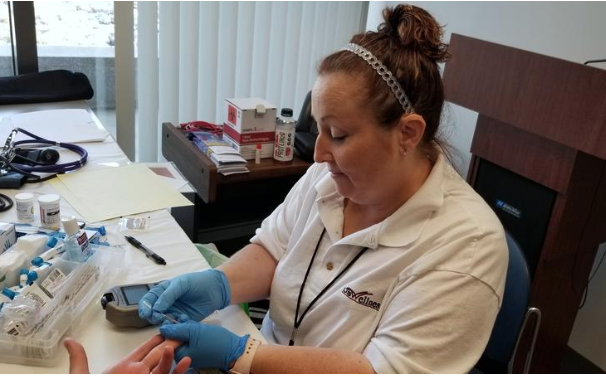
A worker draws blood during a health-care screening in Topeka. Health care jobs will be in high demand as Kansas’ population ages. STEPHEN KORANDA / KANSAS NEWS SERVICE
Despite the good news, Kansas officials see a long-term challenge: having enough employees to fill the state’s jobs, especially in high-demand careers like nursing and accounting.
The total labor force in Kansas peaked in 2009 at 1.521 million, likely driven by the economic downturn that caused people to enter the labor force who otherwise wouldn’t be working. That tapered off, and by the middle of 2014, Kansas’ workforce was 1.493 million.
By July, the number had fallen to 1.479 million.
There are multiple factors at play, Kansas Department of Labor Senior Labor Economist Tyler Tenbrink said, and it starts with the state population.
“Population growth has been almost zero for a few years now,” he said.
Other factors are delaying people from entering the workforce or causing them to leave it. One thing is age: Many in the baby-boomer generation are retiring or could soon.
There’s also pressure on the younger end of the age scale.
“We also have students who are staying in school longer, so they’re not getting into the labor force as quickly,” Tenbrink said.
Certain industries have greater challenges when it comes to the workforce. In the coming decades, the population of older Kansans is expected to grow faster than the state overall, which will require more workers in health care, a sector that’s already struggling.
The Kansas Hospital Association compiled a report outlining the challenges and noted many jobs with expected shortages, ranging from nurses to nursing assistants and home health aids.
“These are the folks that care for people, that are at the bedside,” KHA Vice President Cindy Samuelson said.
To try to tackle the problem, hospitals are partnering with colleges and universities to find ways to let people know there are good-paying careers in demand. Many positions just require a two-year degree, and people can work in the industry while training for a future higher position.
It’s not always as simple as advertising for good-paying jobs. Some hospitals are working to recruit outside of Kansas, but sometimes those workers don’t stay for the long term. It’s led some to find and train local hires, which is what Samuelson calls “growing your own.”
“There is a lot of cost associated with training and getting that person up to speed, and if they’re only there a short amount of years there is a loss,” she said.
It’s a tough nut to crack, and Kansas Labor Secretary Delía García wants state officials to make it a focus by working more closely with education and business groups to train workers while also having lawmakers and officials craft economic development programs to target the problem by attracting people.
“We are in good shape in Kansas, we are stable,” García said. “But we also want to be looking forward.”
Stephen Koranda is Statehouse reporter for the Kansas News Service. Follow him on Twitter @kprkoranda or email skoranda (at) ku (dot) edu.
Every year, Rockalooa gets a bit bigger, and this year promises to be no different as bands from across Kansas, Oklahoma and Colorado will descend upon Hays on Saturday, Sept. 21, in Municipal Park for a music event like no other in the area.
“It seems that every year we do it, there are more bands coming out,” said Matt Isley, organizer.
The event is an opportunity for bands to bring their musical talents to Hays.
“It’s a showcase that features local bands and other bands from regional hubs like Kansas City, Denver and Wichita,” Isley said. “It also features visual artists and food.
“It’s something interesting and out of the ordinary that people can enjoy in Hays,” he added.
This is the second year the event will be held outdoors after the event outgrew venues available in Hays.
“It will be 20 bands at the park and there is going to be an after show at the (Golden Q, 809 Ash), that’s going to be three bands,” Isley said.
While the event will feature several genres of music, rock will be the primary music showcased at the event.
“As the name suggests, it’s mostly rock music,” Isley said. “You’ve got indie rock, you’ve got harder rock, there are some covers in there.
“There are some other genres too,” he said. “We have some singer-songwriters, we have some folk music, there’s some hip-hop music, so it’s pretty diverse and a little bit of everything.”
After being involved in bands in the area, Isley created Rockalooa after seeing an opportunity to bring a music festival to Hays that is a draw in other cities across the state.
It also gives the bands exposure outside of the normal late-night scene at local bars and venues.
“I really feel like it’s a place for local bands have a place to be and showcase them in a light that isn’t just at the bar, on a larger platform than usual,” Isley said.
Outside of the musical acts, art vendors use Rockalooa as a way to showcase their work.
“They are showing art, they are selling art,” Isley said. “You can buy big, nice paintings or you can buy prints of the paintings. There are all kinds of things that people bring out.
“Local artist can show off a little bit and promote their thing,” he said, noting it’s not just visual artists that will be there, but jewelers and handmade bookbinders have been apart of previous events.
Some local organizations also use the event as a fundraising platform through games or sales, Isley said.
While the music will likely appeal to a young adult crowd, Rockalooa will be a family-friendly event.
“It’s all ages, and there are kids activities,” Isley said. “Kids under 10 will get in free with a parent or guardian.”
Tickets are on sale for the 2019 Hays Area Young Professionals’ Adult Prom.
This year’s theme is Masquerade Gala.
The Hays Area Young Professionals will host an event on Saturday, Nov. 9, at the Rose Garden Banquet Hall, 2350 E. Eight St., Hays.
The event will consist of a cocktail social hour at 6 p.m., a catered dinner at 7 p.m. and a DJ’d dance with DJ’s KZNC Party DJ’s. There will be a cash bar available, presented by The Rose Garden Banquet Hall. Prom Attire is welcome, but not required. Masquerade masks welcome, and there will be a small selection of masks available at the event.
Throughout the night, there will be three raffles, as well as the crowning of the prom king and queen. Nominations for the prom court will be accepted through the Facebook event page and will be limited to five candidates for king and queen.
Community Drive
This year, HAYP is teaming up with the Humane Society of the High Plains for Adult Prom. The items requested for donation include: Purina Dog and Puppy Chow, Purina Cat and Kitten Chow, cat and dog Toys, leashes and collars, blankets and towels. Items for donation can be dropped off at any point before Nov. 8 to any of the ticket outlets, as well as during the event. There will be a short presentation from the Humane Society of the High Plains before the dance begins.
Tickets
Tickets will be for $30 each. Groups of six may reserve tables when purchased together. Adults 21 years and older are permitted. Cash and Check are the accepted payment method. Checks should be made out to Hays Area Chamber of Commerce. Ticket Outlets are
The Hays Daily News – 507 Main St.
CBD American Shaman – 2013 Vine St.
Hays Area Chamber of Commerce – 2700 Vine St.
Email [email protected] for tickets if you are unable to reach these locations
Tickets are available for purchase through Oct. 25.
Selection Board will review applications, interview candidates for admission to U.S. Service Academies
WASHINGTON – U.S. Senator Jerry Moran (R-Kan.) today announced members of his 2019 Service Academy Selection Board. The 20-member board will review applications and interview candidates who are applying for admission to U.S. Service Academies.
“One of the greatest responsibilities I have as a United States Senator is to nominate Kansas students to attend service academies,” Moran said. “I am proud of these young students for their desire to serve our nation, and I’m grateful to my Service Academy Selection Board for the thoughtful consideration they put into the application process. These students applying to enter service academies represent the best of Kansas, and I look forward to receiving the selection board’s recommendations and meeting with students in Hutchinson.”
Applications will be reviewed and selected applicants will be interviewed by the selection board on Saturday, Sept. 21, at the Cosmosphere in Hutchinson. The U.S. Service Academies include the U.S. Military Academy, U.S. Naval Academy, U.S. Air Force Academy and U.S. Merchant Marine Academy.
Members of the 2019 Service Academy Selection Board include:
Lt. Col. (RET) Bob Brock of Topeka – Director of Aviation, Kansas Department of Transportation, U.S. Air Force veteran;
Myca Bunch of Garden City – President, Garden City Area Chamber of Commerce, U.S. Air Force veteran;
LTC (Ret) Larry Burks, Sr., of Wichita – Director, Military and Veteran Services, Wichita State University, U.S. Army veteran;
Dennis Butler of Manhattan – Director, Riley County Police Department;
COL John Cluck of Wathena – Mayor, City of Wathena, Vice Commander, 139th Airlift Wing, Missouri Air National Guard;
Ardith Dunn, Ph.D., of Satanta – Retired high school mathematics/computer instructor, K-12 superintendent, mother of U.S. Air Force Academy graduate;
Michael Farris, M.D., of Altamont – Emergency Physician, Freeman Neosho Hospital, Served in the U.S. Air Force Reserves;
Sue Givens of El Dorado – Field Specialist, Kansas Association of School Boards, Retired K-12 superintendent;
Robin Jackson, Ph.D., of Hutchinson – Central Christian College Professor of Science and Mathematics;
Cheryl Kerns of Overland Park – Blue Valley West High School teacher, mother of U.S. Military Academy graduate;
Brian Kessens of Overland Park – Tortoise Capital managing director, U.S. Military Academy graduate;
Katrina Lewison of Manhattan – USD 383 Board of Education Member, Purple Heart recipient, U.S. Military Academy graduate;
Jayne Humphrey Pearce of Wallace – Wallace County Visitors Bureau Marketing and Tourism Director, U.S. Air Force veteran, mother of U.S. Air Force Academy graduate;
Rachael Pitchford of Dodge City – Assistant Principal, Comanche Middle School, U.S. Marine Corps veteran;
Sean Ritchie of Wichita – Cargill North American Operations Lead, U.S. Merchant Marine Academy graduate;
Halley Roberson of Oberlin – City Administrator, City of Oberlin, U.S. Army veteran;
Mike Souder of Prairie Village – Dean of Continuing Education, Johnson County Community College, U.S. Military Academy graduate;
Sam Turner of Leawood – Retired Shawnee Mission Medical Center CEO, Vietnam War veteran, U.S. Army veteran;
Ron Whitney of Emporia – American Legion member, Veterans of Foreign Wars member, U.S. Army veteran;
Beth Wilson of Girard – Business education teacher, Girard High School, mother of U.S. Naval Academy Midshipman.
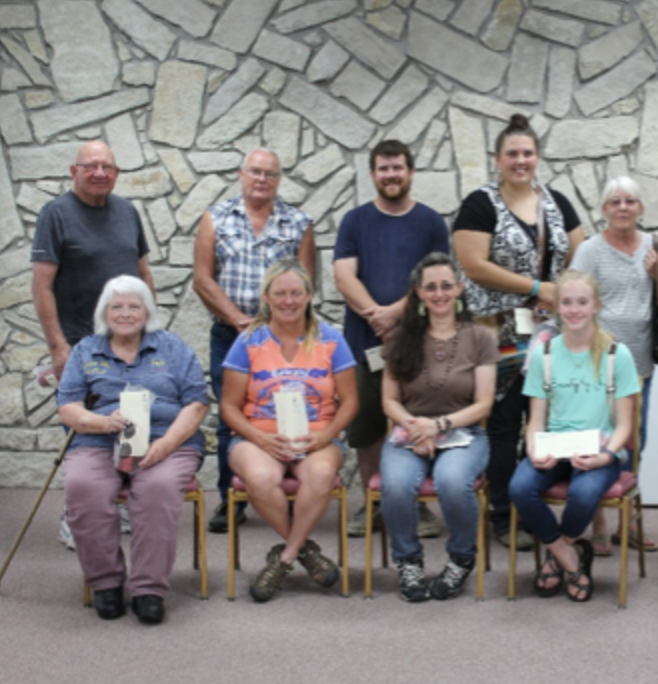
Back Row (L-R): Gale Lohrmeyer, Ron Howland, Sean Linden, Jordyn Leggett, Nancy Williams, Ron Hessling, Virgil Uhrich, Nancy Elting. Front Row (L-R): Joyce Underwood, Stephanie David, Marcia Anderson, Jaelyn Rumback, Dede Elsen, Sami Randle.
LOGAN – Each year, the Dane G. Hansen Museum Board requests the services of two qualified individuals to select 12 winners and two alternates from crafters taking part in the annual Hansen Arts and Crafts Fair.
These chosen crafters become our “Artists of the Month” for the next year. The Dane G. Hansen Museum is pleased to announce the following 46th annual Hansen Arts & Crafts “Artists of the Month” winners:
Stephanie David (Lenora, KS)
Jordyn Leggett (Logan, KS)
Jaelyn Rumback (Clayton, KS)
Virgil Uhrich (Wakeeney, KS)
Nancy Williams (Stockton, KS)
Ron & Betty Jo Hessling (Alton, KS)
Nancy Elting (Lincoln, NE)
Marcia Anderson (Cedar, KS)
Sean Linden (Collyer, KS)
Gale Lohrmeyer (Logan, KS)
Sami Randle (Russell, KS)
and Dede Elsen (Kearney, NE).
Ron Howland (Cawker City, KS) and Ron & Joyce Underwood (Everest, KS) were selected as alternates.
Crafters are selected for their uniqueness, creativity, presentation, individual art form, and excellence of craft. As a winner of this prestigious award, each received a high-quality engraved water bottle with a declaration of their award and the 46th Annual Hansen Museum’s Arts & Crafts Fair logo. Additionally, their craft will be exhibited and sold in the Museum for an entire month during the next calendar year.
The Museum is open Monday through Friday 9-12 and 1-4; Saturday 9-12 & 1-5; Sunday and holidays 1-5. We are closed Thanksgiving, Christmas, and New Years. We are handicapped accessible and admission is always free thanks to the generous support of the Dane G. Hansen Foundation. For more information or if you have questions, please contact us at 785-689-4846.
RENO COUNTY — One person was injured in an accident during a chase just after 2p.m. Saturday in Reno County.
The Kansas Highway Patrol reported a 2004 Suzuki motorcycle driven by Skyler J. Rupp, 21, Wichita, was fleeing from Mount Hope Police southbound on Obee Road six miles south of K-96.
The driver lost control of the motorcycle and crashed.
Rupp was transported to a hospital in Wichita. He was wearing a helmet, according to the KHP. Authorities have not released what prompted the chase.
WICHITA — Large industrial operations — think electrical power plants, oil refineries, ethanol facilities —cough carbon dioxide into the atmosphere by the ton. That, in turn, warms the planet.
Carbon dioxide is all around us. Plants use it for food. Humans exhale it. It’s used in dry ice and to make your soda fizzy.
But it’s produced in serious, problematic quantities when we burn fossil fuels — every time we jump in a car and to generate the majority of the electricity we use.
When we do that, we’re taking carbon that was once stored in the ground and putting it into the atmosphere as carbon dioxide, or CO2.
To prevent some of the catastrophes that would cause, researchers want to stash CO2 emissions back in the ground.
With funding from the U.S. Department of Energy’s CarbonSAFE program, researchers from the Kansas Geological Survey, environmental policy groups, lawyers and oil and gas companies spent the last three years investigating the feasibility of carbon capture and storage in Kansas.
(By Crysta Henthorne/Kansas News Service)Kansas Geological Survey petroleum engineer Eugene Holubnyak has been working on the carbon capture and storage project in Kansas for three years.
“No matter how you slice it,” said Eugene Holubnyak, a petroleum engineer leading the project at the Kansas Geological Survey, “we’re centrally located and I think we have all the necessary components that need to be in place to be a hub for distributing CO2.”
The research first looked at the potential of capturing CO2 emissions from Westar’s Jeffrey Energy Center, a coal-fired power plant located northwest of Topeka. It’s one of the largest emitters of carbon dioxide in the country.
The project would work like this.
First, capture the CO2 straight from the exhaust stacks of the power plant. Then, compress the gas into a liquid. It would then be put it in a pipeline and sent to southwestern Kansas where it would be pumped deep into the ground.
In some cases, it would be put into what’s known as a saline aquifer — essentially a natural underground storage tank.
In other cases, it would be used for something called enhanced oil recovery. That means injecting CO2 into the ground on one side of a deposit to push hard-to-reach oil and gas toward a well on the other side.
The researchers discovered that, at this point, that plan would be too expensive. Even with recently approved tax incentives aimed at jumpstarting carbon capture projects, it would cost Jeffrey Energy Center far more to capture and compress than it could make selling the CO2.
A possibility that might be more economically tempting would capture CO2 from a network of ethanol plants across the Midwest.
That’s because unlike the byproduct of burning coal, which contains multiple chemicals — pollutants that would have to be separated before you pump anything into the ground — ethanol coughs up relatively untainted carbon dioxide.
“The challenge is that, relative to the size of a power plant, ethanol plants are pretty small,” said Brendan Jordan who worked on the project for the Great Plains Institute, a non-profit that wants to transform the country’s energy systems.
Under that scenario, size would matter. To make the same kind of impact that capturing CO2 from a power plant would have, ethanol plants from all over the Midwest would need to be connected through a regional pipeline.
Jordan said that kind of network would be a start until the cost of capturing power plant CO2 and other industrial sources drops dramatically.
And it might rally a range of people often at odds with each other.
Environmentalists support it because it could help curb climate change. Ethanol plants like it because it opens up a new revenue stream selling CO2 to oil and gas companies. The oil and gas industry is on board because it’s looking for a cheap, consistent source of CO2 to use in enhanced oil recovery.
That kind of broad support makes Jordan optimistic a commercial project could launch in the next five to ten years.
“The problem we have in the Midwest is a mismatch between where a lot of the ethanol plants are and where the appropriate geology is,” Jordan said.
Kansas is right in the middle of that equation. Any major pipeline project would have to run through the state — allowing both producers and consumers of CO2 to easily connect.
“You’ve got the right geology to do saline projects and you’ve got a lot of oil and gas,” Duguid said. “Those fields are at the right depths and have the right properties to do enhanced oil recovery.”
But some environmentalists worry about the unintended consequences of the tax incentives that make any of this profitable enough for companies to try. Particularly since it might just enable more oil drilling.
Hawkins argues carbon capture and storage isn’t a grand solution for eliminating all fossil fuel emissions, but rather one of many tools to reduce their impact.
Even if carbon capture makes it easier to drill for, and burn, oil, Hawkins said it could ultimately offset the fossil fuel use it would make easier.
For now, at least, it’s all still an idea. Researchers and industry professionals are working to make it a reality. But a future with large-scale carbon capture, pipelines and storage projects still largely depends on potential regulatory changes, tax incentives, and the economy as a whole.
So when will the first project get built in Kansas?
“Bold statement: five years,” Holubnyak said. “If not in this time it’s probably never going to happen.”
Brian Grimmett reports on the environment, energy and natural resources for KMUW in Wichita and the Kansas News Service. You can follow him on Twitter @briangrimmett or email him at grimmett (at) kmuw (dot) org. The Kansas News Service is a collaboration of KCUR, Kansas Public Radio, KMUW and High Plains Public Radio focused on the health and well-being of Kansans, their communities and civic life.
HAYS, Kan. – The Fort Hays State volleyball team wrapped up a busy weekend with a come-from-behind victory against Northwestern Oklahoma State Saturday evening (9/14). The victory came after the Tigers opened the day with a three-set loss to Western Colorado.
After splitting two matches for the third-straight day dating back to last week, the Tigers wrap up non-conference play with a 3-5 record. The Mountaineers of Western Colorado moved to 3-4 following the win, while the NWOSU Rangers are now 5-4 on the season.
With the MIAA down to 11 volleyball schools, the Tigers will play each team twice in an expanded 20-game conference schedule beginning next week. FHSU will travel to Topeka, Kan. to take on No. 4 Washburn on Friday at 6 p.m. (Sept. 20) before returning home to host Emporia State one week from today (Sept. 21). First serve is set for 5 p.m. from Gross Memorial Coliseum.
Fort Hays State 3, Northwestern Oklahoma State 1 (20-25, 19-25, 19-25, 18-25)
The Tigers head into league play on a high note after a gritty win over Northwestern Oklahoma State. The Rangers appeared to be en route to their fourth win of the weekend after a 25-20 victory in the first set, but FHSU rallied to send the Tiger faithful home with a win.
The Black and Gold could not get out of their own way in the first set, giving the Rangers 12 points on 10 attack errors and two setting miscues. The teams traded the lead for much of the set until NWOSU used a 9-4 run to turn a 16-16 tie into an opening-set victory.
The Tigers turned things around in the second set, swinging at a .359 clip (17-3-39) to overpower a .289 swing rate by the visitors. Morgan West made the most of her opportunities in the frame, dropping in five kills on six attempts. Taylor White tallied three service aces in a five-point stretch late in the set to help the Tigers pull away and level the match.
Delaney Humm was a consistent presence in the Tiger offense, recording six kills in three sets and four in the other. The freshman helped FHSU pull away in the third set after breaking a 10-10 tie with a big kill. Humm followed that up with a service ace, leading to a five-point Tiger run. The Rangers closed within two later in the set, but three NWOSU errors and one final kill from Mykah Eshbaugh handed the Tigers a 2-1 lead in the match.
The Rangers managed to keep the fourth set close for the first few rallies, but the Tigers took the lead for good when a Tatum Bartels kill put them in front 8-7. Humm later gave Fort Hays State a chance at set point with a kill and an assisted block with fellow freshman Morgan Christiansen before the match came to a close on a Ranger attack error.
Humm matched her season high with 22 kills, adding 11 digs, one block, one service ace and one assist. Bartels was also sharp on offense, adding 17 kills with a .364 attack percentage. Abbie Hayes led the team with a career-best 32 digs, the most for a Tiger since the 2015 season (Ari Jacobsen, 39 vs. MWSU, 11/6/15). Katie Darnell’s career-high 61 digs were the most for an FHSU setter in over three years (Hannah Wagy, 61 at Westminster, 9/10/16).
White added 21 digs to her three service aces, while Madison Miller totaled 10 digs and one kill.
After a rough first set, the Tigers finished the match with a .241 attack percentage while holding NWOSU to a .184 swing rate. Fort Hays State had a sizeable lead in back row statistical categories, putting up 80 digs to just 57 from NWOSU and recording three more service aces (FHSU 5, NWOSU 2). The Rangers won the blocking battle, 8-3.
Western Colorado 3, Fort Hays State 0 (18-25, 19-25, 23,25)
The Tigers had trouble with Western Colorado in the opener, allowing the Mountaineers to record their best swing rate of the season at .300. Western Colorado also had a big advantage in blocks, totaling nine team blocks to just four for the Tigers.
Fort Hays State recorded an impressive .300 attack percentage in the opening set, but had no answer for a swing rate of .484 by the visitors.
Tatum Bartels made just one error on 15 swings in the first match of the day, leading the team with 10 kills and a .600 swing rate. Bartels also led the team with four block assists. Katie Darnell led the team with 22 assists with Haley McCorkle adding 13.
 Trella Ann Berscheidt, 75, passed away September 12, 2019, at Clara Barton Hospital, Hoisington. She was born February 29, 1944 in Alexander, KS to Glenn C. & Hazel M. (Swartz) Scheuerman. She married Paul Berscheidt June 23, 1962, at Ellinwood, KS. He survives.