We have a brand new updated website! Click here to check it out!

Kan. school districts double down on drug testing, targeting even middle schoolers

FORT SCOTT, Kansas  Thirteen-year-old Aura Brillhart and her 11-year-old sister, Morgan, will face a new sort of test in school this year: a drug test.

CHRIS NEAL / FOR THE KANSAS NEWS SERVICE

The middle and high schools in their community of Fort Scott, Kansas, are among the latest to require random drug testing of students who want to participate in sports, clubs, dances or any other extracurricular activities.

Fort Scott and the Bushland Independent School District near Amarillo, Texas, join the growing number of communities across America testing kids as young as 11 for illicit drug use.

Nationally, a federal government survey shows, nearly 38% of school districts had such policies in 2016, up from a quarter of districts a decade earlier.

But over that time, the number of schools employing other drug prevention strategies dropped. The latest School Health Policies and Practices Study shows that a declining number of districts require elementary schools to teach drug and alcohol prevention, have arrangements with off-site organizations to provide drug treatment and provide funding for professional development on drug prevention.

The rise in drug testing is a reaction to the still-raging opioid epidemic and liberalized marijuana laws spreading across the country, according to health experts and educators. “The biggest fear is that legalization will lead to more teen use,” said Dr. Paul Glaser, a child psychiatry professor at Washington University School of Medicine in St. Louis.

More schools are adopting drug testing even as research remains mixed on how effective it is at reducing teen drug use. Supporters say it gives kids a reason to say no to drugs and may identify students who need help with drug problems. But opponents argue it invades student privacy and diverts money from educational priorities like books.

Bushland’s program costs about $10,000 a year. Fort Scott’s costs about $4,000, which Superintendent Ted Hessong said is the costliest part of the district’s overall drug prevention strategy.

To Amber Toth, principal at Fort Scott High School, the cost-benefit ratio is clear. Stopping even one student from going down the costly path of drug abuse and addiction, she said, “is worth $4,000.”

Counteracting ‘peer pressure’

Chris Wigington, superintendent of the Bushland district in Texas, said the school board asked him to look into the idea of drug testing after he arrived less than two years ago. In his previous school systems, he said, testing helped kids resist peer pressure to take drugs.

“We all know peer pressure is very real,” he said.

The programs — allowed under a 2002 U.S. Supreme Court ruling — are similar in Bushland and Fort Scott, with random testing of a relatively small portion of the student body several times a year. Under Fort Scott’s policy, 10 middle school students and 20 high school students are randomly tested each month with a urine screening for 10 drugs.

If they test positive, they are suspended from extracurricular activities. In both Fort Scott and Bushland, results are disclosed only to students, parents and certain school staff members, such as the student’s principal. The information does not appear on academic records and isn’t shared beyond school walls.

Families in Fort Scott may opt out of testing. But if they do, their children can’t participate in activities or even park a car in the school parking lot. Toth said only a few families have opted out.

“Our policy is a little bit different than some of the policies of schools in our area,” said Toth, who wrote it. “It has a treatment component where a student can lessen their consequences.”

The school is partnering with a mental health provider offering free services to students who test positive. Hessong said the testing and treatment policies are part of a larger district drug prevention strategy that includes drug education in middle and high school health classes, a “Red Ribbon Week” awareness program in elementary schools and sweeps by drug-sniffing dogs brought in by local law enforcement in the middle and high schools. He said he’s not sure of the total cost of these efforts.

Toth said the district’s drug prevention efforts address a growing issue. A 2018 youth survey showed that pot and prescription drug abuse among middle and high school students was higher in Bourbon County, where Fort Scott is located, than the state average.

More than 8% of students in the county reported using marijuana in the previous month, for example, compared with a state average of 6.5%. And Toth said marijuana use has been rising among local students as other parts of the country have legalized it.

“They sort of view it as harmless,” she said.

Hoener, a former social worker who is now Bourbon County’s economic development director, said her eighth grader, Aura, has told her about friends caught with pot in their lockers.

Concerns linger

It’s unclear whether testing will make a difference. “It’s a mixed bag on the research,” said Washington University’s Glaser.

A 2015 report from the American Academy of Pediatrics said there’s a lack of convincing scientific data demonstrating that testing works. A previous study, directed by the National Center for Education Evaluation and Regional Assistance in 2010, examined seven school districts and compared substance use reported in high schools that tested and those that didn’t. It found that 16% of students subject to drug testing reported using drugs compared with 22% of students in schools that didn’t test. Testing didn’t change students’ reported intentions to use drugs in the future.

Glaser said some students find ways to use drugs outside of testing periods or choose ones that are not screened. Sometimes, he said, kids who are suspended from activities after testing positive may get depressed or bored, making them more likely to use drugs.

Lauren Bonds, legal director for the American Civil Liberties Union of Kansas, said the growth in such testing is concerning. “There are more effective ways to limit student drug use,” she said.

Glaser said districts would do best to have an array of drug prevention and treatment programs. One good strategy, he said, is identifying young children suffering from trauma or family problems and getting them help before they turn to drugs. He’s involved with such a program in Missouri that provides services to young children referred by schools and also gives students, teachers and families preventive information and education.

“It’s always harder to treat the brain after it’s been affected by these substances,” he said.

Aura said that even though she doesn’t use illicit drugs, she realizes she may be randomly chosen for testing at some point. “I’d be OK with it,” she said, “but it would also be weird.”

KHN senior correspondent Sarah Jane Tribble contributed to this report.

Laura Ungar: [email protected], @laura_ungar

Kohlrus, VanEpps earn Toastmaster Competent Communicator credentials

Kohlrus

Travis Kohlrus and Ron VanEpps, members of Hays Toastmasters Club, have completed qualifications for the Competent Communicator level in Toastmasters International.

Kohlrus is senior vice president and general manager of Eagle Broadband, and VanEpps is network administrator for Midwest Energy.

To earn their Competent Communicator pins, each completed the 10 speeches in the Competent Toastmaster manual.

VanEpps

Hays Toastmasters, chartered in 1958, meets at noon each Wednesday at Thirsty’s Brew Pub and Grill, 2704 Vine.

For more information or to contact the club, visit www.toastmasters.org/Find-a-Club/00002609-hays-club.

‘Midnight Marauders’: The night they tried to rob the Kirwin Bank

By KIRBY ROSS
Phillips County Review

In recognition of the Sesquicentennial celebration — the big 150th Birthday Party — which will be held in Kirwin on Saturday, Oct. 5, the Phillips County Review has been running original historical articles on the community.

It wasn’t unusual for some of us who grew up in Kirwin in the latter part of the 20th century to hear the tale of how the Kirwin Bank was robbed back in the “cowboy days.” As is common with the retelling of legends over decades of time, that story even had it that the bank was robbed by Jesse James.

And, as with many legends, there is usually a kernel of truth in there somewhere. In regard to this particular story, the kernel is that yes, somebody tried to rob the Kirwin bank, and yes, that attempt was made in the 1800s.

But it wasn’t made by Jesse James, and the attempt wasn’t a broad daylight strong-arm holdup with six-shooters and a posse–it was done in the dead of night with explosives, and was unsuccessful.

The Phillips County Review first started on the trail of this story after reading one of Fort Bissell Curator Ruby Wiehman’s great articles of her own she has been putting out in support of promoting the Kirwin Sesquicentennial celebration on Oct. 5.

In one article she ran on the pages of the Review several weeks ago, Ruby noted back in the 1890s attempts were made to rob the Kirwin Post Office and the Kirwin Bank a few months apart, and she wondered whether the two crimes might have been connected.

Maybe. After researching both, we’d have to say maybe.

With Ruby throwing clues our way, the Phillips County Review set out to track down “the rest of the story,” as Paul Harvey might have said, and here’s what we found out.

This particular tale starts out in the early morning hours of Fri., May 3, 1889, when a band of outlaws burglarized a Kirwin blacksmith shop and then proceeded to head over to the post office. Once there they forced their way through the street door and went to work on the safe.

Drilling through its double doors with the smithy’s tools they had just stolen, they then inserted an explosive and lit the fuse.

And, as if right out of a Hollywood movie produced a hundred years later, the resulting explosion blew the Kirwin Post Office’s doors off their hinges, propelling them across the room and wrecking the office interior in the process. The time of the robbery was afterwards estimated to be 3 a.m. based upon reports of “a low rumbling sound” that had been heard around town then.

The take that night was at least $100 the postmaster said was contained in the safe, plus an undetermined amount in a number of registered letters which had arrived on the 12:15 a.m. Missouri Pacific train.

The U.S. Land Office reported it was expecting a package containing $200, which was not found in the post office wreckage, making the total take at least $300 (equivalent to $8,000 in 2019 dollars).

This robbery was reported the very next day on the front page of the Topeka Daily Capital under a large-print headline, “MIDNIGHT MARAUDERS.” A subheadline noted “Robbers Force an Entrance Into the Kirwin Post Office and Secure Considerable Booty.”

Fast forward seven years to December 1896 when an attempt was made on the Kirwin State Bank by utilizing virtually the same modus operandi used on the post office.

That month had started out with a wave of burglaries in Kirwin. The clothing store of Charles W. Hull was hit, with “a quantity of cash stolen. A little later the dry goods store of A. Weaver was twice tapped,” said the Phillipsburg Herald.

Hull may have been specifically targeted. If he wasn’t, then he was just plain unlucky because two more efforts would be made against him over the next couple of weeks. Not only did he own Hull Clothing, he was also vice president of the Kirwin State Bank and owned a ranch just outside of town that straddled two miles of the Solomon River, on which he raised racing horses.

On December 11 Landes Meat Market was burglarized, and nine days later, on Sunday, December 20, the restaurant of George Doebler was ransacked, with a quantity of food and cigars being taken.

The night following the Doebler robbery was the big one though. The night after Doebler’s was the night they tried to rob the Kirwin bank.

It all came to a head that Monday, December 21, 1896. This time the bandits started out at the railyards, breaking into the section foreman’s tool chest where a large crowbar was taken. From there the plan was remarkably similar to the heist pulled at the post office several years earlier.

Using that crowbar to break into a blacksmith shop, the thieves stole smithy tools — a sledge, cold chisel, brace and drill bits.

Shortly afterwards entering the Kirwin State Bank on the east side of the square through a back window, they went to work on the its substantial walk-in vault. While the thieves may not have known it, in 1884 that safe had been described as follows, “a fire proof vault, a heavy burglar proof steel chest with time locks.”

It would prove to be formidable.

Drilling a hole through the door just above the lock, the raiders then poured a quantity of gunpowder into that hole.

As reported by the Kirwin Globe, if the criminals thought they inserted enough powder to blow the door, “in this they were disappointed, as the door is so constructed that a bushel of powd’r would fall to the floor of the vault and even if exploded, would not effect the door.”

Having failed to breach the burglar-proof door, the gang then went to work on it with the cold chisel (a tool made of tempered steel used by blacksmiths to cut unheated metal). Being unsuccessful in trying to break the lock with the chisel, they finally abandoned the bank heist altogether and went on a burglary spree around the entire Kirwin business district.

Charles Hull’s store was broken into again that night, but by this time the clothier/banker had learned his lesson and didn’t leave any money on the premises.

Deterred again and moving on, the gang also broke into the lumber yard of C.E. Bradley and found his safe. This one was much easier to crack than the one in the bank — this one wasn’t even locked. Bradley reported he never used the safe to hold money — only books and papers.

The outlaws also hit Quintard’s grocery and men’s clothing store, where they forced two money drawers open and made a score of exactly $3.00. Quintard noted, “they overlooked fifty-one cents in pennies that was in one of the drawers.”

Which would have upped their total night’s take by 20 percent if they had grabbed those pennies.

The grand sum of loot hauled in after spending hours breaking into the bank and multiple businesses? — $3 cash money, a crowbar, a sledge hammer, a chisel, and a drill.

According to the Phillipsburg Herald, the Kirwin townsmen knew who the culprits were and put out the word they would be dealt with severely if the crime wave didn’t stop.

Said the Herald — “All this burglary and robbery has been very closely traced out until it stops at the doors of three men and two boys. A vigilance committee may be organized, and a great crash in the underbrush is not among the impossibilities.”

The Herald also accused the primary newspaper in Kirwin at the time, the Independent, which was housed in the basement of the bank building, of not reporting on the “Deviltry that is going on in Kirwin.” Accusing the Independent of being too focused on writing about happy things and not wanting to report about anything negative occurring in town, the Phillipsburg newspaper suggested the people of Kirwin were being put at risk due to the suppression of information they needed to know.

According to the Herald, “the Independent has been loth to mention” what had been going on “because it was thought to be the best policy to say nothing if it could not say something good.”

Six months after the attempted bank robbery, on Thursday, June 3, 1897, the safecracking efforts came back around full circle as the Kirwin Post Office was hit once again. And, once again, the safe was blown.

This time the thieves tore off a window screen and then broke a window to gain entry to the building.

As with the original post office robbery and the later failed effort at the bank, the safe was drilled, and explosives were poured in. And with that– “The safe was blown to pieces,” reported the Kirwin Globe. This time $95 in cash belonging to the U.S. government was taken, along with $100 in stamps.

The postmistress was also storing personal items in the safe that were taken, including jewelry, a gold watch and chain, $9 in cash and private papers. She retired shortly afterwards.

“The rascals left no clew by which they can be followed,” reported the Globe.

The Phillips County Review has not been able to find reports regarding anybody being brought to justice in any of these matters, either through the courts or by vigilante committees operating in the dead of night.

We were also unable to find any reports on safecracking continuing in Kirwin, so the Golden Age of blowing up the interior of Kirwin businesses to steal a hundred dollars or so appears to have passed.

The Kirwin State Bank continued operations for another quarter century. In 1922 it took over the bank in Cedar which was going under due to nonperforming loans. A year later the Kirwin State Bank itself ran into the same problem and failed on October 25. With an infusion of cash from local investors it soon after reopened as the Exchange State Bank under new management. No depositor lost money during this shutdown and reopening.

However this iteration of the most prominent bank Kirwin ever had lasted just three years before the failure of the 1926 Phillips County wheat crop resulted in a voluntary liquidation of Exchange Bank assets and the closing of its doors for good on June 10, 1926. This time no other financial institutions or townsmen would play white knight and come to the rescue as they had for the Cedar State Bank and Kirwin State Bank just a few years earlier.

Without anybody to bail it out, and seven years away before the creation of the Federal Deposit Insurance Corporation and government bailouts of banks, Kirwin depositors were paid off just 25 cents on the dollar.

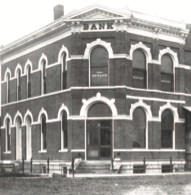
No less worse, without a tenant the building itself would sit vacant for another eight decades. Over the years the structure, an architectural marvel in its heyday, slowly deteriorated and by the early 21st century had fallen into such disrepair that it had to be razed.

No trace of the bank remains, and now its tale, and that of the unknown would-be bank robbers who tried to blow the vault and clean it out 123 years ago, have now faded into the mists of time until all has become just another chapter in the Forgotten History of Phillips County.

Ellis Co. will offer reduced fees on tire disposal

The Ellis County Landfill recently announced a tire disposal discount event.

Due to unavailability of grants for a tire amnesty, the Ellis County Commission has approved a half-price reduction on the rate of tires from 10 cents per pound to 5 cents per pound. The sale will begin Monday, Sept. 30, 2019 and last through Saturday, Oct. 12. All tires disposed of will be recycled.

To utilize this disposal opportunity, residents must comply with the following requirements:

• Waste tires that are being disposed of must be located within Ellis County.
• Hauler/owner will not accept compensation for collection of tires, such as disposal fees for collecting, storing or disposing of tires.
• Customer must sign a waste tire certification, stating source of tire location and residency of owner. Proper identification may be required.
• Ellis County residents only. No businesses.
• Tires must be delivered in a secured method to prevent losing load during transport to the landfill.
• Tires must be separated and not co-mingled with other waste material. Other waste material will be assessed the appropriate fees by waste category.

Direct any questions to the Ellis County Landfill at (785) 628-9460.

2019 Kansas Climate + Energy award winners to be honored

CEP

HUTCHINSON – The Climate + Energy Project is pleased to announce the 2019 Climate + Energy Awards, recognizing individuals and organizations who are leading the way to a clean energy future.

The awards celebrate lifetime achievement, volunteer engagement, and innovative change agents in Kansas. Join us in honoring our award winners on Monday, September 30, at the Lawrence Beer Company for Visions of a Resilient Kansas, our annual fundraiser and awards ceremony.

Mary Fund

Impact Award: A lifetime achievement award recognizing an individual whose work resulted in positive, long-term, broad impacts in climate, energy, and environmental issues across the state.

Mary Fund has dedicated her life to sustainable agriculture and rural communities. A strong presence at the Kansas Rural Center, Topeka,  for the last 40 years, Mary has worked bravely and tirelessly to raise issues of environmental concern – from clean energy to clean water, healthy soils to local foods, and so much more. Mary never shies away from bringing up the important, if controversial issues, including most recently highlighting climate change in town halls across the state. Mary is as direct in her opinions as she is curious about what others think, which makes her a valuable partner to all.

Mary has elevated rural issues to legislators while simultaneously addressing challenging issues with rural audiences. Mary’s no-nonsense, common-sense approach has been foundational to conversations about environmental issues for decades.

Kim Bellemere

Mark Richardson Sustainer Award: A volunteer-recognition award for an individual who has regularly engaged with CEP for at least five years.

Kim Bellemere has been a reliable and enthusiastic partner with the Climate + Energy Project for the last eight years, first as a steering committee member for Water + Energy Progress and most recently as a strong WEALTH partner.

In her work as the Director of Outreach at the Grassland Heritage Foundation, Shawnee Mission, Kim speaks passionately about the important role of grasslands and native plants as a climate solution. Kim’s leadership on climate change among conservationists has lit a spark for change and catalyzed partnerships to address climate issues locally. Kim’s nominator explained, “I’ve often felt overwhelmed by the climate change discussion, until I started having conversations with Kim and noticed the work that she was doing with Grassland Heritage Foundation. Small steps lead to big ones, and it’s people like Kim that take the first step so that the rest of us can follow.”

The Merc Co+op

Changemaker Award: Recognition for an organization or individual whose recent (1-3 years) work has significantly advanced climate, energy, and/or environmental issues in Kansas.

The Merc Co+op, Lawrence, has elevated solar power and electric vehicles as clean energy solutions in a high-profile location. Through a full rooftop array, two solar covered carports and a solar covered patio, the community-owned grocery store installed 688 high performance solar panels to provide 29% of their energy each year, when combined with an electric vehicle charging station and a solar covered pergola the panels will produce enough energy to power 22 homes each year.

The Merc’s highly visible location for solar panels and one of the few Electric Vehicle charging stations in Lawrence has strong potential to inspire other businesses to get on board with clean energy. The Merc Co+op is also working to ease the pressures of food deserts in Kansas by opening a grocery store in Wyandotte county. Since 2012, the co-op has reduced electricity consumption by 30% through LED lighting and preventative maintenance, in addition to reducing waste, improving access to local foods, and presenting sustainable options for the northeast Kansas community.

Metro KC Climate Action Coalition

Metro KC Climate Action Coalition
The Metro KC Climate Action Coalition has rapidly elevated the issue of climate change in northeast Kansas.

Initiated by Lindsey Constance and Mike Kelly, the MKCCAC provides a vehicle for local and state elected officials to take action on climate change. The coalition brings together diverse local elected officials to use their power to tackle climate change at the local and state level. MKCCAC has organized several events, including the upcoming Metro KC Climate Action Summit in Kansas City on September 14. They are in the process of developing a local action playbook, a climate emissions inventory, and more. This bipartisan coalition has made impressive progress convening elected officials across the state line, leading with conversations about regional climate change solutions.

McBroom doubles twice to lead Royals over Marlins

MIAMI (AP) — Ryan McBroom continues to produce in his first week with the Kansas City Royals.

McBroom doubled twice and had three RBI to help the Royals beat the Miami Marlins 7-2 on Saturday night.

“It’s been so exciting and truly a-dream-come-true,” said McBroom, who is hitting .375 with four RBI since the Royals acquired him from the New York Yankees organization Aug. 31.

McBroom’s bases-clearing double off Miami reliever Ryne Stanek in the seventh capped a six-run inning.

“Coming to a new ball club, making my major league debut, the nerves were high,” McBroom said. “You want to come in and impress but don’t want to worry about pressing.”

Jorge Soler hit his 41st homer, a solo blast in the ninth, and Hunter Dozier had two hits for the Royals, who have won six of seven.

Adam Conley (2-8) started the seventh in relief of Marlins starter Caleb Smith and allowed Bubba Starling’s leadoff infield single and walked pinch hitter Cheslor Cuthbert. Miami left-fielder Austin Dean muffed Whit Merrifield’s single that allowed Starling to score from third on the error and tie it at 1.

Dozier’s single with the bases loaded off Stanek put the Royals ahead 2-1 and Alex Gordon’s bases loaded increased Kansas City’s advantage.

Danny Duffy (6-6) allowed one run and two hits in six innings. Duffy struck out five and walked two.

“I knew that we had to continue to battle,” Kansas City manager Ned Yost said. “Duffy gave us an opportunity to not have to score a bunch of runs to get back in it.”

Harold Ramirez’s one-out single off Royals reliever Jacob Barnes in the eighth got Miami to within 6-2. Tim Hill retired pinch-hitter Martin Prado on an inning-ending double play and got the final five outs for his first save.

“Regardless of where we are in the standings, we don’t take a single pitch for granted,” Duffy said. “The way the guys battled in the top of the seventh we all want to do the best we can for each other and finish on a strong note.”

Smith pitched six shutout innings, allowed four hits, struck out eight and walked two. The left-hander was lifted after 100 pitches.

“Tonight was a lot better command wise and all around pitching,” Smith said. “I was able to locate my pitches and throw where I wanted to.”

The Marlins took an early lead after Duffy hit Smith with the bases loaded in the second. Duffy allowed a one-out single to Jorge Alfaro and walked Dean and Lewis Brinson.

SOLER’S MILESTONE:

With his homer, Soler surpassed Tony Perez and is now the third Cuban-born player with most home runs in a season. Rafael Palmeiro hit 47 for the Texas Rangers in 1999 and 2001 and Jose Canseco hit 46 while with the Toronto Blue Jays in 1998.

DUFFY IMPRESSED WITH HIS HIT:

Not getting the opportunity to bat frequently as an American League pitcher, Duffy singled in his second plate appearance Saturday. Duffy struck out in his other at bat.

“I’ll take that, those are few and far between,” Duffy said. “I thought I put together a good at bat the first AB. I was seeing it. But the second at bat, you just kind of close your eyes and swing.”

UP NEXT:

Royals: LHP Mike Montgomery (3-7, 4.42) has allowed two earned runs over 12 innings in his last two starts.

Marlins: RHP Sandy Alcantara (4-12, 4.26) seeks to snap a six-game losing skid in his team-leading 28th start Sunday. Alcantara is winless since June 21 but has limited opposing batters to a .167 average in his last six starts.

Coastal Carolina overpowers Kansas

LAWRENCE, Kan. (AP) — CJ Marable rushed for 148 yards and recorded two touchdowns to lead Coastal Carolina to a 12-7 victory over Kansas on Saturday night.

Fred Payton connected with Marable for 20 yards to pick up the Chanticleers (1-1) lone touchdown of the first half; however, a missed extra-point attempt in conjunction with a shanked 31-yard field goal by Massimo Biscardi sent the Chanticleers to the locker room facing a 7-6 deficit.

To open the second half, Chandler Kryst picked off the pass of Carter Stanley, fueling a 64-yard drive by Coastal Carolina resulting in a second touchdown for Marable and an ultimately insurmountable lead for the Chanticleers.

A third missed field goal by Biscardi, this time from 27 yards, gifted Kansas (1-1) one final offensive drive late in the fourth quarter, yet the Jayhawks were unable to convert, turning the ball over on downs after gaining only eight yards.

In his highly-anticipated season debut following a one-game suspension, Kansas’ Pooka Williams Jr. rushed for 99 yards on 22 carries to lead the Jayhawks.

Khalil Herbert tacked on an additional 82 yards on the ground, including a 41-yard touchdown run to cap the Jayhawks’ opening offensive drive and secure the lone Kansas touchdown. However, the efforts of the shifty Kansas running back unit were unable to make amends for two untimely interceptions and a 107-yard passing performance by Stanley.

THE TAKEAWAY

Coastal Carolina: In only their second season as a full-time FBS team, the Chanticleers were to overpower their first Big 12 opponent in program history for much of the evening, hanging 291 total yards of offense on Kansas compared to the Jayhawks’ 280. Cracking a five-game losing streak, Coastal Carolina showed improvements offensively following a struggle-ridden opener against Eastern Michigan last week featuring four interceptions.

Kansas: Falling to 1-1, the slim margin of victory last week paired with the loss to Coastal Carolina leaves much to be desired from the newly-renovated Kansas offense. The return of Williams appeared to provide a needed spark to the Kansas run-game, allowing the Jayhawks to pick up 68 more yards on the ground than they recorded last week.

UP NEXT

Kansas: The Jayhawks head to Chestnut Hill, Massachusetts, on Friday to take on Boston College in their first matchup on the road this season.

Coastal Carolina: The Chanticleers will host Norfolk State on Saturday.

FHSU volleyball splits on day two of Eagle Classic

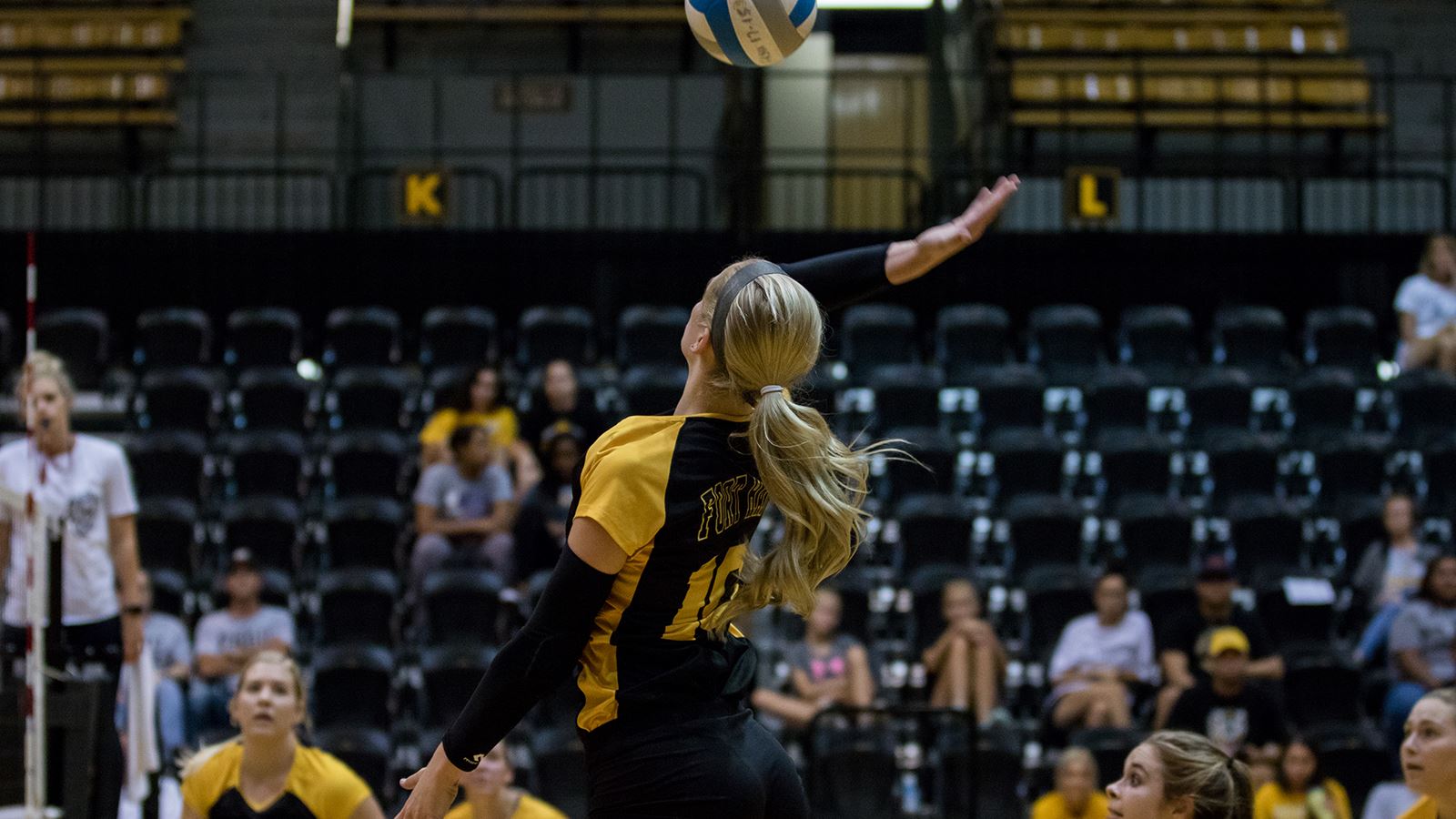
CHADRON, Neb. – The Fort Hays State volleyball team picked up a split on day two of the 2019 Eagle Classic Saturday, wrapping up the weekend with a thrilling five-set win over South Dakota Mines. The Tigers return to Hays 1-3 on the season, while Montana State Billings improved to 1-2 with their win over FHSU and Mines moves to 1-3.

Delaney Humm picked up 36 kills on the day, averaging 5.1 kills per set through the two matches.

Montana State Billings 3, Fort Hays State 0 (26-24, 25-22, 25-17)
The Tigers put together their best offensive performance of the season against the Yellowjackets (.269 attack percentage), but untimely errors cost FHSU a chance at its first win. The Tigers outperformed MSUB in nearly every statistical category, but the combination of 18 attack errors, 10 service errors and seven setting miscues made all the difference.

Montana State Billings opened the match with authority, scoring six of the first seven points en route to a 10-4 lead. The Tigers responded by capturing 12 of the next 13 rallies, including a 9-0 run to jump in front 16-11.

Freshman Delaney Humm recorded four of her team-high 14 kills during the big Tiger rally. The Tigers stretched the lead to eight later in the set when back-to-back kills from Morgan Christiansen made the score 23-15. A kill from Morgan West three rallies later gave the Tigers a chance at set point, but the Yellowjackets pulled off an impressive rally of nine-straight points to take the set 26-24.

The teams went back-and-forth for much of the second set before FHSU used a 7-1 run to take an 18-15 lead. The Tigers were unable to hold the lead after six FHSU errors helped the Yellowjackets close the set on a 10-4 run.

Humm also led the team in attack percentage, posting a .400 attack percentage after collecting her 14 kills on 25 swings. Kayla Vitztum added nine kills while Christiansen totaled eight kills. Katie Darnell tossed up 18 assists and added six digs while Haley McCorkle chipped in 15 assists and five digs. Abbie Hayes led the team with 11 digs while Tatum Bartels and Madison Miller both recorded a pair of service aces.

Fort Hays State 3, South Dakota School of Mines and Technology 2 (25-21, 23-25, 25-21, 25-27, 15-13)
The Tigers recorded their first win of the season in a highly competitive affair, holding on in the fifth set to clinch the win over South Dakota Mines. Delaney Humm was a go-to for the Tiger offense, with the freshman recording the set-winning kill in all three set victories.

Fort Hays State posted a .181 attack percentage in the victory while limiting Mines to a .120 swing rate. The Tigers were clicking in the final set, posting a .333 swing percentage (12-3-27). The Tigers picked up 14 blocks in the win, including five solo blocks from Morgan Christiansen and four from Tatum Bartels.

Humm and Bartels finished the match with a career-best 22 kills, while Humm added 12 digs for a double-double. Haley McCorkle tossed up 34 assists, with Katie Darnell adding 22 assists. Abbie Hayes totaled 18 digs in the win, with Madison Miller (13), Humm and Darnell (10) also reaching double figures.

The teams traded blows all evening, with neither side leading by more than seven in any set. The Tigers slowly built a lead in the first set, but four-straight points from Mines tied things up at 21-21. Humm stepped up to record three kills and a block assist on the final four rallies to give the Tigers a 25-21 win.

Fort Hays State led by three midway through the second set, but the Hardrockers pulled in front with a 6-1 run.

The squads traded sustained runs in the third set before Fort Hays State scored seven of the final 10 points to take a 2-1 lead in the match.

The Tigers appeared to be in the driver’s seat in the fourth set, jumping in front 18-11. Mines didn’t go away quietly, however, scoring the next eight points to take the lead. Fort Hays State battled back to have two shots at match point before the Hardrockers forced a fifth set with three consecutive points.

FHSU and Mines went back-and-forth again in the final set, with the Tigers capturing the first three points before the Hardrockers battled within 8-7 when the teams traded sides. Mines took its first lead of the set at 10-9, but kill from Christiansen returned the momentum to the Tigers. Bartels recorded kills on three of the next five rallies before Humm finished off the match on a pass from McCorkle.

The Tigers return to Hays to host the 2019 Tiger Classic next weekend inside Gross Memorial Coliseum. FHSU will host six matches on both Friday and Saturday (Sept. 13-14), with action beginning at 9 a.m. each day.

Driver dies after NW Kansas semi, pickup crash

RAWLINS COUNTY — One person died in an accident just after noon Saturday in Rawlins County.

The Kansas Highway Patrol reported a 2012 Ford pickup driven by Derrick D. Bassnett, 50, Trenton, NE., was eastbound on County Road AA fourteen miles west and nine miles north of the U.S. 36 and Kansas Highway 35 Junction.

The pickup entered the intersection and was unable to see a northbound 2009 International semi driven by Joshua Joe Friemel, 29, Colby coming due to the tall corn. The semi struck the pickup on the passenger side.

Bassnett was transported to the hospital in Atwood where he died.

Friemel was not injured. Both drivers were properly restrained at the time of the accident, according to the KHP.

Kansas GOP votes to scrap 2020 presidential preference vote

COLUMBIA, S.C. (AP) — Republican leaders in Kansas and South Carolina have voted to scrap their presidential nominating contests in 2020, while party officials Nevada were deciding whether to follow suit as the GOP erects more hurdles for the long shots challenging President Donald Trump.

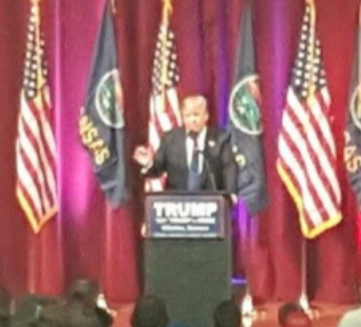
In March of 2016, Trump addressed a large crowd in Wichita. -photo courtesy Mark Cowin

Canceling primaries, caucuses and other voting is not an unusual move for the party of the White House incumbent seeking a second term, and allows Trump to try to consolidate his support as Democrats work to winnow down their large field of candidates.

A spokesman for the South Carolina Republican Party, Joe Jackson, confirmed that the party voted Saturday against holding a presidential primary next year. The Kansas GOP tweeted on Friday that it will not organize a caucus “because President Trump is an elected incumbent from the Republican Party.” Its state committee planned to approve rules Saturday for an “internal party process” for selecting convention delegates, according to Kelly Arnold, the party’s former state chairman, and Helen Van Etten, a member of the Republican National Committee from Topeka.

Officials in Nevada scheduled meetings later Saturday to determine the fate of their contests. A decision in Arizona is expected later in the month.

Challengers have emerged to Trump, including Bill Weld , a former Massachusetts governor, and Joe Walsh , a former Illinois congressman. Others may join them.

Walsh told CNN after the South Carolina vote that his campaign would “fight South Carolina and any other state that considers doing this.” He also noted that Trump complained during the 2016 election “about how the Democrats were rigging the system to get Hillary (Clinton) elected. Well, look what he’s doing now. You talk about rigging a system.”

Primary challenges to incumbents are rarely successful, and Trump’s poll numbers among Republican voters have proved resilient. Nonetheless, Trump aides are looking to prevent a repeat of the convention discord that highlighted the electoral weaknesses of Presidents George H.W. Bush and Jimmy Carter in their failed reelection campaigns

Since last year, Trump’s campaign has worked to monitor and at times control the process by which delegates to next year’s Republican National Convention in Charlotte, North Carolina, are selected. His campaign wants the convention to be a four-night “infomercial” for Trump by sidelining the president’s detractors within the party.

The effort is an acknowledgment that Trump hasn’t completely cemented his grip on the GOP and might not coast to the nomination without some opposition. To that end, the campaign has worked over the past year to scuttle any attempts at a Trump challenge by party dissidents, mindful that a serious primary opponent could weaken Trump heading into the general election.

In January, the Republican National Committee voted to express its “undivided support” for Trump and his “effective presidency.”

In years past, both Republicans and Democrats have cut state nominating contests when an incumbent president from their party ran for a second term. In 1984, South Carolina GOP leaders opted to call off their primary as President Ronald Reagan sought a second term. In 2004, the GOP again canceled the state’s primary with leaders deciding instead to endorse President George W. Bush’s reelection bid.

The South Carolina Democratic Party didn’t hold presidential primaries in 1996 or in 2012, when Presidents Bill Clinton and Barack Obama were their incumbents.

The Nevada Republican Party was expected to hold a vote on possibly changing its rules to allow a bypass of its presidential nominating caucuses in 2020 and endorse Trump outright. The move would allow the state’s central committee members to hold a vote and commit the state’s GOP delegates to the president, shielding him from a primary challenge.

Kansas State dominates Bowling Green

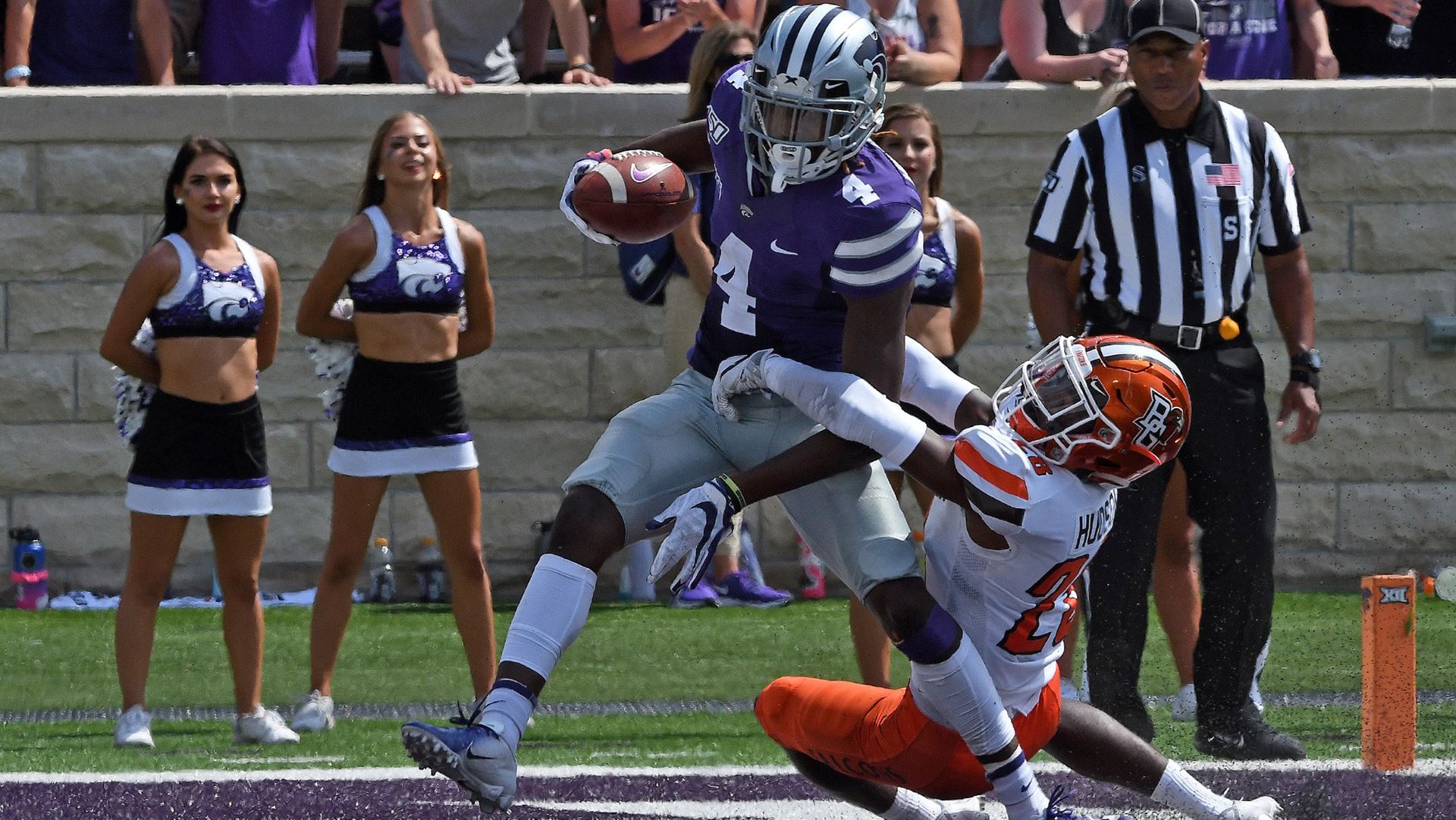
MANHATTAN, Kan. (AP) — Kansas State totaled more than 500 offensive yards in consecutive games for the first time in school history on Saturday after dismantling Bowling Green 52-0.

The Wildcats look to dominate to start the season after outscoring Nicholls and Bowling Green 111-14 combined.

“I challenged the guys this week to improve upon week one and in particular this morning to get the fight started quickly and jump on them from the start,” head coach Chris Klieman said. “I was so pleased.”

The Wildcats did just that, holding their opponent scoreless in the first half for the second straight week.

It was an offensive mismatch as Malik Knowles had 99 receiving yards and two touchdown catches and Skylar Thompson threw for 151 yards and a pair of touchdowns. Knowles missed a few catches last week, but made up for those against the Falcons

“It was relieving, that was my main focus throughout the week to make sure that didn’t happen again,” Knowles said.

James Gilbert led the Wildcats’ ground game for the second straight game with 103 rushing yards and found the end zone twice. Jordan Brown, Harry Trotter and Joe Ervin also provided rushing touchdowns. Kansas State has scored 10 rushing touchdowns in two games.

The Wildcats played many freshmen, including Ervin and Jacardia Wright, who combined for 22 carries, 87 yards and a touchdown.

“Our plan all along was to play a bunch of freshman no matter what the score was just to see how they would react under live fire,” Klieman said. “We’ll look at the film, but I was glad to see some guys playing and we’ll see how much they play moving forward.”

The Falcons never got their offense going, totaling 140 yards with just five first downs.

Darius Wade threw for 79 yards on eight completions for Bowling Green and Davon Jones had 47 rushing yards. The Kansas State defense stifled the Falcons, whose offense was on the field for just 44 plays and a little over 17 minutes.

“He (Darius) did not play as well as we hoped,” head coach Scot Loeffler said. “The way that he was at times his rhythm and tempo were there. We need other people around him to play better.”

The Wildcats marched down the field to start the game, but only got a field goal, then scored TDs on their next five possessions.

“They did not do anything we did not prepare for,” Loeffler said. “They just did it better and more efficient.”

Kansas State was able to rest its starters for most of the second half, which could give the Wildcats fresher legs for their first road game next week at Mississippi State.

The Wildcats will look to get revenge on the Bulldogs after a 31-10 loss last season.

“This is just the beginning, game two, playing good, but we’re not where we want to be,” KSU defensive end Reggie Walker said. “It just all makes us hungry.”

THE TAKEAWAY

Bowling Green: The Falcons were overmatched and couldn’t stop the Kansas State offense in the first half.

Kansas State: For the second straight week, the Wildcats looked about as good as they could. Kleiman has found his quarterback in Thompson, but they’ll face their first true test against an SEC foe next week.

JUST KEEPS WINNING

Klieman has won 23 consecutive games, dating to when he was head coach at North Dakota State. His last loss came to South Dakota State in 2017.

RENOVATIONS COMING

Kansas State Athletics announced a $105 million renovation project, in which part will be for Bill Snyder Family Stadium’s south end zone. Construction will begin in May 2020 and be completed by the start of the 2021 football season.

UP NEXT

Bowling Green hosts Louisiana Tech next Saturday.

Kansas State has its first road game of the season at Mississippi State on Saturday.

FHSU tennis rolls to win over Hastings in season opener

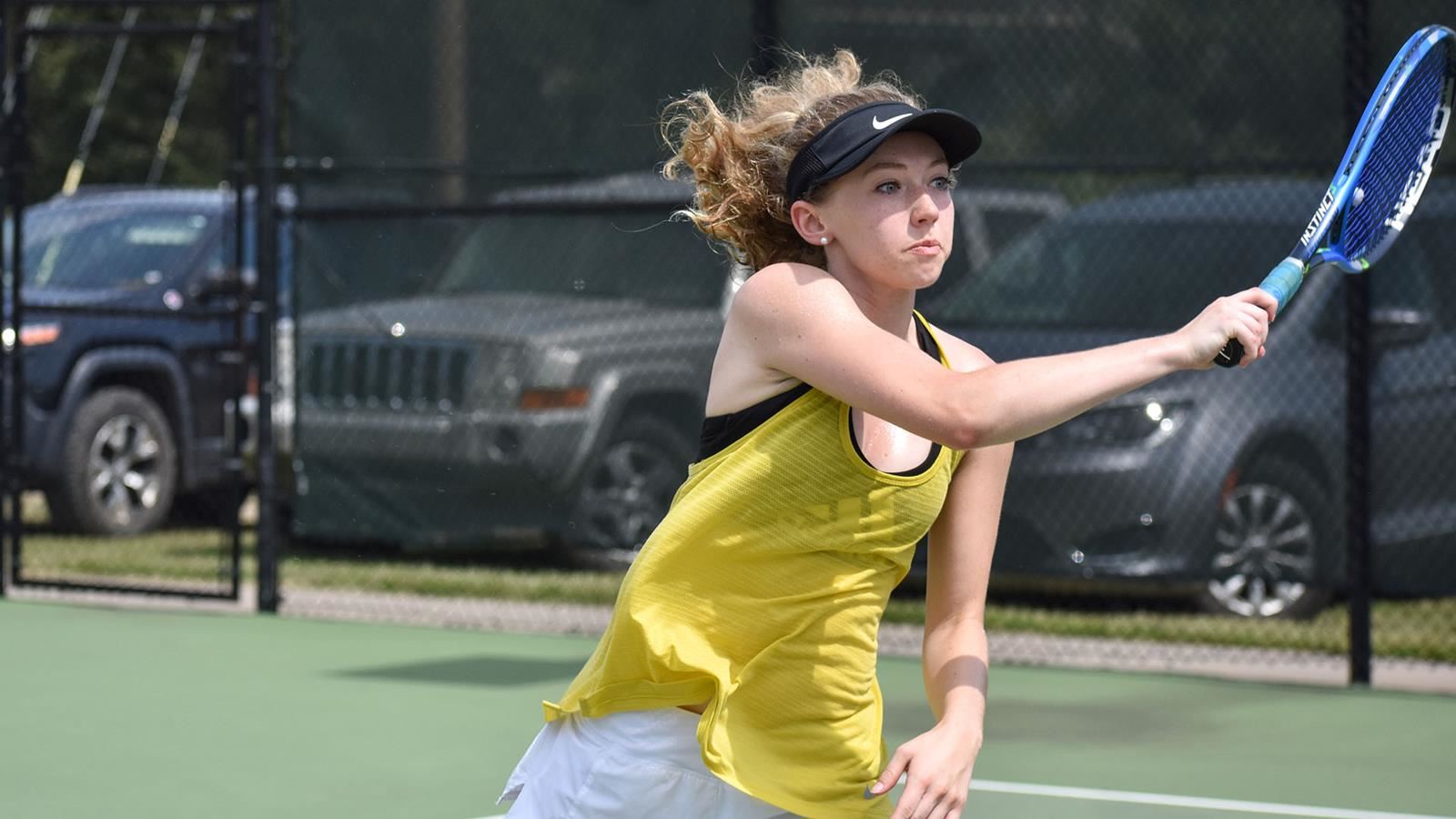
HAYS, Kan. – Fort Hays State Tennis opened its 2019-20 season on Saturday (Sept. 7) at the FHSU Tennis Courts against Hastings College. The Tigers claimed all nine matches on the afternoon, producing a final score of 7-0 in the match.

The Tigers swept doubles play all by scores of 6-1. Ellea Ediger and Natalie Lubbers teamed at the No. 1 position, Macy Moyers and Sydney McAdoo teamed in the No. 2 slot, and Kimberly Stone and Grace Holgerson teamed at No. 3. With the sweep, the Tigers earned the one team point given for doubles play.

Fort Hays State swept all the singles matches in straight sets. Lubbers (No. 1), Moyers (No. 2), and Ediger (No. 3) allowed no more than one point in their matches. Lubbers defeated Megan Petr, winning the first set 6-1 before Petr had to retire from the match due to illness. Moyers claimed her match 6-0, 6-1 over Megan Waterhouse. Ediger defeated Theresa Price 6-1, 6-0.

At the No. 4 position, Sydney McAdoo had to win the first set 6-4 over Hannah Theisen before posting a 6-0 shutout in the second set. Stone defeated Madelyn Redding 6-1, 6-1 at the No. 5 position. Holgerson won at No. 6 by scores of 6-3 and 6-2.

Fort Hays State heads to Pueblo, Colorado next weekend (Sept. 13-14) for three matches against Rocky Mountain Athletic Conference teams. The Tigers will face MSU-Denver, Colorado Mesa, and CSU-Pueblo.

Copyright Eagle Radio | FCC Public Files | EEO Public File