RENO COUNTY — A small earthquake shook portions of south-central Kansas Sunday morning.
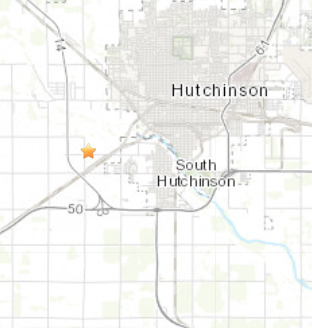
Location of Sunday’s quake USGS image
The quake just before 8:30a.m. measured a magnitude 3.1 and was centered approximately 2 miles northwest of South Hutchinson, according to the U.S. Geological Survey.
Sunday’s quake follows a series of quakes in Reno County in Mid-August including a 4.2 magnitude quake on August 16.
There were no reports of any damage from Sunday’s quake.
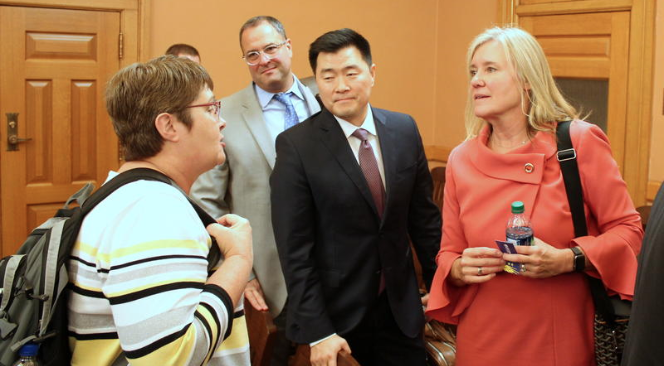
Aetna Medicaid CEO Randy Hyun (center) and Regional Vice President Deb Bacon (right) met with Kansas lawmakers in Topeka on Tuesday. STEPHEN KORANDA / KANSAS NEWS SERVIC
Aetna Better Health is struggling to keep its Medicaid contract with KanCare, to the point that state officials found fault with Aetna’s recent plan to improve services.
But Kansas lawmakers had two words this week for the company: Keep trying.
At a two-day hearing, health care providers told lawmakers how Aetna isn’t paying them on time. Aetna executives took responsibility for the shortfalls, which have put the company at risk of losing its contract after the state said it wasn’t in compliance and later rejected a proposal to fix the problems.
“We get it. Talk is cheap,” Randy Hyun, CEO of Aetna’s national Medicaid division, told the panel. “We need to show action. We need to show progress, and we absolutely intend to do that.”
Already, Aetna has replaced its state-level CEO, and told lawmakers that it did the same with another top staffer.
The company is one of three groups managing patient care the state’s privatized Medicaid program, KanCare, which provides coverage for nearly 400,000 low-income, elderly and disabled people through Medicaid and the Children’s Health Insurance Program, or CHIP.
“I want to apologize for not living up to the expectations that I’ve had,” Hyun said. “We preach operational excellence, and we certainly have not demonstrated that to you.”
During the hearing, lawmakers heard from industry groups about the challenges of working with Aetna. The Kansas Health Care Association, which represents nursing homes, said health care providers are having trouble getting paid by Aetna for the services performed. One facility owner has more than $800,000 in unpaid claims submitted to Aetna.
Cindy Luxem, the group’s CEO and president, said she’s worried about facilities burning through reserves while waiting for the reimbursements.
“Maybe Aetna needs to lay out the money and go back and reimburse at some other point,” she said, “because this isn’t a system that’s working right now.”
The Kansas Hospital Association said some clinics have had trouble signing up with Aetna in the first place to become in-network health care providers. That means the facilities have to get prior approval before providing patients health care.
“We are concerned that access to patient care will be hampered until these network issues are resolved,” said Tish Hollingsworth, vice president of reimbursement for the KHA.
Kansas regulators told Aetna last month that it was out of compliance with its state contract and was at risk of being effectively fired by the state. Aetna’s corrective action plan, delivered Aug. 6, didn’t receive a warm response.
“Quite frankly, we were not satisfied,” Kansas Medicaid Director Adam Proffitt said. “It lacked the necessary detail to show that they were going to get back into compliance.”
The state is reviewing Aetna’s latest proposal this week. Proffitt said it would be a big disruption to cancel Aetna’s contract, as about 100,000 people would have to be shifted to the two other Medicaid contractors. But that doesn’t mean the state will go easy on Aetna. Proffitt wants a quick resolution
“We’re not going to fix the problems for them,” Proffitt said in an interview. “We’re going to provide the support necessary from the state for them to fix the problems.”
Republican Rep. Susan Concannon pointed to the staff shakeup and said she was glad to see the company responding. But, she said, Aetna should have looked at troubles the other managed-care organizations had when the state’s privatized Medicaid program launched in 2013, and “learned from the issues.”
State lawmakers said they’ll keep a close eye on Aetna as the company works to fix problems.
“It’s important that we follow up and make sure the law is being followed and that people get paid and get the care they need,” Democratic Sen. Barbara Bollier said. “If that isn’t being adequately met, then we need to make changes.”
Aetna confirmed during the hearings that David Livingston would replace Keith Wisdom as CEO of the Kansas operation. A LinkedIn profile shows Livingston previously worked for the company on Medicaid in Illinois. Mark Grippi is taking over as acting COO, and previously worked for Aetna in Louisiana.
Stephen Koranda is Statehouse reporter for the Kansas News Service. Follow him on Twitter @kprkoranda or email skoranda (at) ku (dot) edu.
Rarely do the words “brewery,” “dog” and “fundraiser” go together, but a new event next month hopes to combine all three.
From 3 to 7 p.m. Saturday, Sept. 14, the Humane Society of the High Plains and the Hays Public Library will team up to host Paws and Pints at Defiance Brewing Co., 2050 Old U.S. 40.
Humane Society manager Betty Hansen said interest is already high and she hopes will it turn into an annual event.
Paws and Pints will offer “all kinds of new things, and we are hoping to start this year and make this thing bigger and better every year,” she said. “I think it’s going to be great.”
“Bring your dogs out,” she said. “We will have a lot of dog activities.”
Some of the events planned include dog painting, dog toy stations, live music, and a dog talent show, which will be manned by staff and volunteers from the Hays Public Library.
“We are opening it up to the public to help them out,” said Abby Artz, HPL adult services programming coordinator.
Volunteering at the event is a part of the library’s ongoing effort to increase community outreach.
“Every month, we do what we call HPL: Hands-On — a volunteering event with a different organization around town,” Artz said. “We are trying to create more of a sense of togetherness and show that we are a community and it is really fun to work together on different events, especially this one.
“It’s going to be really fun,” she said.
Defiance is also excited to host the event, as co-founder Matthew Bender said working with community organizations is becoming a trend for breweries across the county.
“We are huge, huge animal lovers, so it was a no-brainer for us,” he said. “It felt like a natural fit.”
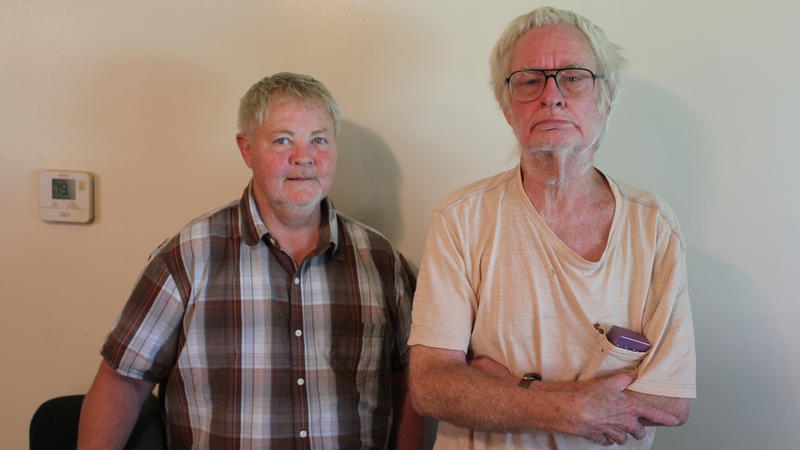
Dennis Ritchey, right, and the attorney who helped him find his way out of a mental health nursing home and on to a life of independent living. (Photos by Stephen Koranda)
VALLEY FALLS — Dennis Ritchey stands in the kitchen of his modest apartment. He calls it efficient, but likes that it has plenty of cabinets.
Most importantly, that kitchen and the rest of the one-bedroom place are his, and his alone. Much like his life more broadly.
His life now stands in sharp contrast to the six years he spent in one of the state’s 10 nursing facilities for mental health. He couldn’t set his own schedule or typically come and go as he pleased.
Now, things are different. He tends to bird feeders outside his apartment window and has freedoms he didn’t enjoy before.
“Eat what I want. Watch what I want on TV. Go to bed when I want to. Get up when I want to,” he said. “I’ve been doing great ever since I left.”
The nursing homes serve as sort of a midpoint between state mental hospitals for people with the most serious problems and community mental health centers for those who need far less help.
Those mid-way outposts in state’s mental health care system — privately owned, taxpayer-funded — have long been a source of concern. That’s partly because the job of looking after people dealing with bipolar disorder, schizophrenia and a range of other problems is inherently difficult. It’s balancing treatment with giving patients a chance to thrive on their own.
A recent report from the Disability Rights Center of Kansas suggests the nursing homes are failing the state’s mentally ill, essentially warehousing people rather than giving them what they need to move on to more independent lives.
The report argues that more people could be living at home and using community-based services. State officials and the nursing home industry see room for improvement but say it will take a more significant remake of the state’s mental health system.
Ritchey isn’t sure what diagnosis sent him to the nursing home in 2011. He’d hit a rough patch and landed in a homeless shelter and mental facility in Lawrence before going to the nursing home. At first, he thought his stay would be short.
“Ninety days went by. Six months. A year. Two years,” he said. “Nobody said nothing to me.”
He got out of the facility in 2017 with the help of Kip Elliot, an attorney with the Disability Rights Center of Kansas. Elliot serves on the board of the local animal shelter, and he helped Ritchey start volunteering and later working there.
Elliot knew that the nursing facility wasn’t the right place for Ritchey.
“When I met Dennis and started seeing him more,” Elliot said, “(there was) absolutely no reason for him to be there.”
Getting Ritchey out wasn’t easy. Elliot said some of that was difficulty working with the facility and the state. But the challenges included lining up the services Ritchey would need, such as an apartment and care for his diabetes.
“That’s one of our biggest issues,” Elliot said. “Community supports, what people need, housing. It’s just not there.”
An attorney for the company that owns the facility where Ritchey lived, Midwest Health, did not respond to a request for comment. The administrator of the Valley Falls facility initially agreed to show the home and comment on the report, but later didn’t respond.
‘Warehouses’
The Disability Rights Center of Kansas published the report calling the nursing homes warehouses. The group surveyed around half of the more than 600 residents of the homes, and 70% wanted to leave and find what support they needed on the outside.
Rocky Nichols
“It’s just a lack of imagination (that) has caused this to happen,” said Rocky Nichols, executive director of the center. “People go to these places. They get stuck in these institutions, and it becomes very difficult for them to get out.”
The report also argues the state is violating the law by institutionalizing people who could live on their own if they received services in the community.
“That’s the textbook definition of unnecessary institutionalization,” Nichols said.
But the head of the advocacy group that represents the mental health nursing homes contends the report doesn’t paint a fair picture.
Cindy Luxem
“These are not warehouses. These are people’s homes,” said Cindy Luxem, president and CEO of the Kansas Health Care Association. “They have no place else to go.”
There simply aren’t enough community-based services right now to take on people in the nursing homes, Luxem said.
She also wasn’t surprised by the survey results, because people often don’t want to live in nursing homes. But she said that doesn’t mean caregivers and family members would always agree that other places offer better results.
“Some of these are tied with not only mental health, but substance abuse issues,” she said. “They don’t have the wherewithal to be safe in the community.”
An alternative
Patrick Schmitz
Patrick Schmitz walks through mural-filled hallways at the Bert Nash Community Mental Health Center in Lawrence, where he’s the chief executive officer. The multi-colored paintings depict grassy rolling hills and colorful night skies. They’re meant to make the section for children more welcoming.
This facility offers a variety of treatments for conditions including depression, anxiety and childhood behavioral issues. They have about 20 spots in a long-term residential program, but most of the 5,000 people they serve annually are on an outpatient basis.
“The vast majority of people we treat are everyday people out in our community who come here for an hour of service,” he said. “(They) go back to work, go back to home.”
Schmitz calls those community-based facilities the front door to the mental health care system. They evaluate people in crisis and help route them to the correct services. They offer treatment as well as assistance with life skills and help navigating government programs.
The Disability Rights Center argues more people should be removed from the nursing homes and instead served at facilities like this one.
Funding for the state’s 26 community mental health centers dropped almost by half over a decade before creeping up in recent years, the report shows.
Even when budgets for those community facilities got cut deeply, funding for nursing homes went up.
“The disparity in how Kansas supports institutions versus community-based services is downright shocking,” the DRC wrote in the report.
A broader approach
There’s a common theme when talking to people about this issue. Community-based mental health services exist, but there’s a lack of availability in certain areas and a persistent shortage of housing needed for people leaving the nursing homes.
“This has to be tackled from a system-wide perspective,” said Shawn Sullivan, a former official in the administration of governors Sam Brownback and Jeff Colyer. Sullivan is now vice president at Mission Health Communities.
Mission Health oversees five of the nursing facilities in Kansas, and he agrees improvements are needed. They need to focus more on discharge planning and preparing residents with life skills so they can leave. But, there must be places for them to go.
“The number one challenge is a lack of affordable housing,” he said. “It’s just not there in a lot of parts of the state. And the places where there is affordable housing, then there may not be the services.”
Tight funding for community mental health centers in recent years has led to longer waits to see patients. It’s also sometimes meant cuts to programs or trouble recruiting and retaining staff.
The centers are ready to take part in a larger change to the mental health system, said Kyle Kessler, executive director of the Association of Community Mental Health Centers of Kansas. However, they can’t take on patients from the nursing homes without additional funding to go with it.
“To do anything within existing resources would mean we were taking from some other need,” Kessler said. “We need to identify additional funding.”
Kessler said expanding Medicaid is one of those steps. It would bolster the budgets of community mental health centers because they’d treat fewer uninsured people. Expansion supporters so far haven’t advanced an expansion bill through the Legislature.
The state is pursuing a waiver that would allow for Medicaid funding to flow to the mental health nursing homes. That could, in turn, jumpstart programs that offer job assistance or other services to help people move out of the facilities. In addition, recent changes mean Medicaid funding could be used for needed housing services.
Laura Howard, the secretary of both the Department for Children and Families and the Kansas Department for Aging and Disability Services, said the state needs to make progress on changes that make it easier for people to live somewhere besides nursing homes.
“The last thing that I would want to do,” she said, “is encourage us to move too quickly and not have the services and supports in place for the individuals.”
Stephen Koranda is Statehouse reporter for Kansas Public Radio and the Kansas News Service, a collaboration of KCUR, Kansas Public Radio, KMUW and High Plains Public Radio covering health, education and politics. Follow him on Twitter@kprkoranda or email [email protected].
The W.R. and Yvonne Robbins College of Business and Entrepreneurship at Fort Hays State University has selected Abbie Schneider, Chappell, Neb., and Avary Huff, Topeka, as the recipients of the 2019-2020 Robbins Ambassador Scholarship awards.
“This is the second time we’ve awarded this scholarship, and it is proving to be a great example of investing in students that pay dividends,” said Dr. Melissa Hunsicker Walburn, interim dean of the Robbins College.
“Prospective students relate to the stories and experiences of current students in powerful ways.”
The scholarships are for any Robbins College of Business and Entrepreneurship undergraduate student exemplifying leadership, academic excellence, extracurricular involvement and a desire to serve FHSU.
Schneider is a junior majoring in human resource management. She is involved in Alpha Kappa Psi, and the Society for Human Resource Management and sits on the executive board of both organizations. Schneider plans to earn a Master of Professional Studies in human resource management. After college, she would like to work in training and development.
Huff is a junior majoring in tourism and hospitality management. She is a member of Delta Zeta sorority and serves as historian and lamp editor. Huff is a student ambassador in the Admissions Office and will be a VIP Ambassador for the 2019-2020 school year.
“FHSU has become my home, giving me opportunities to grow personally and professionally,” said Huff. “I am excited to share about the growth occurring and opportunities available at FHSU.”
Robbins Ambassadors may represent students and the college at events including Tiger Friends and Family Day, student recognition programs, college dinners with alumni and at the annual Robbins College Scholarship Reception.
Ambassadors will attend, participate and network in approximately 12 to 15 events during the academic year.
“The Robbins Ambassadors understand the questions and viewpoints of prospective students, or new FHSU students, because not long ago they were in the same position of evaluating their higher education choices and how to make the most of their educational experiences,” said Hunsicker Walburn.
These awards are possible through the continued support of W.R. and Yvonne Robbins, for whom the Robbins College of Business and Entrepreneurship is named. W.R. Robbins is an alumnus of Fort Hays State.
“I am so excited about our two students selected for these honored scholarships,” said W.R. Robbins. “They will be a positive representation of our university.”
“We congratulate Avary and Abbie in their selection, and we’re excited for their commitment to serve this important role in the upcoming year,” said Hunsicker Walburn.
To learn how to establish a scholarship at Fort Hays State, contact the FHSU Foundation at 785-628-5620 or [email protected]. Learn more about the FHSU Foundation by visiting https://foundation.fhsu.edu.
The Hays Youth Orchestra’s fall season will start up at 10:30 a.m. on Saturday, Sept. 7, in Fort Hays State University’s Malloy Hall for an orientation meeting.
All students between sixth and eighth grade who play the violin, viola, cello or bass are welcome to attend.
Younger students are also welcome to participate with the approval of the director. Older students are invited to participate as assistants and mentors.
Shawn Demuth will serve as this year’s conductor. He is a graduate of the FHSU Department of Music. He plays the violin and piano, composes music and teaches music at USD 388 in Ellis.
“We’re looking at doing fun but challenging music,” said Demuth. “My goal is to bring young musicians together to help build relationships and to increase their passion for music.”
Rehearsals are on Saturday mornings starting in September, with performances scheduled for December and May.
Students interested in playing are should contact Demuth at [email protected] for an application form or additional details.
The Hays Youth Orchestra Program is supported in part by the Hays Symphony Guild, which believes that nurturing the joy of musical performance in today’s youth is critical to developing strong and skilled performers for tomorrow.
CALDWELL COUNTY, Mo. — One person died in in an accident just before 6:30p.m. Saturday in Caldwell County.
The Missouri State Highway Patrol reported a 2018 Chrysler Pacifica driven by Caitlyn Galloway, 32, Overland Park, was eastbound in a driveway on private property on Southwest Ore Road eight miles east of Lathrop.
The vehicle struck 1-year-old Elijah J. Galloway of Overland Park. Caldwell County EMS transported the boy to Liberty Hospital where he died.
Authorities released no additional details late Saturday
When children return to school over the next few weeks, should they find religion on the syllabus? It may surprise some, but a significant majority of Americans — including public school teachers — say yes.
Seventy-five percent of teachers believe public schools should offer a comparative religion elective, with 69 percent of parents saying the same. There is no meaningful political or ideological gap in support of such courses.
Fifty-four percent of teachers think public schools should offer a Bible studies elective; 61 percent of parents agree.
Those findings — from the 2019 PDK (Phi Delta Kappan) poll, a well-respected annual survey of public opinion about K-12 education — should encourage Americans concerned about religious illiteracy in this country.
Religious literacy advocates now have the law, educators and public opinion on their side. The U.S. Supreme Court went out of its way in 1963 to affirm that the study of religion is constitutional. Leading education organizations have affirmed the court’s sentiment that a “complete” education requires students to learn about religion and its relationship with social, political and cultural life. And now PDK shows that more than three-quarters of Americans want religious studies courses in schools.
So why aren’t more schools teaching about religion? The PDK poll provides a clue: fear of indoctrination. Thirty-eight percent of Americans are very or somewhat concerned that “Bible studies classes might improperly promote Judeo-Christian religious beliefs.” Notably, while 82 percent of evangelicals and 78 percent of Republicans favor such courses, only 51 percent of Democrats and 43 percent of liberals support Bible studies.
Fears are somewhat less pronounced for comparative religion classes. Twenty-seven percent of Americans are very or somewhat concerned such courses “might improperly encourage students to change their religious beliefs.” Concerns are highest among evangelicals, 37 percent of whom fear that a comparative religion course might lead a student to “question their family’s faith.”
Yet evidence shows teaching about religion, when done well, will not make students more or less religious; it will make students more likely to support the rights of others, including those with whom they strongly disagree.
We do not have to imagine what it means to teach about religion well. Over the past decade, education and religious studies groups have offered concrete guidance. The National Council for the Social Studies released national guidelines in 2017 for the study of religion. Earlier this year, the organization released a new book solely dedicated to the study of religion in the social studies classroom. Before that, the American Academy of Religion and the Society of Biblical Literature — the largest professional associations for scholars of religion and the Bible — published recommendations for teaching about religion and sacred texts without preaching. And the Religious Freedom Center offers written resources and online professional development modules for teachers and administrators focused on the practical application of religious studies and the First Amendment in the classroom.
We even have examples of strong, standalone religious studies courses in practice. For example, John Camardella, a teacher at Prospect High School in Illinois, has received national attention for his incredibly popular and well-respected religious studies courses for high school students. (In fact, the courses became so popular in the community that parents demanded that Camardella offer a parent-only version of the course once a month in the evening.)
Despite strong guidance and encouraging course models, Americans are wary of required religious studies courses. Again, fear of indoctrination may play a role. The PDK poll shows that only 12 percent of teachers and 7 percent of parents would favor a required comparative religion course. Even fewer teachers and parents — 4 percent and 7 percent, respectively — favor a required Bible studies course.
But religious literacy is necessary, not optional, for the health of our democracy. The American Academy of Religion has argued compellingly that religious illiteracy can reinforce bigotry and prejudice that fuel violence against marginalized communities.
Given today’s increasingly diverse religious landscape and rising religion-related hate crimes, we need to ensure that all children learn about religion in school. Schools without the capacity to offer a required standalone course about religion should integrate the study of religion into social studies and literature courses. Indeed, how can educators teach about history or literature well without some mention of religious individuals’ and communities’ roles in shaping the world around them?
Of course, mandatory religious literacy education would require better training for teachers. Right now, teachers receive very little, if any, training in religious studies. It’s a problem that can lead to unconstitutional or unsound lessons, which further stoke fears of indoctrination.
To ensure educators teach about religion without violating the First Amendment, education institutions should require all teachers-in-training to learn about religion before they set foot in a classroom. We would not let a physics teacher lead a physics class without some knowledge of math. Why would we let a history teacher offer a history course without some knowledge of religion?
Thanks to the PDK poll, we know that public opinion supports elective education about religion. Let’s take it one step further. Put religion on the syllabus — for students and teachers alike.
Benjamin P. Marcus is religious literacy specialist at the Religious Freedom Center of the Freedom Forum Institute. His email address is: [email protected].
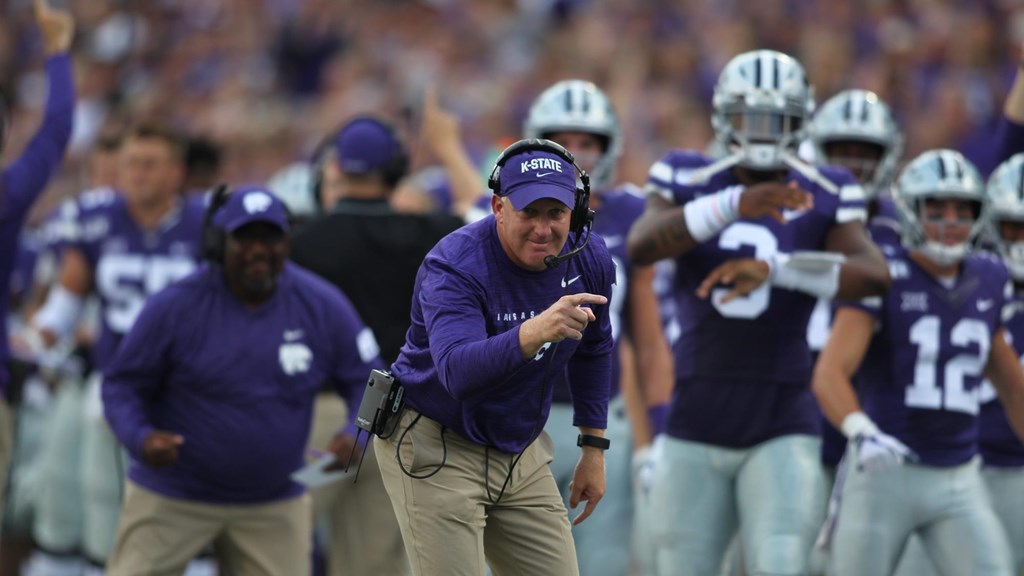
MANHATTAN, Kan. (AP) — Skylar Thompson threw for 212 yards and accounted for two touchdowns, six different Kansas State players reached the end zone, and the Wildcats rolled to a 49-14 victory over Nicholls on Saturday night to give coach Chris Klieman a win in his debut.
James Gilbert paced a Kansas State running attack that rolled up 361 yards by going for 115 and a score. Jordan Brown, Harry Trotter and Tyler Burns also ran for touchdowns.
The Wildcats finished with 573 yards of total offense.
Indeed, it was a near-perfect start for Klieman, who led North Dakota State to four national championships in five seasons but was filling some mighty big shoes. He took over last winter for Bill Snyder, the Hall of Fame coach who took Kansas State from lowly also-ran to a perennial Big 12 contender.
The Wildcats did it in just about all phases, too. They reached the end zone on their first four possessions, got a long TD catch from Dalton Schoen and returned a fumble for another score.
Chase Fourcade, the Colonels’ star quarterback, was just 10 of 18 for 126 yards with a pick. Kendall Bussey and Julien Gums had second-half touchdown runs.
The Wildcats, who the last few years under Snyder had grown stale offensively, roared out of the locker room with a sense of purpose. They brutalized the Colonels at the line of scrimmage, were largely free of penalties and looked every bit the program from a Power 5 conference.
Trotter, a Louisville transfer, reached the end zone first. Thompson scrambled 17 yards for the second score. Brown, a North Carolina transfer, reached pay dirt next. And Gilbert, the newcomer from Ball State, ran 24 yards to give the Wildcats a 28-0 lead with 6:21 left in the first half.
In fact, the Wildcats nearly went 5-for-5 on TDs in the first half. But when Schoen hauled in a 20-yard touchdown pass, a review showed him bobbling the ball as he fell out of bounds.
That led to their only first-half miscue: Blake Lynch missed the ensuing 37-yard field goal.
Schoen finally got his touchdown on the first play of the fourth quarter. He breezed past a defender and hauled in a 38-yard reception to give the Wildcats a 35-7 lead.
Jonathan Alexander’s strip, recovery and 25-yard touchdown return punctuated the win, and allowed Klieman to give his backups and third-teamers a chance to play most of the fourth quarter.
THE TAKEAWAY
Nicholls: After beating Kansas just down the road in their opener last season, the Colonels never really put up a fight. Fourcade threw a pick on their second offensive play, they went three-and-out on their next possession and the Wildcats quickly built an insurmountable lead.
Kansas State: The Wildcats looked a lot like Klieman’s teams at North Dakota State, winning the battle in the trenches and rotating running backs every couple of plays. The result was a team that was fresher and more physical as the game went along.
UP NEXT
Nicholls plays the second of four straight on the road, at Prairie View A&M on Sept. 14.
Kansas State hosts Bowling Green next Saturday before a trip to Mississippi State.
KANSAS CITY, Mo. (AP) — Whit Merrifield hit a tiebreaking sacrifice fly in the eighth inning after Kansas City loaded the bases on three bunts, and the Royals beat the Baltimore Orioles 7-5 Saturday night.
Bubba Starling hit his first homer at Kauffman Stadium after growing up about 30 miles away, and Hunter Dozier connected for the 24th time this season for Kansas City.
Anthony Santander hit two homers for Baltimore. The 24-year-old is the youngest Orioles player since 23-year-old Eddie Murray in 1979 to homer from both sides of the plate in the same game, according to STATS.
Baltimore fell apart defensively in the eighth when Kansas City tried to play small ball. Slow-footed Meibrys Viloria started the Royals’ rally with a bunt single. Brett Phillips tried to sacrifice him to second, but Viloria beat the throw. Nicky Lopez followed with another sacrifice attempt, and catcher Chance Sisco’s throw to third was off the mark.
Merrifield followed with his second sacrifice fly of the night to make it 6-5, and Dozier added an RBI on a groundout.
The three bunts came against reliever Paul Fry (1-6), who took the loss even though those were his only batters faced.
Scott Barlow (3-3) got the win with 1 2/3 perfect innings. Ian Kennedy pitched a perfect ninth for his 24th save in 27 chances.
Starling homered leading off the second, Santander countered with a leadoff shot in the fourth, and then Kansas City pieced together a three-run fourth on two sacrifice flies and a groundout RBI. That rally was helped when Phillips’ routine fly to center was dropped by Stevie Wilkerson.
Baltimore got four runs in the fifth inning to retake the lead. Sisco hit a two-out solo home run before Johnathan Villar and Trey Mancini singled to end the night for starter Jorge Lopez. Santander greeted reliever Tim Hill with his second home run of the night, the first multihomer game of his career.
Dozier’s solo shot tied it in the seventh.
SWEEPING UP
The Royals acquired minor league slugger Ryan McBroom from the Yankees for international signing bonus pool money and a player to be named or cash. The 27-year-old first baseman and outfielder hit .315 with 26 homers for Triple-A Scranton/Wilkes-Barre.
TRAINER’S ROOM
Royals LHP Danny Duffy is expected to be reinstated from the 10-day IL for Sunday’s start against the Orioles. Duffy has been on the IL since Aug. 8 with a left hamstring strain. … Royals SS Adalberto Mondesi and C Cam Gallagher also are expected to be activated Sunday. Mondesi has been on the IL since July 17 with a left shoulder subluxation and Gallagher has been on the IL since Aug. 8 with a left oblique strain.
ROSTER MOVES:
The Orioles had three players in the clubhouse and plan to activate them Sunday when rosters can be expanded. OF Dwight Smith, Jr. has played in 84 games with this season, hitting .238 with 12 home runs and 48 RBIs. RHP Branden Kline is 1-4 with a 7.44 ERA in 25 relief appearances. Tanner Scott is 1-0 with a 5.29 ERA in 15 appearances with the parent club. The Orioles are considering other call-ups but have not announced them.
The Royals are expected to have some call-ups, but with most of their minor league teams preparing for postseason, no announcements were made, other than from the injured list.
UP NEXT
Orioles: RHP Aaron Brooks (4-7, 5.79 ERA) will try to duplicate his recent outing against the Royals when he allowed one run on seven hits over five innings.
Royals: LHP Danny Duffy (5-6, 4.96 ERA) will return from his second stint on the 10-day injured list to make the start.
HAYS – The 2019 Hays High Lady Indian Volleyball team started their new season in solid form with a 2nd place finish at the inaugural Maroon and Gold Invitational in Hays. The Lady Indians finished 3-2 on the day with their only two losses coming at the hands of Olathe West.
Hays started the day with a 25-23, 27-25 win over Wheatland. Tasiah Nunnery led the way with eight kills and 11 assists. Brooke Denning and Brooklyn Schaffer finished the match with 10 digs each. Next up was a tough 19-25, 19-25 loss to eventual champion Olathe Wes. Schaffer had eight more digs while Nunnery and Carly Lange led the charge with four kills.
The Lady Indians would not have it easy the next two matches. The first was a 25-21, 21-25, 25-16 three set win over Scott City. Nunnery paced the team with 17 kills, Kyah Summers 17 assists and Schaffer had 11 digs. Next was a close 25-22, 25-20 victory of Salina South. Nunnery had 14 kills and 10 assists and Schaffer 12 digs.
That win pushed the Lady Indians to the championship match where the long day of play showed with some tired legs for the host team. Hays lost a lop-sided tilt to Olathe West 15-25, 10-25. Nunnery and Schaffer were both named to the all tournament team with Nunnery being named the Most Outstanding Player of the tournament.
TMP-Marian went 2-3 and finished third. The Monarchs went 1-2 and finished second in their pool. After beating Bucklin (25-17, 25-17) the Monarchs lost to Salina South (17-25, 25-18, 17,25) and Colby (29-31, 25-15, 19-25). In the semifinals they lost to Olathe West (24-26, 14-25) but bounced back to beat Salina South (25-19, 25-18) in the third place match.
Hays High is now off until September 12th when they travel to Dodge City.
SHAWNEE COUNTY — Law enforcement authorities are investigating a suspect on drug charges after a a tip from the public.
Tim Kaberline photo Shawnee Co.
On Thursday, the Shawnee County Drug Enforcement Unit investigated information received on illegal drug activity at a residence in the 600 block of NE Twiss Avenue in Topeka, according to Lt. Shayna Anderson.
Drug Task Force Officers from the Sheriff’s Office and the Topeka Police Department executed a search warrant and discovered a marijuana grow operation, methamphetamine, firearms and drug paraphernalia.
They arrested 59-year-old Timothy J. Kaberline and booked him into the Shawnee County Department of Corrections on requested charges that include Possession with Intent to Distribute Controlled Substance, Unlawful Cultivation of a Controlled Substance, Possession of Drug Stimulant and Possession of Drug Paraphernalia.
The Shawnee County Drug Task Force continues to investigate this narcotics distribution operation. Kaberline has four previous convictions for driving under the influence, according to the Kansas Department of Corrections.