We have a brand new updated website! Click here to check it out!

Tyson will pay employees while southwest Kansas plant closed

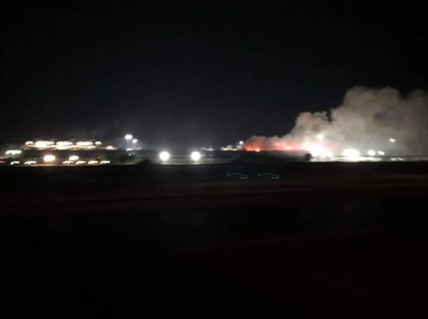
HOLCOMB, Kan. (AP) — Fire officials are trying to determine the cause of a fire that has temporarily shut down the Tyson Fresh Meats plant in Holcomb.

Fire at the Tyson plant west of Garden City -photo courtesy Holcomb Community Fire Department

Investigators say the fire Friday night started in the box shop near the area where animals are killed, causing part of the roof to collapse. It took firefighters more than 12 hours to get the fire under control.

Garden City Fire Chief Rick Collins said no one was injured.

The Topeka Capital-Journal reports Secretary of Commerce David Toland and Secretary of Agriculture Mike Beam met Saturday with representatives from Tyson, local government and economic development officials to coordinate state aid if it is needed.

The plant will be closed indefinitely. The company said in a statement Saturday that it will pay employees until production resumes.

Flooding rain, damaging winds from Sunday’s summer storm

RAWLINS COUNTY — Sunday evening’s summer storm brought damaging winds, flooding rain, hail, funnel clouds and one unconfirmed report of a tornado in Rawlins County.

Storm clouds rolling out of Colorado and into northwest Kansas Sunday evening photo courtesy NWS Goodland

Authorities are still working to determine the amount of damage in Rawlins County. Trees and power poles are down south and west of Atwood and water was also reported out of portions of Beaver Creek, according to the Rawlins County Sheriff’s Department.

In addition to street flooding in Atwood, streets are also flooded in St. Francis, Goodland and other communities in northwest Kansas.

Power is out in portions of Rawlins County. The sheriff’s office indicated they may not have electricity until noon as crews from Midwest Energy and Prairie Land work to restore service.

Ellis Co. business owner to be recognized by international organization

By JAMES BELL
Hays Post

Just at the edge of Hays down a little dusty road off Old U.S. 40 sits a modest automotive shop, but out of that non-descript space, comes some highly tuned, fully restored classic cars that would make anyone turn and to notice.

“Primarily, we are in the business of restoring vehicles, so all things automotive,” said Trisha Haskell, who owns Show Me Restoration, 1930 Louie Road, with her husband, Jason.

“Jason can do bottom-up work, pretty much anything you can dream up of doing to a car we’re in the business of doing,” she said.

Later this year, the effort of the shop will be highlighted by the Specialty Equipment Market Association in their 35 under 35 awards that will come out later this year.

“To us, it is a big deal,” she said. “We are over the moon to get an honor like that.”

While the business is located in Hays, their clients come from all over the country.

“It’s anybody and everybody,” Haskell said.

She said they work with a community of people that identify with vehicles.

“We have a nice selection of vehicles that we get in that people identify with and want to be restored,” Haskell said.

Those vehicles range from the common old vehicle, such as a Studebaker Goldenhawk, to the much more rare, such as a classic Shelby GT 500 – both currently being restored in their shop.

“The automotive industry is unique in that a lot of people if they find out you do good work, they will travel from all ends of the earth to come find you,” she said. “It’s kind of neat the array of people we get to meet.”

While both Trisha and Jason are transplants to Hays, they grew up in western Kansas. Jason is from Kinsley and Trisha from Garden City.

After Jason was recruited from Northwest Kansas Technical College in Goodland to work in Skeeter’s Body shop in Garden City, the pair met in Garden City and decided they liked Hays. They set up shop in 2013 shortly after moving into town.

“It’s been great. We really enjoy it,” Haskell said.

While Hays might not be the center of the automotive restoration world, being recognized by SEMA shines a light on the shop that will be seen across the world.

“SEMA is known worldwide,” she said. “There is a lot of buzz going on there,” Haskell said.

SEMA is best known for its annual trade show, which will begin on Nov. 5 in Las Vegas.

“We love old cars and restoring them and doing anything with them,” she said. “I think that is what is exciting about SEMA is that it gives a news twist on allowing you to see some of the creative things that people are doing with these resto-mods and that sort of thing.”

Haskell said the organization is a lynchpin in the wide field of car restoration.

“They encompass the entire industry and what everyone is trying to do. It’s nice to have that when you are so specific in a very broad industry such as automotive,” Haskell said.

The SEMA 35 under 35 will come out next month and will feature Jason and his restoration work including what he has done in the automotive industry and where he sees it going she said.

More about SEMA can be found at their website semashow.com. 

More about Show Me Restoration can be found on their facebook page, @SMRHAYSKS.

Portion of W. 4th closed starting Monday

City of Hays

Beginning Monday, the 400 block of West 4th Street between Elm and Ash Streets will be closed to traffic. This work is related to the Elm/Ash/4th Street reconstruction project.

Signs will be in place to direct the traveling public. The traveling public should use caution and if possible, avoid this area.

The City of Hays regrets any inconvenience this may cause to the public. If there are any questions, please call the Office of Project Management at 628-7350 or the contractor, Morgan Brothers Construction, at 432-3104 or 394-1777.

FHSU’s Harper presents in the United Kingdom on administrative work

FHSU University Relations

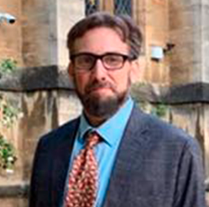
Fort Hays State University’s Jason Harper, senior lecturer and international coordinator for the Departments of English, Global Business English, Computer Sciences and Health and Human Performance, recently presented a talk titled “On a Slow Boat to China: Hiring Challenges to Get Faculty on the Ground in the Middle Kingdom” at the University of Oxford in the United Kingdom.

Harper’s presentation focused on his administrative work and discussed how the international faculty hiring decisions made by FHSU are determined through careful consideration of needs of the location, anticipated demand, historic interest, program uniqueness and accreditation constraints.

“These hiring decisions are deliberated on the home campus in conjunction with – and support from – a departmental committee, human resources staff, department chairs, deans and other such on-site representatives,” said Harper.

Harper’s recruitment and hiring processes for FHSU’s off-campus faculty occur through identical methods, just as they are done for on campus faculty.

“I need to develop flexible strategies to weave my way through a quagmire of oftentimes unpredictable tribulations that often trip up these staffing processes,” said Harper.

Kansas troopers catch stolen car suspect on I-70

SHAWNEE COUNTY — Law enforcement authorities are investigating a stolen car suspect after a chase and arrest.

Troopers catch stolen car suspect photo courtesy Kansas Highway Patrol

On Saturday, Kansas Highway Patrol Troopers from Troop B and Troop G were involved in a pursuit with a stolen vehicle on the Kansas Turnpike westbound from Douglas County. The pursuit continued into Shawnee County.

Shawnee County Sheriff’s deputies  were ready with tire deflation devices. They were successful with their deployment, hitting 3 of the 4 tires as the pursuit passed westbound on I-70 near the Croco Road overpass. The suspect exited the interstate at Deer Creek and surrendered without further incident.  Troopers have not named the suspect and possible charges.

Bollig named associate at Hays accounting firm

Bollig

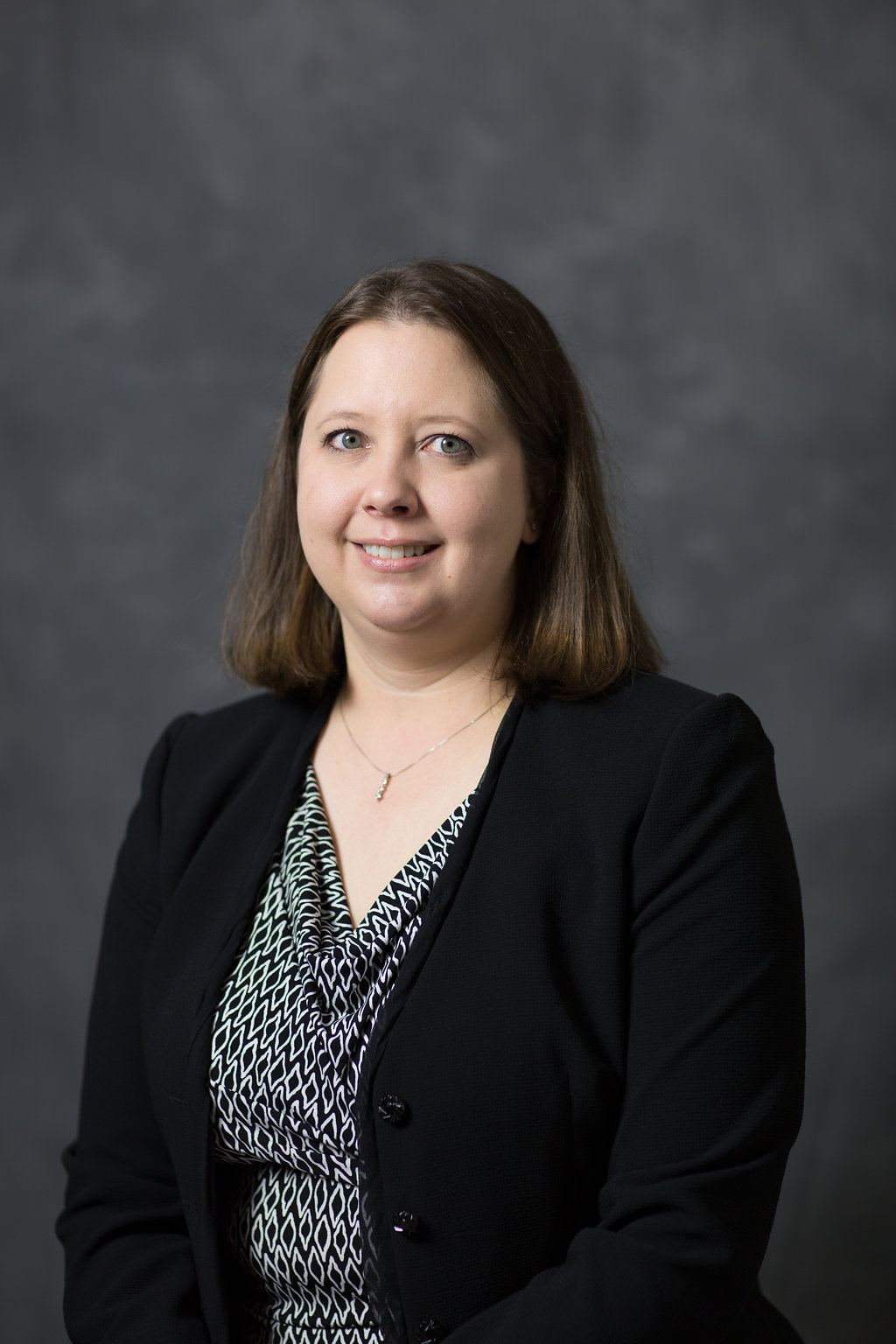
The Certified Public Accounting firm of Brungardt Hower Ward Elliott & Pfeifer L.C.recently announced the promotion of Kim Bollig, CPA, to associate.

Bollig is a graduate of Fort Hays State University with a B.B.A. in accounting. She is originally from Great Bend and lives in Hays with her husband and two children.

Bollig’s areas of expertise include financial statement audits and tax planning and return preparation.

Brungardt Hower, with offices in Hays and Garden City, serves clients in central and western Kansas.

FIRST FIVE: Countering conspiracy theories with critical thinking

Katharine Kosin

By Katharine Kosin and Kirsti Kenneth
Freedom Forum Institute

The First Amendment protects all kinds of speech we don’t like, but nothing in those 45 words prevents us from critically evaluating what we believe — or choose to retweet.

El Paso, Texas, and Dayton, Ohio, have now joined the growing list of American cities that have suffered the horrors of mass shootings.

While both investigations are still unfolding, authorities currently believe that the El Paso gunman’s motivations might be explained by a manifesto posted online under his name shortly before the shooting. This manifesto touched on several conspiracy theories, including claims of a “Hispanic invasion of Texas” and that corporations controlled the government, while also praising a manifesto by the New Zealand mosque shooter that advanced a theory of “white extinction.”

The FBI also has begun labeling such conspiracy theories as domestic terrorism threats. There is renewed public discussion about the potential consequences of conspiracy theories and the presence of places on the internet like 8chan, where users have been known to encourage acts of violence.

When Infowars founder Alex Jones promoted a baseless theory claiming the parents of children slain at the Sandy Hook Elementary School shooting were “crisis actors,” some of the parents he named became targets of harassment. At a societal level, the spread of conspiracy theories about vaccines or medical treatments can lead to the spread of viruses like measles or Ebola.

Kirsti Kenneth

Belief in conspiracy theories is not confined to extremists. A study by University of Chicago political scientists J. Eric Oliver and Thomas J. Wood between 2006 and 2011 surveyed Americans about seven common conspiracy theories, ranging from “Barack Obama was born outside the U.S.” to “The U.S. government planned 9/11 to justify war in the Middle East” and “Aircraft vapor trails contain chemical agents being deliberately deployed into the atmosphere.” They found that at least 50 percent of Americans consistently believed in at least one of the seven theories presented.

As First Amendment advocates, we don’t seek to censor conspiracy theories. As ugly and unbelievable as some may be, such views are constitutionally protected from government action unless the speech is deemed an immediate incitement to crime and violence, constitutes a true threat to an individual or causes an immediate breach of the peace. Some conspiracy theories do grow from a seed of truth that deserves closer scrutiny.

Rather than ban production and publication of conspiracy theories, we should educate students and ourselves how to act responsibly and ethically when it comes to this type of content. Pausing to think critically before liking or sharing conspiracy-fueled posts or articles can go a long way toward stopping the spread of damaging misinformation. What constitutes critical thinking in these instances: Asking if claims are supported by facts and evidence, if they come from reliable sources, if they’re meant to entertain, raise awareness or simply inflame? Consider these questions before you act. According to a 2018 Pew Research Center survey, 71 percent of U.S. adults trust the information they get from friends and family, so be thoughtful about the content you may be passing on. Not every story is worth endorsing with your text, tweet or share.

But responsibility doesn’t stop there.

While government cannot regulate speech protected by the First Amendment, news creators, social media platforms and tech companies may need to reexamine their practices and regulations. Reporters covering conspiracy theories should weigh the value of the revelations against the added visibility the story will bring to a possibly damaging theory.

Social media platforms must reconsider algorithms that prioritize shocking and outrageous content, surfacing conspiracy theories in front of people who weren’t actively looking for them and enabling their spread. YouTube and Facebook say they’re working to address this.

Cloudflare, a company that protects websites from denial-of-service attacks, has announced it will drop 8chan as a client because it said 8chan had crossed the line from “content that we find reprehensible” to “directly inspir[ing] tragic events.”

There is a range of explanations as to why some people buy into preposterous theories. No matter the root of the belief, once someone accepts one of these theories as true, psychology makes it much more likely they’ll reject any contradictory evidence that comes their way.

In the wake of these latest tragedies, a sense of helplessness often accompanies the grief. But now is not the time to lose heart. Conspiracy theories aren’t going away, but it is possible to help limit their spread and harmful effects.

Contributing to this column were Barbara McCormack, vice president of education at the Freedom Forum Institute, and Pierce McManus, NewseumED’s digital communications and outreach director. Katharine Kosin, NewseumED museum educator, and Kirsti Kenneth, NewseumED’s curriculum developer, can be reached for media inquiries at [email protected].

Agricultural research center in Hays hosts Fall Field Day on Aug. 21

Soybean field at K-State Ag Research Center, Hays

Kansas State University’s Agricultural Research Center in Hays will provide updated management strategies for numerous Kansas crops when it hosts the annual fall field day on Wednesday, August 21.

There is no cost to attend the event, which takes place from 8:30 a.m. to 2 p.m. Lunch will be provided. The research center is located at 1232 240th Avenue in Hays.

The schedule includes a series of field tours beginning at 9 a.m., including:

  • Pearl millet hybrid performance
  • Grain sorghum hybrid performance
  • Occasional tillage in wheat-sorghum-fallow rotations
  • Integrated weed management in soybeans
  • Pre- and post-herbicide options for weed management in grain sorghum
  • Imidazolinone-tolerant grain sorghum: A new technology for weed control.

The afternoon includes a look at insect management in soybeans; and a presentation on alternative crops for western Kansas, including field peas and industrial hemp.

Organizers say that pesticide applicators and certified crop consultants can earn up to four hours of continuing education credits by attending this year’s field day.

Interested persons are encouraged to pre-register by calling 785-625-3425. More information, including a list of speakers for this year’s field day, is available online at www.hays.k-state.edu.

– SUBMITTED –

Kan. man’s trial delayed over crash deaths of 4 on motorcycles

NORTH PLATTE, Neb. (AP) — The Nebraska trial of a Kansas man charged with the 2017 traffic deaths of four Iowa motorcyclists has been delayed again until October.

CISNEROS HERNANDEZ- photo Keith County

A judge recently agreed to delay the trial for 24-year-old Jeser Cisneros-Hernandez, of Liberal, Kansas. He’s pleaded not guilty to four counts of vehicular homicide, one of reckless driving and one of failing to drive in his lane.

The new trial date is Oct. 15. Cisneros-Hernandez remains free on bail.

Prosecutors say Cisneros-Hernandez’s vehicle hit two motorcycles carrying two people each on July 1, 2017, near Ogallala.

Authorities say 54-year-old Sheila Matheny and 61-year-old James Matheny, from Bedford, Iowa, were on one motorcycle. The other motorcyclists were 58-year-old Michal Weese and 59-year-old Jerolyn Weese, who lived in Council Bluffs, Iowa.

Kansas anti-vaccine groups say membership numbers surging

TOPEKA, Kan. (AP) — A Kansas anti-vaccination group says its membership is growing dramatically since the state added two new vaccination requirements for children returning to school this fall.

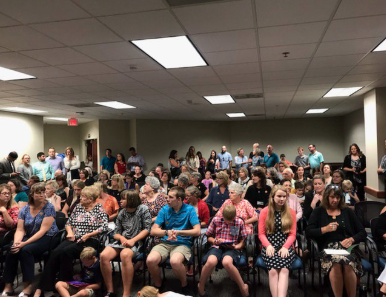
Standing room only on June 27, as Kansas citizens wait to listen and share their opinions on the school vaccine requirements.-photo Immunize Kansas Coalition

As of Aug. 2, Kansas is requiring a meningitis vaccine for students beginning seventh grade and students entering 11th grade who weren’t vaccinated before their 16th birthdays. And students entering kindergarten or first grade need two doses of the hepatitis A vaccine. The vaccines are required for children in public and private schools and are in addition to five other mandated vaccines.

Exceptions are allowed for religious or medical reasons.

Connie Newcome, president of Kansans for Health Freedom, said the nonprofit has grown larger since the Kansas Department of Health and Environment held a hearing on the two new vaccination requirements in June.

“I think most people in Kansas are independent enough that they prefer to make their own family decisions without the government telling them what to do,” said Newcome, a grandmother living outside Hutchinson who says she stopped vaccinating her children decades ago.

The new requirements follow recommendations of the Advisory Committee for Immunization Practices.

“Both of these illnesses are severe and preventable, and the safety profile of the vaccines is well-recognized, in keeping with the CDC (Centers for Disease Control) and other scientific authority,” said Kristi Pankratz, a spokeswoman with the state health department.

Members of the anti-vaccination group told The Star they worry about the pharmaceutical industry’s influence on scientific studies. Many also discussed their children’s illnesses and disorders, which they claim occurred or grew worse after vaccinations — despite research largely showing the contrary.

Christine White, a Johnson County physician, said research shows the benefits of vaccines far outweigh the risks, especially with life-threatening diseases such as meningitis.

“Parents who refuse meningitis (vaccines) often say their children aren’t at risk because they’re homeschooled or aren’t often in group environments. And we try to discuss it only takes one sneeze or one shared drink with a kid who has it to get it,” White said. “I’ve had a few converts with that one. But meningitis scares people. People know that it can kill you.”

In 2017, 72% of Kansas teenagers had been vaccinated against meningitis, lower than the national average of 85%. Kansas ranks sixth from the bottom in meningitis vaccination rates in the country.

Last year, 90% of Kansas children were vaccinated against hepatitis A, due to a previously approved requirement for children in day cares.

Copyright Eagle Radio | FCC Public Files | EEO Public File