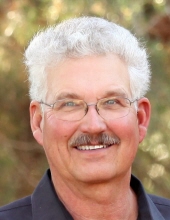
Edgar “Ed” Herman Wetzel, 87, died July 23, 2019, at Salina Regional Health Center, Salina. He was born February 28, 1932, to Herman and Elsie (Weiss) Wetzel in Ford County. He was baptized as an infant in the Lutheran faith at Zion Lutheran Church south of Offerle, Kansas. He attended grade school near Offerle. He also attended and graduated from Dodge City Senior High School in 1950.
He entered the United States Air Force on December 10, 1951, during the Korean War, graduating #1 in the Radar and Electronics class. He earned the rank of A1C, and was honorably discharged on December 5, 1955. Edgar married Helen Maskus on December 28, 1952, at St. Michael’s Lutheran Church in Hodgeman County. He moved to Great Bend in December 1955 and was the service manager at Martin Jaeger for 20 years. Ed was the owner and operator of Ed’s TV and Air Conditioning, traveling from Odessa, Texas to Moline, Illinois, repairing and installing electrical, television, sound systems and air conditioning systems for 25 years.
Ed was a member of Trinity Lutheran Church where he served on the count team, buildings and grounds team and was a former head usher; he was also a member of the American Legion Argonne Post 180 in Great Bend. His interests included hunting, trap shooting, bowling, carpentry and coaching. Ed enjoyed time spent with family, from days spent on baseball and softball fields, to weekends at the lake. He was always lending a helping hand, love and support.
He is survived by his wife Helen of the home; his children, Randy Wetzel and wife Brenda of Great Bend, and Renee Holl and husband Dennis of St. John; one grandson, Dennis Price of Wichita; three great-grandchildren, Haley Jackson and husband Chris of Russell, Cody Piland of Great Bend, and Ava Winters of Winfield; two great-great-grandchildren, Kaylee and Kellie Jackson. He was preceded in death by his parents; brother, Carol Wetzel; and one grandchild, Michelle Price.
Visitation will be held from Noon to 9:00 p.m., Thursday, July 25, 2019, at Bryant Funeral Home, with family receiving friends from 5:00 to 7:00 p.m. Funeral Service will be at 10:30 a.m., Friday, July 26, 2019 at Trinity Lutheran Church, with Pastor Barbara Jones and Pastor Jon Brudvig presiding. Interment will be in the Great Bend Cemetery.
Memorials are suggested to Trinity Lutheran Church Endowment Fund, in care of Bryant Funeral Home.
William “Bill” Thomas, 68, passed away Sunday, July 21, 2019, at his home in Hoisington. He was born May 2, 1951, in Denver, Colorado, the son of Rawlin and Jane (Veach) Thomas.
Bill was a longtime resident of Otis and Hoisington. He was a truck driver for Linde Global Helium Inc. and Big A Auto Parts. He was a member of the Soaring Club in Hoisington. He enjoyed guns and clocks.
Survivors include three sisters, Lydia Strickland of Alvarado, Texas, Patty Settles and Martha Gonzalez both of Denver, Colorado; and many nieces and nephews. He was preceded in death by his parents.
No services will be held. Cremation has taken place.
ALBUQUERQUE, N.M. (AP) — Five trees planted in New Mexico from seeds taken to the moon during the Apollo 14 mission and given to the state by NASA have all died or been forgotten, according to officials at the locations where the trees were planted decades ago.
Officials at New Mexico sites where the trees were planted decades ago admit their agencies since have lost track of the trees and some of them likely died with little notice, KOAT-TV in Albuquerque reports.
Moon trees were grown from 500 seeds taken into orbit by former U.S. Forest Service elite parachuting forest firefighter Stuart Roosa during the 1971 mission. Roosa and the seeds orbited more than two dozen times around the moon.
NASA said the seedlings were planted throughout the U.S. and elsewhere around the world after Apollo 14 returned to Earth. The trees were meant to honor Durango, Colorado-born Roosa, who died in 1994.
Five of the trees that grew from the seeds, which included American sycamores and Douglas Firs, were given to then-New Mexico Democratic Gov. Jerry Apodoca.
They were planted at the State Capitol in Santa Fe, the Smokey Bear Historical Park in Capitan, the New Mexico Space Museum in Alamogordo, Gough Park in Silver City and Albuquerque’s Civic Plaza, according to newspaper archives.
The tree planting events in the mid- to late-1970s generated fanfare and intense media coverage.
“We are not sure exactly where it was but it had to have been in this particular area right here,” said Mike Shinabery, an education specialist at the New Mexico Space History Museum in Alamogordo, New Mexico, told a reporter.
“I am assuming that they may have planted it out here,” said Bennie Long, director of Smokey Bear Historical Park in Capitan, New Mexico, as she pointed to an old abandoned train depot. “Now that is just my guess.”
Raphael Drhett Baca, building superintendent of the New Mexico State Capitol, said officials there have no idea where the moon tree was planted.
Albuquerque officials said that the moon tree planted in Civic Plaza later died after the plaza was remodeled in 1996.
Other states, like Arkansas, Florida and Georgia, have kept up with moon trees and periodically organize events around them.
LINCOLN COUNTY, NE. —Troopers with the Nebraska State Patrol (NSP) have arrested two people and seized several controlled substances, including 16 pounds of methamphetamine, during a traffic stop on Interstate 80 near North Platte, according to a media release.
Just after 8a.m. Tuesday, a Nebraska State Trooper observed an eastbound BMW sedan speeding near mile marker 175. During the traffic stop, the trooper detected the odor of marijuana coming from inside the vehicle.
A search of the vehicle revealed several controlled substances, including 16 pounds of methamphetamine, and smaller amounts of heroin, cocaine, prescription pills, and marijuana. Troopers also located three loaded handguns in the vehicle.
Adams photo Lincoln Co.Jones photo Lincoln County
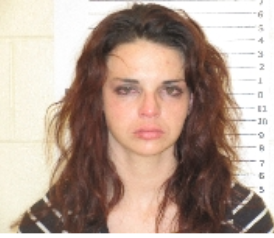
Deputies arrested the driver, Richard Adams, 27, of Corona, California, and passenger, Kacee Jones, 26, of Wichita, Kansas, on requested charges related to possession of controlled substances, possession with intent to deliver, possession of firearms during the commission of a felony, possession of drug paraphernalia, and other related charges.
Both remain in custody in the Lincoln County Jail.
COLUMBUS, Ohio (AP) — The moon may be made of cheese, but these astronauts are made of butter.
The Ohio State Fair is commemorating the 50th anniversary of the moon landing with life-size butter sculptures of Neil Armstrong and his fellow astronauts.
Gov. Mike DeWine opened the 166th edition of the fair Wednesday morning with a ribbon-cutting ceremony. Afterward, the Republican governor toured the fairgrounds and stopped by this year’s annual butter display.
The display features a life-size sculpture of Wapakoneta (wah-puh-kuh-NEHT’-uh) native Armstrong saluting the American flag after planting it on the moon’s surface as he stands beside a lunar module.
The display also includes the Apollo 11 emblem and life-size sculptures of Armstrong and fellow astronauts Buzz Aldrin and Michael Collins sitting beside the traditional butter cow and calf.
CHICAGO (AP) — Chicago police say three thieves smashed a display window of a high-end department store and stole three mannequins dressed from head to feet in designer clothes.
Police say the theft occurred around 4:15 a.m. Wednesday at the Neiman Marcus store on Chicago’s Magnificent Mile.
They say three people wearing hoodies pulled up to the store, smashed the window, threw the three mannequins wearing expensive clothes including shoes and bags into the back of an SUV and fled. At least two arms from the mannequins fell off during the theft and were left lying on the ground amid broken glass.
The value of the clothing and other details haven’t been released. Police say no one has been arrested.
NEW YORK (AP) — Bindi Irwin, the daughter of the late conservationist, Steve Irwin, is getting married.
She posted Wednesday on her social media that longtime boyfriend Chandler Powell’s proposed on her 21st birthday, Tuesday.
Powell is a 22-year-old wakeboarder from Florida whom she met in 2013 when he was visiting the Irwin family’s Australia Zoo .
Steve Irwin, known as “The Crocodile Hunter,” was a popular TV personality. He was killed by a stingray in 2006 while filming an underwater documentary.
His wife, Terri, and children Bindi and Robert have carried on his conservation work.
Bindi Irwin starred in her own wildlife series as a child. She won season 21 of “Dancing with the Stars.”
SANGATTE, France (AP) — A French aviation buff and inventor glided partway over the English Channel on a homemade “flyboard” Thursday — then crashed in the sea.
Undeterred, he plans to try again.
After careful preparations, Franky Zapata took off from the French coastal town of Sangatte fastened to the small flying platform he designed.
From afar, it looked like he was skateboarding on the sky.
But as he descended for a refueling stop about halfway across, the platform he was meant to land on was moving too much due to waves. So he was not able to grab onto it, and he fell into the water, his wife Christelle said.
He was rescued by French divers and is doing fine, she told The Associated Press.
“These are the kind of things that can happen,” she said. He traveled more kilometers than he expected, and faster than he expected, so she said it wasn’t a total disaster.
“He will do it again,” she said. “He never sits back after a failure.”
Zapata had hoped to make it across 36 kilometers (22.4 miles) to the Dover area in southeast England in about 20 minutes. He was carrying a power pack full of kerosene, and was planning to refuel from a boat partway across.
Zapata, 40, wowed crowds in Paris on Bastille Day, whirling over European leaders on the flyboard. But crossing the windy, ship-filled Channel is a much tougher challenge.
He scheduled Thursday’s flight to coincide with the 110th anniversary of the first flight across the Channel, by French aviator Louis Bleriot on July 25, 1909 — who also left from Sangatte after multiple failed attempts. The beach where Zapata took off Thursday bears Bleriot’s name.
A little girl went up to her mother one day while holding her stomach saying, “Mommy, my stomach hurts.” Her mother replied, “That’s because it’s empty, you have to put something into it!”
Later that day when a couple was over for dinner. The woman began to feel bad. Holding her head she said, “I have such a terrible headache!”
The little girl looked up at her giving her the sweetest smile that any little child could give. Then she said, “That’s because it’s empty, you have to put something into it!”
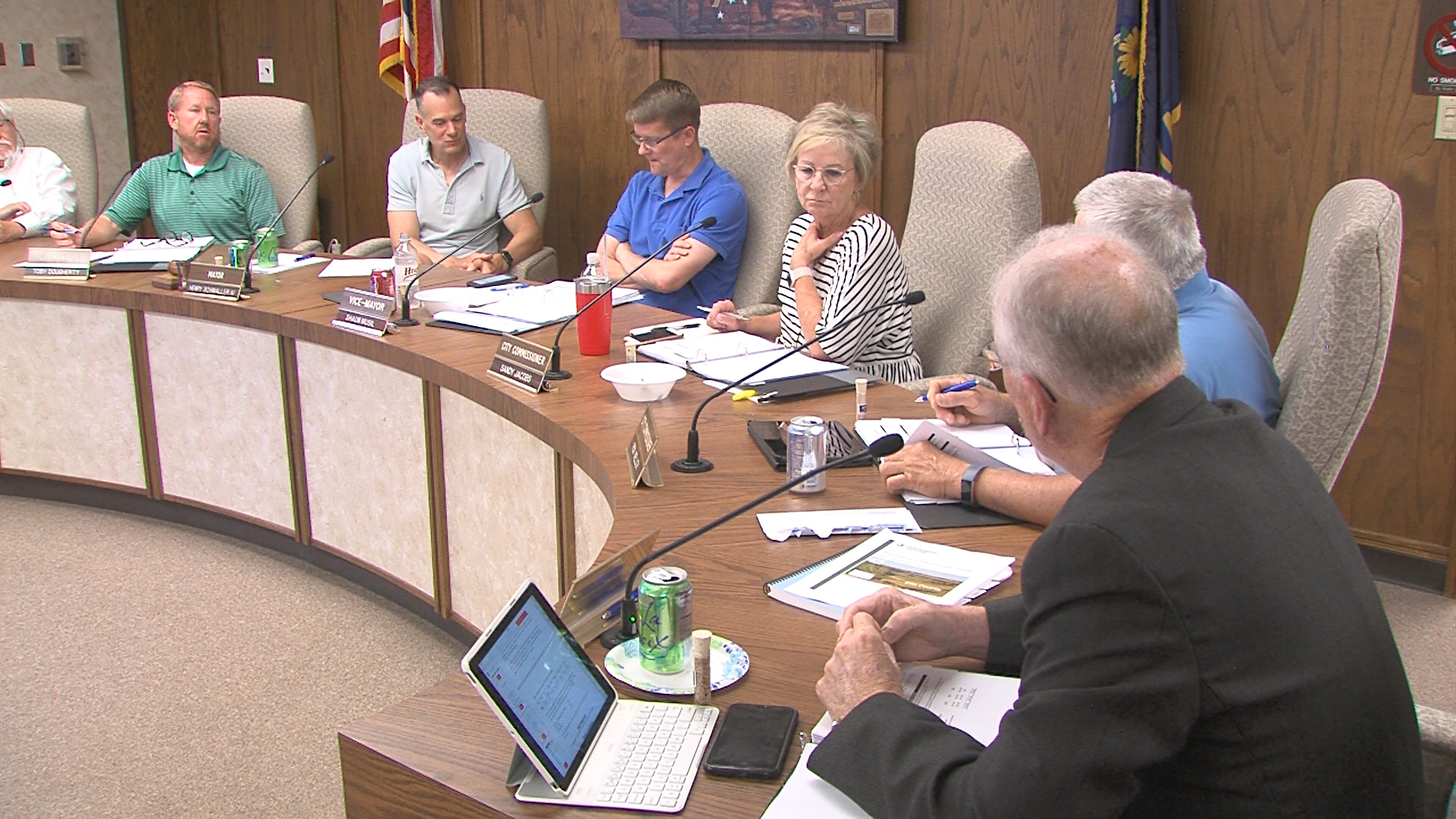
City commissioners discuss outside agency funding during a second review of the 2020 budget draft.
By BECKY KISER Hays Post
After requesting funding from the city of Hays for the first time in two years, Grow Hays will receive a little more than it asked for.
Doug Williams, Grow Hays executive director, made a $100,000 funding request from the city’s proposed 2020 budget during a presentation in June.
During last week’s work session, commissioners agreed to Mayor Henry Schwaller’s suggestion not to renew the $45,000 city contract with business recruiter Retail Strategies for a third year, resulting in a savings of $42,500 in the economic development fund this year.
“They told us what we needed to know. … We know our trade area, we know who lives here, we know what they buy and what they’re seeking.
“We’re done. They can’t recruit anybody and we haven’t heard from them in a year,” Schwaller said.
“That’s where I’m at,” said Shaun Musil, vice mayor.
“We may see some impact on our retail side from additional work being done by Grow Hays,” Commissioner Sandy Jacobs said. Grow Hays was formerly the Ellis County Coalition for Economic Development.
“We have $42,500 for economic development in the 2019 budget that is not spent,” Musil pointed out. “I’d like to offer that to Grow Hays this year and possibly that same amount next year.”
Jacobs went further, offering the remaining $42,500 this year plus the total economic development budget of $87,500 in 2020 “since we’re not going to renew with Retail Strategies,” she said.
The total would be $130,000 to Grow Hays over the 2019/2020 budget cycle. All the commissioners agreed.
“We would also hope that their solicitation of investment from local businesses increases as well,” added Phelps.
The commission will vote on the $42,500 expenditure for 2019 at their meeting tonight.
Commissioners also gave their consensus to the following funding requests:
CARE COUNCIL – $168,000, up from $164,000
Fort Hays State University Scholarship Program – $100,000
Downtown Hays Development Corporation – $50,973
Ellis County Historical Society – $12,000
Hays Arts Council – $12,000
Wild West Festival – $9,500
“That $100,000 investment is realized over and over during the school year,” Phelps said of the FHSU allotment.
Mellick praised DHDC for asking for 5% less this year.
“I’m happy with that. I think that’s showing some restraint in not thinking this is an entitlement,” Mellick said.
“They do good things. … We’ve given them lots of money over the years and lots of opportunity, and they have ran with that money well. But they need to slowly – to a certain extent – become a little more self-funded.”
The Ellis County Historical Society is working on a strategic plan, which could include a new building. The museum is housed in the First Presbyterian Church, 100 W. 7th, located in the city’s historical district. Mayor Schwaller noted it would require a resolution from the city commission to raze the church.
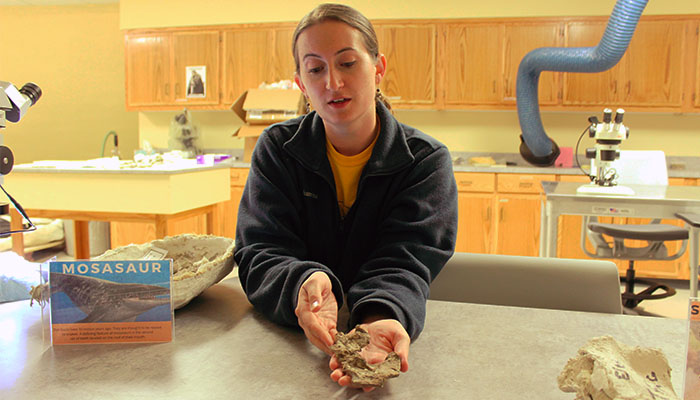
Christina Byrd, Sternberg collections manager, displays part of a mosasaur cranium she has been cleaning in the fossil preparation lab.
By CRISTINA JANNEY Hays Post
The Sternberg Museum has opened its backroom to show the public the transformation of fossils from the field to something that can enter the museum’s collection.
Christina Byrd, Sternberg collections manager, discusses the different stages fossils go through when they are being prepared for the collection.
A big part of this has been the opening of the newly renovated Dane G. Hansen Paleontology Center. In addition to new state-of-the-art equipment, the lab has windows through which museum visitors can see scientists working on fossils.
Christina Byrd, collections manager, is using the space to offer fossil identification at noon each Friday in July.
As there was no line waiting for Byrd’s services, I took my own “fossils” in for identification. I have been hunting crinoids with my dad in the gravel pits on my grandfather’s farm every since I can remember, so I dug into my box of rocks and fished out three promising specimens.
Two of my “fossils” weren’t fossils, Byrd said. They were just interesting rocks.
Byrd holds dental tools, which are used to clean fossils.
The one fossil was a mold of the inside of a clam. Byrd said although the shell of the clam was gone, sediment had likely deposited inside of the clam to form the mold.
Although I had not marked the fossil, based on the box I found it in, I think this came from the area below the Tuttle Creek Dam. Many fossils were found there after flooding washed away topsoil and rock in 1993.
Byrd said she enjoys the opportunity to interact with visitors thanks to new lab space.
“I think being able to interact with the scientist who is actually doing the work is so important,” she said. “I get stuck downstairs so often that I love the opportunity to come up and talk to everybody about the stuff I get to do everyday.”
Byrd shows a mosasaur skull that she has been cleaning in the prep lab.
The day I visited, she was working on a mosasaur skull. Mosasaurs were large aquatic reptiles that lived during the Cretaceous period from 100 million to 66 million years ago. They inhabited the inland see that covered Kansas at that time.
Byrd’s specimen on Friday was found in Gove County. Of the museum’s 21,000 catalog fossils, 14,000 of them were found in Kansas.
If you visit the lab, you can see the stages fossils move through as they are being prepared.
The fossil is first removed from the surrounding material and placed in a burlap and plaster cast for shipping. Once at the museum, the paleontologist has to remove the surrounding material.
My little clam fossil was pretty clean, probably because it was forcefully ripped out of the rock by a torrent of water. Not so for Byrd’s fossil. Her mosasaur skull was encased in a matrix.
The material surrounding the mosasaur skull was fairly soft, so Byrd was using dental tools to painstakingly clean the fossil. To add to the challenge, plant material had tried to grow into fossil.
Dinosaur fossils found in other areas of the U.S. can be located in much harder material. This can require pneumatic tools.
How long it takes to clean a fossil depends on its size and the material in which it was found. Some fossils can take years to prepare, Byrd said.
All of the paleontologists’ work is done under a microscope, but a monitor is mounted outside of the lab so visitors can see what the scientists are seeing.
“Because we do everything under a microscope, it is sometimes hard to see when someone is at the window because we are so focused. However, I can hear when they are interacting with that monitor,” Byrd said. “Because I hear a mom say, ‘Hey sweetie, see what she is working on there. You can actually see it up close there.’
“If I have the windows open I can say, ‘Hey, do you have any questions? Would you like to learn anymore about what is in here?’ Or kids will point and say, ‘What’s this?’ Having this larger window and broader space, people can see what is in here.”
All of the surrounding sediment materials cleaned from the fossils is saved. A specific researcher is using the material around the fossils to evaluate in what type of environment the animals lived.
“Once you have taken it all off, you have lost a specific detail of this bone’s history,” Byrd said. “It’s another clue. When you think about life, you have to think in the whole view. You can’t think in terms of just one animal. You have to think in the ecological view — the animals, the plants. What are the sediments telling us?
“Especially in the Western Interior Seaway since it was covered in water, the sediments can tell you a lot about what changes happened through time within those sediments. Did it get more course? Did it get finer? That can tell us different things about how water is moving throughout this area through that broad span of time that water covered the U.S.”
Microscopic creatures can be found in the sediment that also give clues to environment, such as temperature and salinity.
The original prep lab is now the histology lab. Scientists cut very thin slices of bone and grind them down to be viewed under a microscope.
Looking at the bone at the minute structural level can also gives clues about how the animals grew and what they ate. When reptiles experience a trauma, that can have arrested growth, which shows up in their bones.
Bone growth can also give researchers clues to the environment in which the animals lived, including water temperature and if the animal was warm- or cold-blooded.
One FSHU graduate student has been recently using histology to study the growth patterns of the Sternberg’s plesiosaur.
“You have all of these clues that confirm what scientists have been thinking of,” Byrd said. “It is just more evidence to support the case and give us a more solid understanding.
“We are taught to always question, but once you get enough information, we can say, ‘How much do we trust the current evidence? Test it again, see if we get the same results.’ If we continue to get the same results, then ‘OK that’s it.’ ”
You don’t have to have a fossil to visit the lab during the fossil ID ID time. You can just show up with questions. The event is free with admission.
If you have a question about a fossil and can’t make it on Fridays, check with the front desk or call the museum.
 Edgar “Ed” Herman Wetzel, 87, died July 23, 2019, at Salina Regional Health Center, Salina. He was born February 28, 1932, to Herman and Elsie (Weiss) Wetzel in Ford County. He was baptized as an infant in the Lutheran faith at Zion Lutheran Church south of Offerle, Kansas. He attended grade school near Offerle. He also attended and graduated from Dodge City Senior High School in 1950.