We have a brand new updated website! Click here to check it out!

TMP grad’s photo of Mister Rogers featured on stamp

Editor’s Note: This story originally was published May 8, 2018. Tom Hanks will star as Mr. Rogers in “A Beautiful Day in the Neighborhood,” which is scheduled to open in theaters this Thanksgiving. Watch the trailer above.

By CRISTINA JANNEY
Hays Post

The United States Postal Service recently released a stamp featuring children’s show legend Mister Rogers.

The photo used for the stamp was taken by a graduate of Thomas More Prep-Marian, Walter Seng.

Seng, 74, who now lives in Arizona and has retired from photography, spent over a decade creating promotional images for Fred Rodger’s “Mister Rogers’ Neighborhood.”

Photo courtesy of the USPS

Seng, TMP class of 1961, said he made some lifelong friends at TMP and still keeps in touch with some of his classmates.

Seng drew and painted from the time he was young. He learned to paint from his grandfather, but he fell in love with photography at Carnegie Mellon University, when he attended his first black and white photo exhibition.

“The spirit of those images really drove home to my particular personality and my psyche. It picked me. I didn’t pick it,” he said.

Seng attend TMP as a residential student because his uncle was a priest and teacher at the school. However, he was from Pittsburgh, where “Mister Rogers Neighborhood” was filmed, and Seng became connected with the show there.

Walter Seng. Courtesy photo

Seng began taking marketing photos for the show in 1972 and worked with Rogers through the 1980s.

Seng was notified by the USPS about the stamp more than two years before its release March 23. However, he had to keep the release a secret.

The USPS receives more than 20,000 applications each year for new stamp designs and picks only a handful for publication. The photo that was chosen for the stamp features Rogers in a red sweater with one of the puppets from the show, King Friday.

Seng said the photo was one of a number of publicity photos that was taken in about 1985 to showcase Rogers with all the neighborhood puppets and props, including Queen Sara Saturday, X the Owl and Daniel Striped Tiger. All the puppets lived in the Neighborhood of Make-Believe, and children were transported there via a trolley. The show aired nationally from 1968 to 2001.

For those with younger children, Daniel Tiger now has his own animated series on PBS.

Rogers was known for starting the show by donning a sweater and putting on his sneakers as he sang, “Won’t You be My Neighbor,” one of many songs Rogers composed for the show. Besides composing for the show, Rogers also voiced most of the puppets. Seng said there was a reason behind the sneakers. When he first starting working on TV, he found sneakers made less noise when he was walking backstage during filming.

Seng said Fred Rogers the man was much like his TV persona — kind and professional. Rumors Rogers was a former marine are not true. He was actually a minister, who found his calling in TV and working with children.

Photo by Walter Seng. Courtesy photo

Rogers also had a sense of humor, which Seng said helped the two work together. Soon after Seng started taking photos for the show, he was set to take a series of photos with Rogers on various emotions, including love and anger.

For the love photo with King Friday and Queen Saturday, he placed a pencil under King Friday’s robe. Rogers came in and laughed and said, “Why King Friday, aren’t we feeling amorous today?”

“It was really what connected us in terms of irony and humor,” Seng said.

Seng described Rogers as a genuinely warm, approachable, considerate, kind person.

“He was quiet in spirit and really strong in intellect,” Seng said. “He was a brilliant person.”

Rogers also had a knack for listening.

“Fred was one of the best listeners on the planet,” Seng said. “When you spoke to him, he wanted you to talk, not him. It was very disarming because people when they are talking to someone, they are thinking about what they are going to say next. Fred thinks about what you are going to say next. It puts it on you to carry a lengthy and well-thought-out conversation with him. He draws out the best in you that way.”

Rogers throughly researched his shows and tackled tough topics for kids, including anger, divorce and death.

Seng said Walters was very responsive to the children who watched the show. A blind girl who listened to the show sent a letter in saying she was concerned Rogers was not feeding his fish. When he fed the fish on the show after that, he talked about it so she would know he was taking care of the fish and sometimes mentioned her name. Rogers also worked with children off screen and frequently visited a nearby school for disabled children.

In addition to getting to work with Rogers, Seng was often brought in to take photographs of visiting celebrities. One of his favorite celebs was Wynton Marsalis, who brought his whole family to the set. Others included Yo-Yo Ma, Big Bird and Peggy Fleming. For the visit from Olympic gold medalist, Seng photographed Fleming and Rogers skating at the Pittsburg Civic Arena.

Photo by Walter Seng. Courtesy photo

The favorite project he did with Rogers was a book titled “Who Am I?” The story was about an African-American girl who wore hearing aids. The book taught children to embrace differences. They shot photographs of the girl playing and jumping rope. Another photo depicted the girl whispering something into a friend’s ear and then him whispering something into her ear.

Seng said Rogers was a good subject.

“He once said to me, ‘Walt, you are the only photographer that I give myself to.’ I said, ‘That is a good compliment. Don’t make me cry. I won’t be able to shoot.'”

Rogers died in of stomach cancer in 2003, but Seng said he thinks he would have appreciated the Postal Service honoring him with a stamp.

Postmaster General Megan J. Brennan dedicated the stamp honoring Fred Rogers where it all began 50 years ago — WQED’s Fred Rogers Studio in Pittsburgh.

“Mister Rogers and his Neighborhood of Make-Believe made the ups and downs of life easier to understand for the youngest members of our society,” said Brennan in a USPS press release. “In ‘Mister Rogers’ Neighborhood,’ children learned, in a safe space, how to be a friend and create relationships. He shaped generations with his kindness and compassion. It’s why we honor him today.”

Seng continued to work commercially and artistically after he stopped photographing Fred Rogers.

“I liked photographing people on the street,” he said. “I always had my camera with me.”

Seng, who was an avid biker, said his favorite image is a picture of four bikers under Mount Rushmore.

Photo by Walter Seng. Courtesy photo

“It was a coincidence. It helped me believe in God once again,” he said. “That there could be four guys — a Mexican, an Indian, an Irishman and a Norwegian — just like the faces of the presidents and they were bikers. I thought about doing a shot just like that, but thought it would take months to find the right models and there they were. They were all there. They were friends right there at the base of the mountain waiting for my camera.”

He said the best part of being a photographer was meeting people.

“I could work with a homeless guy sitting by a garbage can and an executive making millions a year and have a rapport with all of those people. That is why I got along with Fred so well. It was not about me, and it was not about him. It was about the process. It was about getting the best out of both of us without wearing it as a label on your chest to do a good job. I loved it. I loved photography.”

Exploring Outdoors Kansas: Redneck garden remedies

Steve Gilliland

What do you get when you mix equal amounts of water and cider vinegar in a jar with a drop or two of dishwashing soap? According to a friend of ours, you get a redneck fruit fly trap. This time of the year along with all the fresh fruit and veggies from our gardens also comes those pesky tiny fruit flies that buzz around our produce. This concoction draws them to the scent of the cider vinegar and the dishwashing soap eliminates water surface tension so that when they land in the jar they sink straight to the bottom. She says it works great!

An effective hillbilly mouse trap can be made by filling a five gallon bucket a couple inches from the top with water, smearing peanut butter on the upper lip of the bucket or pouring grain or livestock feed to float on the water, then leaning a board at an angle from the floor to the top of the bucket for a ramp. Mice searching for an easy meal will attempt to hang onto the rim to get the peanut butter or lean out over the water to eat some floating feed and ultimately end up in the drink.

After hearing from my brother last night about all he has to go through to protect his garden from deer and other critters where he lives deep in the southern Ohio woods, I referred to a book by America’s Master Gardener, Jerry Baker, entitled “Bug Off” in which he presents bushels full of down-home remedies for keeping all manner of critters, especially raccoons, rabbits and deer, out of gardens and truck patches.

  • Raccoons are the bane of the sweet corn patch. Jerry recommends corralling all the electric fans you can barter for at garage sales, then, using outdoor extension cords place them all around the garden and run them on high all night for several nights in a row to dampen the coon’s interest.
  • Evidently raccoons hate the smell of both bleach and ammonia, so fill old margarine tubs with either liquid and place them among your most vulnerable plants.
  • As a trapper, I know that coons’ have very sensitive feet and this hindrance uses that weakness against them. Around the perimeter of the garden, lay a three foot wide strip of broken pot shards, jagged stones, thorny rose or bramble canes, wire mesh or anything else sharp or prickly and coons’ will refuse to cross it. This one requires the most work but will last the longest.
  • Rabbits can devour a patch of greens’ overnight. Much of Jerry’s advise for deterring rabbits centers around fencing where practical, and making your yard or garden less inviting by removing nearby cover, growing plants rabbits don’t like and luring them away from the garden with plants they can’t resist. He does however have a couple novel suggestions.
  • The first is a spray he calls his Hot Bite Spray, concocted from cayenne pepper, Tabasco sauce, ammonia and baby shampoo. He guarantees that any critter who tastes this stuff will never come back for a second bite (contact me for the formula and directions.)
  • The other suggestion is to buy a ferret, or make friends with someone who owns a ferret and offer to babysit.
  • Someone recently asked me how to keep deer away from his grapes and berries, and a friend of mine in Minnesota who operates a full time animal control business recommended electric fence about waist high around the patch. Jerry Baker takes that one step further and says to smear the fence with peanut butter. The smell of the peanut butter will cause them to  smell it or lick it, resulting in a zap to the snoot or tongue, and they will never return.
  • Instead of washing or tossing your husband’s old smelly socks and sneakers, hang them around your truck patch. Jerry calls this a classic deer-chasing trick.
  • We trappers use all manner of strange animal scents and smells, and Jerry says that urine from any major predator will send deer running. Coyote urine is readily available, and a little sprinkled around your garden will never be noticed by you, but the deer will surely flee.

These are just a few of the more novel suggestions Jerry Baker has for keeping four-footed critters from ravaging your produce, and this book is just one of many he has published full of the same kind of down-home suggestions. Although there’s really nothing “Redneck” about any of these remedies as the title implies, I figured it might grab your attention and get you to read further, and if you’re reading this sentence, I’d say it worked! So eat well as you continue to Explore Kansas Outdoors.

Steve Gilliland, Inman, can be contacted by email at [email protected].

Allison ‘Al’ Francis Davis

Allison “Al” Francis Davis, 76, of McPherson, KS, passed away peacefully on Sunday, July 21, 2019, surrounded by family at the Robert J. Dole VA Medical Center, Wichita.

Al was born on December 28, 1942, in Hays, KS, the son of Albert and Florentine (Bieker) Davis. During his early years, he was raised on a farm outside of Schoenchen and graduated from Larned High School. He joined the Army in 1964 and served six years in the National Guard.

On December 28, 1966, Al was united in marriage to Dolores “Dee” Diane Nicholson in Larned, KS. This union was blessed with four children, Chris, Frank, Alicia, & Diane.

Al worked at Safeway as a produce manager, Kit Manufacturing, Pyle Construction as a heavy equipment operator and plumber, and retired from General Air Plumbing and Heating in 2006.

He was a member of American Legion Post #24, McPherson and the British Car Club, Wichita. Being a lifelong car enthusiast, he rebuilt a 1976 MGB, which he and Dolores enjoyed driving coast to coast with the British Car Club.

One of his favorite pastimes was golfing with his brother, Ron, in Sterling. He loved outdoor sports, which included camping, boating, fishing, shooting, and hunting. He especially enjoyed playing with his kids, grandkids, and great-grandkids. They will always remember the spur of the moment trips.

Survivors include: his wife, Dolores “Dee” of the home; three children, Frank Davis (Ruth) of McPherson, KS, Alicia Barkhurst (Dave) of Kansas City, MO, and Diane Curtis (Terry) of Moundridge, KS; brother, Ron Davis (Vickie) of Sterling, KS; four grandchildren, Arial Conklin (John) of Newton, KS, Andrew Davis (Arii Weis) of Canton, KS, Dusty Gallope (Andrew Harris) of McPherson, KS, and Myles Davis of Wichita, KS; three great-grandchildren; two special “adopted” granddaughters, Angela Shields and Kaylynn Chick; and many nieces, nephews, cousins, and extended family and friends.

He was preceded in death by: his parents, Albert & Florentine Davis; two brothers, Rick Davis and Lynn Davis; and son, Chris Davis.

Visitation will be held from 5:00 PM to 7:00 PM, Wednesday, July 24, 2019, at Stockham Family Funeral Home. A memorial service will be held at 10:00 AM, Thursday, July 25, at Stockham Family Funeral Home with David Nicholson officiating. Burial of cremains with Military Honors will follow at McPherson Cemetery.

Memorial donations may be given to McPherson County Humane Society or the American Legion Post #24 in care of Stockham Family Funeral Home, 205 North Chestnut, McPherson, KS 67460.

Kansas pond scum is ruining more than your lake trip

By BRIAN GRIMMETT
Kansas News Service

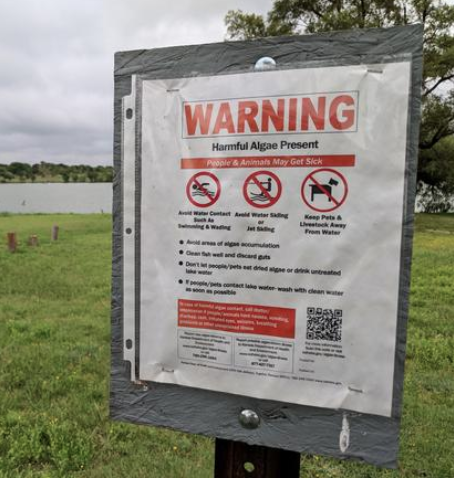
WICHITA — Toxic blue-green algal blooms have been causing major problems on Kansas’ lakes since about 2010.

A blue-green algae warning sign at Afton Lake.
BRIAN GRIMMETT / KANSAS NEWS SERVICE

Because the pond scum can make people sick, the lakes became out of bounds for swimmers and the like.

The algae, also known as cyanobacteria, can cause rashes, stomachaches, and diarrhea if touched or swallowed. Blooms have even killed small animals unlucky enough to drink the toxic water.

Typically, it’s mostly a problem for recreational use of the lakes.

But many of those lakes also feed into municipal water systems. The blooms have recently begun fouling water treatment plants. Their operators, in turn, have had to change the way they process and treat it.

Toxic algae has bloomed on Keith Sebelius Lake in Norton County, Kansas, since 2014. While a nuisance, it hadn’t really impacted the city of Norton’s water — until last year when the bloom drifted toward, and into, the plant’s intake pipes.

To protect the drinking water supply, the whole plant had to be shut down. Most of the tanks had to be drained and cleaned.

“Oh, you can’t print that,” plant supervisor Jamie Amlong joked when asked what his first thoughts were when he found the bloom had made it into the plant.

He said the blooms have made his job horribly stressful. Any time there’s a bloom, he’s constantly worried about the potential for toxins to make it through the plant and into the town’s faucets and sinks.

This year, water quality tests sent to the Kansas Department of Health and Environment detected very low levels of toxins in water coming out of the treatment plant.

Four other municipal water plants — Hillsboro, Marion, Carbondale and Yates Center — have also discovered toxins in their finished water after blue-green algae blooms.

The levels detected are so small that they aren’t even close to exceeding the safe level determined by the Environmental Protection Agency. Still, the news has caused additional stress and costs for several small municipal water agencies.

It’s the first time KDHE has ever detected the toxins in treated water. But the detection of it’s likely because tests are getting better and because KDHE is helping small utilities test more frequently.

Starting this year, KDHE offered to highly subsidize water quality tests aimed at looking for toxins created by cyanobacteria. The tests, which usually cost $100 to $130 each, will now cost program participants $25 each.

Of the 72 systems that get their water from rivers and lakes in the state, 23 signed up for the program.

Robert Gavin, KDHE Public Water Supply section professional geologist, said the program allows local water systems to prevent tainted water rather than try to reverse a problem.

Previously, state park officials would detect a bloom on a lake. Then they’d notify the state public water division, which would scramble to get tests out to those locations.

But now, bottles for raw water samples are sent out weekly in the mail. If there’s ever a positive test result, more bottles are sent to test the treated water.

“After a couple of years, this will probably be old hat. They’ll kind of just know what to do,” Gavin said. “But they’re all kind of learning right now.”

There is a safe and effective method to remove those toxins.

Officials at KDHE recommend the plants add activated carbon to their water treatment process. The activated carbon is able to latch on to the algae, making it heavier. It then falls to the bottom of settling ponds allowing the clean water to move on through the rest of the process.

It’s a relatively simple addition, but something that most smaller plants didn’t do until now.

It also costs more money — a relatively modest expense that smaller water systems struggle with.

“Any time there’s an algae bloom out at the lake there’s potential for that to get into the plant and through town,” said Amlong, the Norton County water plant supervisor. “We’re on pins and needles from the beginning of the bloom until two or three weeks after the bloom.”

Brian Grimmett reports on the environment, energy and natural resources for the Kansas News Service. You can follow him on Twitter @briangrimmett or email him at grimmett (at) kmuw (dot) org. 

Viola Depperschmidt

Viola Depperschmidt, 90, Liebenthal, Kansas, died Sunday, July 21, 2019, at Rush County Memorial Hospital Intermediate Swing Bed, La Crosse, Kansas.

Viola was born July 13, 1929, in rural Liebenthal, Kansas, the daughter of Isidore and Albertina (Legleiter) Herrman.  She was a lifelong resident of Rush County, Kansas.  A 1948 graduate of Schoenchen High School, Schoenchen, Kansas, she was an owner/manager of the 1886 Hotel, La Crosse, Kansas, before her retiremen.

She was a member of St. Joseph’s Catholic Church, and St. Ann’s Altar Society, both of Liebenthal, Kansas.  She was a religious education instructor in Liebenthal, Kansas, and La Crosse, Kansas, and a 4-H leader in La Crosse, Kansas.

Viola loved gardening and taking care of her chickens.

On May 30, 1949, she married Alfred “Fritz” Depperschmidt at St. Joseph’s Catholic Church, Liebenthal, Kansas.  He preceded her in death November 1, 1984.

Survivors include:  five sons, James Depperschmidt (Theresa), Sylvia, Kansas, Mark Depperschmidt, Langdon, Kansas, Neil Depperschmidt, Liberal, Kansas, Melvin Depperschmidt, Topeka, Kansas, and Paul “Beau” Depperschmidt, Liebenthal, Kansas; two daughters, Cheryl Ann Resner (Gerald), Great Bend, Kansas, and Ruth Schaffer, Arvada, Colorado; seven grandchildren, Jennifer Gunder (Bob), Claflin, Kansas, Thomas Depperschmidt (Tammy), Sylvia, Kansas, Emma Albert (Justin), Milton, Kansas, Jacob Resner (Ashley), Lee’s Summit, Missouri, Matthew Resner (Stacie), Great Bend, Kansas, Casey Schaffer (Jenice), Arvada, Colorado, and Lori Schaffer, Arvada, Colorado; 20 great grandchildren; one brother, William “Bill” Herrman, La Crosse, Kansas; and three sisters, Henrietta Haselhorst, Hays, Kansas, Mary Catherine Dreher, Plainville, Kansas, and Georgiana Herrman, Great Bend, Kansas.

She was preceded in death by her parents; her husband; one son, John Depperschmidt (September 7, 1980); one son in law, Terry Schaffer; one brother, Michael “Mike” Herrman; and one sister, Lillian Leiker.

Visitation will be Sunday, July 28, 2019, from 4:00 P.M. to 8:00 P.M. at the Janousek Funeral Home, La Crosse, Kansas.  A vigil service and rosary will be at 7:00 P.M. 

Church visitation will be Monday, July 29, 2019, from 9:00 A.M. to 9:50 A.M. at St. Joseph’s Catholic Church, Liebenthal, Kansas.

Funeral service will be Monday, July 29, 2019, at 10:00 A.M. at St. Joseph’s Catholic Church, Liebenthal, Kansas, with Father Stephen Dabanka officiating.  Interment will be in the La Crosse City Cemetery, La Crosse, Kansas.

In lieu of flowers or plants, the family requests memorials to the St. Joseph’s Catholic Church Steeple Fund, Liebenthal, Kansas.

Condolences or remembrances may be left for the family at www.charterfunerals.com/locations/janousek-lacrosse.php.

Arrangements were by Janousek Funeral Home, 719 Pine Street, P O Box 550, La Crosse, Kansas 67548, 785/222-2517.

Alma Marlene ‘Molly’ Brin

Alma Marlene “Molly” Brin, age 80, of Hays, Kansas passed away Saturday, July 20, 2019 at Via Christi Village, Hays. She was born April 30, 1939 in Dresden, Kansas to Julius and Mae (Weaver) Diederich. On April 22, 1961 she married Carrol Brin at St. Joseph’s Catholic Church in Hays.

Molly was a RN at the Graham County Hospital, St. Anthony Hospital, Hays Medical Center where she retired from and St. John’s Nursing Home. She was a member of St. Joseph’s catholic Church and she enjoyed sewing, quilting, gardening, the lake and family outings.

She is survived by her husband, Carrol of Hays; two sons, Richard (Connie) Brin of Hays, Rodney (Verda) Brin of Hays; a daughter, Rhonda (Scott) Stults of Hays; two brothers, Dale Diederich of Olathe, Kansas and Dennis Diederich of Colby; three sisters, Leona Clark of Colby, Janet Levenstein of Hoxie and Darla Zerr of Hoxie; five grandchildren, Cameron Brin, Meagan Brin, Kaylee Brin, Liam Stults and Alec Stults.

She was preceded in death by her parents and a brother, Jerome “Gabby” Diederich.

Funeral services will be 10 AM Thursday, July 25, 2019 at St. Joseph’s Catholic Church in Hays. Burial will follow in St. Joseph’s Cemetery, Hays.

Visitation will be Wednesday 4 PM – 8 PM with a combined parish vigil and rosary at 7 PM and Thursday visitation will be 9 AM – 9:30 AM all at Brock’s-Keithley Funeral Chapel and Crematory 2509 Vine Hays, KS 67601.

Memorial contributions are suggested to St. Joseph’s Church, TMP-Marian or donor’s choice.

Condolences may be left by guest book at www.keithleyfuneralchapels.com or by email at [email protected]

NW Kansas communities receive KDHE solid waste reduction grants

20 individual grants distributed to recipients across Kansas

TOPEKA – The Kansas Department of Health and Environment’s Bureau of Waste Management has announced the recipients of solid waste reduction grants. These annual solid waste grants are awarded to cities, counties and private entities across the state. The grants total nearly $390,000 for 2020 and establish recycling and composting programs that will divert recyclable material from landfills.

In northwest Kansas, grants were awarded for projects  Colby, Smith Center, Atwood and Oakley.

The Solid Waste reduction grants go toward funding waste reduction education, recycling and composting. This year’s 20 individual solid waste reduction grants range from $1,275 to $83,211.23. The grants are funded through a $1/ton waste disposal fee.

For more information on KDHE’s waste reduction grant opportunities and application procedures, visit www.kdheks.gov/waste.

— KDHE

Police wait downstream for suspect trying to swim to freedom

LAKE LURE, N.C. (AP) — A wanted Tiki bar cook tried to flee authorities by swimming away in a North Carolina river, but was caught by officers waiting downstream.

A Lake Lure Police statement says 38-year-old Jesse Lee Boyd was wanted by the U.S. Marshals Service on warrants accusing him of forgery or counterfeiting in Iowa.

Investigators said they made a plan over the weekend to arrest him at the management office of the Geneva Riverside Tiki Bar. But they say Boyd was warned as he walked to the office and fled on foot before dashing into the Rocky Broad River.

Officers positioned themselves downstream along the banks, and Boyd eventually gave himself up.

A police statement Monday said department officials didn’t know if Boyd has an attorney.

Art Neville, member of Neville Brothers, Meters, dies at 81

NEW ORLEANS (AP) — Art Neville, a member of a storied New Orleans musical family who performed with his siblings in The Neville Brothers band and founded the groundbreaking funk group The Meters, died Monday. The artist nicknamed “Poppa Funk” was 81.

Neville’s manager, Kent Sorrell, said Neville died at his home.

“Art ‘Poppa Funk’ Neville passed away peacefully this morning at home with his adoring wife, Lorraine, by his side,” Sorrell said in an email.

The cause of death was not immediately available but Neville had battled a number of health issues including complications from back surgery.

“Louisiana lost an icon today,” Gov. John Bel Edwards said in a news release.

The Neville Brothers spent some of their childhood in the now demolished Calliope housing project in New Orleans and some at a family home in uptown New Orleans.

In a 2003 interview with Offbeat magazine, Art Neville described going to a Methodist church as a child where he had his first encounter with a keyboard.

“My grandmother used to clean the pulpit. She was in there cleaning it one day and I guess she was babysitting me ’cause I was in there with her. She went to one side and all of a sudden I was on the side where the organ was,” he said. “Something told me to turn it on. I reached up and pressed a bass note and it scared the daylights out of me!”

That experience helped kick off a lifelong career as a keyboardist and vocalist.

The Neville Brothers — Art, Charles, Cyril and Aaron — started singing as kids but then went their separate ways in the 1950s and ’60s. In 1954 Art Neville was in high school when he sang the lead on the Hawketts’ remake of a country song called “Mardi Gras Mambo.”

He told the public radio show “American Routes” how he was recruited by the Hawketts. “I don’t know how they found out where I lived,” he said in the interview. “But they needed a piano player. And they came up to the house and they asked my mother and father could I go.”

More than 60 years later, the song remains a staple of the Carnival season, but that longevity never translated into financial success for Art Neville who received no money for it.

“It made me a big shot around school,” Art said with a laugh during a 1993 interview with The Associated Press.

In the late ’60s, Art Neville was a founding member of The Meters, a pioneering American funk band that also included Cyril Neville, Leo Nocentelli (guitar), George Porter Jr. (bass) and Joseph “Zigaboo” Modeliste (drums).

The Meters were the house band for Allen Toussaint’s New Orleans soul classics and opened for the Rolling Stones’ tour of the Americas in 1975 and of Europe in 1976.

They also became known for their session work with Paul McCartney, Robert Palmer and Patti LaBelle and recordings with Dr. John.

The Meters broke up in 1977, but members of the band have played together in groups such as the Funky Meters and the Meter Men. And in more recent years The Meters have reunited for various performances and have often been cited as an inspiration for other groups.

Flea, the bass player for the Red Hot Chili Peppers, paid homage to The Meters when he invited members of the group onstage to perform with the Chili Peppers during a 2016 performance at the New Orleans Jazz & Heritage Festival.

“We are their students,” Flea said.

As The Meters were breaking up, The Neville Brothers were coming together. In 1978 they recorded their first Neville Brothers album.

Charles died in 2018.

For years, The Neville Brothers were the closing act at Jazz Fest. After 2005′s Hurricane Katrina, the four brothers — like many New Orleanians — were scattered across the country while the city struggled to recover. They returned to anchor the festival in 2007.

“This is how it should be,” Art Neville said during a news conference with festival organizers announcing their return to the annual event. “We’re a part of Jazz Fest.”

He shared in three Grammy awards: with The Neville Brothers for “Healing Chant,” in 1989; with a group of musicians on the Stevie Ray Vaughn tribute “SRV Shuffle in 1996; and with The Meters when they got a lifetime achievement in 2018.

“Art will be deeply missed by many, but remembered for imaginatively bringing New Orleans funk to life,” the Recording Academy, which awards the Grammys, said in a news release.

Neville announced his retirement in December.

KZ Country Cheesy Joke of the Day 7/23/19

khaz cheesy joke logo 20110802The Perfect Caddy

The golfer called to one of the caddies and said, “I want a caddy who can count and keep the score.”

“Yes, sir. I’m very good at keeping score.”

“We’ll see. If I shoot 3 on the first hole, 4 strokes on the second hole, and 5 on the third, what’s my score so far?” asked the golfer.

“Ten, sir,” said the caddy.

“Good, you’ll do perfectly.”


Join fans of 99 KZ Country on Facebook:  https://www.facebook.com/99KZCountry


Iowa State pays, praises ex-director to end Lego art dispute

CORALVILLE, Iowa (AP) — In 2016, Iowa State University accused an employee of fraud and theft in a dispute over the unusual but lucrative campus assets she managed: popular outdoor sculptures made of thousands of Lego bricks.

Three years later, the school has withdrawn its allegations against Teresa McLaughlin under a settlement reached last month. The university paid McLaughlin $225,000 in wages and attorneys’ fees, will offer her health insurance until 2022 and has given her a glowing letter of recommendation from its president calling her an honest employee who made major contributions over 17 years. Iowa State will also dedicate a bench for McLaughlin in Reiman Gardens, the campus landmark that she spent much of her career building as its director.

Those steps end a dispute that derailed the Lego art program conceived by McLaughlin, called Nature Connects. The traveling exhibits featured sculptures of plants and animals, were displayed at zoos and gardens nationwide and brought in revenue for Iowa State.

McLaughlin said she wants to restore her reputation, which she believes was unfairly sullied by her alma mater. She said the university made claims of wrongdoing against her without evidence and while in possession of records that exonerated her.

She said the dispute hurt her finances and “took a great toll on me and my family.”

“I did not think Iowa State would do this to me,” she said in an interview in Coralville, where she lives. She called the experience “confusing, unfair and unfortunate.”

The university does not admit wrongdoing in the settlement, which avoided a June trial.

McLaughlin envisioned the sculptures as a way to draw visitors to Reiman Gardens, a 17-acre (7-hectare) space on the Ames campus. McLaughlin began working there in 1999 and built one of the “finest and most unique public gardens in the country,” according to university President Wendy Wintersteen’s recommendation letter.

Iowa State hired Brooklyn artist Sean Kenney to build the sculptures, which went on display at Reiman Gardens in 2012. Seeing demand to market them nationwide, the school reached agreements with Kenney to build four more.

McLaughlin stepped down as gardens director in 2014 to become director of Nature Connects. Dozens of institutions from Hawaii to Chicago agreed to pay between $70,000 and $150,000 to display the exhibits for several weeks. Directors of zoos and gardens raved about how they boosted attendance.

But by 2016, an aide to Roy Reiman, a top university donor who helped fund the exhibits and for whom the gardens are named, was questioning the costs, including payments to Kenney and McLaughlin, who received a 10% commission on exhibit sales under her university contract.

Emails show that a top aide to then-President Steven Leath pushed to change the formula for splitting the profits with the artist so the school could get a larger “administrative fee.” McLaughlin objected to the request, noting the contracts had been signed after reviews by Iowa State officials and could not be changed unilaterally.

A school-ordered restructuring then laid off McLaughlin’s assistant and transferred oversight of the program’s finances to the administration. Kenney began complaining that the university took away support that was critical to making the exhibits successful and wasn’t paying him what he was promised. A frustrated McLaughlin announced she would take an early retirement but agreed to stay a few months to finalize several pending sales. Things soon got worse.

She received a surprise letter from a law firm hired by Iowa State. The letter ordered her to stop working and telling her she was under investigation for alleged conflicts of interest related to her outside work with Kenney’s company.

Iowa State stopped paying commissions McLaughlin was owed, and she filed a lawsuit seeking payment. The university filed counterclaims accusing McLaughlin of breaching her fiduciary duty and committing fraud and unjust enrichment. It alleged that she was profiting at the university’s expense by secretly helping Kenney market competing exhibits.

McLaughlin said the claims were false, noting that Iowa State approved her limited work for Kenney’s company. She denied ever putting Kenney’s interests ahead of Iowa State’s and she earned little from the arrangement. Iowa State settled its dispute with Kenney in 2017. McLaughlin, 62, said she doesn’t understand why the school fought her for two more years.

On the bench honoring her, McLaughlin has asked the school to enshrine a Dalai Lama quote: “Be kind whenever possible. It is always possible.”

Marvel’s next films will bring diversity, onscreen and off

LOS ANGELES (AP) — Marvel’s push for more women and people of color in its immensely popular film franchise is extending to behind the camera as it launches its next round of films after the massive success of “Avengers: Endgame.” Of the five films the superhero studio announced at Comic-Con on Saturday, only one is set to be directed by a white man.

“It’s about fresh voices and new voices and great filmmakers who can continue to steer the (Marvel Cinematic Universe) into new places,” Marvel Studios president Kevin Feige said in an interview after the studio’s explosive Hall H panel. “And I am as proud of that lineup of directors as you saw today as any.”

In addition to a slew of women and people of color at the helm of the upcoming Marvel films, the weekend’s announcements promised more diversity on screen.

First up for release is the long-awaited solo film starring Scarlett Johansson as the Black Widow, the lethal assassin she has played for nearly a decade. The film is set for release in May 2020.

Johansson said the search for “Black Widow” director Cate Shortland wasn’t easy.

“It’s really interesting because when we were looking for a director, you start to see some of the systemic problems,” Johansson said. “Even looking for a female director who has had enough experience — who has had the opportunity to have the experience to sit at the helm of something huge like this, you know, choices are limited because of that. And it sucks.”

Scarlett Johansson explains why the search for an experienced female director for ‘Black Widow’ highlights a Hollywood problem. (July 21)
The actress added that she was proud to see the diversity on stage during Marvel’s Hall H panel.

“Looking out on that stage tonight, it was incredible. It was really moving, also just to see how incredibly diverse the universe is — and reflects what we see all around us. It’s incredible,” she said.

In terms of more diversity, “Black Widow” is just the beginning.

“The Eternals” will feature a cast full of actors of color, including Kumail Nanjiani, Brian Tyree Henry, and Salma Hayek. Simu Liu will become Marvel’s first big screen Asian American superhero when “Shang-Chi and the Legend of the Ten Rings” is released in February 2021. Natalie Portman will play a female Thor in the new “Thor: Love and Thunder,” which will also feature Tessa Thompson’s character, Valkyrie, as the MCU’s first LGBTQ superhero.

“First of all, as new King (of Asgard), she needs to find her queen, so that will be her first order of business. She has some ideas. Keep you posted,” Thompson said during the panel. Feige later confirmed the news in an interview with the website io9.

The studio is also reviving one of Marvel’s most iconic black characters, Blade (previously played by Wesley Snipes), with the help of Academy Award winner Mahershala Ali. Feige told The Associated Press that right after winning his second Academy Award for “Green Book” earlier this year, Ali set up a meeting.

“Within 10 minutes, he basically was like, ‘What’s happening with ‘Blade’? I want to do it.′ And we went, that’s what happening with ‘Blade.’ Let’s do it,” Feige said.

“Captain Marvel,” released in March, was the first of Marvel Studios film to be centered entirely on a female character. It earned $427 million domestically, and along with the DC Comics film “Wonder Woman” has created momentum for more films with female heroes leading the way.

“Marvel is really focused on having very strong female characters at the forefront of their stories,” said actress Rachel Weisz, who also stars in “Black Widow.” ″And I think that’s great. This film has got three. It’s Scarlett, Florence Pugh, myself. So I think yeah, they are doing wonderful work to represent women, people of color, and tell different kinds of stories.”

The sliver of Hollywood still on the outside of the Marvel’s cinematic empire was paying close attention to the news.

Actress, writer and director Lena Waithe tweeted Sunday: “Captain America is black. Thor is a woman. the new Blade got two Oscars. 007 is a black woman. And The Little Mermaid bout to have locs. (Expletive). Just. Got. Real.”

Russell Community Theater announces auditions for ‘Four Old Broads’

By LESLIE KIMBELL
Russell Community Theater

RUSSELL — Open auditions for the Russell Community Theater production of Four Old Broads will be held July 31 and 31 from 7:00 to 9:00 p.m. Auditions will be held at the RCT Playhouse at 5th and Kansas, Russell. Prepared audition materials are not required.

In Four Old Broads, retired burlesque queen Beatrice needs a vacation from Magnolia Place Assisted Living. A Sassy Seniors Cruise sounds perfect if she can convince her best friend, Eaddy Mae, to join her. Other residents are facing their own issues – including memory loss, soap opera obsession, and unrequited love. And things just haven’t been the same since Nurse Pat began working there. Adventures unfold as the gals try to outsmart the evil Nurse Pat and solve a multitude of mysteries. Hilarity ensues as they try to throw Nurse Pat off their trail and make it to the cruise ship after all.

Roles are available for 6 adult women and 1 adult man. Production dates are Tuesday through Saturday, October 8-12, 2019. Four Old Broads is presented by special arrangement with Samuel French, Inc.

For more information, contact RCT at 785-483-4057.

Russell Community Theater is a non-profit theater company in Russell, Kansas. The sole purpose of RCT is to produce theater for the community and the surrounding area. Completely volunteer-driven, RCT is supported financially solely through ticket admissions and gifts from those supportive of community theater. Since its inception in 1986, RCT has presented 96 full-scale theatrical productions.

Copyright Eagle Radio | FCC Public Files | EEO Public File