Dixie “Charlene” Anderson, 87, of Salida, CO formerly of Graham County, KS, died June 24, 2019. She was born November 29, 1931, in Morland, KS to Ivan Louis and Geraldine (Boss) Rawson. She graduated from Morland High School in 1949 and married Dwane M. Anderson on May 22, 1949. She worked side by side with her husband at Anderson Motor Company, in Kinsley and Beloit, KS and Salida, CO from 1971 until 2005. Charlene and Dwane enjoyed traveling the US. She also was a quilter and seamstress and enjoyed crafting. Charlene was a member of the Salida Red Hats Society. Her greatest love was her family.
She was preceded in death by her parents; husband Dwane; infant children, Jerry and Dixie Anderson; brothers Stanley and Gerald Rawson and brother-in-law Gene Keith.
She is survived by her children Cathy Dimmick, Hoxie, KS and Craig (Kayla Velharticky) Anderson, Howard, CO; grandsons, Brandon (Kari) Dimmick, Brady (Leanne Chamberlin) Dimmick and Wyatt Velharticky; granddaughter Miranda Archuleta; great grandchildren, Cameron and Caleb Dimmick, Trinity Dimmick, Preston Burt, Rylin, Rahlison, Royceton and Radisen; sisters-in-law, Sharon Rawson, Doris (Marvin) Warner and Gail Keith.
Visitation starts at 9:00 a.m. with the Funeral Service at 10:00 a.m. Monday, July 1, 2019, at the Christ Community Church, Hoxie, KS. Burial will follow in the Morland Cemetery, Morland, KS. Memorials are suggested to the Valley to Valley Senior Care Center, sent in care of Baalmann Mortuary, PO Box 391, Colby, KS 67701. For information or condolences visit www.baalmannmortuary.com
SHAWNEE COUNTY — After two months, law enforcement authorities have not announced an arrest in the shooting death of 23-year-old Dwane Simmons and wounding of 23-year-old Corey Ballentine, both members of the Washburn University football team.
Dwane Simmons photo Washburn Athletics
Over the past week, an anonymous donor came forward with a $5,000 reward leading to an arrest in the shooting death of Washburn football player Dwane Simmons, according to a media release.
Just before 1a.m. April 28, police responded to the 1400 Block of SW 13th in Topeka after report of a disturbance with gunshots. Upon arrival, officers discovered a victim identified as 23-year-old Dwane Simmons. He was pronounced dead at the scene.
Another victim from the same incident identified as 23-year-old Corey Ballentine arrived at an area hospital by private vehicle with a non- life-threatening gunshot wound.
Simmons was a junior mass media major from Lee’s Summit, Missouri.
Investigation has determined that this incident occurred during a social gathering outside of a residence, according to a media release. There were dozens present at the social gathering.
In addition to the $5,000, Crime Stoppers is also offering up to a $2,000 reward. You can call us to report tips anonymously at 785-234-0007 or online at p3tips.com/128.
Anyone with information regarding this crime is encouraged to contact the Topeka Police.
By RANDY GONZALES FHSU University Relations and Marketing
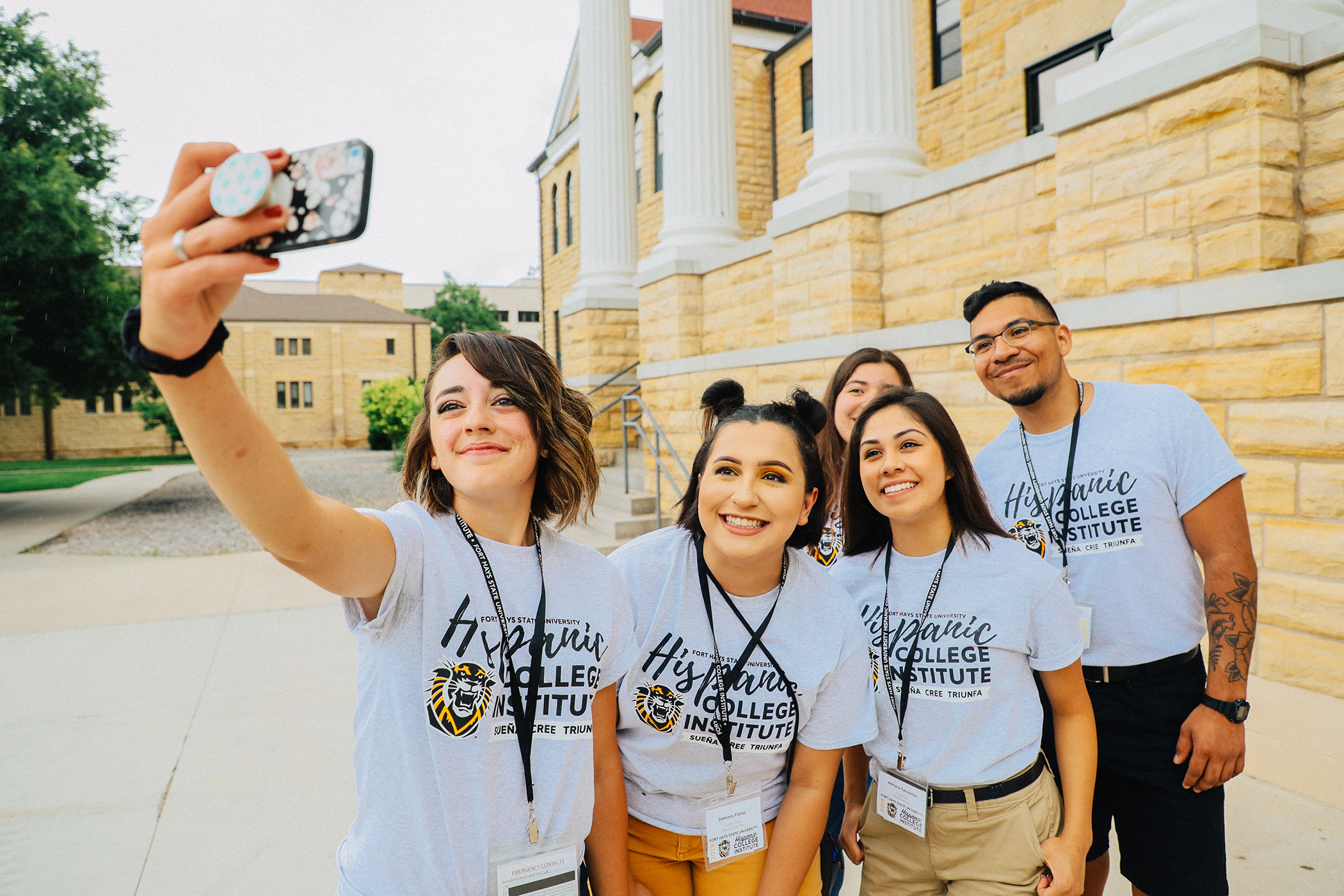
Adriana Cervantes remembers feeling uneasy about her accent while participating as a high school student in Fort Hays State University’s Hispanic College Institute back in 2016.
FHSU student volunteers helped her overcome her self-consciousness. Now a sophomore at Fort Hays State, Cervantes served as a student volunteer for this summer’s HCI. She provided similar support to participants in the program that is one of a kind in Kansas and one of only a few in the nation.
Cervantes, a double major from Shawnee, wanted to give back as a student “Tiger Team leader,” guiding a group of Hispanic students at this year’s HCI.
You found it! Click on the Golden Egg for a chance to win FREE Wild West Festival VIP tickets!
“I wanted to help other students who are in the same situation as I was and to tell them that everything is going to be OK, everything is going to be fine,” Cervantes said. “I understand them. I was in their shoes.”
Since the inaugural HCI at Fort Hays State in 2016, Hispanic sophomores and juniors in high school spend three-and-a-half days on campus in June learning about college life.
Cervantes can look back now at how even after her high school graduation she still was not sure if she could succeed in college. She credits her HCI experience in contributing to her confidence to attend college and is glad she chose Fort Hays State.
“Last year, I thought I wasn’t college material,” said Cervantes, who will be a sophomore at FHSU this fall. “HCI helped me. I really fell in love with the campus and the faculty members. I’m really happy with the decision, and right now, I have really good grades.”
Cervantes and her family immigrated to the Kansas City area from Mexico five years ago, and she attended HCI two years. HCI student leaders helped Cervantes think differently about her accent.
“They really helped me open my mind, not be embarrassed about my accent,” Cervantes said. “They helped me see that being Hispanic is fine.”
HCI is just one example of how Fort Hays State cares about education and opportunity.
“What I love about the DNA of Fort Hays State University is that we provide the access, give students the opportunity at an affordable cost,” said Dr. Joey Linn, vice president for student affairs. “I think Fort Hays State is perfectly poised for a program like this to let students know that there is an institution here that truly cares about them.”
Cervantes came to the United States as an undocumented immigrant as a freshman in high school and did not know a word of English. She recalled how HCI helped her in the summers after her sophomore and junior years at Shawnee Mission North High School.
At HCI, Cervantes met other Hispanic high school students who also had an interest in attending college. She felt at home.
“I think it’s good that Fort Hays State makes Hispanic and Latino students feel welcome,” Cervantes said.
Alicia Santos, a first-time HCI participant this year, appreciated Fort Hays State hosting the program again this summer.
“I think it’s amazing,” said Santos, who will be a junior this fall at Dodge City High School. “Hispanic people need to come together and do this kind of thing. I think it’s good that they’re encouraging people to go to college and get that education that they need.”
Sixty-four high school sophomores and juniors from Kansas and Colorado at this year’s event learned about college life and how to get into college. The FHSU community – from President Tisa Mason to student volunteers who served as Tiger team leaders – made the high school Hispanic students feel like they were part of a “familia.”
“You can go to college and you can succeed,” Mason said at Saturday’s closing ceremony, adding she was a first-generation college graduate. “I just want to thank you for being here and continuing to believe in your dream and taking the chance to learn during this week. We’re going to believe in you, and your dreams will come true.”
Linn was all smiles while handing out scholarship money at the closing ceremony. FHSU awarded $9,500 in scholarships.
He said the final day is the most transformational, because parents who come to pick up their children marvel at the difference they see. He surprised the HCI students by announcing that one of the program’s sponsors had agreed to pay everyone’s application fees to Fort Hays State.
“It’s truly exciting to know that their dreams can come true,” Linn said. “I think Fort Hays State does a tremendous job of making these students understand it can be done. They just need that extra push, that extra support. That’s what Fort Hays State University does well.”
Skills and information gained at HCI are part of the success story. Among other activities, participants learn about college life, the application process and obtaining financial aid. They participated in a service project and had fun times, too, highlighted by a lip sync battle among “familias.”
Linn told the students that Fort Hays State wants to make sure they have the opportunity to succeed.
“You’re not just a student here,” Linn said. “We take great pride in making sure we help you get across the finish line.”
Xavier Hernandez, whose son Ezra participated in this year’s HCI, liked how FHSU helped get students to the starting line. Having buses pick up students from all across the region made a difference, he said, especially since they live in Overland Park.
“That’s initially why I jumped on it,” Xavier said of having his son participate. He added that he had never heard of FHSU, but the opportunity for his son to spend time on campus was a big selling point.
After the HCI experience, which included receiving a $500 scholarship during the week, the Hernandez family now has FHSU on its radar as a college choice.
“I thought it was a really cool thing to do, just give a college experience and surround ourselves around our culture,” said Ezra, who will be a senior this fall at Shawnee Mission North. “It’s been incredible.”
Cervantes has a younger brother, Jesus, who will be a sophomore in high school this fall. She said she is going to make sure he attends next summer’s HCI program.
“I’m sure he can go to college,” she said. “HCI will help him.”
Your horticulture questions can be answered Monday and Wednesday between 1-4pm by calling the extension office’s help desk at 628-9430 or visit them online at Cottonwood.K-State.edu.
You found it! Click on the Golden Egg for a chance to win FREE Wild West Festival VIP tickets!
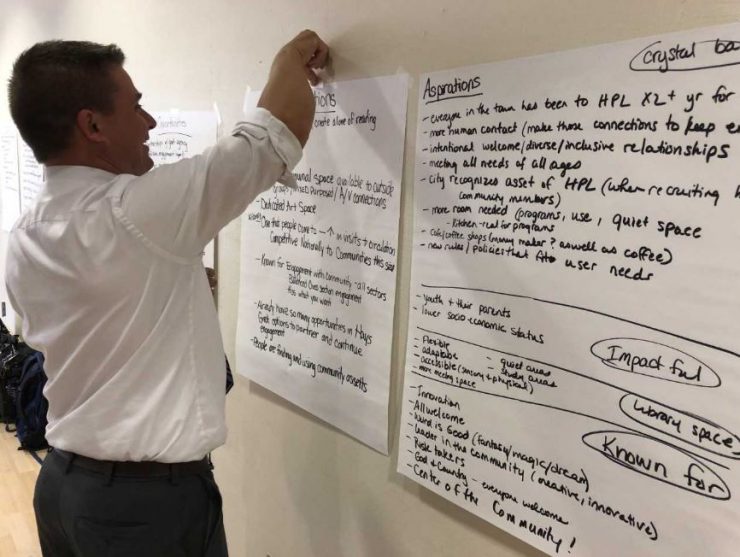
Brandon Hines, Hays Public Library director, tapes up a list of aspirations for the library generated during a recent stakeholders session.
By BECKY KISER Hays Post
More than 50 plus-sized sheets of information and ideas were taped to the walls of the Hays Public Library (HPL) meeting room following two library stakeholders meetings earlier this month.
Now director Brandon Hines and his library staff of 33 are awaiting compilation and analysis of the two public sessions led by Gail Santy, Central Kansas Library System (CKLS) executive director. CKLS is based in Great Bend.
“The purpose of the sessions is to solicit feedback and ideas about the role of the library in our community and to guide future priorities of the organization,” Hines told the 40 or so attendees at the beginning of each session. “Specifically, we are looking to establish goals and actions that will optimally benefit the community and uphold the mission and values of the Hays Public Library.”
CKLS consultants were at each table as facilitators, consolidating and then writing the answers from their groups to the questions asked by Santy.
Patty Collins, CKLS Youth Services Consultant listens to a stakeholder at her table as Celeste Lasich, First Presbyterian Church pastor, looks on.
Two of the consultants have ties to Hays. Patty Collins, CKLS Youth Services Consultant, and Christie Snyder, CKLS School Library Consultant, are both graduates of Fort Hays State University.
Santy guided them through “SOAR – Strengths, Opportunities, Aspirations, Results – What can we build on? What are our possible future opportunities? What do we care deeply about? How will be know we are succeeding?” The SOAR design comes from the Aspen Institute, an international nonprofit think tank founded in 1949 as a nonpartisan forum for values-based leadership and the exchange of ideas.
The questions in each category were created by the HPL staff and library board members early in the day prior to the public sessions. HPL staff members were also at each stakeholders table giving their input.
“We’re here to kind of push us through the end of our strategic planning process,” said Hines who was hired as HPL director last summer. He worked previously at HPL in charge of the children’s department, then left to be director at two other Kansas libraries.
“When I came on there was a lot of work that had been done around here but just quite hasn’t been executed on. So we made a one year action plan to finish up some of this work,” explained Hines. “We’ve really progressed well with that.”
The library is looking to the public and its patrons to help guide its future.
“We’re at the point now where we need to sit back and get some ideas, feedback on some of the changes we’ve already made and also on some of the work we want to do,” Hines said.
Part of the action plan is to remodel some areas of the library within the next couple of years. The current building was constructed in 1968; Hays Public Library opened in 1911.
The last major renovation was in 2004. “We know our needs for the space has changed quite a bit since then,” Hines told the group gathered around eight tables. “All this information we gather here today will help guide that.” He said the library intends to soon form a design committee to address space changes in the building.
Earlier this year the library completed its Mission, Vision, Values statement.
The information was at each table which Hines hoped would help “establish the right mindset” during the discussions.
“This is why you’re here,” Hines explained. “We need help with specific goals and outcomes and then specific actions we want to take or some ideas to get us to that point.”
Once the report and compiled data is returned by CKLS, it should give HPL a directional map for the next three years.
Santy urged the attendees to be candid. “We can’t move forward unless we know how you really feel.”
Margie Sheppard, CKLS Library Technology Consultant, listens to input from her group.
The groups spent an hour discussing questions including the greatest value the library provides to the community, key areas of untapped potential, the look of library space in 10 years and what excellence looks like.
Those offering their input in the afternoon session included representatives of USD 489 and TMP-Marian schools, the Hays Arts Council, churches, Northwest Kansas Area Agency on Aging, Downtown Hays Development Corporation, Friends of the Hays Public Library, and local residents.
After 60 minutes, the meeting room walls were covered with sheets listing each table’s ideas of strengths, opportunities, aspirations, and results.
Gail Santy, CKLS executive director, led the HPL stakeholders sessions.
Santy quickly read aloud each answer and suggestion.
Ideas included starting a bookmobile, more charging stations for personal electronic devices, more meeting space and areas redesigned for smaller groups, finding annex locations for programs already offered by the library, providing ESL (English as Second Language) interpreters, and getting more involved with the local governing bodies.
Then the stakeholders were invited to use sticky dots to vote anonymously for their top two priorities.
Pat Hill (left) wants to see smaller meeting places available at HPL.
Pat Hill feels the library should concentrate on books and literacy, and opportunities for children.
“We have a lot of good connections with Hays schools,” Hill noted.
She’s a member of Friends of the Library which operates the used book store in the library.
Hill is new to Hays, moving here from Michigan about 18 months ago.
“There’s a lot of things I didn’t realize the library does, and all the community participation,” she said, “but I can see we need to make a few improvements although we have a lot of strengths.
“We had a wonderful discussion at our table. I’m very proud of our library.”
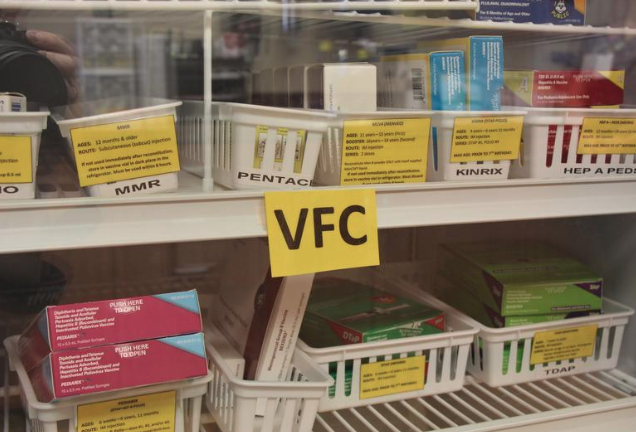
A vaccine refrigerator at a health clinic in the Coffeyville school district. CELIA LLOPIS-JEPSEN / KANSAS NEWS SERVICE
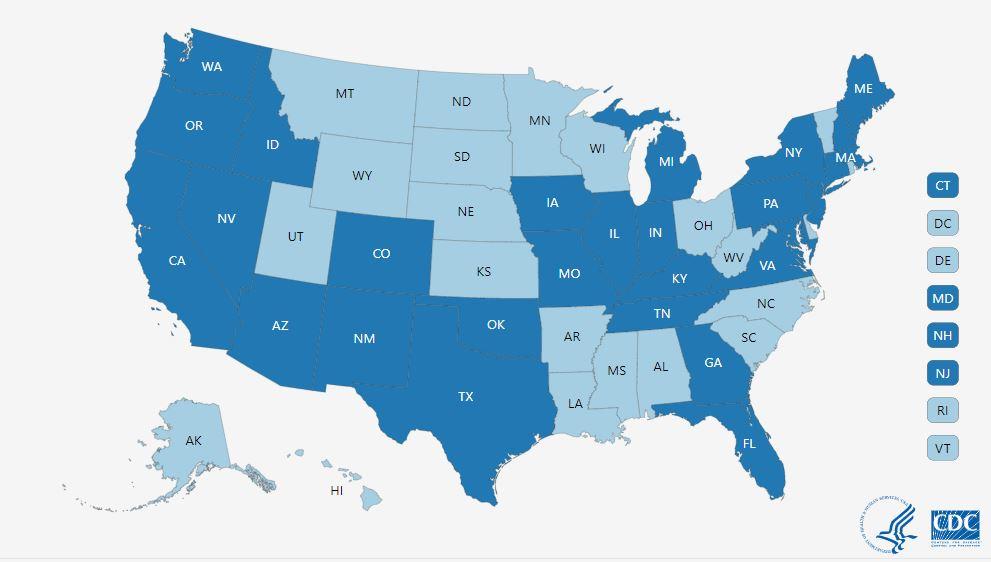
The national measles outbreak — numbering more than 1,000 cases so far — hasn’t hit Kansas yet, but it has crept awfully close to home.
State health officials think a case in Kansas looks nearly inevitable. And the state’s annual survey of kindergartener vaccination rates suggests some counties do better than others at getting little kids their potentially life-saving shots of MMR vaccine.
But while measles snags all the headlines, doctors, nurses, and public health workers worry not just about that, but about other vaccine-preventable diseases that rarely raise the same alarms for the public.
The best evidence suggests hundreds of thousands of Kansans lack one shot or another — or several. Those inoculations have the potential to save lives from pneumonia, cancer and other threats.
Why so many under-vaccinated people?
The latest map of the 2019 measles outbreak. Kansas is in a shrinking minority of states without cases yet (light blue).
CREDIT CDC
As best as public health experts can tell, religious objections and the anti-vaccination movement account for just a tiny sliver of the myriad reasons.
More commonly, the obstacles involve busy work lives, rural distances, poverty, spotty vaccine records, health providers with gaps in vaccine stock or limited walk-in hours, and the public’s lack of knowledge about things like adult vaccine schedules.
You found it! Click on the Golden Egg for a chance to win FREE Wild West Festival VIP tickets!
Every age group is affected, from infants to the elderly. Though Kansas theoretically requires shots against illnesses such as measles, whooping cough and polio for school attendance, 15% of kindergartners last year weren’t up to date on those.
If this all sounds dismal, some public health experts see cause for optimism.
Changing the mind of someone truly opposed to vaccines can seem daunting, even amid outbreaks of illnesses such as measles. This despite the risks of foregoing shots: hospitalization, brain damage, deafness or even death. A 105-degree fever is common with measles, Mayo Clinic says.
The vaccine against measles, mumps and rubella is required to attend school in Kansas.
CREDIT CELIA LLOPIS-JEPSEN / KANSAS NEWS SERVICE
“They cannot be swayed,” pediatrician Barbara Pahud said. “Focus on this ginormous group in the middle …. They’re already on board for some vaccines, so there is hope if you want to see it that way.”
That “ginormous” middle group of under- or unvaccinated people greatly outnumbers those who reject all vaccines based on religion or other beliefs. Researchers peg the latter group at just 1 to 3 percent of the population, said Pahud, a specialist in infectious diseases at Children’s Mercy Hospital in Kansas City and an associate professor at the University of Kansas and University of Missouri-Kansas City.
Read about the known side effects of specific vaccines here. No evidence links vaccines to autism, a myth that got its start with a debunked academic article. Read Autism Speaks’ FAQ page on what does and doesn’t cause autism here.
Likewise, researchers estimate inoculation against the cancer-causing HPV virus would wipe out 80 percent of the tens of thousands of cancer cases it causes across the country each year. (The vast majority of people pick up HPV at some point in their lives, though most clear it out of their bodies naturally without necessarily ever knowing.)
“Just imagine: Almost everybody knows a woman who’s had an abnormal pap smear,” said Edward Ellerbeck, chair of preventive medicine and public health at KU’s School of Medicine. “And imagine now, ‘Oh, I don’t have to worry about abnormal pap smears.’”
The HPV vaccine eliminates the number one cause of those worrying results.
Yet surveys and other sources that the federal government uses to gauge vaccine rates suggest just half of Kansas teens get even the first dose of the two-to-three dose HPV vaccine. The same problematically low rates apply to the state’s elderlyand the recommended pneumonia immunizations.
That frustrates groups trying to rein in the havoc these diseases wreak on our health, happiness and pocketbooks. Compared to other measures we should take to safeguard ourselves — exercise more, eat healthier, quit smoking — a shot in the arm is an easy lift.
“If there was a vaccine against breast cancer or lung cancer or prostate cancer, we’d probably run out of vaccine,” said Dan Leong, of the American Cancer Society in Kansas.
It’s tempting to conclude Kansans simply don’t want the HPV vaccine for cultural reasons. That theory seems less convincing when the best data available, though imperfect, suggest many more teens get the shots in other states. That includes nearby states with similar populations and cultural attitudes.
Checking records
It’s difficult to single out what hurdles stand between Kansans and vaccines — HPV or otherwise. Public health experts see a patchwork of barriers large and small, some of which are counterintuitive.
Last month, the Immunize Kansas Coalition launched a video campaign targeting not just parents but fellow doctors. Why? Because some physicians don’t talk to parents about the HPV vaccine. For that matter, says Wichita pediatrician Gretchen Homan, some don’t talk to patients about other vaccines, either.
Sometimes doctors assume parents will say no. Other times, they may not have the vaccines on hand.
“They don’t even pull up a vaccine record on the kids that they see,” said Homan, a professor at the KU School of Medicine in Wichita. “Because they’re not stocking those vaccines, they don’t even check the status and don’t have the conversation.”
That can leave families mistakenly thinking they’re up to date on all their shots, or that inoculation isn’t important. She encourages doctors and nurses to check vaccine records no matter what, and tell patients about locations that stock what they need.
Families, meanwhile, should feel free to ask.
Hepatitis A vaccine is already required for daycare in Kansas and will likely soon be required for school, too.
CREDIT CELIA LLOPIS-JEPSEN / KANSAS NEWS SERVICE
“Say, ‘Hey, I’ve heard there are three vaccines due at this age,’” she said, “‘and I want to know about all of them.’”
Other hurdles
Getting a handle on the problem is tough in part because of gaping holes in what we know about who does and doesn’t get vaccines.
“Our struggle right now is really being able to know what the true vaccination rate is in any county,” said Phil Griffin, who heads immunization programs at the Kansas State Department of Health and Environment.
State and federal vaccination estimates both have their limits. Kansas calculates rates among kindergartners annually with cooperation from a solid sampling of schools that provide more precise data than some of what the Centers for Disease Control publishes.
The CDC rate calculations, though, cover a wider range of shots and age groups.
But state health officials will gradually get a better picture of immunization rates across the state in coming years. Lawmakers tightened rules for electronic vaccine records starting next year.
That same change will fill in some of the gaps for health providers who often don’t know which shots a new-to-them patient has yet to get. Doctors and pharmacists will gain more consistent access to vaccine histories, as long as the shots occurred in-state.
Kansas lawmakers passed a law to give health providers more consistent access to electronic vaccine records when patients move within the state.
Griffin hopes that will boost vaccine rates. Think of a person dropping by a local pharmacy for a flu shot, for example. He or she could easily find out whether they need a pneumonia shot, too. And if so, get it then and there.
A few other efforts going on to boost vaccine rates in Kansas:
Starting this fall, Kansas plans to phase in two more vaccine requirements (hepatitis A and meningococcal ACWY) for school attendance. Inoculation rates for both would likely increase, though the hep A rates were already fairly strong because they’re required for day care in Kansas. On Thursday, parents opposed to vaccinations protested the state’s plans at a public hearing.
The state recently hired an epidemiologist to dig into vaccine rates across the state, is chasing grants to support the effort, and working closely with individual health providers on a regular basis to improve their practices.
Lawmakers also recently expanded vaccine access by letting pharmacists give more shots. That may particularly benefit teenagers who no longer visit their pediatricians as often, but who still lack a number of vaccines.
Celia Llopis-Jepsen reports on consumer health and education for the Kansas News Service. You can follow her on Twitter @Celia_LJ or email her at celia (at) kcur (dot) org.
Photo #2 (L to R): Lt. Governor Lynn Rogers, CEO – Joe Kreutzer (photo credit: Nick Poels, Executive Director Phillips County Economic Development)
PHILLIPSBURG — The Kansas Department of Commerce awarded local business, Prairie Horizon Agri-Energy, with the Governor’s Regional Award of Excellence on Tuesday. This award kicked off the KDC Business Appreciation Month to spotlight businesses that contribute jobs and support their local communities. The award presentation took place in conjunction with the Lieutenant Governor’s Office of Rural Prosperity Listening Tour in Phillipsburg.
The KDC Business Appreciation Month program has been in place since 1995 and serves as a statewide tribute to Kansas businesses for their contributions to our state. Businesses are nominated in one of four categories: Service, Retail, Manufacturing/Distribution and Hospital/Non-Profit.
You found it! Click on the Golden Egg for a chance to win FREE Wild West Festival VIP tickets!
One winner in each category is chosen from each of the seven designated regions of the state by a panel of judges from the business and economic development community. “We were honored to receive the award and thank PECD for nominating us. Phillips County thrives on support from all of its’ area businesses and residents. We are proud to be part of Phillips County and give back to our community,” said CEO, Joe Kreutzer. “Every year the Governor of Kansas recognizes the very best of trade and industry across the state. Award winners are notably businesses that exhibit strength with both internal success and community impact; Prairie Horizon is a shining example of these qualities,” said Nick Poels, Executive Director Phillips County Economic Development.
Prairie Horizon Board President – Monte Abell, Rep. – Ken Rahjes, Sen. – Rick Billinger, CEO – Joe Kreutzer, Lt. Governor Lynn Rogers, Prairie Horizon Board Member – Lloyd Culbertson
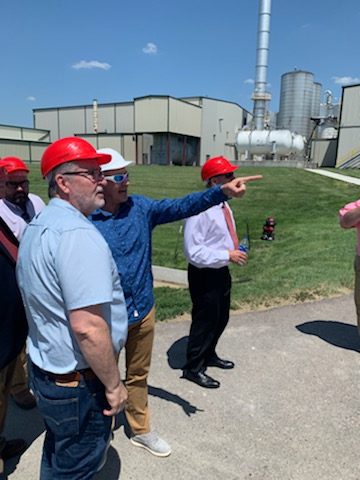
The ethanol plant was one of many stops during the Lt. Governor’s visit to Phillipsburg on Tuesday. Topics of discussion during the tour included: the importance of ethanol to the ag community and in offering consumers a choice at the pump, as well as the challenges the industry faces today. The tour is intended to foster new ways to help rural Kansas communities by hearing from the residents themselves.
Prairie Horizon Agri-Energy is a limited liability corporation, founded in November 2003 in the rural community of Phillipsburg, Kansas. Our company is owned by 300 area investors and employs thirty-six people. Annually, Prairie Horizon produces over 40 million gallons of ethanol and grinds 15 million bushels of grain; yielding just around 127,000 tons of high protein livestock feed. Prairie Horizon’s USA Clean Fuels on East Highway 36 in Phillipsburg, KS offers the consumer a fuel choice that is cleaner, more affordable and better performing.
The second annual VIRTUAL Golden Egg Hunt: Win Wild West Fest VIP tickets! Made possible by JD’s Country Style Chicken.
Hidden somewhere in Hays Post stories is the Virtual Golden Egg! The egg is posted as a picture in articles published no earlier than June 30. Click on the Golden Egg, fill out the entry form and be entered for a chance to win TWO VIP tickets for all three nights of shows at the 2019 Wild West Festival.
PANMUNJOM, Korea (AP) — With wide grins and a historic handshake, President Donald Trump and North Korea’s Kim Jong Un met at the heavily fortified Demilitarized Zone on Sunday and agreed to revive talks on the pariah nation’s nuclear program. Trump, pressing his bid for a legacy-defining deal, became the first sitting American leader to step into North Korea.
The moment President Trump meets Chairman Kim at the DMZ and becomes the first sitting President to enter North Korea: pic.twitter.com/VwqGAEmmxz
What was intended to be an impromptu exchange of pleasantries turned into a 50-minute meeting, another historic first in the yearlong rapprochement between the two technically warring nations. It marked a return to face-to-face contact between the leaders after talks broke down during a summit in Vietnam in February. Significant doubts remain, though, about the future of the negotiations and the North’s willingness to give up its stockpile of nuclear weapons .
The border encounter was a made-for television moment. The men strode toward one another from opposite sides of the Joint Security Area and shook hands over the raised patch of concrete at the Military Demarcation Line as cameras clicked and photographers jostled to capture the scene.
After asking if Kim wanted him to cross, Trump took 10 steps into the North with Kim at his side, then escorted Kim back to the South for talks at Freedom House, where they agreed to revive the stalled negotiations.
The spectacle marked the latest milestone in two years of roller-coaster diplomacy between the two nations. Personal taunts of “Little Rocket Man” (by Trump) and “mentally deranged U.S. dotard” (by Kim) and threats to destroy one other have given way to on-again, off-again talks, professions of love and flowery letters.
“I was proud to step over the line,” Trump told Kim as they met in on the South Korean side of the truce village of Panmunjom. “It is a great day for the world.”
Kim hailed the moment, saying of Trump, “I believe this is an expression of his willingness to eliminate all the unfortunate past and open a new future.” Kim added that he was “surprised” when Trump issued an unorthodox meeting invitation by tweet on Saturday.
Trump had predicted the two would greet one another for about “two minutes,” but they ended up spending more than an hour together. The president was joined in the Freedom House conversation with Kim by his daughter and son-in-law, Ivanka Trump and Jared Kushner, both senior White House advisers.
Substantive talks between the countries had largely broken down after the last Trump-Kim summit in Hanoi, which ended early when the leaders hit an impasse.
The North has balked at Trump’s insistence that it give up its weapons before it sees relief from crushing international sanctions. The U.S. has said the North must submit to “complete, verifiable and irreversible denuclearization” before sanctions are lifted.
As he announced the resumptions of talks, Trump told reporters “we’re not looking for speed. We’re looking to get it right.”
He added that economic sanctions on the North would remain. But he seemed to move off the administration’s previous rejection of scaling back sanctions in return for piecemeal North Korean concessions, saying, “At some point during the negotiation things can happen.”
Peering into North Korea from atop Observation Post Ouellette, Trump told reporters before he greeted Kim that there had been “tremendous” improvement since his first meeting with the North’s leader in Singapore last year.
Trump claimed the situation used to be marked by “tremendous danger” but “after our first summit, all of the danger went away.”
But the North has yet to provide an accounting of its nuclear stockpile, let alone begin the process of dismantling its arsenal.
The latest meeting, with the U.S. president coming to Kim, represented a striking acknowledgement by Trump of the authoritarian Kim’s legitimacy over a nation with an abysmal human rights record.
Trump told reporters he invited the North Korean leader to the United States, and potentially even to the White House.
“I would invite him right now,” Trump said, standing next to Kim. Speaking through a translator, Kim responded that it would be an “honor” to invite Trump to the North Korean capital of Pyongyang “at the right time.”
Trump became the first sitting U.S. president to meet with the leader of the isolated nation last year when they signed an agreement in Singapore to bring the North toward denuclearization.
In the midst of the DMZ gathering, Trump repeatedly complained that he was not receiving more praise for de-escalating tensions on the Korean Peninsula through his personal diplomacy with Kim. Critics say Trump had actually inflamed tensions with his threats to rain “fire and fury” on North Korea, before embracing a diplomatic approach.
North Korea’s nuclear threat has not been contained, according to Richard Haas, president of the New York-based Council on Foreign Relations. He tweeted Sunday that the threat of conflict has subsided only because the Trump administration has decided it can live with North Korea’s “nuclear program while it pursues the chimera of denuclearization.”
Every president since Ronald Reagan has visited the 1953 armistice line, except for George H.W. Bush, who visited when he was vice president. The show of bravado and support for South Korea, one of America’s closest military allies, has evolved over the years to include binoculars and bomber jackets.
While North Korea has not recently tested a long-range missile that could reach the U.S., last month it fired off a series of short-range missiles . Trump has brushed off the significance of those tests, even as his own national security adviser, John Bolton, has said they violated U.N. Security Council resolutions.
You found it! Click on the Golden Egg for a chance to win FREE Wild West Festival VIP tickets!
The U.S. Army Corps of Engineers reminded area residents on Wednesday flooding that has affected Kansas through June should be thought of as a long-term event, and restoration of Wilson Lake will be a long-term process.
Americans know more about their First Amendment freedoms than in many years previously — but if we’re honest about it, it may well be because we’re now worried about keeping them.
The 2019 State of the First Amendment survey, released today by the Freedom Forum Institute, shows the highest awareness of those basic rights than at any time in the 22-year history of the national sampling.
Ok — we should always know a good deal about those core freedoms of religion, speech, press, assembly and petition. The First Amendment defines those unique qualities of what it means to be an American. But in most years of the survey, we failed miserably on even naming them … often with more than one in three adults unable to even name a single one of those five, 226-year-old freedoms that begin the Bill of Rights.
This year:
71 percent named at least one freedom, up from 60 percent in 2018;
The number of respondents who couldn’t name even one dropped to 21 percent from 40 percent last year;
More of us, across the board, could name specific freedoms than in years past. Comparing 2019 to 2018, speech rose to 64 percent from 56 percent; religion rose to 29 percent from 15 percent and press rose to 22 percent from 15 percent.
Why are those figures up? Calls for more education focused on the First Amendment have been sounded for years. More likely, it’s increasing controversies: Hate speech on the web or at public rallies. Bullying via social media or on the job. Protection for religious preferences that some see as a pretense for permitting bias and prejudice. Attacks on a free press, along with disappearing local news media outlets.
You found it! Click on the Golden Egg for a chance to win FREE Wild West Festival VIP tickets!
Even familiarity with First Amendment freedoms does not guarantee automatic support: 29 percent said those freedoms go too far, compared with 23 percent last year. Still, that’s well below the all-time high of 49 percent who said we have too much freedom, reported in the 2002 survey — about nine months after the 9/11 terrorist attacks in 2001.
Chief among the factors that seem to be driving that “too far” concern: 77 percent see misinformation on the web and the spread of “fake news” as serious threats to democracy.
We do seem to be parsing misinformation concerns apart from the institutions that comprise a free press: Despite repetitive, multi-year claims by some politicians — including, most visibly, President Trump — that news operations present “fake news” and are “enemies of the people,” the 2019 survey found about the same level of support for a free press as last year: 72 percent. The all-time low of 68 percent came in 2017, perhaps an echo of the previous year’s election rhetoric led by then-presidential candidate Trump.
Even when it comes to student press — an oft-neglected or excluded part of the free press — and student speech on social media, majorities favored uncensored posts and comments. Fifty-four percent of adults said student journalists should be free to report on controversial issues without the approval of school authorities; 64 percent said students should be able to express opinions on social media without being punished later by school officials.
Let’s not get too giddy about the increase in awareness, though it’s nice to see. Majorities do favor a free press and freedom of expression, but there still are sizeable numbers that would curtail or control those freedoms in some fashion.
Nevertheless, we can take comfort in this year’s survey findings that do seem to evidence the resiliency of our core freedoms and our attitudes toward them: When our freedoms are under attack, we — the beneficiaries of those freedoms — pay attention and push back.
Gene Policinski is president and chief operating officer of the Freedom Forum Institute. He can be reached at[email protected], or follow him on Twitter at@genefac.
Ron Wilson is director of the Huck Boyd National Institute for Rural Development at Kansas State University.By RON WILSON Huck Boyd National Institute for Rural Development
The woman stands 8 feet tall and 3 feet wide. Wow, that would be quite a basketball player. But this is no basketball player, it is a statue. Specifically, it is a monument to the pioneer women of America. It is one of only 12 such statues which are located across the nation. This one is found in rural Kansas.
This statue is located in Council Grove, county seat of Morris County. Diane Wolfe is the director of the Council Grove/Morris County Chamber of Commerce. I was referred to Diane by Kay Hutchinson, who recently retired after 22 years as executive director of the Greater Morris County Development Corporation.
Kay and Diane are strong advocates for Morris County. “There are more historic sites on a per capita basis in Morris County than Washington, D.C.,” Kay said. As a key community along the Santa Fe Trail, Council Grove is the location of the Custer Elm, Post Office Oak, and 20 or more other historic locations.
In 1911, the National Society of the Daughters of the American Revolution established a national old trails road committee to explore establishment of a national memorial highway. That led to the founding of the National Old Trails Road Association in Kansas City in 1912. This group promoted the creation of a national highway from Cumberland, Maryland to California, part of it along the route of the Santa Fe Trail. The DAR chose to place statues in the 12 states along this route.
The purpose of these statues, according to the DAR website, was to “provide a symbol of the courage and faith of the women whose strength and love aided so greatly in conquering the wilderness and establishing permanent homes.”
Sculptor August Leimbach was commissioned by the DAR to create these twelve identical statues, funded entirely by private contributions. The design was titled Madonna of the Trail.
The sculpture depicts a pioneer woman striding forward in sunbonnet and long skirt. A young boy is clutching her side. She holds a baby with one arm and a rifle barrel with the other. The head of a rattlesnake can be seen in the grass at her feet.
Each sculpture is placed on a 10-foot base. The sculpture and base together weigh five tons.
The sculptures were dedicated in 1928 and 1929. At that time, the president of the National Old Trails Association was none other than the future U.S. president, Harry S Truman.
The statues were located in the 12 states along the route, in communities where there was a DAR chapter to support it. In Council Grove, the statue is located in a pretty park at the intersection of Highways 177 and 56.
Phyllis Metzger at Council Grove is active in the DAR. The Kansas State chapter of DAR pays for upkeep on the statue.
“We are very proud of her,” Phyllis said. “What those women went through to go west in those days was absolutely phenomenal.”
All 12 statues still stand in the same communities, although some have been slightly moved due to road construction. Only one of those statues is placed so that it faces east. That one is in Bethesda, Maryland. The local joke is that the statue was placed facing east because no sensible woman would turn her back on Washington, D.C.
The twelve statues are a lasting memorial to those brave frontier women. “The statue represents how those women were so instrumental in the settling of America,” Diane Wolfe said.
It is exciting to find this statue in the rural community of Council Grove, population 2,051 people. Now, that’s rural.
The woman stands 10 feet tall and 3 feet wide. She is a larger-than-life depiction of the pioneer women who bravely made their way west. We commend Diane Wolfe, Kay Hutchinson, Phyllis Metzger, and all those who are making a difference by honoring this history. I’m glad each of these sentinels still stands, as the Madonna of the Trail.
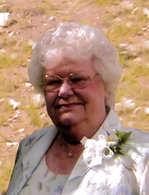
 Dixie “Charlene” Anderson, 87, of Salida, CO formerly of Graham County, KS, died June 24, 2019. She was born November 29, 1931, in Morland, KS to Ivan Louis and Geraldine (Boss) Rawson. She graduated from Morland High School in 1949 and married Dwane M. Anderson on May 22, 1949. She worked side by side with her husband at Anderson Motor Company, in Kinsley and Beloit, KS and Salida, CO from 1971 until 2005. Charlene and Dwane enjoyed traveling the US. She also was a quilter and seamstress and enjoyed crafting. Charlene was a member of the Salida Red Hats Society. Her greatest love was her family.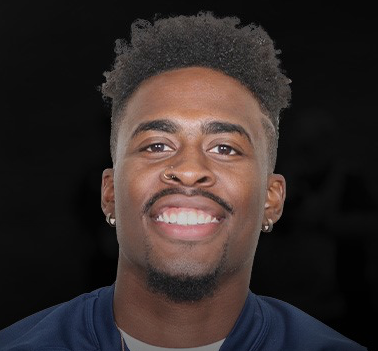














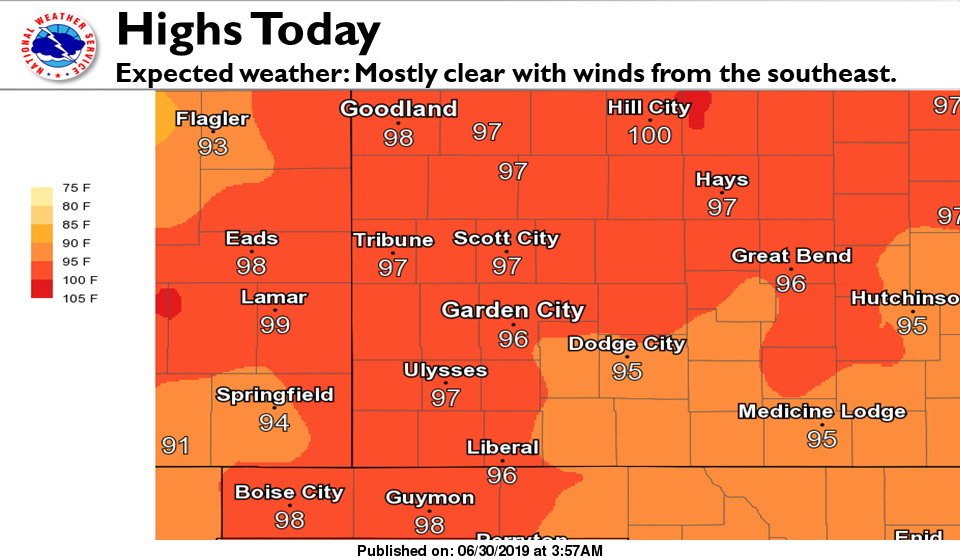
 Today
Today