TOPEKA, Kan. (AP) — The Kansas Supreme Court has refused to shorten the time a man will spend in prison over a November 2014 murder in McPherson County that authorities say he planned.
Darrah photo KDOC
The court ruled unanimously Friday against Samuel Darrah of McPherson. He pleaded no contest to charges including first-degree murder and attempted aggravated kidnapping in the stabbing of James Croft.
Authorities said Darrah plotted Croft’s murder because he had given Croft $3,200 to buy drugs and Croft did not supply them. A friend of Darrah’s stabbed Croft.
The trial-court judge sentenced Darrah to 25 years to life for murder and to eight-plus years for kidnapping and ordered the sentences served one after the other. Darrah said he should serve them at the same time.
The Supreme Court called the judge’s action reasonable.
Kirk McClure, KU Professor, Urban Planning, School of Public Affairs and Administration
KU NEWS SERVICE
LAWRENCE — For decades, the federal government has used housing vouchers as part of a strategy to help low-income Americans obtain affordable housing as a way out of poverty. Part of that strategy was to help individuals and families settle closer to employment opportunities, but new research shows that proximity to jobs may not be as crucial as previously thought.
Kirk McClure, professor of urban planning in the University of Kansas School of Public Affairs & Administration, has co-written a study examining a national dataset of households receiving support from the Housing Choice Voucher Program from the U.S. Department of Housing and Urban Development. The analysis showed that recipients tended not to locate in neighborhoods that are closer to areas with high job availability compared to their previous neighborhoods and that when they do move to such areas, it does not result in higher earned income.
“We have assumed for a long time that if a household locates in a neighborhood with a lot of jobs, or at least not as much competition for jobs, that’s good,” McClure said. “Congress has not wanted this program to be a form of welfare but a way to move out of poverty and into gainful employment.”
McClure co-wrote the study with Michael Lens of the University of California Los Angeles and Brent Mast of the U.S. Department of Housing and Urban Development, Office of Policy Development and Research. It was published in the journal Cityscape. The authors set out to determine if very low-income renter households using the program, known as HCV households, move closer jobs, and if they do, whether the moves are associated with higher income. McClure and co-authors analyzed data from HUD, which included about 2 million households. Of those, approximately half were included in the study, as they were adults in the workforce, and the other half were not in the workforce due to age or disability. The data showed no association between proximity to jobs and HCV households or an increase in earnings for those who relocated closer to jobs.
“The data says people who move don’t necessarily have higher employment or earnings,” McClure said. “That suggests we may have been using this program in not the absolute best way for 25 years, and it says to me of the linkage between place of residence and place of employment is not as important as we thought.”
Other factors are almost certainly at play, the authors point out. Available transportation for HCV households was not accounted for in the study, and HCV households with vehicle ownership are more likely able to commute farther distances to jobs and services without the necessity to move. Access to public transportation also plays a role, and if a recipient moves closer to jobs, but public transit is lacking, that can be reflected in an inability to reliably get to work, get kids to school and access other basic services.
Proximity to good schools and other neighborhood characteristics play a role as well. The authors point out that many recipients likely look at those characteristics before job proximity when deciding where to move. Families show a tendency to move to neighborhoods in good school districts that are more suburban by nature and not as close to high job-density areas. Landlord resistance is another common obstacle in HCV household relocation. Landlords are under no obligation to rent to voucher recipients and can legally choose not to rent their property to voucher recipients.
McClure said the results make several points clear. First, researchers and policymakers must rethink the “geography of opportunity.” That is the driving idea behind such programs that seek to help low-income families move to new neighborhoods. Moving away from high crime areas is one factor, but what makes a desirable neighborhood is less clear. If proximity to jobs is not as important as once thought, factors such as access to transportation must be more closely studied.
“We need to rethink what it means to be a high opportunity neighborhood,” McClure said.
Second, annual report cards that are provided to the more than 2,700 housing authorities across the country that take part in HCV programs need rethinking as well. HUD has long graded housing authorities on the quality of the neighborhoods where HCV households locate. Proximity to jobs is likely overvalued in those rankings, again in respect to other factors such as access to transportation. In addition, landlord outreach needs to be strengthened. As landlords are not under an obligation to rent to voucher recipients, housing authorities should be able to offer incentives to landlords such as guaranteeing rent and guaranteeing occupation of set numbers of available units, among others, McClure said.
While policy has long focused on the proximity to jobs for housing choice vouchers, McClure and co-authors argue that the absence of data to support a benefit does not mean the programs are not working. Instead, policy should take into account other factors.
“Ultimately, we think that the rational policy response to these findings should be to keep the importance of job proximity in perspective. Evidence of the importance of job proximity for HCV households is simply not sufficient to warrant that it be as high a priority as are safe neighborhoods and access to high-quality schools,” the authors wrote. “HCV households are a diverse group, however, and for households in the workforce and without access to reliable transportation, proximity to jobs is worth paying attention to without allowing it to override concerns that evidence suggests may be more important.”
MCDONALD COUNTY, Mo. — A Kansas man died in an accident just after 6:30p.m. Friday at the Elk River below the low head dam at Noel, Missouri.
An unidentified woman swimming was swept underwater by the dam, according to the Missouri State Highway Patrol.
Jacob T. Farley, 26, Wichita, entered the water downstream in an attempt to rescue her.
A fire crew from Noel arrived on the scene and used a throw rope to rescue the woman. Farley drowned. The McDonald County Coroner pronounced him dead at the scene.
A GoFundMe account has been started to raise money for his family. Farley leaves behind a 3-year-old son.
Janice LaRue Coker, 88, died June 22, 2019, at Woodhaven Care Center, Ellinwood. She was born April 16, 1931, in rural Rice County, Kansas, the daughter of Samuel Franklin and Lucy Mathilda (Allinger) Stackhouse. Janice graduated from Bushton High School in 1949.
On September 4, 1949, she married Kenneth Victor Coker in Bushton. He preceded her in death on September 19, 1972.
A longtime Hoisington resident, Janice was a homemaker, a seamstress for Suburban Cleaners, and the custodian for the First United Methodist Church for 12 years.
She was a member of First United Methodist Church and the United Methodist Women. She also volunteered at Friendship Meals. Janice loved cooking and canning everything she grew in her garden. She was an accomplished seamstress, she made clothing and quilts for all of her grandchildren, and also taught them how to sew, crochet, and embroider. She loved spending time with her family, especially the holidays where she would cook a big meal for them.
She is survived by five children; Richard Coker (Deanna) of Hutchinson, Keith Victor Coker of Hoisington, Cheryl Coker of Hutchinson, Rita Lillard (David) of Houston, Texas, and Nancy Shives (Ron) of Hoisington; a sister, Margaret Williams of Welch, Oklahoma; 14 grandchildren, LaMonte Lillard (Crystal), Virginia Lillard (Lewis Nunez), Frank Coker (Debra), Kenny Coker, Carrie Achilles (Martin), Delbert Flanders, Sherry Smith (Garrett), Kayla Curtis (Danny), Landon Coker, Mary Coker, Janice “LaRue” Coker, Candi Coker, Golden Coker, and Darrell Shives (Amber); 34 great grandchilden and 6 great great grandchildren.
She was preceded in death by her parents, a son, Gerald Ray Coker, brother, Norman Stackhouse, and a brother-in-law, Jack Williams.
Friends may call 1 to 8 p.m. Monday, and 9 a.m. to 8 p.m. Tuesday, with family to receive friends from 6 to 8 p.m.. Tuesday at the funeral home. Funeral service will be 10 a.m., Wednesday, June 26, 2019, at Nicholson-Ricke Funeral Home Chapel, with Rev. Seong Lee presiding. Burial will follow in Clafin Cemetery, Claflin, Kansas.
Memorials may be made to the American Diabetes Association or the American Heart Association in care of Nicholson-Ricke Funeral Home, PO Box 146, Hoisington, KS 67544.
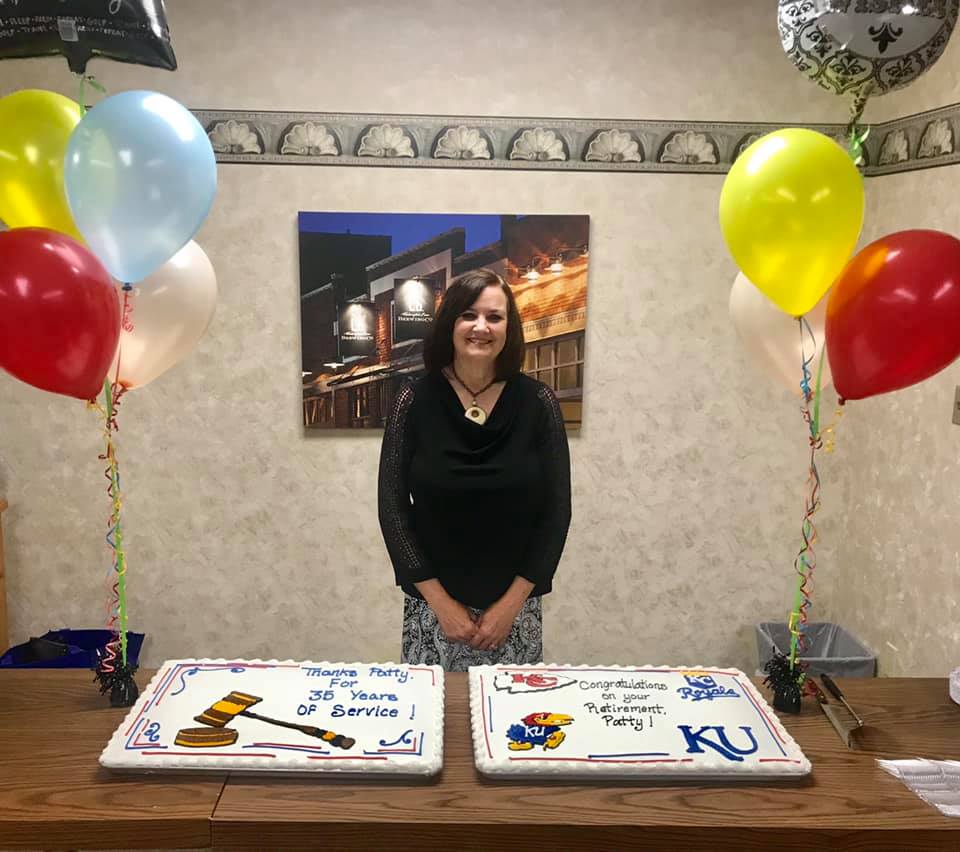
Patty Wolf retired last week after working for 35 years for the Hays Municipal Court. Photo courtesy of Hays PD.
By CRISTINA JANNEY Hays Post
Most people are not in the best of moods when they meet Patty Wolf for the first time.
They are usually paying a fine or facing the challenge of a legal matter.
But for 35 years, Wolf has met that challenge with kindness and grace, as she served the Hays Municipal Court.
Wolf, 62, retired from her clerk position last week.
Wolf said she really enjoyed being able to help people better understand the court and their options. The clerk is one of the first people in the court system people deal with. She said being able to help people was her biggest reward from her job.
“Sometimes people get in a position and they don’t know they have options available to them,” she said. “While we can never give advice, [we can] explain options to people to let them know there are other ways to possibly remedy their situation. It was gratifying being able to help individuals.”
In 1984, Wolf had been recently laid off, when she heard there was a position open with the city. She was initially assigned to work as the the Hays PD secretary before being transferred nine months later to the municipal court.
“The city is a great organization to work for,” she said. “They take care of their employees, have great benefits and it was just a fit for me.”
She said she has dealt with some diverse cases over the years, but said she did not want to relate specifics for fear of embarrassing anyone involved. However, she said it did keep her job interesting over the years.
“I really enjoyed working with the patrol,” Wolf said. “They are an amazing group of dedicated, courageous young men and women. I watched as their families made sacrifices to protect me and this community, and I am grateful for their service.
“I have also made a lot of friends along the way,” she added. “There are some great people who work throughout the city of Hays — staff at city hall, our IT department, animal control, dispatch, so I had a lot of contact with them, as well as our judges and prosecutors, attorneys I have met along the way as well and worked with.”
As a clerk of the court, she collected money for tickets, dealt with attorneys and created reports for the court.
Wolf said the biggest change at the court in the last 35 years has been the introduction of technology.
When Wolf started working at the court in the ’80s, the court had hand-written ledgers. The court would eventually make the transition to computers and a large amount of data had to be entered to get that system off the ground.
Now that she is retired, Wolf plans to travel, spend more time with her grandchildren and her mom, go fishing and volunteer.
“I truly enjoyed my work at the city and everyone I worked with — the ladies in the office,” she said. “It was a great work environment. It was like a family there. Everyone was very supportive. That I will truly miss, but I’m on to my next adventure. ”
“A Clockwork Orange.” “Invisible Man.” “Twelve Years a Slave.”
“Naked Lunch” by William S. Burroughs and “Life in Prison” by Stanley Williams are just two of the books on a list of banned publications in Kansas prisons. NOMIN UJIYEDIIN / KANSAS NEWS SERVICE
Issues of Bloomberg Businessweek, Us Weekly, Elle.
“Excel 2016 for Dummies.” “Tarot Fundamentals.” “Electrical Theory.”
Over the past 15 years, the Kansas Department of Corrections banned those titles, and about 7,000 others, from its prisons across the state.
The department says it censors books and magazines that could threaten security. But others argue that the size of the list and the broad topics covered under censorship guidelines limit inmates’ education, make their time in prison that much less bearable and further cut them off from an outside world to which they’ll eventually return.
Interim corrections secretary Chuck Simmons said the department prioritizes safety over giving inmates an unlimited selection of books and magazines.
“We censor based on the impact, or potential impact, on the security and operations of the correctional facility,” he said. “There are other publications that the inmate has access to that can accomplish the same purpose in their education or rehabilitation goals.”
For example, books and magazines about tattoos are forbidden because tattooing isn’t allowed in prisons. The prisons also ban books containing descriptions of drugs and violence.
Books about electronics and information technology are considered possible security risks. “The Turner Diaries” — inspiration for the 1995 Oklahoma City bombing — and Adolf Hitler’s “Mein Kampf” are on the list.
Sexually explicit content and images aren’t allowed either — a rule reflected in numerous banned items, from “Fifty Shades of Grey” to dozens of issues of Playboy, Penthouse and the like. That rule, Simmons said, aims to keep explicit materials away from sex offenders. It also protects prison staff from being exposed to sexual content in the workplace.
Censorship Process
The evaluation of books and magazines begins in each prison’s mailroom, Simmons said. First, staff skim through every publication sent to inmates. Materials flagged for possible censorship then go to the mailroom supervisor at the prison in Lansing. There, a final decision is made on whether to ban a publication across the system.
“None of our staff have time to read the full content of all of the publications that come through the correctional facilities,” Simmons said. “It is a significant number.”
Inmates have the chance to appeal censorship decisions within 15 days. In the past 15 years, 1,622 appeals have been filed. Only 141 were successful. If a book or magazine is ultimately banned, an inmate must pay to have it sent back or it will be destroyed.
Simmons said the list of banned items accounts for a small percentage of the titles sent to inmates over the past 15 years. A department spokeswoman said she couldn’t provide an estimate of the total number of books and magazines received in mail rooms. But she said the state’s eight adult prisons house 100,000 books altogether.
The department said it plans to develop a training program to teach Lansing staff about censorship standards. And from now on, officials will take another look at censorship decisions about some topics, including art books, mainstream magazines, information technology and vocational skills like plumbing and welding.
Information Access
The full list of banned books surfaced when Books To Prisoners, a Seattle-based nonprofit group, tweeted the results of an open records request filed with the Kansas Department of Corrections.
Michelle Dillon, a volunteer with the organization, wrote the tweet. She works for the Human Rights Defense Center, the nonprofit that filed the records request and publishes the monthly magazine Prison Legal News. She said she was shocked by the length of the list and many of the titles on it.
“Ultimately, it comes down to control of the population, which I think is especially reflected in the breathtaking array of books that Kansas has made a decision to ban,” she said in a phone interview. “Most of them, I think that the general population would agree are very nonsensical.”
The list includes biographies of musicians such as Kurt Cobain and Tupac, memoirs by raunchy comedians Richard Pryor and Lenny Bruce and novels by bestselling authors like Nora Roberts and Dean Koontz.
Also banned are issues of comics like “Deadpool” and “The Walking Dead,” Japanese manga, and books and magazines about LGBTQ topics.
Many publications by and about people in prison also make it on the list: Prison Legal News, the Incarcerated Worker newsletter, “A Queer Prisoners Anthology,” and “Are Prisons Obsolete?” by communist and civil rights activist Angela Davis.
A selection of books banned in Kansas prisons. Bestselling memoir “Between the World and Me,” by Ta-Nehisi Coates, is on the list.
CREDIT KANSAS DEPARTMENT OF CORRECTIONS / KANSAS NEWS SERVICE SCREENSHOT
Dillon said limiting access to those books can severely impact inmates’ ability to learn and keep in touch with current events.
“We take for granted that we have the internet and we can look up all of these kinds of information,” she said. “But information access in prisons is extremely constrained.”
She said prison libraries are an option, but they might not offer what inmates actually want to read or learn.
“Although we love prison libraries, they don’t fulfill all of the needs that prisoners have for accessing information,” Dillon said. “They’re closed during certain hours of the day. They might be understaffed, underfunded.”
Ultimately, she says banning reading materials could go against one goal of prisons: to rehabilitate the people inside.
“Do we want to just lock people away inside of bare concrete walls for years and decades on end?” she said. “If you eliminate books, the wide range of information and ideas and engagement with the world that books represent, what are you doing for prisoners?”
N.K. Jemisin, a science fiction and fantasy author whose works are banned in Kansas prisons, agrees.
“They need to be able to read things that are actually enriching to their experience, helping them process whatever it was that they did,” she said in a phone interview. “We’ve got a problem where people go into prison and they come out worse. Maybe reading some books would help.”
Jemisin said she didn’t know why three of her books — a fantasy trilogy starring gods and demons — were censored.
“There’s nothing based in the real world happening there,” she said. “I don’t even think most of my stuff is set on Earth.”
A Connection to the Outside
Reading gave Hannah Hudson a virtual escape from her 30-day stint in the Johnson County jail. She spent much of the time reading from a cart of books. She read titles by James Patterson and Danielle Steel — authors who appear on the list of books banned in Kansas.
“Reading books honestly helps pass the time in prison,” she said. “It gets you out of your head a little bit.”
Hudson still has friends in prison in Kansas. Earlier this year, she tried to send them books so they knew she was thinking of them. But only one made it through: a Bible.
“The Black Book,” by James Patterson and David Ellis, was banned from Kansas Prisons on Sept. 17, 2018.
CREDIT JAMESPATTERSON.COM
She tried sending a few others: Patterson’s “The Black Book,” novels by bestselling author David Baldacci and a subscription to Prison Legal News. But her friends received notices that the books were contraband and would be destroyed.
“James Patterson’s like gold in jail. That’s the one everybody wants to read,” Hudson said. “To see it be banned is unfortunate and shocking.”
Hudson faces federal charges for distribution of methamphetamines — the maximum sentence is life in prison. For her, reading is a way to connect to the outside world that she might be leaving behind.
“I will be incarcerated potentially for a long time,” she said.
“There’s not much you can get in jail: a letter or a postcard, a picture, a book,” she said. “To deny people the opportunity, not only to read, but just to get something from home, I think is unfortunate.”
Nomin Ujiyediin for the Kansas News Service. You can send her an email at nomin at kcur dot org, or reach her on @NominUJ
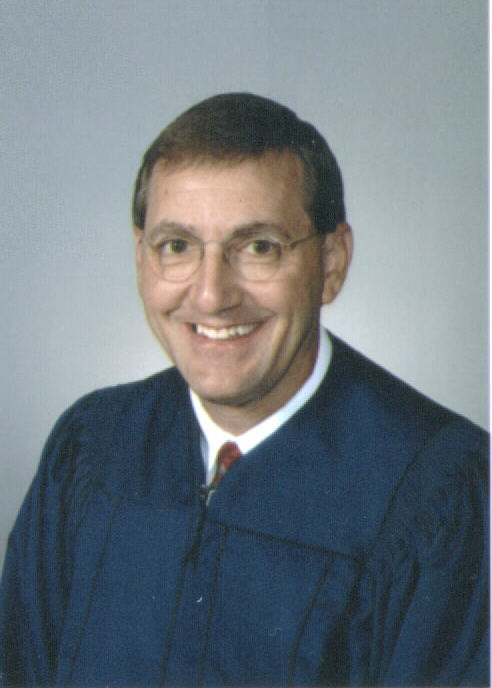
FlaxTOPEKA — The Kansas Supreme Court appointed District Magistrate Judge Richard Flax, District Judge Michael Hoelscher, and District Magistrate Judge Dale Snyder to the Judges Assistance Committee.
The Judges Assistance Committee provides help to any Kansas judge in need due to mental or physical disability, or addiction.
Flax and Hoelscher will serve four-year terms from July 1 through June 30, 2023.
Flax serves in Trego County of the 23rd Judicial District and succeeds District Magistrate Judge Keith Whitney, who serves in Meade County of the 16th Judicial District.
Hoelscher serves in Sedgwick County of the 18th Judicial District and succeeds Retired District Judge Steve Becker of Buhler, who served in Reno County of the 27th Judicial District.
Snyder will complete a vacated term on the committee that expires June 30, 2022. He serves in Rush County of the 24th Judicial District. He succeeds Moundridge Municipal Judge Amie Bauer.
Other members of the Judges Assistance Committee are:
District Judge Ben Burgess, who serves in Sedgwick County of the 18th Judicial District.
District Magistrate Judge Marty Clark, who serves in Russell County of the 20th Judicial District.
District Judge Sally Pokorny, who serves in Douglas County of the 7th Judicial District.
District Judge Mark Ward, who serves in Bourbon County of the 6th Judicial District.
Western Kansas Human Resource Management Association will hold its monthly meeting from noon to 1 p.m. Aug. 14 at the Robbins Center on the campus of Fort Hays State University.
Registration is from 11:15 to 11:30 a.m., with a short business meeting starting at 11:30 a.m.
The program for the August meeting will be “How Tos of Internships,” presented by Karen McCullough and Lisa Karlin with FHSU Career Services. The program will be submitted for SHRM continuing education credits.
WKHRMA members can RSVP at wkhrma.shrm.org. The deadline to RSVP is noon on August 9. WKHRMA is an affiliate chapter of SHRM (Society for Human Resource Management), a local professional organization for persons engaged in personal or human resource management.
For more information on WKHRMA, visit wkhrma.shrm.org.
Nothing has touched my soul and spoken to aging with grace quite like the ancient Indian medicine wheel and the traditions that have evolved from it. From the National Library of Medicine, I learned that in the Americas, Indian tribes have multiple interpretations of the four directions, but the following prayer is my own, geriatrician’s interpretation of a version from the book Black Elk Speaks and Oyate (Nakota, Dakota, Lakota) tradition.
First, we get down on our knees and feel the soil, the sacred Mother Earth, bringing the world around us, the animals, plants, prairies, lakes, mountains, the environment of our planet from where all food and sustenance comes. Earth is foundation. Then we stand up on our tiptoes, and raise our arms to sacred Father Sky, the sun, stars, clouds, rain, wind, air and breath of life, light and dark; from where all energy flows and ebbs. Sky is infinity. Earth and sky, the beginning and the end.
Around the central campfire and within the circle, first we bow east, symbolized by red, rising sun, springtime, birth, blood, the very young; a sense of innocence, youth. May we have hope for a future with an open mind to all things new and true.
We bow south, symbolized by yellow, full sun, summer, sexuality, the anticipating young woman and young man; a sense of unconquerable power and invulnerability, early adulthood. May we have the courage and strength to fight for justice.
We bow west, symbolized by black, setting sun, an approaching dark thunderstorm, oncoming night, autumn, resignation, the reality filled community leader and medicine woman/midwife; a sense of the horrors of war and reality of loss, mature adulthood. May we have the gravity to protect freedom of choice and face vulnerability with honest eyes.
Finally, we bow north, symbolized by white, starry night, winter, old age, wisdom, the sagacious elder and teacher; a sense of beauty, grandchildren and the circle of life, an experienced body and mind, release from the fear of change and death. May we have insight to savor family and friendship, and the good sense to walk in another’s moccasins.
Inside the circle is the tree of life, where we become aware of our self, our consciousness, tribe, community, country, world, and our connection to all direction.
Dear Mother/Father of Earth and Sky, thank you for your blessings, the sacred hoop of life, and especially the wisdom to find release from fear of death. May our sisters and brothers of all Clans and Nations realize our sacred connection and, in harmony, savor the joy and even the sorrow of our circle of life and aging.
For free and easy access to the entire Prairie Doc® library, visit www.prairiedoc.org and follow The Prairie Doc® on Facebook, featuring On Call with the Prairie Doc® a medical Q&A show streaming live most Thursdays at 7 p.m. central.
PRATT – Kansas Wildlife and Parks Magazine, a bimonthly publication of the Kansas Department of Wildlife, Parks and Tourism (KDWPT), will be managed by a female editor for the first time in the magazine’s 76-year history.
Current KDWPT employee Nadia Reimer, who was promoted to chief of information production in April, will serve as the magazine’s executive editor. Reimer previously served as the magazine’s associate editor from 2013-2015, and managing editor from 2015-2019. She follows in the footsteps of long-time executive editor, Mike Miller, who now serves as KDWPT’s assistant secretary of wildlife, fisheries and boating in Pratt.
“Nadia brings a wealth of talent, ideas and energy to her new role. As an avid angler and hunter, she also lives the outdoors lifestyle,” said Ron Kaufman, Director of Information Services at KDWPT. “We look forward to her leadership in continuing the fine tradition of the department’s flagship outdoor recreation magazine.”
Kansas Wildlife and Parks Magazine had humble beginnings in 1938 as a seven-page, typed pamphlet. Today, the award-winning 48-page, full-color publication has made it as far as 47 of the 50 states and three countries.
“Kansas Wildlife and Parks Magazine is the voice of our agency, and carrying on its legacy is a responsibility I feel privileged to take on,” said Reimer. “KDWPT employees are some of the most knowledgeable and passionate people you’ll meet, and when you combine their expertise with the experiences of our constituents, you get an incredible publication at the end of the day.”
Each issue of Kansas Wildlife and Parks Magazine features work from some of the state’s top freelance outdoor photographers and writers who, alongside department staff, cover wildlife, hunting, fishing, state parks, camping, conservation, recipes, tips and tricks, and more.
A single issue costs $3.75, a year subscription (six issues) is $13, a two-year subscription (12 issues) is $22, and a three-year subscription (18 issues) is $32. Interested readers can sign up to receive the magazine by calling the KDWPT Pratt Operations Office at (620) 672-5911, or by visiting ksoutdoors.com/Services/Publications/Magazine.
HAYS – The Hays Larks offense exploded in the seventh inning Saturday night as they rallied from down three to beat the Valley Center Mud Daubers 17-7 in eight innings.
Valley Center was able to keep the Larks offense at bay for a good portion of the game and built a 7-4 lead through six and a half innings but that is when the Larks offense came to life.
In the seventh the Larks sent 12 to the plate and scored nine runs to take a 13-7 lead.
Justin Lee delivered the first big hit of the inning, hitting his first grand slam as a Larks and then a few batters later Jimmy DeLeon added a three-run homerun to put Hays up by six runs.
In the eight inning the Larks added three more runs on wild pitches and then Matt Cavanagh delivered and RBI single that would give Hays the 17-7 run-rule win.
Tommy Garcia allowed two runs in two innings of relief and earned the victory.
Every starter for the Larks had at least one hit and all but two drove in at least one run.
Lee was three-for-five on the night with five RBI’s and three runs scored.