We have a brand new updated website! Click here to check it out!

CLINKSCALES: Poppa and Father’s Day

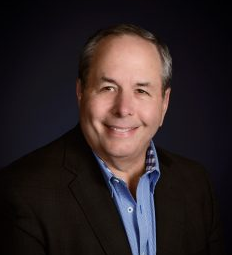
Randy Clinkscales
One of my early memories as a child was visiting with my grandparents in Hillsboro, Texas. Snow in the Hill Country of Texas is very rare. So, it was one of those rare mornings when we woke up to discover that it had snowed. It was my first snow, and I remember running outside so excited.

My grandfather had a small ranch. He needed to go check the cattle, and I bundled up and headed out with him. For whatever reason, Pop decided to cook breakfast on the ground. We were surrounded by a few inches of snow. Pop piled some stones together, put in some twigs and sticks, and started the fire. He then chopped up some bacon, fried it in an iron skillet and then mixed in eggs. The steam and smell wafted into the air. It was delicious. Forever, that is what I have always called “Pop’s breakfast”.

My grandfather was quite the man. A giant for his time (6 ft. 2 in.), he played center for the town basketball team. Games were played outside on the earth. He was married to my grandmother but died 15 years before she passed. They were married for over 50 years. In the course of 50 years, they spent one night not together. When he passed, my grandmother’s heart was broken.

I often wonder what would have happened if my grandmother would have passed away first. I just do not know that my grandfather would have been able to carry on.

My grandfather was madly in love with my grandmother. They had breakfast together each morning. They would have coffee. There would usually be biscuits and gravy.

My grandfather was never in a hurry. He always had time for a conversation. While big, he was always gentle.

Through his years, he had a variety of jobs. Pop and Mammaw married just at the beginning of the depression. Pop liked to say that they were better off than most, having a farm where they could raise their own food. Pop got a job hauling rock for the county roads. Again, he felt so fortunate.

Over time, Pop continued with working at whatever he could, and for whatever purpose. He had one goal: provide for his family.

Through the years, he was County Clerk, he sold freezers of meat (some of you are going to remember that), he was the Sheriff of Hill County, Texas, and later in life was a policeman in River Oaks, Texas (a suburb of Fort Worth).

I was always impressed by his attitude. He would “get” to go to work. It was never he “had” to go to work. He always felt fortunate that he was able to provide for his family.

His two sons (my two uncles) were hemophiliacs. One of them died while quite young. Pop never would talk about it. It was too painful.

When I was in college, my grandfather’s other son (my uncle) lost a child. The baby was stillborn. Because I was going to college near Fort Worth, I stepped up to make the funeral arrangements. It was the first time that I had ever seen my grandfather cry. I remember he and my grandmother looking at that little casket, standing arm in arm. The child was named after my grandfather.

As a police officer, I always had to laugh at Pop’s approach. We often joked that Pop would have been killed in a car but for the fact that he was in a police car and everyone moved out of the way. He really was not a good driver. He enjoyed taking his time and looking around.

He carried that approach into his duties. If he stopped someone for a minor infraction, he had the philosophy that if they would truly listen to his lecture, he would let them go. But those lectures could be long. I experienced some of them myself.

Pop was a good man. He was always honest but never critical. He was never hurtful. He never judged me, though I would go through various stages of life.

Upon my arrival to visit with Pop and Mammaw, it would not take long before the dominoes came out. The dominoes were an excuse to have a meaningful conversation at the table. When someone scored a big score, Pop had this wonderful laugh, slow and deep; proud either for himself for scoring the points, or for the person scoring the points. It did not matter to him.

Pop was eventually forced to retire. I believe he was about 67 when he reached the mandatory retirement age with the police department. They had quite a celebration recognizing Pop for all his years of service, his role as a police officer, what he meant to so many of the junior officers, and all the lives he touched in the community.

He had a stroke. We really did not think he would make it, and certainly not make it at home, but he and my grandmother were determined that he would.

Eventually, he fully recovered. The last years of my grandfather’s life were spent as a full-time companion with my grandmother. They gardened; they worked in the yard; and they fished. They would put on these funky hats, and drive to Lake Worth, just a few minutes away. I do not think it was very important to them whether they caught fish. They just enjoyed being together and relaxing.

Probably the greatest lesson that I learned from my grandfather was how to love your wife. Through the many years, their marriage was a partnership. He and Mammaw did things together. Though most of the time my grandmother was a stay-at-home mom, her role was great in the marriage. Poppa leaned on her; she leaned on him.

I never heard Poppa say one harsh word to my grandmother. I never heard him at any time diminish her capabilities or her role. In fact, there was a certain amount of awe he had for my grandmother.

I was fortunate in my life to have my father and stepfather who meant so much to me, but I was just as fortunate to have a grandfather who helped me learn what it meant to be a father, a husband, and a man.

Remember your fathers and grandfathers this year on Father’s Day. And grandfathers, remember the influence you will have on your grandchildren, even when they are 65 years old and you are long gone. You are special.

Randy Clinkscales of Clinkscales Elder Law Practice, PA, Hays, Kansas, is an elder care attorney, practicing in western Kansas. To contact him, please send an email to [email protected]. Disclaimer: The information in the column is for general information purposes and does not constitute legal advice. Each case is different and outcomes depend on the fact of each case and the then applicable law. For specific questions, you should contact a qualified attorney.
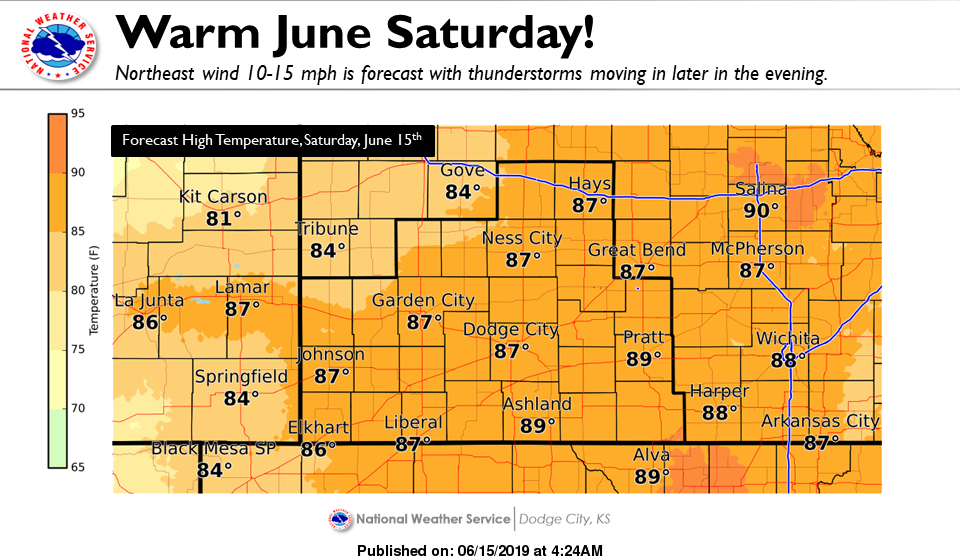
Sunny, warm Saturday

Today
Mostly sunny, with a high near 87. West northwest wind 8 to 10 mph becoming north in the afternoon.
Tonight
A 30 percent chance of showers and thunderstorms, mainly before 1am. Mostly cloudy, with a low around 61. North northeast wind 7 to 9 mph.
Sunday
A 30 percent chance of showers and thunderstorms after 1pm. Partly sunny, with a high near 82. North wind 7 to 10 mph becoming east northeast in the afternoon.
Sunday Night
A 20 percent chance of showers and thunderstorms. Partly cloudy, with a low around 59. East wind 5 to 10 mph becoming light in the evening.
Monday
A 30 percent chance of showers and thunderstorms, mainly after 1pm. Partly sunny, with a high near 79. East wind 3 to 8 mph.
Monday Night
A 50 percent chance of showers and thunderstorms. Mostly cloudy, with a low around 60.
Tuesday
A 50 percent chance of showers and thunderstorms. Mostly cloudy, with a high near 78.
Tuesday Night
Showers and thunderstorms likely, mainly before 1am. Mostly cloudy, with a low around 60. Chance of precipitation is 60%. New rainfall amounts between a quarter and half of an inch possible.
Wednesday
Partly sunny, with a high near 82.

First Soviet hijacking triggers insights into Cold War boundaries

KU NEWS SERVICE

Aeroflot Flight 244 (Photos courtesy of Erik Scott)

LAWRENCE — There was a time when hijacking a plane was considered heroic. Glamorous, even.

Erik Scott

“The idea that hijacking was romanticized is hard to fathom in our post-9/11 mentality,” said Erik Scott, associate professor of history at the University of Kansas.

But that was the case 50 years ago when air safety and border security were viewed quite differently.

While working on a book about defection, Scott came across one of the most bizarre incidents of the Cold War: the first successful hijacking of a Soviet aircraft. His research led to writing an article titled “The Hijacking of Aeroflot Flight 244: States and Statelessness in the Late Cold War.” The 10,000-word piece appears in the May issue of Past & Present, one of the world’s leading historical journals..

“It grabbed my attention because it was such a dramatic story,” Scott said.

On Oct. 15, 1970, Pranas Brazinskas and his 15-year-old son, Algirdas, boarded a plane in the Georgian city of Batumi. The two Soviet Lithuanians, armed with pistols and a grenade, handed a note to a young flight attendant named Nadezhda Kurchenko. She reacted by rushing to lock the cockpit door and warn the pilot. The men began shooting when the pilot intentionally nosedived the aircraft, killing Kurchenko and wounding members of the flight crew.

The hijackers eventually commandeered the plane and diverted it to Turkey, hoping to secure asylum.

Algirdas Brazinskas, left, and Pranas Brazinskas, right, confer with a Lithuanian-American supporter after the hijacking.

Scott, who actually tracked down and interviewed the surviving hijacker, said, “The (Brazinskases) were basically trapped in limbo in Turkey for nearly a decade since the incident spurred governments on both sides of the Iron Curtain to crack down on hijacking. Although they ultimately managed to leave Turkey, fleeing to Italy, Venezuela and then the United States, they remained isolated and virtually stateless, rejected by governments around the world.”

The blight of “skyjacking” became prominent in the late 1960s and early ’70s. A five-year stretch of that era witnessed 326 hijacking attempts — an average of about one every five days.

Scott writes in Past & Present: “For a time, hijacking offered non-elite and often marginal individuals the opportunity to reorder the hierarchies that governed airspace and mount a challenge to Cold War boundaries.”

“It was not initially associated with terrorism,” he said. “And so although hijacking was very common, it was not always violent. It certainly involved coercion because you had to demand that the pilot would take a plane somewhere else, but at least at first it rarely involved people getting hurt or dying.”

Airlines and the U.S. government even disregarded the crime for a time, believing the public would not put up with added security measures at airports.

“One thing that’s misunderstood is that most hijackings in this period were not from the socialist camp to the capitalist one, but from the capitalist camp to the socialist one — in particular, from the U.S. to Cuba,” Scott said.

“So for a long time, the Soviet Union took a rather tolerant approach of hijacking beyond its borders. They saw it as a symptom of discontent in the capitalist world. They gave tacit support to hijackers, including some factions of the PLO.”

Nadezhda Kurchenko

The Soviets were not so tolerant of the hijackers of Flight 244, especially seeing as they murdered a crew member. (A 1974 Soviet film titled “Abiturentka” [The Applicant] provided a fictionalized account of this event that heroicized the slain woman.) And their fate became a complex and often absurd saga, stretching on for decades and ultimately involving the U.S.

Scott located the younger Brazinskas currently incarcerated in a California prison, where he was sentenced for bludgeoning his father to death in 2002.

“In the trial, he argued his father had a long history of violence,” Scott says of Algirdas Brazinskas. “But in our correspondence he returned to this idea that this was a heroic action they took, and they should be remembered accordingly. My own take on the incident is rather different. I see it as a very murky episode that fits with my broader research on defectors. While we tend to think of defectors as people who made a conscious political choice, many were people at the margins of society whose motivations were personal as well as political, and whose decision to flee was more impulsive than deliberate.”

While researching this article, Scott scoured the recently declassified KGB archives in Georgia. He also made trips to Russia, the U.K. and the National Archives in Maryland.

He considers this a part of a larger book project examining how defection was jointly produced by the way socialist states criminalized exit and the way capitalist states encouraged departure.

The Boston native has earned a National Endowment for the Humanities fellowship and a fellowship from the American Council of Learned Societies. He’s hoping to complete the book manuscript within the next two years.

Scott, who has worked at KU since 2012, is an expert in Soviet and global history, and he offers courses on the history of migration, comparative empires and modern Russia. He is fluent in Russian and Georgian.

“We live in a time when people like to make comparisons to the Cold War, but historians are still coming to terms with what that period entailed,” Scott said.

“While it is common to think of the Cold War as a time when borders were solid and impermeable, this incident shows that Cold War borders were much more tenuous and contested. And though the Cold War is now over and people from the former Soviet Union are free to travel abroad, all of us now live in a world where airspace and airports are much more regulated than they were in the early days of air travel.”


Larks beat Rangers to run winning-streak to 10

HAYS – The Hays Larks scored in double-figures for the sixth consecutive game and ran their winning streak to 10 games with a 13-4 victory over the Park City Rangers Friday night at Larks Park. The game was called with one-out in the seventh due to rain.

The Larks (11-1, 10-0 KCLB, 4-0 KCLB Jayhawk West) scored four runs in the bottom of the first then after the Rangers (4-8) scored four in the third to close the gap to 6-4, the Larks answered with three in the fifth and sixth and one on the seventh before the game was halted.

Jimmy DeLeon had three of the Larks 16 hits and drove in two. Matt Cavanagh, Wyatt Divis, Mikey Gangwish, Justin Lee and Brook Brannon all had two hits.

Ryan Ruder allowed all four runs on seven hits with four strikeouts and one walk over six innings for the win.

The Larks and Rangers play the third of the four-game series Saturday night at Larks Park.

Twins’ late home run sinks Royals in pitchers’ duel

MINNEAPOLIS (AP) — Mitch Garver‘s two-run homer in the eighth inning snapped a scoreless tie, and Kyle Gibson gave up two hits in eight innings in the Minnesota Twins‘ 2-0 victory over the Kansas City Royals on Friday night.

Garver’s 11th home run of the season was deep to the berm in center field off Kansas City reliever Jake Diekman (0-4) after Max Kepler had walked. Minnesota has won 16 of its past 22 games and started a big weekend at Target Field with three expected sellouts and Joe Mauer’s number retirement ceremony on Saturday.

Gibson (7-3) struck out six in his longest outing of the season. Taylor Rogers secured his seventh save in nine chances.

Kepler reached base three times but the Twins’ No. 1 offense was stifled by Royals starter Brad Keller. Keller matched Gibson along the way, surrendering just three hits and striking out five.

Garver finally supplied the power Minnesota has enjoyed all season.

It was the Twins’ league-leading 133rd homer. Minnesota has a home run in 12 straight games.

BUXTON’S BRUISE

Byron Buxton was hit in the wrist by a pitch from Keller in the sixth inning but stayed in the game. However, Marwin Gonzalez pinch hit for Buxton in the eighth and Buxton was announced out with a right wrist bruise. The team said Buxton was day to day.

ROSTER MOVES

Both teams were active before the game. Kansas City optioned struggling first baseman Ryan O’Hearn to Triple-A Omaha and recalled outfielder Jorge Bonifacio. O’Hearn was hitting .188 in 56 games.

Manager Ned Yost indicated Bonifacio’s arrival was because the team is facing a slew of left-handed starters in the next two series and that his appearance will be short-lived with Hunter Dozier close to being activated from the injured list.

Minnesota swapped out right-handed relievers, sending Fernando Romero back to Triple-A and recalling Zack Littell. Manager Rocco Baldelli said Littell, mostly a starter in his minor league career, will be used in the bullpen going forward.

TRAINER’S ROOM

Royals: Alex Gordon was in the lineup at designated hitter a game after being hit by a pitch in the shoulder.

Twins: Rogers pitched for the first time since June 6 after dealing with a back injury.

UP NEXT

RHP Jake Odorizzi (9-2, 1.92 ERA) starts for Minnesota in the second game of the three-game series, with Kansas City countering with RHP Glenn Sparkman (1-2, 3.58). Odorizzi has won nine straight decisions, the longest active streak in the majors, and hasn’t allowed a run in six of his past seven starts. Sparkman is 1-1 with a 3.15 ERA in four games as a starter this season.

Kan. man sentenced for killing after doughnut shop robbery

TOPEKA, Kan. (AP) — A 25-year-old man has been sentenced to 46 years and two months in prison for breaking into a Topeka home with three other people and killing a man after they robbed a doughnut shop.

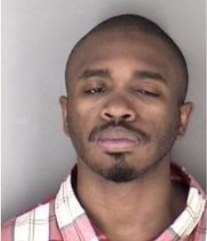
Kirtdoll photo Shawnee Co.

Erion Kirtdoll was sentenced Thursday for second-degree murder and aggravated robbery in the death of Tyrone Baggett.

District Attorney Mike Kagay says Baggett was shot in February 2018 when four men broke into his home. Detectives also connected the four to an armed robbery about 45 minutes earlier at Daylight Donuts.

Another suspect, Dion Troupe, is awaiting sentencing after pleading no contest to second-degree murder and three counts of aggravated robbery. And a plea hearing is scheduled for next week for a third man, Eli Perry.

Kansas governor plans to end economic border war in KC area

TOPEKA, Kan. (AP) — Kansas Gov. Laura Kelly says she plans to issue an executive order to end a longstanding economic border war between her state and Missouri in the Kansas City area.

Kelly told reporters Friday that her executive order will mirror a new Missouri law that prevents incentives from being used to lure businesses across the border in the metropolitan area. The Missouri law takes effect only if Kansas acts.

It was the first time that Kelly publicly committed to issuing an executive order. In Missouri, such a policy requires a change in state law.

Both states have spent millions of dollars luring businesses across the state line over the past decade. Area officials see such efforts as wasteful and want to focus on attracting businesses from outside the region.

Feds seeks forfeiture of $470K in cash seized in Kansas

WICHITA, Kan. (AP) — Federal prosecutors are seeking the forfeiture of $470,000 in suspected drug money that was seized earlier this year during three Kansas traffic stops.

That one stop alone yielded $250,000 in cash. A Kansas Highway Patrol trooper found that money in vacuum-sealed plastic bags and a duffel bag after stopping a rented car in February on Interstate 70 in Ellsworth County. Three days earlier, $55,000 was found during a traffic stop along I-70 in Wabaunsee County.

Another $165,000 was found in March wrapped in plastic and hidden inside the rear fender panel of a sport utility vehicle that was pulled over on Interstate 35 in Chase County.

For now, the money that the government wants to keep is in the custody of the U.S. Marshals Service.

Leonard Anthony Kashka

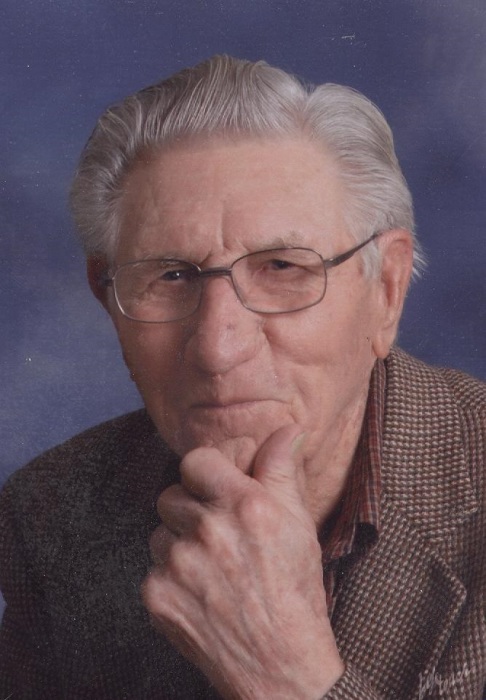
Longtime Goodland resident Leonard Anthony Kashka, Sr., 94, passed away on June 12, 2019 at his home in Goodland.

Leonard was born on September 30, 1924 in Atwood, KS to Victor and Victoria (Studer) Kashka. He was one of seven children. He grew up in Atwood and graduated from Atwood High School in 1942.

Leonard served in the United States Army from 1945 to 1946. On November 11, 1946, he married Antoinette Marie Musalek at the Catholic Church in Goodland. To this union, three children, Threse, Toni and Leonard Jr., were born.

Leonard enjoyed playing cards and dominos, driving around in the country looking at the crops, calling Bingo at Wheatridge, and visiting with friends and family.

Preceding him in death were his parents, his wife Antoinette, one step brother, two step sisters and one great granddaughter.

He is survived by his three children; Threse (Joe) Armstrong, Toni (Roy) Cummings and Leonard (Ramona) Kashka, Jr., all of Goodland. He is also survived by seven grandchildren, eleven great grandchildren and six step great grandchildren; two brothers, Marvin Kashka of Green River, AZ, LeRoy (Judy) Kashka of Kansas City, MO, and one sister Marlene Webster of McCook, NE, as well as numerous nieces, nephews and extended family.

A Mass of Christian Burial was held on Monday, June 17, 2019 at 10:30 AM MT at the Our Lady of Perpetual Help Catholic Church in Goodland with Father Norbert Dlabal officiating. Burial followed in the Goodland Cemetery.

Visitation was held on Sunday, June 16, 2019 from 4:00 to 6:00 PM MT at the Church with a Parish Rosary and Vigil service at 6:00 PM MT.

Memorial contributions may be designated to the OLPH Catholic Church or to the Goodland Senior Citizen’s Center and may be left at the services or mailed to Koons-Russell Funeral Home, 211 N. Main Ave., Goodland, KS 67735.

Online condolences for the family may be left at www.koonsrussellfuneralhome.com.

Funeral services have been entrusted to Koons-Russell Funeral Home in Goodland.

Another Kansas house fire blamed on discarded cigarette

SEDGWICK COUNTY — For the second time this week, fire officials in Kansas say discarded smoking materials blamed for a residential fire.

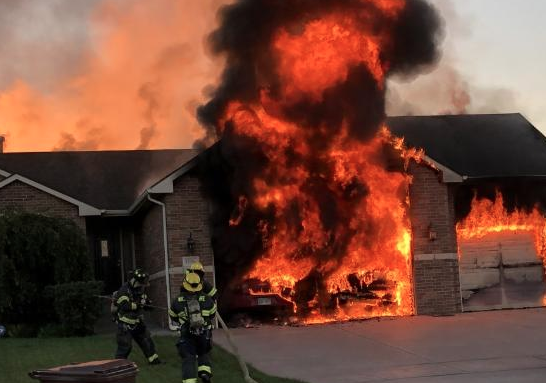
Thursday morning fire in Wichita photo courtesy KWCH

Just after 6a.m. Thursday, fire crews responded to 12351 East Willlowgreen Court in Wichita, according to Captain Jose Ocadiz.  As crews arrived on the scene, the found heavy smoke and fire from the home’s garage.

The fire did $60,000 to the home and an additional $40,000 to the contents. A cigarette discarded in a plastic trash can caused the fire, according to Ocadiz.

All family members were able to safely escape because they had working smoke alarms. There were no injuries.

A fire in a duplex Thursday in Hutchinson was blamed on discarded smoking materials.

Not all Kan. leaders happy with court ruling on school funding

TOPEKA —Kansas Gov. Laura Kelly and other leaders are responding the state Supreme Court decision approving a new law boosting funding for public schools.

The high court declined in its ruling Friday to close the protracted education funding lawsuit that prompted the decision.

The school finance law boosted funding roughly $90 million a year.

The court declared the new money is sufficient under the Kansas Constitution but said it was keeping the underlying lawsuit open to ensure that the state keeps its funding promises.

Democratic Gov. Laura Kelly had hoped the Supreme Court would end the lawsuit. Four local school districts sued in 2010.

The districts’ attorneys argued the new law would not provide enough new money after the 2019-20 school year. Education funding tops $4 billion a year.

14-year-old leads police on chase through central Salina

Salina Post

SALINA — A Salina teen was sent to the juvenile detention center in Junction City Thursday after leading police on a chase through the central part of Salina.

Salina Police Captain Paul Forrester said Friday that an officer saw a 1995 Ford Taurus eastbound in the 600 block of East Crawford Street. When the officer ran the tag, it came back as being registered to a Buick, he said. The officer pursued the Taurus and attempted to stop it in the 800 block of East Crawford Street at about 10:45 a.m. Thursday, but when the vehicle entered the parking lot of the former Long John Silver’s, it then turned north into the southbound lanes of South Ohio Street, Forrester said. With the officer in pursuit, the vehicle took the following route at speeds up to 50 mph, he said.

  • West on East Prescott Road
  • North on Guernsey Drive
  • West on East Prescott Road
  • South on South Second Street
  • West on East Crawford Street

At that point, the officer lost sight of the vehicle, however officers later located the vehicle parked in the 600 block of South Third Street , Forrester said. A Kansas Highway Patrol K-9 was brought in and located the driver hiding in a shed behind a house in the 600 block of South Third Street, he added.

Forrester said the driver, a 14-year-old boy, had two active failure to appear warrants from district court. The teen also was arrested on suspicion of the following, Forrester said.

  • Flee and elude of a law enforcement officer
  • Operating a motor vehicle without a valid license
  • Unlawful acts vehicle registration violation
  • Driving on the wrong side of the roadway

According to Forrester, the case remains open as the police are investigating how the boy obtained the vehicle and why it had a tag from another vehicle on it.

Wichita State basketball player jailed for alleged theft, domestic violence

SEDGWICK COUNTY —  Law enforcement authorities are investigating a member of the Wichita State men’s basketball team after a Thursday arrest.

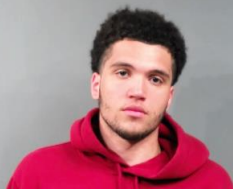
Teddy Allen photo Sedgwick County

Just after 3:30 a.m.Thursday, police responded to a domestic disturbance call at a residence in the 1800 block of North Doreen in Wichita, according to officer Charley Davidson.

A 23-year-old female resident told police Teddy Allen, 21, a member of the Wichita State University Basketball team, came to the home, battered her, took and broke her cell phone and took keys belonging to another 27-year-old female resident.

Police arrested Allen in the 1700 Block of North Gentry in Wichita, according to the Wichita Police Department Booking report. He was jailed on requested charges that include theft of property or services, domestic violence and criminal damage to property.

He posted bond and was no longer in custody Thursday morning, according to online Sedgwick County jail records.

Allen was the Nebraska Gatorade High School Player of the Year in 2017, according to the bio from Wichita State. He sat out last season per NCAA rules after he transferred to Wichita State from West Virginia. He appeared in 35 games for the Mountaineers.

The case will be reviewed by the City of Wichita Prosecutors Office, according to Davidson.

-----------

SEDGWICK COUNTY —  Law enforcement authorities are investigating a member of the Wichita State men’s basketball team after a Thursday arrest.

Teddy Allen, 21, was arrested Thursday in the 1700 Block of North Gentry in Wichita, according to the Wichita Police Department Booking report. He was jailed on requested charges that include theft of property or services and criminal damage to property.

He posted bond and was no longer in custody Thursday morning, according to online Sedgwick County jail records.

Allen was the Nebraska Gatorade High School Player of the Year in 2017, according to the bio from Wichita State. He sat out last season per NCAA rules after he transferred to Wichita State from West Virginia. He appeared in 35 games for the Mountaineers.

Copyright Eagle Radio | FCC Public Files | EEO Public File