An engineering design supplement for the North Vine Corridor roundabout project will be considered by Hays city commissioners tonight.
The agreement would give the engineering firm WSP more authority related to right-of-way property acquisitions needed as part of the project.
When the initial engineering contract was awarded, the scope of the project had not yet been formally defined.
“Without having the design started, we weren’t exactly sure which portions of property we would need to require right-of-way on,” said Jacob Wood, asst. city manager.
“We felt like it was better to have this happen after the fact, once we had a little bit of the design done and we know where the roundabouts are going to go, where the streets and sidewalks are going to go.”
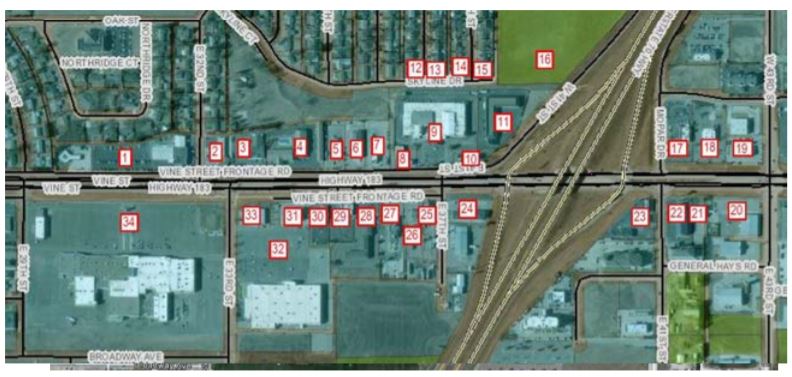
There are approximately 34 land parcels involved in existing rights-of-way and easements for the Vine Street traffic roundabouts at 32nd/33rd, 37th, and 41st Streets.
“It’s kind of everything around the edges of each roundabout that’s not included in the current right-of-way,” Wood explained. “Some of the property will be a few feet; some are a little larger than that. This supplement will determine what those areas are and get the actual legal description.”
Cost of design supplement #1 with WSP is $49,904.65 to be paid with the Convention and Visitors Bureau (CVB) contingency fund.
Also on the work session agenda are discussions requested by city commissioners about parks improvement policy and mayor-appointed boards and committees.
The first draft parks improvement policy provides an outline for determining priorities of park amenities as well as how matching funds from outside entities are considered.
Mayor Schwaller asked for a discussion of the various volunteer boards and committees throughout the city.
There are currently 13 Mayor-appointed boards and committees:
According to historical information collected by staff, there are a few boards and committees that have either outlived their initial purpose or provide very little continual value.
Therefore, city staff has recommended the following five groups be disbanded:
Airport Advisory Committee
Building Trades Board
Fort Hays Municipal Golf Course Advisory Board
Hays Beautification Committee
Sister Cities Advisory Board
A memo to city commissioners explains how the recommendations were made. The committees have regular meetings, yet very little to discuss. Staff spends a significant amount of time in preparing for, scheduling, attending, and managing the meetings.
It’s recommended the five areas be handled with ad hoc groups and meetings, allowing for continued targeted and valuable input to the city.
An ordinance and resolution to authorize general obligation bonds for the Heart of America Second Addition and the King’s Gate First Addition. Improvement district projects for those areas are complete, the assessments have been levied, and the projects are ready for permanent financing. The maximum principal amount will be approximately $360,000.
WASHINGTON (AP) — After nearly two years of waiting, America is getting some Trump-Russia answers straight from Robert Mueller.
Attorney General William Barr during Thursday’s news conference -image courtesy U.S. Dept. of Justice
Eager to get in the last word ahead of the public release of the special counsel’s report, Attorney General William Barr on Thursday laid out in advance what he said was the “bottom line:” No collusion between the Trump campaign and Russian government hackers.
While Mueller drew no conclusion about whether President Donald Trump had obstructed justice in the investigation, Barr said he and Deputy Attorney General Rod Rosenstein personally had concluded that while Trump was “frustrated and angry” about the Mueller probe, nothing the president did rose to the level of an “obstruction-of-justice offense.” Barr said Mueller’s report examined 10 episodes pertaining to Trump and obstruction.
Barr said the president did not exert executive privilege to withhold anything in the report. And he said the president’s personal attorney had requested and gotten a chance to review the report before its public release.
The Justice Department was to release a redacted version of the special counsel’s report later Thursday on Russian election interference and the Trump campaign, opening up months, if not years, of fights over what the document means in a deeply divided country.
TOPEKA – To celebrate the modernization of liquor laws in the state of Kansas, which now allow for beer greater than 3.2 percent Alcohol By Weight to be sold in select locations, the Budweiser Clydesdales will symbolically deliver beer to the Kansas Capitol Thursday.
The delivery is reminiscent of the Budweiser Clydesdale delivery of beer in 1933 to President Roosevelt to celebrate the repeal of Prohibition.
The Clydesdale visit just before 2p.m. will include the presentation of a plaque with a Clydesdale horseshoe to Speaker of the House Ron Ryckman.
Anheuser-Busch has a long-standing relationship with the state of Kansas, working with 15 distributors that employ approximately 500 Kansans. The brewer is happy to celebrate with all of Kansas today as the state embraces modern beer laws that will help the Kansas beer industry and entire state economy grow.
The Hays Fire Department will be inspecting and flow testing fire hydrants on April 19 in the area of Hwy 183 to Elm St. between Hwy 183 Bypass to 6th St., Allen St. to Vine St. between 5th St. and 13th St. and Vine St. to Commerce Pkwy between 13th St. and Hwy 40.This is part of a coordinated effort by the City of Hays to inspect all fire hydrants in the city and flush all water mains annually.
Inspecting fire hydrants ensures that the valves operate properly and that there is no damage or obstructions that will prevent or interfere with the prompt use of fire hydrants in an emergency.Firefighters are also checking the pressure and volume of water mains in each neighborhood for firefighting purposes. The associated flushing of water mains allows chlorine to be distributed throughout the system to eliminate bio-filming in the water mains.
Slight discoloration of the water supply may be encountered although there will be no health risks to the consumer.All reasonable efforts will be taken to minimize the inconvenience to the public.Drivers are asked to avoid driving through water discharging from a fire hydrant during the short flushing period.
For more information, please contact the Hays Fire Department at 628-7330.
The Hays Fire Department will be inspecting and flow testing fire hydrants on April 18 in the area of Vine St. to Ash St. between 27th St. and 19th St., Augusta St. to Hall St. between 27th St. and 15th St. and the Sports Complex. This is part of a coordinated effort by the City of Hays to inspect all fire hydrants in the city and flush all water mains annually.
Inspecting fire hydrants ensures that the valves operate properly and that there is no damage or obstructions that will prevent or interfere with the prompt use of fire hydrants in an emergency.Firefighters are also checking the pressure and volume of water mains in each neighborhood for firefighting purposes. The associated flushing of water mains allows chlorine to be distributed throughout the system to eliminate bio-filming in the water mains.
Slight discoloration of the water supply may be encountered although there will be no health risks to the consumer.All reasonable efforts will be taken to minimize the inconvenience to the public.Drivers are asked to avoid driving through water discharging from a fire hydrant during the short flushing period.
For more information, please contact the Hays Fire Department at 628-7330.
HUTCHINSON, Kan. — The suspect in a kidnapping and rape case entered a plea Tuesday to an amended complaint, which dropped the kidnapping charge and also changed five rape charges to aggravated sexual battery.
Pedraza
Victor Pedraza, 21, also entered a plea to aggravated domestic battery and possession of marijuana.
He requested a departure before sentencing, but that was denied by Reno County District Judge Joe McCarville. He was then sentenced to just under six years in prison.
Pedraza was convicted for the beating and sexual battery of the Japanese student he had been dating. She had been attending Hutchinson Community College.
Pedraza set her passport and documents on fire. Police also said the victim was tied to a bed and beaten, then forced into sex twice. The crimes occurred in June of 2017.
Pedraza entered a plea last year, but then withdrew it. He apparently had a change of heart and entered a plea in the case Tuesday.
Deputy District Attorney Tom Stanton had agreed to the plea earlier so the victim wouldn’t have to testify in the United States. She was allowed to stay home in Japan.
Submitted by
Judith Deedy, Game On for Kansas Schools
Patty Logan, Stand Up Blue Valley
Megan Peters, Education First Shawnee Mission
Nikki McDonald, Olathe Public Education Network
Susan DeVaughn, Educate Andover
House Speaker Ron Ryckman’s recent op-ed was extremely disappointing to Kansas public education parent advocates.
We disagree with Rep. Ryckman’s assertion that the Legislature should have passed his “better” school funding plan. We oppose the way his plan attempts to resolve the inflation issue and believe it would fail constitutional muster. We can’t go into much detail, though, because Rep. Ryckman submitted only an outline of his “better” plan to his fellow legislators over 250 days after the Court issued its opinion and with only two days remaining in the regular session. Rep. Ryckman’s “better” plan had no public hearings, no budget runs, no legal basis, and yet he complains because his last-minute deal wasn’t adopted.
Instead of proposing a last-minute problematic plan, Rep. Ryckman should have provided constructive leadership through the regular session. The Senate understood how narrow the Gannon VI school finance ruling was and how close lawmakers are to reaching constitutional adequacy for the first time in over a decade. They passed a bill to fund inflation in mid-March. House leadership failed to resolve the inflation issue, choosing instead to usurp the role of our state and local boards of education through controversial policy changes and entered the final days of the regular session without having passed a funding bill.
More offensive than the procrastination and lack of focus exhibited by House leadership is the way Rep. Ryckman rewrites history. If the Legislature had returned to the promises made in the Montoy case as the national recession lifted in 2010, there would be no Gannon lawsuit. Instead leadership prioritized continued budget cuts and later the 2012 tax plan that many of us correctly predicted would put Kansas in a huge fiscal hole, leaving it unable to meet its financial obligations. The Block Grant plan Rep. Ryckman championed in 2015 is more typical of past obstinance that ensured school finance litigation would continue as our children progressed from elementary to middle to high school. The bill passed by the Legislature this session is not “the same failed approach,” but is rather a refreshing good-faith effort to end the litigation.
Rep. Ryckman’s concept of how to deal with fiscal uncertainty in the future defies common sense and abdicates his responsibility. His overall theme is that we must “help” our children by avoiding promising them adequately funded schools, because that promise might be challenging to keep in the future. Instead, he urges Kansans to ignore actual estimates on the cost of educating our children, and instead for schools to make do with less, regardless of needs, regardless of state standards. Rep. Ryckman’s stance is particularly ironic given his support for SB 22, a tax cut proposal that would blow a much bigger hole in the budget than the inflation adjustment that just passed.
Funding inflation into the future is not a “poison pill.” Unless the Legislature plans to prohibit school vendors from increasing their prices, the inflation adjustment merely maintains district purchasing power from year to year. Failure to adjust for inflation was the lesson we learned from the Montoy case and results in functional cuts to our schools.
Rep. Ryckman knows we were watching the votes on the inflation funding bill. He voted against it. He says the vote was not about who loves schools and who doesn’t, but about whether “we want to make promises we can keep.” We understand the competing demands on the state budget, but the Legislature has never been able to demonstrate our schools don’t need the funding they agreed to provide last year. The expert hired by the Senate last year only bolstered the claims of education advocates. The real question isn’t how do we avoid making promises we can’t keep, it’s how do we keep the promises we need to make for the sake of Kansas children?
After 40 years as a doctor interacting with patients, in the last two and a half years the tables turned, and I’ve become the patient. Although most are good, I’ve found some doctors are detached, some are too quick, some would rather be somewhere else, some are even angry; but, when a physician who cares walks into the room, and I’m not exaggerating, the day becomes better, the pain becomes less, and hope fills my heart. Scientific knowledge is important, but the ability to convey honest concern, human thoughtfulness and compassion is equal in importance in this healing profession. So, how do we select pre-med students for that, or teach compassion in medical school?
There are studies that show those interested in humanities or taught disciplines that explore how people tick, do better in the compassion department. These disciplines include history, literature, religion, ethics, anthropology, psychology, cultural studies and the arts of theater, film, painting and poetry. Some explain that the humanities give us the very reason to learn science and mathematics.
Several studies support the value of humanities in medicine. Seven hundred medical students were surveyed about their lifetime exposure to the humanities and the results indicated that those who had more humanities knowledge had more empathy, tolerance to ambiguity, resourcefulness, emotional intelligence and less burnout. Another study found that a med student’s ability to recognize diagnostic clues increased by more than 35 percent after taking a visual arts class. Another study found practicing improv theater helped med students learn to prepare for unexpected questions and conversations. A fourth study showed how writing exercises helped med students have foresight into what a patient may be experiencing. Clearly, an exposure to the humanities makes a better doctor.
I believe that care providers who have had a well-rounded humanities education have a better chance of understanding about how it feels to face pain, nausea, loss of bodily functions or even a cancer diagnosis. Those steeped in good literature or art have a better opportunity to tap creative juices to problem solve and tolerate a life that can be ambiguous and unpredictable. Those who are knowledgeable of history, ethics, cultural ways will find it easier to know when it is time to stop aggressive care and move toward comfort.
This is a call for all students to become readers, to find time to enjoy the humanities, to exercise your caring and compassion muscles; so, when you come into the room of a person suffering, it makes their pain less and day better.
For free and easy access to the entire Prairie Doc® library, visit www.prairiedoc.org and follow The Prairie Doc® on Facebook, featuring On Call with the Prairie Doc® a medical Q&A show streaming live most Thursdays at 7 p.m. central.
Master storyteller Roy Wenzl will discuss his book “The Miracle of Father Kapaun” at the Hays Public Library on April 20 at 2 p.m. in the Schmidt Gallery.
Father Emil Kapaun, a Kansas native, was a priest and U.S. Army chaplain who won the Medal of Honor for actions in combat and in a North Korean prisoner of war camp. Kapaun also is being considered by the Vatican for canonization as a saint.
The book, authored by Wenzl and Travis Heying, chronicles Kapaun’s service and alleged miracle healings. Kapaun died in captivity in 1951.
Wenzl is an award-winning Wichita journalist, who is also the primary author of “Bind, Torture, Kill: The Inside Story of BTK, the Serial Killer Next Door.”
You can find out more about this and other library programs at hayslibrary.org or by calling 785-625-9014.
LOGAN — The Dane G. Hansen Museum will present a grilling class, led by instructors Anna Schremmer and Cody Miller from the Phillips-Rooks K-State Research & Extension Office.
The class will be at 6 p.m. Tuesday, April 23 in the Hansen Museum Community Room.
Enjoy samples and discover new recipes during this fun class at the grill.Menu includes several items, including grilled pizza and kabobs.All grilling supplies will be provided.Class size is limited, so sign up today.Registration deadline is April 20.
This creative learning opportunity is offered to the public through the Hansen Museum’s Continuing Education Program with funding from the Hansen Foundation. Registration fee is $25 per participant. For more information, contact Director Shari Buss at 785-689-4846.
The museum is open weekdays 9 a.m.-noon and 1-4 p.m.; Saturdays 9 a.m.-noon and 1-5 p.m.; Sundays and holidays 1-5 p.m.. It is closed Thanksgiving, Christmas and New Year’s Day. The museum is handicap-accessible, and thanks to the generosity of the Dane G. Hansen Foundation, there is never an admission fee.
SHAWNEE, Kan. (AP) — Authorities say a man has died after being electrocuted while working in the garage of a suburban Kansas City home.
Police say the man’s death Wednesday morning at a homein the 6500 block of Hallet Street in Shawnee, Kansas, is under investigation but appears to be an accident.
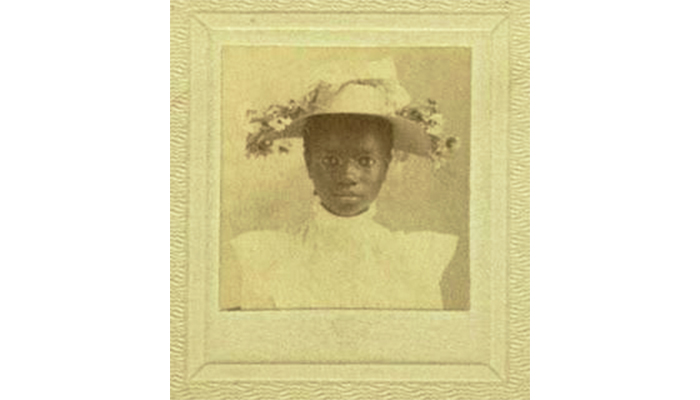
African American girl from Nicodemus. Photo courtesy of the Nicodemus Historical Society.
Angela Bates, executive director of the Nicodemus Historical Society, gave a presentation Saturday in Hays on Nicodemus and the role of African American women through history.
Bates spoke to the Courtney-Spalding Chapter of the Daughters of the American Revolution.
She is a descendant of the first settlers in Nicodemus, who came to Kansas in 1877. Nicodemus is the last and only remaining all-African American settlement west of the Mississippi. At its height, the community had about 600 residents, but the population declined after the railroad decided not to route through the town.
Bates has done extensive research on Nicodemus. In 2012, she published a book with more than 200 historical photos. It is still available in Nicodemus, which Bates was instrumental in getting declared a National Historic Site.
To understand African American culture today, Bates said you have to go back to the slave culture in the South.
“Women did not have choices during slavery,” Bates said.
African American women worked in the fields or in the master’s house. Women who were older or not as physically capable raised the children during the day. They referred to them as aunties or grannies.
This is why women or men that are family friends are often still referred to as aunts or uncles in black culture, even though they may be no blood relation. It is a term of respect, Bates said.
African American girl and resident of Nicodemus. Photo Courtesy of the Nicodemus Historical Society
Some of the slave children would be assigned to the master’s children. They would help take care of the children, empty their chamber pots, fan them, help them dress and maybe even play with them.
By the time the slave children were 12, they were assigned adult jobs.
“You did not have any control of what was going to happen to your kid,” Bates said. “If they wanted take the kid and take her to the house like in the movie ‘Queen’ after she had the child by her master, the master could say ‘I want the child to be raised in the house.’ ”
Bates said part of the psychology of controlling the slaves was divide and conquer. The slave owners fostered division between house and field slaves as well as division among light-colored slaves and darker-colored slaves.
Yet, any amount of African blood in a person in the South, no matter what their appearance, meant they were regarded as black.
“If you were dark and had kinky hair, you were considered less than a mixed blood that would have lighter complexion and more white features and straighter hair,” she said.
“So when Emancipation comes, the mixed bloods that were living in the house and some of them may be living in quarters, they are shunned on both sides of the fence. The full bloods have been taught to shun them because they think they are better, and that still has psychological effects on African Americans today. We have intraracial prejudice against each other along those same lines.”
Also after Emancipation, women begin to have choices not only about their own lives, but the rearing of their children.
Angela Bates, executive director of the Nicodemus Historical Society, gives a presentation Saturday in Hays to the Courtney-Spalding DAR chapter.
“Freedom affords you an opportunity to have a choice,” Bates said. “You can pick who you want to be married to. You can decide what your children’s names are going to be. Many people change their names right after Emancipation.”
In some cases, brothers chose different surnames. Bates gave the example in Nicodemus of the Wellingtons and Weltons. There were three brothers all Wellingtons, but one changed his name to Welton.
“If you were looking at genealogy or even the census, you would not know,” she said.
In another case, a woman was pregnant at the end of the Civil War and decided to give her child the surname Taylor, instead of the name of her plantation owner. There were brothers and sisters in that family as well who had a different surnames.
Freedom in Kansas meant choices, your children weren’t going to be sold away from you and it was an end to a violent life.
“Imagine you have a child and you love that child and you watch that child grow, and then he does something that he wasn’t supposed to do and he gets beat on the public pole,” Bates said. “You don’t have any choice, and they make you stand there and watch your child get beat.”
A new psychology took hold after African Americans were freed. Bates summed up with the phrase “We rear our daughters and we love our sons.”
Bates said African American women are very independent and opinionated.
“We had to be,” she said. “How can you depend on a man who you may have jumped the broom with, but he doesn’t have any control over himself? So how can I rely on him? Coming out of slavery, African American women relied on themselves. So in the culture we raise our daughters to be independent.”
Women also continued to rely on the “sisterhood,” friends and other women in their community, just as the women in slavery relied on the aunties and grannies to raise their children.
In a white society, black mothers felt sons, who might struggle to find jobs and face other prejudices, needed their support, Bates said.
“We are all suffering from post-slavery trauma,” Bates said referring to both white and black cultures.
Bates said the relationships between black and white women can still be strained.
“Back in the ’60s I would be called a Tom, an Uncle Tom,” she said. “That would be someone who embraced relations with white people. I have found just being a human being that people are people, no matter what. There are people who are black that I would not want to be around.”
Angela Bates receive the DAR Women in American History Award Saturday.
At the end of her presentation, Bates was honored with the DAR Women in American History Award for her work to preserve African American history.
Bates also serves as a speaker for the Kansas Humanities Speakers Bureau, who sponsored her talk Saturday. She is a member of the National Parks Conservation Association and the National Trust for Historic Preservation. Bates received the Kansas Sampler Foundation’s “We Can” award (1993), the Brown Foundation’s award for excellence (1994), the Outstanding Contributions award (1996) from the Kansas Humanities Council, the African-American Preservation Hero award (1996) from the National Trust for Historic Preservation, and the Woman of Distinction award (1997) from the Kansas Martin Luther King, Jr. Memorial Committee of Topeka for her work in preserving African American history, and, more recently, the 2012 Kansas Trail Blazer Award. (Bio information courtesy of the University of Kansas).