We have a brand new updated website! Click here to check it out!

‘What Were You Wearing?’ exhibit aims at sexual assault myth

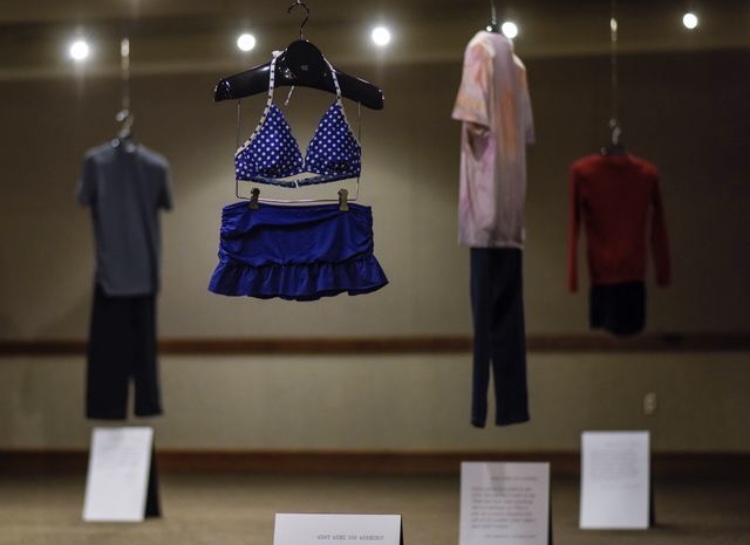
“What Were You Wearing?” exhibit (Photos provided by Jana’s Campaign)

Every April, victim advocacy and prevention organizations across Kansas, and the nation, recognize April as Sexual Assault Awareness Month and an opportunity to bring awareness to the ongoing issue of sexual violence in our communities.

This year, Options Domestic & Sexual Violence Services, Jana’s Campaign, and the FHSU Women’s Leadership Project are collaborating to bring “What Were You Wearing?”, a sexual assault survivor art exhibit, to the FHSU campus and the community at large for the second time in as many years. The exhibit features re-creations of outfits that survivors of sexual assault were wearing at the time of their assault, based on personal testimony from the survivors themselves.

The survivor art exhibit was born out of an advocacy lens. The question, “What were you wearing?” is pervasive for most survivors. The project’s intent is to place the work of bearing witness to this question’s answer back onto the shoulders of the community. The exhibit asks viewers to understand that sexual assault is NEVER about the clothing the survivor wore – and the act of shedding those clothes is never enough to bring peace or comfort to survivors. The violence is not simply woven into the fabric of the material; it is a part of the survivor’s new narrative.

The exhibit requires all of us to evaluate what caused us, as individuals and as a society, to ask victims of sexual assault, “What were you wearing?” in the first place. To ask the question, “What were you wearing?” costs the questioner nothing; however, the survivor pays dearly in not only their answer; but also in the burden of self-blame.

“Everyone in our community needs to see this exhibit and understand the survivor is never at fault. The exhibit is also personal; attendees can see victims as their friends, family, neighbors, even themselves, and realize sexual assault can happen to anyone.” Kim Cebula, executive director of Jana’s Campaign.

“Research shows that one in five women will experience sexual violence in their lifetime; and in eight out of ten cases, the rapist already knew their victim. As you read the stories in this powerful exhibit, you’ll see that statistic rings true,” said Jennifer Hecker, executive director of Options Domestic and Sexual Violence Services. “Demand for sexual assault services at Options has increased 655% in the last three years alone. This isn’t a problem in other communities – it’s a problem right in our own backyard.”

The “What Were Your Wearing?” exhibit will be open April 15-18 from 10 a.m. to 4 p.m. in the south end of Forsyth Library on the Fort Hays State University campus. The exhibit will also be featured in the Spring Art Walk in Hays on April 26th from 6 p.m. – 9 p.m. at Styles Dance Centre at 1501 Main St.

If you or someone you know needs help because of domestic violence, sexual assault, stalking, or human trafficking, call Options’ free Helpline at 800-794-4624 for help 24 hours a day, 7 days a week.

Options Domestic & Sexual Violence Services, Inc. is a non-profit agency dedicated to providing direct assistance to victims and survivors of domestic violence, sexual assault, human trafficking and stalking through individual support. Options provides services to 18 counties in northwest Kansas; services are always voluntary and provided free of charge, with complete confidentiality.

Jana’s Campaign is a national education and violence prevention organization with the single mission of reducing gender and relationship violence. In honor of the late Jana Mackey and other victims and survivors of gender and relationship violence, Jana’s Campaign delivers educational programs that prevent domestic and dating violence, sexual violence, and stalking.

– SUBMITTED –
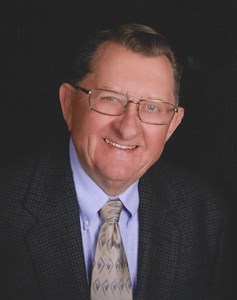
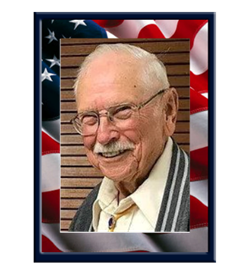
Lyle Eugene ‘Gene’ Cunningham

Lyle Eugene “Gene” Cunningham, 81, passed away April 5, 2019 in Olathe, KS.

He was born April 23, 1937 in Parsons, KS to Verdna Lavina( Bowman) and Lyle Frank Cunningham.
On July 5, 1958 he was married to Elizabeth “Betty” O’Hara at St. Patrick’s Catholic Church in Parsons, KS.

Gene and Betty moved to Chanute, KS in 1965 and he was employed as a Marketing Group Representative for over 27 years with Blue Cross Blue Shield of Kansas, until his retirement in 1992. During his time with Blue Cross Blue Shield, he was the recipient of several awards and special recognitions.

Following his retirement, Gene enjoyed helping at Cleaver Farm and Home Rental Store, golfing, helping a friend with his farming needs, and participating in his grandchildren’s activities. Gene and Betty were also able to travel to all 50 states, and enjoyed traveling in their RV for more than 16 years.

Gene was a proud 3rd and 4th Degree members of the Knights of Columbus, a lifetime member of the Elks Club and a member of Prince of Peace Catholic Church.

Surviving family include his wife, Elizabeth “Betty”, of the home, daughter Brenda (Marlyn) Swayne of Hays, KS, son Steve (Lisa) Cunningham of Olathe, KS., and six grandchildren: Michelle (Spencer)Swayne-Goff of Victoria, KS, Shannon Swayne of Glenwood Springs, CO, Samuel (Haley) Cunningham of Olathe, KS, Grace Albers of Norfolk, VA, Andrews Cunningham of Olathe, KS, Erin Albers of Muncie, IN, and two great-grandchildren, Mason and Aeris Goff of Victoria, KS.

Gene is also survived by his brother Richard (Beth) Cunningham of Salina, KS.
He was preceded in death by his parents, his daughter Debra Kathleen Cunningham-Albers, and his brother, Larry Cunningham.

Visitation will be held Wed., April 10 from 6-8pm at Penwell-Gabel Funeral Home, Olathe, KS, followed by funeral mass on Thurs., April 11 at 11:00am at Prince of Peace Catholic Church, Olathe, KS. Committal services will be held on Thurs., April 11 at 4pm at Mount Olivet Catholic Cemetery, Parsons, KS.

In lieu of flowers, memorials are suggested to the Prince of Peace Catholic Church Altar Fund.

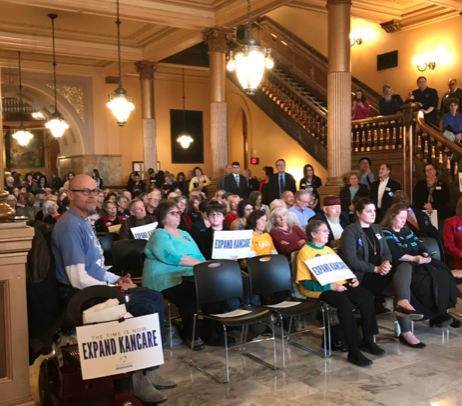
Medicaid expansion fight delaying work on next Kansas budget

By JOHN HANNA

TOPEKA, Kan. (AP) — A legislative fight over expanding Medicaid in Kansas is delaying approval of the state’s next annual budget as expansion supporters try to keep Republican opponents from blocking it for another year.

Some top GOP lawmakers are conceding that an expansion plan could pass because expansion is a priority for Democratic Gov. Laura Kelly and has bipartisan support in the Republican-controlled Legislature. However, opponents hope for time this summer and fall to develop a smaller program than Kelly wants with restrictions she opposes, such as a work requirement for participants.


Expansion became a sticking point in budget negotiations between the House and Senate, causing lawmakers to put off votes until May on any part of the state’s spending blueprint for the fiscal year beginning in July. Potential expansion costs are hotly debated, but the disagreement in budget talks is over how much to tie Kelly’s hands as she pursues expansion this year.

“We have a Democrat governor,” Senate Majority Leader Jim Denning, a conservative Kansas City-area Republican. “There will be a time when we won’t be able to maneuver around it.”

Supporters argue that Medicaid expansion will benefit working-class families, help struggling rural hospitals and boost the economy with an influx of federal funds. Opponents predict expansion will prove far more expensive than advertised, even with the 2010 federal Affordable Care Act’s promise that the federal government would cover 90 percent of the cost.

Thirty-six states, including GOP-led ones, have expanded Medicaid or have seen voters approve ballot initiatives.

In Kansas, Republicans who oppose expansion still hold key positions in both chambers and prevented even a committee vote for weeks. However, supporters forced a debate in the House last month, and it passed a modified version of Kelly’s expansion plan over GOP leaders’ objections.

The Senate didn’t take up the measure before lawmakers began their annual spring break Saturday. However, Senate Minority Leader Anthony Hensley, a Topeka Democrat, notified colleagues that he will try to pull it out of committee May 1, when legislators reconvene to wrap up business for the year.

In arguing for further delay, GOP leaders note that Republican-led Utah is pursuing a scaled-back version of an expansion approved by voters last year to control the potential costs.

Kelly’s administration projects that her plan to extend Medicaid health coverage to as many as 150,000 more Kansas residents would come with a net cost of the state of $34 million in the program’s first full year. Top Republicans are skeptical and believe the net cost easily could be twice as much.

They also want Kansas to consider work requirements, though a federal judge blocked them in Arkansas and Kentucky. Republicans also have suggested drug testing for people receiving the expanded Medicaid coverage. Kelly opposes both ideas, but it’s not clear what she would do if either was included in expansion legislation.

GOP leaders announced plans last week to have a committee study possible alternatives to Kelly’s plan this summer and fall.

“We’re going to do it on our own schedule,” Denning said.

To help build pressure for Medicaid expansion, Kelly is having a town hall meeting Tuesday in Wichita, and Lt. Gov. Lynn Rogers is touring western Kansas hospitals.

“We’ve studied this for multiple years,” Rogers said Monday. “When they (Republican leaders) say we need more discussion, it’s on them. It’s not on the Kansas people.”

Legislators initially planned to pass a bill containing most of the next state budget before the spring break, to make finishing their work in May easier.

However, the budget talks stalled last week. Medicaid expansion was among a few remaining issues in reconciling differences between the House and Senate versions of the spending blueprint.

Neither chamber included funds to cover expansion costs, but Denning persuaded senators to add an amendment to their version to prevent the state from spending any dollars on expansion paperwork.

A 2014 law already requires prior legislative approval for expansion, but Denning said he wants to ensure that putting funding in the budget isn’t interpreted as a go-ahead for a specific plan.

House negotiators balked, with even expansion foes seeing the provision as overkill. The dispute — and resulting budget impasse — gives expansion supporters extra unexpected political leverage.

“That amendment could have caused us problems for passing expansion,” said state Rep. Kathy Wolfe Moore, a budget negotiator and Kansas City Democrat who supports expansion. “As long as that was in there, anyone who voted for expansion would not vote for the budget.”

Mary Emma Fischli Fix

Mary Emma Fischli Fix was born June 21, 1919 in Valentine, Nebraska. The second daughter of Richard Julius Fischli and Mary Elizabeth Kinter Fischli, she passed away from this life on April 6, 2019 at the age of 99 at the Solomon Valley Manor in Stockton, Kansas.

Mary was born on her Father’s homestead two miles East and three miles north of Valentine, Nebraska. In March 1922, when she was two and a half years old, Mary’s parents returned to the area where they had grown up, to a farm Northwest of Speed, Kansas. Mary’s parents built the farmstead structures starting with the barn, in which they lived while the house and other farm structures were being built. Mary started school when she was 5. She attended a one room schoolhouse called Wolf Creek in Belmont Township located Southwest of the farmstead. After grade school, she attended and graduated from Speed High School.
Mary was united in marriage to Floyd Dean Fix on June 21, 1938 in the probate judge’s office in Phillipsburg, Kansas.

On May 10, 1939, the following year, the couple welcomed a son, William Leroy. Needing to support a family, Floyd learned telegraphy, became a telegraph operator and went to work for the Missouri Pacific Railroad, taking the young family to live in Mt. Clair, Nebraska. Floyd continued “to bid” on stations in order to move to better locations which took the family to Speed, Edmund and Woodston, Kansas. Mary was a homemaker until the railroad drafted her to run the depot so they could send Floyd to other locations as needed during World War 2.

On July 5, 1948, the family welcomed a daughter, Mary Ann, into the world and in 1950 made their last move to Stockton, Kansas. Mary continued to work with Floyd for the railroad until 1955 when Mary took a job as a clerk in the Rooks County Clerk’s Office and later became deputy clerk before being elected to County Clerk; she worked for 26 years before retiring in 1981.

She enjoyed reading, needlework, crocheting and knitting until macular degeneration took her eyesight and even then, remained independent in her own home until 2016, when she went to the Solomon Valley Manor, where she continued to voraciously “read” her audiobooks. She was a member of the Stockton United Methodist Church and served as a Worthy Matron of the Eastern Star.

She was preceded in death by her loving and faithful husband Floyd, her treasured daughter Mary Ann McLaughlin, her beloved father, mother, and her two sisters Beatrice Kloepper and Lucille Loyd.

Left to cherish her memory is her brother Richard Fischli of Logan, KS; son William Fix and wife Louise of Orange, CA; son-in-law, Donald McLaughlin and wife Linda of Stockton, KS; grandchildren, Vickie and Walter Turkowski of San Antonia, TX, Mary and Steven Cardinal of La Quinta, CA, Diana and Gail Strutt of Stockton, KS, Laurie and Brian Fritz of Topeka, KS, and Dawn and Jerry Gerstenkorn of Arlington, TX, and twelve great-grandchildren.

She leaves many other relatives and friends who will miss her sharp wit, intelligent conversation, generous spirit, peaceful wisdom, fierce devotion, and unending love.

Funeral Services are planned for 10:30 a.m. Saturday, April 13, 2019 at the United Methodist Church in Stockton with burial following in Stockton City Cemetery. Visitation will be on Friday from 2:00 p.m. until 8:00 p.m. at the funeral home with family greeting friends from 6:00 p.m. until 8:00 p.m. Memorials are suggested to United Methodist Church in Stockton or Solomon Valley Manor and may be sent in care of Plumer-Overlease Funeral Home, 723 N. 1st, Stockton, Kansas 67669.

Roy E. Wangerin

Roy E. Wangerin, 97, passed away Saturday, April 6, 2019 at Smith County Memorial Hospital, Smith Center, KS.

A celebration of Roy’s life will be held at 10:30 a.m., Saturday, April 20, 2019 at First Saint John Lutheran Church, Kensington, KS, with Pastor Dave Hutson officiating. There will not be a public visitation as cremation was chosen. Inurnment will take take place in Germantown Cemetery, Kensington, KS. Memorials may be given to Roy E. Wangerin Memorial Fund and can be sent in care of All Faiths Funeral Chapel, 113 S. Madison St., Smith Center, KS 66967.

Aull obituary is pending with All Faiths Funeral Chapel.

1 person dies in head-on crash with cattle truck in Kansas

POTWIN, Kan. (AP) — Authorities say one person and around a dozen head of cattle have died in a head-on wreck in rural Kansas.

Emergency crews on the scene of Tuesday’s fatal crash –photo courtesy KWCH

KWCH-TV reports that the crash happened late Monday on Kansas 196 near the Butler County town of Potwin, which is about 25 miles northeast of Wichita. The Butler County Sheriff’s Office says it’s unclear whether a tractor-trailer or passenger vehicle crossed the center line before the collision.

The driver of the passenger vehicle was killed; the cattle truck’s driver wasn’t hurt. More than 30 cattle survived the wreck. They were either stuck inside the rig or wandering around a nearby wooded area. Deputies warned drivers in the area to be on the lookout.

HAWVER: Medicaid expansion could be Kelly’s trifecta

Martin Hawver
Remember back in November, when there were five choices for governor, and a blank line where you could write in your neighbor or your dog or probably any other mammal for the state’s top job?

And remember that it came down essentially to one decision for Kansas voters: very conservative Republican Secretary of State Kris Kobach or Democrat Sen. Laura Kelly?

Well, Kelly won, of course, by more than 50,000 votes, or 48% to 43% over Kobach.

The race essentially came down to Kobach, or the best-known candidate who wasn’t Kobach. Not being Kobach was a campaign asset — he was a lightning rod for folks who didn’t care for his voter rights/immigration policies and for those who feared he would reignite the Gov. Sam Brownback fiscal era.

But just being “not Kobach” didn’t really tell us anything about whether the “not Kobach” would be a competent and persuasive governor.

With the first adjournment of the Legislature last Friday, it looks like Kelly has been persuasive. She got the GOP-pushed tax-cut bill knocked down; her veto won’t be overridden. That’s victory No. 1.

And she got her school finance plan, worth about $90 million more a year for schools for the next four years, passed. That might, just might, be enough to convince the Kansas Supreme Court that the state is “adequately” funding public schools for our kids and grandkids. Not sure, depending on the court, but it could well be victory No. 2.

Victory No. 3? That would be expansion of Medicaid health care to more than 100,000 generally poor Kansans, their children, the disabled and others who can’t afford health care. No. 3 will be the target of the governor’s intense lobbying of legislators and their constituents during the next three weeks. Kelly and Lt. Gov. Lynn Rogers will be crisscrossing the state during the Legislature’s spring break, with public events where they can try to get Kansans to tell their senators that they want Medicaid to be expanded.

The Senate has so far refused to hear the bill in committee, to consider voting it to the floor of the Senate where there are probably enough votes to pass it. It’s a different deal than two years ago. When the Legislature strongly passed Medicaid expansion, Gov. Brownback vetoed it, and either because of allegiance to the outgoing governor or maybe just because most Republicans were still referring to it as “Obamacare,” legislators couldn’t or didn’t override the veto.

That puts this year’s House-passed Medicaid bill, which the Senate’s anti-expansion leadership has specifically opposed, the target of Kelly and the health-care industry and Kansans without health coverage and lots of others in the next three weeks.

It’s the biggest test of the political power and the political strategy of the “not-Kobach” governor who got elected last November.

If successful, the effort by Kelly and others to get Medicaid expanded could reshape the Republican Party in Kansas.

It could mean that the hard-right conservativism, which got Kobach through the GOP primary election by about 400 votes over slightly more moderate then-Gov. Jeff Colyer, has seen its day. Could mean that the leaders of the Kansas House and Senate, who essentially set the rules for lawmakers and have their thumbs on the scale on nearly every vote taken, are losing horsepower.

Debate over important issues such as taxes, school finance and Medicaid expansion is a good thing. That’s how you find the upside and the downsides of major issues.

The outcome could tell us just how persuasive the new governor is…and might mean Republicans have to figure out how to deal with her…

Syndicated by Hawver News Company LLC of Topeka; Martin Hawver is publisher of Hawver’s Capitol Report—to learn more about this nonpartisan statewide political news service, visit the website at www.hawvernews.com

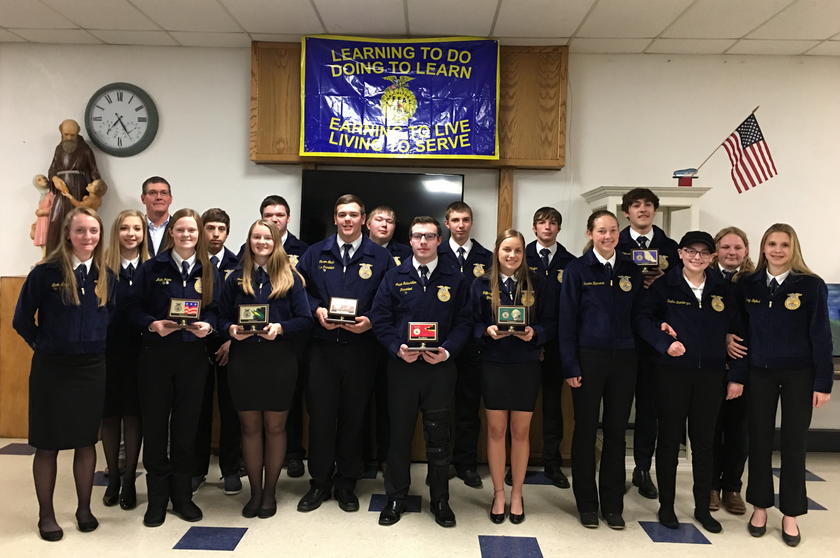
First awards banquet for FFA Chapter at Thomas More-Prep

TMP-M

On March 31, the TMP-Marian Future Farmers of America Chapter hosted its first annual Banquet and Awards Night.  Seventeen students received either their Greenhand or Chapter FFA Degrees.

FFA members enrolled in their first year of a high school credit in agricultural science, that have satisfactory plans for a Supervised Agricultural Experience (SAE) Program and that have demonstrated their understanding of the history and purpose of the FFA may apply for their Greenhand Degree.  The Chapter Degree is the highest degree a chapter can bestow on its members.

It is usually awarded during the second or third year of membership.  Requirements include having the Greenhand FFA Degree, two semesters of agricultural course work, SAE Program, SAE earnings and investments of at least $150 or 45 hours outside of class time, leadership of a 15-minute group discussion, demonstration of five procedures of parliamentary law, progress towards individual achievement in the FFA Award Program and satisfactory scholastic record.  While students are active members of the FFA there are a total of 5 degrees that they can obtain.  Degrees include: Discovery Degree, Greenhand Degree, Chapter Degree, State Degree and American Degree. The State Degree and American Degree are only awarded by state associates and an elite group of members at the national level.

A highlight of the evening was when Sophia Linenberger, FFA Member, currently fighting cancer, came to share in the festivities.

“We had such a great night sharing a meal and time with her,” said Jay Harris, FFA adviser.

Principal Chad Meitner said, “The ceremony was very nice.  I want to say thanks to Jay for all his work with the FFA! It gives our kids some great experiences.”

In addition, at the FFA Meal funds were collected to send to the Nebraska Red Cross for victims of the flooding in Nebraska.  A total of $310 was collected.

“I took the donation to the Eagle Communications office where I was told that the Schmidt Foundation is matching all donations brought to them.  This means the money we collected will be doubled to $620,” said Harris.

Exploring Outdoors Kansas: Skunk 101

Steve Gilliland
A term often used around Christmas and Thanksgiving is “Seasonal Smells,” meaning scents like pumpkin pie, roasting turkey and the scent of pine; pleasant fragrances that we associate with that time of the year. We are entering a time of the year that also has a specific essence associated with it that is not quite so pleasant.

Anyone who has set foot outside lately and has a nose on their face has noticed the air of late smells slightly more “skunky” than usual. Also at this particular time of the year, dead skunks seem to litter the roadside. Welcome to skunk breeding season in Kansas! For our pungent friends the skunks, breeding season begins at the first sign of spring warm up, usually late February and early March, and I believe is a tad later this year because of a slightly later spring warm-up. Skunks are among the most den-dependent furbearers, meaning that more than many other furbearers, their lives rely on them having a permanent den from which to come and go daily.

Skunks do not hibernate, but become very inactive during the heart of winter, when a den becomes very important. Communal denning is common during this time, and a dominant male will often share a den with a dozen or more females during this time of inactivity. Their breeding season is fast and furious, but very short, so keeping oneself close to as many females as possible pays big dividends for male skunks when skunk love is in the air.

All right, so this is skunk breeding season, but I’ve always wondered why that means we have to smell them so much more than usual. After all, they certainly don’t spray their girlfriends do they? Maybe it’s some kind of ritual mating dance that ends each time with a poof into the air? The answer is simple, and as a trapper I should have figured it out. At this time of the year male skunks might roam as far as five miles in one night looking for eligible ladies, and since all male skunks are currently of the same mind, the chances are pretty good males will encounter each other on their quests. And then, just like a bunch of jocks fighting over the cheerleaders after the junior high dance, someone’s gonna’ get sprayed! Figure this happening several times a night for a few weeks with all the male skunks in Kansas and you have the answer.

With that solved, what about the reason for finding so many dead skunks along the road right now? I’m glad you asked, because I’ve found some interesting takes on that question too. First and the most obvious part of the answer is simply the fact that all male skunks in the kingdom are draggin’ main street right now lookin’ for girls, so the law of averages says that because of that, many will get flattened. There’s possibly more to the answer though, and that calls for a little skunk psychology lesson.

Skunks have few natural enemies and can turn even the biggest bully around on a dime with just the lift of their tail. This seems to create in them a certain cocky attitude that appears to be present even from birth. Skunks will not back down from anything; it’s as simple as that. Couple that with the fact that male skunks have a one-track-mind this time of year, and if they even notice a car coming at them, they possible see it as just another bully that will turn and run with the lift of their tail. That all equals a flat skunk! Another interesting suggestion says that skunks have black eyes that do not reflect light well like the eyes of most other animals, possibly making them hard to spot ahead of time.

By the way, if you, your dog or your car ever happen to get sprayed directly by a skunk, here is a recipe for a deodorizer that really works, and yes, I know this from experience, and that’s another story in itself: mix together 1 quart 3% hydrogen peroxide, ¼ cup baking soda and 1 teaspoon liquid dish soap (Dawn works well.) Mix this up just before use and don’t save any leftover. Bath yourself or the dog and scrub the car with this concoction.

Skunks are amazing critters that have amazingly soft, luxurious fur (once you get past the smell) and whose potent, pungent essence is invaluable to the fur-trapping industry as an additive to trapping lures. Trappers who extract the pure skunk “quill” from the animals can expect to get one to two ounces per skunk, and at about $20 an ounce that’s pretty good gas money. Skunk essence enhances and magnifies other fragrances and is actually used in very minute amounts in perfume. Some years back there were rumors that someone was developing an aerosol spray from skunk essence called “Skunk Power” that could be used by women against an attacker. I couldn’t verify its existence but what a good idea! Native Americans are said to have used skunk oil as a healing balm and liniment; I knew our Native American ancestors were tough, but that fact gives me a whole new respect for them.

So there you have it, a little Pepe Le Pew 101 so-to-speak. When I smell a feed yard here in Kansas I just think of it as the smell of money. Even though I know they’re yet another example of God’s marvelous and diverse Creation, it’s pretty hard to think that way when the spring air is ripe with the smell of skunk. Continue to Explore Kansas Outdoors!

Steve Gilliland, Inman, can be contacted by email at [email protected]

First Five: In the religious liberty world, dialogue is not fluffy — it is essential

Kristen Farrington is executive director of the Religious Freedom Center of the Freedom Forum Institute.

By KRISTEN FARRINGTON
Freedom Forum Institute

Religious freedom in today’s world is synonymous with controversy. Debates rage around the country on issues that touch our deepest beliefs: abortion, adoption, vaccinations, war memorials, equity and identity.

Families and communities are torn apart waiting for courts to sort out the fine and complicated lines between basic human rights and religious liberty. After waiting months if not years for court decisions, communities discover that legal rulings don’t have the power to heal fractured communities.

This part of our American story is as old and real as when the first settlers arrived on our shores, but the intensity today feels somehow different. Surely by 2019 we Americans have learned to live together despite our deepest differences!

The stark reality is that, no, we haven’t. According to several watchdog organizations and the FBI, religious intolerance and religion-based hate crimes are on the rise; bullying in schools continues to threaten the well-being of our children.

Religious leaders and educators share similar stories — we just aren’t equipped to deal with the controversy and division we are experiencing in our classrooms and communities. There is an urgency to do something, coupled with a sense of exhaustion that all we have been doing is simply not working.

Complex issues call for complex solutions. Civil dialogue is not the solution, but it needs to be an integral part.

Over the last 10 years, organizations have emerged to provide resources, training and opportunities for dialogue: Living Room Conversations, Difficult Dialogues National Resource Center, National Institute for Civil Discourse, Generation Global and the Religious Freedom Center are just a few committed to restoring civility and creating intentional spaces for difficult conversations while promoting pluralism and understanding across differences.

It is easy to dismiss the value of this work. Someone once described such efforts to me as fluffy. Make no mistake — there is nothing fluffy about dialogue or understanding our differences. Such work takes commitment, constant practice and the courage to stay engaged when things get heated.

Any person can engage in informal dialogue by learning the basic skills and finding opportunities to practice them at home, at work, with friends, neighbors and family. Formal dialogue is usually a series of dialogue sessions led by a trained teacher.

I’ve met a lot of people who don’t really understand the purpose of dialogue. At the most basic level, it means to seek understanding through words. The purpose of engagement is to learn as much as you can about each other — to share stories, beliefs and perspectives about an issue. It is a space where you can explore an issue from many different sides, so you come to understand the meaning and significance of that issue to each person in the discussion. Dialogue is a place for curiosity — a place where you can ask questions about and explore a perspective with which you completely disagree. It is a space where you can disagree and yet stay engaged.

Dialogue is not debate, deliberation, mediation, conflict resolution or problem solving. Its value often is overlooked in favor of rushing to solve a problem or dismissed because people don’t wish to engage with different beliefs, values or perspectives.

As a dialogue practitioner, I’ve had opportunity to train thousands of educators, religious and civic leaders. As the religious liberty debates rage around us, as we watch our schools, communities and places of worship become places of controversy and division, as we find ourselves caught in situations that challenge our deepest beliefs, I can attest that dialogue works. I’ve seen it transform classrooms and community groups.

I’ve seen educators, community and religious leaders become more confident in helping their students, congregations and communities navigate difficult issues. I’ve heard young people find their voices and become more confident talking about what is meaningful and significant in their lives. I’ve seen prejudice challenged, pain shared and unlikely friendships forged.

We should give it a try.

Kristen Farrington is executive director of the Religious Freedom Center of the Freedom Forum Institute.

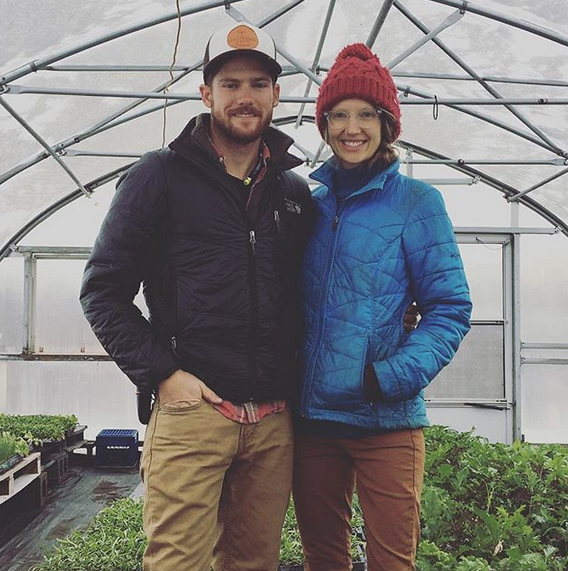
Now That’s Rural: Adam & Maggie Pounds, Simple Abundance Farm

Ron Wilson is director of the Huck Boyd National Institute for Rural Development at Kansas State University.

By RON WILSON
Huck Boyd National Institute for Rural Development

“How big is your farm?” “It’s about 4-by-8.” “Oh, 4-by-8 acres? “No, 4-by-8 feet.” That imaginary conversation sounds like an unlikely discussion between Kansas farmers, but it illustrates how one young couple got their start in urban farming. They started raising microgreens on a 4-by-8 sheet of plywood. Now this innovative young couple is expanding their operation to provide local food while serving their community.

Adam and Maggie Pounds are the founders of Simple Abundance Farm in South Hutchinson, Kansas. Adam grew up at Hutchinson and went to Wichita State. Maggie went to high school at the nearby rural community of Buhler, population 1,289 people. Now, that’s rural. She went on to Bethel College.

Adam and Maggie met through friends and ultimately married. “We caught the travel bug,” Adam said. They worked a summer at Estes Park and then in Key West, Florida doing eco-tourism. Adam and Maggie are also talented musicians, playing guitar and multiple folk instruments. “Maggie sings like an angel,” Adam said.

The young couple traveled and played music. While visiting friends in the Pacific Northwest, they decided to focus on the principles which were important to them: Community, intentional living, healthy food, and an active lifestyle. They apprenticed at an organic farm in Washington state.

“As you’re traveling, you see life through a different lens,” Maggie said. Their passion for a healthy, local food system grew. They moved back to Kansas to put this into practice.

Adam and Maggie Pounds

In winter 2014, they started growing microgreens in South Hutchinson. “Our whole farm consisted of a 4×8 sheet of plywood,” Adam said. Seeds were planted in compost on trays. Plants were harvested very young. “Microgreens are tender, nutty, and tasty,” Adam said. They now have a high tunnel for additional vegetable production.
They produce sunflowers, peas, radishes, arugula, spinach, salad greens, kale, and more. “We use natural and sustainable methods to produce high yields on a minimal amount of land while protecting the environment,” Adam said.

Back when they were still interns but wanting to start a farm of their own, Maggie and Adam were on a farm tour in the northwest. While in one grower’s home, they saw a cross-stitch design on the wall that said “Simply Abundant.” The term clicked for both of them. When they got back to Kansas, they named their place Simple Abundance Farm.

The “farm” is a specialty crop operation on less than an acre in the city of South Hutchinson. “We are urban, so we’re very convenient for our consumers,” Adam said. “The city has been really great to work with us.”

“They’ve been an amazing addition to our Reno County Farmers Market,” said Pam Paulsen, K-State Research and Extension – Reno County horticulture agent. “We are huge advocates of farmers markets,” Adam said. They have also opened what they call the Farm Stand, which is a self-service market for their farm crops and other local products year-round. “Our customers get a key code so they can pick up products at their convenience,” Adam said.

They are now building a commercial kitchen which will enable them to produce shelf-stable products such as sauerkraut and kimchi. They’re also joining the Kansas Department of Agriculture’s “From the Land of Kansas” program.

Meanwhile, they’re caring for their two-year old son Arlo. “We call him quality control, he’s out there in the dirt,” Adam said.

Maggie is president of the newly-formed Central Kansas Young Farmers Coalition. She also recently lobbied for the farm bill with the National Young Farmers Coalition in Washington, D.C.

“We need to support one another, whether a farmer or consumer, to forge a path for local food production,” Maggie said.

For more information, click HERE.

How big is your farm? This innovative young couple got a start on a 4-by-8 sheet of plywood. Now they are producing a wide variety of fresh and flavorful produce. We salute Maggie and Adam Pounds – and Arlo too – for making a difference with their approach to urban agriculture. Their farm ground may be small, but their vision is tremendous.

Copyright Eagle Radio | FCC Public Files | EEO Public File