We have a brand new updated website! Click here to check it out!

MaryAnn Funk

MaryAnn Funk, age 87, a loving wife for 39 years, a devoted mother of four, a grandmother of eight, and a great-grandmother of fourteen, passed away peacefully, surrounded by her family on Sunday, March 17, 2019, at The Addison of Pleasant Prairie.

Born in Hays, Kansas on October 1, 1931, she was the oldest child of Rose and Clement Urban. MaryAnn was educated in Hutchinson, Kansas and moved to Colorado, where in 1951, she married Louis H. Funk. One of their first dates, to her mother’s utter delight, was a Sunday Mass.

They moved to the family farm in Paris, WI and had four children: Janice, Joseph, Jill, and Jackie.

MaryAnn worked at a hospital and on the farm; baked delectable apple pies; traveled to Palm Springs, Hawaii and Florida; and played pinochle and golf with a passion. When she was 62, she hit a hole-in-one.

When she lost her favorite travel partner, Louie, in 1990, she kept taking trips with friends and family, touring China, Germany, Florida and Alaska. She also loved to watch her beloved White Sox play baseball.

She is survived by her three oldest children, Janice (Bruce) Bosman of Kenosha, Joseph (Dianne) Funk of Union Grove and Jill Oscarson of Pleasant Prairie; all of her grandchildren and great-grandchildren; two brothers, Jim and Jerry Urban; and a brother-in-law, Jerry Turner.

In addition to her parents, she was preceded in death by her husband; their youngest daughter, Jackie; nine sisters and brother; and her son-in-law, Richard Oscarson.

Click HERE for service details.

Floodwaters threaten millions in crop and livestock losses

DES MOINES, Iowa (AP) — Farmer Jeff Jorgenson looks out over 750 acres of cropland submerged beneath the swollen Missouri River, and he knows he probably won’t plant this year.

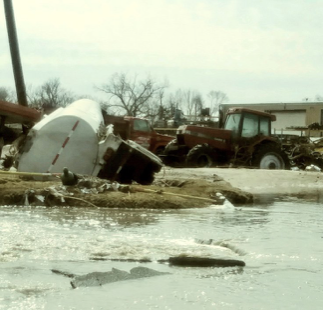
But that’s not his biggest worry. He and other farmers have worked until midnight for days to move grain, equipment and fuel barrels away from the floodwaters fed by heavy rain and snowmelt. The rising water that has damaged hundreds of homes and been blamed for three deaths has also taken a heavy toll on agriculture, inundating thousands of acres, threatening stockpiled grain and killing livestock.

In Fremont County alone, Jorgenson estimates that more than a million bushels of corn and nearly half a million bushels of soybeans have been lost after water overwhelmed grain bins before they could be emptied of last year’s crop. His calculation using local grain prices puts the financial loss at more than $7 million in grain alone. That’s for about 28 farmers in his immediate area, he said.

“The economy in agriculture is not very good right now. It will end some of these folks farming, family legacies, family farms,” he said. “There will be farmers that will be dealing with so much of a negative they won’t be able to tolerate it.”

Jorgenson, 43, who has farmed since 1998, reached out to friends Saturday, and they helped him move his grain out of bins to an elevator. Had they not acted, he would have lost $135,000.

Vice President Mike Pence surveyed flooded areas in Nebraska Tuesday, where he viewed the raging Elkhorn river, talked to first responders and visited a shelter for displaced people. He promised expedited action on presidential disaster declarations for Iowa and Nebraska.

“We’re going to make sure that federal resources are there for you,” Pence told volunteers at Waterloo, a town of less than 1,000 residents about 21 miles west of Omaha that was virtually cut off by the floodwaters.

The flooding is expected to continue throughout the week in several states as high water flows down the Missouri River. Swollen rivers have already breached more than a dozen levees in Nebraska, Iowa and Missouri, according to the Army Corps of Engineers.

The water rose so quickly that farmers in many areas had no time to get animals out, said Chad Hart, an agricultural economist at Iowa State University.

“Places that haven’t seen animal loss have seen a lot of animal stress. That means they’re not gaining weight and won’t be marketed in as timely a manner, which results in additional cost,” he said.

In all, Nebraska Farm Bureau President Steve Nelson estimated $400 million of crop losses from fields left unplanted or planted late and up to $500 million in livestock losses.

In a news release issued Tuesday, Gov. Pete Ricketts said there have been deadlier disasters in Nebraska but never one as widespread. He said 65 of the state’s 93 counties are under emergency declarations.

In neighboring Missouri, water was just shy of getting into Ryonee McCann’s home along a recreational lake in Holt County, where about 40,000 acres and hundreds of homes have been flooded. She said her home sits on an 8-foot foundation.

“We have no control over it,” the 38-year-old said. “We just have to wait for the water to recede. It’s upsetting because everything you have worked for is there.”

The Missouri River was forecast to crest Thursday morning at 11.6 feet above flood stage in St. Joseph, Missouri, the third highest crest on record. More than 100 roads are closed in the state, including a growing section of Interstate 29.

Leaders of the small northwestern Missouri town of Craig ordered an evacuation. The Holt County Sheriff’s Department said residents who choose to stay must go to City Hall to provide their name and address in case they need to be rescued.

In nearby Atchison County, Missouri, floodwaters knocked out a larger section of an already busted levee overnight, making the village of Watson unreachable, said Mark Manchester, the county’s deputy director of emergency management/911.

Officials believe everyone got out before thousands of more acres were flooded. But so many roads are now closed that some residents must travel more than 100 miles out of their way to get to their jobs at the Cooper Nuclear Station in Nebraska, he said.

“It’s a lot harder for people to get around,” Manchester said.

River flooding has also surrounded a northern Illinois neighborhood with water, prompting residents to escape in boats. People living in the Illinois village of Roscoe say children have walked through floodwaters or kayaked to catch school buses.

Flooding along rivers in western Michigan has damaged dozens of homes and businesses.
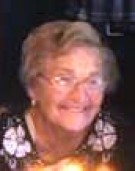
Duane Evan Johnson

Duane Evan Johnson, 62, passed away March 17, 2019, at his home in Great Bend. He was born September 20, 1956, at Great Bend, to Herman M. and Velma L. (Narey) Johnson.

A lifetime Great Bend resident, Duane was a supervisor for Primus Sterilizer. He was an avid motorcycle enthusiast and bicycle rider. He was a lover of dogs and considered them to be his friends, especially his canine companions, Hobo, Molly and Max.

Survivors include, one brother, David Johnson and his wife Deanna of Wichita; two nieces, Rachel Johnson and Rebecca Brockel; his Great Bend family, Randy and Erin Martin, and their children, Josh Martin and his wife Dawn, Jacquelyn Armstrong and her husband Alex, and Jessica Hopper and her husband Jeff; and grandchildren-in-heart, Remy Martin, Kaiden Armstrong, Karson Armstrong, Keaton Armstrong, Taylor Kern, Ryder Borschuk and Crew Hopper. He was preceded in death by his parents, Herman M. and Velma L. Johnson.

An informal celebration of life with a time for memory sharing will be held at 6:00 p.m. Thursday, March 21, 2019, at Bryant Funeral Home. A private family graveside service will be held Friday, March 22, 2019, at the Great Bend Cemetery. Memorials are suggested to the Golden Belt Humane Society, in care of Bryant Funeral Home.

Kansas Farm Bureau Insight: The art of civil discourse

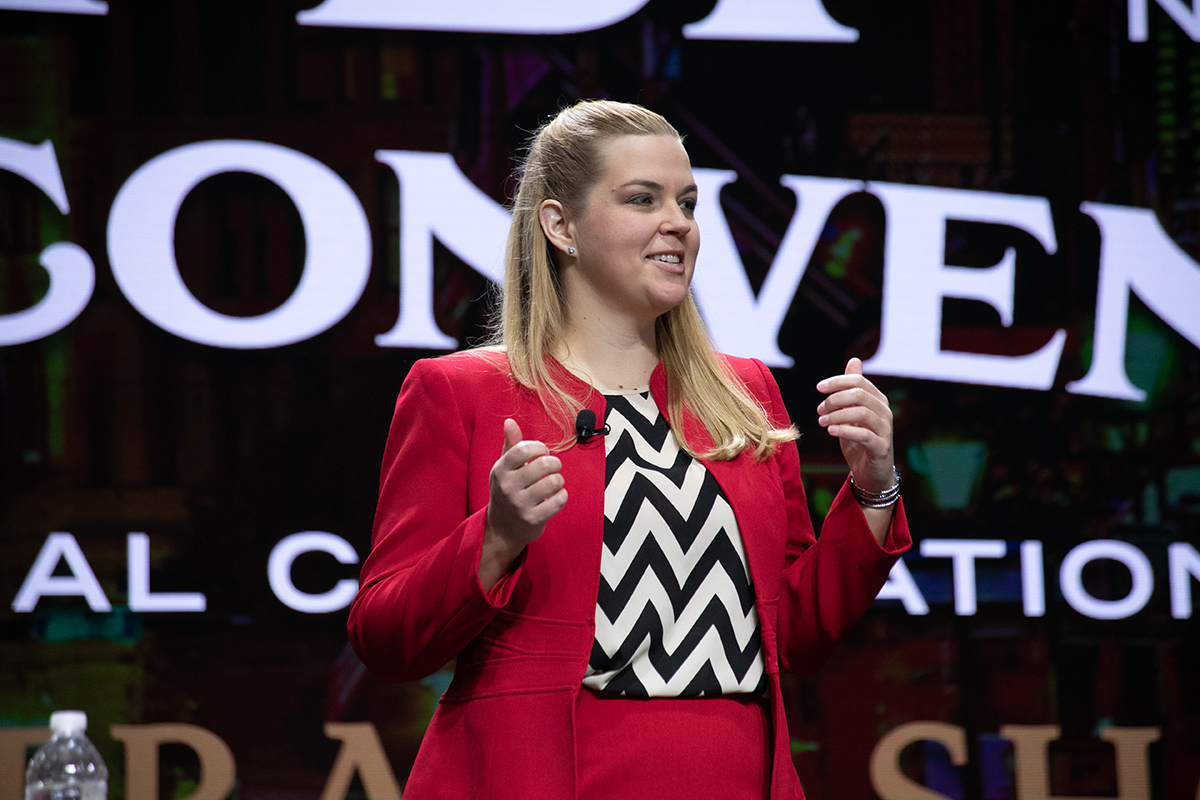
Jackie Mundt

By JACKIE MUNDT
Pratt County farmer and rancher

The world today is quick to judge. A lurking mob stands ready to provide a sum judgement of a person’s character and worth based on a small sample of actions or choices.

Look at responses to any social media post made by an elected official. Even the most positive statements are used to air a grievance about non-related issues.

Opinions, and the arguments they inevitably bring, are divisive and fierce. Whom you voted for in the last presidential election or where you stand on a water issue will likely earn you enemies without ever meeting them. When we argue, call names and get ugly with each other, what do we gain?

I am not advocating for a shift away from conflict and criticism. When people give me honest feedback it gives me the insight needed to change and grow. Through the processes, I become better and stronger.

My plea is for people everywhere to learn how to disagree productively and exercise civil discourse, which does not aim to tear down but to build a better, stronger future.

Civil discourse is commonly defined as “an engagement in conversation intended to enhance understanding.” The concept is simple, but the effect is game changing.
Civil discourse starts with a basic but vital assumption of respect. Each person is entitled to an opinion and has the right to share their perspective.

No matter how much you disagree with a person’s viewpoint, try not to get emotional. Two people yelling at each other does little more than embarrass other people at the table.

Instead of getting angry, get interested. Why do they feel that way? How did they come to that conclusion? Am I missing something in my knowledge of the subject?

Taking the first step to seek understanding shows an important level of patience. When you seek first to understand others, you show respect for their opinion. Don’t worry about getting your point across. Showing respect will build trust; as trust increases, the conversation becomes more robust and opportunities will arise to bring in a different perspective.
This deference to another speaker also subtly acknowledges that your opinion is not the most important. Humility, which is often missing in disagreements, can diffuse emotional responses.

Humility can also help us to overcome very natural emotions. Do you approach an argument or disagreement with any acknowledgement that you might have your mind changed? Some people who answer this question honestly find they fear being wrong or may be disloyal to someone in the process.
If you aren’t open to changing your mind, why should anyone be willing to have you change his or her mind? Civil discourse has an implied social contract that both parties will equally work toward the best resolution. Try not to let pride and stubbornness prevent you from being an honest player in the conversation.

Listening to another perspective doesn’t make you disloyal to your ideals; it will give you a deeper understanding of the issue and confidence in your position. Play devil’s advocate and try to understand the opposing point of view. Having a truly open mind will make you more likely to ask the tough questions and strive to see the whole picture.

When you reach the end of a civil discourse, you and your fellow conversers may still maintain your original opinions, but you will likely have gained each other’s respect and trust.

“Insight” is a weekly column published by Kansas Farm Bureau, the state’s largest farm organization whose mission is to strengthen agriculture and the lives of Kansans through advocacy, education and service.

Quinter student among winners of Wichita State Rudd Scholarships

WSU Strategic Communications

WICHITA — Fifteen Kansas high school seniors have been named as part of the newest class of Rudd Scholars, each receiving a 4-year scholarship to attend Wichita State University.

The scholarships cover all remaining tuition and fees, books and supplies, and room and board.

In addition to living on campus and carrying a full load of classes toward, scholars will receive mentoring and success coaching to help them graduate in four years. They will also participate in many developmental activities outside the classroom, network with leaders in their future professions, build strong relationships among themselves, and serve to help the next generation of scholars through an active and connected alumni association after graduation.

The 15 incoming Shockers are:

Wyatt Abell, Oakley High School
Darbee Chard, Chanute High School
Wendy De Loera, Wichita East High School
Storm Dial, Emporia High School
Brady Flesner, Medicine Lodge Jr./Sr. High School
Julie Gonzalez-Morales, Sumner Academy of Arts and Science
Maria Jimenez, Yates Center High School
Brooke Keith, Meade High School
Cali Keith, Meade High School
Codi Kentner, Quinter High School
Kennedi Meiers, West Franklin High School
Ronald Michel, Wichita County Jr./Sr. High School
David Nevarez-Saenz, Sumner Academy of Arts and Science
Lauren O’Donnell, Blue Valley High School
Ian Weaver, Hesston High School

In addition, five Kansas students received Rudd Scholarships to attend Emporia State University, and another five will attend Fort Hays State University. The expected value for all 25 winners over four years is $1.4 million.

“We couldn’t be more pleased with the exceptionally high-caliber, well-rounded students that were chosen for this year’s Rudd Scholarship,” said Peter Najera, president of the Rudd Foundation. “We expect them to maintain their grades and graduate in four years, and in return they will earn their degree debt free.”

The Rudd Scholarship is earned through a competitive selection process that requires grades, test scores, essays, letters of recommendation, and for the 50 semifinalists a personal interview. The process opened in the fall and drew hundreds of applications from all four corners of the state.

“Kansas high schools continue to produce very talented young men and women imbued with the Midwestern values of grit, determination and work ethic, and we are excited to make an investment in them through a college education,” said Najera. “These 25 recipients, in addition to the 19 previously selected, brings us to a total of 44 Rudd Scholars in college who will continue to support each other as they are groomed to strengthen the talent pipeline here in Kansas upon graduation.”

“In just two more years we will have nearly 100 Rudd Scholars on campus learning from one another,” said Najera, “and a few years after that they will all be networking with one another throughout the state as they continue on their trajectory of being positive contributors to our Kansas communities and society as a whole.”
About the Rudd Scholarship

The Rudd Scholarship is a renewable, 4-year program that covers any remaining cost of attendance after all other aid, grants and scholarships are applied to a student’s account. Cost of attendance includes tuition and fees, books and supplies, and room and board.

By removing financial barriers to a college education, chosen scholars are expected to achieve a high level of excellence on campus in preparing themselves to be leaders in their profession and in their communities after graduation.

Game wardens mourn the loss of K9 who saved Kansas girl

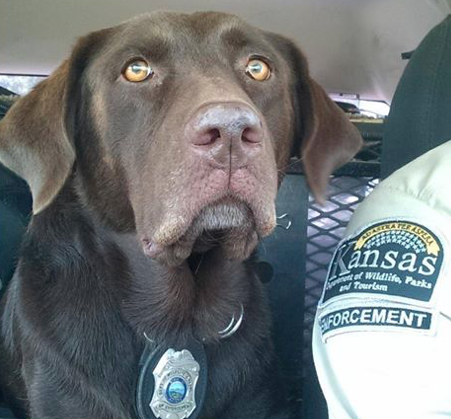
Game Wardens with the Kansas Department of Wildlife Parks and Tourism are mourning the death of a special K-9.  On their social media page, wardens reported that K-9 died Tuesday just 14 months following her retirement.

photo courtesy KDWP&T

According to the wardens, “Meg is credited with making a multitude of poaching cases, apprehension of many fugitives, and providing critical evidence recovery in murder investigations.

She has also been credited for saving lives including a three-year-old girl in Jackson County in 2016 who went missing from her home during an extremely hot day.

Meg was a true public servant, and a Kansas Game Warden to the end. We will miss you girl, rest easy.”

FHSU men’s golf finishes 11th at Hillcat Classic

OWASSO, Okla. – The Fort Hays State men’s golf team resumed their 2018-19 wrap-around season this week with an 11th place finish at the fourth annual Hillcat Classic (March 18-19) hosted by Rogers State. The tournament was held at the Bailey Ranch Golf Club, with a par-71, 6,670-yard setup in the first two rounds and a par-71, 6,639-yard setup in round three.

Mac McNish led the Tiger attack after carding rounds of 78, 79, and 76 (233) on his way to a tie for 36th individually. McNish posted three birdies for the tournament. Bryce Cowan placed solo 52nd after posting rounds of 83, 79 and 85. Connor Schultz shot rounds of 83, 81 and 86 to finish in a tie for 53rd. Schultz posted two birdies for the week. Isaiah Grover fired off a first-round 81 before finishing the tournament with identical 85’s in the final two rounds. Grover fired three birdies and an eagle in the tournament. Marcus Willey shot rounds of 95, 90 and 88.

Rogers State took the team title with an aggregate score of 879. Lubbock Christian finished second with a score of 881 and Texas A&M International (884) placed third. Parker Holekamp of Texas A&M International claimed the individual title after posting a 2-over (215) score for the tournament, after defeating Tucker Tovar (Arkansas-Fort Smith) and Luke Palmowski (Rogers State) in a playoff.

The Tigers are back at it next week when they travel to Wichita, Kan. to compete in the Rockhurst Invitational (March 25-26), hosted at Crestview Country Club.

Jury: Roundup weed killer is major factor in man’s cancer

SAN FRANCISCO (AP) — Roundup weed killer was a substantial factor in a California man’s cancer, a jury determined Tuesday in the first phase of a trial that attorneys said could help determine the fate of hundreds of similar lawsuits.

Roundup, the Monsanto brand name pesticide built on the chemical glyphosate, is used on farm fields and on lawns and gardens. FILE: by GRANT GERLOCK / courtesy HARVEST PUBLIC MEDIA

The unanimous verdict by the six-person jury in federal court in San Francisco came in a lawsuit filed against Roundup’s manufacturer, agribusiness giant Monsanto. Edwin Hardeman, 70, was the second plaintiff to go to trial out of thousands around the country who claim the weed killer causes cancer.

Monsanto says studies have established that Roundup’s active ingredient, glyphosate, is safe.

A San Francisco jury in August awarded another man $289 million after determining Roundup caused his non-Hodgkin’s lymphoma. A judge later slashed the award to $78 million, and Monsanto has appealed.

Hardeman’s trial is before a different judge and may be more significant. U.S. Judge Vince Chhabria is overseeing hundreds of Roundup lawsuits and has deemed Hardeman’s case and two others “bellwether trials.”

The outcome of such cases can help attorneys decide whether to keep fighting similar lawsuits or settle them. Legal experts said a jury verdict in favor of Hardeman and the other test plaintiffs would give their attorneys a strong bargaining position in any settlement talks for the remaining cases before Chhabria.

The judge had split Hardeman’s trial into two phases. Hardeman’s attorneys first had to convince jurors that using Roundup was a significant factor in his cancer before they could make arguments for damages.

The trial will now proceed to the second phase to determine whether the company is liable and if so, for how much.

Hardeman declined to comment outside court.

“This has been a long time coming for Mr. Hardeman,” said one of his attorneys, Jennifer Moore. “He’s very pleased he had his day in court, and we’re looking forward to phase two.”

Many government regulators have rejected a link between cancer and glyphosate. Monsanto has vehemently denied such a connection, saying hundreds of studies have established that the chemical is safe.

Bayer, which acquired Monsanto last year, said in a statement after the verdict that it continues to “believe firmly that the science confirms glyphosate-based herbicides do not cause cancer.”

“We are confident the evidence in phase two will show that Monsanto’s conduct has been appropriate and the company should not be liable for Mr. Hardeman’s cancer,” it said.

Monsanto developed glyphosate in the 1970s, and the weed killer is now sold in more than 160 countries and widely used in the U.S.

The herbicide came under increasing scrutiny after the France-based International Agency for Research on Cancer, which is part of the World Health Organization, classified it as a “probable human carcinogen” in 2015.

Lawsuits against Monsanto followed. The company has attacked the international research agency’s opinion as an outlier.

The U.S. Environmental Protection Agency says glyphosate is safe for people when used in accordance with label directions.

Hardeman started using Roundup products to treat poison oak, overgrowth and weeds on his Sonoma County property in the 1980s and continued using them through 2012, according to his attorneys. He was diagnosed with non-Hodgkin’s lymphoma in 2015.

Sunny, mild Wednesday

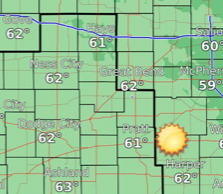
Wednesday Sunny, with a high near 61. West northwest wind 9 to 15 mph.

Wednesday Night Clear, with a low around 30. North northwest wind 6 to 10 mph.

ThursdaySunny, with a high near 62. North wind around 5 mph becoming light and variable.

Thursday NightPartly cloudy, with a low around 37. South southeast wind around 6 mph.

FridayA 30 percent chance of showers after 1pm. Partly sunny, with a high near 62.

Pro-life group in Kansas wants ex-nominee to resign as judge

TOPEKA, Kan. (AP) — The Latest on Kansas Gov. Laura Kelly withdrawing a nominee for the Kansas Court of Appeals over political posts on his Twitter feed.

Judge Jeffry Jack courtesy photo

A pro-life group influential in Kansas politics has called on a trial-court judge to step down after political posts on his Twitter feed sunk his nomination for the Kansas Court of Appeals.

Kansans for Life said Tuesday that Democratic Gov. Laura Kelly’s decision to withdraw her nomination of Judge Jeffry Jack for the state’s second-highest court is a good first step.

But Executive Director Mary Kay Culp said the group believes Jack also should resign from his current position of Labette County district judge.

Jack’s Twitter page included posts from 2017 criticizing President Donald Trump and expressing support for gun control and abortion rights. Some used vulgar language.

Jack asked to have his name withdrawn Monday night after Republicans predicted he would not be confirmed by the GOP-controlled state Senate.

—–

A Kansas judge whose Twitter feed sunk his nomination to the state’s second-highest court says he was expressing personal opinions that do not influence his work on the bench.

In a statement Tuesday, Judge Jeffry Jack also criticized Senate President Susan Wagle for opposing his confirmation to the Kansas Court of Appeals before he had a hearing.

His Twitter page showed hundreds of tweets and retweets from 2017 that criticized President Donald Trump and expressed support for gun control and abortion rights. Some included vulgar language.

Kelly withdrew Jack’s nomination Tuesday.

Jack said his tweets were “anti-violence, anti-discrimination and anti-hypocrisy.” He said he assumed he was expressing personal opinions to a small group of followers and did not understand that his tweets were accessible to the public.

Kansas woman sentenced for killing ex, setting body on fire

LAWRENCE, Kan. (AP) — A woman has been sentenced to life in prison with no possibility of parole for 50 years for killing the father of her child whose body was found inside a burning house near Lawrence.

Tria Evans stands next to her attorney Carol Cline during an appearance before Judge Kay Huff on Tuesday, Feb. 6, 2018 in Douglas County District Court-photo by Nick Krug courtesy Lawrence Journal World

39-year-old Tria Evans appeared in court Tuesday for sentencing six weeks after a jury deliberated 1½ hours. She was convicted of first-degree murder, conspiracy to commit murder, arson and aggravated burglary in the November 2017 killing of 34-year-old Joel Wales.

Evans and Wales had a child together and a history of domestic disputes.

Judge Kay Huff says “it doesn’t get much more premeditated than this case.”

Wales was shot six times while house-sitting at his mother’s home just south of Lawrence. Gasoline was was poured over his body and lit on fire.

___

Copyright Eagle Radio | FCC Public Files | EEO Public File