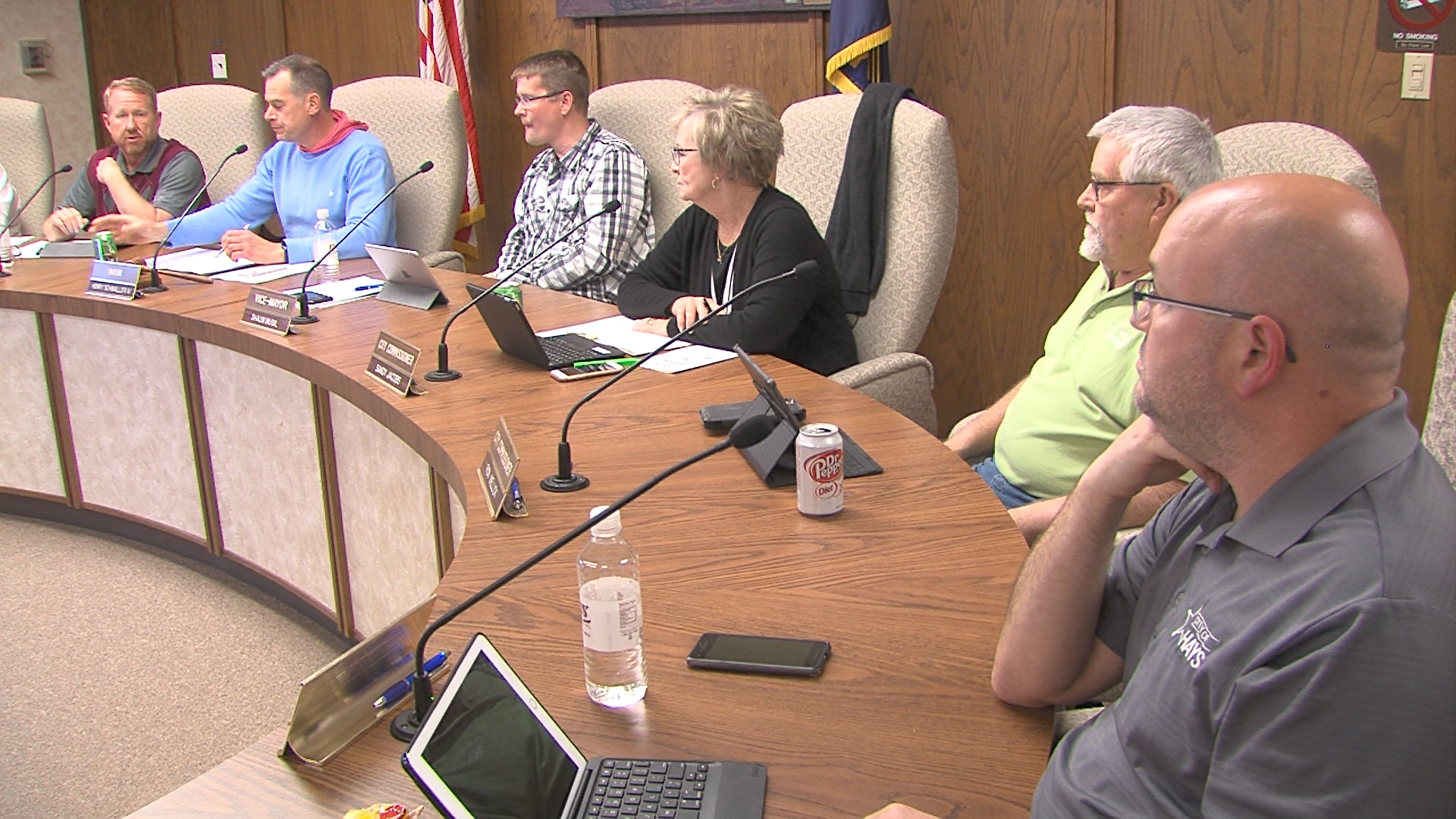
Not a lot of Fort Hays State University students living off campus are participating in Hays’ water conservation programs, but most of them would like to reduce their water use.
A survey of nearly 500 Hays residents by a group of FHSU students known as Water Wise Tigers shows there may be an opportunity for the city to target incentives to property landlords.
Sociology major Kiley Heine presented the findings to the Hays city commission Thursday night.
“Eighty-six percent of the students in our sample live in rental homes. Offering policies or programs that give property owners an incentive to invest in and install water-saving fixtures in rental homes such as low-flow shower heads, faucet aerators, low-flow toilets and high efficiency washing machines may help bridge the social gap between students’ desire to contribute to water-saving efforts and the reluctance to invest in water-saving fixtures and appliances,” Heine reported.
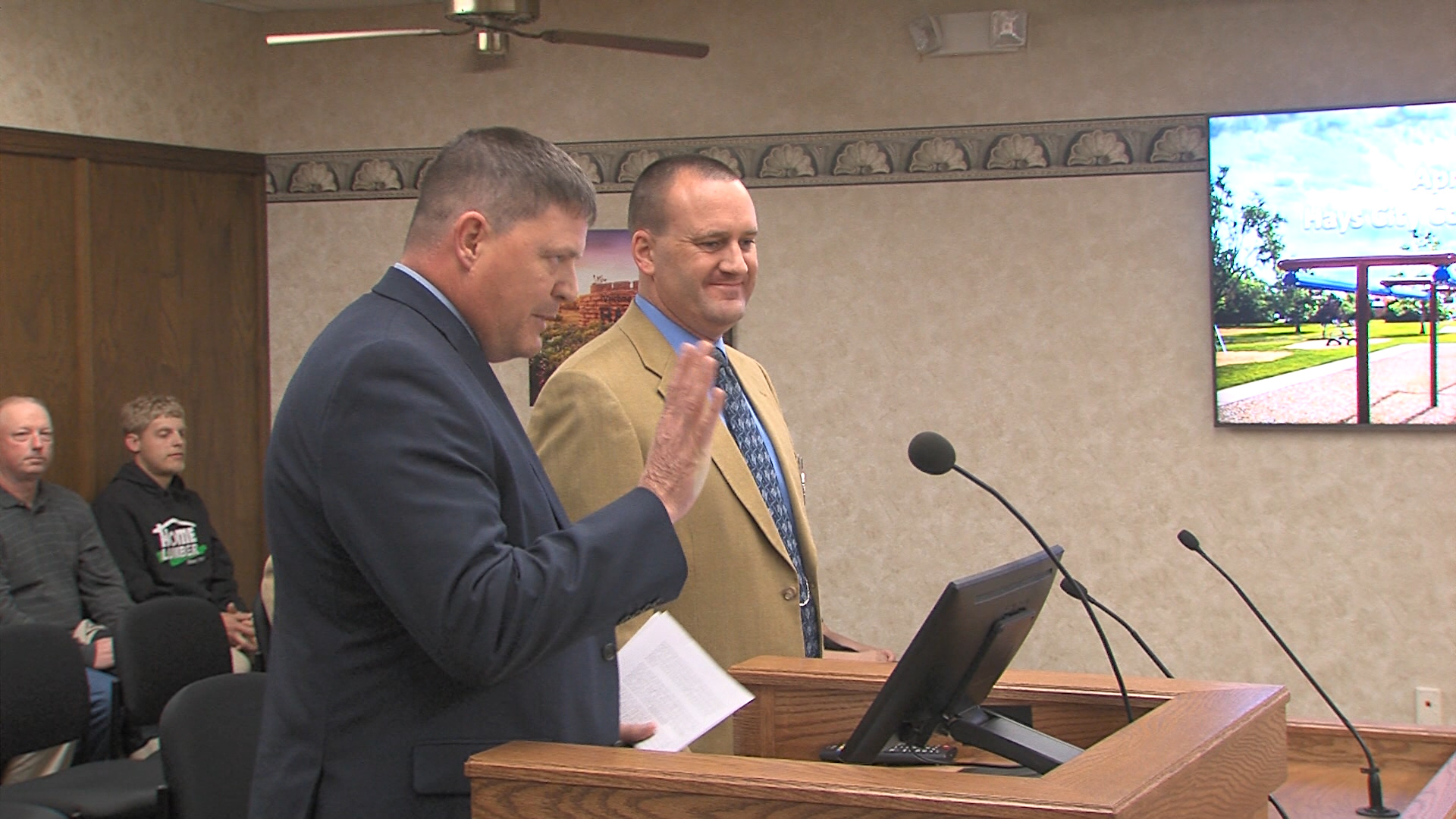
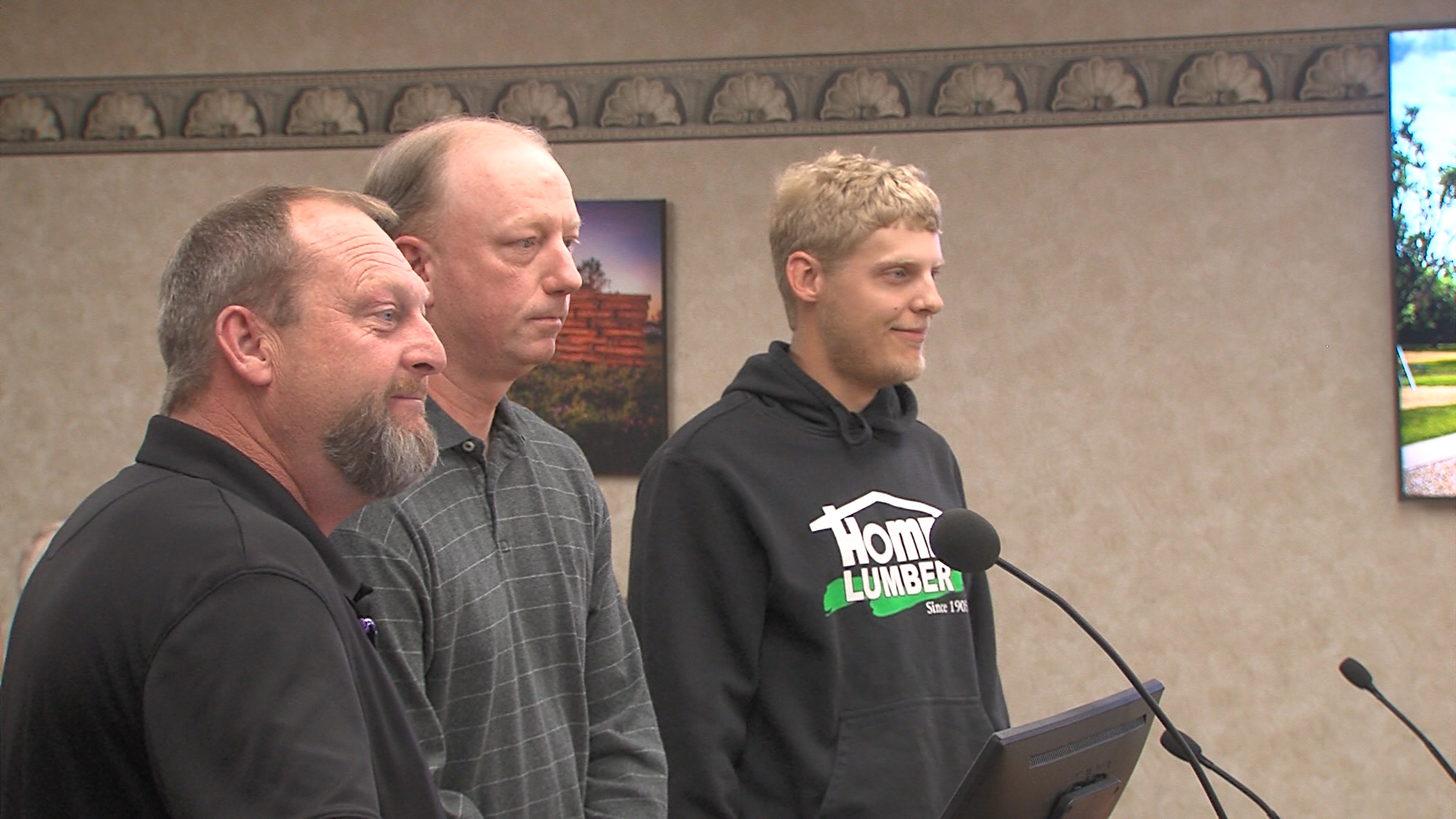
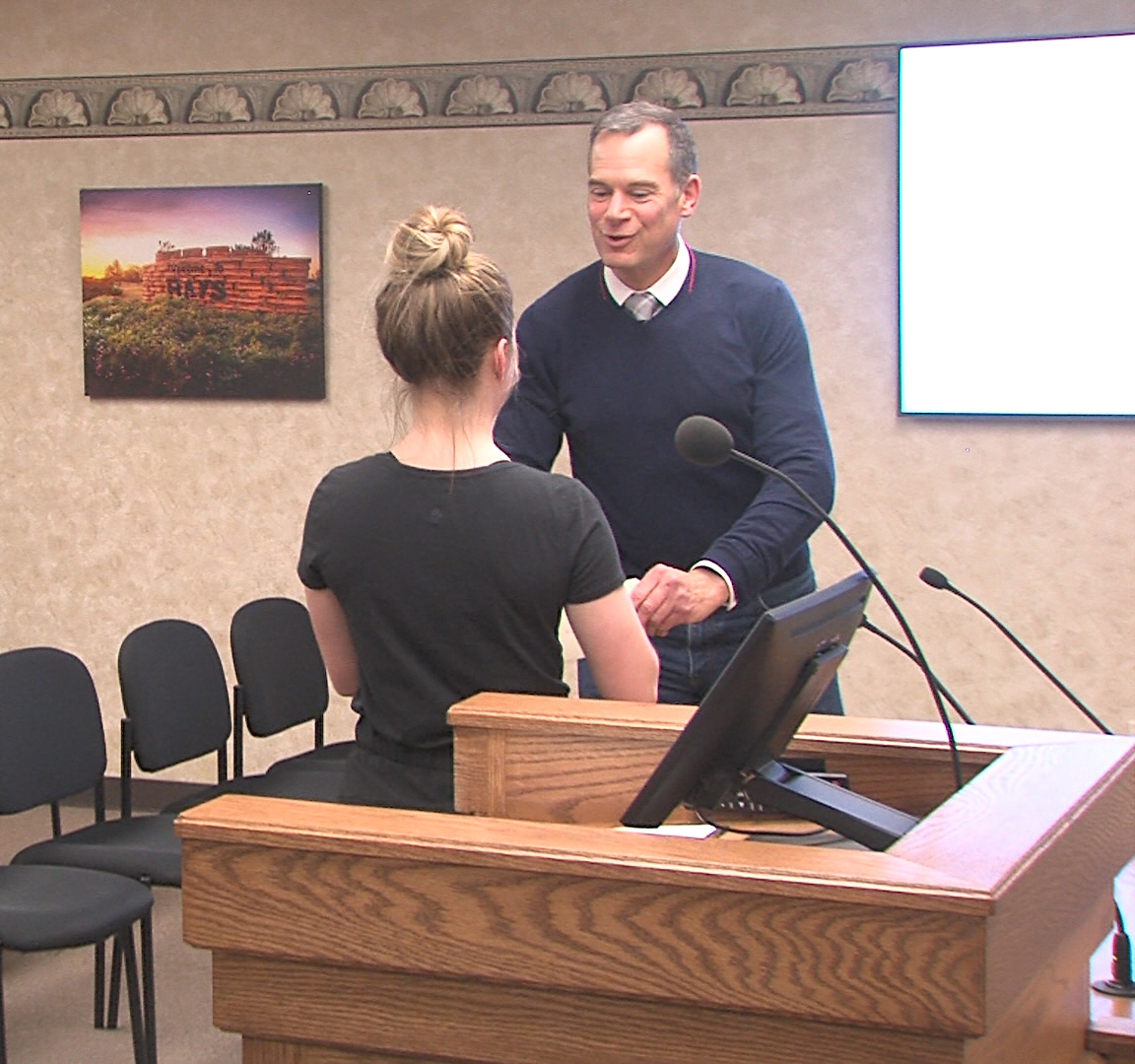
Hays Mayor Henry Schwaller (right) thanks FHSU student Kiley Heine and Dr. Brett Zollinger for the survey about water conservation attitudes in Hays.
Other students in the Water Wise Tigers group are Diane Hernandez-Ramirez and Amanda Buday, who conducted the research under the direction of Dr. Brett Zollinger, chairman of the Department of Sociology.
Six of the 37 wells that produce water for the city of Hays need to be rehabilitated.
Groundwater contains bacteria and minerals which cause well plugging. Screens, gravel pack and formations may become blocked, reducing the amount of water that can be pumped to the surface.
Water Resources employees maintain productivity of the wells by acidizing them, but as City Manager Toby Dougherty explains, periodic professional rehabilitation is necessary to maintain peak efficiency.
“Maintenance only goes so far and there are times you have to do a complete rehabilitation on those wells,” Dougherty explains. “This keeps them operating as efficiently as possible which is especially important when we get into times of drought.”
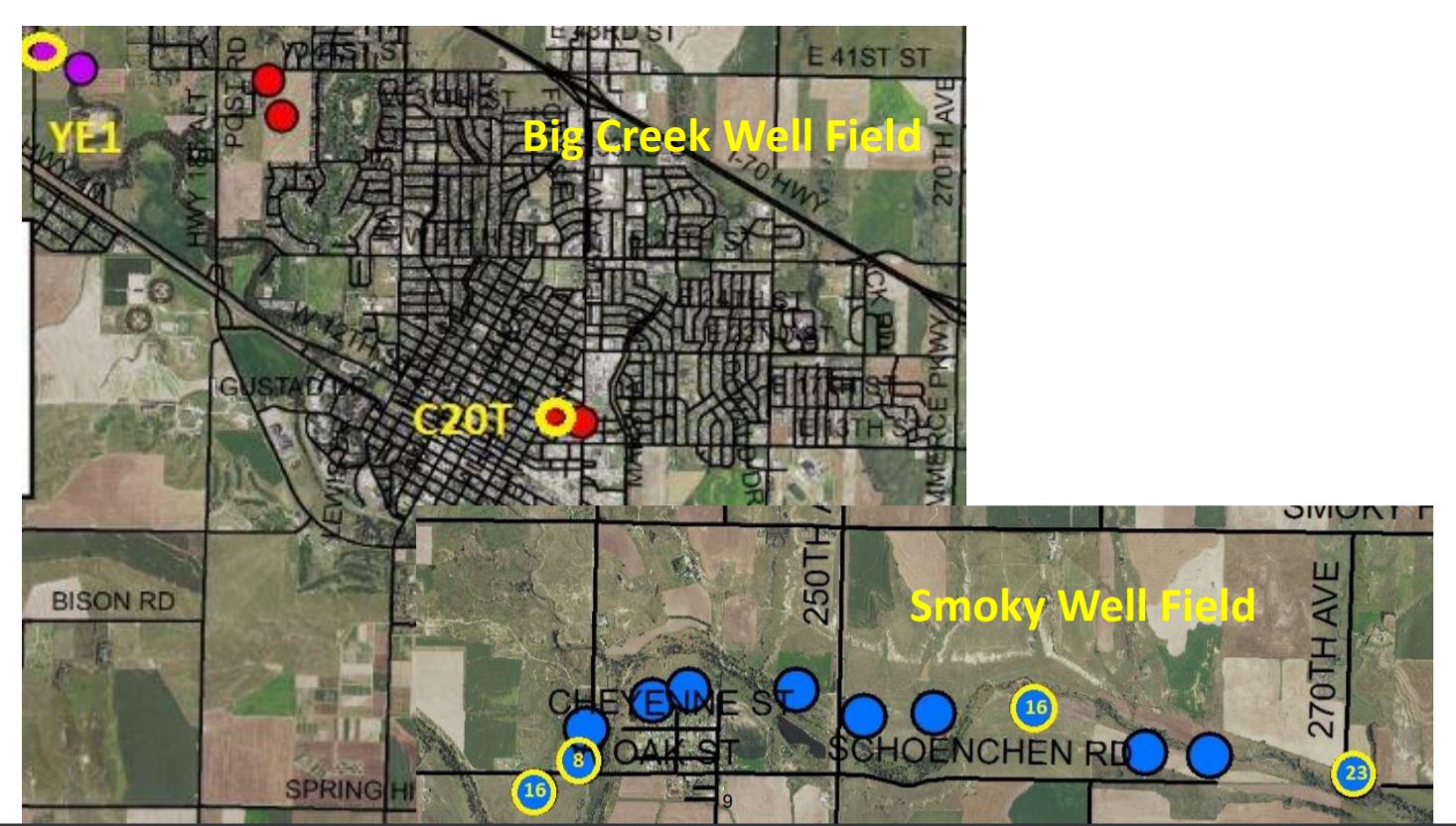
Six Hays water production wells (circled in yellow) will be soon be rehabilitated.
The Hays city commission will review bids Thursday for the rehab project. The low bid is from Layne Christensen Company of Kearney, Neb. for $67,230.
The city of Hays has the ability to withdraw groundwater from three different aquifers through 37 wells. The three aquifers are the Smoky Hill River, Dakota and Big Creek.
Also on the May 2 work session agenda is a report from the Fort Hays State University Water Wise Tigers. The student group conducted a research project involving water conservation in Hays.
Sidewalk project work for 2019 will be presented by Project Manager John Braun.
Commissioners will consider bids for installation of sidewalks at Rolling Hills Park and several locations at 13th and Canterbury and adjacent to the Hays Recreation Commission.
The two low bids are both from DHC, Hays, with Rolling Hills at $26,841.90 and 13th & Canterbury at $35,135.53.
The final results of Saturday’s Thomas More Prep Marian 2019 Auction for Christian Education (ACE) fundraiser are still being tallied, but it was “very, very successful” according to Troy Ruda, advancement director.
Ruda said Wednesday morning he does know the popular ACE Live Auction Item #60 reached and exceeded its goal.
“With $222,000 raised, the Leo J. and Albina Dreiling Trust matching funds were added, earning a total of $422,000,” Ruda reported.
ACE Live Auction Item #60 targets different needs each year.
In 2019, the funds will be used in two areas.
First up is the replacement of the student activity bus for TMP-Marian Sr./Jr. High School and Holy Family Elementary.
“The bus was donated to us in 2011 with 900,000 miles on it and today has more than 1.5 million miles,” said Ruda. “These buses are designed to be driven for many more miles than a passenger vehicle, but it needs to be replaced. There may be some safety concerns develop and it’s not very economical (on gas.)”
Ruda says a volunteer committee is looking at a new Executive Liner coach similar to those at Fort Hays State University which can be serviced in Hays. The current bus has to be taken out of town for maintenance. He’s hoping the new bus will be on campus by the end of 2019.
Other monies are going to the junior high renovation project.
It currently operates in the northeast wing of the second and third floors.
The goal is to relocate all the junior high classrooms and junior high administration to the third floor and allow the high school to completely occupy the first and second floors.
Construction of the new library, known as the Learning Commons, is expected to get underway this summer Ruda says, and the third-floor Center for Research will be vacated.
ACE was streamed live on Hays Post. Click here to review the auction.
May is a busy month in Hays as school calendars come to a close and graduation ceremonies are scheduled. Outdoor sports pick up and the two city swimming pools open for the season.
Melissa Dixon, Convention and Visitors Bureau executive director, has a preview of some of the spring activities.
An updated calendar of events is available on the Hays CVB website www.haysusa.net.
Sunday night’s thunderstorm contained many lightning strikes.
By BECKY KISER Hays Post
Sunday night’s spring thunderstorm lit the sky with lots of lightning.
It also dropped the first moisture during the month of April for the city of Hays.
The official amount of rainfall recorded April 28 at the K-State Agricultural Research Center south of town was 0.89 inches. The Hays Regional Airport measured 0.84 inches of rain along with a peak northerly wind gust of 35 mph just before 10 p.m.
The Eagle Communications Media Center, 2300 Hall, had 1.09 inches of rain.
So far for 2019, Hays has received 3.63 inches of moisture.
“I took an officiating class at Barton County JUCO in 1973 and the rest is history.”
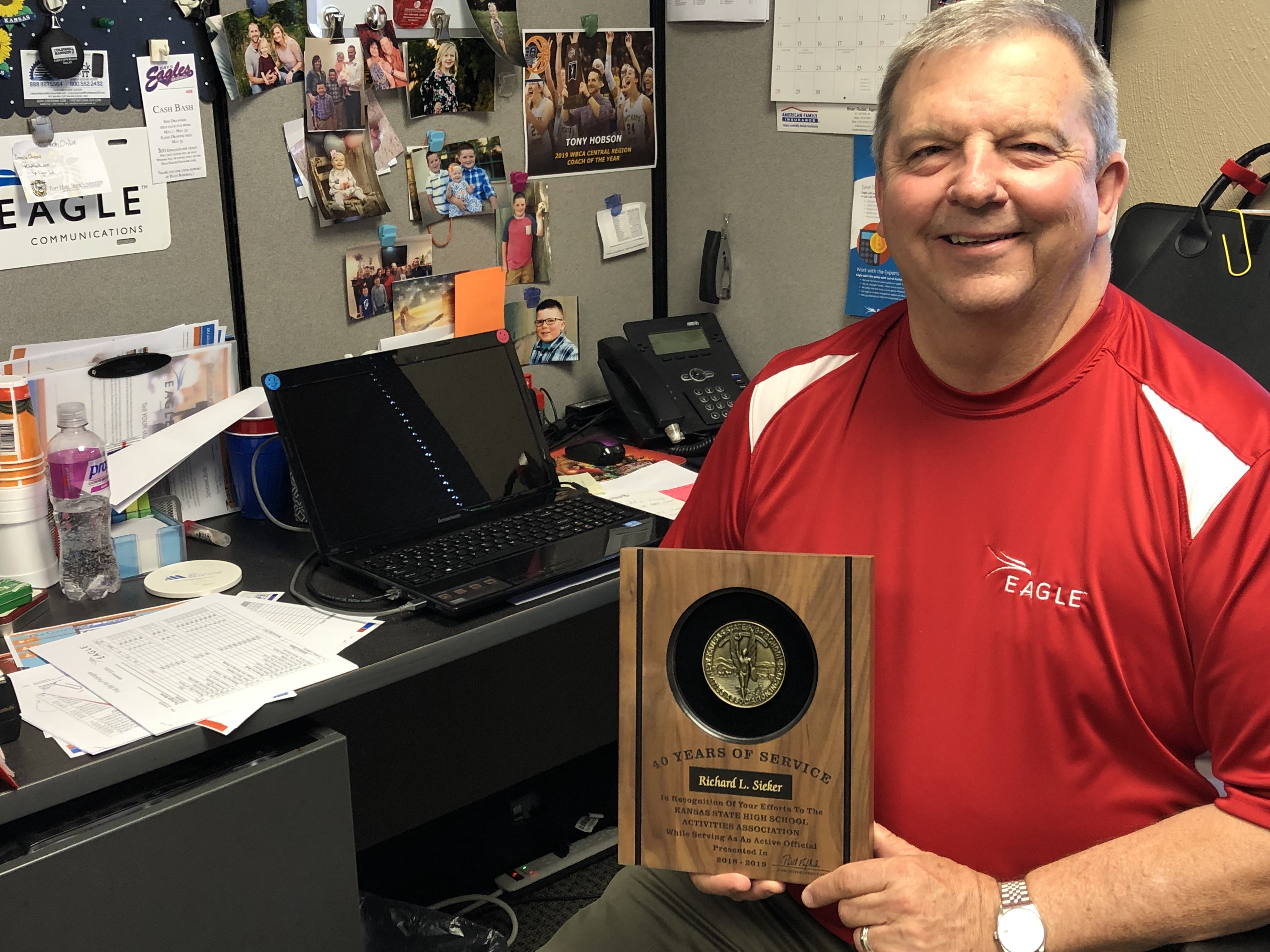
That’s how Hays resident Rich Sieker began his journey to recently being honored by the Kansas State High School Activities Association, Topeka.
Sieker was recognized for his decades of service to KSHSAA while serving as an active official.
The plaque he received from KSHSAA reads 40 years of officiating. It’s actually been 45 years, according to Sieker.
“I should have let them know about it sooner,” he smiled.
The class that started it all was taught by Gary Tranbarger at the Great Bend junior college.
Tranbarger assigned Sieker and his classmates to officiate area junior high and high school junior varsity games in Larned, St. John and Hoisington, as well as in Great Bend. If the students were good enough, they moved up to officiating high school varsity games.
Sieker was better than good enough.
He went on to work college football for three years and college women’s basketball for 20 years. He officiated many state playoff games as well as Kansas Shrine Bowls for standout high school football players across the Sunflower State.
“I was blessed to start working varsity in 1979 with a great group of guys in Russell where I taught history at Ruppenthal Middle School. ”
Rich Sieker (with black cap) stands at attention prior to the start of a Hays High School football game. (Courtesy photo)
Sieker, 64, still fills in on football crews as needed.
He says he’s “been blessed to work with some great individuals” who went on to become outstanding college players, including Jackie Stiles of Claflin, and many others as well as soon-to-be pro athletes including Jordy Nelson who played for Riley County High School, Kansas State, the Green Bay Packers and the L.A. Raiders, retiring last fall.
Sieker also recalls a lot of “wonderful coaches and officiating partners” including Larry Dougherty, Monty Applehans, Mark Goodheart, Brad Taylor, Todd Tichenor who became a Major League baseball umpire, Mark Brack, brothers John and Jim Adams, John Bruckner and Fred Schweer.
Editor’s note: Rick Sieker is an employee of Eagle Communications, the parent company of Hays Post.
A car submerged in the street near 17th and Fort July 6, 2018. No injuries were reported. (Photo by Cristina Janney)
By BECKY KISER Hays Post
There are areas in Hays where rainwater tends to collect in the streets during a downpour and cause flooding.
An unusually wet year in 2018 – the third wettest year on record for Hays – saw several street flooding events.
When that happens, Public Works Dept. employees go out and place bright orange traffic cones in places where water crosses the road.
By the time all the cones are set out, the water is usually already starting to recede, according to Jacob Wood, assistant city manager.
“Our drainage system actually works pretty well,” says Wood.
17th and Ash
“So instead of sending our guys out to put cones in every location, we’ve put signs up in places where water typically crosses the road.”
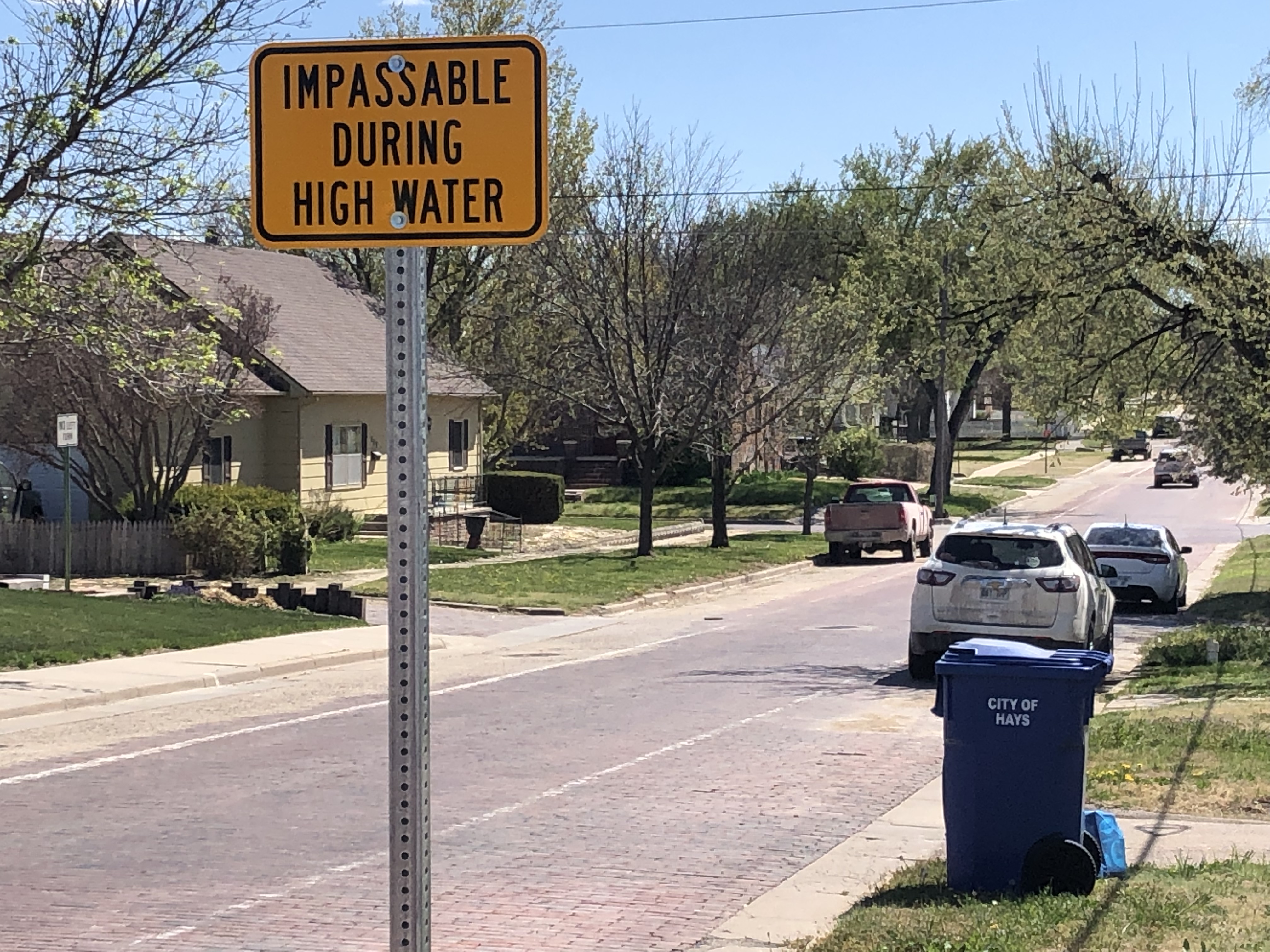
Twelve yellow diamond caution signs read “WHEN FLOODED TURN AROUND DON’T DROWN.” Another 30 yellow rectangular signs read “IMPASSABLE DURING HIGH WATER.”
Public Works will no longer put out the traffic cones during minor street flooding but “we do want to notify the public there could be water in the area,” he said.
In cases of major street flooding, the cones will still be moved into place as a warning to drivers.
“For the most part we’re trying to get away from sending everybody out to put cones up in areas where the flooding is not really terrible and most of the time vehicles can cross. It’s not advisable to drive through that,” Wood stressed, “but it’s not necessarily a life-threatening situation.”
17th and Fort
He used as an example the intersection of 13th and Allen Streets.
“There’s not really a whole lot we can do there to get that water going faster just because of the elevations after we rebuilt 13th.
“So any time we have a heavy rain, water piles up there. Now we’re not going to put cones there because we have traffic signs that say caution, when it’s raining heavy, water collects here.”
Typically, the flood-prone area doesn’t get water deep enough to cause problems, but Wood says if someone is driving a low-riding car, they may stall out.
“A lot of times when we put the cones up, people drive around them anyway,” he acknowledged with a grin.
There are 42 signs now installed in areas of Hays where traffic cones have historically been placed during a hard rain. The diamond shaped signs were provided to the city through the Federal Emergency Management Association and the Division of Water Resources.
A summer thunderstorm last July 6 resulted in a Flash Flood Warning for central Ellis County with more than four inches of rain falling in Hays in a short time. Notable flooding occurred in areas that rarely flood, including 17th Street.
“We put signs up there, but that water was deep enough that if it happens again, we’re going to go ahead and barricade those streets and other places like that if gets to the point of a really significant rainfall.”
That part of Hays had not flooded in many years.
“It just depends on the kind of rain that you get and how saturated the earth is at the time,” Wood added.
Mother Nature is not the only factor in a flooding event.
July 6, 2018 flooding along the south side of Hays City Hall (at right), 1507 Main. (Photo by Cristina Janney)
“When people build things or tear things down, it dramatically changes the way the water flows.
“We actually saw that around city hall (1507 Main). We tore a couple of houses down behind it and put in a parking lot and the water flowed totally different around city hall at the last flood event than it had in previous years.”
Some city streets act as part of the storm water system, which is designed to move water off the streets.
“In places where we don’t have underwater conveyance or ditches or that sort of thing, the water does flow in the street. Fortunately, it typically moves out pretty quickly.”
By eliminating the process of setting out and picking up the cones, city employees will now be able to take care of other flooding issues more quickly.
“When it’s raining heavily or flooding, our public works crews have more things to do than just set cones out. They’re trying to take care of
Lincoln Draw flooding July 6, 2018 (Courtesy Heidi VanDoren Weiss)
the whole city, and making sure everything is all right in Lincoln Draw. If it would get significant enough that we need to sandbag areas, they’re out doing that. They also monitor areas where it does get deep enough that it’s a life safety concern.”
Wood noted the Hays Police Department also monitors flood zones during heavy rains.
“If basements are filling up on 17th Street, that’s life-safety related. It’s really about saving lives and managing our resources the most effective way.”
Wood says the city typically hasn’t issued citations or tickets for driving around the traffic cones and onto a flooded street.
“It’s really more of a ‘go here at your own risk’ type of thing. If you do go through the water or around the cones and your car gets stalled out, that’s kind of on you.”
Several homeowners, including Terry Blide, who spoke to the Hays city commission Thu., oppose the proposed extension of 37th St. as part of the north Vine Street roundabout project.
By BECKY KISER Hays Post
Before the Hays city commission voted 3-1 Thursday night to approve an engineering design supplement to the North Vine Street Corridor roundabouts project, two residents spoke during citizen comments against a portion of the project affecting 37th Street.
The $49,904.65 supplement agreement with WSP Engineers, Lenexa, includes the scope and fee for services related to right-of-way property acquisition. The original $396,895.26 engineering contract was approved May 25, 2018 with WSP. Both will be funded out of the Convention and Visitors Bureau contingency fund.
Four traffic roundabouts are to be constructed on Vine Street/U.S. Highway 183 at 32nd/33rd, 37th, 41st Streets, and a partial roundabout at the eastbound exit ramp of Interstate 70.
A portion of the engineering contract for the Vine Street traffic roundabouts includes extension of 37th Street to the west. (Click to enlarge)
In addition, the corridor project calls for W. 37th to be extended west to the new development area and for W. 41st – the west frontage road – to be realigned to meet W. 37th further west than the existing intersection location. A new public street would be constructed south of the new intersection to maintain access to the existing gas station south of W. 37th.
Some nearby homeowners are concerned about increased traffic with the extension of 37th and the possibility of falling property values.
Bill Lovewell lives in the 100 block of W. 37th.
“It’s a safe neighborhood with slow traffic and my granddaughter can ride her bike there without worrying about every kind of vehicle coming through,” Lovewell told commissioners, “and I’ve put in thousands of dollars in improvements on my home.
“I have concerns about traffic and the fact my home is not going to be as valuable it is now. … Who wants to buy a house on our street if all that traffic is going to go through?”
Lovewell said he doesn’t have a problem with the roundabout but questions why 37th needs to be extended to the west.
“Every kind of vehicle in the world is going will coming down that street,” Lovewell believes.
Mayor Henry Schwaller noted the city commission has not taken action and has had only informal planning discussions about the project.
“One of the options that we are considering but has not yet been brought to public discussion is connecting 37th across from the old (Ambassador) motel property to Skyline Drive.
“We have not made a decision where that road will terminate because if it comes through the middle of the lot, it won’t be 37th or 38th. It would be in the middle, approximately where the alley is,” Schwaller explained. “So, there may be a consensus one way or the other, but we have not taken any formal action.”
He encouraged Lovewell and others in the audience to attend the commission meeting when the street extension is on the agenda for discussion. “We want you to be involved as we move forward.”
Terry Blide, another homeowner in the 100 block of W. 37th, asked commissioners to “please keep it a residential street, not a business street.”
Blide is worried semi-trucks will drive into his neighborhood. “You really think they’re going to mind those signs about ‘no traffic on 37th Street’?”
The full design of the roundabout project is not yet complete, according to city manager Toby Dougherty.
“We will listen to you before we move forward, I promise,” Schwaller added.
Vice-Mayor Shaun Musil said “I one hundred percent do not think 37th Street should be a direct-through street. I am for connecting to Skyline because I believe – I know – it’s going to grow north of 38th Street. Some of us here don’t agree, but I’d like to see it more of a “T” from left to right.”
Musil and Schwaller both said they had talked with concerned residents earlier Thursday.
“Nothing has been voted on,” Musil reiterated. “Nothing has been designed. I promise you there will be more information before anything will happen.
“I live very close where you guys live. … I personally agree with you.”
Later in the meeting Schwaller voted against the supplemental engineering contract. “I don’t support the project as designed,” he said, “so I didn’t want to spend the money this way.”
Commissioner Sandy Jacobs was absent from the meeting.
Warm season Buffalograss uses considerably less water than a cool season grass such as Fescue.
By BECKY KISER Hays Post
Now that the growing season is here, the city of Hays is again offering a turf conversion rebate for property owners wanting to convert cool season grasses to warm season grasses or water conserving landscaping.
The program is directed towards properties with irrigated and well-maintained cool season turf grass such as Tall Fescue and Kentucky blue grass, according to the city’s water conservation specialist Holly Dickman.
“These grasses thrive when the weather is cooler in the spring and fall, but typically require supplemental irrigation during the hot summer months to keep them looking nice,” Dickman explained.
“Warm season grasses like Buffalo and Bermudagrass thrive during the heat of the summer and therefore require very little, if any supplemental irrigation once established. The same is true with drought tolerant landscaping plants.”
Native species like Buffalograss have a deep root system that allows the turf to withstand extended periods of drought.
The rebate for turf conversion is $1 per square foot with a maximum of $1,500 per property.
Pre- and post-inspections are required.
“You need to call my office and we’ll set up a time when I’ll come out and actually look at your landscape and see if you qualify for the rebate program. We’ll take some measurements and have you fill out some paperwork. That part is required before any work is done, so you can’t already have taken out that turf grass and then call me.
After pre-inspection, the applicant has up to one year to do the turf conversion.
“After the conversion is complete, you call me back. I’ll come do a post-inspection and then we issue the rebate after that.”
More information about the turf conversion rebate program is available at www.watersmarthays.com or calling Dickman at 785-628-7350.
A new high priority item on the proposed Hays Parks Improvement Plan is a shade structure for the bison herd in Frontier Park West.
By BECKY KISER Hays Post
At the suggestion of Hays city commissioners, a policy has been drafted for determining priorities in park improvements as well as how matching funds from outside entities are considered.
The draft includes a new park amenities schedule created with the assistance of Jeff Boyle, director of parks. The total cost is approximately $3.35 million.
“We would anticipate updating that every year with high, medium and low priority projects,” City Manager Toby Dougherty told the commission last week. It would be adopted as part of the annual budget of the Parks Department after review by the commission.
Civic groups or other donors wishing to help fund a project would be steered to the high-priority replacement projects, according to Dougherty. Those items are what city staff believes to be the most pressing issues. Some are replacements, others are new pieces.
“I don’t want someone coming in and saying I want that shelter house and we expect you to do it this year,” said Commissioner Ron Mellick, “but that will be all in the schedule.”
Sandy Jacobs wondered what would happen if a group wanted to provide a 50% match for a project that is not on the high priority list comprised by the city. “Would you consider moving it up if they wanted to spend their money that year?” she asked Dougherty.
“It’s up to the commission,” Dougherty replied.Aubel Bickle Park (Photo courtesy city of Hays)
A separate process would prioritize the projects in the city’s five-year Capital Improvement Plan (CIP).
If an entity wants to accelerate the creation of a high-priority project, there will be a 15% funding match required.
For medium-priority items, there is a 50% match required while low-priority items will required a 75% funding match.
If a proposed improvement is not on the Parks Amenities Schedule, a 100% funding match is required plus additional monies for a 10-year minimum of maintenance, operation, and depreciation costs.
Shaun Musil noted the high priority list included items noted as broken, portions needing replacement, washed out or in poor condition. There were also several new requests.
“I thought the whole object of this was to limit new requests,” Musil said. “Why would you have something like that at the very top?” he questioned Dougherty.
“More recently the commission said ‘we want to focus our efforts and new stuff on multi-use paths,'” Dougherty reminded commissioners. “So that’s a new request. That’s your priority, your request.
“Right now what we’re trying to stay away from is any more restrooms and $70,000 pieces of play equipment and things like that. You are going to see some new requests in here that we (city staff) that we think are valid.”
Dougherty pointed to the Parks Dept. parking lot as one example. Installing a paved lot to replace the dirt lot is listed as one high priority. Drainage mitigation and concrete parking in Frontier Park East is “also a new request but it’s solving a problem we’ve been dealing with for a lot of years.”
A shade structure for the city’s bison herd in Frontier Park West is also a new request on the high priority list.
“We have bison in the pen with relatively no shade and it’s hot and sunny here,” said Dougherty.
“It’s a new construction but it’s relatively cheap.”
Funding sources would vary. Some of the amenities are for parks sponsored by Hays civic groups. The Hays Aquatic Park has its own fund and budget as does the Fort Hays Municipal Golf Course, as well as the Parks Department.
Civic groups or other donors often come to Boyle and ask what is needed in the city’s parks.
“The whole intent is if somebody comes along with money we can try to steer them to the high priority items,” Dougherty added. “If somebody comes along with an idea that is not on the list, the commission can say ‘we appreciate it but it’s not on our priority list – either high, medium, or low – so therefore the burden is on you to come up with the money, and some money to take care of it.'”
Last year, a restroom was installed in Ekey Park, 19th and Holmes Road. The Sunrise Rotary Club requested the city commission authorize the installation be moved up from 2020 to take advantage of a $10,000 grant the club received from the Dane G. Hansen Foundation, Logan.
“This looks great,” said Mayor Henry Schwaller. “It’s a huge step forward.”
The commission will consider adopting the Parks Improvement Policy at its April 25 meeting.
The Ellis County Joint Planning Commission will meet at 7 p.m. Wednesday in the Ellis County Administrative Center, 718 Main, in the lower level meeting room.
The agenda follows.
Agenda is Subject to Change
I. Call to Order
II. Roll Call
III. Approval of March 27, 2019 meeting minutes
IV. Public Presentation
V. Staff Report
A. Activity Report
B. Other
VI. Old Business
A. Clint Long Schoenchen Business CUP (ConditionalUsePermit) follow-up
B. Solar Company CUP follow-up
C. Comprehensive Plan update- Keith Marvin
D. Members decision to remain on Zoning Committee
E. Other
VII. New Business
A. Nex-Tech CUP
B. Recreational Dwelling Issue
C. Other
VIII. Confirm next meeting date: May 22, 2019 at Ellis County
Administrative Center Meeting Room, 718 Main Lower Level, Hays, Kansas at 7:00 p.m.
IX. Adjournment
New employees and current employees who have been recently promoted were introduced to the Hays City Commission during their April 11 meeting.
POLICE Aaron Larson, Promotion to Detective Sergeant
Larson has a Bachelor’s Degree in Criminal Justice from Fort Hays State University and has served 12 years in the Army Reserve. Larson started with the Hays Police Department in 1998 as a dispatcher. He is now the supervisor overseeing the HPD Investigations Division.
PARKS Cliff Engel, New Employee-Maintenance Worker I
Engel is the caretaker of Mount Allen Cemetery. He replaces Steve Barnes who recently passed away.
Taylor Bahan, New Employee-Maintenance Worker I
PUBLIC WORKS Kate Armstrong, New Employee-Building Inspector
Armstrong passed the International Code Council exam for ICC Residential Inspection Certification after just six weeks on the job. No other PIE employee has done so as quickly, noted Jesse Rohr, public works director.
Tony Acosta, New Employee-Maintenance Worker I, Service Division
Gabe Koerner, New Employee-Maintenance Worker I, Solid Waste
Josh Young, New Employee, Maintenance Worker I, Airport
Rick Hines, Promotion to Airport Operations Foreman
Hines started with the city in 2012 as airport maintenance worker. He coordinates FCC compliance.
Jamie Salter, Promotion to Airport Manager
Salter is the former airport administrative assistant. She trained under Ovid Seifers, who retired earlier this year. Salter started her career in the City Clerk’s office in 2007. She is a Hays native and graduate of FHSU.
WATER RESOURCES
Caleb Vopat-New Employee, Plant Operator I
Vopat is a 2012 graduate of Leadership Hays.
Hays Police Asst. Chief Brian Dawson with Det. Sgt. Aaron Larson
Parks Dir. Jeff Boyle, Cliff Engel-Mount Allen Cemetery Caretaker, and Taylor Bahan-Maintenance Worker I
Public Works Dir. Jess Rohr, Gabe Koerner-Maintenance Worker I, Tony Acosta, Maintenance Worker I, and Kate Armstrong, Building Inspector
Rohr with Rick Hines-Airport Operations Foreman, Josh Young-Maintenance Worker I, and Jamie Salter-Airport Manager
Water Resources Dir. Jeff Crispin with Caleb Vopat, Plant Operator I
The Hays city commission is considering disbanding several mayor-appointed boards and committees.
By BECKY KISER Hays Post
The city of Hays has 13 mayor-appointed volunteer boards and committees.
In recent years, it’s become difficult to find citizens to serve on the boards and their operation has always been time consuming for city staff.
Following a discussion request by Mayor Henry Schwaller, staff research revealed some of the boards also regularly struggle to find issues to address during their monthly meetings and have effectively outlived their usefulness.
A recommendation presented at Thursday’s city commission work session suggests eliminating four of the boards and instead, relying on ad hoc committees to meet as needed for specific projects and topics.
City Manager Toby Dougherty and commissioners agreed input from the boards and committees has always been valued and desired.
“We’re very lucky to have people that volunteer to serve on all of these groups and we appreciate their work, especially when they’re serving in an advisory capacity,” Schwaller said. “They come up with recommendations and many times, nothing happens. So for them, it’s a pretty trying exercise.”
James Meier noted he had a difficult time as mayor finding a resident to serve on the library board and he eventually posted a notice on Facebook where someone responded to the request.
Meier thinks the recommendations should be considered “not as an opportunity to get rid of these but rather to transform how we’re processing their information. So that not only are we utilizing our staff’s time efficiently, but the people that serve on these boards, their time is valuable too.”
There may be more public input if topical ad hoc groups are formed, according to Meier.
“I view this as a way to actually get more input and more people involved because it’s going to be a specific task with a specific timeline and something they’re truly interested in having input on.”
Several of the commissioners talked about having attended various committee and board meetings.
Ron Mellick said he’s seen undue pressure by board members on city staff at those meetings, recalling an incident at the municipal golf course several years ago.
“I feel sorry for staff and the fact that sometimes I think they get pressured into doing things that shouldn’t be done,” said Mellick. “I’m not picking on just the golf course. I have seen this done at several of these committees I’ve been to.”
Seven of the current 13 groups are required by state and/or federal statutes:
Hays Area Board of Zoning Appeals
Hays Area Planning Commission
Hays Convention and Visitors Bureau (CVB) Advisory Committee
Hays Housing Authority
Hays Public Library Board
Hays Recreation Commission
Northwest Kansas Community Corrections Board
Four of the six groups created by commission action are recommended to be disbanded:
Airport Advisory Committee–Created in 1971
Created when Hays Regional Airport was focused on general aviation and there was very little staff knowledge
Valuable input on general aviation matters as well as long-term capital issues
Input and feedback could be gathered on an ad-hoc basis or with annual meetings
Building Trades Board–Created in 1992
Has met one time the past two years; Could be folded into Board of Zoning Appeals
Fort Hays Municipal Golf Course Advisory Board–Created in 1980
Create ad-hoc venues for input from Women’s and Men’s Associations as well as general membership
Hays Beautification Committee–Created in 1988
Productivity limitations due to lack of funding and staff time available for projects
Smaller tree board, a requirement of participation in Tree City USA program, could be created
The Sister Cities Advisory Board, created in 1998 by the city commission, serves as a valuable conduit to Hays’ sister cities in China and Paraguay. Instead of a formal dismantling, it’s recommended the board be allowed to appoint its own members. The city could still fund the board from the annual CVB budget.
CARE Council, organized in 1997, is the sixth commission-created group. The 12 members are responsible for reviewing any agency requesting monies from the city’s Social Services budget and the city’s and county’s alcohol tax budgets.
Commissioners want to keep the CARE Council as is.
The commission is expected to vote on the elimination recommendations at its April 25 meeting.
Dissolution of such groups is not unprecedented.
In 2003, the city commission passed a resolution that formally disbanded 11 committees. The Neighborhood Revitalization/Downtown Development Review Board was dissolved in 2013.
 By BECKY KISER