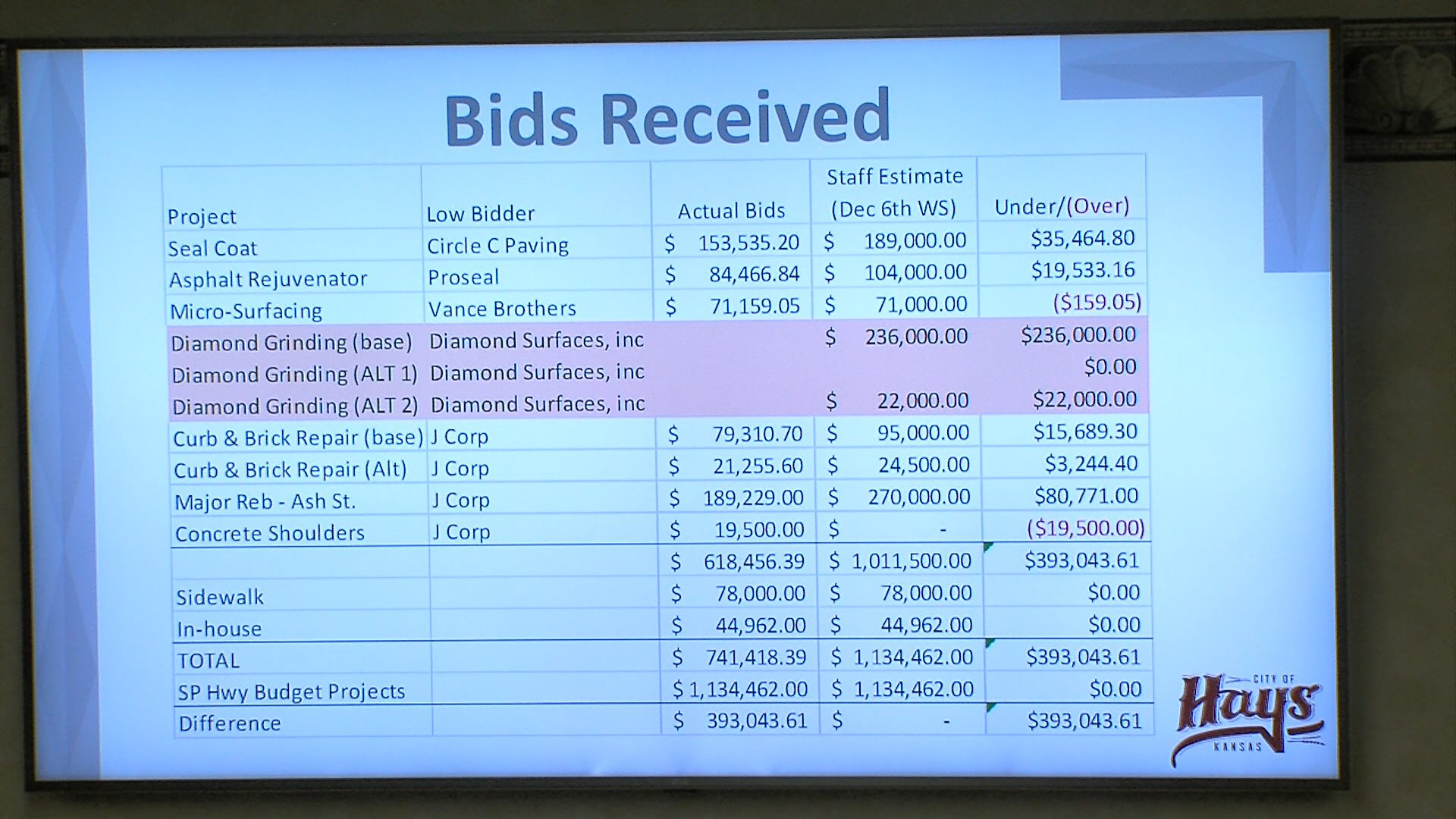
Hays city commissioners Thursday night approved six low bids totaling $774,456.39 for the 2019 Street Maintenance Program.
Monies will come from the Special Highway fund. A little more than $1.1 million is budgeted for street maintenance this year.
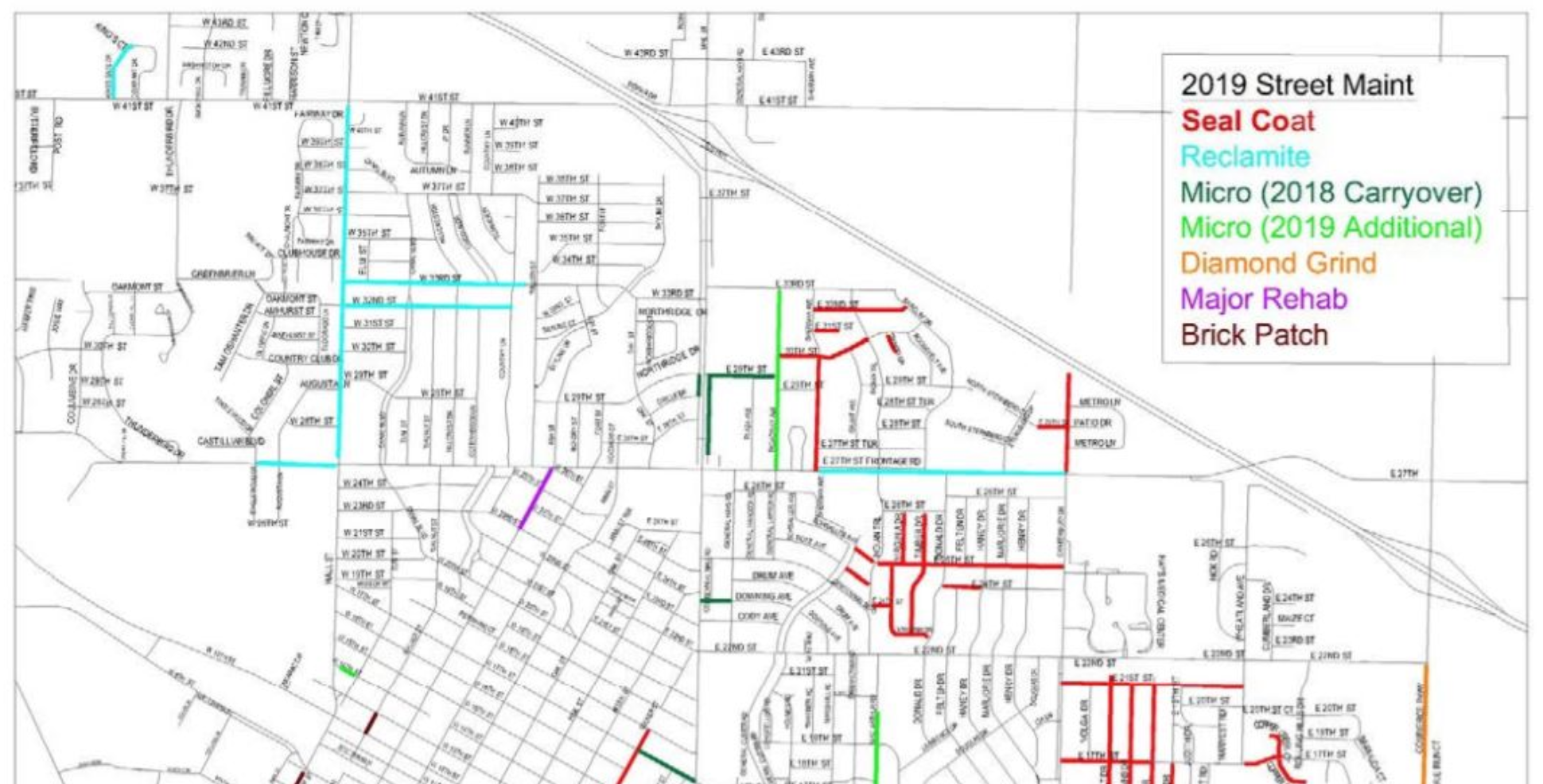
The street work includes include seal coat, asphalt rejuvenator, micro-surfacing, curb and brick repair, major rehabilitation of Ash Street from 23rd to 27th, and concrete shoulders along portions of 8th Street and Old Highway 40 east of Vine Street.
Circle C Paving and Construction, LLC, Goddard, in the amount of $153,535.20 for seal coat
Proseal Inc., El Dorado, in the amount of $84,466.84 for asphalt rejuvenator
Vance Brothers, Inc., Kansas City, MO, in the amount of $71,159.05 for micro-surfacing
J Corp., Inc., Hays, in the amount of $100,566.30 for curb and brick repair
J Corp., Inc., Hays, in the amount of $189,229.00 for Ash Street major rehab
(Click to enlarge)
J Corp., Inc., Hays, in the amount of $175,500.00 for concrete shoulders
Vance Brothers had the contract in 2018 for micro-surfacing but was unable to finish all the work, according to John Braun, the city’s project director. The company will return this year to complete last year’s remaining work and will add additional street work, all at the 2018 contract prices.
Commissioners rejected the sole bid for diamond grinding of Commerce Parkway as recommended by Braun.
“The unit bid the contractor submitted was 60% higher than the price they submitted last year,” Braun told the commission. “They indicated their schedule was pretty full and the price that they bid is the price they bid. That’s why we’re not recommending awarding the diamond grinding bid at this time.”
Instead, a portion of the estimated $393,000 for diamond grinding will be used to also extend the concrete shoulders on East 8th Street.
“That would leave about $237,000 remaining for other work which night include diamond grinding [bids] later this year for work next year,” suggested Braun.
“I had the pleasure of driving on Highway 40 today,” said Mayor Henry Schwaller.
“I saw an 18-wheeler go onto the gravel shoulder, and it was a stunning moment. Are they going to make it or are they not? So I’m glad we’re going to do those concrete shoulders. That’s a good suggestion.”
Hays city commissioners approved a 3% salary increase Thu. for City Manager Toby Dougherty (at left).
In other business, commissioners unanimously approved a 3% increase in the base salary for City Manager Toby Dougherty, beginning with the first pay period of Jan. 2019, as well as a 40 hour annual reduction in his Paid Time Off (PTO).
The commission thanked Dougherty for his leadership of the city.
“To recognize the wonderful job that he does is to recognize the department heads that he has,” said Sandy Jacobs.
“He allows them to work very independently. They do their job very well. He supports everything that they do and I think that kind of leadership is very important in our community.”
Dougherty was hired as the Hays city manager June 28, 2007.
Nearly four years ago, the cities of Hays and Russell filed applications with the state of Kansas requesting the transfer of water from their jointly-owned R9 Ranch in Edwards County to Hays in Ellis County.
They’re still waiting.
At the end of Thursday night’s Hays city commission meeting, Mayor Henry Schwaller read a brief historical statement about the project to acquire a long term water supply. He acknowledged “the process is long.”
The Water Transfer Act, which takes water from one water basin to another, has never been triggered in Kansas.
Schwaller said the city has had a good working relationship with the Division of Water Resources (DWR), part of the Department of Agriculture. DWR is the state agency that will issue the final Master Order to allow the use of the water.
“To make this relationship work out, Hays and Russell went so far as to reduce the amount of water, called consumptive yield, that we would use from the R9 Ranch, far below what the state statutes allow,” Schwaller said, “with the promise this would speed up the process of approval.
“Unfortunately, it has not.”
Schwaller said the cities “will continue to work over the next three months with our representatives in Topeka and state officials to make this project happen.”
Each of the other Hays commissioners chimed in with their support of Schwaller’s statement.
“It’s beyond time for the state to step up to the plate, cross the t’s, dot the i’s and finish this,” said Commissioner James Meier.
“It’s my personal opinion that we have been treated quite differently from anybody else who would have filed a change order application. Some of that is justified because we knew there would be a transfer process at the end of this, but the vast majority of it, quite unfairly.”
Kansas now has a new governor, Laura Kelly and a new Secretary of Agriculture, Mike Beam.
“Very frustrating,” agreed Commissioner Ron Mellick. “We’ve been getting promises that haven’t been met.
“As a commission we’re going to start pushing a little harder. It’s not about playing nice. It’s about elected and appointed officials doing what they’re supposed to do.”
Sandy Jacobs is the shortest-serving city commissioner – two years – and said the water situation is the “only issue and frustration for me. It’s not been dealt with by me as long as it has by every other commissioner on this panel today.
“We’ve done everything we’re supposed to do,” Jacobs stressed. “We have a city manager that’s led us through the process that knows more about water and what’s going on in the state of Kansas than about anybody.
“It’s time we get it done.”
Vice-mayor Shaun Musil pointed out the water project is “not only for Hays, but our neighbors and western Kansas.
“We need western Kansas to grow and if we don’t get this soon, it’s going to hurt for a long time. I hope the mayor continues to push on this.”
The communities of Ellis, Victoria and La Crosse have supported the project and may become potential purchasers of the water in the future.
Following a public hearing in Greensburg last June, DWR Chief Engineer David Barfield began preparing the Master Order.
“The order is actually written,” Schwaller said after Thursday’s city commission meeting. “He is putting in the facts and bullet points he thinks are important that he got from that meeting before issuing it.”
According to Schwaller, the city was told the order would be completed before Christmas.
“There’ve been some friendly communications, some confusing communications. We do continue to stay in touch with the Division of Water Resources but we’re not gaining any ground.”
“Our communities in the region need the R9 Ranch in order to remain economically viable,” Schwaller said.
“This will be the largest project in our cities’ history and we are very concerned about the delay in issuing that Master Order.”
Schwaller added that he hopes to have some new information about the project status on Tuesday.
An archive of the city of Hays/R9 Ranch Water Right Changes and Water Transfer Application is available on the KDA/DWR website.
City commissioners will vote Thursday night on the proposed bid awards for the 2019 Street Maintenance program.
The recommendations from city staff total $774,456.39, which would be funded out of Special Highway.
• Circle C Paving and Construction, LLC in the amount of $153,535.20 for Seal Coat
• Proseal Inc. in the amount of $84,466.84 for Asphalt Rejuvenator
• Vance Brothers, Inc. in the amount of $71,159.05 for Micro-Surfacing
• J Corp., Inc. in the amount of $100,566.30 for Curb and Brick Repair
• J Corp., Inc. in the amount of $189,229.00 for Ash Street Major Rehab
• J Corp., Inc. in the amount of $175,500.00 for concrete shoulders
Other agenda items include annexation of property at Highway 183 Bypass and West 33rd Street owned by Robert and Sondra Swift. The couple has plans for an RV park on the land.
Commissioners will also consider approving a 3.0% pay increase of the base salary for City Manager Toby Dougherty and will recognize employee promotions and new hires.
Chad Ruder, IT director, will review the layout and efficiencies of the city’s new website design.
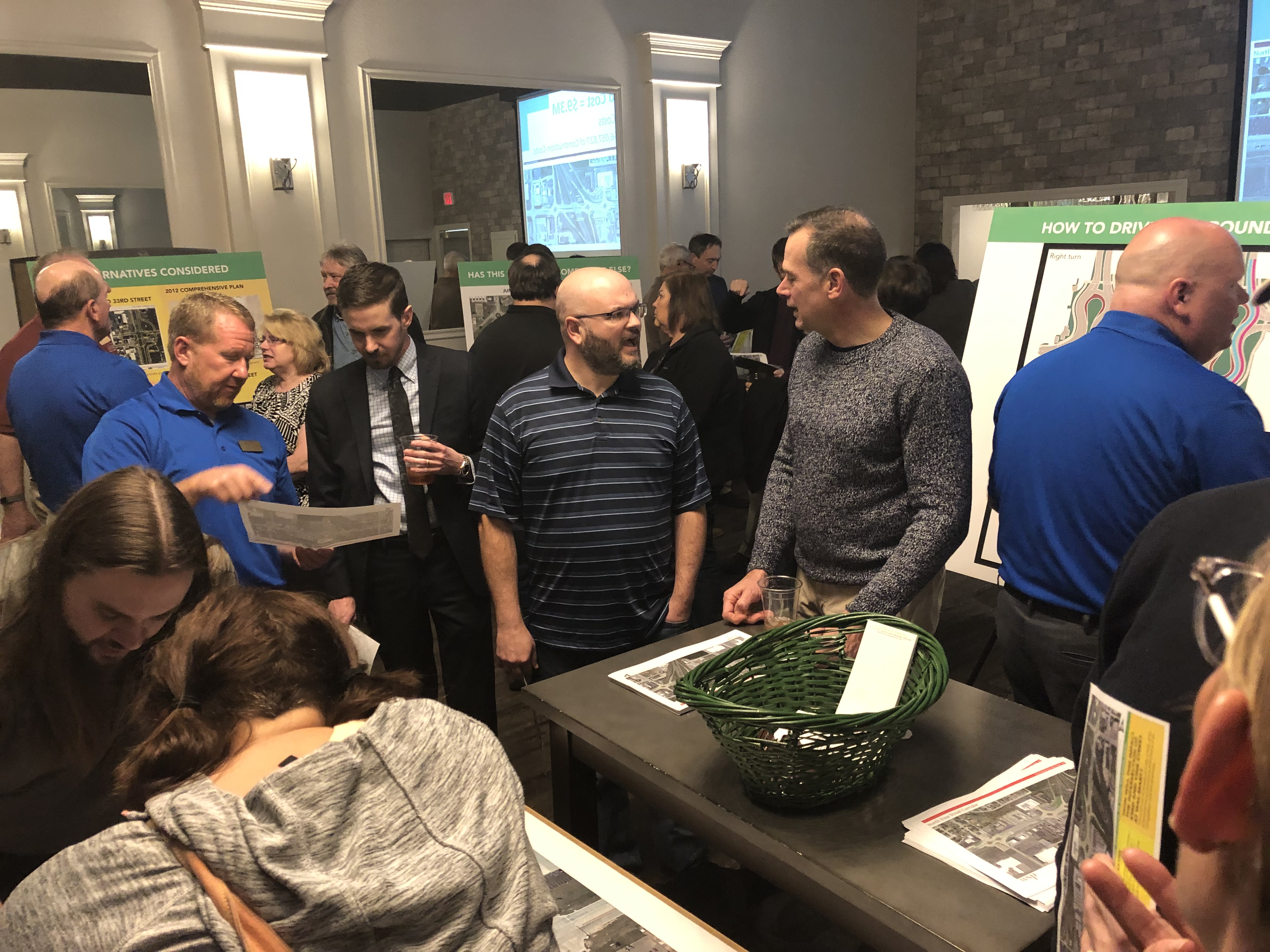
The city of Hays hosted an information session Tuesday night about the proposed North Vine Street Corridor Improvement Project.
By BECKY KISER Hays Post
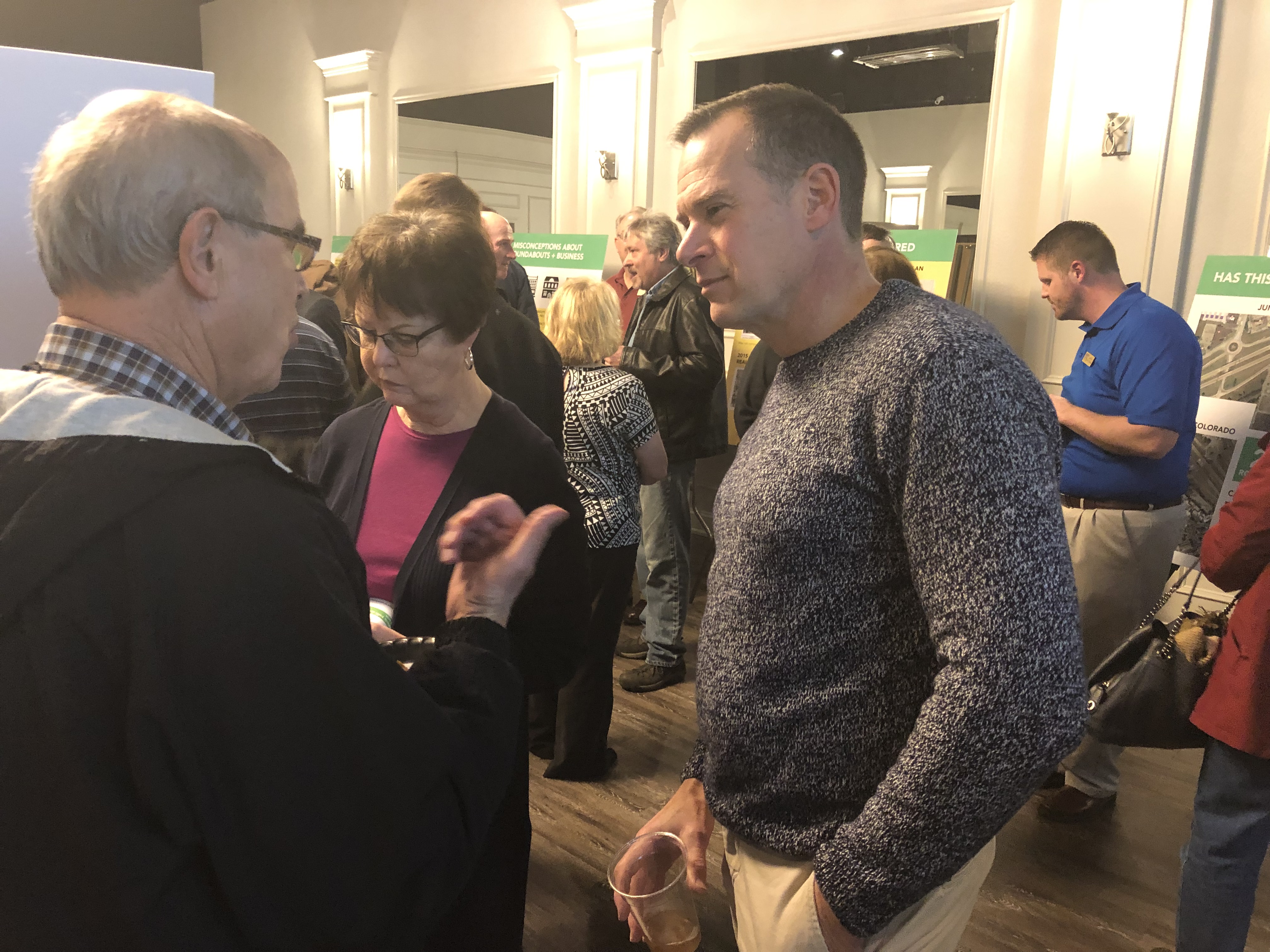
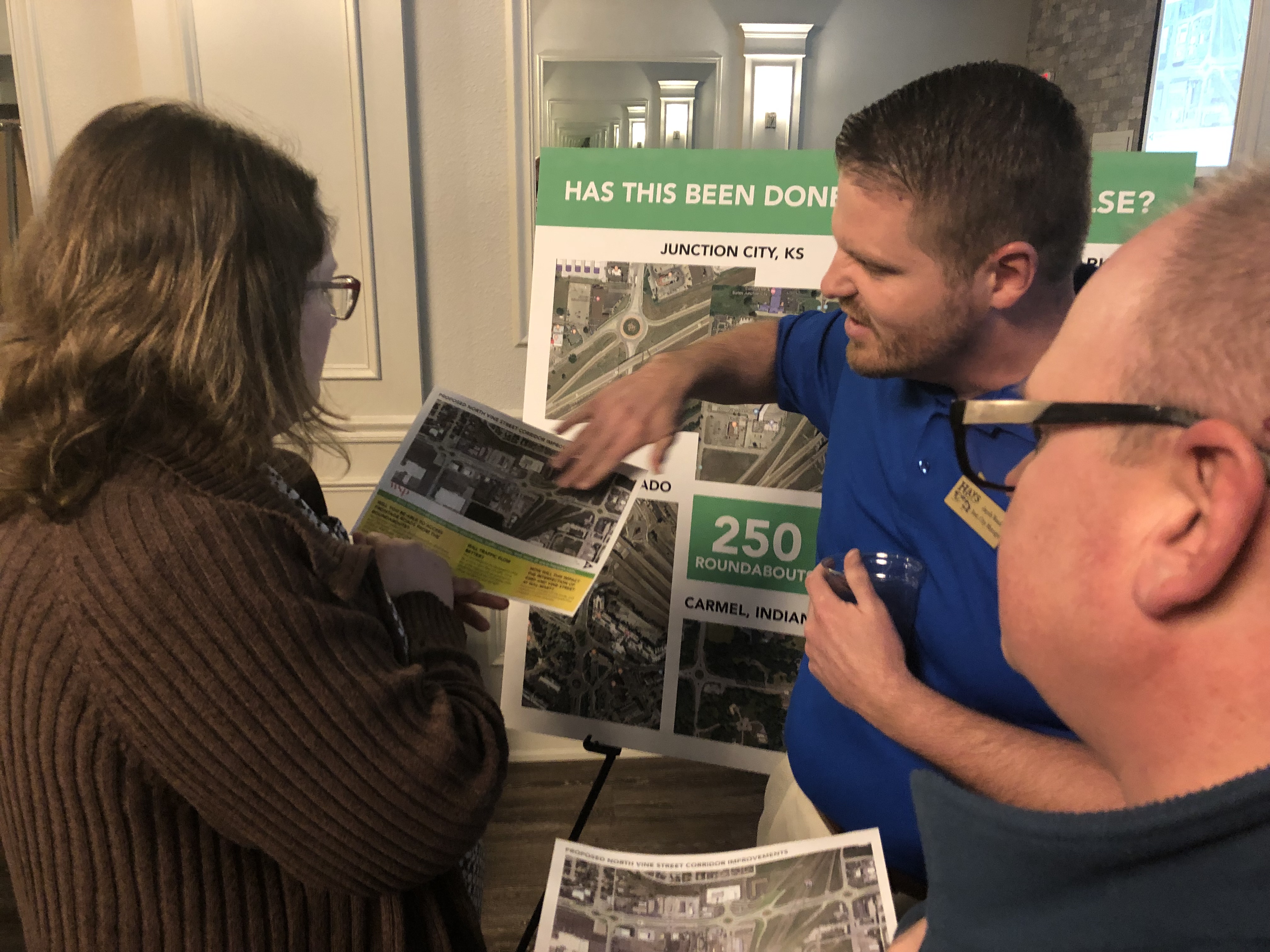
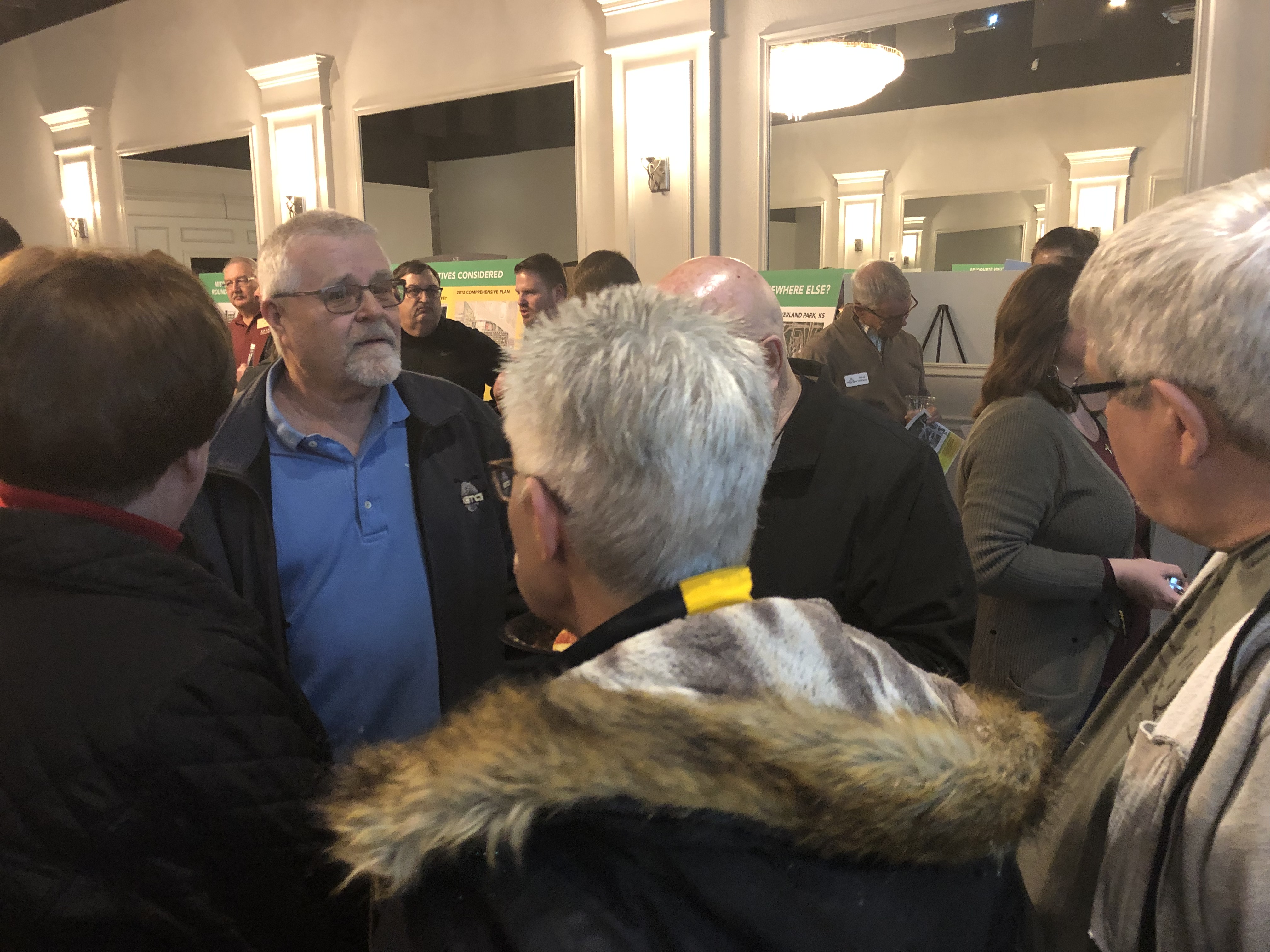
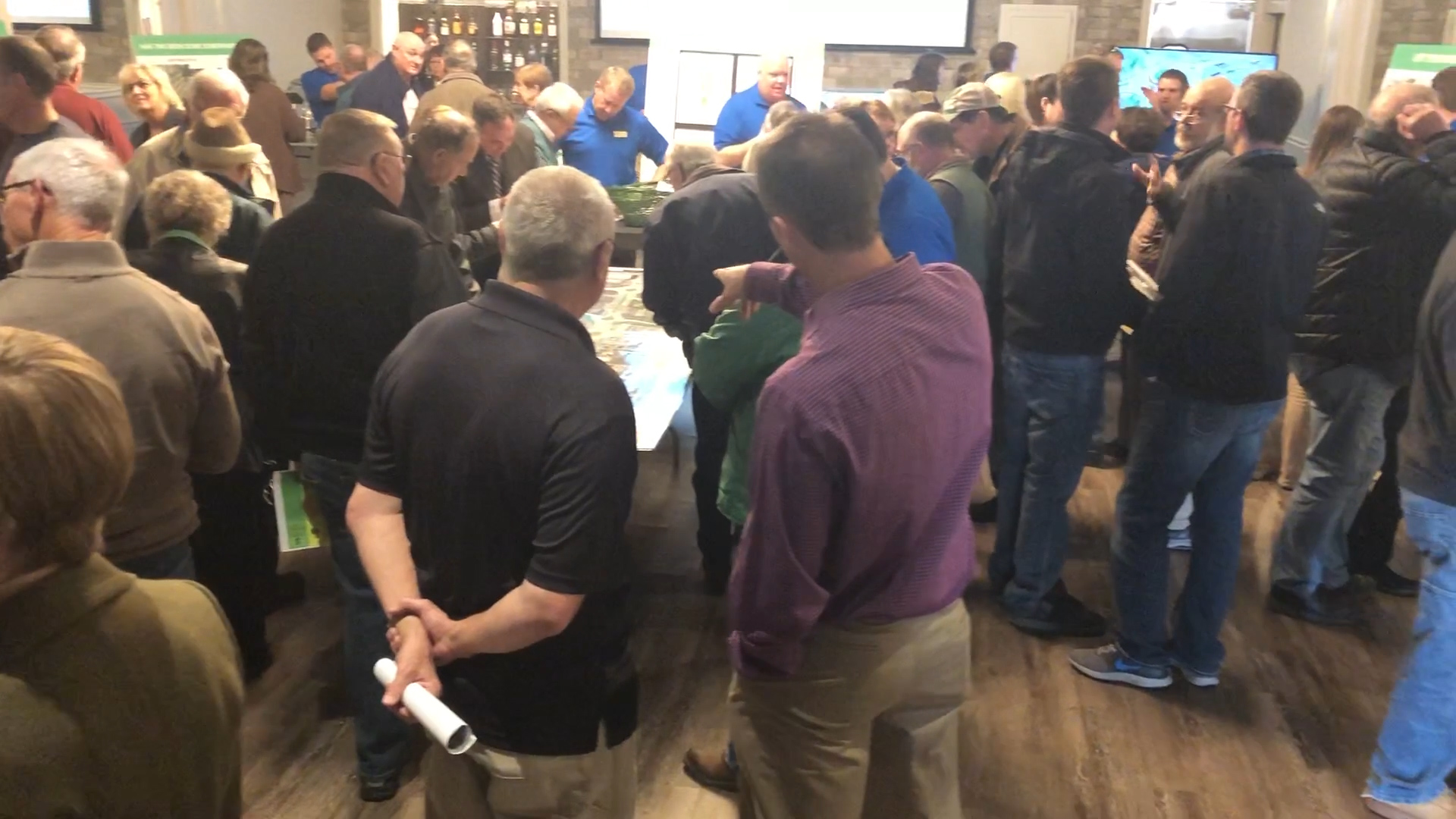
Within the first 15 minutes, 80 people gathered Tuesday night for the city of Hays’ open house to see the design concept for four proposed traffic roundabouts on north Vine Street.
They were greeted — and counted — by Melissa Dixon, executive director of the Hays Convention and Visitors Bureau.
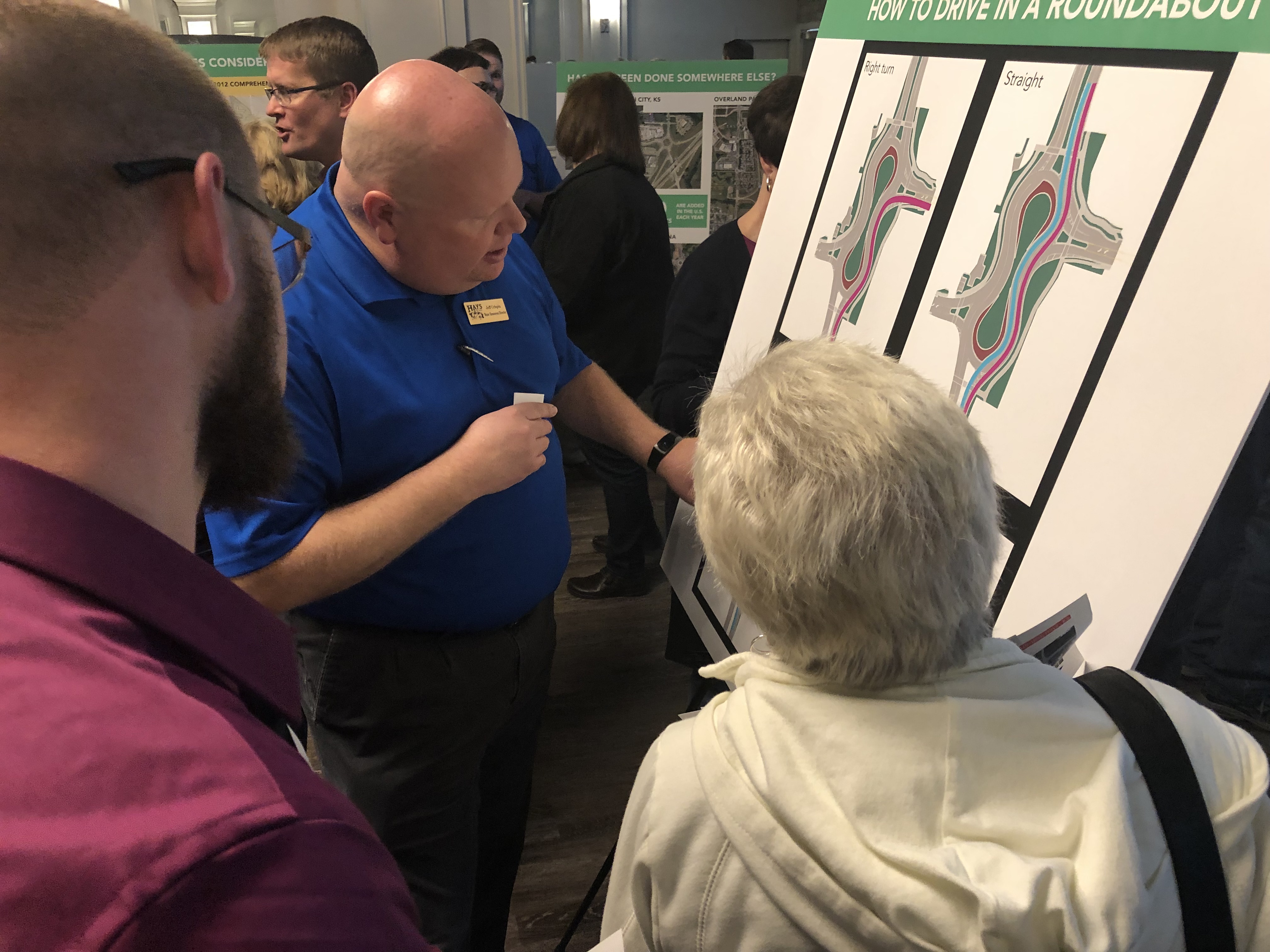
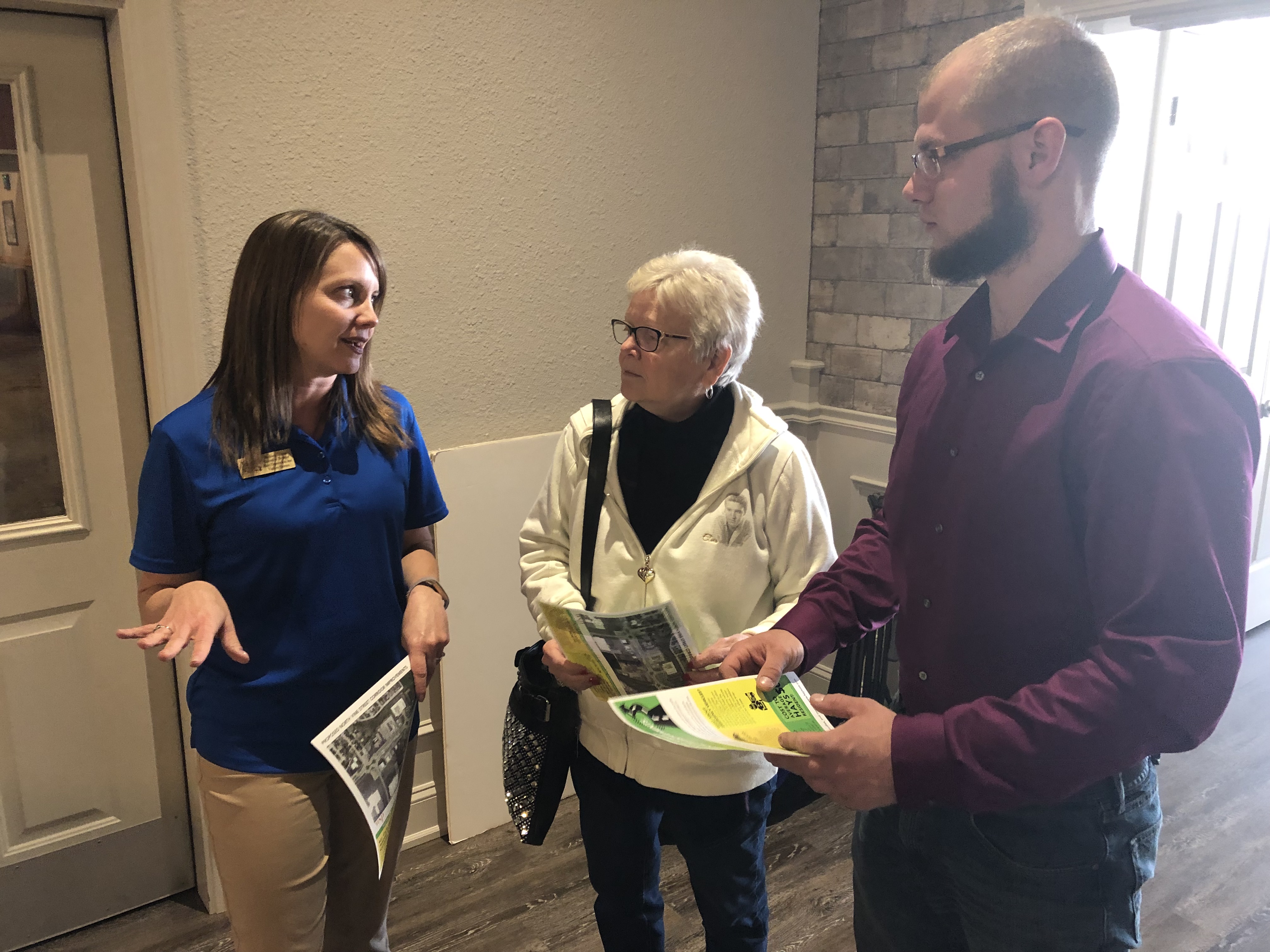
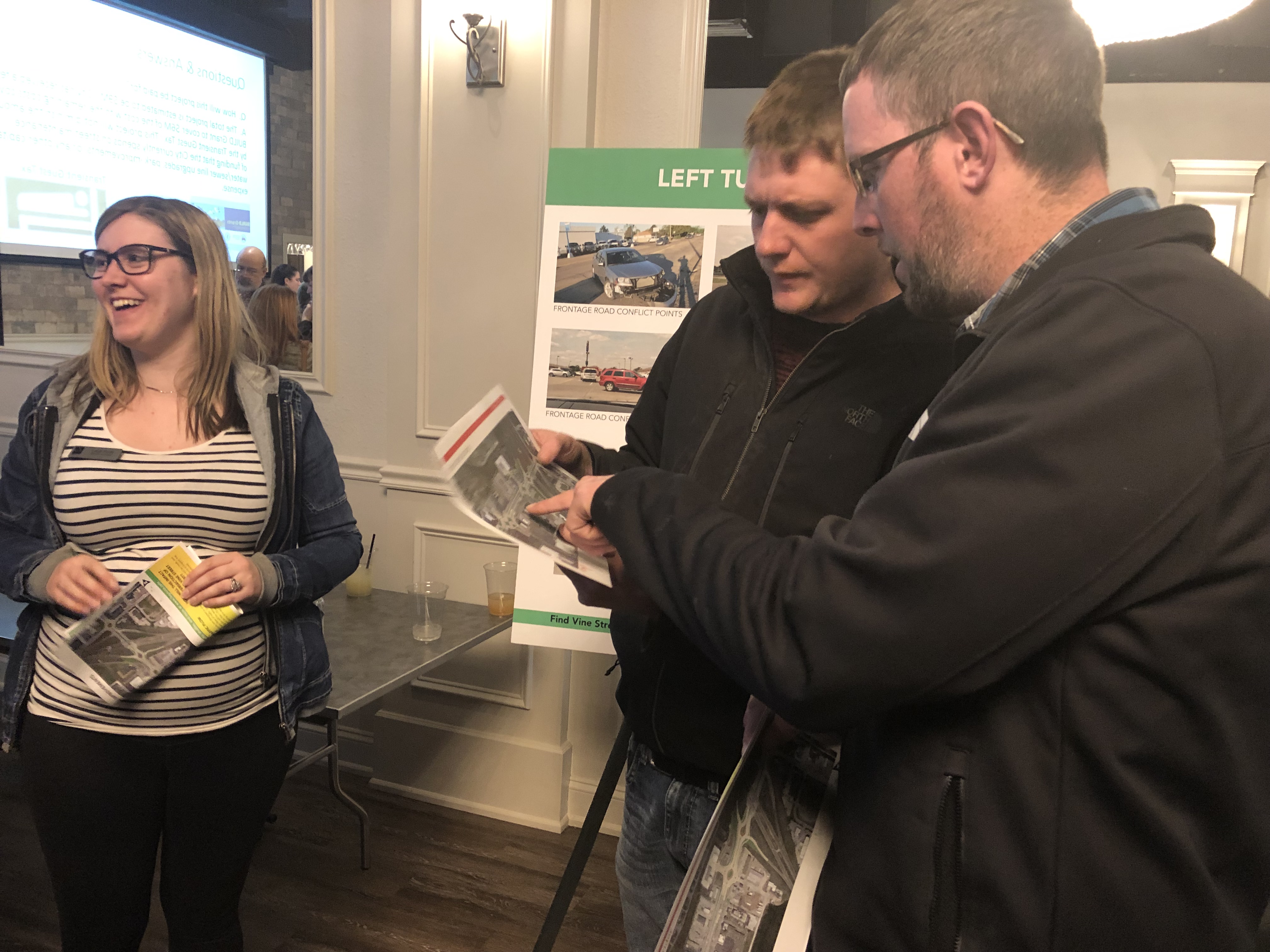
More than 200 people attended the two-hour event at The Venue in Thirsty’s Bar & Grill, where city staff, wearing bright blue polo shirts, were on hand along with project engineers from WSP and the Kansas Department of Transportation to answer questions from the public.
“I was hoping for a good turnout,” said James Meier, city commissioner, “but this is better than I expected.” Meier, who favors the roundabouts, said he hoped the information “alleviates some fears” residents might have.
Mayor Henry Schwaller said he talked to more people opposed to the project than in favor of it.
“This gives everyone a chance to see what the project will probably look like and how it works. This is a design. It’s not been approved,” he said.
Schwaller has said previously he is a “roundabout skeptic.”
He agreed the situation at 32nd and 33rd streets creates the most dangerous intersection in the city and “something has to be done.” Schwaller also sees a problem at 37th Street, where the former Ambassador Hotel was located.
“We can’t put a stoplight there. The Kansas Department of Transportation won’t allow us that,” he said.
The rest of the proposed project is too big to work, Schwaller said, “particularly for visitors coming from out of town. Getting through that gauntlet can be pretty daunting.”
Still, Schwaller concedes the city commission will “go for what the majority wants.”
RELATED: Hays Post conducted two polls, one on HaysPost.com and the other on Facebook, asking the public for their opinion of the proposed north Vine Street improvements.
The city is still waiting for final design on the project. Preliminary design is expected to be completed in March with a final design in November, according to John Braun, the city’s project manager. Bid opening would begin in April 2020 with construction planned to start in June 2020. The work is scheduled to be finished in November 2021.
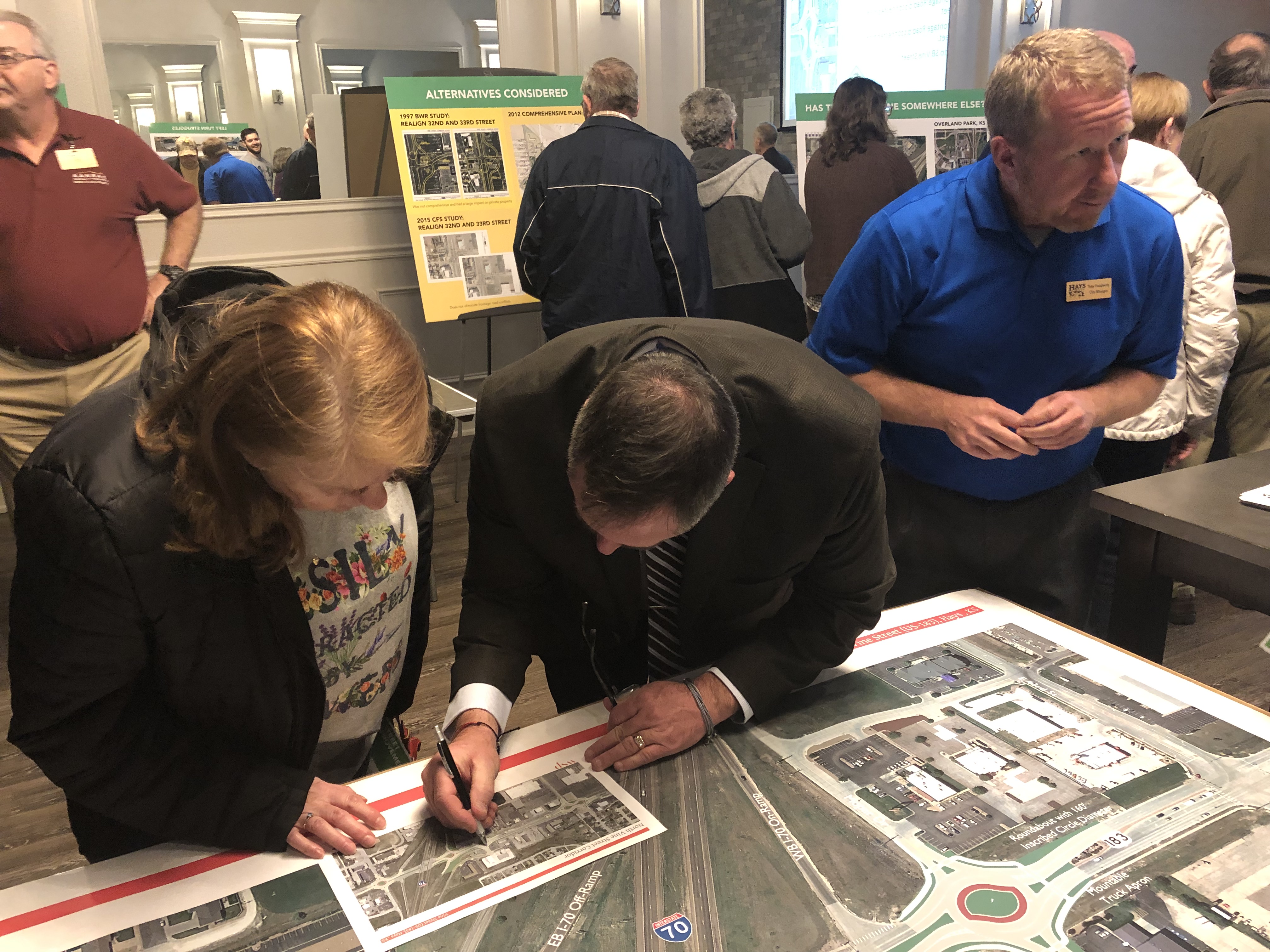
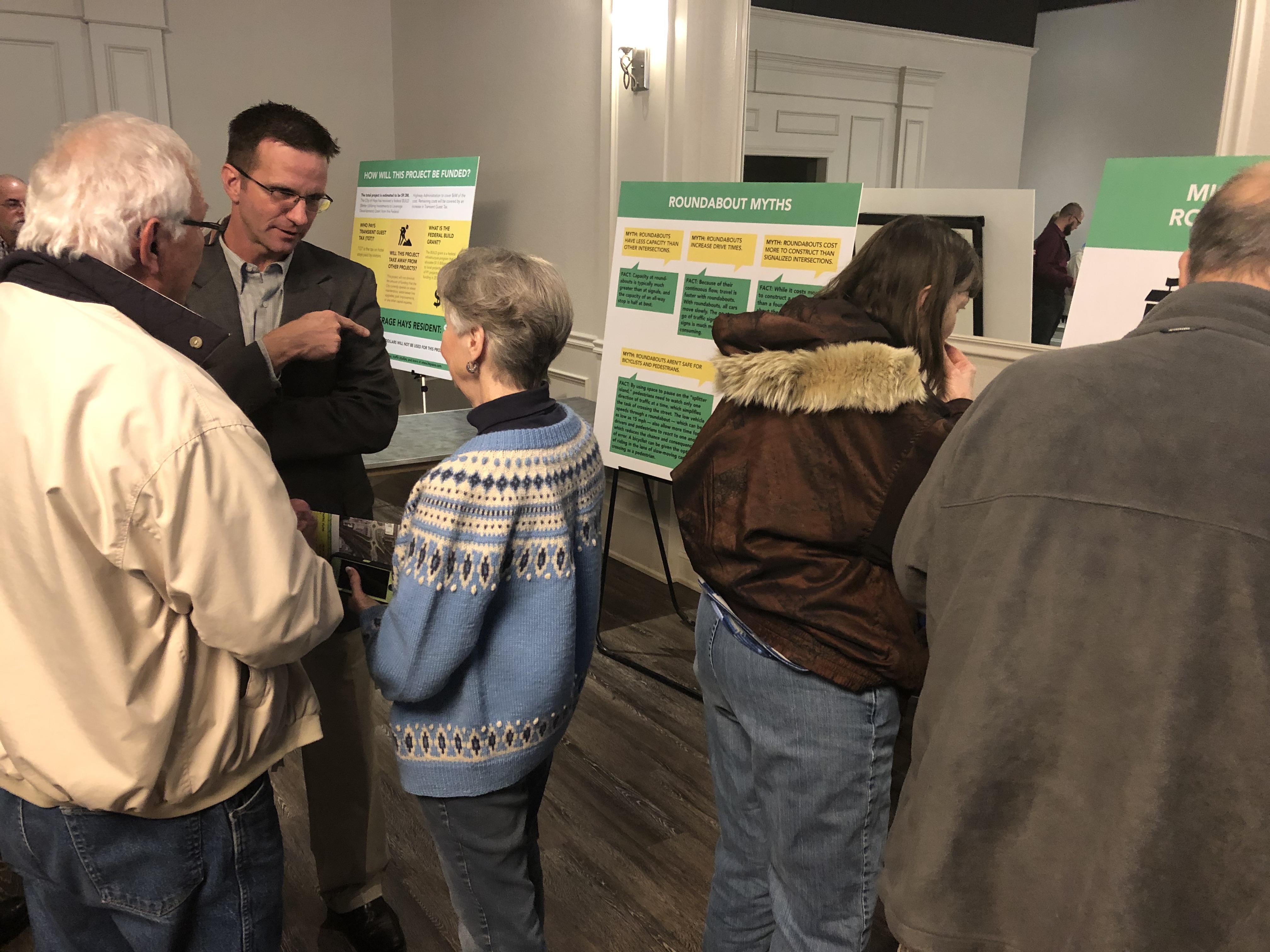
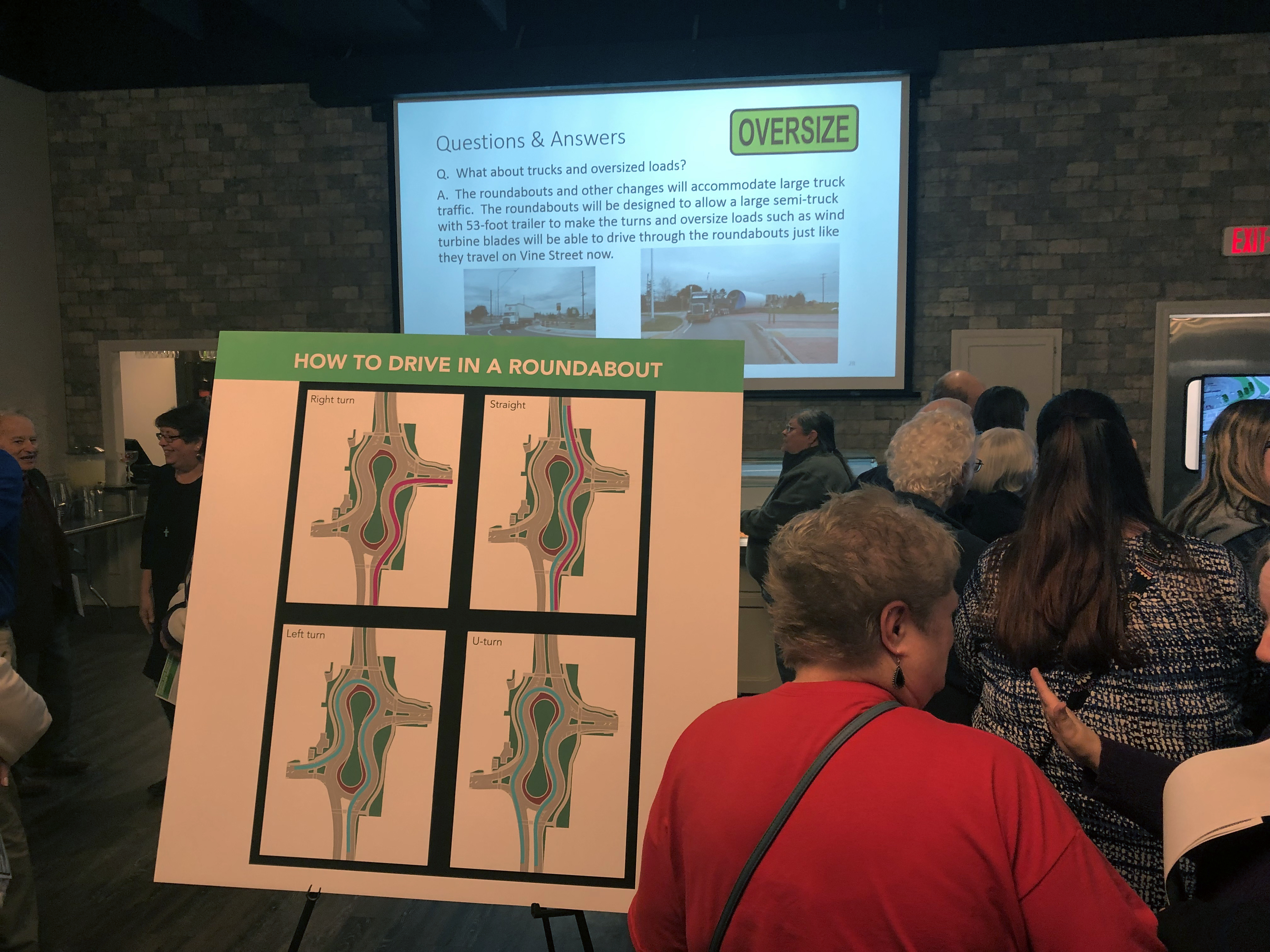
The conversation was non-stop in the meeting room. Posters depicting often-asked questions and the answers were set up on easels around the room perimeter. One poster showed four previous design plans to improve safety which were all rejected.
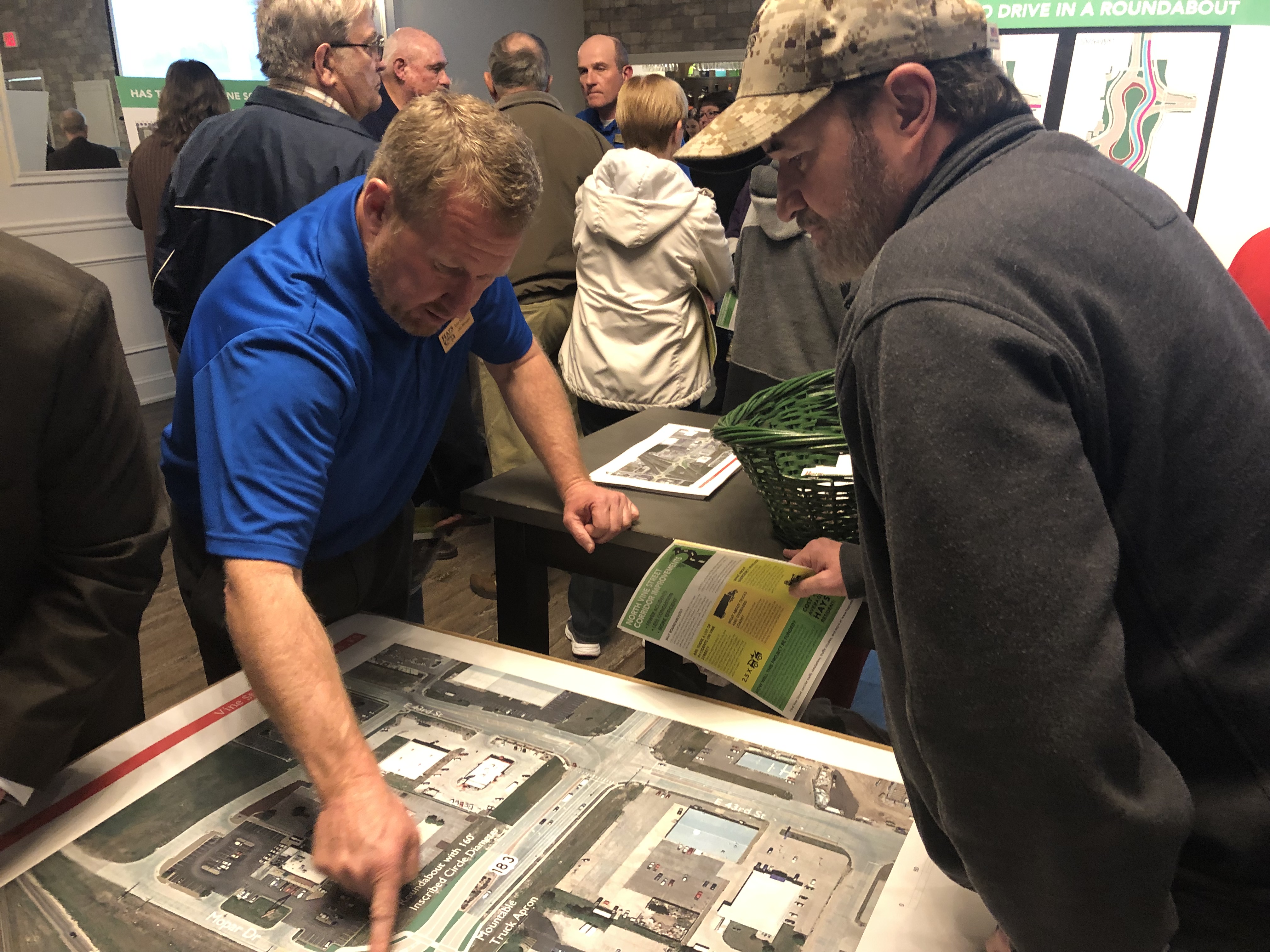
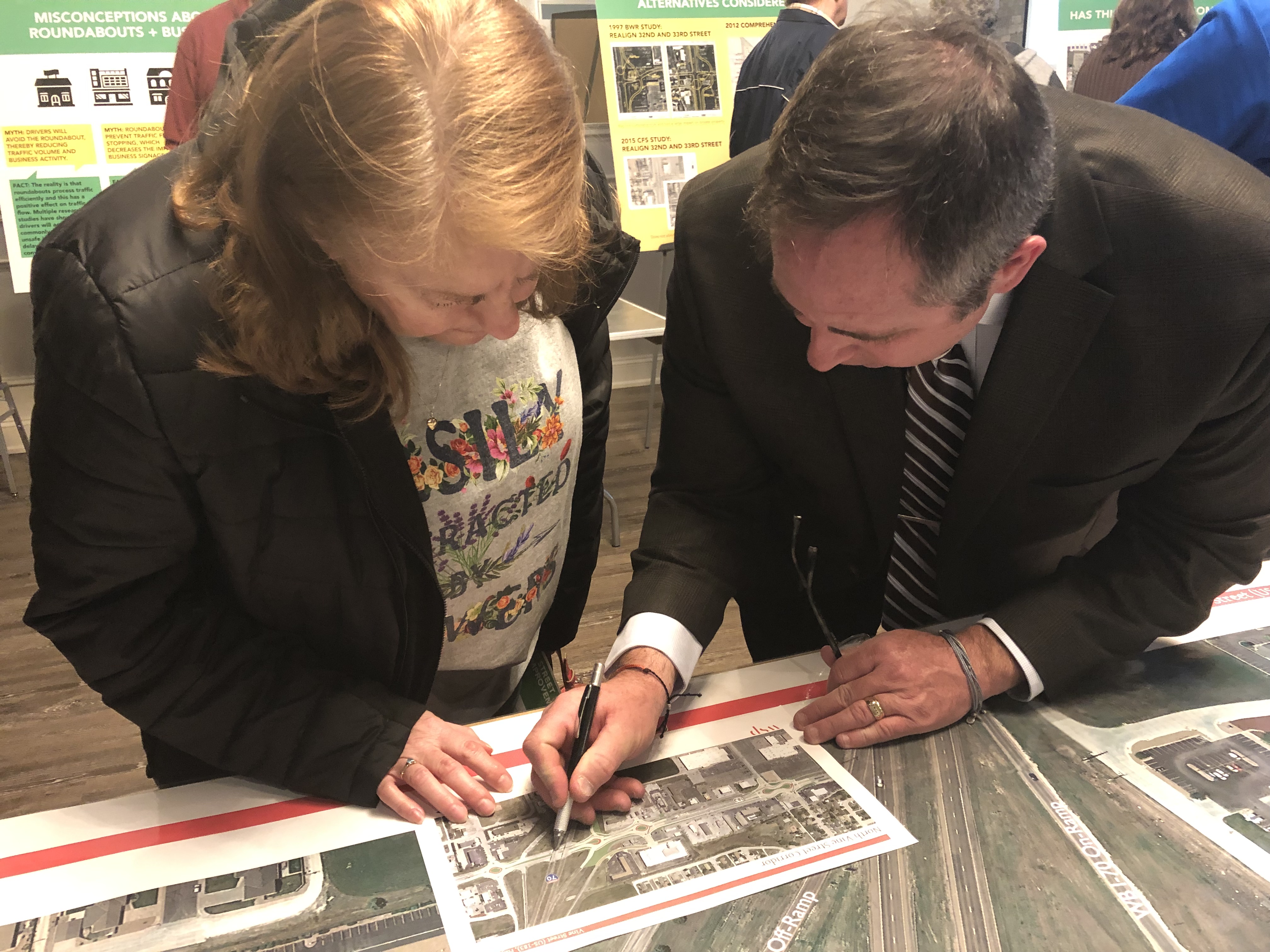
An oversized map of the Vine Street traffic corridor design between 32nd and 41st streets was laid out on a table in the middle of the room. People crowded around it the entire evening, pointing to specific areas with their questions. Staff and engineers used dry erase markers on the map to illustrate their points.
(Click to enlarge)
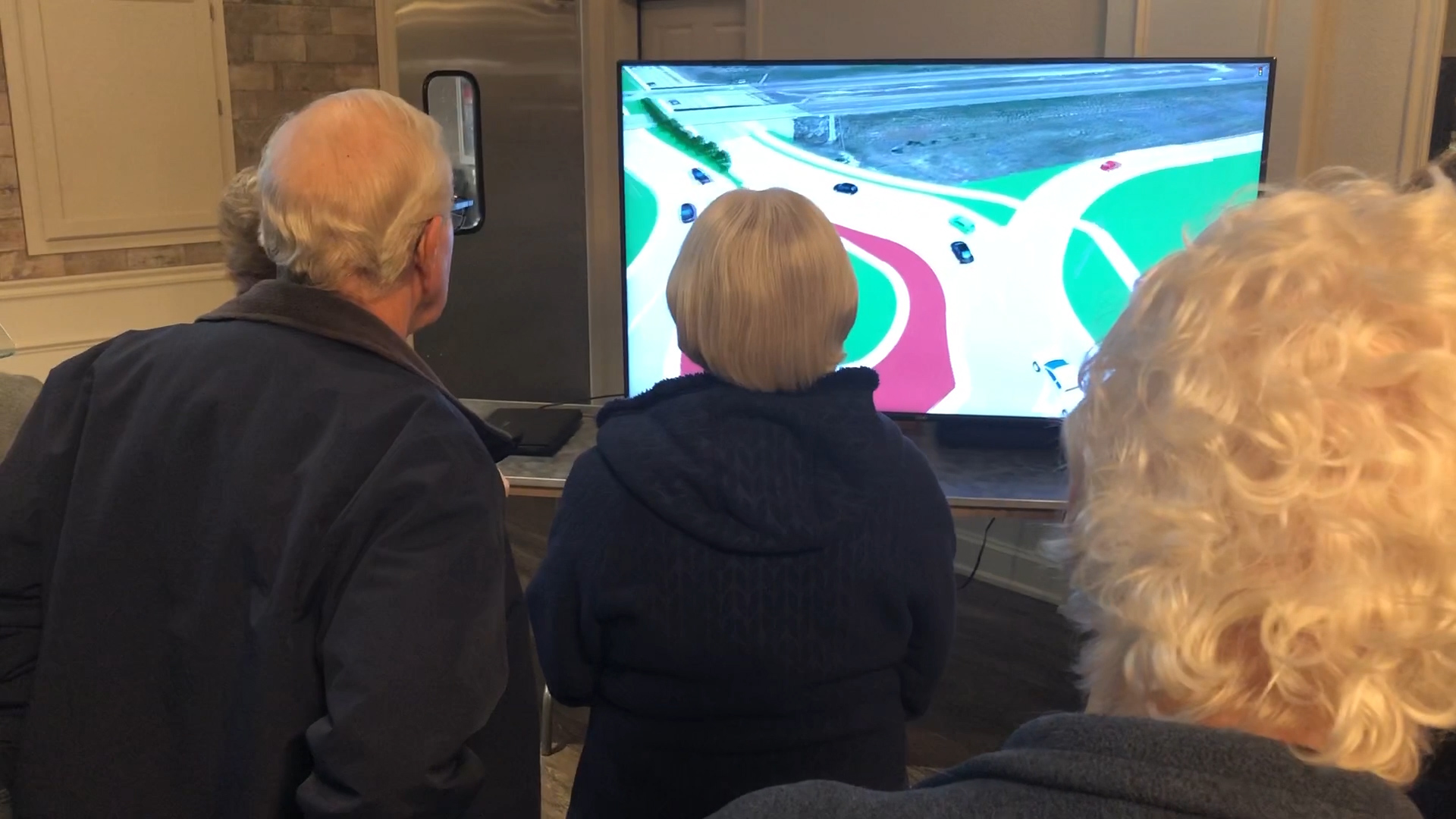
A large-screen TV continuously played the simulated corridor traffic flow through the roundabouts at 32nd/33rd, 37th, 41st and the westbound Interstate 70 exit ramp.
The simulation, created by Jay Aber, senior traffic engineer at WSP Engineers, Lenexa, uses a four-year study of Hays traffic in the corridor.
Another video screen scrolled through questions and answers with graphics showing examples of the changes.
Marcie Pray lives in Victoria and works in downtown Hays. She’s driven through traffic roundabouts in bigger cities.
“I think it’s becoming an accepted thing although it’s very intimidating to us drivers who are little older,” Pray said with a laugh. “You gotta know which lane you’re getting into and how to get around to where you’re trying to get at.”
She described the open house as “overwhelming but informative.”
A simulation of traffic flowing through proposed Hays roundabouts.
“But I think the best was the video. That was tremendous. First of all, I didn’t realize it was actually Hays video, and that really shone the light. And seeing the traffic flow was really helpful,” Pray said.
Aber answered several questions about how semis would get through a roundabout.
“U.S. 183 is a really important freight corridor. The highway is Vine Street itself. Obviously you have a lot of regular trucking. You also have a lot of oversize loads, including wind turbine towers and blades.
“One of the early requirements for this project was that two semi-trucks could drive side by side through the entire corridor,” said Aber.
“It’s also designed for the wind turbine blades specifically because they’re roughly the length of of two and half semi-trucks together. The wheels track really far outside of any kind of typical truck.
“So we also designed it so that a wind turbine blade on a 180-foot long truck can drive through the corridor without needing to stop traffic or to stop and use any special rear-wheel turning.”
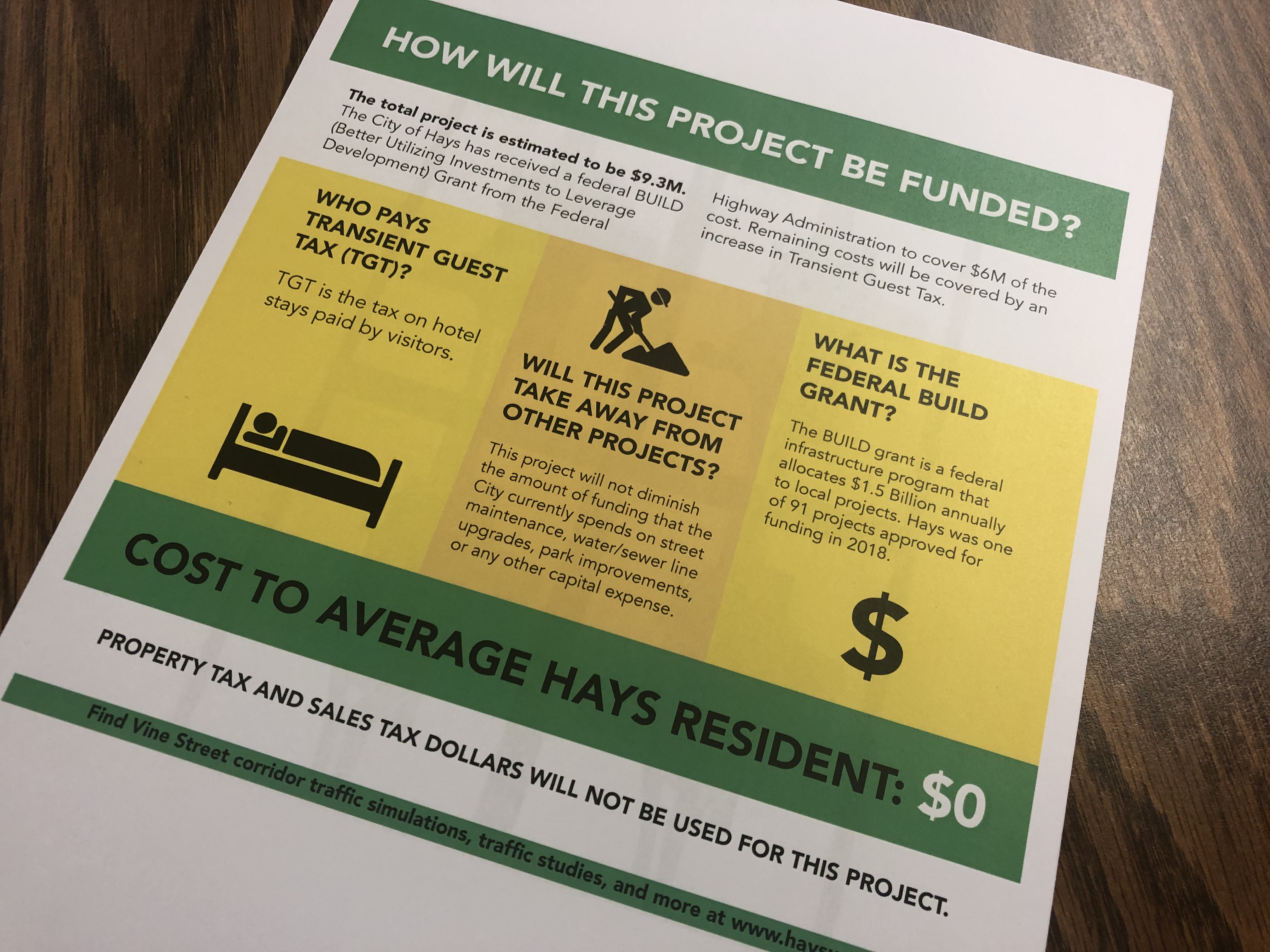
Even though the proposed $9.3 million project would be funded by a $6 million federal grant and a dedicated 20-year 2 percent increase in the transient guest tax, 77-year-old Tom McClelland believes it’s “a waste of money.”
“I wish I was 35, 40 years younger. I’d buy a piece of property close and buy wrecker trucks because I think there’s gonna be a lot of them (wrecks),” the retired McClelland said. “All the people that are for this are telling me that’s not gonna happen, that there’ll be minor crashes. No T-bone wrecks but I can see a lot of side-swiping.”
Hays Police Chief Don Scheibler
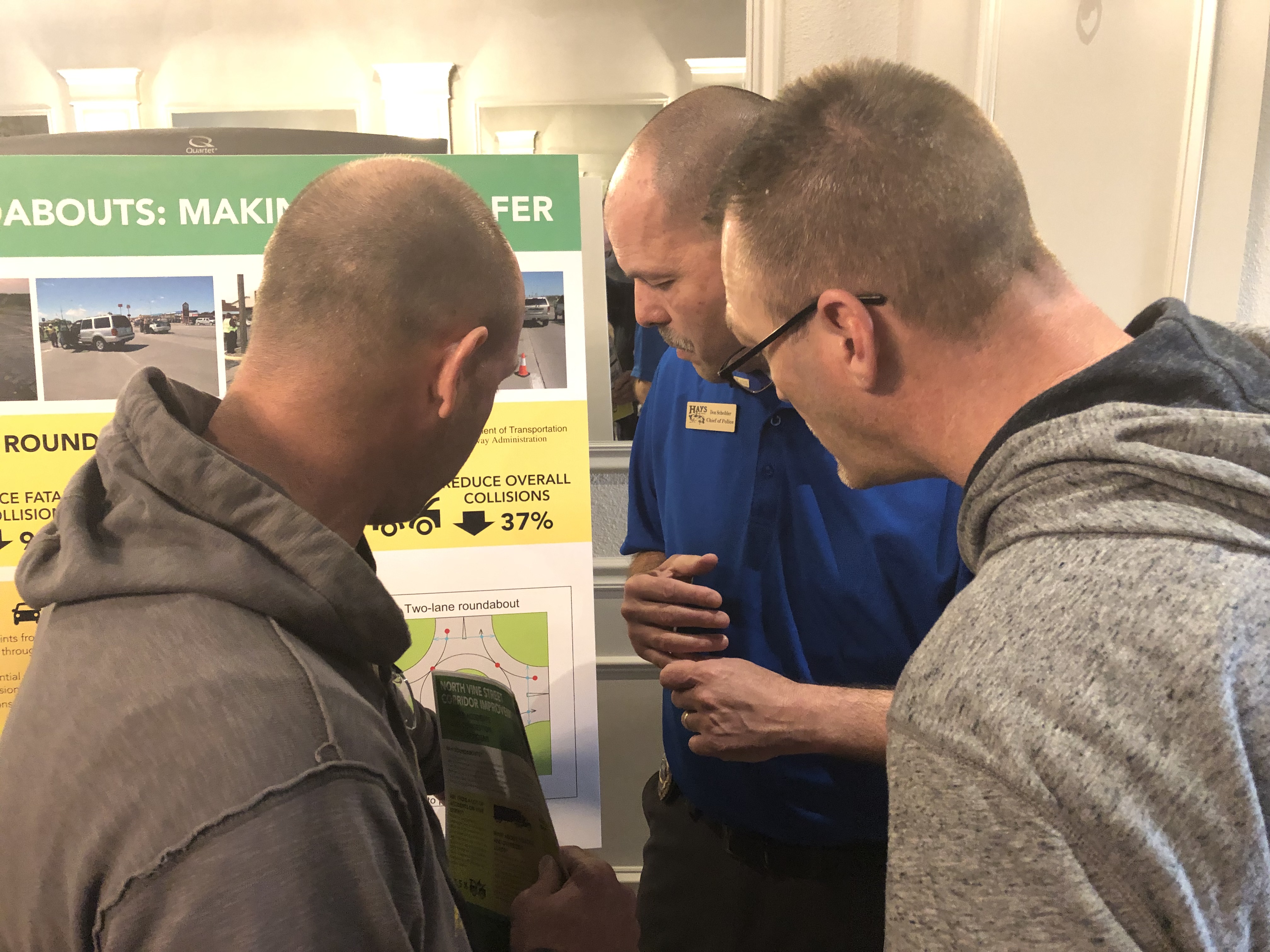
Hays Police Chief Don Scheibler talked about roundabout safety to the crowd, using statistics from the U.S. Department of Transportation.
According to the Federal Highway Administration, roundabouts reduce fatality collisions by 90 percent and injury collisions by 75 percent. Overall collisions in a traffic roundabout are reduced by 37 percent.
The roundabouts would reduce the current number of vehicle conflict points from 32 to 8. Scheibler prefers to call them “contact points.”
“The current configuration really encourages aggressive driving through this area on Vine,” Scheibler said. “To make it through all the traffic lights, you have to speed.”
Scheibler also pointed out the driving speed in a roundabout is reduced. “Somebody may be going 40 miles an hour right now on Vine. That’ll be slowed down to about 25 miles an hour.”
The four-year traffic study of the Vine Street corridor from 32nd to 41st showed there were 124 vehicle accidents; 119 of those occurred in intersections.
With the elimination of traffic signals by the roundabouts at 32nd/33rd and the I-70 ramps, the potential of head-on and T-bone collisions typical in signaled intersections, are also eliminated. Vehicle crashes are more likely to be side-swipes at much lower speeds, Scheibler explained.
The project design is also safer for pedestrians, reducing conflict points from 24 to 8.
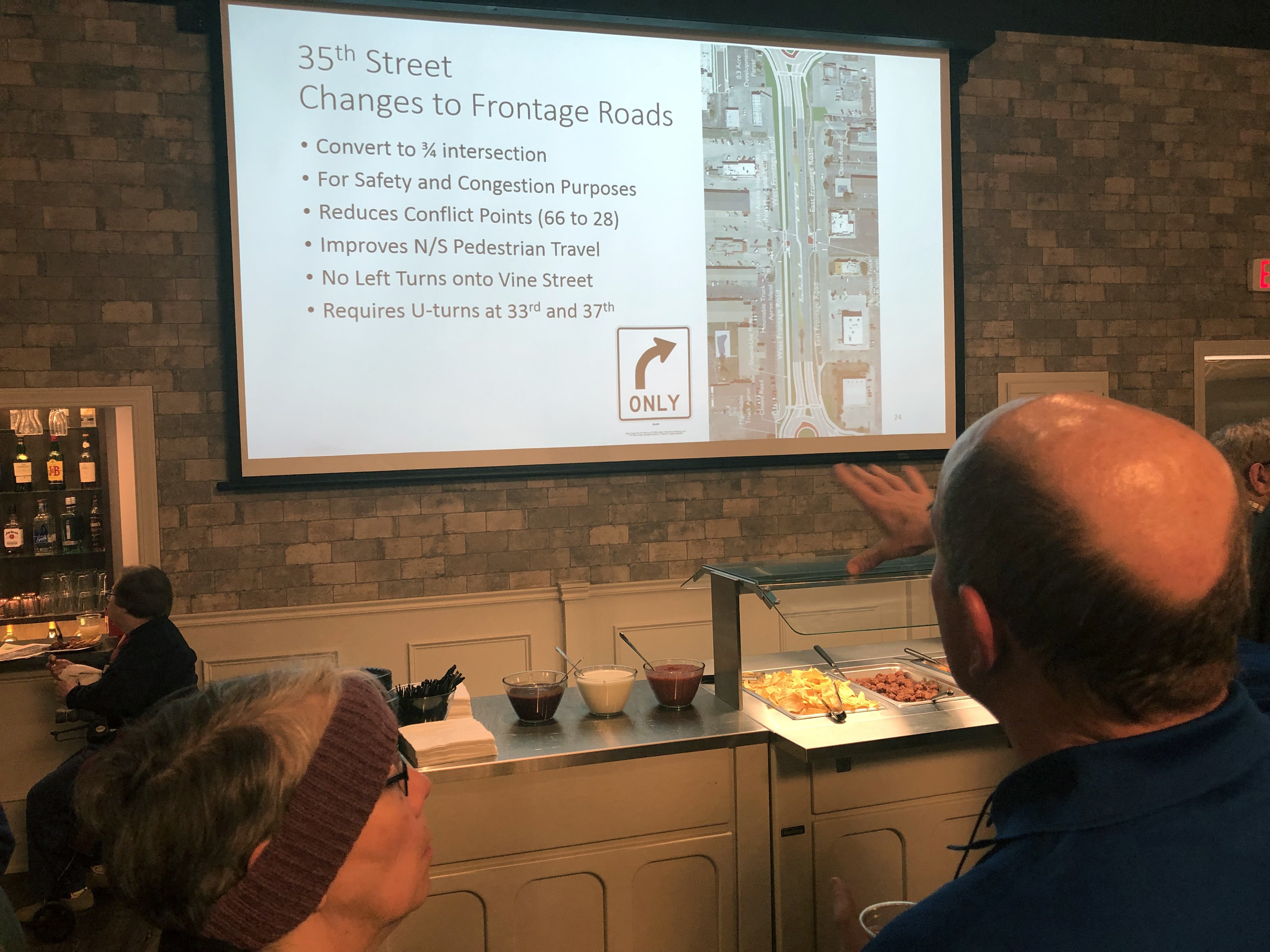
Existing frontage roads would be disconnected from 32nd and 37th. Frontage roads will only have access to Vine at 35th, which will be changed to a 3/4 intersection. That would allow right and left turns from Vine but only right turns onto Vine.
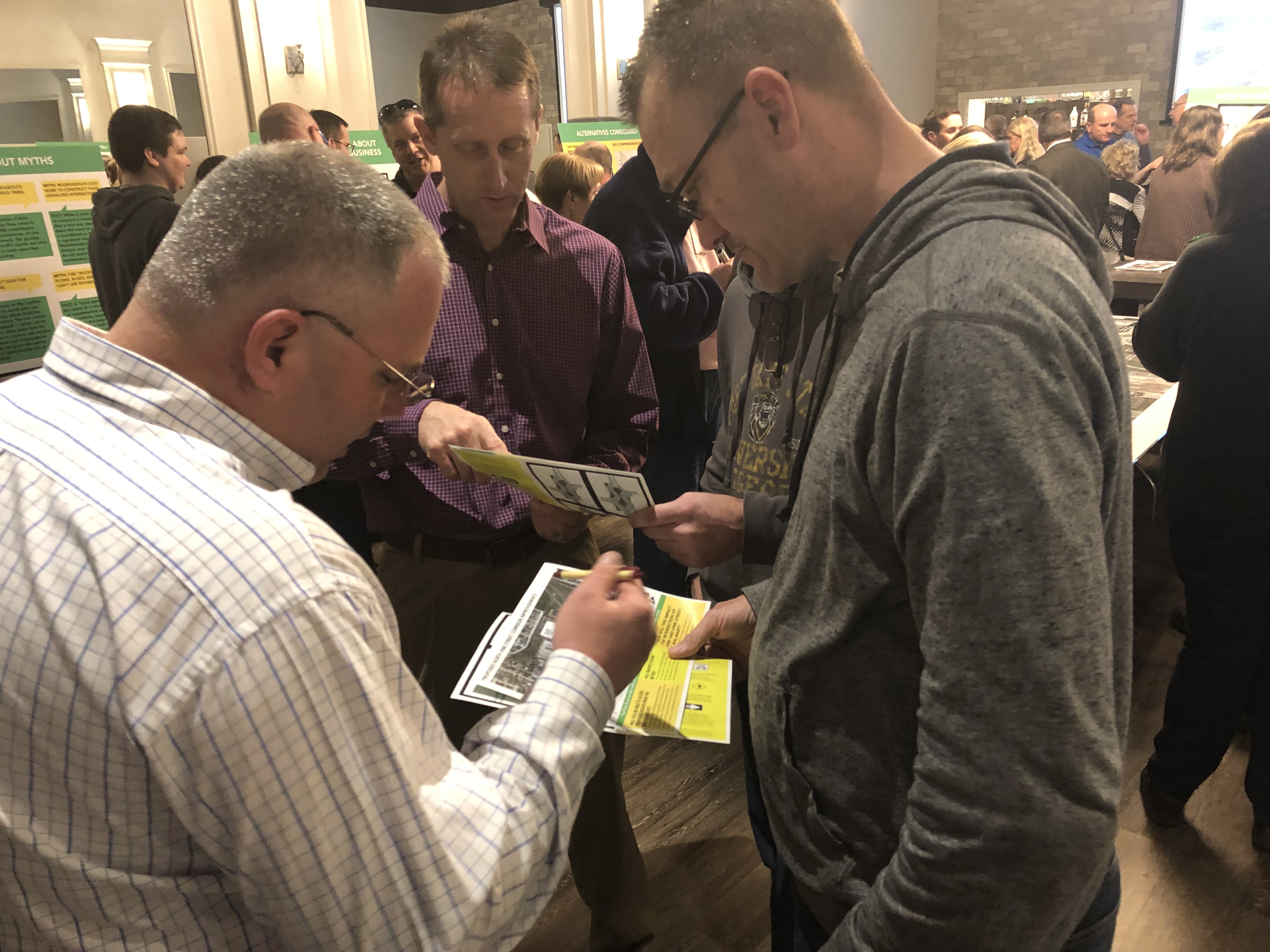
Attendees were given handouts and copies of the poster boards to take home for further study.
Pray is somewhat sure the roundabouts would be a positive addition to Hays. “I think it is. It’s just going to take a learning curve to accept it.”
The traffic simulation video and copies of the poster handouts are available on the city’s website www.haysusa.com.
Hays Mayor Henry Schwaller
Asst. City Manager Jacob Wood
Water Resources Dir. Jeff Crispin
CVB Exec. Dir. Melissa Dixon
City Commissioner Ron Mellick
City Manager Toby Dougherty, Ellis Co. Commissioner Dustin Roths, City Commissioner James Meier, Mayor Henry Schwaller
Police Chief Don Scheibler
City of Hays Project Dir. John Braun
The city of Hays hosted an information session Tuesday night about the proposed North Vine Street Corridor Improvement Project.
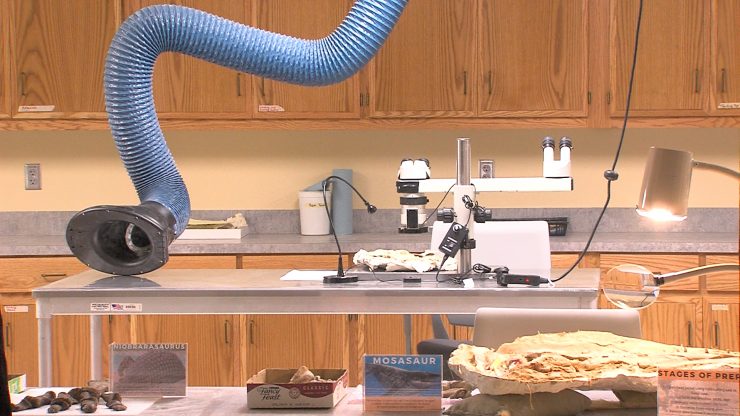
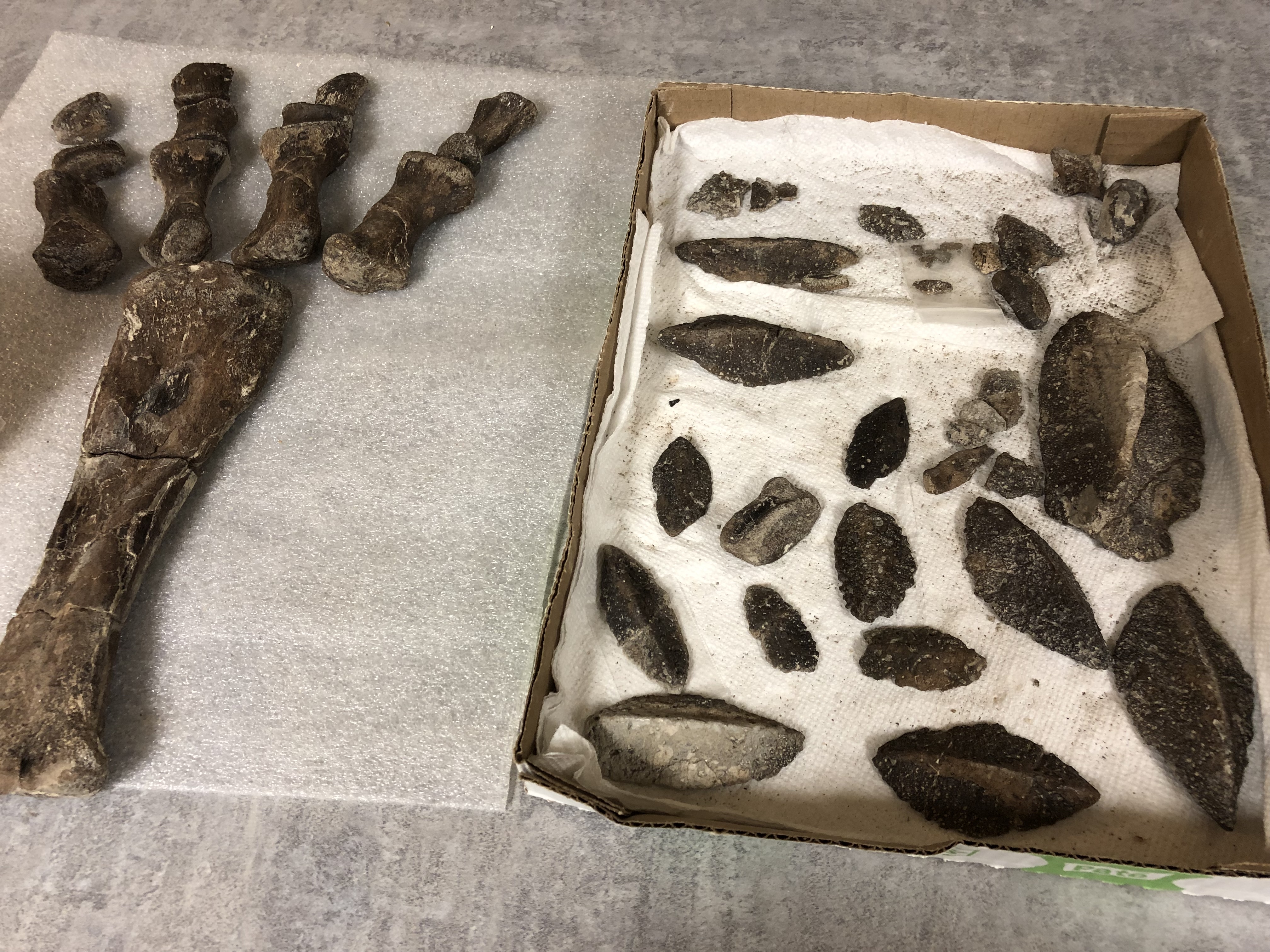
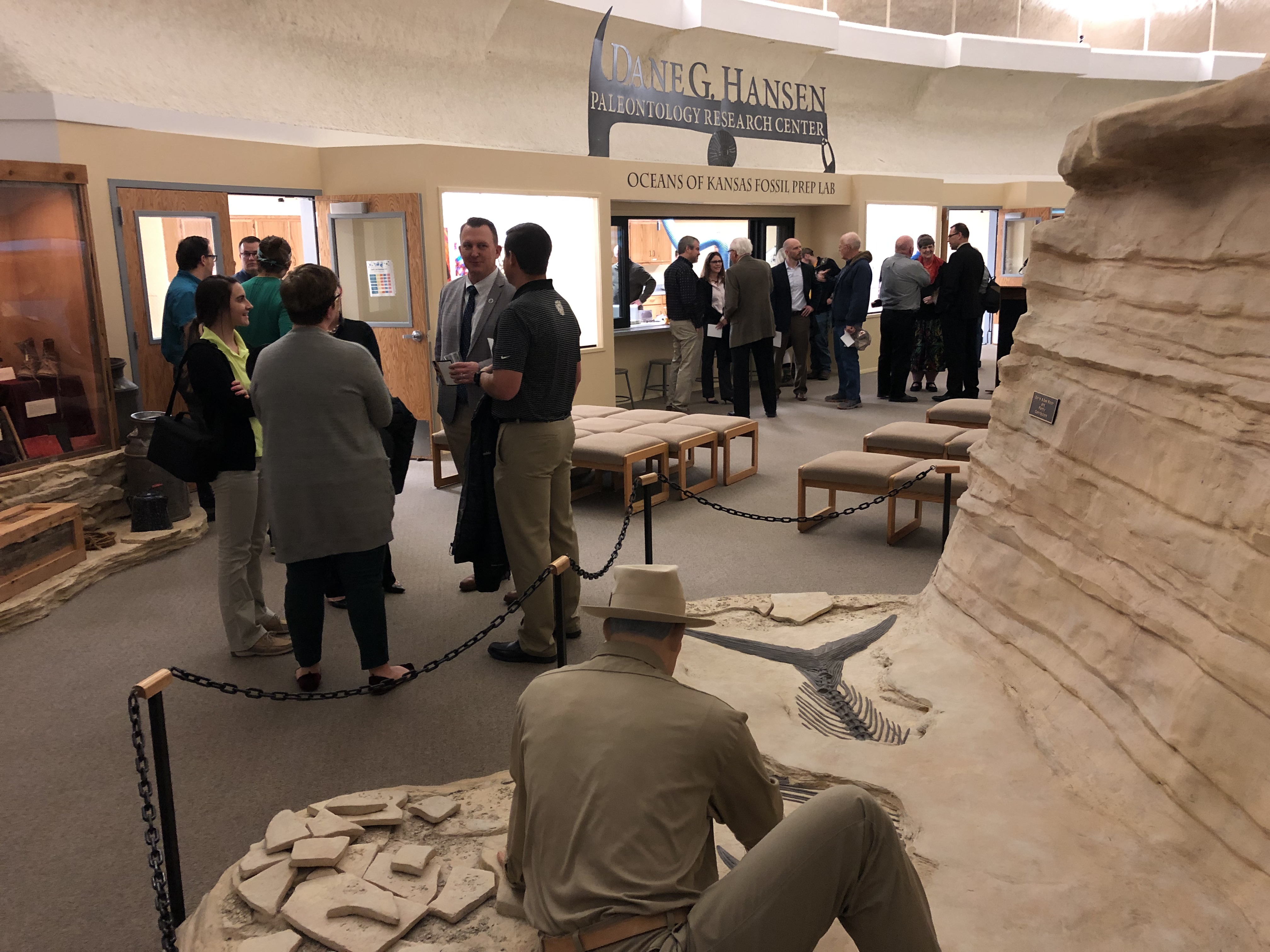
A representation of Hays paleontologist George Sternberg overlooks the new Dane G. Hansen Paleontology Research Center/Oceans of Kansas Fossil Prep Lab in the FHSU Sternberg Museum of Natural History.
By BECKY KISER Hays Post
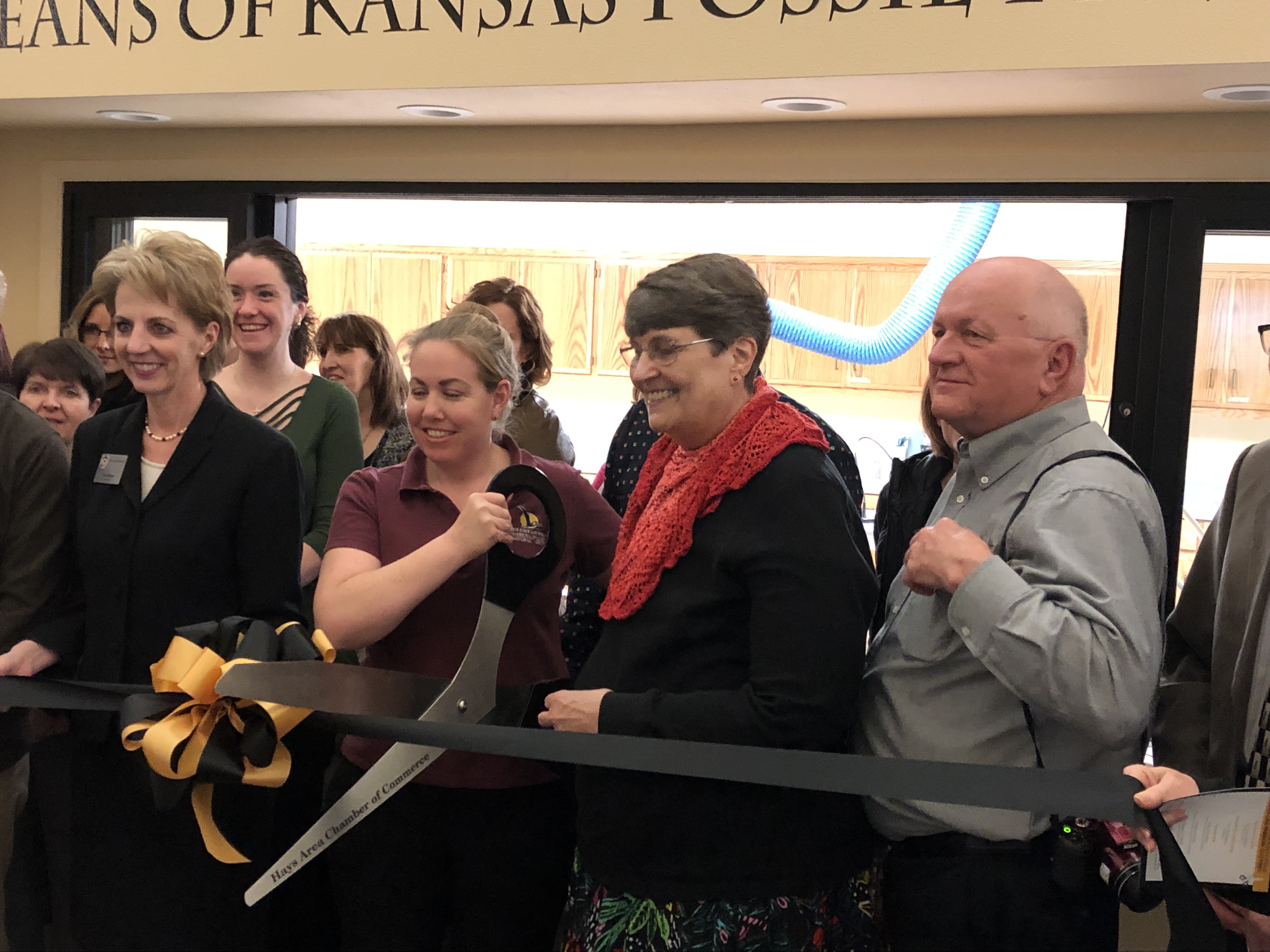
The new paleo lab at the Fort Hays State University Sternberg Museum of Natural History is now open thanks in part to the mother of Dr. Laura E. Wilson, curator of paleontology.
During Monday’s ribbon cutting ceremony with the Hays Area Chamber of Commerce, Wilson told the crowd it was one of her goals when she started at the Sternberg six years ago to modernize and expand the prep lab and research lab facilities.
“This is really important to our central mission in terms of a crossroads between research, collections, exhibits and education,” said Wilson.
As an academic, Wilson knows how to apply for grants for research and data-driven projects. But she did not have any experience in finding funding for infrastructure renovation.
“I knew we had to take a different path. So, thanks to my very Southern mother who taught me from a young age how to host a party, we came up with the idea of throwing a gala.”
In spring 2016, a gala for interested patrons kicked off a fundraising campaign. Another spring gala was held in 2017 and the initial capital was raised for the project.
“That got the ball rolling for being able to apply to the Dane G. Hansen Foundation for a matching grant.”
Soon after that, Mike and Pam Everhart came forward with “a very generous donation that helped us realize our goals were not only attainable but in a reasonable time frame, like my lifetime,” joked Wilson.
The Everharts are an important part of western Kansas paleontology and Western Interior Seaway paleontology.
The couple have been collecting fossils in the area for decades and donating them to the Sternberg Museum.
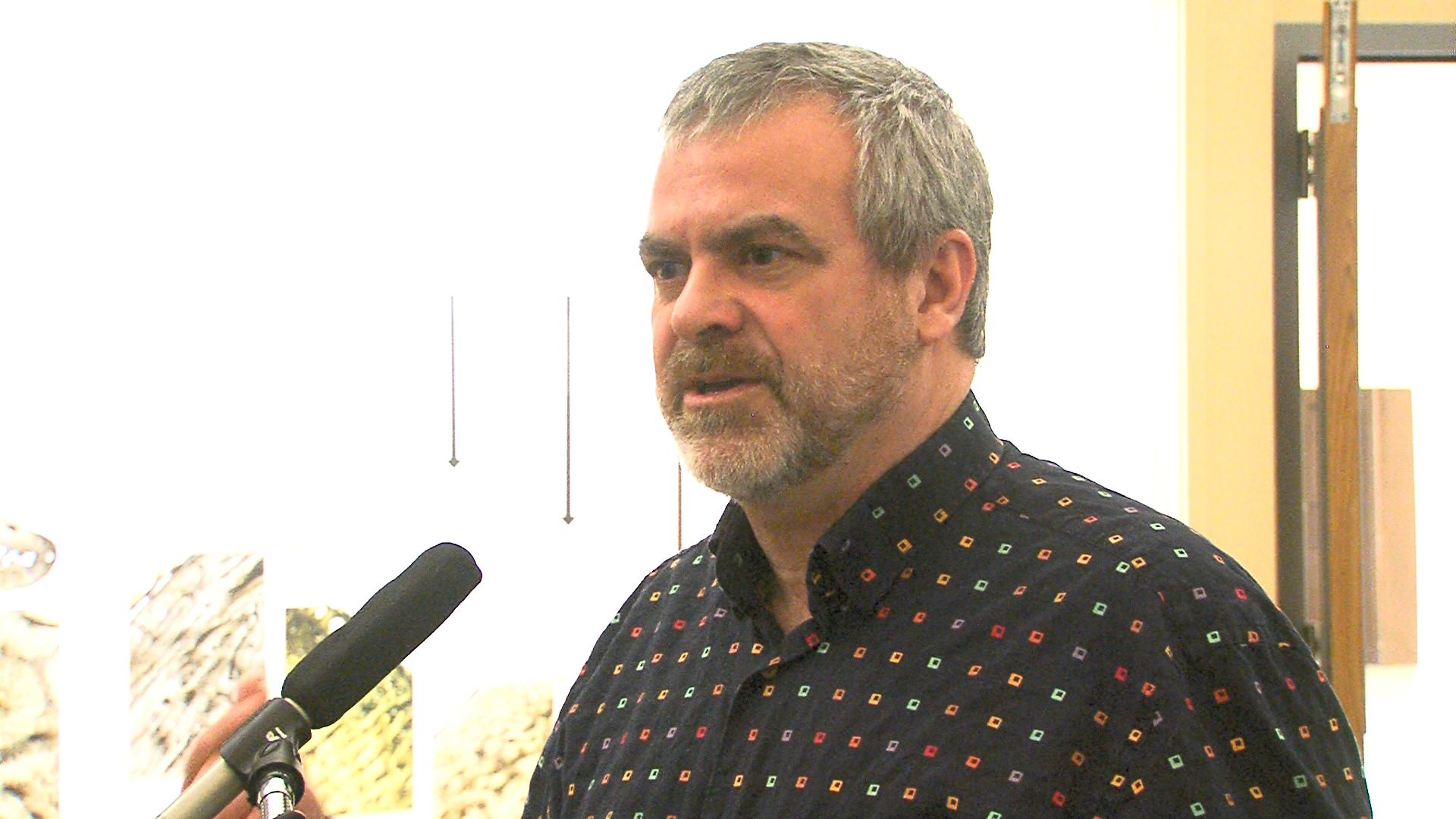
“The Everharts are number three on the list of most specimens collected and put into the museum,” director Dr. Reese Barrick said. “They are number two behind only George Sternberg for the number of fossils from the Western Interior Seaway that are here in the Sternberg Museum of Natural History.”
Mike Everhart is a museum adjunct curator and author of “Oceans of Kansas” which highlights discoveries made in Kansas by George Sternberg and other paleontologists in the state.
“I’m always amazed in telling groups about the ocean that covered this state for millions of years,” Everhart said. They give me this blank look like ‘we’re in the middle of the Midwestern desert here. What ocean?’ But when you start really looking at the discoveries that have been made in Kansas and the fossils that occur naturally – some of the best in the world – it’s pretty apparent that Kansas has not always been high and dry.”
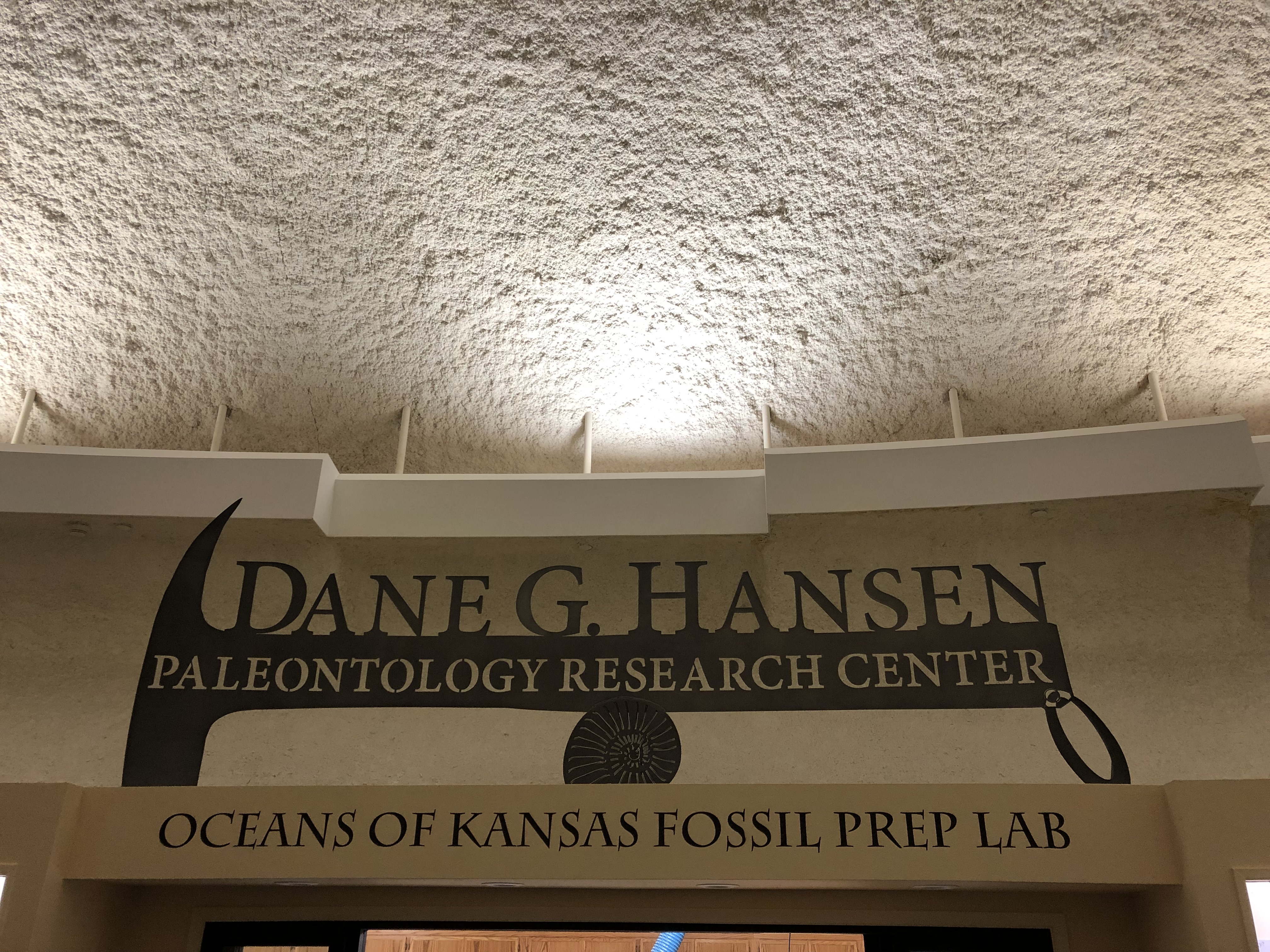
The new “Oceans of Kansas Fossil Prep Lab” is named for the Everharts. It’s part of the new work area called the “Dane G. Hansen Paleontology Research Center.”
“Mike and Pam Everhart are among the most influential paleontologists in the country on the Western Interior Seaway and some of the most influential people in science in the state of Kansas,” added Barrick.
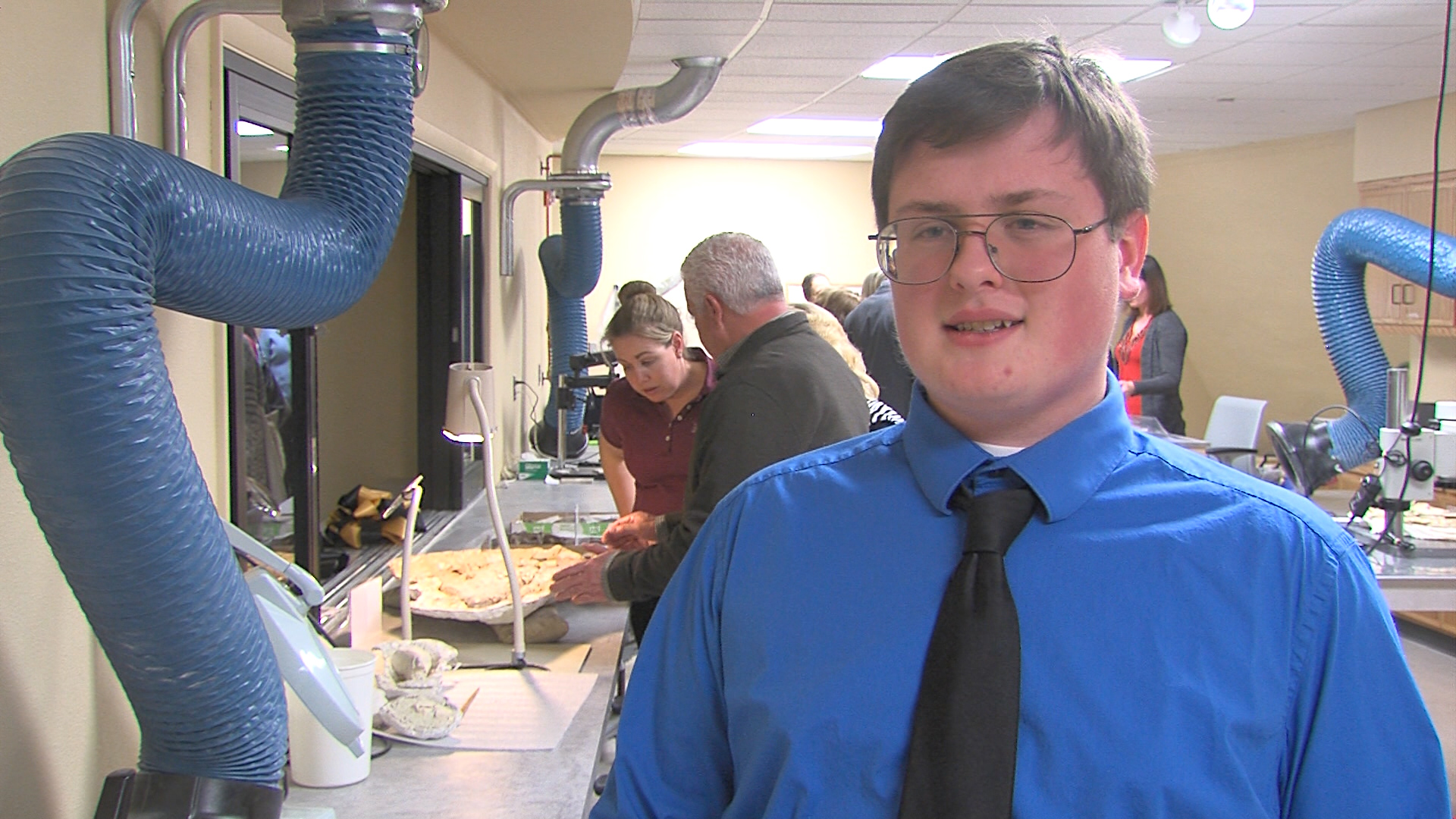
Kaiden O’Dell, a freshman geosciences major from Salina, is one of the first five FHSU students who have been training in the lab.
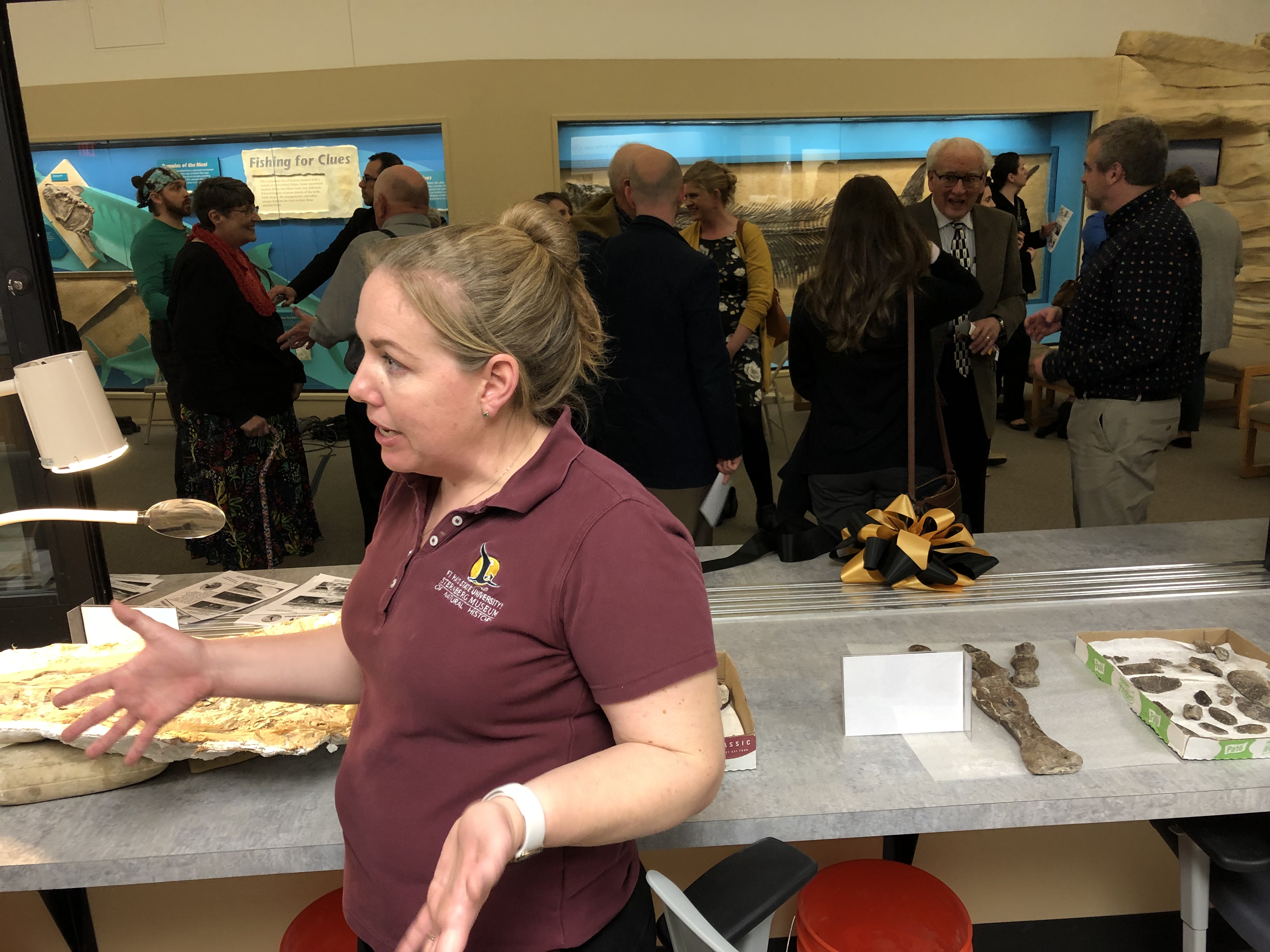
“Prep work is a large part of paleontology,” said O’Dell. “It’s not just getting the fossils out of the ground. It’s making sure you don’t break them once they do get out of the ground. We’re learning how to preserve them so you can do research later.”
Being selected to the first student team for training is a dream come true for O’Dell.
“Every little kid likes dinosaurs and my parents bought me a dinosaur encyclopedia. It had real stories about what they would be doing back then,” O’Dell recalled. “Later we came to visit the Sternberg Museum. I saw these amazing and beautiful fossils of fish and giant lizards that were in Kansas. I think it sparked something in me that’s never died since.”
Dr. Tisa Mason, FHSU president, described the advanced paleo lab as a “gateway to fascination, inquisition and science.”
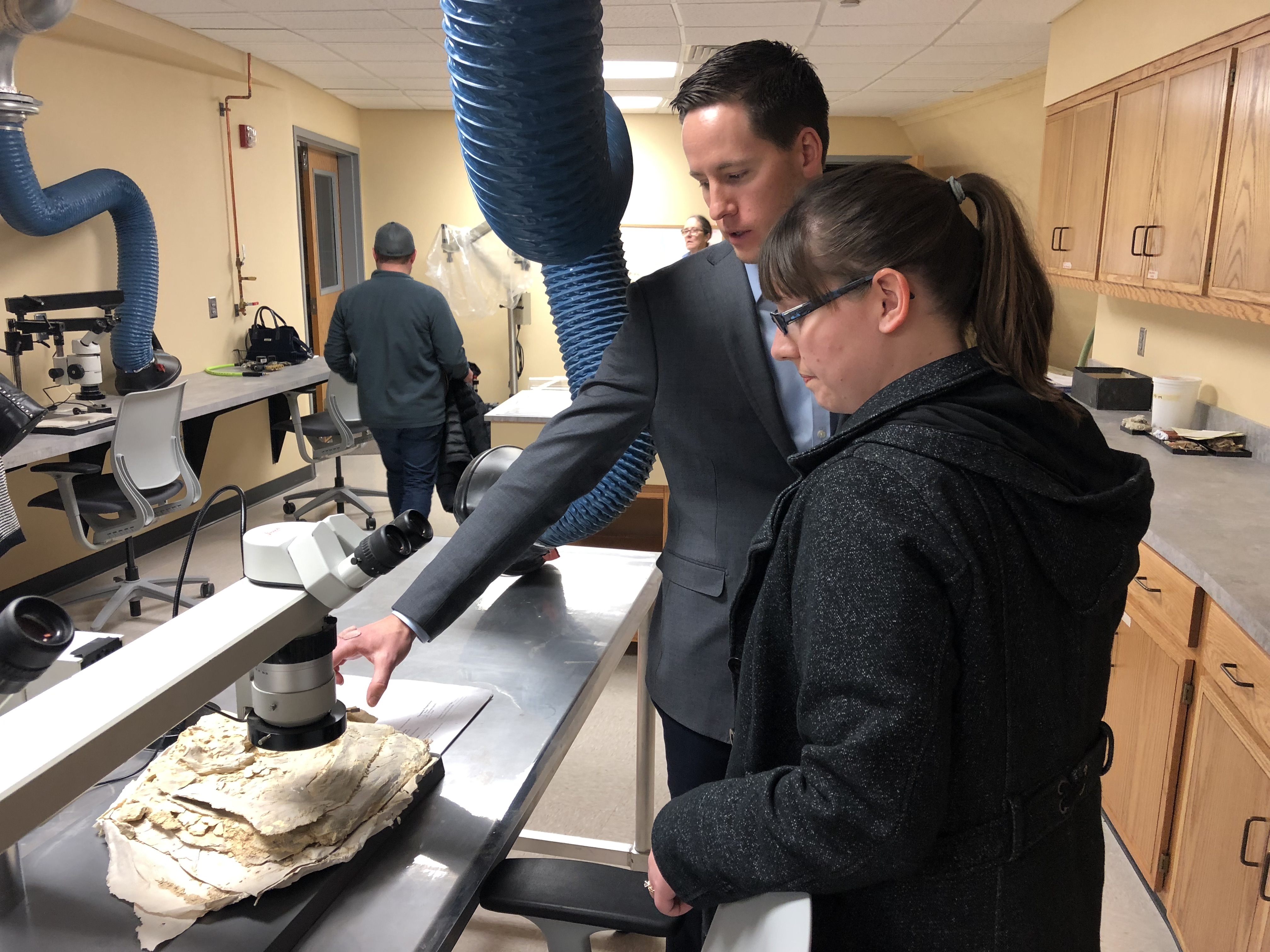
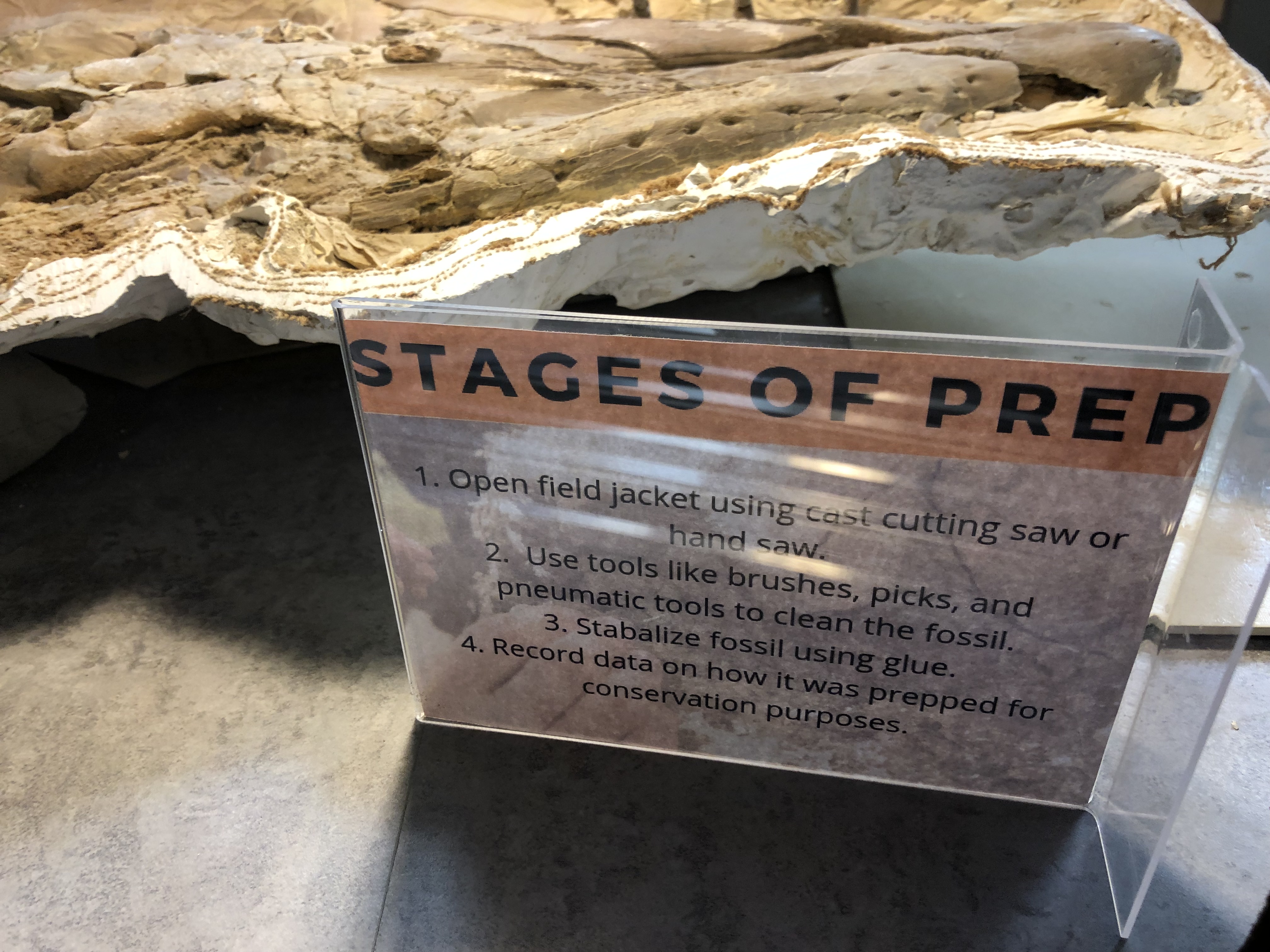
The wide lab windows open to allow workers to explain their hands-on processes to people touring the museum.
In April, Sternberg Museum will host the annual meeting of the Association for Materials and Methods in Paleontology whose members come from across the United States and Canada.
Kaiden O’Dell, FHSU geosciences freshman
Sternberg director Dr. Reese Barrick
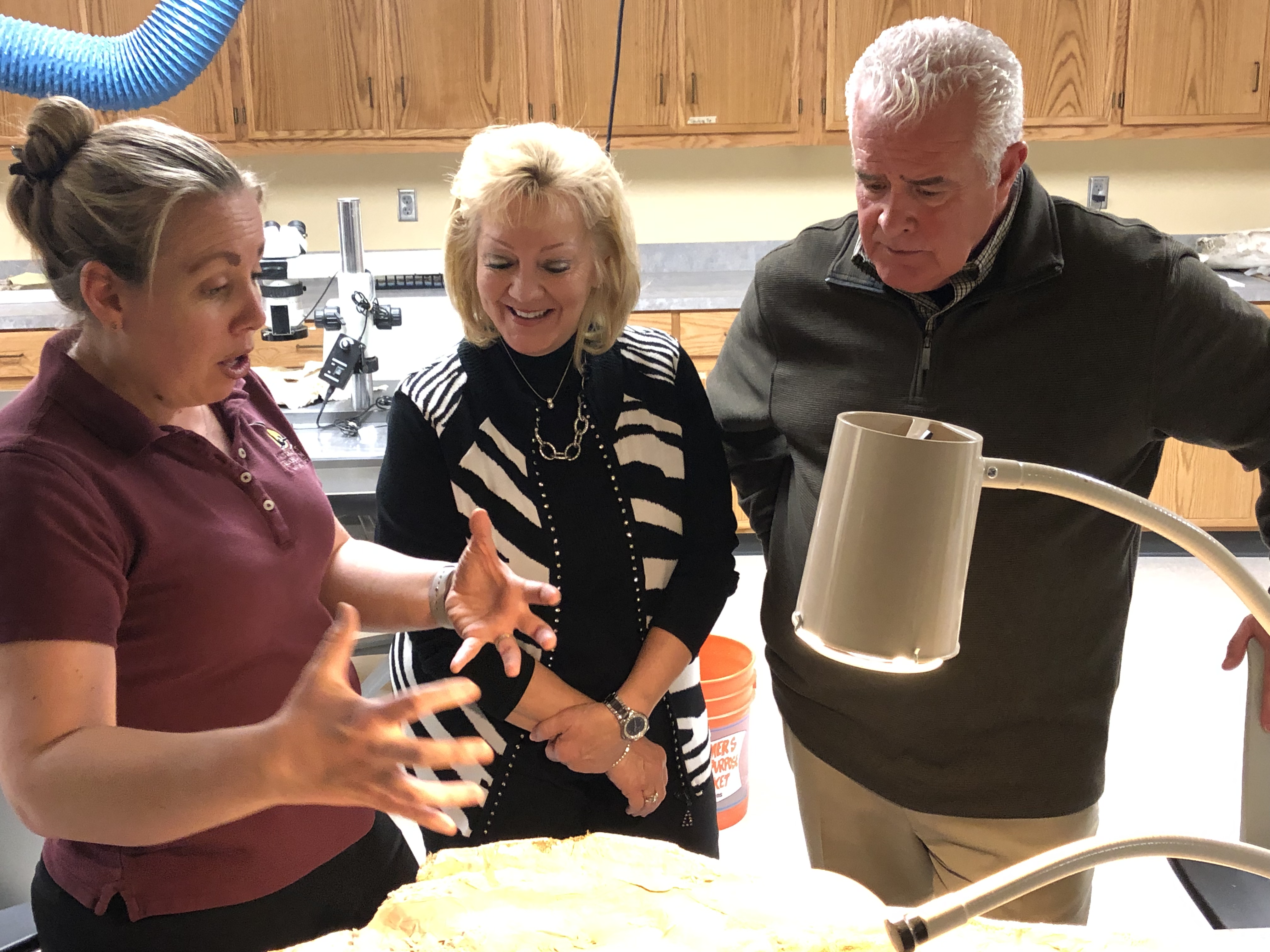
FHSU pres. Dr. Tisa Mason, paleontology curator Dr. Laura E. Wilson, paleontologists Pam and Mike Everhart
Project Manager John Braun shows Hays city commissioners a large vinyl map of the four proposed traffic roundabouts on north Vine Street.
By BECKY KISER Hays Post
Hays Mayor Henry Schwaller is “still a roundabout skeptic.” Vice-Mayor Shaun Musil is not a skeptic.
Commissioner Sandy Jacobs is encouraging the public to attend next Tuesday’s open house about the North Vine Street Corridor Improvement Project.
“It’s really exciting and that’s when some of the best stuff comes, when you bring people together and ask questions,” Jacobs said.
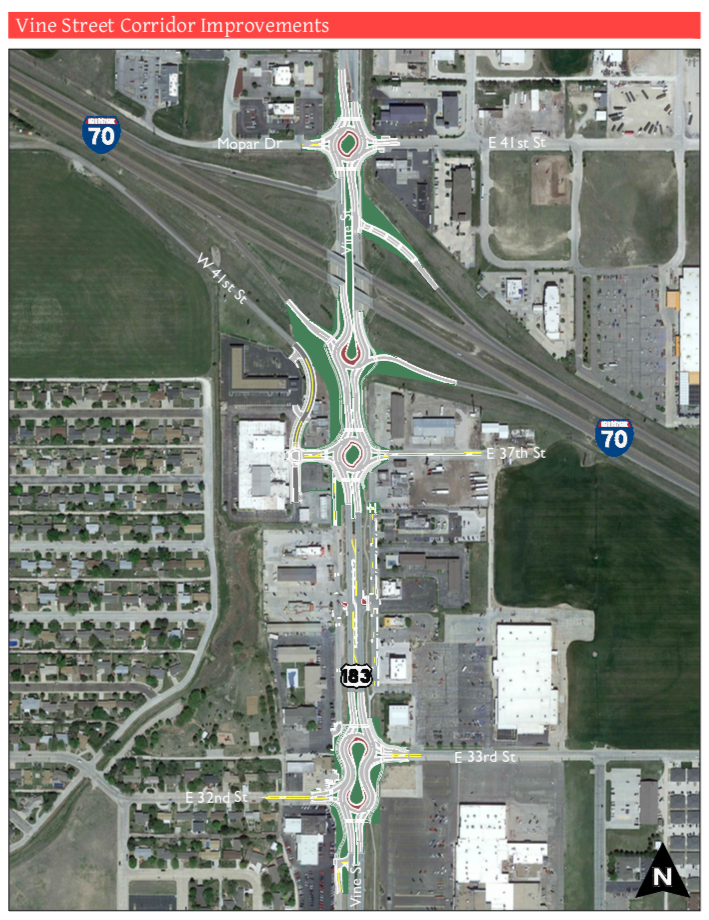
John Braun, city project manager, updated the city commission Thursday night about the plan, which includes three traffic roundabouts and one partial teardrop roundabout on Vine/U.S. 183 between 32nd and 41st streets.
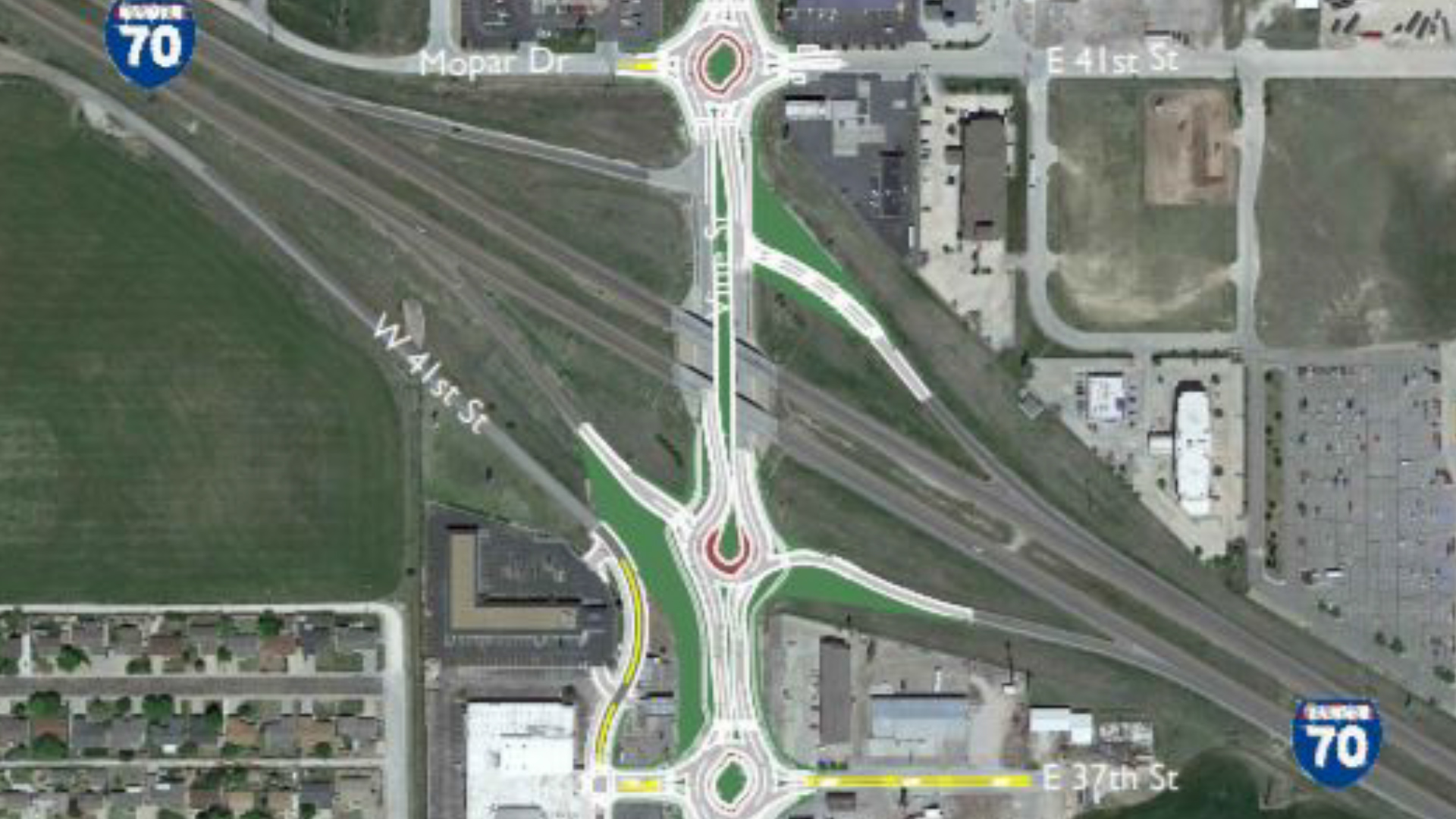
The most recent addition to the plan is a partial roundabout called a “teardrop” at the eastbound exit ramp of Interstate 70.
The teardrop was added after consultant WSP Engineers asked for an independent review of the plan by Kittelson & Associates, a nationwide firm which specializes in transportation projects.
Traffic going eastbound will be able to pull off the interstate, go through the teardrop, and head directly north on Vine rather than having to drive further south to the 37th Street roundabout to then head north.
A teardrop partial roundabout has been added to the eastbound I-70 off ramp for the North Vine Street corridor traffic improvements. (Click to enlarge)
The median on Vine will be replaced by a roundabout at 41st and Mopar. Left turns and cross traffic are currently prohibited at the location. “The roundabout would provide excellent access to and from businesses in that area,” Braun said.
He noted the four roundabouts will accommodate semis with 53-foot trailers and oversized loads such as those carrying wind turbine blades and tower sections.
The 32nd and 37th Street roundabouts will disconnect the current frontage roads, which may cause increased traffic volume at 35th Street, where Arby’s and Hickok’s Steakhouse are located.
“To ease the congestion there, we’re changing to a 3/4 intersection which reduces the traffic conflict points from 66 to 28,” Braun explained. “It improves pedestrian safety north and south along the frontage roads.
“From Vine, you’ll still be able to make right and left turns onto the frontage roads, but you’ll only be able to make a right turn out to Vine. Therefore, motorists wanting to turn left will have to turn right, go to the nearest roundabout and make a U-turn.”
Discussion turned to the deteriorated west frontage road as Schwaller asked whether it should be repaved.
“It’s on our priority list,” said Toby Dougherty, city manager, “either the top year or the second year.”
Commissioner James Meier also asked if the city should add dedicated parking along the frontage road.
“Maybe parallel parking between Vine and the frontage road. Drivers have created it themselves. I don’t think it’s actually supposed to exist,” he said.
Commissioner Ron Mellick pointed out the plan calls for a sidewalk. It would run the full length of the west frontage road similar to what is on the east frontage road.
“The sidewalk is actually very important. I don’t want to take away from that,” Meier said. “If there’s a way we can accommodate some of those businesses with parking, such as Freddy’s, I think we should take a look at it. Maybe we could do it on both sides.”
“If you have off-street parking and a sidewalk, there’s going to have to be some sort of separation there,” Mellick said. He also wondered if the businesses would be assessed the additional cost of the parking.
Assistant City Manager Jacob Wood has been in meetings with all the affected Vine Street business owners.
“Not a single one has said anything about the parking through there,” he told the commission. “Nobody has said we’d like to have parking or we think it’s necessary. Nobody said that.”
“This is just me thinking out loud,” Meier said.
“I don’t think there’s anything wrong with that,” Jacobs said. “When we start these projects, I think sometimes we need to think outside of the box and outside of the project about what we can do because we’re doing work at that time. It doesn’t make sense to finish something and then say why didn’t we do that?
“What’s extra bad about those streets is when it rains, people don’t stay on that street. So you have these big gullies right off on the side. Not only are they unattractive, they’re dangerous.
Vice-Mayor Shaun Musil looks at printouts of informational posters that will be at the Vine Street project open house Feb. 12.
“I think we should look in to possibly doing it,” she concluded. Musil agreed with Jacobs, noting there are often vehicles pulling trailers parked in the grass and gravel.
“We’ll take a look at it,” promised Dougherty. “People are obviously parking there now and we’ve struggled with that.”
The “peanut” roundabout at 32nd and 33rd Streets allows the two intersections to operate as one.
“The hourglass shape has a smaller footprint to minimize the amount of additional right of way required and slows the travel speed as compared to an oval,” explained Braun. “Disconnecting the north and south frontage streets at 32nd reduces conflict points by two-thirds of what they are now.”
With the addition of the teardrop roundabout, the overall project cost estimate has increased from $7.6 million to $9.3 million, plus the expense of acquiring right of way. The city has been awarded a federal BUILD grant of $6,057.827 to cover construction costs. The remaining amount will be paid with a dedicated 20-year two percent increase in the transient guest tax.
Preliminary design is expected to be completed in March, with a final design in November. Bid opening would begin in April 2020 with construction planned to start in June 2020. The project is scheduled to be finished in November 2021.
An extra-large map of the traffic corridor between 32nd and 41st streets will feature the proposed four roundabouts. Numerous poster boards will suggest topics for discussion.
City staff, engineers and KDOT representatives will be on hand to answer questions.
“We don’t know what’ll come out of it. But please take the time to come and attend,” urged Jacobs.
The updated information about the traffic corridor plan is available on the city’s website, www.haysusa.com.
City staff from Hays met last month with Kansas Department of Transportation (KDOT) and Federal Highway Administration (FHWA) officials in Topeka regarding the North Vine Street Corridor Project.
The project is complicated by the $6 million federal BUILD Grant funds involved and that U.S. Highway 183 [Vine Street] is a federal highway controlled by KDOT.
Preliminary design work for traffic roundabouts at 32nd/33rd, 37th, and 41st Streets, plus a partial tear drop roundabout at the eastbound exit of Interstate 70 have been underway for the past year.
According to Jacob Wood, assistant Hays city manager, KDOT will act as the pass-through agency, by letting and managing the improvements.
City Project Manager John Braun will update the city commission tonight on the current status of the project as well as the planned schedule and procedures moving forward.
(Click to enlarge)
Braun will also present proposed bid awards for the 2019 Street Maintenance Projects, a total of $618,456.39.
This year’s work includes seal coat, asphalt rejuvenator, microsurfacing, diamond grinding, curb and brick repair, major rehab of Ash Street from 23rd to 27th, and shoulders along portions of 8th Street and Old Highway 40 east of Vine Street.
Commissioners will also hear a proposed annexation of property at Highway 183 Bypass and West 33rd Street. Because it is noncontiguous to the city limits, the Ellis County Commission had to also approve the request, which is has done.
A teardrop partial roundabout has been added to the eastbound I-70 off ramp for the North Vine Street corridor traffic improvements. (Click to enlarge)
By BECKY KISER Hays Post
A fourth major traffic element has been added to the plan for improvements to the Hays North Vine Street corridor between 32nd and 41st Streets.
The project has been in development the past 12 months by the city’s consultant, WSP Engineers of Lenexa, the Kansas Department of Transportation (KDOT) and city staff.
“Our engineers [WSP] hired another engineering firm to do an independent review of the whole plan just to make sure we got another set of eyes on it,” said Jacob Wood, assistant city manager.
The nationwide firm Kittelson & Associates specializes in transportation projects.
“One of the things that they recommended was that we put in what we’re calling the ‘teardrop’ on the south side of I-70.
“It’s not a full roundabout but what it will allow is traffic going eastbound to pull off of the interstate, go through the tear drop, and go directly north,” Wood explained.
“The old plan would have had them going south, and coming around the roundabout and then going north. This will make it a bit easier to come off the interstate and go north, if they want to do that.”
Traffic studies and modeling determined the teardrop would alleviate some of the congestion at the 37th Street roundabout.
“We looked at doing [a teardrop] on the north side of I-70 but there’s really not enough room to do it between the interstate and the intersection. So [westbound traffic] will still have to pull off the interstate and go north through the roundabout to then head south on Vine.”
Plans are to build two-lane traffic roundabouts at 32nd/33rd, 37th, and 41st Streets, plus the teardrop at the eastbound I-70 exit ramp.
Adding the teardrop increases the total project cost from an estimated $7.6 million to approximately $9 million.
In early December the city was awarded a $6 million federal grant from the Department of Transportation for the Better Utilizing Investments to Leverage Development (BUILD) Grant program for the North Vine Street Corridor Project construction.
The remainder of the project cost will be paid through a two percent increase in the Transient Guest Tax (TGT). It went into effect Oct. 1 and is projected to raise $6.2 million over 20 years.
On January 9 city staff attended a meeting in Topeka with representatives from the Federal Highway Administration (FHWA) and KDOT to discuss how the project is to be administered. KDOT will act as the pass-through agency in letting the bids and managing the project.
“We’ve had conference calls with them, both KDOT and Federal Highways, and will continue to do that as part of the process as it goes forward.
“Anytime you do a project of this magnitude on a state highway at the intersection of an interstate, you’re going to have those players involved anyway. But they’ll probably be a little bit more involved this go around [due to] the federal money.
Wood says the concept plan is now “pretty well refined.”
The city has been meeting with business owners along Vine Street throughout the corridor.
“We’ve been having conversations and, actually, some of those have resulted in changes to the plan. Those guys that work on Vine have the operator-level kind of knowledge that maybe city staff and engineers don’t see.
“For the most part, the meetings have been positive.”
The city will host a public meeting and open house Tue., Feb. 12, 5:30-7:30 p.m., at The Venue at Thirsty’s Brew Pub & Grill, 2704 Vine. Information will be presented about Vine Street corridor improvements, including the proposed roundabout solutions. Detailed models of proposed changes will be on display to show the capabilities of roundabouts and how they improve safety for vehicles and pedestrians.
“We’ll see if there’s any feedback that may require adjusting or tweaking the plan, and we’ll still be able to do that. But we’ll really start kicking on the design pretty heavy after next week.”
Utilizing the federal funds required a slight shift in the work timeline.
Design will continue until October or November. Once the design plan is finalized and approved, bids will be let with a construction start expected in the summer of 2020.
“It’s a long road and there are a lot of regulatory requirements, which we would have to deal with regardless of whether we got the federal dollars,” Wood added.
ELLIS – The sewer system in Ellis has problems with inflow and infiltration and the city council has agreed to pay for a month-long flow monitor study to determine what’s wrong.
Alan Scheuerman, public works director, told council members Monday twice as much water is entering the sewer system than is produced, causing it to work over capacity and resulting in excess chemical cost.
Wilson & Company will conduct the flow study at a cost of $22,646 to determine the location of the infiltration.
Reporting on a water-related issue, City Attorney Olavee Raub said the real estate contracts for the Water Exploration Project have been closed and the deeds signed. The deeds have been submitted to the Ellis County Appraiser for filing.
In other business, modified site plans for the Lakeside Campground expansion project were presented by Buck Driggs, Driggs Design Group. It was determined some of the historic roundhouse foundation may need to be covered with fill dirt for the project. Driggs said he and the campground committee met with the Railroad Museum board which indicated they support the project. The museum is requesting a monument sign be placed at the roundhouse site to preserve its historic significance.
The complete meeting minutes follow.
ELLIS CITY COUNCIL REGULAR MEETING
Minutes
February 4, 2019
CALL TO ORDER
Mayor David McDaniel called the meeting to order at 7:30 p.m. Present were Council members Bret Andries, Holly Aschenbrenner, Steve Ferland, Martin LaBarge, Jolene Niernberger, and Bob Redger. Also present were Public Works Director Alan Scheuerman, City Clerk Amy Burton, Police Chief Taft Yates, and City Attorney Olavee Raub.
PLEDGE OF ALLEGIANCE
AMENDMENTS TO AGENDA
None
PUBLIC PRESENT
Chad Pritchett, Verda Flinn, Glen Keller, and Buck Driggs.
CONSENT AGENDA
Council member Bob Redger moved to approve the consent agenda containing the Minutes from the Regular Meeting on January 21, 2019, the Special Meeting on January 29, 2019 as revised, and Bills Ordinance #2062. Council member Martin LaBarge seconded the motion. The Council approved the consent agenda 6-0.
PUBLIC COMMENTS
Chad Pritchett, Secretary for the Walter P. Chrysler Boyhood Home, discussed the financial struggles surrounding the museum. Mr. Pritchett requested the City’s assistance with tying the two electric meters together to reduce the administration fees billed by Midwest Energy, and for the City to take over responsibility for mowing the museum property. He believes the museum could realize a cost savings of $1,260 per year between the two items.
PRESENTATIONS OF AWARDS, PROCLAMATIONS, REQUESTS & PETITIONS (HEARINGS)
None
SPECIAL ORDER
None
UNFINISHED BUSINESS
Campground: Special Project
Buck Driggs, Driggs Design Group, presented the modified site plans for the Campground Expansion Project. Mr. Driggs and the Campground Committee recently met with the Railroad Museum Board to discuss the historic roundhouse foundation, as some of the foundation may need to be covered with fill dirt for the project. The Museum Board plans to submit a letter in support of the project and requests a monument sign placed at the site to preserve the historic significance. The Committee has also met with the adjacent land owner who has voiced support for the project. The Committee plans to submit their grant application to the Dane G. Hansen Foundation later this month.
Water: Acquisition
Public Works Director Alan Scheuerman presented a revised quote from Metron-Farnier, LLC for electronic read water meters. The City has approximately 45 of the meters in use currently and the purchase would increase that number to 150, or roughly 12% of the total active residential meters in the City. Council member Holly Aschenbrenner moved to approve the purchase of electronic read water meters from Metron-Farnier, LLC in the amount of $37,855, with funds to come from the Water Depreciation Reserve fund. Council member Bob Redger seconded the motion. The motion carried 6-0.
Sewer: Repair/Maintenance
Mr. Scheuerman presented cost estimates and discussed the modifications needed to convert the Cedar Lane Lift Station from a single phase pump to a three-phase pump. The City would need to acquire the right-of-ways from the two property owners prior to the project. City Attorney Olavee Raub stated she has not been in contact with the property owners yet. It was the consensus of Council to table consideration until Ms. Raub can investigate the possibility of acquiring the right-of-ways.
NEW BUSINESS
Capital Improvement: Acquisition
Mr. Scheuerman requested ratification of the invoice from C & E Doors, LLC for the south overhead shop door. Council had approved the purchase on October 1, 2018 at a cost of $2,450, however, the door size needed to be increased which resulted in a higher cost. Council member Bob Redger moved to ratify the invoice from C & E Doors, LLC in the amount of $2,860 for the overhead shop door, with funds to come from the Capital Improvement fund. Council member Holly Aschenbrenner seconded the motion. The motion carried 6-0.
Sewer: Special Project
Mr. Scheuerman presented a Letter of Agreement from Wilson & Company for evaluation of the City’s inflow and infiltration (I&I) into the Sewer System. The City has a serious issue with I&I that has resulted in twice as much water entering the sewer system than is produced. The system is working over capacity, straining equipment and resulting in some excess chemical cost. The City contracts annually for sewer cleaning and a small portion of the lines are videoed at that time, but to date the City has been unsuccessful in determining the source of the I&I. The proposed flow monitoring study will evaluate five flow meters placed in designated manholes for a series of four or eight weeks. The study will aid the City in determining the location of the infiltration. After further discussion, Council member Holly Aschenbrenner moved to approve the Letter of Agreement from Wilson & Company for a four-week flow monitoring study at a cost of $22,646, with funds to come from the Sewer Depreciation Reserve fund. Council member Martin LaBarge seconded the motion. The motion carried 6-0.
Sewer: Acquisition
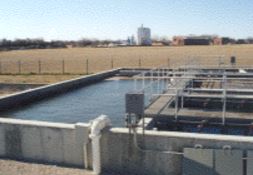
The City is experiencing an algae growth problem at the sewer clarifier. The Kansas Department of Health and Environment prohibits the use of chemicals to reduce the algae. Mr. Scheuerman presented two bids for the purchase of a carport to shade the clarifier to help prevent the growth of the algae. The purchase was not budgeted in 2019 and would need to be funded out of cash reserves. It was the consensus of the Council to table consideration at this time and to budget the purchase in 2020.
Water: Acquisition
Mr. Scheuerman presented a bid for the purchase of a 6” team valve and five – 6” gate valves. The valves will replace current valves that do not work. The valves allow the Department to isolate areas of town during leaks, thus reducing the number of residences affected by the disruption of water service to complete the repair. Council member Bret Andries moved to approve the quote from Municipal Pipe Supply in the amount of $12,445.75 for the purchase of valves, with funds to come from the Water Depreciation Reserve Fund. Council member Steve Ferland seconded the motion. The motion carried 6-0.
REPORTS FROM CITY OFFICIALS
Public Works
Mr. Scheuerman presented the Comparative Water Report for the period November 10th – December 10th and the individual Water Reports for each month in 2018. Council reviewed a letter submitted by Water Operator John Leiker concerning the presence of trihalomethanes (THM) in the water system. Residences will receive a letter explaining the presence of the by-product and how the City is mitigating the situation.
Police
Police Chief Taft Yates presented the Monthly Activity Report for January and the February Staff Calendar. The Department will participate in their annual Taser certification and officers will receive narcotics investigation training.
City Clerk
City Clerk Amy Burton presented the draft minutes from the recent Campground Committee meeting and the 2018 Safety Report. There were significantly more accidents in 2018 than in prior years, resulting in the City paying $6,248 in worker’s compensation claims. Ms. Burton also reviewed the annual Catastrophic Sick Leave Bank summary. The Bank has met its calculated cap due to the retirement of a long-term City employee. The Swimming Pool Committee will meet with the engineer from Larkin Aquatics on February 5th to discuss concept plans for the Community Development Block Grant application.
Attorney
City Attorney Olavee Raub reported the real estate contracts for the Water Exploration Project have been closed and the deeds signed. The deeds have been submitted to the Ellis County Appraiser for filing.
Mayor Update and Announcements
Mayor David McDaniel recently attended the League of Kansas Municipalities Local Government Day in Topeka. Some of the topics discussed affecting cities were the re-amortization of KPERS and how medical marijuana can affect random drug testing.
EXECUTIVE SESSIONS
Mayor David McDaniel asked for a motion to recess into executive session. Council member Holly Aschenbrenner moved for City Council to recess into executive session for 10 minutes to discuss contract negotiations pursuant to the attorney-client privilege exception, K.S.A. 75-4319 (b)(2) with City Attorney Olavee Raub present. The open meeting will resume at 9:17 p.m. Council member Bret Andries seconded the motion. The motion carried 6-0. No action was taken in executive session and the open meeting resumed.
ADJOURNMENT
Council member Holly Aschenbrenner moved and Council member Bob Redger seconded a motion to adjourn the meeting. The motion carried 6-0. The meeting adjourned at 9:18 p.m.
With the third wettest year just locked into the Hays record books, and the Kansas Water Office declaring the entire state drought free for the first time since June 2017, water conservation may be the furthest thing from your mind.
But smart water use is always at the forefront of daily life in western Kansas, where drought is a persistent threat.
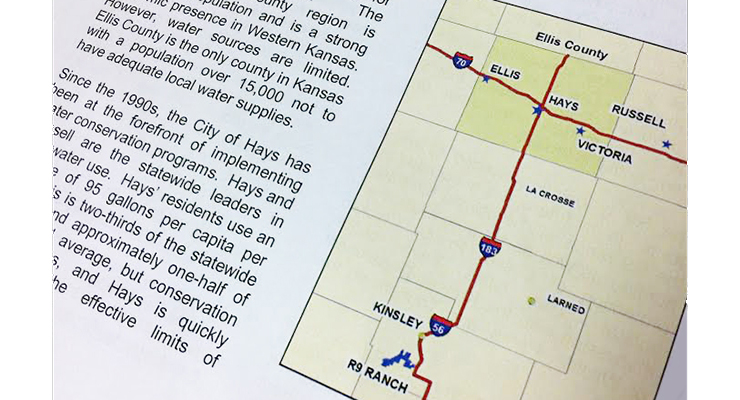
Of the 34 Kansas counties that have a population of more than 15,000 people, 33 counties either sit atop a major aquifer or are east of Highway 81/Interstate 135 where there is reliable surface water flow.
Ellis County is that 34th county and does not have an adequate local water supply.
A conservation plan was implemented in 1992. In 1994, the R9 Ranch in Edwards County was purchased by the cities of Hays and Russell as a regional longterm water supply source. In 2015, Hays city commissioners voted to begin pursuing the regulatory process to move the water it owns, along with Russell, from the R9 north to the Schoenchen water wellfield south of Hays.
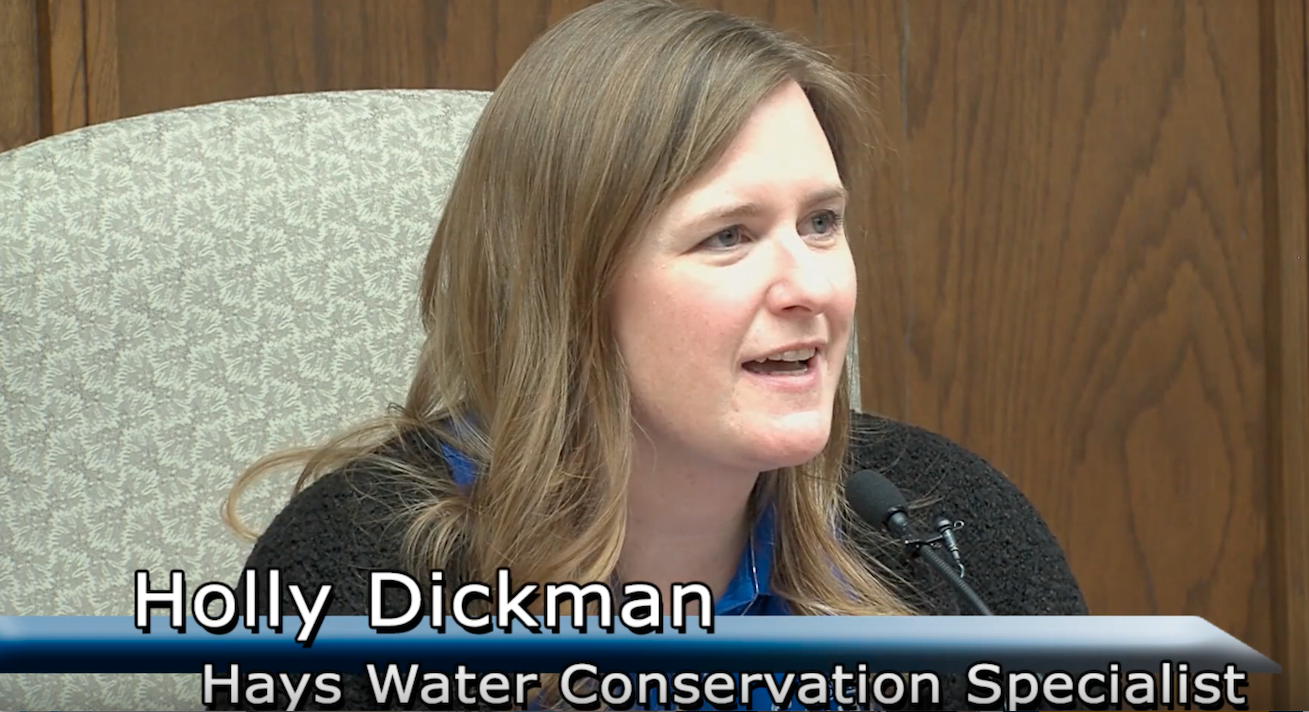
The city of Hays continues to offer water conservation rebates and giveaway programs for residents and businesses, as Holly Dickman, water conservation specialist, explains.
High Efficiency Toilet Rebate Program – Rebates from $50 to $150 are available for replacing an old inefficient toilet with a new high efficient model. The fewer gallons used per flush (GPF) the higher the rebate.
High Efficient Clothes Washer Rebate Program – $100 rebate available for replacing an old washing machine with a high efficiency model with an integrated water factor (IWF) of 3.7 or less to qualify.
Efficient Showerheads and Faucet Aerators – Available at City Hall Finance Office, 1507 Main; Aerators are free. Seven types of shower heads with 3 models free with exchange of old showerhead and 4 models can be purchased for $5 with exchange of old showerhead.
Turf Conversion Rebate – Up to $1,500 per property available for converting cool season turf (i.e. tall fescue or Kentucky bluegrass) to warm season turf (i.e. buffalograss or bermudagrass) or water conserving landscaping; Pre- and post-inspections required to qualify.
“Don’t wait to the next drought,” Dickman encouraged property owners. “Take advantage of the good soil moisture we have now to convert to a more drought tolerant landscaping in the coming growing season.”
The first 2019 legislative coffee hosted by the Hays Area Chamber of Commerce was held Sat., Feb. 2, at Fort Hays State University.
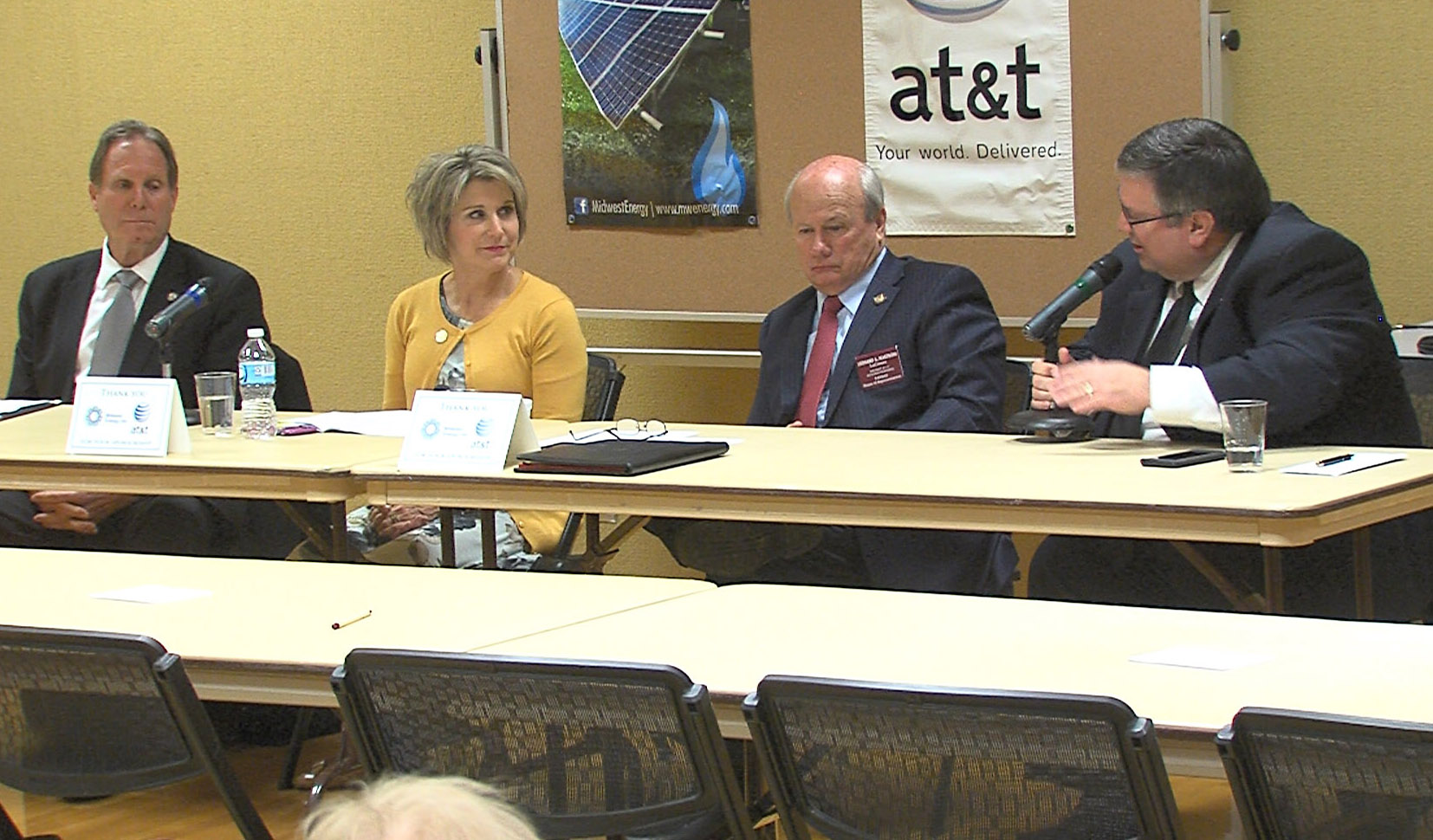
Area legislators on the panel were 40th Dist. Sen. Rick Billinger (R-Goodland), 111th Dist. Rep. Barb Wasinger (R-Hays), 117th Dist. Rep. Leonard Mastroni (R-La Crosse), and 100th Dist. Rep. Ken Rahjes (R-Agra) who had to leave early to attend a family funeral.
Sen. Rick Billinger (R-Goodland), Rep. Barb Wasinger (R-Hays), Rep. Leonard Mastroni (R-La Crosse) and Rep. Ken Rahjes (R-Agra) at Saturday’s legislative coffee in Hays.
By BECKY KISER Hays Post
The first 2019 legislative coffee hosted by the Hays Area Chamber of Commerce Saturday morning was the first-ever for 111th Dist. Rep. Barb Wasinger, R-Hays. She was elected in November, defeating incumbent Eber Phelps, D-Hays, and resigned her seat on the Ellis County Commission.
“It’s been a long time since I’ve was a freshman,” Wasinger joked with the 35 or so attendees in the Fort Hays State University Black and Gold Room.
Rounding out the legislative panel were 100th Dist. Rep. Ken Rahjes, R-Agra, who had to leave early to attend a family funeral, 117th Dist. Rep. Leonard Mastroni, R-La Crosse, and 40th Dist. Sen. Rick Billinger, R-Goodland.
Rahjes announced he is the new chairman of the Higher Education Budget Committee. Presidents of the universities, colleges and technical schools in Kansas, including FHSU’s Dr. Tia Mason who was in the audience, will appear this week and next in front of the Appropriations Committee.
Following opening remarks, the first question from the audience was whether the legislators would support Gov. Laura Kelly’s proposed $9 million increase to higher education funding.
“We’re focusing and trying to make good investments in higher education,” Rahjes said, noting Friday’s news that Kansas collected $49 million less in taxes than expected in January. The decrease broke a 19-month streak of better-than-anticipated tax collections.
“My first goal as chairman is make sure we at least have what the governor has recommended,” Rahjes replied. “In talking with leadership, I think there are some opportunities to enhance that in some form. I will fight for an increase, absolutely, but I think we need to be cautious and not have a false sense of security that we have a lot of extra money.
“We have been told, and in discussions, this may be the year for increases,” he added. “To get the full increase of what the cut was years ago, it won’t happen. Nobody’s going to be made whole from those, I don’t believe.”
“We’ve got a pie of money and everyone wants a piece of it,” said Wasinger. “As you’ve heard, we’re having [financial] problems with transportation, corrections, the foster care system and we need to pay back KPERS (Kansas Public Employees Retirement System). We need to be as equitable as we can possibly be.”
Billinger went into detail about the “money pie.”
“We have an ending balance of about $900 million. Over $100 million of that was a skipped KPERS payment, $317 million was borrowed from the PMIB (Pooled Money Investment Board), $300 million of that continues to be swept from KDOT (Kansas Dept. of Transportation),” he explained.
“I think it’s a little premature to say we would do any amount for higher ed or other areas. We have a lot of challenges.
“This first year we’re probably going to be okay money-wise, but going forward, we’ve gotta be very careful.”
The legislators were also asked about the Democratic governor’s proposal to reamortize, or refinance, KPERS to keep future state contributions to the pension fund manageable.
Billinger is among 18 Republican senators who’ve co-sponsored Senate Bill 9. It would put $115 million into KPERS this fiscal year to make up for previous contribution delays authorized by former Gov. Sam Brownback and the GOP-controlled Legislature.
According to Billinger, the Senate will vote on the bill Monday.
“We skipped a KPERS payment in 2016 when finances were tight and the legislature promised we would pay it back in 2018 with interest. It still wasn’t very clear where the revenues were and we didn’t make the payment then.
“It costs us $630,000 a month not to pay this payment,” said Billinger.
“We’ve been focusing on this since 2011, when I first came to Topeka. We had one of the worst state-funded pension plans in the country. It was on the verge of bankruptcy.
“We have put $5.1 billion into this since 2011. And now we’re talking about reamortizing. The latest figures I’ve seen is that would cost us $7.4 billion by pushing this down the road.”
Billinger recalled Gov. Brownback talked about amortization two years ago. “The costs are just not doable.”
“A Republican legislature shut down a Republican governor,” added Rahjes. “It’s not political. It’s called being fiscally responsible.”
Mastroni said he’s talked to a lot of other state representatives and there is “huge support” for KPERS. “I think there’s only about 10 years left to get this paid off,” said Mastroni, “and I’d really hate to see the reamortization kick in for 30 years, ’cause that’ll leave $7.4 billion for our grandchildren [to pay] and that’s just plain wrong.”
Wasinger agreed.
“KPERS was refinanced in 1993 with a 40-year term. We’re actually at the last 15 years of paying off that loan,” Wasinger said. “We’re just getting to the point where we’re starting to pay off all the principal. It’s important that we finish this.”
“If this Senate bill passes Monday, and it goes through the House and the governor signs it, it’ll be the first time in 25 years that we’ve hit the actual required contribution,” Billinger said.
There are more than 311,000 current and former public employees whose financial retirement plans are managed by KPERS, according to the KPERS website.
The second HACC legislative coffee, sponsored by Midwest Energy and AT&T, will be held at 8:30 a.m., Sat. April 6 in the FHSU Memorial Union Stouffer Lounge. There is no charge to attend.