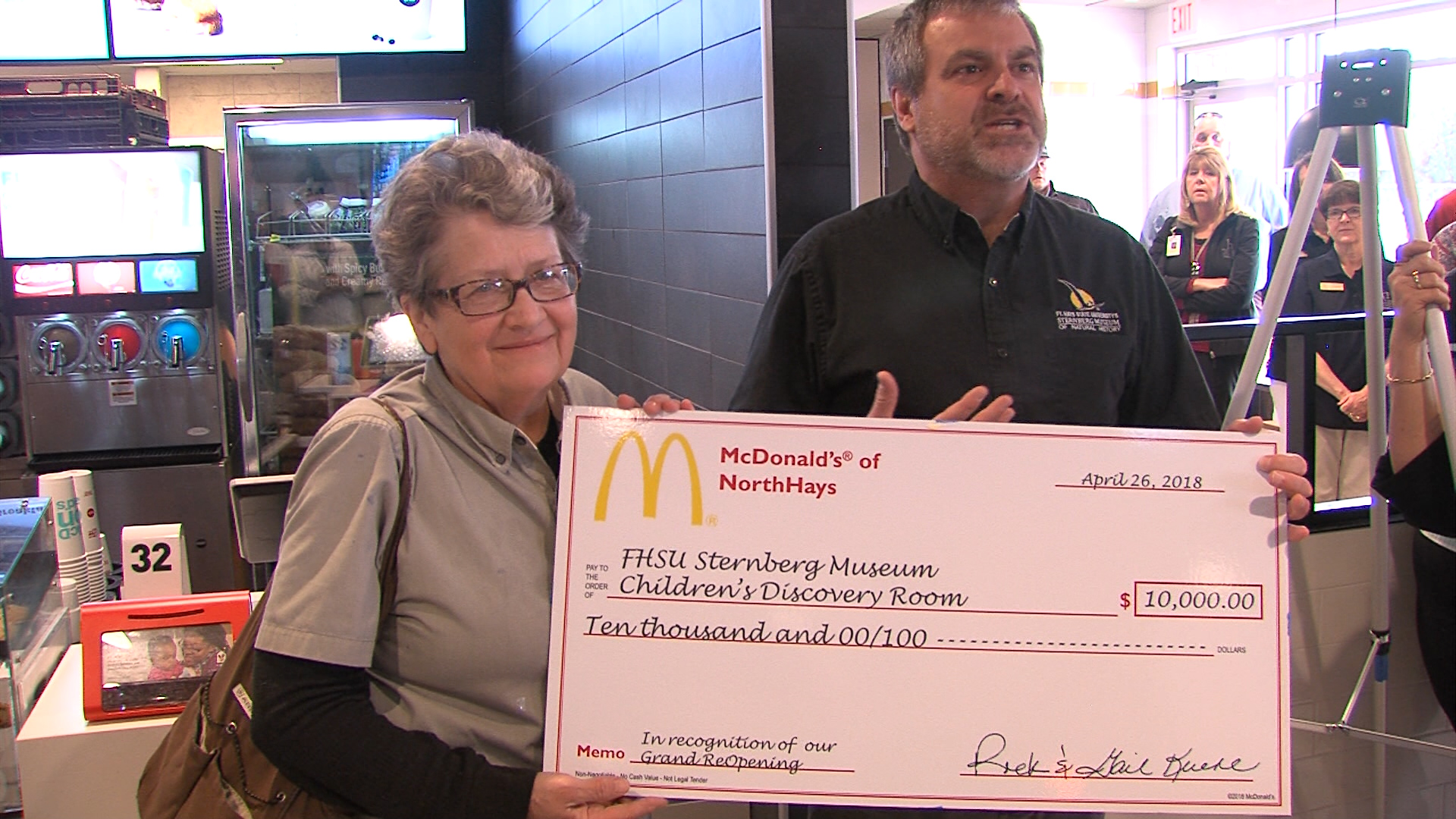
Gail Kuehl presents a $10,000 donation for the Sternberg Museum Children’s Discovery Room to director Dr. Reese Barrick in celebration of NorthHays McDonald’s 39th anniversary and remodel.
By BECKY KISER Hays Post
McDonald’s of NorthHays, 3406 Vine, just celebrated its 39th anniversary and gave a gift to the Sternberg Museum of Natural History.
During a recent ribbon cutting ceremony to show off the restaurant’s newly remodeled interior and its new features, owners Gail and Rick Kuehl also honored Sternberg employees and Fort Hays State University with a $10,000 check to the Children’s Discovery Room.
“One of our belief systems when we first moved here was to give back to the communities because they come see us at McDonald’s and because we believe that’s important,” said Gail Kuehl.
“One of our favorite projects over the years, other than working with the schools, is the Sternberg Museum Discovery Room. When it first happened, McDonald’s was a big part of that and it’s always been pretty special to us.
“When we first opened the Discovery Room, (current museum director) Reese Barrick wasn’t here. But, (former director) Jerry Choate and I, and (former) Hays educators Nancy Harman and Nancy Talbott, along with a lot of other teachers, were on a committee to kind of design it and get it going. We wanted that educational piece.”
She presented an over-sized mock check to Barrick who was joined by Discovery Room manager Thea Boeckner.
After thanking the Kuehls, Barrick told the crowd Gail Kuehl was one of the first people he met when he came to Hays nine years ago. “She does love the children and the Discovery Room. Rick and Gail have been amazingly supportive since I’ve been here.”
Barrick noted the Sternberg Museum has been in its “new” location at 3000 Sternberg Drive nearly 20 years.
“This is the most timely thing,” Barrick said with a big smile on his face. “Thea and I along with the rest of my staff have actually just been talking about how we are ready to do some things to update the Discovery Room to make it special for kids and families in the years to come.”
Canterbury Drive will remain a 4-lane street following a vote Tuesday by Hays city commissioners to amend the current project contract.
By BECKY KISER Hays Post
Three residents addressed the Hays city commission Tuesday night during a special meeting about changing the lane configuration on Canterbury Drive.
After recent diamond grinding to smooth the pavement, the section between 13th and 22nd Streets was scheduled to be restriped May 7 from four lanes to three lanes.
Although the “road diet” was approved late last year as part of the 2018 Street Maintenance program, commissioners just recently have received comments from some residents opposing the change.
Connie Mermis lives on 13th Street which has been reduced to 3 lanes. She opposes the restriping of Canterbury Road to 3 lanes.
The trio speaking up last night were split in their opinions.
Connie Mermis, who lives on 13th Street which was changed to three lanes, complained about traffic backup at certain times of day. “I’m not an advocate,” she told the commission.
A driver for the public transportation ACCESS van, Matt Tottle, favored three lanes. “You have four lanes of traffic to watch trying to make a left turn onto Canterbury and they’re going different speeds. It’s really hard to judge a gap in the traffic.” Making a left turn off Canterbury, Tottle said he’s seen drivers “stop dead in the street without a turn signal and people coming up behind them will just veer out into the next lane and cut somebody else off.” He suggested 27th Street traffic would also benefit if reconfigured to three lanes.
The third person to speak, Ben Tillman, said most of his questions had already been answered by the brief presentation given by Hays Projects Director John Braun but still wanted to know if the three lane striping was being done to accommodate new bike lanes. Commissioners quickly assured Tillman bike lanes had nothing to do with the project.
“There are both pros and cons to lane reductions,” Braun reiterated. “The advantages include a protected left turn lane, reduced speed, and according to the Federal Highway Administration, fewer traffic accidents.”
According to the Hays Police Department, there are an average 15 crashes a year on Canterbury. Traffic volume is about 7,500 vehicles a day.
Braun also outlined the disadvantages including one through traffic lane instead of two and the potential for vehicle stacking at signal lights.
Commissioners voted 3-2 to amend the current contract, which means when Canterbury is restriped, it will remain four lanes.
Commissioner Shaun Musil has opposed the change to three lanes since the beginning, citing his concern about “school traffic” at 13th and Canterbury and that he doesn’t believe there would be any significant advantage to the lane reduction. “Apparently, traffic will be safer if we do it, but I just don’t see a huge gain,” Musil said prior to the vote.
Vice-Mayor Henry Schwaller and Commissioner Chris Dinkel opposed the change.
“I think this stretch of road is one that would benefit from the change because of the amount of left turn traffic,” Dinkel said. “Maybe the area by Midwest Energy would have fewer left turns because that’s a residential area. But I see slowing down the traffic and reducing the aggressive driving near the hospital, medical clinics and retirement homes as a very beneficial feature of this.”
“Just because there’s not a glaringly broken issue, doesn’t mean we can’t make it better,” added Dinkel.
Dinkel and Musil were the only two commissioners to comment.
After the meeting, Commissioner Sandy Jacobs said “all the commissioners received 14 emails today in opposition to the change and we had 6 to 8 before that. I also had about 8 phone calls, all against it. Several people I talked to in person who were opposed are employees of HaysMed.”
“I’m delighted that we had this much input from residents. That’s what needs to happen on any issue,” Jacobs added.
There shouldn’t be any financial penalty to the city for making the contract amendment, according to Assistant City Manager Jacob Wood.
“We don’t think there’ll be any issue with that,” Wood said Wednesday morning. “It actually should be a little bit cheaper because with the four-lane configuration there’ll be less striping, less turn arrows and that sort of thing.”
The contractor is still scheduled to begin the restriping Mon., May 7.
Canterbury Drive will remain a 4-lane street following a vote Tuesday by Hays city commissioners to amend the current project contract.
By BECKY KISER Hays Post
Canterbury Drive will remain a four-lane street.
In a special meeting Tuesday night, Hays city commissioners voted 3-2 to amend a contract which calls for reconfiguring the street to three lanes between 13th and 22nd.
Commissioner Shaun Musil has been opposed to the “road diet” since the 2018 Street Maintenance plan was adopted late last year.
“Apparently, traffic will be safer if we do it, but I just don’t see a huge gain,” Musil said prior to the vote.
“I was for changing to 3 lanes on 13th and on Hall Streets and personally think we have seen reduced accidents there. The daughter of a friend of mine was almost severely hurt when someone didn’t see her going north on Hall Street and turned into her (when it was still 4 lanes on Hall Street.”)
Vice-Mayor Henry Schwaller and Commissioner Chris Dinkel opposed the change.
Check Hays Post for more details in an upcoming story.
Canterbury Drive between 13th and 22nd is scheduled May 7 to be restriped from 4 lanes to 3 lanes. Hays city commissioners have called a May 1 special session to reconsider that decision following some recent public opposition.
By BECKY KISER Hays Post
Hays city commissioners will meet in a special session tonight at 6 p.m. to discuss the restriping of Canterbury Drive.
As part of the 2018 Street Maintenance plan approved by the commission last year, Canterbury between 13th and 22nd Streets has just undergone diamond grinding to make the pavement smoother. It is scheduled to be restriped Monday, May 7, from the current four lane configuration to three lanes, with the middle lane dedicated to left turns.
Other areas in Hays have been changed from four lanes to three lanes, including portions of 8th, 13th, 27th and Hall Streets. Numerous national and state traffic studies as well as those by city staff and the Hays Police Department have determined there are fewer vehicle accidents on three-lane roads and traffic moves more quickly.
At last week’s meeting Mayor James Meier noted commissioners have recently received a number of complaints from some residents opposed to the three lane configuration and asked if the commission should “rethink it.”
Meier first laid out the steps in the commission Rules and Procedures which would have to be followed to change the contract.
Commissioner Shaun Musil has continued to favor four lanes. “I think the community would like us to keep it that way,” he said Thursday. He offered the motion to suspend a portion of the Rules and Procedures requiring a super majority vote to amend the contract.
After some discussion, the motion failed unanimously.
Vice-Mayor Henry Schwaller had vehemently opposed the notion. “I have to choose my words very carefully. You may be down a commissioner,” Schwaller said. “You’re repealing something that’s been in effect for many years for a reason.” He noted there was no city staff present to answer questions about the restriping. “I don’t think that’s a good precedent and I do not wish to serve with a commission that makes decisions hastily.”
“I don’t think we’re doing this in haste,” countered Commissioner Sandy Jacobs who seconded Musil’s motion. “We voted (Jan. 8) on section 8.1 in Rules and Procedures saying things can get suspended but I don’t like asking for the suspension.”
“I’ve had more calls on this than any other subject, which surprises me. We’ve talked about this in the past. I don’t care if the lanes are striped four lanes or three lanes.”
“I don’t think this issue is worth executing the Rules and Procedures suspension,” said Commissioner Chris Dinkel.
He also wondered if it made sense to go back on staff recommendation for the three lanes and “make a snap decision.”
“We hear from people because people hate change,” Dinkel said. “We’ve discussed much bigger issues in this commission which have gotten much less play just because they don’t affect people’s daily lives.”
Mayor Meier questioned City Manager Toby Dougherty if the striping contractor could be asked to hold off on the project until after the commission’s next regular meeting on May 10.
“Yeah,” Dougherty answered. “But a lot of this is based off timing, so it may cost the city money. The contractor may agree to wait and go do another job first, but he’ll have to remobilize and fit our project into another slot,” he explained..
Commissioners also talked about the possibility of calling a special meeting to further discuss the restriping rather than using a Rules suspension Thursday night.
Late Friday afternoon, the city sent a notice to news media that a special session will be held Tue., May 1 “to discuss the lane configuration on Canterbury Drive.”
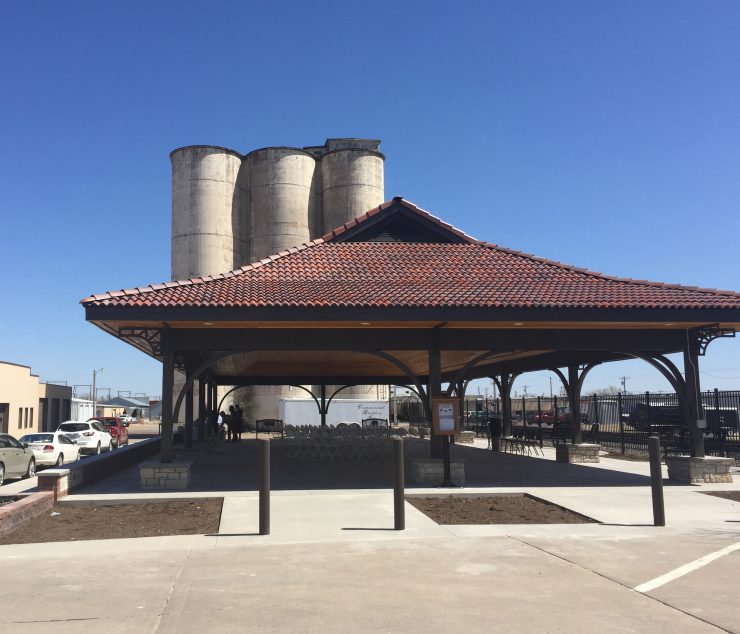
The new Downtown Hays Pavilion was dedicated Friday afternoon. FHSU and NCKTech students who provided labor for the project helped cut the ribbon.
By DIANE GASPER-O’BRIEN FHSU University Relations and Marketing Video/Photos by BECKY KISER Hays Post
The definition of collaboration in the Oxford Dictionary is “the action of working with someone to produce or create something.”
Performing in the true sense of the word, two pillars of the community collaborated with classes from two of the city’s post-secondary institutions to build a gathering space for the ages in downtown Hays.
The Downtown Hays Development Corporation planned a 46-by-86-foot outdoor pavilion on 10th Street, about a block east of Main. The planning and design class at Fort Hays State University designed the structure. FHSU’s building construction class built it with some guidance from Commercial Builders Superintendent Geoff Withington. And an electrical technology class from North Central Kansas Technical College installed the electrical wiring and lighting.
The dedication of the new Downtown Pavilion in Union Pacific Park on a warm, sunny afternoon Friday was a long time coming.
Sandy Jacobs, former DHDC board president, said the idea of a downtown pavilion had been tossed around for more than 15 years.
The project was boosted from a proposal in 2012 to a plan that came to fruition six years later with a $100,000 donation from the Bob and Pat Schmidt Foundation and a matching grant from the Dane G. Hansen Foundation.
Cornerstones and bricks in the north wall
The DHDC sold 50 bricks and 24 larger cornerstones to the public that were placed in a wall on the north side of the pavilion. The wall was finished with a cement cap for seating purposes. An additional thousand-plus bricks were available after being removed from the sidewalk area to the west when a public restroom was built in 2017.
“I think the bricks add a lot of history,” said Sara Bloom, DHDC executive director.
Dustin Roths, current DHDC board president, called the pavilion “a gift to the people of Hays, to all of western Kansas.”
Ellis Co. Commissioner Barb Wasinger with FHSU Building Construction instructor Kris Munsch and Gary Weatherbee, Commercial Builders president.
Kris Munsch, assistant professor of applied technology and instructor of FHSU’s building construction class, said he and his students enjoyed witnessing the public’s interest in construction. Several people drove and walked by to take a look at the progress of the project on Tuesday and Thursday afternoons.
“Oh my goodness, it’s a very visual project for the community,” Munsch said. “It’s a community investment.”
From the cathedral ceiling with a tongue-and-groove pine ceiling to the clay tile roof – and everything in between – FHSU senior Caden Schulz said the project was a learning experience.
“I’ve been really excited about getting it done and seeing what people think,” said Schulz, a construction management major from Wray, Colo. “I had never done a tile roof before, so I was glad to be able to be a part of that.”
The pavilion is available for use free to the public, and groups can reserve it by calling the Hays Parks Department at 785-628-7375.
Eight benches commemorating several partnerships that made the project possible surround the outside corridor of the pavilion. Four more benches have been placed near the public bathroom area.
In addition to the cement wall, more seating was provided with square limestone structures covering the 12 steel base plates of the column supports.
By design, the rest of the area is open space. Groups are able to bring their own seating if needed.
“We’ve had a lot of requests to keep it open,” Bloom said. “We already have musical performances and barbecue contests scheduled here. There are so many possibilities for this space. There can be dances and family gatherings. The possibilities are endless.”
The pavilion also features free internet access provided by Nex-Tech.
Dr. Tisa Mason, FHSU president, was unable to attend the dedication but sent her congratulations to all who were part of the project.
Brent Hirsch, current vice president of the Student Government Association, read remarks from Mason.
“Fort Hays State University is proud to have played an important role in the design and construction of the Downtown Pavilion,” Hirsch read. “This structure represents a strong partnership between Fort Hays State University and the Hays community, representing a downtown dream and the creativity and strength of approximately 80 FHSU students.”
“I can’t think of a better way to teach our students the importance of community,” Mason wrote. “Thank you for this opportunity for our students to learn, create and grow in their areas of study. We look forward to future partnerships and the development of new and exciting projects in the Hays community.”
Bloom agreed.
“Both Fort Hays State and NCK Tech are intricate parts of our community in so many ways,” she said. “A lot of time the partnerships are through the professors and instructors and not the students. This is the students getting excited about the community, investing in the community and maybe staying in the community even after they graduate.”
Munsch’s building construction class traditionally builds residential garages for its spring project. But he jumped at the chance for something different.
“This is by far more interesting than a garage, partly because of the scale of the project,” he said. “A garage is about 10 yards of concrete, and this was 90 yards.”
Allen Hill, chair of the electrical technology department at the Hays campus of NCK Tech, said the project also worked out really well for his students.
“They’ve had a good time with it,” he said, “and it was a great experience for them.”
The pavilion has a cathedral ceiling with tongue-and-groove pine with decorative metal corbels on the underside.
Other NCK Tech students also contributed to the project as the welding class provided decorative corbels on the underside of the roof.
Schulz said he was glad he had the opportunity to get to work with a professional construction superintendent.
“Geoff is a good instructor himself,” Schulz said. “He’s been really patient with us, and we learned a lot working with him.”
Withington expressed mutual feelings.
“I truly enjoyed it,” he said. “I told the students this is a real-life experience. I’d like to do something like this again.”
Some folks hung around after the dedication, proclaiming the beauty of both the pleasant spring weather and the new addition to downtown Hays.
Bloom glanced around and realized that the pavilion was now open to the public. In fact, the inaugural event was scheduled for just a few hours after the dedication. The FHSU Jazz Ensemble and Quartet were set to play there Friday night during the city’s Spring Art Walk.
“We want this to be the most utilized shelter in Hays,” Bloom said. “I’ve heard it’s beautiful in the dark, all lit up. I can hardly wait until tonight.”
Munsch hopes some of the folks utilizing the shelter are the young people who helped build it.
“The students can really take pride in this,” Munsch said. “It’s about leaving a legacy. They can come back here 20 years from now, take their family under it and say, ‘I helped build this.’ ”
Hays Mayor James Meier said he hopes this can just be the beginning of other similar projects.
“Let’s think what else we can do to make our city better,” he said. “Let’s look at more campus to core. Let’s look to the future.”
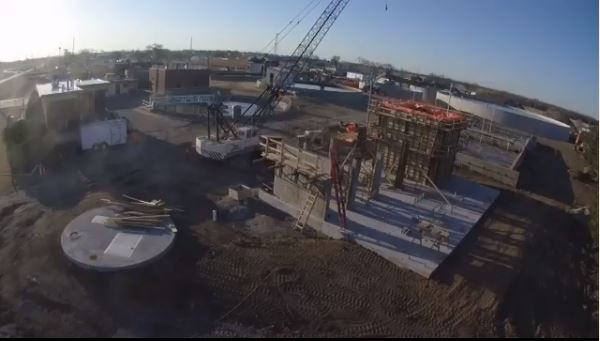
The Hays wastewater treatment plant, 1498 E. Highway 40, is undergoing reconstruction.
By BECKY KISER Hays Post
Reconstruction of Hays’ updated wastewater treatment plant is running 45 days ahead of schedule.
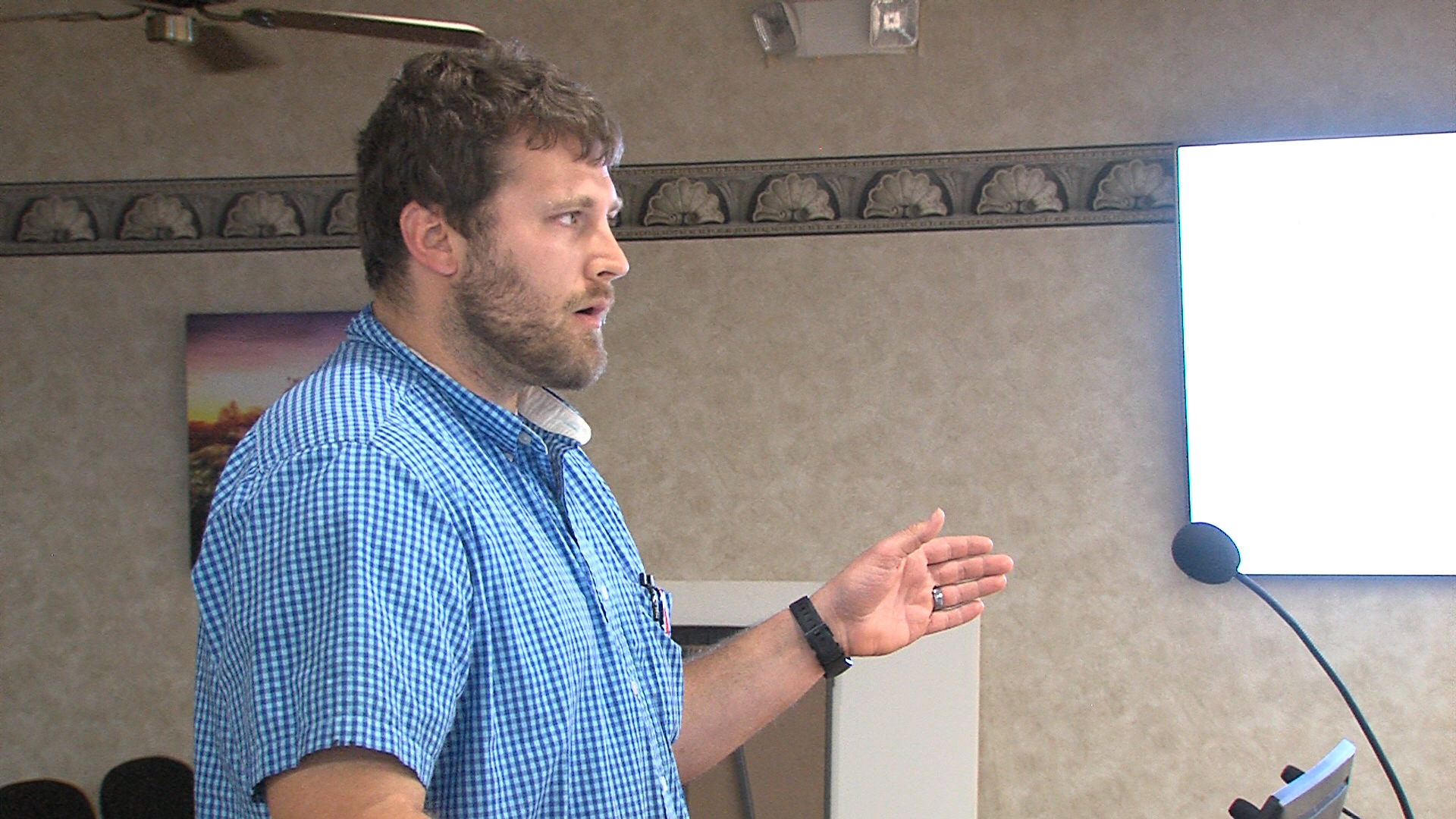
A progress report was presented Thursday night to city commissioners by Stan Christopher, HDR Engineering.
Most of the work is now taking place above ground. Christopher likened the current status of the $28.4 million project as “builders having a new house roughed in.”
He showed photos of the site including a 185-foot diameter aeration basin which will replace two smaller ones.
“It’s not that the plant capacity is being increased, but the quality of water coming out of the new plant is much tighter than what your current plant,” explained Christopher.
“In order to achieve that you need to be able to treat the wastewater for a longer period of time and that’s why this structure is bigger than what you have currently.”
The biosolids, or wastewater, will go from the aerator into two clarifiers and settled out, is filtered and disinfected, and then discharged into two reclaim/reuse water tanks.
“That effluent water is fully treated,” said Christopher, “and can be either discharged to Chetolah Creek or be pumped out for use on the Fort Hays Municipal Golf Course and the ball fields for irrigation reuse.”
Christopher noted there have been no change orders on the project, and was quick to compliment the city employees working with the contractor.
“We’ve seen tremendous support out of your staff at the plant,” he told the commission.
“Any modification of a plant requires you to make connections to the existing plant at numerous times. That usually requires shutting down the entire facility for four to five hours, sometimes up to eight hours. Obviously, those have to be timed when wastewater’s not being discharged into the sewer, or at least, very little of it, and that’s usually 1 o’clock in the morning. Your staff is working with the contractor with those shutdowns and fast-tracking it into three or four hours, and putting the plant back into operation well before most of us are up for the day.”
The final completion date is projected to be August 1, 2019.
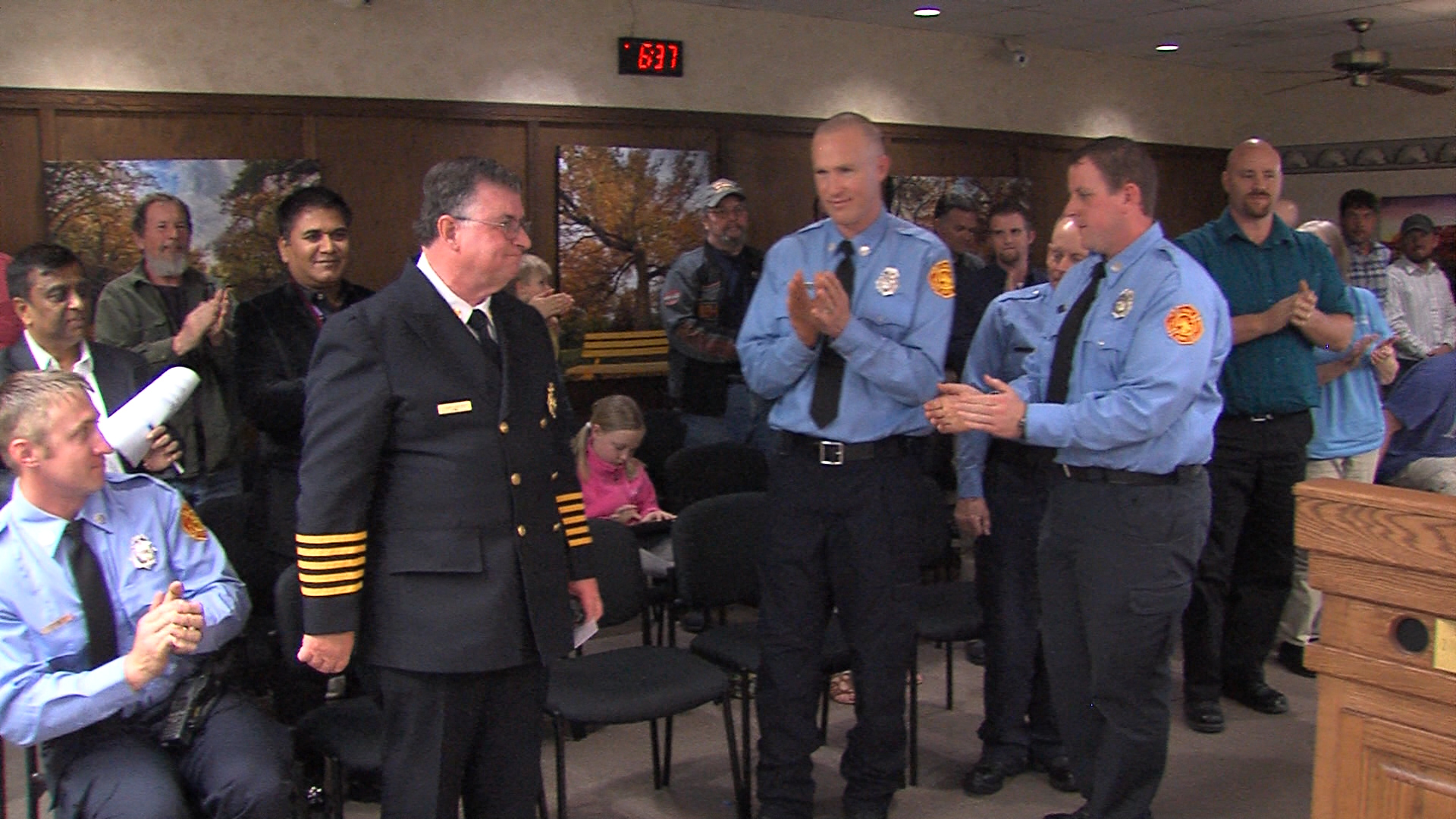
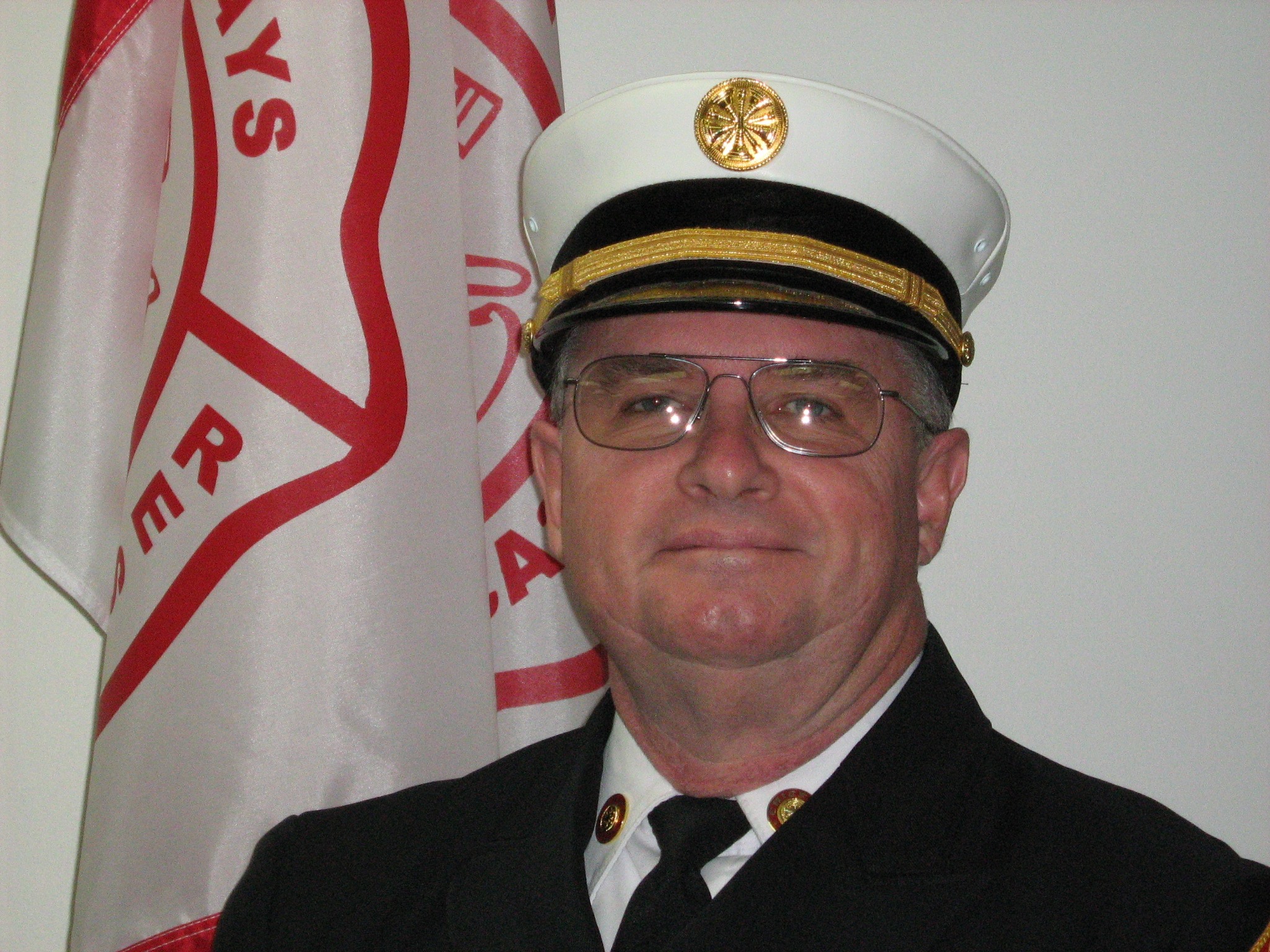
Hays Fire Chief Gary Brown received a standing ovation Thursday night during the city commission meeting. Brown will retire Friday.
By BECKY KISER Hays Post
It surely was a bittersweet moment for Hays Fire Chief Gary Brown Thursday night as he stood before the city commission for the final time. With Brown were three city firefighters.
“Ahh, Chief. This will be the last time you do this,” commented Mayor James Meier.
Brown is retiring from the Hays Fire Department today after 45 years as a firefighter, the last 15 years served in Hays.
Wearing his dress uniform, Brown had a smile on his face as he noted the promotions of Aaron Dome to Fire Captain and Tim Detrixhe to Fire Lieutenant. He also introduced a new firefighter, B. J. Hill.
“We’re very happy to see all these changes in the fire department and people moving upward,” Brown concluded.
As Brown was about to return to his seat in the audience, Meier jumped in.
“I don’t think we can let this go by without talking about one more person, and that is the chief. I think it’s appropriate to thank you for your service and what you’ve done for the city of Hays.”
“There’s never been a negative word said about you,” Meier noted, “and we’re so glad you came to Hays. It’s going to be a great loss.”
Brown said he would be “staying in Hays for a while while we figure out what we’re doing.”
The other commissioners and City Manager Toby Dougherty echoed Meier’s thank you and stood to give Brown a standing ovation as did the entire audience in the commission chamber.
A come and go public reception will be held for Brown this afternoon from 3:30 p.m. to 5 p.m. in Hays City Hall, 1507 Main.
The city of Hays is still waiting for official word from the Federal Aviation Administration (FAA) about the number of passenger boardings there were last year at the Hays Regional Airport.
“As far as the city stands, we believe we’ve hit over the 10,000 mark,” Assistant City Manager Jacob Wood said. “We’ve counted and we believe we’re over those. But it’s really up to the FAA to approve that number and give us the final results.”
If there were more than 10,000 boardings in 2017, the city becomes eligible for a $1 million grant from the FAA. Otherwise, the grant funding program annually allocates $150,000 for airport projects.
Recognizing the “FAA is a huge bureaucracy, it takes a long time for them to give us the actual numbers,” Wood acknowledged.
He thinks there may be something preliminary from the FAA next month.
Previous million dollar FAA grants have paid for construction of the airport fire station, the Instrument Landing System (ILS), repair of the main runway and to make improvements in the terminal.
“Once you reach 10,000 boardings, it really changes the scope and scale of the airport,” said Vice-Mayor Henry Schwaller. “It would also be indicative that the new air carrier SkyWest is paying off.”
According to Ovid Seifers, airport manager, the boarding reports come from two sources: SkyWest, the airport’s Essential Air Service (EAS) provider and from boardings with charter flights with a Part 135 Operator, an aircraft that is hired on demand for transport.
SkyWest 50-passenger jets began providing service at the Hays Regional Airport in August, 2014, with flights to and from Denver. A Chicago flight, in cooperation with the Salina Regional Airport, was added earlier this month.
The airport last reached 10,000 boardings in 2011 and 2012. City officials are hopeful the new Chicago flight will help boost the numbers regularly.
The U.S. Supreme Court is mulling over the contention that the current standard requiring online retailers to collect state sales tax only if they have a physical presence in said state should be abolished.
South Dakota Attorney General Marty Jackley presented his argument April 12 in front of the high court saying “times have changed” in the retail business. Sales taxes are not collected by out-of-state sellers by internet retailers such as Amazon and Wayfair. That savings, often combined with free shipping from the company, is driving many customers to the internet instead of Main Street. Many “bricks and mortar” retailers are seeing a downward trend in their sales.
The state of Kansas and several other states have filed an amicus brief in the North Dakota case. The Supreme Court is expected to issue its ruling in June.
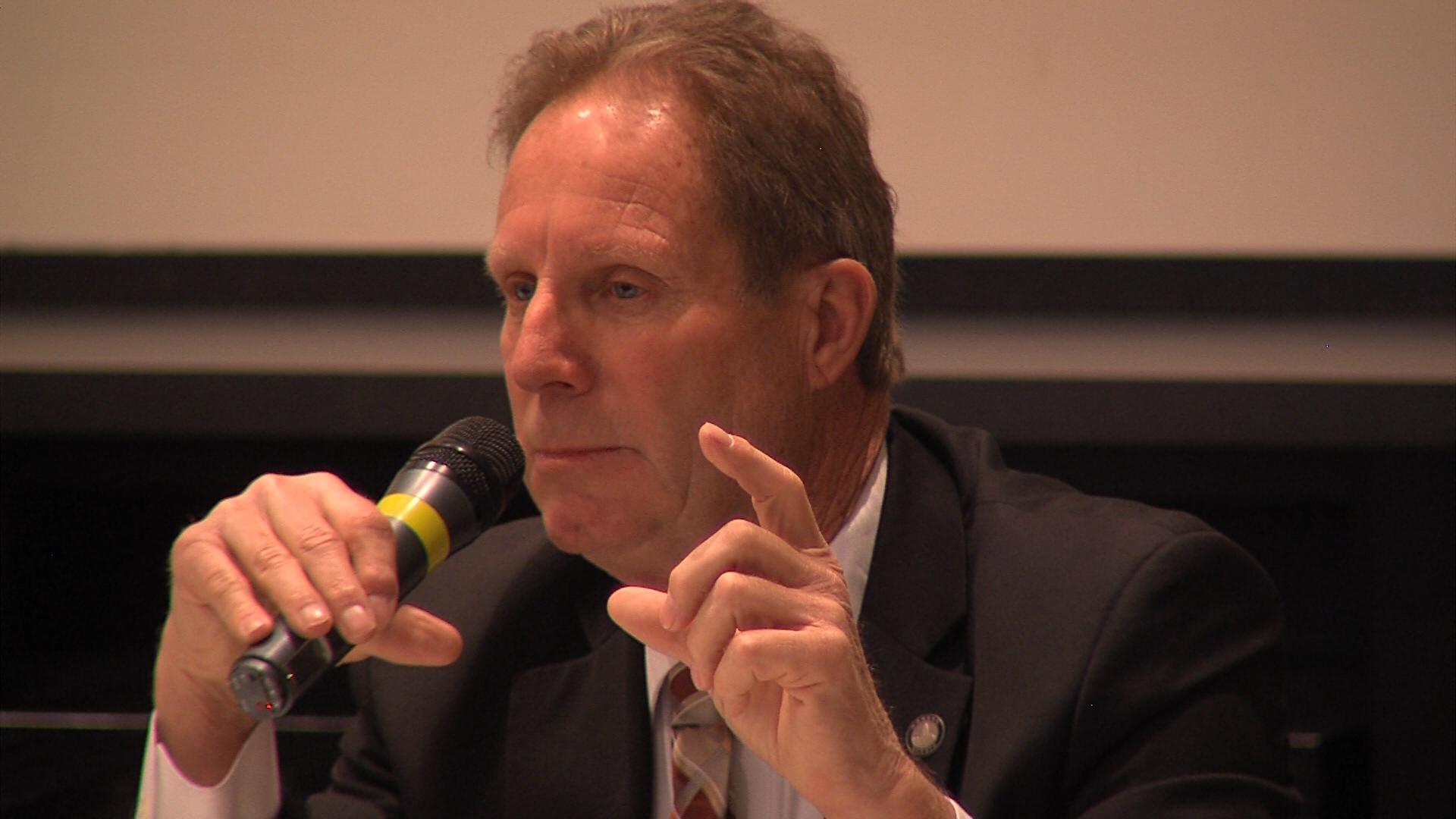
Although it’s a federal case, the Kansas legislature “continues to work on state legislation to try to capture the sales tax on the internet,” according to Goodland senator Rick Billinger. He was in Hays Saturday, along with Reps. Eber Phelps of Hays and Ken Rahjes of Agra for a legislative coffee presented by the Hays Area Chamber of Commerce.
There are challenges to collecting the sales tax for online purchases.
“Kansas can say we’re going to collect our 6% for the state, but, for example, Hays has a local sales tax. Some counties also have a local sales tax,” Billinger pointed out. There are also special taxing districts. “Every county has something different. In Sherman County, our total combined tax is over 9% and figuring out who is to be paid what, is difficult.”
Amazon does have a physical presence in Kansas with two warehouses and a sort center in Johnson and Wyandotte counties, so the state sales tax is collected.
Billinger favors an across-the-board internet sales tax but says the federal court must first “fix the hodge-podge.”
In Kansas, the majority of online sales are made with Amazon, Walmart and Best Buy, according to the Department of Revenue, Rahjes said. They all have a physical presence in Kansas and are collecting the state sales tax, mostly.
“Not all the supply partners of these companies have a Kansas presence, so you may buy something from Amazon and not be charged our state sales tax,” explained Rahjes.
“As this nationwide explosion to capture sales tax revenue gets closer, then the unintended consequences come in,” he added in agreement with Billinger.
“Part of the argument against this is the burden it will put on small retailers. There’s not going to be a handy card to look at saying this is how much the tax is.”
Some of the internet giants are offering to figure it out for businesses, for a fee.
“So are you willing to pay more in order to make it fair for the businesses on the bricks in downtown Hays?,” Rahjes asked the audience.
In talking to the small “mom and pop” businesses in his 110th District, Rahjes said he is an advocate of the internet sales tax, “trying to keep it as advantageous as possible for Main Street.”
It won’t be simple, but he’s predicting it will happen.
There are, however, many sales tax exemptions in Kansas, “millions and millions and millions of dollars’ worth,” said Rep. Phelps.
“We’ve really shrunk that population in our state that collects the sales tax. I think that adds momentum to the support for taxing internet sales that are out of state and selling in our community.”
He has also talked with local businesses about implementation of an internet sales tax.
“I was talking with Goodwin’s Sporting Goods in Hays about people who come in to try on the latest Nike tennis shoe and ask questions about it. Then they go and order the shoes online, probably saving a few dollars. But in the meantime, you have a local store that has the overhead right here in our community.”
The 8.75% sales tax in Hays is split three ways:
Hays: 1.75%
Ellis County: 0.5%
Kansas: 6.5%
The city’s general fund comes primarily from the local 1.75% sales tax, not property tax. Hays is the only city in Kansas to finance its general fund with sales tax.
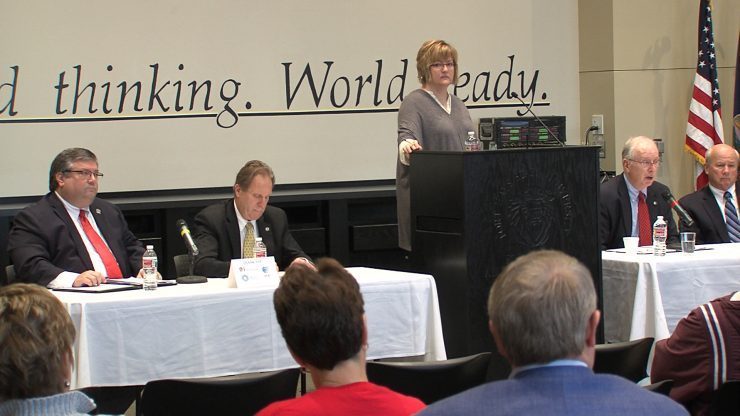
Hays Area Chamber of Commerce Exec. Dir. Tammy Wellbrock moderated Saturday’s legislative coffee featuring Rep. Ken Rahjes (R-Agra), Rep. Eber Phelps (D-Hays) and Sen. Rick Billinger (R-Goodland.).
By BECKY KISER Hays Post
Kansas legislators will return to the statehouse in Topeka Thu., April 26, for their 2018 wrap-up session.
Since the April 8 adjournment, area legislators have been on the road talking with constituents. Saturday they were in Hays at the Fort Hays State University Robbins Center for the second Legislative Coffee presented by the Hays Area Chamber of Commerce.
The top topic still on the minds of Reps. Eber Phelps (D-Hays) and Ken Rahjes (R-Agra) along with Sen. Rick Billinger (R-Goodland) is school financing.
In the early morning hours of Sunday, April 8, Kansas lawmakers passed a $534 million increase in education funding over five years. The Kansas Supreme Court ruled in October the state’s current education funding of more than $4 billion a year isn’t sufficient.
The State Department of Education later discovered an error lowering the size of the spending increase by at least $80 million. Republican Gov. Jeff Colyer signed the bill last week and plans to work with legislators when they return to fix the problem.
Sen. Billinger did not vote for what has been called the “gut and go” bill that came out of the conference committee.
“There were no negotiations when it came out of the House and so it was over,” Billinger said Saturday. “When it came to the Senate, it was just a yes or no vote. No amendments. Basically, nothing changes.”
Billinger told the audience he did not support the bill because “starting in year four, the numbers are in the red.”
“I didn’t think it was right to say to schools we’re going to give you this much money over five years, knowing that in the fourth year, we don’t have the money to give them.
“That’s not a good way to do business. I think we need to have money available when we’re going to spend it.”
Although state revenues have been above estimates since last August, Billinger pointed out the legislature continues to sweep money from the Kansas Department of Transportation to balance the budget.
“I call it the ‘Trump Bump’ and it’s good that we have that. But without the $300 million from KDOT, that ending balance is not very large.”
According to Billinger, the KDOT budget has been “the go-to place for funding” since at least 2008.
“You have to find the money where you have it to pay your bills. Without (KDOT sweep), we’re not going to even get close to funding this education deal.
“We’ve got to find a new funding source,” Billinger said.
Billinger will return to Topeka Wednesday for a joint meeting of the Senate Ways and Means committee and the House Appropriations committee to finalize the budget, what he called “the mega-bill.”
He’s hoping it will be a quick process. Last year there were more than 100 different items to be debated between the House and Senate budget in a conference committee. This year he says there aren’t nearly that many.
Shayelyn Akers, FHSU Ag Business senior, chaired Ag Day. She will go to work for Midland Marketing in Hays after graduating next month.
By BECKY KISER Hays Post
Although she could have used her chairmanship of Fort Hays State University Agriculture Day as a resume builder, Shaelyn Akers doesn’t need to.
The senior agriculture business major from Cheyenne Wells, Colo., has already accepted a job with Midland Marketing in Hays as an assistant grain merchandiser.
“I’m looking forward to meeting a lot of the farmers in the area and being able to help them with their operation,” Akers said. “I’ll be helping the advisory team buy and sell the farmers’ grain, working with their position.”
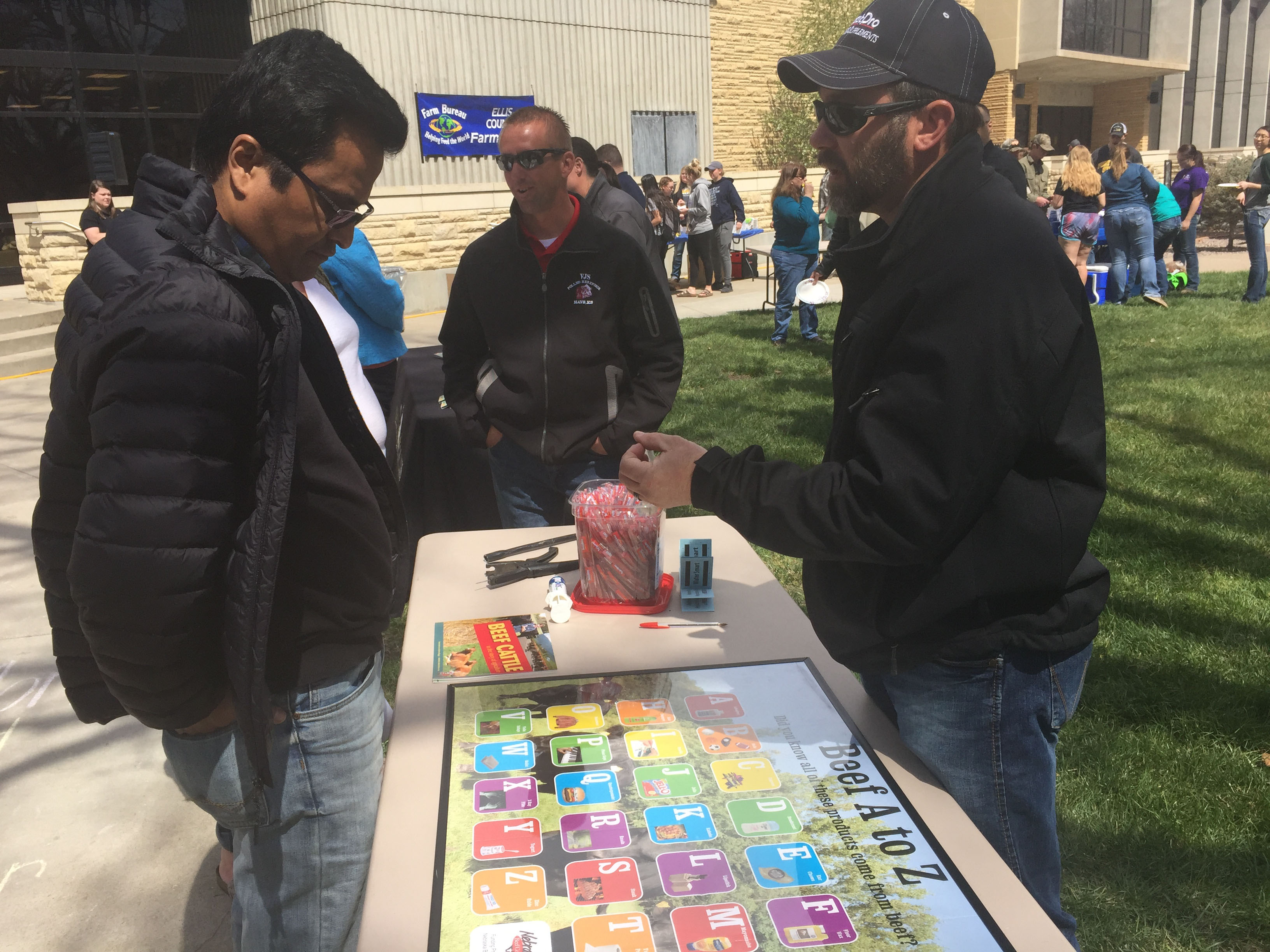
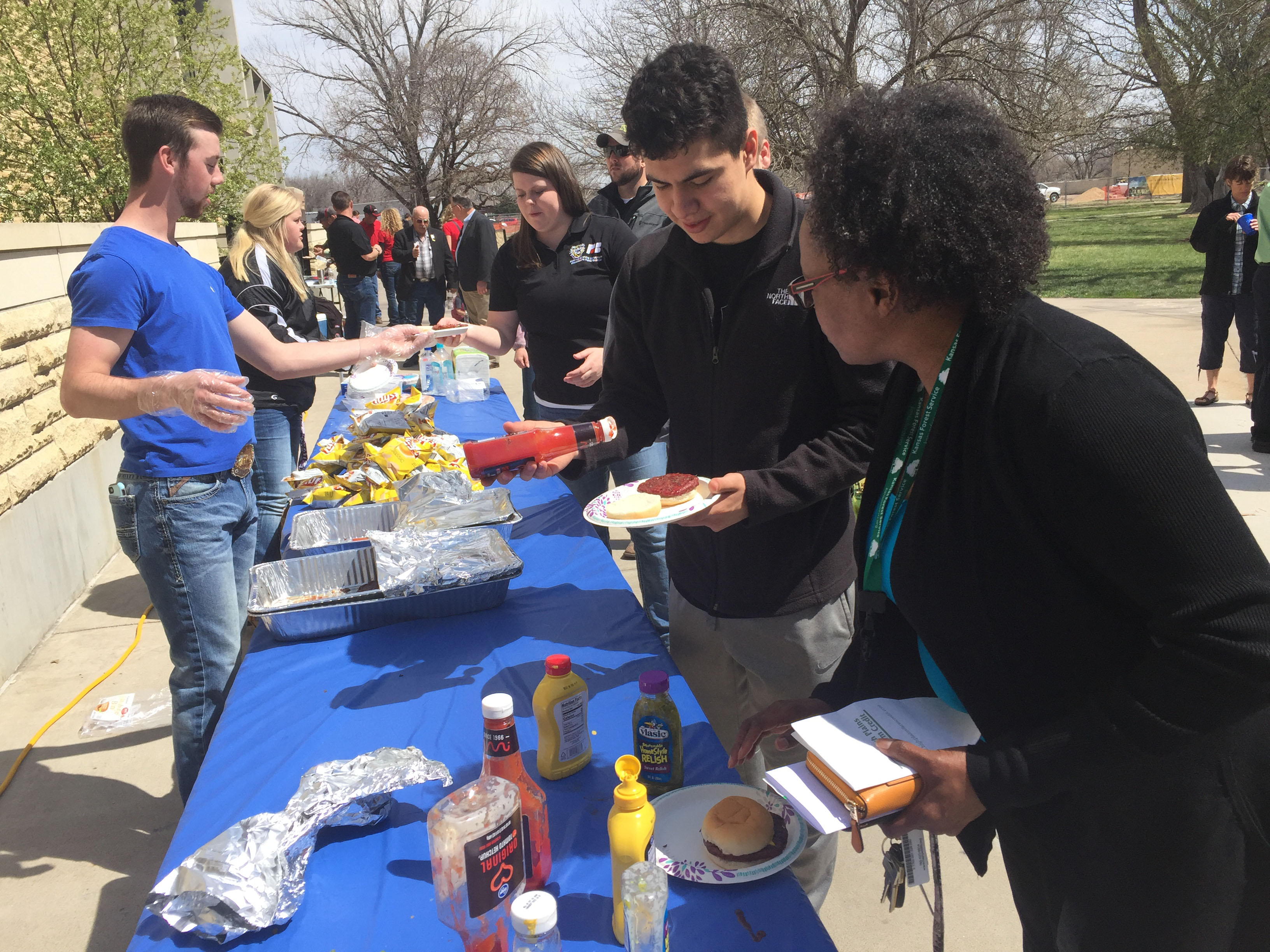
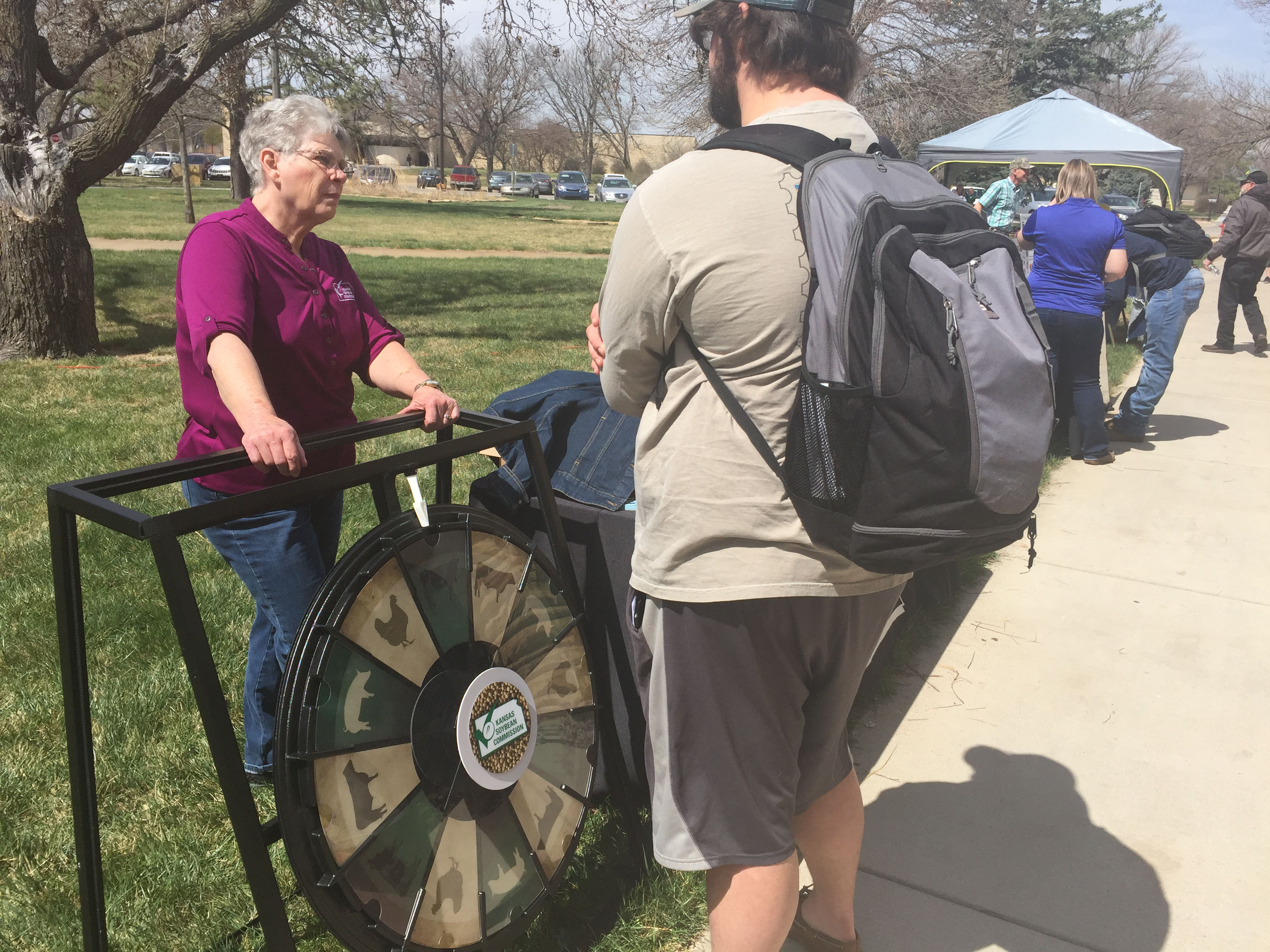
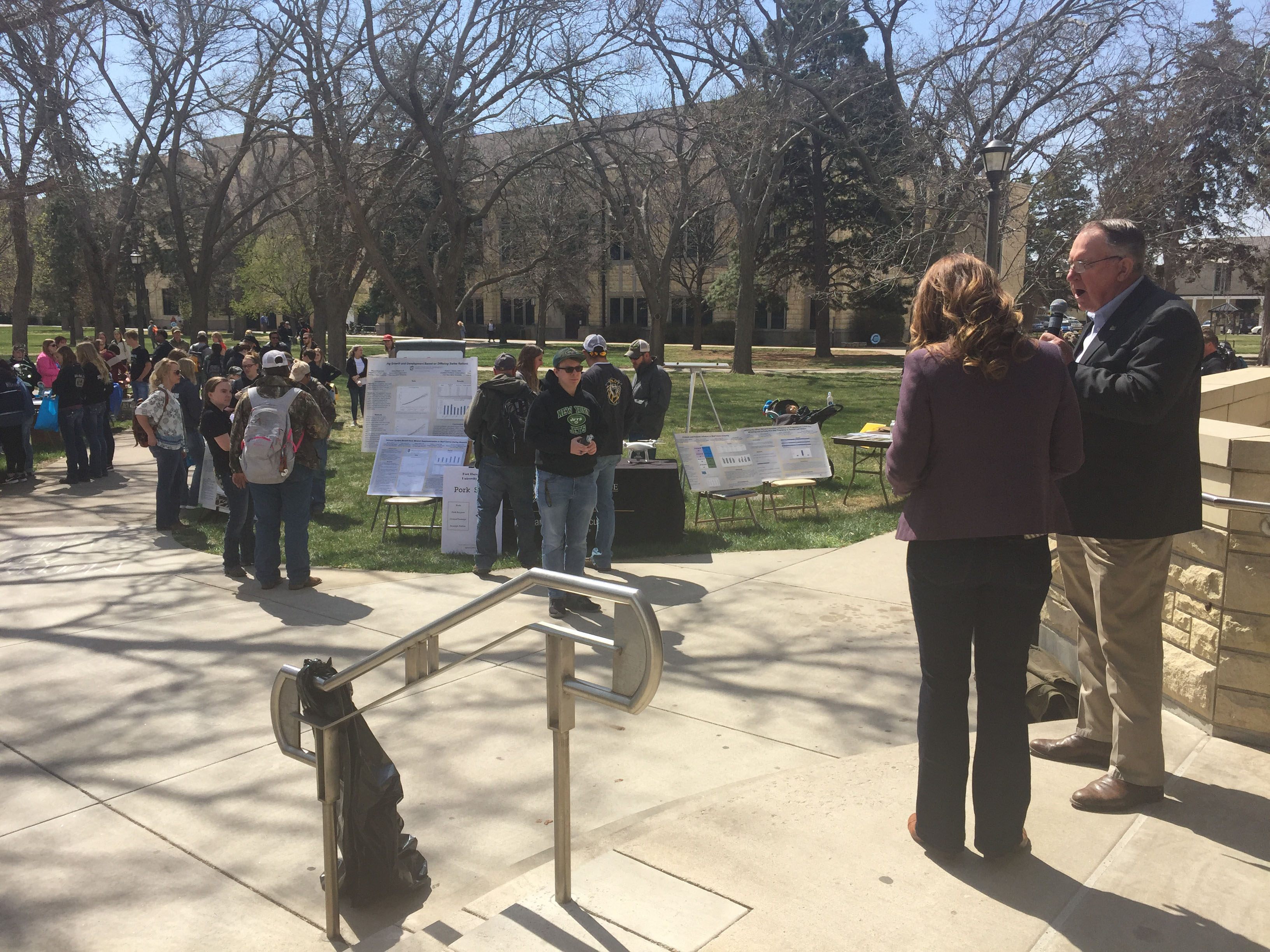
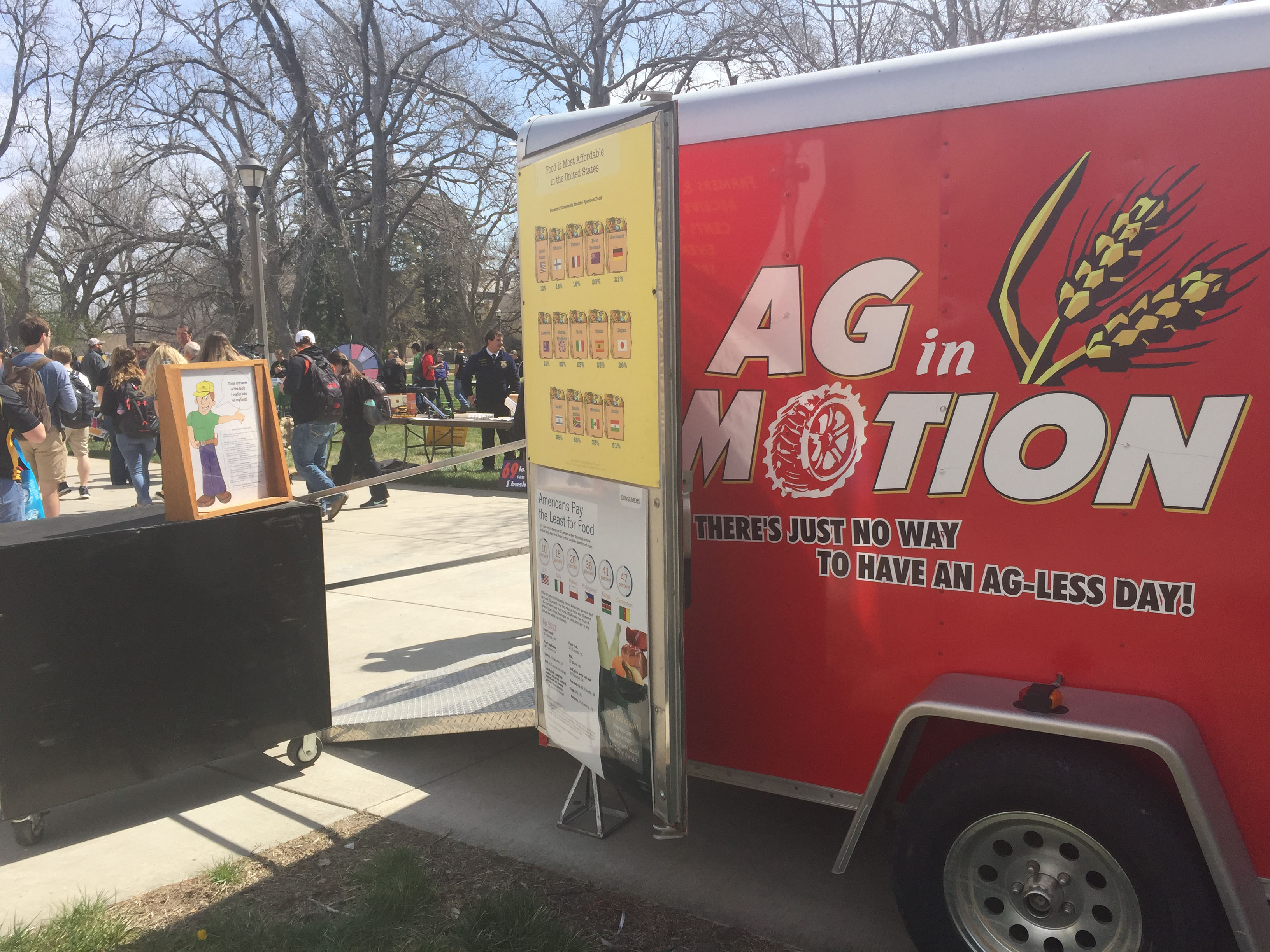
Wheat was just one of the many commodities visitors could learn about in the FHSU quad Tuesday where they enjoyed a free beef meal on a perfect spring morning.
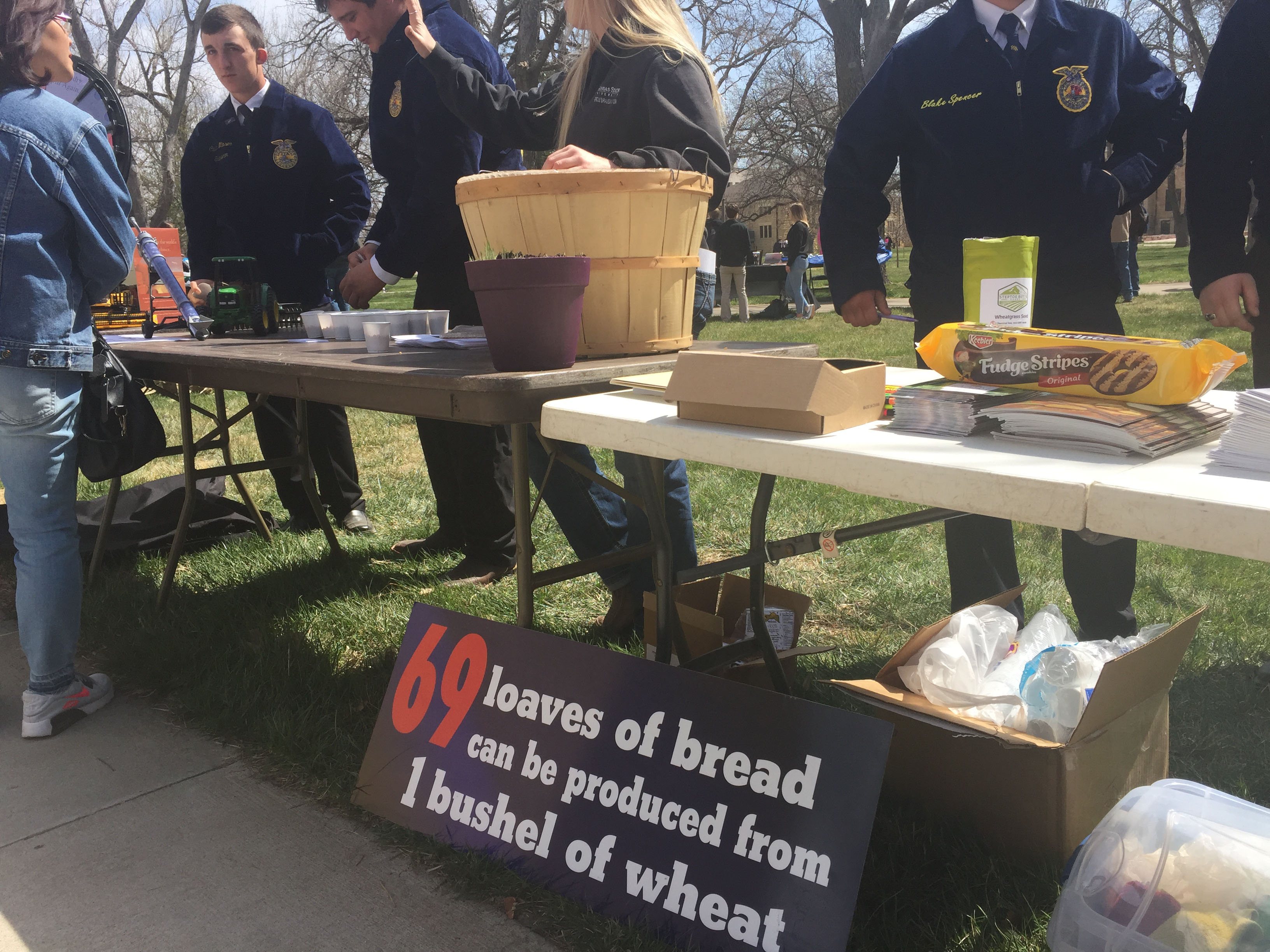
WaKeeney FFA
“It takes one bushel of wheat to produce 69 loaves of bread,” WaKeeney FFA high school sophomore Carter Minson explained to an international FHSU student.
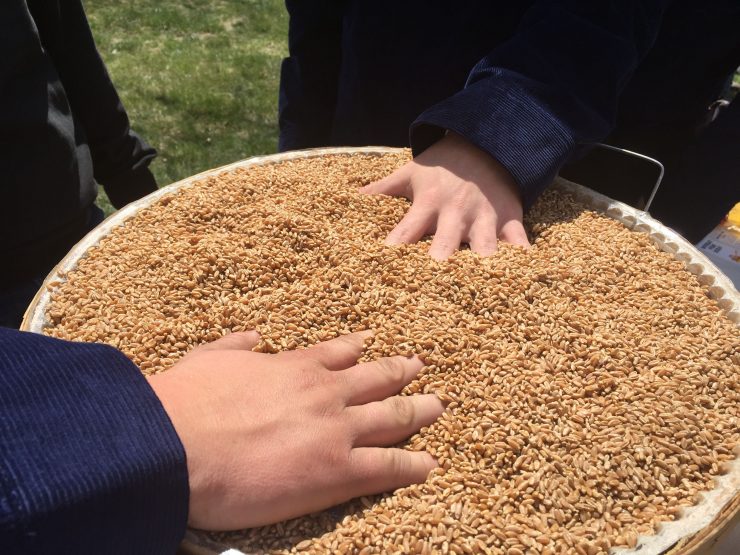
Minson, along with senior Blake Spencer, were demonstrating how much a bushel of wheat weighs — 60 pounds — and handing out samples of wheat kernel snacks. Models of farm equipment used to harvest wheat lined the table top along with a variety of foods made with wheat.
“Even though Kansas is a leading wheat-producing state, it’s crazy how much people don’t know about wheat,” Minson said.
“Somebody asked how many states are in the wheat production business,” Spencer said. “They didn’t know and we had to tell them it’s 41.”
Spencer works at Frontier Ag in WaKeeney and will continue there when he graduates next month. Minson currently serves as treasurer of their FFA chapter.
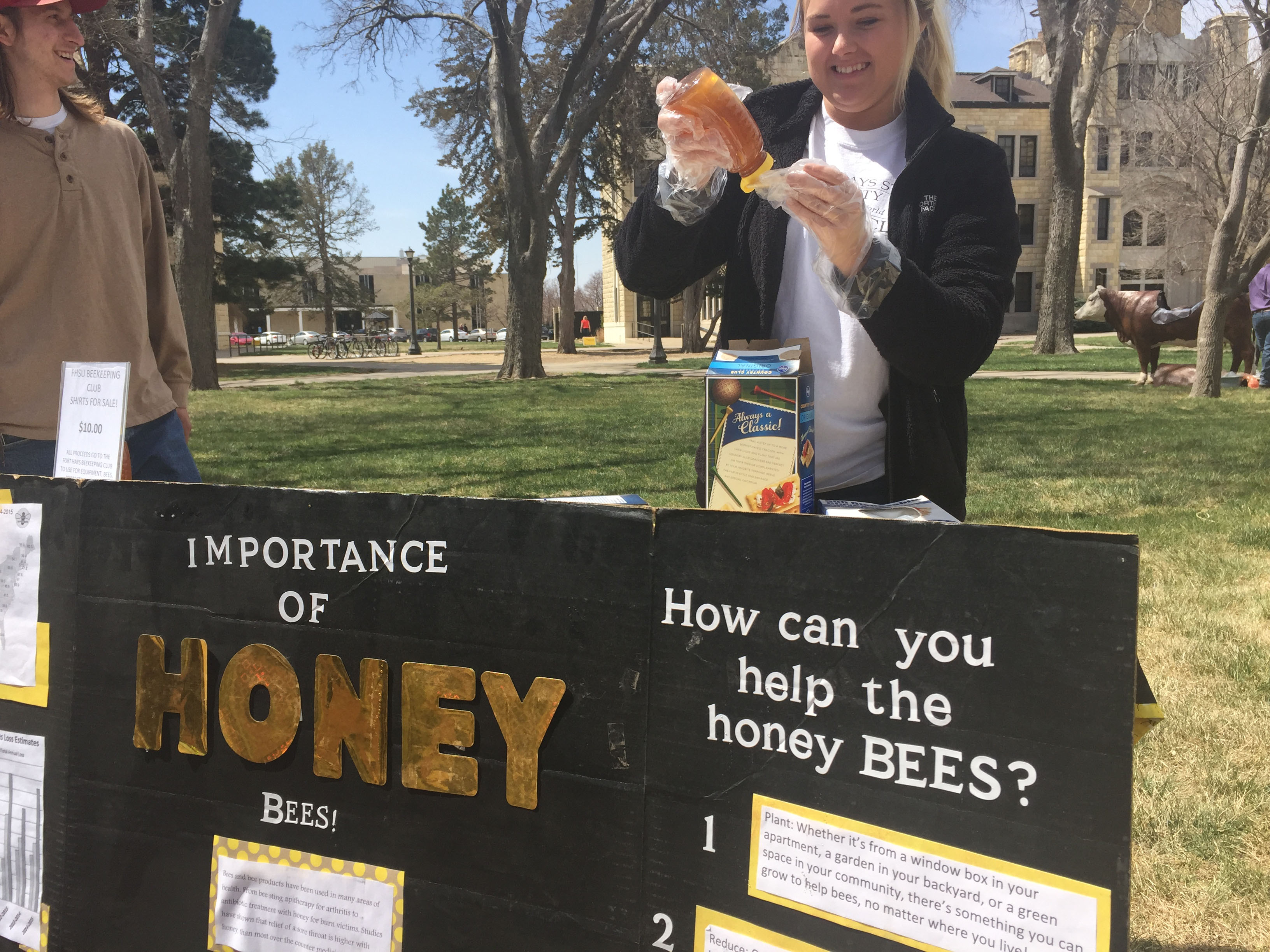
FHSU Bee Club members Ryan Engel and Elissa Jensen with honey harvested from the university’s hives.
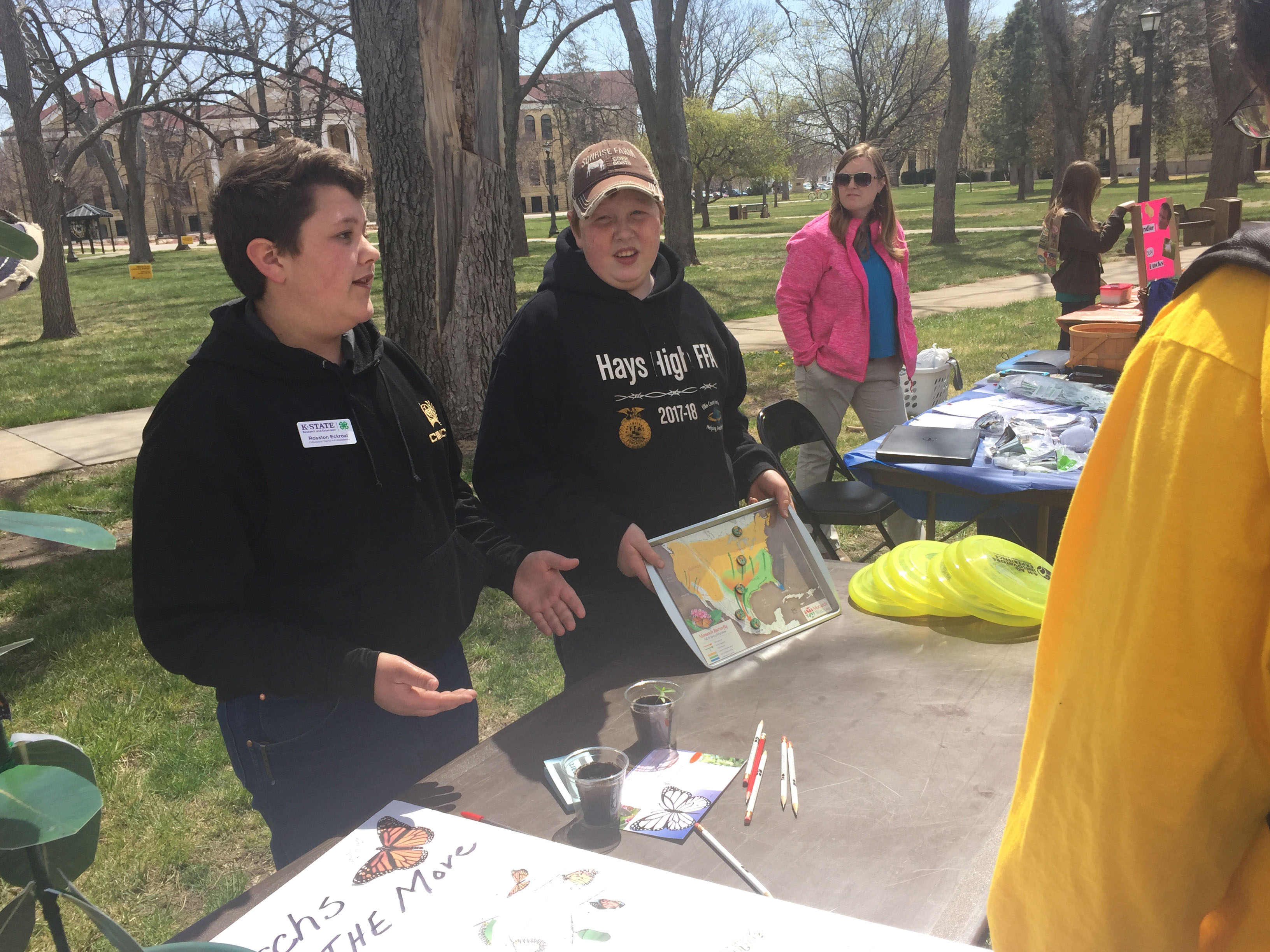
Members of the Hays High School FFA talked to the crowd about growing sunflowers for seed and oil and how the monarch butterfly plays a role in assisting with pollination of flowers and some crops.
Bees are vital to crop pollination. FHSU Bee Club Ryan Engel and Elissa Jensen explained why as they gave out samples of the lightly colored, lightly sweet honey harvested from the university’s two bee hives.
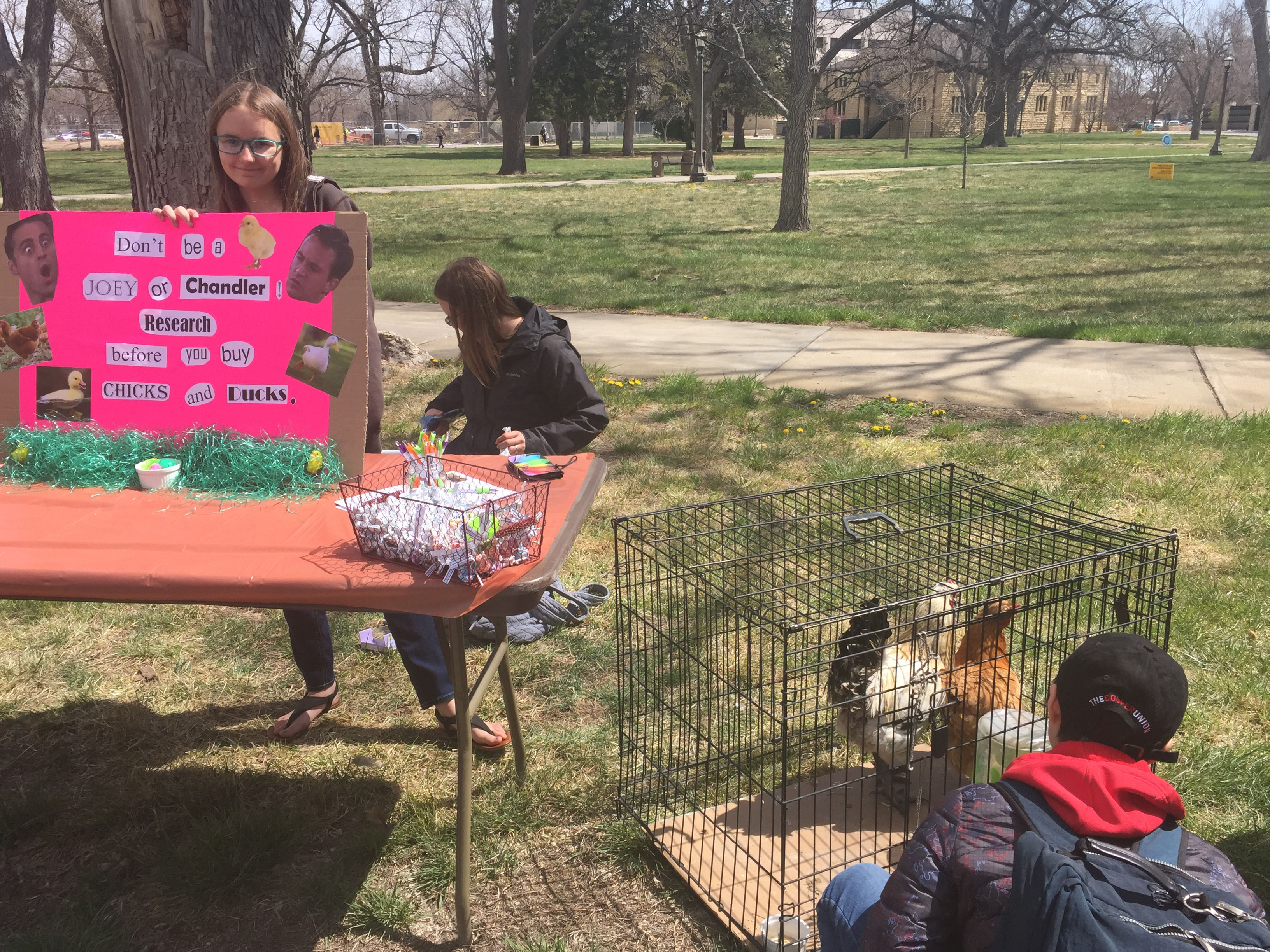
Girls Scout Troop 10058 with chickens and ducks
Girls Scouts from Troop 10058 were there with chickens and ducks, talking about humane ways to raise the poultry.
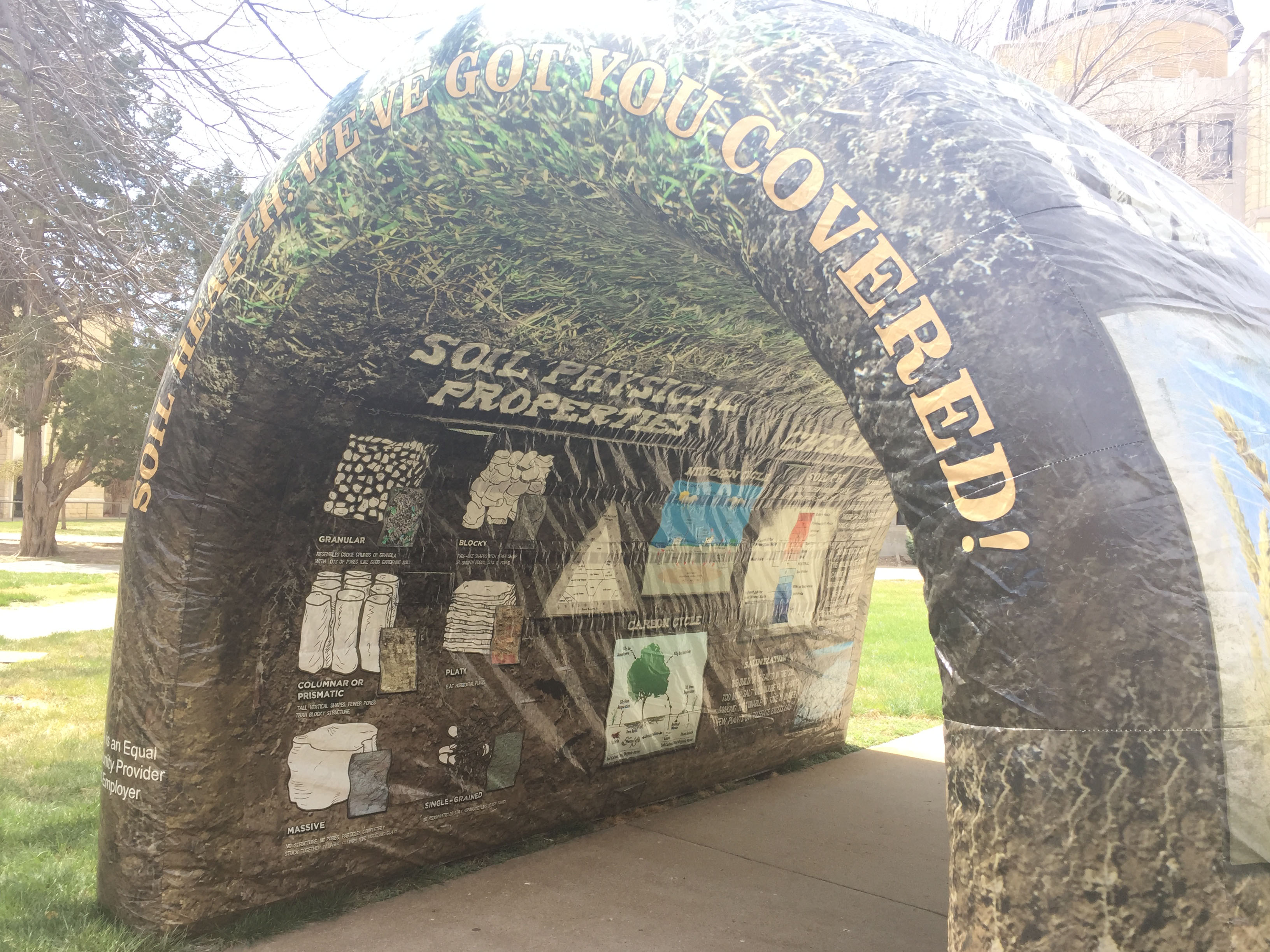
Other participants provided information about soil and water quality and quantity.
One student from China was surprised to learn how much bigger American farms are than those in his country.
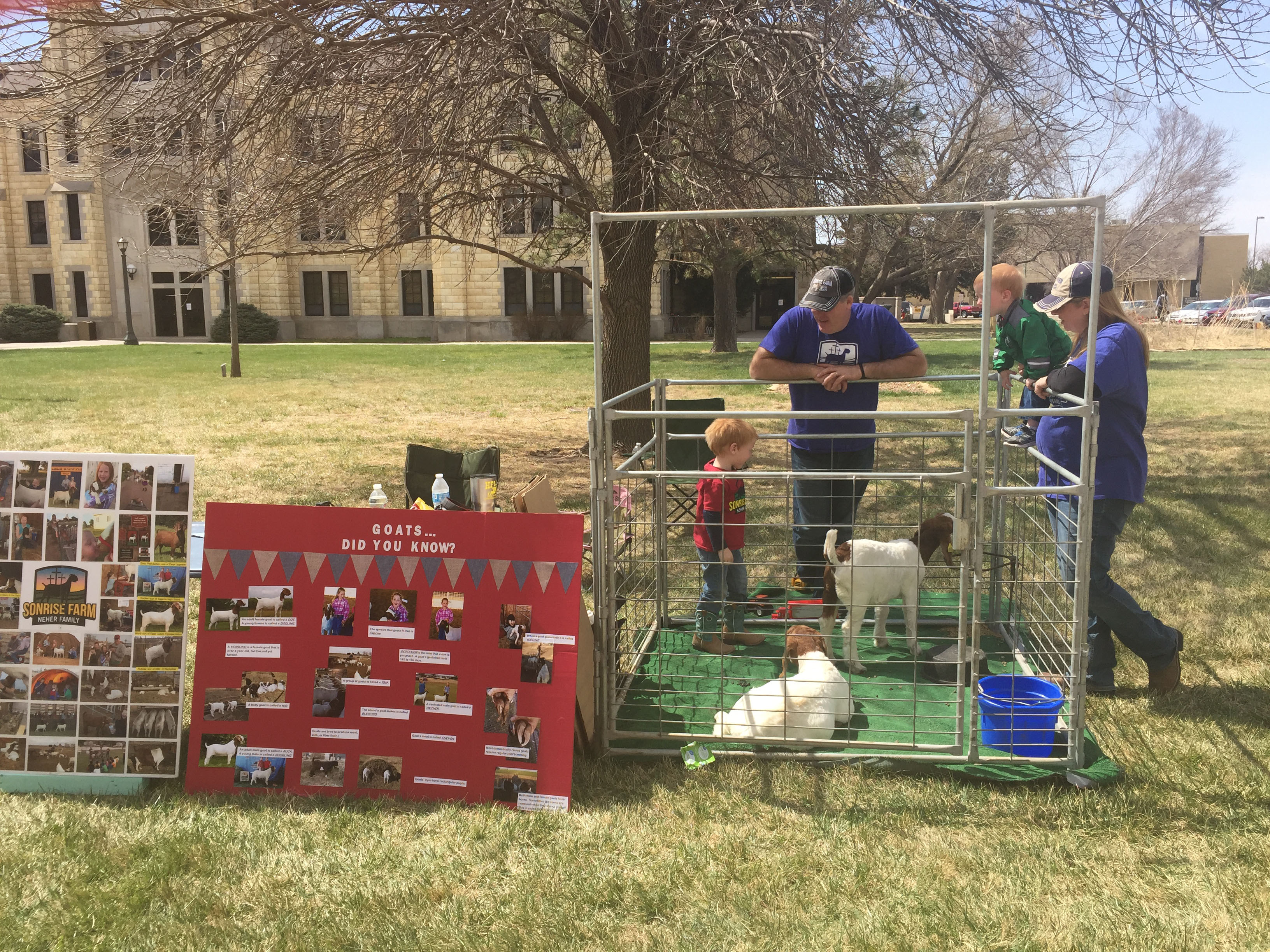
The Sonrise Farm, operated by the Neher family of Pfeifer, had two of their Boer meat goats in a pen on the green grass. People were invited to lean down and pet the goats but cautioned about the goats’ propensity to nibble on loose clothing.
Sonrise Farm Boer Goats, Pfeifer
“Goat meat production is increasingly dramatically in the U.S.,” Jeff Neher said. “It’s a very lean meat that’s high in protein.” Sonrise Farm has been raising show does, wethers and registered breeding stock the past four years.
Akers is also a member of the FHSU Collegiate Farm Bureau chapter, which organized Agriculture Day. The event was formerly known as Beef Day and was reorganized last year to include all types of Kansas agriculture.
“This was the first time we invited all these commodity commissions and the FFA kids,” said Steph Eckroat, coordinator for Ellis County Farm Bureau. “Next year we hope to invite area school children and the general public to attend.”
A calf birth is demonstrated by Dr. A. J. Tarpoff, KSU assistant professor and Extension Beef Veterinarian.
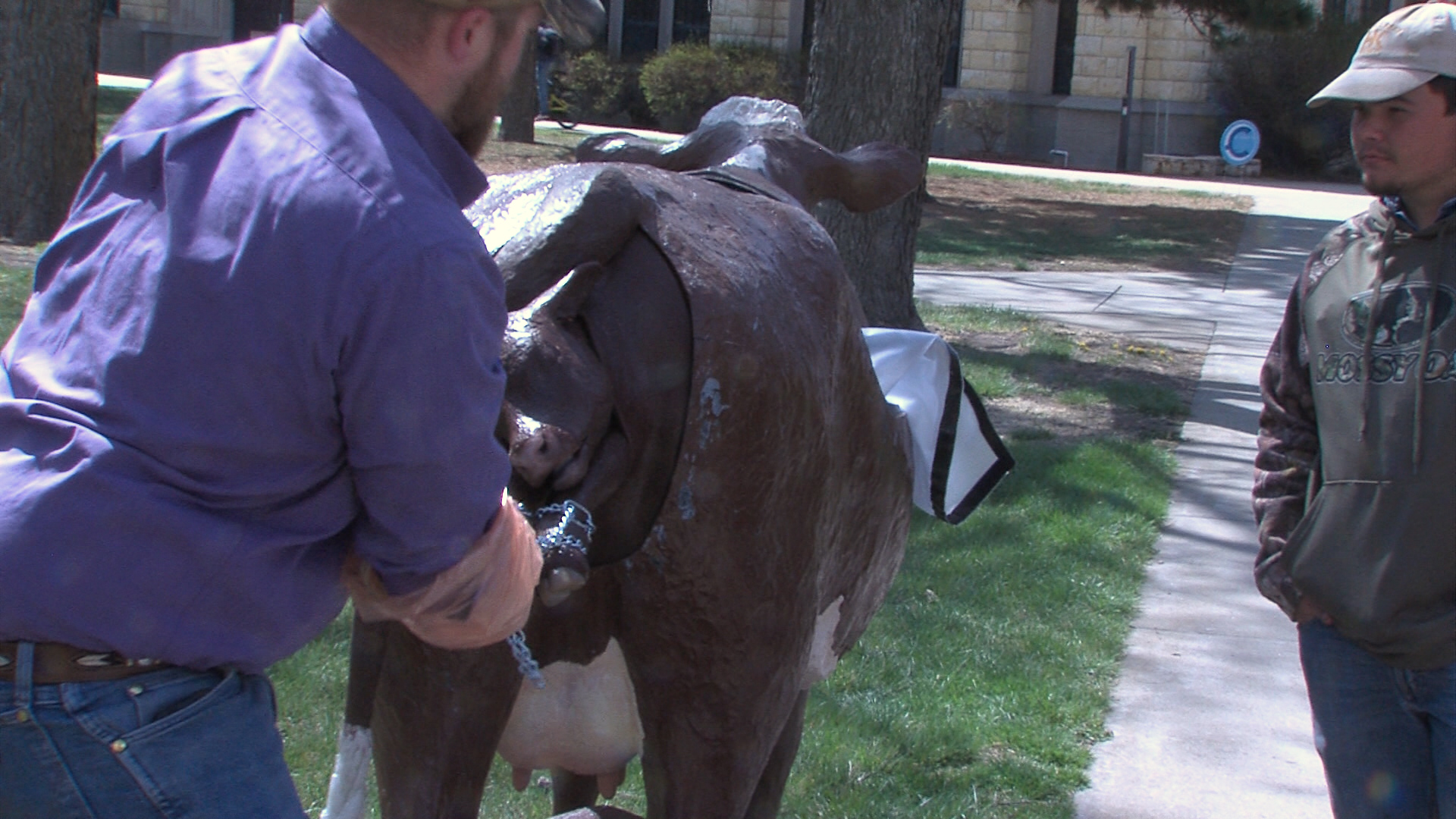
Demonstrations included a life-size model of a cow giving birth by Dr. A.J. Tarpoff, an assistant professor and Extension Beef Veterinarian at Kansas State University, Manhattan. The crowd watched with rapt attention as he talked them through the birth process, using the same supplies and equipment utilized by ranchers, and in difficult cases, by a veterinarian, to help pull a calf from the mother’s body.
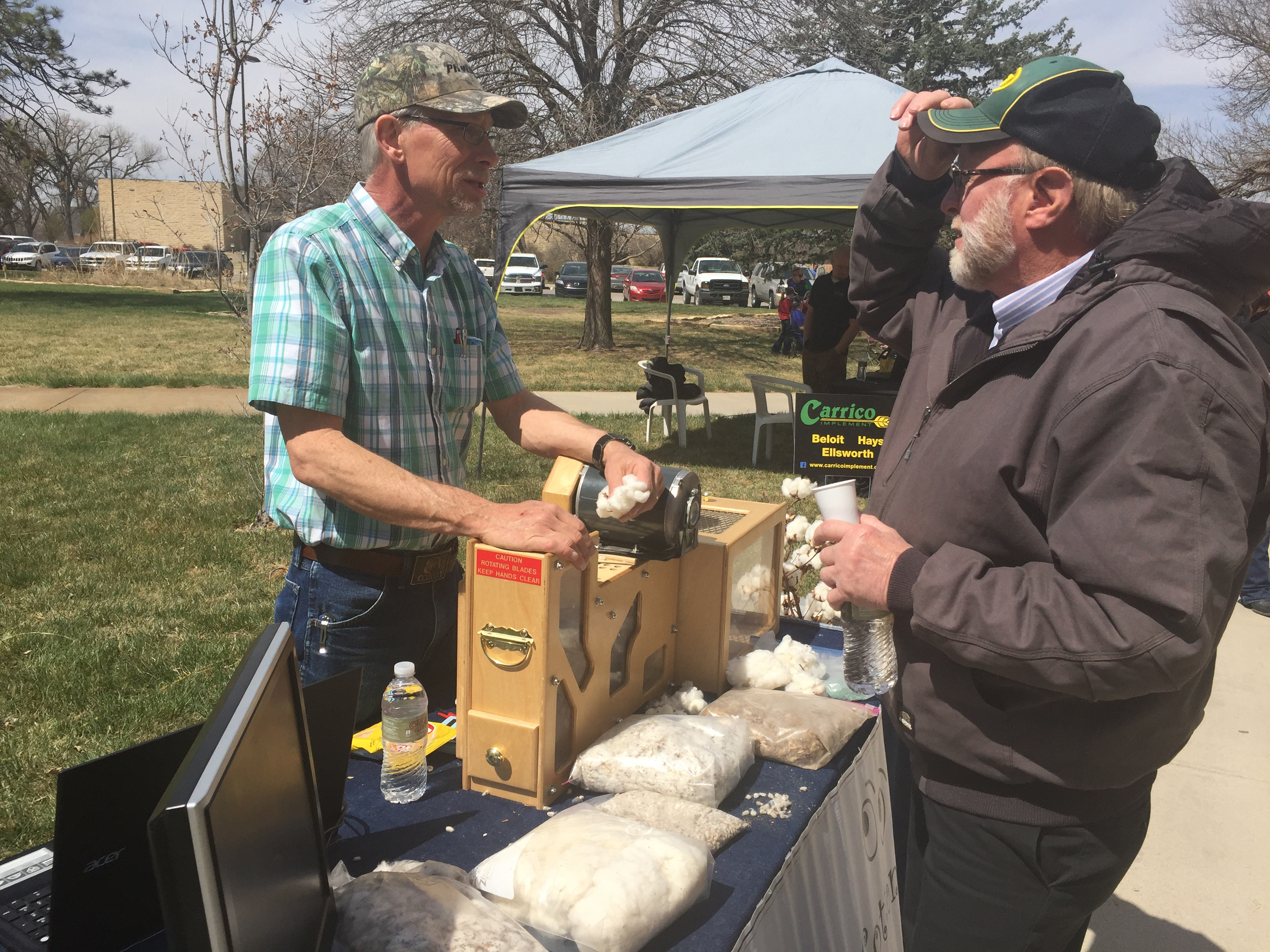
An old fashioned miniature cotton gin was in use by the Southern Kansas Cotton Growers Coop and the Southwest Dairy Museum brought their mobile cow milking unit.
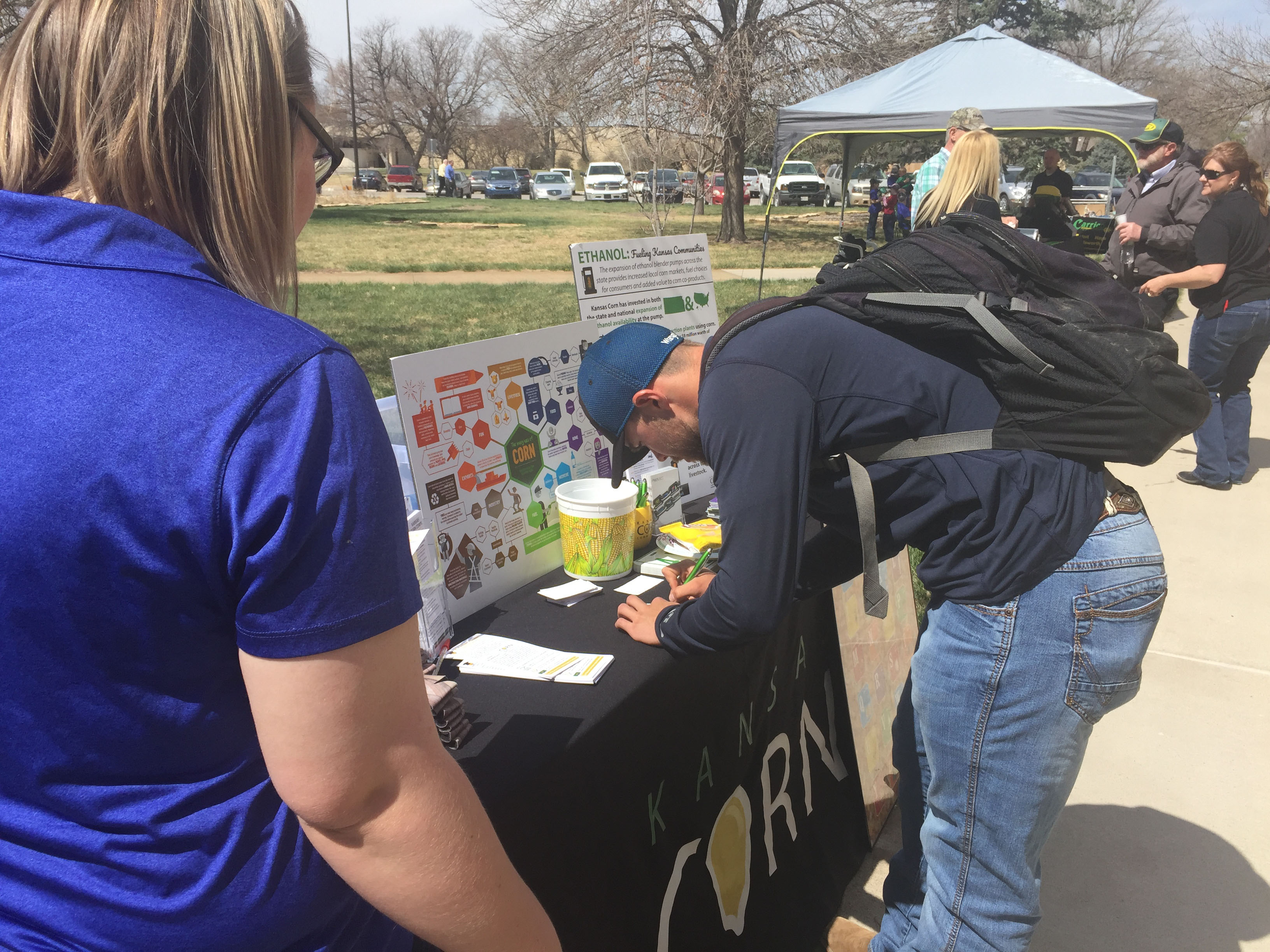
The Kansas Soybean Commission and Kansas Corn Growers Association were also on hand as was Harry Watts, director of the Kansas Farm Bureau Foundation in Manhattan and an FHSU alum. Other booths featured the latest technology for use in agriculture, including drones.
“I love everything about agriculture. It’s always been in my blood and it always will be,” Akers vowed as she surveyed Ag Day from the steps of the Memorial Union.
She grew up on her family’s farm in eastern Colorado, helping with production of wheat, milo, corn and feed, along with the cow/calf operation. They’ve raised horses, pigs and even buffalo.
“We’re the ones feeding the world, putting the food on the plate,” Akers added. “Everyone needs to be aware of that.”
The second Legislative Coffee hosted by the Hays Area Chamber of Commerce will be held Sat., April 21, at the Fort Hays State University Robbins Center.
The event was postponed from April 7 because the Legislature remained in session that Saturday.
Doors open tomorrow at 8 a.m. with the legislative panel speaking at 8:30 a.m.
Scheduled to participate are Sen. Rick Billinger (R-Goodland), and Reps. Eber Phelps (D-Hays), Ken Rahjes (R-Agra) and Leonard Mastroni (R-LaCrosse).