We have a brand new updated website! Click here to check it out!

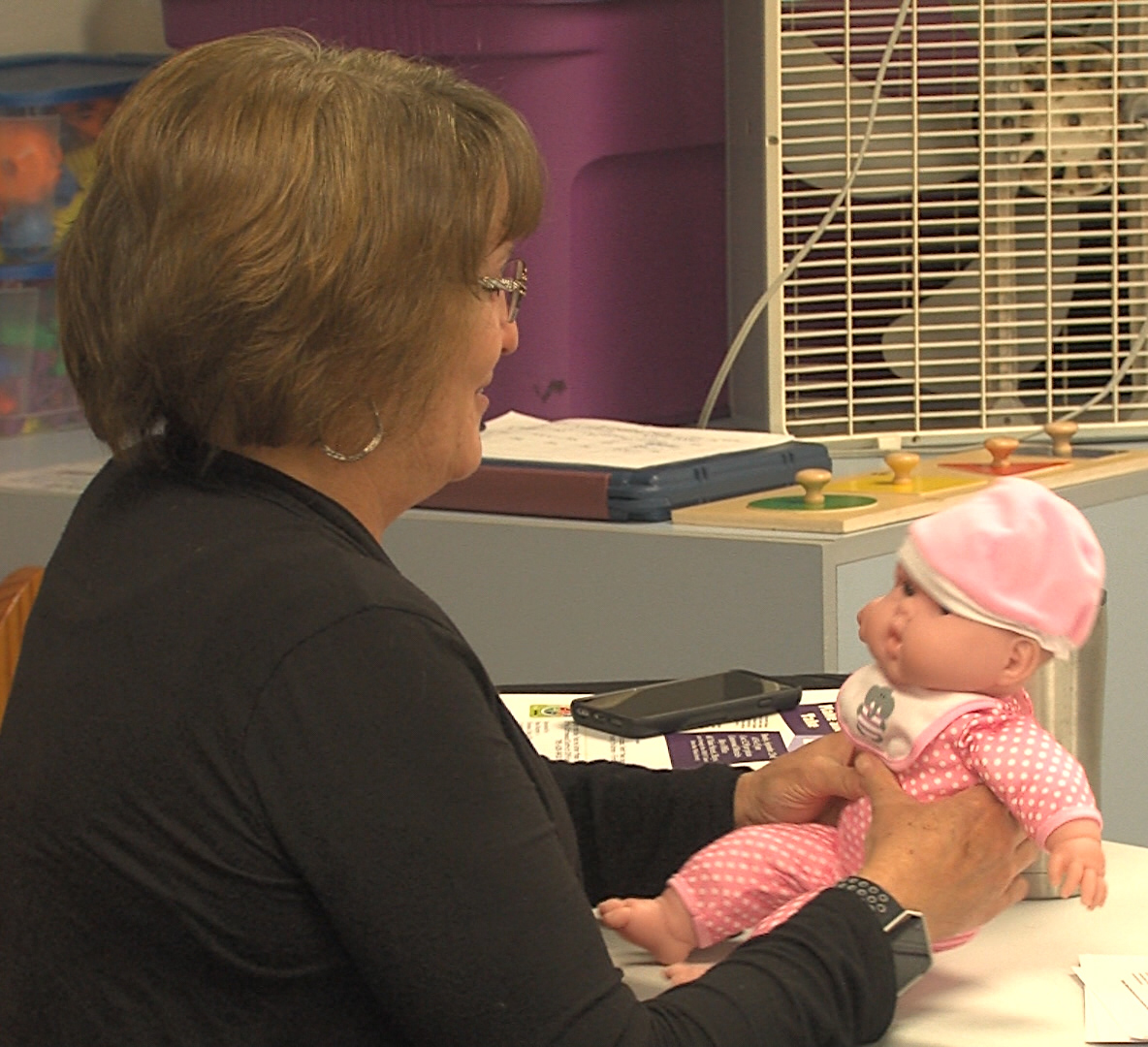
🎥 Specialist: Better brains for babies make smarter kids

Dr. Bradford Wiles, KSRE Early Childhood Development Specialist, speaks with parent-educators at Early Childhood Connections in Hays Friday.

By BECKY KISER
Hays Post

For years, scientists have known that what happens – or doesn’t happen – during a baby’s first few years makes a big difference in a child’s later life, and babies who do not get enough love and attention in infancy are less likely to be well-adjusted adults.

“I think we all want our kids to be smart and happy,” says Dr. Bradford Wiles, K-State Research and Extension (KSRE), a Manhattan-based specialist in early childhood development. “We aren’t born with the innate ability to be good parents.”

“What we do in these parent education and parent educator classes is essentially teach how to make smart kids.”

Wiles was in Hays last week presenting seminars about the importance of early brain development. Friday he worked with parent educators in the Parent As Teachers program at USD 489 Early Childhood Connections. Parent Educators meet regularly with parents in their home.

“We remove the things that are barriers to kids’ learning and to their social/emotional development. We encourage the things – like play – that are known to facilitate cognitive, social/emotional and physical development.”

Also important to child development is consistency and routine, with wiggle room allowed.

“First, it helps children to know what to expect. For all of us, knowing what to expect is a tremendous benefit. It reduces anxiety. It helps us to plan.

“When children are in an inconsistent environment, they don’t know what to expect. So learning new things becomes a lot more difficult. They tend to be a lot more anxious. They’re unable to focus very well because they have no expectations that they know are going to be met.”

Adults can modify a routine as needed. Children should not be randomly changing their routine, according to Wiles.

“If a parent sets 7:00 p.m. as bedtime and they want to take the child along with them to visit friends and won’t be home until 8:30 p.m., that’s fine. That’s the adult’s choice.

“When it’s the child randomly staying up until 8:30 p.m., that becomes very chaotic and doesn’t provide the structure children need to be able to process and learn things.”

Wiles says most people don’t recognize how important development is from birth to age 5.

“Those foundational years are what set the stage for all learning and development.”

From the moment a baby is born, every experience taken in by the five senses helps strengthen the neural brain connections that guide development.

Talking to a baby face-to-face builds the brain connections needed for both language skills and a healthy emotional bond.

“It would never occur to some parents to give baby a ‘play-by-play of what they’re doing, or use infant-directed speech in that really high-pitched voice… That’s what we’re after, to help people realize there’s simple things they can do that will make their kids smarter.”

Wiles says empathy and compassion are important when working with families and their children.

“Recognizing that all families have unique demands and needs, and tailoring what we can help them with to meet those needs is critical.”

Some parents are ready and able to implement more routines than other parents.

“We need to meet people where they are. Trying to implement everything all at once is going to be very difficult.”

With some parents, implementing micro-routines is a good way to start.

“Maybe it’s teeth brushing that needs the same routine morning and night. Maybe it’s book reading that’s the thing you start with by saying we’re going to do this at this time every other day. It’s a start.

“It’s really helping parents learn new skills and implement them at their own pace that will prove beneficial to the child.”

Wiles bases his presentations on “Better Brains for Babies,” developed by public and private agencies in Georgia.  Created in 1998, the program is dedicated to promoting awareness and education about the importance of early brain development in the healthy growth and development of infants and young children

Additional resources are available in the KSRE book store in the Home and Family section.

Rate hike of 10% hits Hays solid waste customers in Oct.; increases continue through 2024

By BECKY KISER
Hays Post

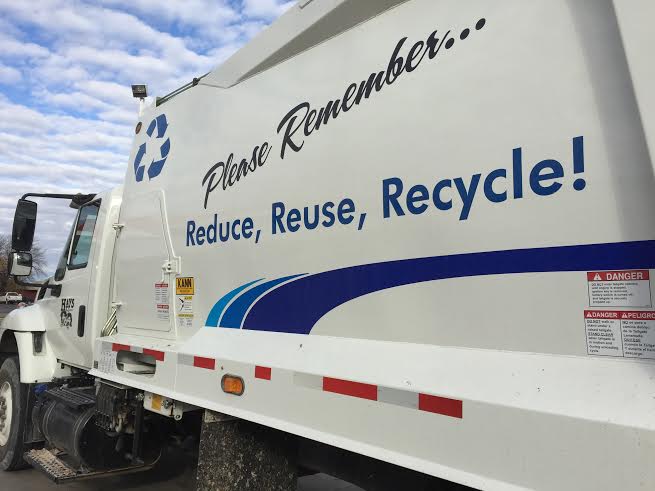
The monthly bill for solid waste collection in Hays is going up 10% starting next month, and will continue increasing over five years.

City commissioners unanimously approved a series of hikes through 2024 during their Thursday night meeting, although not quite as steeply as staff had first recommended.

City of Hays customers have been paying $15.20 a month since 2006 for trash and recyclables pick up.

That generates about $1.3 million in annual revenue, Public Works Director Jesse Rohr told the commission. However, estimated expenses for the Solid Waste Department next year are $1.5 million.

Inflation has crept in over 13 years and the solid waste fund has been slightly going into the negative the past two years. There also has been no money put into the fund’s reserves for equipment replacement during that time.

“What we’re trying to achieve is to keep the unreserved fund balance as close to zero as possible,” said Toby Dougherty, city manager, “without building up too much cash or going too far into the hole.”

Staff had recommended a hike to $17.30 starting next month.

Mayor Henry Schwaller and Commissioner Sandy Jacobs were concerned the jump was a little steep.

“I’d rather see it a little flatter,” Jacobs said.

Schwaller noted the city has also had to raise its sewer and water rates. “People, especially those working at minimum wage jobs or just above that, are having trouble paying their bills,” he said.

The commission, absent Vice-Mayor Shaun Musil who was away, agreed to a 10% hike in the October bill to $16.72, an increase of $1.12 per month or 10%.

In Jan. 2021 the bill will go up 9% to $18.22. The hikes slow down for the next three years with a 5% increase in 2022 to $19.14 a month. The increase will be 2% the next two years. The monthly bill will be $19.52 in 2023 and $19.91 in 2024.

In total, the increase will be $4.71 a month, gradually going up over 5 years.

Hays has had the least expensive solid waste collection fee among comparable Kansas cities, according to data collected by Rohr.

Expenses within the Solid Waste Division have slowly increased the past 13 years due to fuel increases, higher hauling and sorting fees for recyclables, salaries, and higher tipping fees at the Ellis County landfill.

Commissioners thanked the Ellis County Commission which agreed to reduce the tipping fee charged to the city from $75 to $72 a ton. The decrease was effective Sept. 1 and will continue through 2020 when a $1 increase will be implemented. Hays is the largest customer of the Ellis County waste transfer station.

A potential agreement with a private trash hauler was considered this summer. Dougherty noted the owner recently increased his contract price, making it unfeasible for the city.

Most of the solid waste rate paid by Hays customers goes to refuse collection and the annual alley cleanup. A portion goes to the award-winning curbside recycling program that began in 1995. A small part of the rate is used for operation of the free compost site started several years ago.

Revenue from the recycling program has declined due to changes in the worldwide recycling market. It was $63,000 in 2011, compared to $5,000 in 2018.

Reducing or eliminating the recycling program would result in a smaller rate hike, but Rohr is not recommending any alterations in the program.

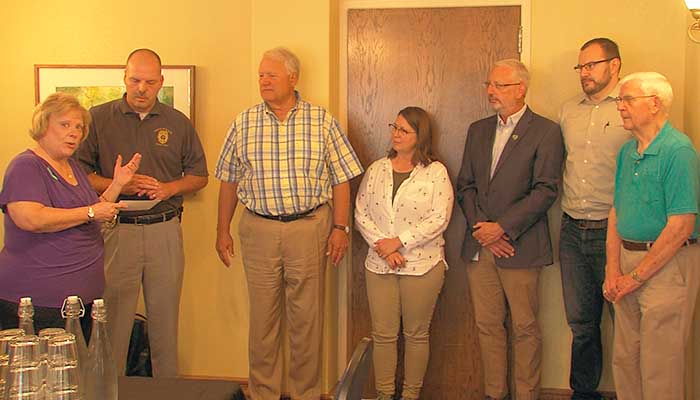
Brian Dawson, HPD Asst. Chief, introduces new employees Sarah Wheeler, Joe Lantz and Derick Nordell to city commissioners Thursday.

In other business, the commission welcomed three new employees of the Hays Police Department who were introduced by Assistant Chief Brian Dawson.

Sarah Wheeler is a new HPD municipal court records clerk. Joe Lantz, Wichita, and Derick Nordell are new police officers. Nordell previously served in the Hays Police Department, moved to Concordia, and is now back in Hays.

An update on plans for transitional housing at First Call For Help for homeless Hays residents was presented by Linda Mills, executive director, and Dennis Wilson, FCFH board member.

Mayor Schwaller called for a 50 minute executive session at the end of the meeting to discuss matters of attorney/client privilege and discuss potential property acquisition.

Musil joined the executive session via phone along with Doug Williams, Grow Hays executive director and bond counsel, as well as the city project director, city attorney, city finance director and city manager.

No action was taken following the executive session.

City commission to vote on recommended hike in solid waste fees

By BECKY KISER
Hays Post

Hays residents will likely see their fees go up for refuse and recycling collection by the city, starting with a 14% hike next month.

The city commission will vote Thursday on the recommendation made by city staff in July for a series of hikes in solid waste fees.

They would begin with 14% in October 2019. Then, smaller increases are recommended starting in January 2021 with 5.5%, a 3% increase beginning January 2022, and a 2% increase in 2023 and in 2024.

The monthly collection fees of $15.20 have been in place since 2006 and the city needs to catch up with inflation, says Toby Dougherty, city manager.

“The last couple years we’ve been eating into our end of year balance a little bit to where now we’re going negative,” Dougherty explained, “and we’re not putting money into reserves.

“We’re going to reach a point where a piece of equipment fails and we don’t have the money to pay for it.”

Expenses within the Solid Waste Division have slowly increased in the past 12 years due to fuel increases, higher hauling and sorting fees for recyclables, salaries, and higher tipping fees at the Ellis County landfill.

According to information supplied by Jesse Rohr, Hays public works director, recent discussion with the Ellis County Commission resulted in a $3 decrease in tipping fees charged to the city starting Sept. 1. That has lowered the rate from $75 to $72 a ton based on the volume the city hauls to the transfer station. The price will remain in effect through 2020, at which time a $1 increase will take place. Hays is the largest customer of the Ellis County landfill.

Also on the Sept. 12 agenda is an update about the services provided by First Call for Help by Linda Mills, executive director.

The meeting begins at 6:30 p.m. in Hays City Hall, 1507 Main.

🎥 ‘Best year on record’ in boardings at Hays Regional Airport

(Photos courtesy Hays Regional Airport)

By BECKY KISER
Hays Post

“This has been our best year ever to date and we are going to far exceed our expectations.”

Enplanements on United Express at the Hays Regional Airport are up considerably this year, according to Hays City Manager Toby Dougherty.

July 2019 enplanements at the Hays airport set a new monthly record with 1,450 passengers.

In fact, July was the best month on record for airport boardings and total boardings so far in 2019 are also at a record high.

For years, the Hays benchmark boardings number has been 10,000 passengers per year. Reaching that number qualifies the airport for grant monies from the Federal Aviation Administration.

“We’re going to have to modify that benchmark,” Dougherty said, noting every month of enplanements this year has exceeded those of 2018.

Enplanements at the Hays Regional Airport so far in 2019

Dougherty includes himself in those numbers, having recently flown twice from Hays to Florida and also to New York to visit family.

“Ridership is good. The flights are pretty full going out,” Dougherty confirmed.

“Between Hays and Salina, we’re packing that airplane, which is good. Full seats mean revenue for the carriers and that means they want to keep doing business here.”

Utilization of the direct flight to Chicago is increasing.

“We were a little slow to adapt to that flight. I think Chicago is just such an unknown quantity for the Hays Regional Airport flying public.

When Dougherty and his wife traveled to New York, they flew into Denver and then Syracuse, New York, on a direct flight.

“But coming back, it was easier to come through Chicago,” he said.

“Everybody understands the Denver airport – the layout, the schedule, the terminal. O’Hare is a lot different airport. It was a good experience. I had no problem with it. It’s just different than what people are used to with that Denver outlet.”

Boardings at the Hays Regional Airport are “demonstrating that a lot of people are realizing Chicago is another venue, especially if you’re going east or if you’re coming back from the east. So, those boardings for the Chicago flight are slowly increasing.”

Dougherty attributes the overall increased ridership to schedule and consistency. “We have pretty prime schedules.”

The first weekday flight out of Hays was adjusted Sept. 1, moving back an hour to 8:03 a.m. from about 7 a.m.

“That still gets you to the big bank of flights in Denver and you can make it pretty much anywhere the same day.”

Dougherty believes the morning flight out, a mid-day turnaround with a swing-through to Chicago, and the late night flight coming back to Hays, is a schedule attractive to both business and pleasure travelers.

“It puts most of the United States in a situation where you can easily get there in one day and you can easily get back in one day. In many cases you can get there and get back that afternoon.”

When Dougherty flew to Syracuse, they left on the morning flight and arrived at 1:30 p.m. local time. Coming back through Chicago, they left Syracuse in the morning and arrived in Hays by 1:30 p.m.

“That’s a pretty timely schedule to leave central New York and arrive back in Hays in the early afternoon.”

Passengers using the Hays Regional Airport has always been more heavily skewed toward business travelers.

Still, Dougherty encourages people to check flyhays.com and use the True Cost Calculator when planning any type of trip.

“Our flights are relatively affordable when you look at comparing flying directly out of Kansas City or Wichita or Denver.

“We are extremely competitive and extremely affordable especially when it’s just one person traveling.

“It’s rare to find an instance out of Hays where it’s cheaper to drive somewhere and then fly. By the time you figure in time, gasoline, the possibility of an overnight stay, and parking, it is rarely cheaper than flying out of Hays.”

If you’re flying a family of four, however, Dougherty acknowledges it’s sometimes more expensive to fly out of Hays.

Still, he says, “when I fly out of Hays, I see a lot of people who are heading out on vacation.”

🎥 Grissom: ‘Kitchen table issues’ more important in U.S. senate race

Barry Grissom, a Democratic candidate for the U.S. Senate seat being vacated by Pat Roberts, stopped in Hays Saturday at Breathe Coffee House.

By BECKY KISER
Hays Post

It’s the “kitchen table” issues, not national politics, Barry Grissom is most interested in as a Democratic candidate for the U.S. Senate seat being vacated in Kansas. Republican Pat Roberts  is retiring after nearly 40 years in Washington.

Grissom, 65, is the former U.S. Attorney for the District of Kansas, a position he was appointed to by President Barack Obama. The Leawood resident served in that office from 2010 to 2016.

Grissom was in Hays Saturday afternoon to meet privately with the Ellis County Democratic Party after kicking off his senate campaign July 1.

“Most of us got jobs, we got kids, we got responsibilities. We can’t be in the finger-pointing game that exists in Washington, D.C. or in different media circles,” Grissom said in an interview prior to joining the local Democratic get-together.

The Kansans he’s talked with are more concerned about issues directly impacting their daily lives, Grissom says.

“Things like is my kid going to get a good education, am I safe in my community, I want to exercise my religion as I see fit, I want to vote.

“Issues that people have, whether Republicans, Democrats or independents, the vast majority of them are the same. I think the differences that separate us are not that great and we can disagree about those.  But we agree on so much. I think what has happened is we’ve gotten away from the larger group agreeing on the agreeable items and just focused on the divisive items. And I think that only harms us as a community and certainly as a state and as a country.”

Those agreed-upon “kitchen table” issues include three major areas, according to Grissom.

“Not surprisingly, number one is health care. Access to rural health care in Kansas is a real challenge, and even in some larger communities.”

He pointed to Fort Scott, the county seat of Bourbon County, which does not have a hospital. Mercy Hospital closed its doors Feb. 1. “We have one institution in Crawford County servicing the needs of 50,000 residents in southeast Kansas. Even if you’re fortunate enough to have the best health insurance in the world, if you have no place to utilize it, health insurance really doesn’t make any difference.”

Grissom is a little surprised by another “kitchen table” issue –  student loans – but it’s come up more and more as he’s talked with Kansans during his campaign.

“If you have a young person in your family and they have a lot of student loan debt and you live in a rural area, they’re probably not going to return to the rural area because there aren’t jobs there that provide sufficient income to service your debt.

“So they’re forced to leave the farm. They’re forced to leave a community they might otherwise want to come back to.”

Community safety concerns are something Grissom is well-acquainted from his years as a U.S. Attorney.

He recalled his office’s investigation and prosecution of bombing plots targeting Wichita Mid-Continent airport in 2013 and Fort Riley in 2016.

“So I’ve had some real, on-the-ground meaningful experience working with law enforcement.

“We all came together. Nobody was a Republican. Nobody was a Democrat. We came together as a team to keep Kansans safe.”

Grissom has also worked with smaller law enforcement agencies, particularly in human trafficking and drug transportation along Interstates 70 and 35. While in office, Grissom spoke to classes at Fort Hays State University about human trafficking and sexual exploitation.

In 2014, he worked with Ellis County law enforcement and the Kansas Highway Patrol in a drug stop that netted 80 pounds of methamphetamine and 11 pounds of cocaine.  Grissom was also involved in the prosecution and conviction of a former temporary employee of HaysMed who infected a number of patients with Hepatitis-C, including one woman who died.

As the state’s former top federal law enforcement official, Grissom has name recognition in Kansas as a senate candidate.

So does second-term First District Congressman Roger Marshall of Great Bend, who announced his candidacy for the senate seat Saturday morning at the state fair in Hutchinson.

“I’m going to leave it to my Republican friends to sort out who they want to be their standard-bearer after the primary,” Grissom said with a smile.

Grissom went back into private law practice for a short time after his appointment ended. “It was satisfying in its own way but didn’t give me the satisfaction I got from doing public service.”

He and his wife talked about whether they wanted to “throw ourselves into the meat grinder that is otherwise known as politics.” They decided to do it and once Sen. Roberts announced he would not run again, Grissom says “it became that more attractive.”

An open federal seat in Kansas is rare.

“It provides our citizens in Kansas a real opportunity on both sides of the aisle,” Grissom believes, “to have a primary process and pick somebody that they think might do their very best to share their interests and their desires of what a public servant might do, from all the major things you might think about in national politics to the more important things, which are ‘kitchen table’ issues.”

Kansas, a die-hard “red state,” has not had a Democratic U.S. Senator since 1932.

The federal election is Nov. 3, 2020.

The man behind Kansas’ fastest growing CBD chain is gaining notoriety

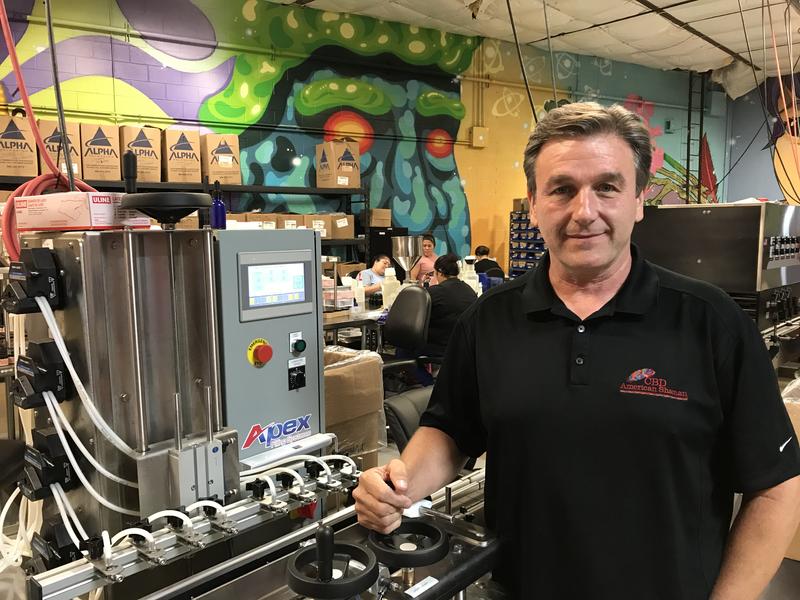
Vince Sanders, CEO of CBD American Shaman, heads a group of companies that employs more than 150 people, mostly in the Kansas City area.

By MARK DAVIS

KANSAS CITY – As a teenager, Vince Sanders watched his father go to prison. He dropped out of school and ended up serving time himself.

It makes an unlikely history for the 55-year-old founder of a fast-growing retail chain who owes his fall and rise to the cannabis plant.

Nineteen years ago, Sanders went to prison for organizing and financing a scheme to sell marijuana. Federal officials tracked it for five years and valued his take at $2.5 million.

“It actually was a lot more than that,” Sanders said recently, flashing a mischievous grin.

Few beyond family and close friends know about Sanders’ criminal record. He readily acknowledged his past during an interview, calling it neither a secret nor a “talking point” for the business he’s in now.

Sanders heads CBD American Shaman, the Kansas City, Missouri,-based company he founded four years ago to market health-promising bottles of cannabidiol, or CBD.

CBD comes from hemp, which is a cannabis plant that has little or no tetrahydrocannabinol, or THC, the main psychoactive compound in marijuana that produces the high associated with the plant. Sales of CBD have been surging in recent years, and the industry gained a boost when the 2018 Farm Bill made it legal to grow hemp in the United States.

Sanders helped push for that change and to align state laws to accommodate hemp and CBD products through the U.S. Hemp Roundtable, on which he serves as one of eight board members.

“Personally, and for the industry, we’re big believers in second chances,” said Jonathan Miller, the group’s general counsel, who was unaware of Sanders’ marijuana conviction. He credited Sanders for “turning his life around, building a very legitimate and legal business model.”

That business model has put American Shaman stores in more than 30 states and garnered industry attention as a pioneer of CBD-specific stores. Most CBD operations have sold their products online or through other specialty health stores, drug stores and groceries.

Miller said American Shaman and similar businesses that have followed a brick-and-mortar path now have the rest of the industry thinking about CBD-focused stores themselves.

Sanders owns a group of companies that includes a franchising office at 2300 Main St. in Kansas City, manufacturing operations on Southwest Boulevard and a new hemp processing facility in Montana. Sanders said those businesses directly employ about 150 people.

Some CBD store rivals, who formerly did business with American Shaman, question Sanders’ tactics. They cite business practices that smack of retaliation. One rival said she felt “bullied” by American Shaman.

The extent of Sanders’ store network is difficult to pin down. He has claimed conflicting totals when asked how many American Shaman stores are open. And the company’s extensive list of “coming soon” locations includes several in the Kansas City area that aren’t intended to open at the addresses listed.

Other questions have been raised by American Shaman’s unusual reliance on former door-to-door vacuum cleaner salesmen, which has made it the target of a lawsuit in Ohio.

Local entrepreneur

Sanders grew up in Kansas City and said that, at times, he had a difficult life. His father struggled with problems that were exacerbated by drinking and had “drifted away,” Sanders recalled.

When Sanders was 15, a Kansas jury convicted his father of involuntary manslaughter. The charge sent Stephen Vincent Sanders to the Kansas State Penitentiary.

Sanders, whose full name is Stephen Vincent Sanders II, has described himself as a class clown who wasn’t into school. He dropped out of Southwest High School but said he later got his GED.

He married and became a father. The couple, now divorced, owned two homes in Kansas City and additional property in Overland Park. There also was a Corvette, a Mercedes-Benz and jewelry that included a ladies Rolex Chronometer.

Federal prosecutors said it was a lifestyle financed by illegal marijuana sales. Sanders’ guilty plea earned him a 32-month prison sentence, though he said he served only about a year. Prosecutors also sought forfeiture of $2.5 million, the alleged amount of Sanders’ ill-gotten gains, which he said they collected.

“Oh, I had it,” Sanders said.

Sanders said he has never held a paycheck job. Even as a teenager he ran his own auto detailing business — at a family-owned car wash at 77th Street and Wornall Road.

His other businesses manufactured an assortment of goods, from teeth whiteners and self-tanning lotions to male enhancement products and vape juice, or e-liquids, for electronic cigarettes.

Without an attentive father, Sanders said he became close to his mother’s uncle, Denny Van Tuyl, who was 11 years his senior. By Sanders’ account, Van Tuyl became something of a big brother or father figure to him.

It was Van Tuyl’s cancer that led Sanders back to cannabis — this time for the possible curative powers of CBD after traditional medicine seemed to fail his uncle. Van Tuyl died in 2012.

It’s a story Sanders tells often. Personal experiences with CBD are often the drivers of those in the CBD business.

But is it legal?

For Sanders, shifting from witnessing CBD’s promise to marketing CBD products came slowly.

For starters, there was that marijuana conviction in his past.

“There was a lot of hesitation and homework to make sure this is legal, right?” he said. “I talked to a lot of attorneys.”

Convincing others of its legality was nearly as painstaking. Sanders said he approached smoke shops, chiropractors, vitamin and health stores. Each store that carried his early American Shaman CBD products did so after extensive education about its legality and effectiveness, he said.

At that point, Sanders sold only wholesale. The chiropractors and shop owners were his sales force.

All of that changed when Brendon Hodgson came along.

Hodgson convinced Sanders that they could retail CBD directly and they opened The CBD Store at 18th and Oak in Kansas City. Sanders produced the CBD that the store sold under an Evolution brand.

It worked out, and Sanders said the city’s First Fridays were the key. The CBD Store held an open bar and pitched CBD while a captive audience waited for drinks.

A second store in Brookside, owned and run by two women whom Sanders said approached him with the idea, took a bit longer to succeed. After that, there was a third. More retailers followed, buying products from CBD American Shaman and reselling them to consumers.

The group grew to about 40 outlets when Sanders shifted to his current franchise business model.

That core business sells franchise rights to prospective store owners who are committed to buying CBD products from Sanders’ manufacturing company. All but six CBD American Shaman stores are owned by franchisees.

“He basically made his own customers with this franchise model. It’s really good,” said Cyrus Riahi, a Lenexa entrepreneur who briefly co-owned a store in Columbia, Missouri, and now operates rival Buddha Leaf stores.

Riahi said the franchising strategy has allowed American Shaman to dominate the Kansas City-area CBD market.

“I’ve only got two stores here in Johnson County, and they’re my lowest sales stores,” Riahi said.

Sanders credited one of his early wholesalers with another strategy that accelerated the store count growth. It’s called an affiliate program.

Under that program, franchise owners who bring in another franchisee earn a dime for every dollar of product that recruits buy from American Shaman. They can get a similar deal for recruiting smoke shops or others to buy American Shaman products wholesale.

According to Sanders, the affiliate program is also why so many of his franchisees are former Kirby vacuum cleaner salesmen.

That idea came from Jason Todack, who had been a Kirby vacuum distributor. Todack said Kirby worked the same way, and it helped attract fellow Kirby salesmen to American Shaman.

Today, Todack owns only one store but said he earns between $15,000 to $25,000 a week from the affiliate program.

In its lawsuit, which was filed a year ago in Ohio, the Kirby Co. tells a different story.

It claims American Shaman poached 20 or more Kirby salesmen. The suit names Sanders, American Shaman Franchise Systems Inc.; its president Bud Miley, a former president of Kirby Co.; and two other individuals who had been at Kirby. Todack is not a defendant in the suit.

Sanders said American Shaman “hasn’t done any Kirby people” since the lawsuit was filed. He called the lawsuit ridiculous.

Trademark grab

Sanders’ shift from wholesaling CBD to organizing a network of CBD franchise stores did not sit well with some of his early retailers.

Trevor Burdett, who was recruited by Todack, bought American Shaman products and sold them under the American Shaman store banner before there was a franchise system. When American Shaman wanted him to convert to a franchise arrangement, Burdett complained that he had only a week to review the lengthy legal document.

“I had to sign a franchise agreement or they would stop selling to me,” Burdett said.

He concluded there were no benefits to becoming a franchisee. He dropped American Shaman and began setting up his own CBD stores called Sacred Leaf.

When Burdett sought to trademark his Sacred Leaf brand in June 2018, he found Sanders had beaten him to it by two months.

“That seems to be their go-to. If you cross American Shaman, they will file a trademark on your name and try to shut you down before you even get into business,” Burdett said.

Public records show Sanders trademarked “SUNMEDCBD” about three months before Florida-based, Sunflora Inc. filed a trademark on “SUNMED CBD.” Sunflora, founded by a former American Shaman wholesaler, supplies SUNMED CBD products to Your CBD Stores through licensing agreements.

SunFlora acting CEO Marcus Quinn declined to comment for this story.

“He did it to us, too,” said Emily Christianson, whose CBD HempDropz brand Sanders claimed in a trademark filing in 2018.

Christianson, who previously bought American Shaman products wholesale, balked at the franchise offer and said she felt “bullied” by how American Shaman handled it.

She said the company set up an American Shaman franchise directly across from her CBD store in Springfield, Missouri. The plan, she was told, was for it to “crush” her as a former wholesaler turned competitor.

Kathleen Wade, who opened that American Shaman Springfield store, corroborated that the plan targeted Christianson.

Wade said she already had leased space in a different location in Springfield, but Sanders required her to open across from Christianson’s store.

Sanders denied any such requirement. He and Wade agreed that they have other disputes, and Wade said she “walked away” from the franchising company.

Burdett, Christianson and Wade all said Sanders turned on them suddenly.

“I swear he was a good guy until he turned out to be a snake,” Christianson said.

Did Sanders intend his trademark-grabbing tactics to stop his former customers from becoming rivals?

“Perhaps,” Sanders said. “Every one of these people started with us. We spent an enormous amount of time and effort training them and teaching them this industry. How do we protect ourselves from that kind of thing happening?”

As for being called a snake or turning on people, Sanders chalked up those sentiments to the rough-and-tumble world of business.

“This is a competitive world,” he said. “If you want to play in a competitive league, then step up.”

Coming soon?

How well Sanders’ American Shaman is faring in that competition is difficult to say.

As a privately owned company — Sanders said he owns it all and has no investors — American Shaman does not disclose financial information publicly.

One large CBD company does report financial details. CV Sciences Inc. sold $16.8 million of PlusCBD consumer products during April, May and June, chalking up a profit of $1.2 million.

The San Diego-based company doesn’t operate its own stores or offer franchises. Instead, it supplies products to 4,591 retail stores “mostly in the natural product industry” but also to 945 Kroger stores under a deal announced in July.

American Shaman’s distribution map looks more like rival SunFlora, whose website lists 290 locations for Your CBD Stores in 32 states.

But American Shaman’s store map is a bit fuzzy.

In a March interview, Sanders said the company had “a little over 300” stores, that 100 were “building out” or “finding locations,” and that the count “would be at 400” in 60 days.

“They’re writing 50-plus new franchises a month,” he said on Dick & Loy’s Media & Marketing Mayhem podcast.

On June 26, the American Shaman website listed addresses for 244 open stores in 30 states. The same month, however, Sanders told KCUR radio’s Andrea Tudhope that there were many more stores.

“We had 391 stores as of yesterday, open,” Sanders said when interviewed on June 20.

In a subsequent interview for this story in August, Sanders said the website’s 244 store count in June probably was accurate at the time. The larger number he’d given to KCUR in June must have included stores opening soon, he said.

After reviewing company records, Sanders said there were 299 American Shaman stores open, an additional 295 stores with leases and in the process of being built for opening, and 352 more store franchises that had been sold but were still scouting for locations.

American Shaman’s website lists addresses for hundreds of stores that are “coming soon.” Often these addresses are not specifically where the store expects to be opened. The company often “pins” an address in the general area where a franchise is being planned.

American Shaman CBD products also are sold through retail stores in six states where the company isn’t yet set up to offer franchises.

Several times during the August interview, Sanders said things were happening fast.

To wit: He wants to offer tours at the factory on Southwest Boulevard. The company’s CBD processing facility in Montana is now up and running after a year of work. He’s promoting more regulation of the industry to drive out “bad actors.” He’s taking steps to get into the white-label side of the business, which would mean selling CBD products through other retail outlets but not under the American Shaman label.

American Shaman will be reserved for the franchise stores, which Sanders now said will number 600 in November.

“We want to be the biggest,” Sanders said. “We don’t want to be a boutique brand. If you think CBD, I want you to think American Shaman.”

EDITOR’S NOTE: A CBD American Shaman franchise was opened in Hays in December by Jessica Moffitt, a Hays health educator.

KCUR’s Andrea Tudhope contributed to this story.

Mark Davis is a freelance writer in Kansas City.
🎥 Drill assesses emergency response to aircraft crash at Hays Regional Airport

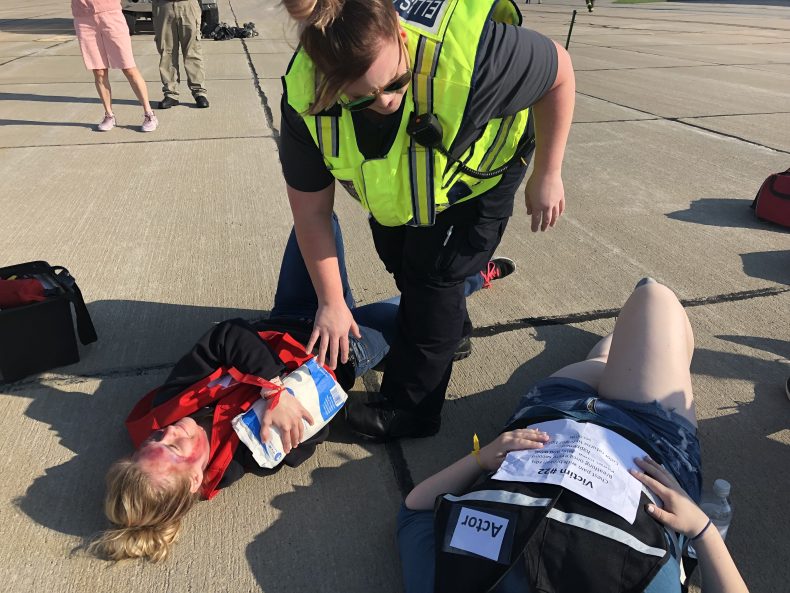
Ellis County EMS personnel triage volunteer plane crash victims during Wednesday’s drill at the Hays Regional Airport.

By BECKY KISER
Hays Post

A drill for the emergency response to an airplane crash at the Hays Regional Airport won’t replicate such an incident exactly, but it comes close.

Emergency responders from throughout Ellis County participated in a full-scale exercise Wednesday morning at the airport.

Darin Myers, Ellis County Emergency Manager and Rural Fire Chief, along with Ryan Hagans, Hays Fire Chief, were the exercise directors.

Overall, things went well, Myers said.

“You can only have a pretend fire for so long before the pretend fire goes out. Then you move on to the next phase of evacuating the fuselage.”

The drill started at 9 a.m. and took a little more than 90 minutes. An actual airplane crash response would likely take longer.

“It may have taken us only 10 to 15 minutes down there, but in real life to move patients who are unable to walk like we did today, they would have to be carried out or drug out,” Myers said. “That would take a lot more time.”

Approximately 30 volunteers from the NCK-Tech College nursing program portrayed the injured passengers.

Each person wore a vest identifying them as an actor and also had a piece of paper with their symptoms written on it. Most actors were wearing red makeup to resemble blood flowing from their injuries. Some patients also had moulage kits applied to simulate wounds.

After they were triaged by Ellis County EMS personnel, four passengers were declared dead.

“I had no visible injuries,” said Kylie Watson, Topeka, “but I had a blank stare, couldn’t feel air movement and had no color to my fingertips. So they had to decide whether I was dead or not, which I was.”

Tyra Younie, Hays, portrayed a victim who had been decapitated.

“I wasn’t wearing any special makeup to indicate that. I just kind of slumped over and hid my face,”  Younie said.

Alexa Brull, Catherine, had a head injury. “I was not responsive, not breathing, so I was tagged ‘black.’

The NCK-Tech students have been working with hospitalized “patients” in their classrooms. They found the response to casualties at an airplane crash to be quite different.

“It was very interesting to see how they coded each one of us and who they responded to first,” Watson said.

“We were all on the aircraft. They got to us pretty quick and were really good about prioritizing each victim and getting us off the plane.”

There were also individuals inside the airport terminal portraying distraught family members.

In yesterday’s exercise, a Hays USD 489 yellow school bus served as the airplane. Hays and Ellis County firefighters poured water on the simulated fire and smoke visible at the crash site off the south end of the airport apron.

The Hays airport is required by the Federal Aviation Administration to conduct such emergency exercises every three years.

Following the drill, all the participants gathered near the airport fire station and submitted their feedback in written form to Myers. Then each agency, observer and evaluator talked about what went well and what could have been done better.

Airport manager Jamie Salter and Hays Public Works Director Jesse Rohr

This was the first such exercise for airport manager Jamie Salter, who was appointed to the position in late February. “I felt like she did a great job,” said one observer.

In her series of contacts, Salter first notified Jesse Rohr, Hays public works director, then city management followed by the city’s Public Information Officer. Rohr was one of the on-site observers.

Hays Fire Department Captain Aaron Dome talked about the incident command post.

“We had a pretty good unified command between medical branch, law branch, and the airport. We were all face-to-face. It went pretty smooth  on our end,” Dome said.

Site security was evaluated by Toby Prine, the Kansas Regional Emergency Management Coordinator for northwest Kansas who is based in Hays.

Toby Prine (left), NWKS Emergency Management Coordinator, evaluated site security during the Hays airport drill.

“About 9:04 a.m., Hays police started blocking access to the airport. At 9:16 a.m. they brought in mutual aide units like the sheriff’s department and Kansas Highway Patrol,” Prine reported.

“Later on they identified the hospital as a possible critical area with internal security at the hospital (HaysMed). The discussion was we need to keep that in the forefront in case they need additional law enforcement out there. Overall, they did a very good job,” he added.

Don Scheibler, Hays police chief, agreed.

“In this type of event, law enforcement’s primary job is to provide a safe and secure environment for you guys to do what you need to do,” Scheibler told the participants.

Ellis County EMS reported they were on scene for 40 minutes with all the critical patients transported within 20 minutes. SkyWest Airline personnel provided information to EMS on the number of passengers and crew which EMS used to determine whether they needed to request out-of-county ambulances.

A couple of concerns were noted by firefighters.

All the county’s fire trucks are paired with supplies according to the vehicles’ engine capability.  “On scene we can split the crew, but we need to keep the equipment together,” said one rural firefighter.

Hays firefighters assist a patient into an ambulance.

“In that transition period when we went from operations fire-wise to EMS-wise on our end, we kind of ditched a crew down there. I knew Justin (firefighter Choitz) had it under control,” said Tyler Brungardt, HFD lieutenant. “I feel like that probably could have gone a little bit smoother.”

HaysMed Security Manager Mike Filley evaluated the performance of EMS and health support. “I’m going to talk to Kerry (McCue-Ellis County EMS/Health Services Director) a little more about it but, overall it was pretty good.”

An after-action report will be compiled and distributed with a summary of key information related to the evaluation along with plans for improvement.

Participating agencies were Hays Public Works, Fire, and Police Departments, Ellis County EMS, Fire and Emergency Management, and Sheriff Departments, Kansas Highway Patrol, Hays Aircraft, SkyWest Airlines, TSA, Hays Medical Center, EagleMed, and NCK-Tech College.

🎥 August rainfall in Hays more than 7.6″ above normal

By BECKY KISER
Hays Post

The final figures are in for a rainy August in Hays.

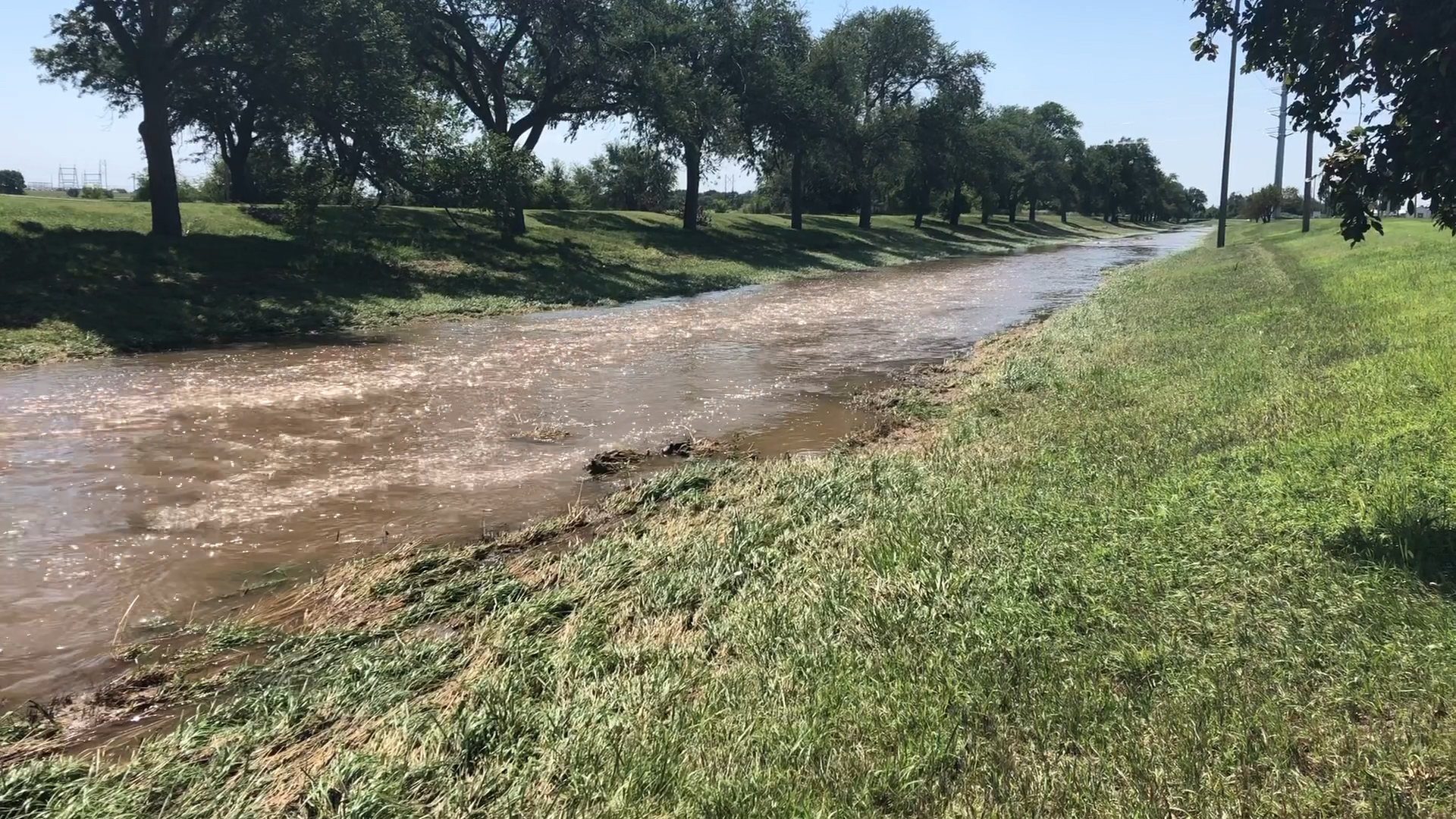
According to official records from the K-State Agriculture Research Center south of town,the total amount of rain during August in Hays is 10.64 inches. The normal amount is 2.97 inches.

Year-to-date moisture is 25.21 inches. The average precipitation through the month of September is just shy of 20 inches.

Total annual moisture in Hays averages 23.46 inches.

🎥 Grant pays for more training of local Crisis Intervention Team

Ann Leiker, NAMI-Hays, presents a $10,000 check to Hays Police Chief Don Scheibler for national CIT training in Spokane, Wash. Onlooking are Joe Jeter, trustee of the Schmidt Foundation which funded the grant; Sherrie Vaughn, NAMI-Kansas exec. dir., Dave Anderson of High Plains Mental Health Center and an Ellis County CIT Council member; Josh Tanguay, psychologist and Ellis County CIT Council member; and Tom Pitner, founder of NAMI-Hays.

By BECKY KISER
Hays Post

Six members of the new Ellis County CIT (Crisis Intervention Team) Council were in Seattle, Wash., this week for national CIT training, thanks to a $10,000 grant from the Bob and Pat Schmidt Foundation of Hays.

NAMI-Hays (National Alliance on Mental Illness) applied for the grant on behalf of the council.

“One of the areas Bob and Pat Schmidt were always interested in was health in our community,” said Joe Jeter, Schmidt Foundation trustee. “When Tom Pitner (the founder of NAMI-Hays) approached the foundation about a potential grant for NAMI, it seemed like a no-brainer. It fit right into what we’re doing. We know Bob and Pat would be very pleased about this.”

Crisis Intervention Team programs are supported nationally by NAMI in more than 2,700 communities.

The lack of mental health crisis services across the U.S. has resulted in law enforcement officers serving as first responders to most crises. A Crisis Intervention Team (CIT) program is an innovative, community-based approach to improve the outcomes of these encounters, according to NAMI.

“High Plains Mental Health Center has always had a really strong and great working relationship with local law enforcement,” said Dave Anderson, a member of the Ellis County CIT and director of clinical resources at HPMHC.

“We rely on them heavily for the work that we do because many of the people who are in mental health crisis, law enforcement is often the first people that come into contact with them,” Anderson pointed out. “CIT strengthens that relationship. We spend a lot of time talking about issues in the community and the ways we can work together to help deal with those issues.”

“CIT in a community this size is fairly unusual. It’s usually in larger, more urban areas. We’ve had some challenges, but I think we’ve hit the ground running.”

Hays Police Chief and CIT member Don Scheibler spoke to the HPMHC board about CIT last month and explained the challenges law enforcement faces in dealing with people who have mental health crises.

CIT, which is ever evolving, began with the Memphis, Tenn. police department in 1988 following the fatal shooting of a mentally ill person.

“In 2016, we had the same situation happen here in our community,” Scheibler said, “and that really made us start looking at a way we could do this better, is there a way we could provide better service to our mental health consumers, and that’s how CIT grew out for us.”

“I’m especially pleased with the support of High Plains Mental Health Center and NAMI, and Ellis County law enforcement.”

Scheibler agreed that “law enforcement has become the de facto health provider for a lot of people.”

“We are often the very first people they see in a crisis. Better training, better preparing of our people in those types of situations is huge.”

Hays resident Joey Weber, 36, who had autism, was shot and killed by a Hays police officer during a brief struggle Aug. 18, 2016, following an attempted traffic stop for an expired license tag. The Kansas Bureau of Investigation determined the officer acted in self-defense.

The bill “Joey’s Law,”  aimed at protecting Kansas drivers with cognitive disabilities, was signed into law by then-Governor Sam Brownback  on April 7, 2017.

NAMI was actively involved in the Memphis development of CIT and continues to be involved in CIT, according to Dr. Sherrie Vaughn, executive director of NAMI-Kansas.

“We were active partners and collaborators for the implementation of CIT and growing it across the nation,” Vaughn said. She thanked Jeter and the Schmidt Foundation for supporting NAMI-Hays in their efforts to support the Hays police department and the CIT team.

“What a great opportunity that this grant award is going to give to you and your board in growing CIT here in Hays. I’m excited about what that’s going to do for your department, for your department morale and also for the citizens that receive your services,” she added.

Scheibler and Anderson attended an international CIT training program in Kansas City last year, where presenters urged CIT groups to have training for all their members.

ELLIS COUNTY CIT COUNCIL

Sgt. Brandon Hauptman, President–Hays Police Dept.
Sgt. Tim Deines, Vice-President–Ellis Co. Sheriff’s Office
Chief Don Scheibler–Hays Police Dept.
Chief Ed Howell–FHSU Police Dept.
Chief Taft Yates–Ellis Police Dept.
Undersheriff Scott Braun–Ellis Co. Sheriff’s Office
Brenda Basgall–Ellis Co. Attorney’s Office
David Anderson–High Plains Mental Health Center
Gina Smith–FHSU Kelly Center
Bob Piatt–NAMI Hays
Josh Tanguay–NAMI Hays
Pat McGinnis–Community member

The Hays Police Department recently completed the One Mind Campaign started by the International Association of Chiefs of Police. HPD was the second agency in Kansas participate in the intiative to improve response to community members with mental illness.

HPD Activity Log Aug. 19-22

The Hays Police Department responded to 8 animal calls and conducted 20 traffic stops Mon., Aug. 19, 2019, according to the HPD Activity Log.

Mental Health Call–1400 block E 29th St, Hays; 4:45 AM
Burglary/business–2500 block Vine St, Hays; 5:09 AM; 5:11 AM
Lost Animals ONLY–500 block E 15th St, Hays; 7:37 AM
Criminal Damage to Property–2200 block Vine St, Hays; 7:52 AM; 8:08 AM
Found/Lost Property–1900 block Vine St, Hays; 9:11 AM
Civil Dispute–100 block W 12th St, Hays; 9:43 AM
Animal At Large–30th and Sherman, Hays; 9:56 AM
Suspicious Activity–200 block W 15th St, Hays; 10:47 AM
Theft of Vehicle–400 block E 16th St, Hays; 12:19 PM
Pursuit/Chase–1900 block Ash St, Hays; 2:03 PM; 2:03 PM
Domestic Disturbance–2300 block Donald Dr, Hays; 2:20 PM
Lost Animals ONLY–4400 block Larned Cir, Hays; 4:02 PM
Phone/Mail Scam–2500 block Marjorie Dr, Hays; 4:27 PM
Civil Dispute–1000 block E 29th St, Hays; 4:56 PM
Harassment (All Other)–100 block Elm St, Bunker Hill; 5:09 PM
Suspicious Person–26th and General Hancock, Hays; 10:08 PM
Drug Offenses–100 block E 15th St, Hays; 11:30 PM

The Hays Police Department responded to 7 animal calls and conducted 8 traffic stops Tue., Aug. 20, 2019, according to the HPD Activity Log.

MV Accident-City Street/Alley–1200 block E 27th St, Hays; 7:47 AM
Lost Animals ONLY–100 block W 25th St, Hays; 8:07 AM
Animal At Large–700 block Park St, Hays; 9:02 AM
Burglary/vehicle–100 block W 12th St, Hays; 11:55 AM
Found/Lost Property–1000 block Reservation Rd, Hays; 8/11 8 PM; 8/20 11:30 AM
Harassment (All Other)–2300 block Donald Dr, Hays; 12:48 PM
Dead Animal Call–1500 block Haney Dr, Hays; 1:32 PM
MV Accident-City Street/Alley–4300 block Roth Ave, Hays; 1:45 PM
Suspicious Person–400 block E 5th St, Hays; 2:51 PM
Found/Lost Property–100 block W 12th St, Hays; 3:26 PM
Found/Lost Property–3400 block Vine St, Hays; 2/27 12 PM
Drug Offenses–2700 block Epworth St, Hays; 6:14 PM; 10:35 PM
Bicycle – Lost,Found,Stolen–1200 block Main St, Hays; 6:52 PM
Criminal Damage to Property–3200 block Vine St, Hays; 7:21 PM; 7:27 PM
Abandoned Vehicle–1800 block Eisenhower St, Hays; 8:18 PM
Civil Dispute–1200 block E 30th St, Hays; 9:38 PM
Welfare Check–1300 block Douglas Dr, Hays; 10:10 PM
Suspicious Activity–100 block W 15th St, Hays; 10:20 PM
Found/Lost Property–2700 block Epworth, Hays; 10:32 PM
Welfare Check–3700 block Vine St, Hays; 10:37 PM

The Hays Police Department responded to 8 animal calls and conducted 23 traffic stops Wed., Aug. 21, 2019, according to the HPD Activity Log.

MV Accident /DUI–700 block E 6th St, Hays; 1:13 AM
Disturbance – Noise–1700 block Sunset Trl, Hays; 2:14 AM; 2:21 AM
Theft (general)–300 block W 39th St, Hays; 10:10 AM
Assist – Other (not MV)–200 block E 7th St, Hays; 8/20
MV Accident-City Street/Alley–8th St and Allen St, Hays; 11:41 AM
Disturbance – General–3600 block Vine St, Hays; 12:27 PM
Animal Cruelty/Neglect–4300 block Vine St, Hays; 3:04 PM
Warrant Service (Fail to Appear)–100 block W 12th St, Hays; 3:14 PM
Juvenile Complaint–1700 block Volga Dr, Hays; 3:51 PM
MV Accident-Private Property-Hit and Run–1700 block Hall St, Hays; 3:50 PM
MV Accident-City Street/Alley–1300 block Vine St, Hays; 4:40 PM
MV Accident-City Street/Alley–2700 block Canal Blvd, Hays; 6:02 PM
Animal At Large–2900 block Grant Ave, Hays; 6:38 PM
Suspicious Activity–1100 block Cedar St, Hays; 7:19 PM
Warrant Service (Fail to Appear)–300 block Indian Trl, Hays; 8:43 PM
Credit Card Violations–2900 block Vine St, Hays; 8:45 PM
Found/Lost Property–15th and Montgomery, Hays; 9:26 PM
Harassment, Telephone/FAX–400 block E 22nd St, Hays; 10:14 PM
Domestic Disturbance–1600 block E 27th St Terr, Hays; 10:29 PM

The Hays Police Department responded to 10 animal calls and conducted 20 traffic stops Thu., Aug. 22, 2019, according to the HPD Activity Log.

Mental Health Call–2500 block Gen Hancock Rd, Hays; 4:52 AM
Welfare Check–4400 block Vista Dr, Hays; 8/16; 8/19
Bicycle – Lost,Found,Stolen–2500 block Gen Hancock Rd, Hays; 8:50 AM
Abandoned Vehicle–100 block Ash St, Hays; 10:05 AM
Animal At Large–20th and Pine St, Hays; 10:12 AM
Found/Lost Property–1300 block 285th Ave, Ellis County; 10:42 AM
Lost Animals ONLY–1700 block Pine St, Hays; 12:10 PM
Found/Lost Property–800 block Commerce Pkwy, Hays; 12:22 PM
Burglary/residence–1000 block E 8th St, Hays; 7/25; 8/22 1 PM
Harassment (All Other)–1000 block W 27th St, Hays; 2:12 PM
Burglary/residence–1000 block E 8th St, Hays; 8/21 10 AM; 8/22 10 AM
Criminal Damage to Property–800 block Walnut St, Hays; 4:12 PM
Civil Transport–200 block E 7th St, Hays; 4:25 PM
Suicidal Subject–400 block W 12th St, Hays; 4:38 PM
Suspicious Activity–1300 block Eisenhower Rd, Hays; 5:15 PM
Credit Card Violations–Hays; 5:40 PM
Credit Card Violations–Hays; 5:42 PM
MV Accident-Private Property-Hit and Run–500 block W 27th St, Hays; 6:30 PM
Found/Lost Property–300 block W 32nd St, Hays; 8:53 PM
Drug Offenses–800 block Fort St, Hays; 8:58 PM; 9:07 PM
Burglary/residence–2700 block Walnut St, Hays; 9:32 PM
MV Accident-Hit and Run–1700 block Marjorie Dr, Hays; 10:03 PM
Lost Animals ONLY–300 block E 6th St, Hays; 10:45 PM

Hays rainfall to date already exceeds yearly average

By BECKY KISER
Hays Post

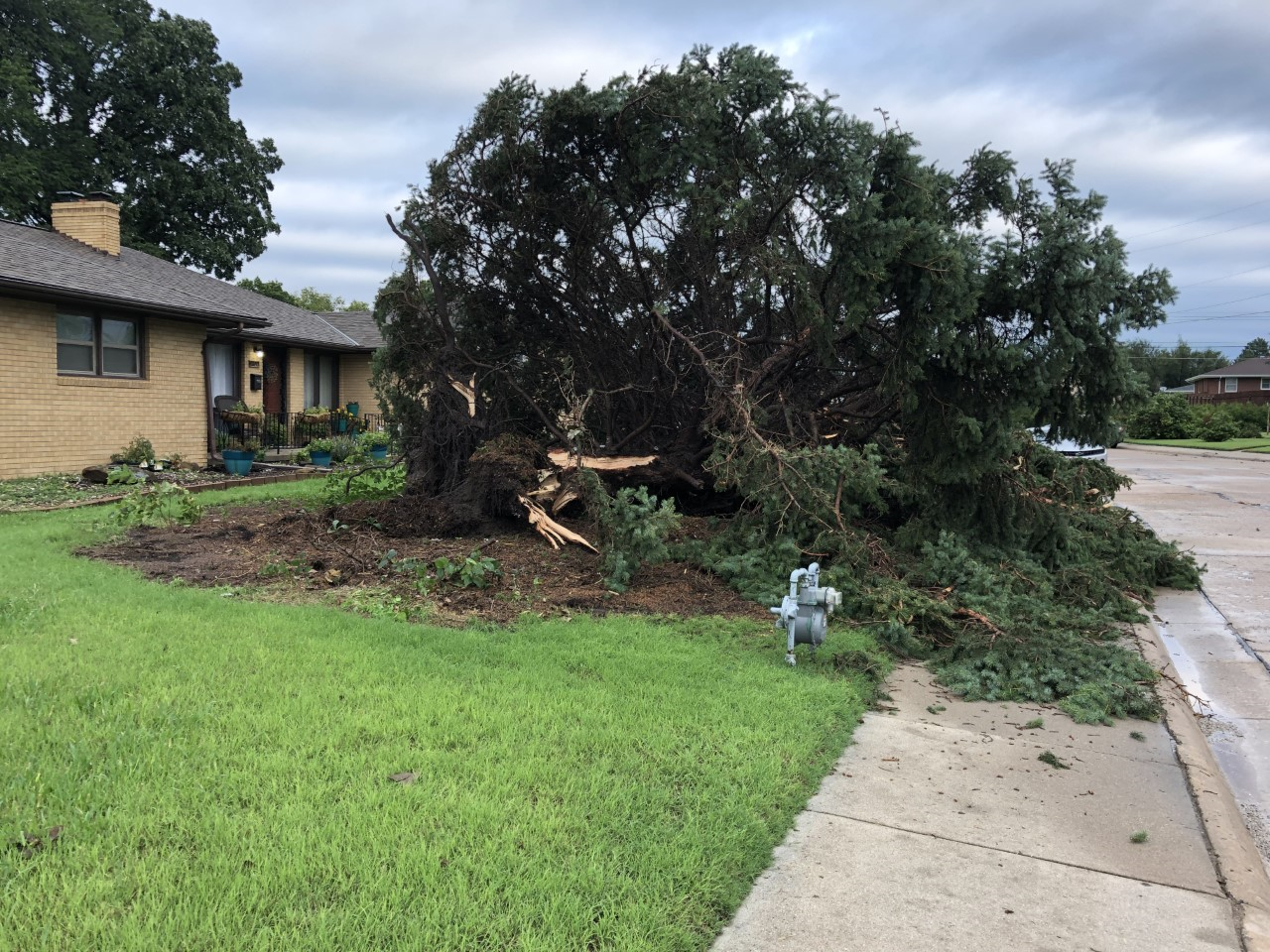
Another night, another thunderstorm slamming through Hays.

Saturday’s severe weather arrived in Hays about 10:30 p.m., with several storms coming through into early Sunday morning.

The K-State Agricultural Research Center south of town measured a peak wind gust of 66 mph at 10:40 p.m. with continued high wind for about 30 minutes. There was no measurable hail.

The official rainfall amount was 1.51 inches with a total so far in August of 9.77 inches. Average precipitation during August in Hays is 2.97 inches.

According to Joe Becker, research center weather record keeper, the 2019 accumulated moisture amount on Friday had already exceeded the total yearly average for Hays.

Year-to-date moisture is 24.31 inches. Average moisture total by the end of August is 17.57 inches.

Rainfall at the Hays Regional Airport measured 2.03 inches, with a peak wind gust of 66 mph.

A Flood Warning is in effect for Ellis County until 7 a.m. Monday.

🎥 United Way 2019 fundraising campaign kicks off

Lyndsey Crisenbery, CASA of the High Plains executive director

By BECKY KISER
Hays Post

The 2019 fundraising campaign for the United Way of Ellis County is off and running.

A kickoff luncheon Friday afternoon with the Hays Area Chamber of Commerce and Eagle Communications at the Rose Garden Banquet Hall featured a quick game of “3 Truths and 1 Lie.” Representatives of the 17 United Way partner agencies tried to stump a panel of four volunteers with one incorrect statement about their non-profit group and its work for Ellis County residents.

The panel did well, knowing most of the history of the agencies and their community support.

Kelly Lewis, 2019 United Way Campaign Chair

Kelly Lewis, 2019 Campaign Chair, has served on the United Way Board of Directors for three years. She joked that she missed just one meeting this spring, and that’s how she became campaign chair.

“It’s a title that I’m honored to accept,” Lewis told the audience.

“This year our campaign goal is $400,000 and I have no doubt that with a little hard work, we’ll be able to hit that goal.

“We have 17 partner agencies providing Ellis County with all these wonderful opportunities that wouldn’t be available without all your kindhearted donations.”

Lewis, vice-president of Bank of Hays, has also been a volunteer on the CARE Council. “It’s a way to find out a little bit more about each of our partner agencies.”

Each group goes through an extensive funding request process with the CARE Council. Its recommendations are sent to the United Way Board of Directors which awards the funds to the select agencies.

A search is underway for a new executive director of the United Way of Ellis County.

Sherry Dryden will step down Sept. 6 after four years to become executive director of the American Red Cross serving central and western Kansas. Erica Berges, United Way administrative assistant, will serve as interim executive director.

Dryden spoke briefly at the lunch, saying it had been “an honor to serve the United Way.” She added she will continue working with the United Way through the Red Cross which is one of its partner agencies.

Dryden turned the microphone over to Berges, who talked about four major accomplishments of the United Way in 2018.

“We have a new downloadable app for Ellis County Resource,” Berges reported. ” This helped expand the access of our Ellis County Resource Directory, which was in paper form and is still online at www.elliscountykshelp.com.”

RealityU held in the spring on the campus of Thomas More Prep-Marian school brought a little bit of life’s realities into focus for Ellis County high school students.

“It taught them about personal finance in an interactive and engaging way.” The students imagined themselves to be 26 years old and completed a lifestyle questionnaire about their occupation, marital status and use of credit cards, and then found out what their monthly expenses would be.

“It was very interesting to watch the students watch their monthly income go down,”Berges said with a smile. “The number one thing they found out is expensive – kids,” she laughed along with the audience.

TMP, Ellis, Victoria and Hays high schools will participate in RealityU this fall.

A new website  — www.nwksvolunteers.org —  was launched in the spring for people wanting to volunteer and pairs them with agencies needing volunteer help.

More than 100 volunteers have already signed up and Berges can vouch for the program’s success.

“These brochures at your tables, we have to stuff each one of them individually with the pledge cards. Within 10 minutes of the task being on the website, I had a response. This guy came in and stuffed all 5,000 of those for us over the course of a week. It was awesome. It saved us so much time.

“We probably have a volunteer for life. He’s already responded to several other things.”

Berges also talked about the Wonder Women League.

“Since they’ve started, they’ve done the learning trail in Sunrise Park and last fall they held a self-defense course for women. Their newest project, “Matthew’s Gift,” was launched this winter.

“It’s a bag given out to families who are having a loved one flown out of Hays Med to another medical facility,” Berges said. “The bag contains items like snacks, bottled water, notepads, toiletries, a gas card and other essentials that a family might need so they don’t have to leave their loved one while in the hospital.”

The United Way of Ellis County 17 partner agencies are:

  • American Red Cross
  • ARC of Central Plains
  • Big Brothers/Big Sisters
  • Cancer Council
  • Catholic Charities
  • Center for Life Experience
  • Cerebral Palsy Research Foundation
  • Court Appointed Special Advocates
  • Developmental Services of Northwest Kansas
  • Early Childhood Connections
  • First Call For Help
  • Hays Area Children’s Center
  • KVC Wheatland
  • OPTIONS
  • Parents and Children Together
  • Western Kansas Association on the Concerns of the Disabled
  • Western Kansas Child Advocacy Program


Copyright Eagle Radio | FCC Public Files | EEO Public File