We have a brand new updated website! Click here to check it out!

🎥 Former Miss Idaho talks about learning to love her type I diabetes

By CRISTINA JANNEY
Hays Post

Sierra Sandison was diagnosed with type 1 diabetes when she was a senior in high school.

She already felt awkward, unattractive and struggled to find success in your typical high school activities like choir and theater.

She finally tried out for basketball her senior year and earned a benchwarmer spot on the JV team.

Sandison would go on to compete at Miss America as Miss Idaho and be spokesperson for her illness, but there were many ups and downs along the way. Sandison spoke at the Hays Public Library Tuesday night about her journey.

Sandison had already been dealing with a lot of bullying when she was diagnosed.

“Internally I had a lot of things about me that made me feel different and weird that I did not like about myself and wished I could change or even hated about myself,” she said.

The media, Sandison said, influenced that list of criteria she had to meet to be accepted and beautiful.

Being diagnosed with a chronic illness was a horrible blow to her self-confidence and self-esteem.

Some classmates thought her illness was contagious. Others thought her diabetes was her fault because she had eaten too many potato chips.

Type 1 diabetes actually is an auto-immune disease and is not caused by diet or exercise.

Sandison was reluctant to get an insulin pump, which monitors blood sugar and automatically delivers insulin to the body. She said it was a physical reminder to everyone that she was different.

“It was another thing that I could add to my list of things that made me weird, or different or that I didn’t like about myself,” she said.

Discouraged she sat in her high school classroom, and a Google search landed her on the name of Nicole Johnson, who in 1999 was the first Miss America to have type 1 diabetes.

“I realized how silly and ridiculous it was to be looking at this narrowly defined list of what it meant to be beautiful and comparing myself to it,” she said. “There was nothing about my insulin pump that made it not beautiful except what me and society had decided.”

She said everyone has that insulin pump — that thing that is different that you wish you could change.

Sandison, sweaty with her hair up in a pony tail and no makeup, grabbed her friend and said, “ I am going to go to Miss America and wear my insulin pump.”

Sandison would eventually make it Miss America, but she had some bumps along the way. The first pageant she entered in her home town, she lost.

She tried a smaller pageant and won and went on to Miss Idaho. However, she didn’t make the first cut. she was in the bottom seven of 18 contestants.

Her second year she won her hometown pageant, Miss Twin Falls, which sent her back to Miss Idaho.

But there was another obstacle. Sandison developed diabetes burnout, which is a form of depression common to people with chronic illnesses. Sufferers often find if difficult to take the medicine that will sustain their lives.

Sandison had to back away from some of her diabetes activism in order to take care of her own physical and mental health.

Meeting a girl with disabilities at a local camp, who asked her questions about her pump, helped her focus on her dream again.

It came time for Miss Idaho, and Sandison still dreamed of wearing her insulin pump on stage, but as she prepared to go out on stage, a girl pointed at her insulin pump and said, “What is that?”

Sandison was mortified and ran back to the dressing room and ripped off her pump. She was almost in tears when the little girl came up to her and explained she also had type 1 diabetes and seen her insulin pump. The girl had heard that there was a contestant who had a pump in the pageant and wanted to meet her.

The girl came up after the pageant excited, telling here that she was going to go the next week to get her own insulin pump. The girl’s mother was in tears and told Sandison that the girl had not wanted to get a pump and the issue had been a point of contention in their household for some time.

Sandison won Miss Idaho in 2014 and went on to be the first women to wear a medical device on stage at Miss America, where she made it to the top 15 and the televised portion of the program.

Today Sandison travels the country speaking about her pageant experiences and advocating for those with type I diabetes.

She wrote a book called “Sugar Linings: Finding the Bright Side of Type 1 Diabetes” about her experiences. A signed copy is now in the Hays Public Library. The library also gave away a signed copy of the book, which went to Hayley Keller, a 15-year-old Palco girl who also has type 1 diabetes.

Sandison was in Kansas this week with Beyond Type 1’s Bike Beyond on a cross-country bike ride. The group, which is completely made up of diabetic bikers, are riding more than 4,000 miles between New York and San Fransisco.

Her team was in Stockton Tuesday and will cycle to Minlow today. Sandison is sitting out a week because she hurt her knee.


🎥 Peterson Farm Brothers to perform at Russell Fair

By CRISTINA JANNEY
Hays Post

You may remember the Peterson Farm Brothers from their break-out viral video five years ago “We’re Farmers and We Grow It.”

The three brothers from Assaria, Greg, Nathan and Kendal, have parlayed their social media sensation into active advocacy for agriculture and farmers.

Greg has traveled to 49 states and eight foreign countries singing the family’s parodies and informing audiences about the importance of agriculture. Their YouTube videos have received more than 45 million views.

All three brother will be at the Russell County Free Fair at 9 p.m. July 27, where they perform some of their parodies and relate their ag message.

Greg, 26 and Nathan, 23 are both graduates of Kansas State University and Kendal, 21, is a student there. All three are working on the family’s fifth-generation 1,400 acre row-crop farm with their dad and hope to make farming their careers.

“We just hope the presentations inspire those who are in farming to be proud of what they are doing and to share that message with others,” he said. “For people who aren’t in the ag community, we want them to think about and realize how important farming is and to be thankful to the farmers around them. We want to give the audience a feel-good feeling about farming and who farmers are.”

Keeping farmers inspired is even more important during a depressed farm economy, Greg said.

“With the ag economy being harder, I think it is easier for farmers to get discouraged,” he said, “and not feel really good about what they are doing. Despite where the economy is at, the service we are providing is really important, and you can still get a lot of enjoyment out of what you are doing. We just try to share that in our videos.”

First Call for Help moves, considers transitional housing

By CRISTINA JANNEY
Hays Post

An open area in First Call for Help’s new building that could be renovated into sleeping rooms for transitional housing.

It may look like an empty shell now, but the non-profit First Call For Help has big dreams for a portion of the space at its new location.

The organization would like to eventually build sleeping rooms for transitional housing at its new location at 607 E. 13th St. The organization moved there at the end of June.

The organization had been leasing space at the Hadley Center, but its programs had outgrown the space. Also Linda Mills, director, said owning a building made more economic sense than continuing to rent.

There are a wide range of housing options available in Hays. Efficiency apartments can start at $400 to $500. However, families living on minimum wage often struggle to find something with enough space in their price range.

“We would like to be able to offer at least a step in that direction to try to help them stabilize for housing,” Mills said. “What that looks like we are not exactly sure yet.

“We are considering transitional housing, which would be a place for people to stay while they build the necessary resources to be able to get their own housing situation and create some stability.”

First Call served 268 individuals last year, 117 of those needed shelter.

An office in First Call for Help’s new building 607 E. 13th St.

If an individual or family loses housing, saving enough for a deposit can be difficult.

Noel Morales found himself in this very spot Thursday afternoon. He moved to Hays from Puerto Rico to live with his son.

The two quarreled over Morales’ Christian religious beliefs.

He felt he had no choice but to move out.

Morales, 54, a native of Chicago, is a veteran who flew missions over Korea and Lebanon during peace times. He is unable to work because of an injury to his hand in the military and a back injury he received while working in Puerto Rico.

A balcony fell on him, and doctors told him he would never walk again. Morales explained God intervened, and after a year in physical therapy, he walked again.

Morales was able to pay for his deposit and a debt he owed for his plane ticket to the U.S., but the $1,119 per month he receives in VA benefits and disability left no money for groceries.

He walked a mile and half in 90-degree heat to seek assistance from First Call, the first charity assistance he said he has ever asked for in his life.

Morales struggled to hold back tears. He said he is a proud man and it was hard to ask for help.

“It means a lot,” he said. “These people are helping others. When people do that, it shows love. … They are helping people grow.”

First Call gave Morales hygiene items and a bag of food from its newly expanded food pantry and pointed him to other resources, including the Learning Center where he might be able to earn his GED.

Space in the First Call for Help’s new building that is being used as a food pantry.

Mills said the food pantry is not meant to replace other resources in the community but will allow the center to offer one-time immediate assistance to those needing food.

Mills admitted transitional housing is a far-off dream at this point. First Call will have to bring in an architect to see what facilities could be constructed within its new building. Then it would require raising 10s of thousands of dollars in a capital campaign to do the renovations.

Work is still underway to finish the office spaces in the new building. Much of the work thus far has been done with the help of volunteers.

The new space should allow First Call to run its BackPack for kids campaign out of the building, conduct informal classes for clients and conduct board meetings.

Updated: 7-12-17

Handing over cash not always best help for hitchhikers

By CRISTINA JANNEY
Hays Post

During spring and summer, you may see a common sight at 45th and Vine — people holding up signs asking for money.

Some claim to be having car trouble or being hungry. One recent visitor to Hays claimed to have a spaceship in need of repair.

The transient population in Hays can be diverse, and many are in need.

However, as much as local residents may feel the tug on their heart string, stopping and opening your wallet may not be for the best.

Local law enforcement said transient traffic through Hays has been an issue for years and is often linked to its proximity to Interstate 70.

Hays Police Chief Don Scheibler urged residents to contact the police department if they have concern about a person who may be homeless or in need of other assistance.

If you wish to have law enforcement check the welfare of a transient person, you can call the police department’s 24/7 non-emergency number 785- 625-1011.

The HPD works with non-profit First Call for Help to aid transients. First Call assists with fuel, bus tickets, food, a hotel or other shelter.

First Call has trained volunteers who work with transients to determine their needs and help them access resources. Members of the HPD will do standbys if necessary.

Linda Mills, director of First Call for Help, said a donation to First Call for Help can be an alternative to a direct donation to a transient.

“I don’t discourage people from helping if that is what they want to do,” she said. “If it is something they feel empathy toward that person standing out there in the heat but don’t want to stop and give them money, supporting First Call for Help is also an excellent way to help those folks if you don’t feel comfortable doing it on their own.”

If you wish to donate or volunteer, call 623-2800 or visit the organization’s website at www.firstcallEllis County.com.

There are several reasons handing money over to transient may not be the best first option. Some transients have mental health problems and may act adversely to being approached by strangers.

Sgt. Sheriff’s Sgt. Tim Deines said about 60 percent of the transients the sheriff’s department deals with have some type of mental health issue.

Others could have criminal records or be under the influence of drugs or alcohol, according to law enforcement officials.

Still others may not be truthful about their needs.

HPD Lt. Brandon Wright said some transients panhandle for a living.

“We have had officers approach individuals about assistance and been told they don’t want help with a hotel because they are making good money and they can pay for their own hotel. They want us to go away and leave them alone,” he said.

Hitchhiking is illegal on the interstate. Hitchhikers can be along the on ramps to the Interstate. It is not illegal to hitchhike or panhandle in the city of Hays as long as the individual is not in the roadway or obstructing traffic.

The Ellis County Sheriff’s Office will do transports of transient individuals in need when possible.

There are no shelters between Salina and Denver. Western counties have set up a relay system to transport needy individuals across the western portion of the state.

Ellis County Sheriff Sgt. Garrett Brening said if Russell County will transport an individual to the Ellis County border and an Ellis County deputy is available, Ellis County will transport the individual to the Trego County border.

The Sheriff’s Department is doing about 100 of these transports per year.

Both the sheriff’s department and police department said they often see an annual migration of the transient population. Individuals tend to go west and north in the summer and east and south in the winter.

The sheriff’s department has started to track those that it assists and will not give transport to people who repeatedly seek to use the department’s services.

“Some people use us as a taxi service,” Brening said. “They come through here in the spring and the fall. We won’t do transports for them.”

Deines said the department tries to determine who really is in need.

Brening said about 90 percent of the department’s transports are people trying to go west to Denver. Brining and Scheibler both suggested traffic west may be linked to the legalization of marijuana for recreational use in Colorado.

Brening said one man he recently transported said he was going to Denver from Texas because Veterans Affairs in Texas would not give him his prescription medication if he had marijuana in his system.

If law enforcement finds an individual in possession of marijuana or other illegal drugs, they are arrested and transported to jail.

If law enforcement makes contact with a transient, they will attend to determine their identification. Not all transients carry ID, so this can be challenging. The HPD or Sheriff’s Department then runs a check for warrants.

“If you have a question, call us and we can check it out,” Brening said. “There are a lot of people who are down on their luck and need help, but you never know.”

“It is hard to know who is who,” he said.

Deines said on the check of one individual, he found the person was under surveillance by the Secret Service. It was determined he had not broken any laws, and he was allowed to go on his way.

The number of calls the HPD recorded for transient aid had been on a steady increase since 2012, when the HPD received 231.

The number of calls peaked in 2015, the year after Colorado implemented Colorado Amendment 64, legalizing recreational marijuana. That year the PD received 332 calls for transient aid.

That number dropped to 296 in 2016. The PD has responded to 129 calls for transient aid so far this year.

The HPD sometimes receives more than one report about a person.

Mills said often people her organization deals with just have difficult circumstances. Mills noted only about 5 to 10 percent of individuals who make it to First Call have legal issues. Those offenders that First Call does encounter usually have warrants for minor offenses, such as driving on a suspended license.

It could be a person who was traveling across country with a friend. They get in a fight with their friend, and they just leave them in Hays, she said.

She said she has also worked with individuals who have been working for a contract company that is temporarily in town. The company finishes its job, closes up shop and lays off all its staff. The worker has no way to get home.

Scheibler said he thought the system Hays and Ellis County has in place serves the needs of the transient population in the area. He said he did not think Hays needs a homeless shelter.

He argued more transients would stop in Hays if they knew there was a shelter here.

However, Mills noted there is a difference between the transient population who is traveling through Ellis County and local homeless. She had a different view on a shelter.

Providing hotel rooms for transient and homeless individuals and families is expensive and is a very temporary solution.

Those who have ties to Hays — family, jobs, children in school — can struggle to find permanent housing after an unexpected loss of housing.

First Call for Help is seeing challenges assisting those who do need temporary shelter. First Call served 268 individuals last year, 117 of those needed shelter. First Call had been housing people in the Budget hotel and the Ambassador. Both of those are now closed.

The remaining hotels are more expensive, which has meant an increased costs for hotel vouchers. The organization is paying almost twice what it was for hotel stays.

“Hays in my opinion needs a shelter,” Mills said. “Maintaining people for one night in a motel room is expensive.”

Some local homeless try to maintain temporary shelter in a motel by paying on a weekly basis, but the cost makes it very difficult for an individual or family to save enough for a deposit for a rental.

Sending homeless individuals to Salina or Garden City can take an individual or family away from a job, family members, school and other supports.

Mills tried to encourage the people of Hays to not judge transients based on their lifestyle or appearance.

“We as middle class don’t understand why people would choose to live that way. It is a different lifestyle — one that we may not agree with. A lot of people are travelers. They don’t stay in one place, and they don’t earn a regular living.

“We work hard to be non-judgmental. A lot of the people have substance abuse problems and other types of issues — a lot have mental health issues that go untreated. There may be funding issues for them accessing care. We work with everyone to find what we can do to help.”

Washburn University announces spring 2017 graduates

TOPEKA—Washburn University announced its graduating class of students in spring 2017.

 “Each and every one of these students has worked hard to successfully graduate from Washburn, and I have no doubt that they will continue to excel as they embark on their careers,” said Dr. Jerry Farley, Washburn University president.

Graduates include:

Jeffrey House, Bachelor of Arts in Political Science, Goodland

Sara Kyte,  Associate of Liberal Studies in Liberal Studies, Oberlin

Andrew Casey, Bachelor of Arts in Kinesiology, Plainville

Jordan Hecker, Bachelor of Business Administration in Accounting, Russell

 Chantal Prester, Bachelor of Arts in Kinesiology, Russell

 Kyle Calvin, Juris Doctor of Law in Law, Topeka

About Washburn—Founded in 1865, Washburn University is a public institution with more than 8,000 students and 1,000 faculty and staff involved in more than 200 academic programs. Washburn’s programs lead to certification, associate, bachelor, master’s degree or doctor of nursing practice and juris doctor degrees.

In addition, Washburn Institute of Technology (Washburn Tech) serves adult and high school students as well as business and industry participants with career-specific training.

Washburn University in Topeka is accredited by the Higher Learning Commission of the North Central Association and many of the individual programs have additional accreditations.

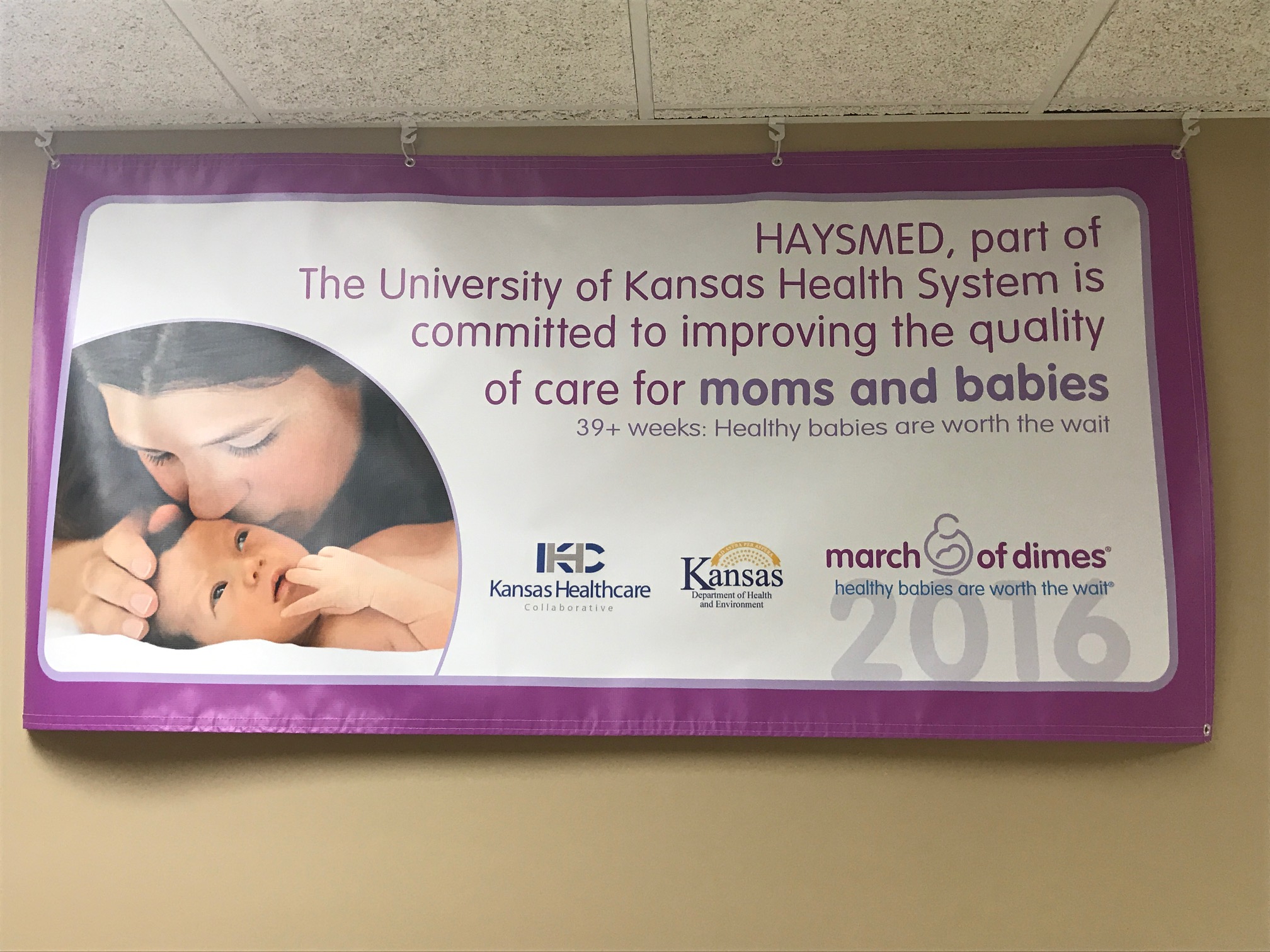
HaysMed recognized by for work to give more babies a healthy start in life

HaysMed

HaysMed has reduced the number of elective inductions and cesarean deliveries performed before 39 completed weeks of pregnancy. This effort, encouraged and recognized by March of Dimes, gives more babies a healthy start in life.

The Kansas Department of Health and Environment Bureau of Family Health,  March of Dimes and the Kansas Healthcare Collaborative have joined together to encourage continued progress towards eliminating early elective deliveries in Kansas. The collaborative efforts and hard work of hospitals have resulted in a rapid and significant reduction in the statewide EED rate from 8 percent in 2013 to 2 percent in 2015.  March of Dimes’ national Hospital Banner Recognition Program is designed to recognize hospitals that have achieved EED rates below 5 percent.

“We’re proud of our expert team of physicians and nurses who recognized the problem of unnecessary early deliveries and put in place policies to avoid scheduling c-sections or inductions before 39 weeks of pregnancy, except when medically necessary,” said Terry Siek, MSN, RN, chief nursing officer and vice president for patient care at HaysMed.

“The last weeks of pregnancy are important.  Babies aren’t just putting on weight.  They are undergoing important development of the brain, lungs and other vital organs,” says Paul E. Jarris, MD, MBA, March of Dimes senior vice president and chief medical officer. “We commend HaysMed for being a champion for babies with their quality improvement effort.”

According to Lisa Brening, MSN, RN, HaysMed OB/NICU clinical supervisor, there is a general misconception amongst the public that if you are term, your baby must be perfectly ready to be born and handle life on his or her own.

“In reality, we know that this just isn’t true, and it is best for mother and baby to allow labor to occur naturally, or at the very least wait until at least 39 weeks to induce or help labor along.” said Brening.  “ In our own setting, we have seen our NICU rates drop tremendously, in turn being able to keep more moms and babies together postpartum.”

“This laudable achievement deserves recognition, and KDHE is proud to supply banners at no cost to qualifying hospitals,” said Susan Mosier, KDHE Secretary and state health officer.

Babies born before 37 weeks of pregnancy are considered premature. Even babies born just a few weeks too soon can face serious health challenges and are at risk for lifelong disabilities including breathing problems, vision loss, cerebral palsy and intellectual delays. In the United States, about 380,000 babies are born too soon each year—that’s 1 in 10.

“March of Dimes knows that Healthy Babies are Worth the Wait,” said Kansas Market Executive Director Kenneth Jackson. “This campaign urges women with a healthy pregnancy to wait for labor to begin on its own, rather than scheduling delivery before 39 weeks,” he added.

March of Dimes offers both professional and consumer education materials about the critical importance of a full-term pregnancy to the health and well-being of babies.

New Hickok’s Steakhouse to open July 24 on Vine

By CRISTINA JANNEY
Hays Post

A new steakhouse with a Wild West theme will open on Vine Street at the end of July.

Hickok’s Steakhouse will be in the remodeled space that last housed Peter Mandy’s restaurant at 3402 Vine. It is set to open July 24.

The restaurant will serve steaks, seafood and fresh sides paired with more than 120 offerings of beer from around the country and a wall of hand-picked wines.

Operating partner Daman Hoar said his vision for the restaurant is efficient service with quality, fresh-made dishes.

Hoar has spent his entire career in food service, working in steakhouses and in fine dining in the Harris Casino system.

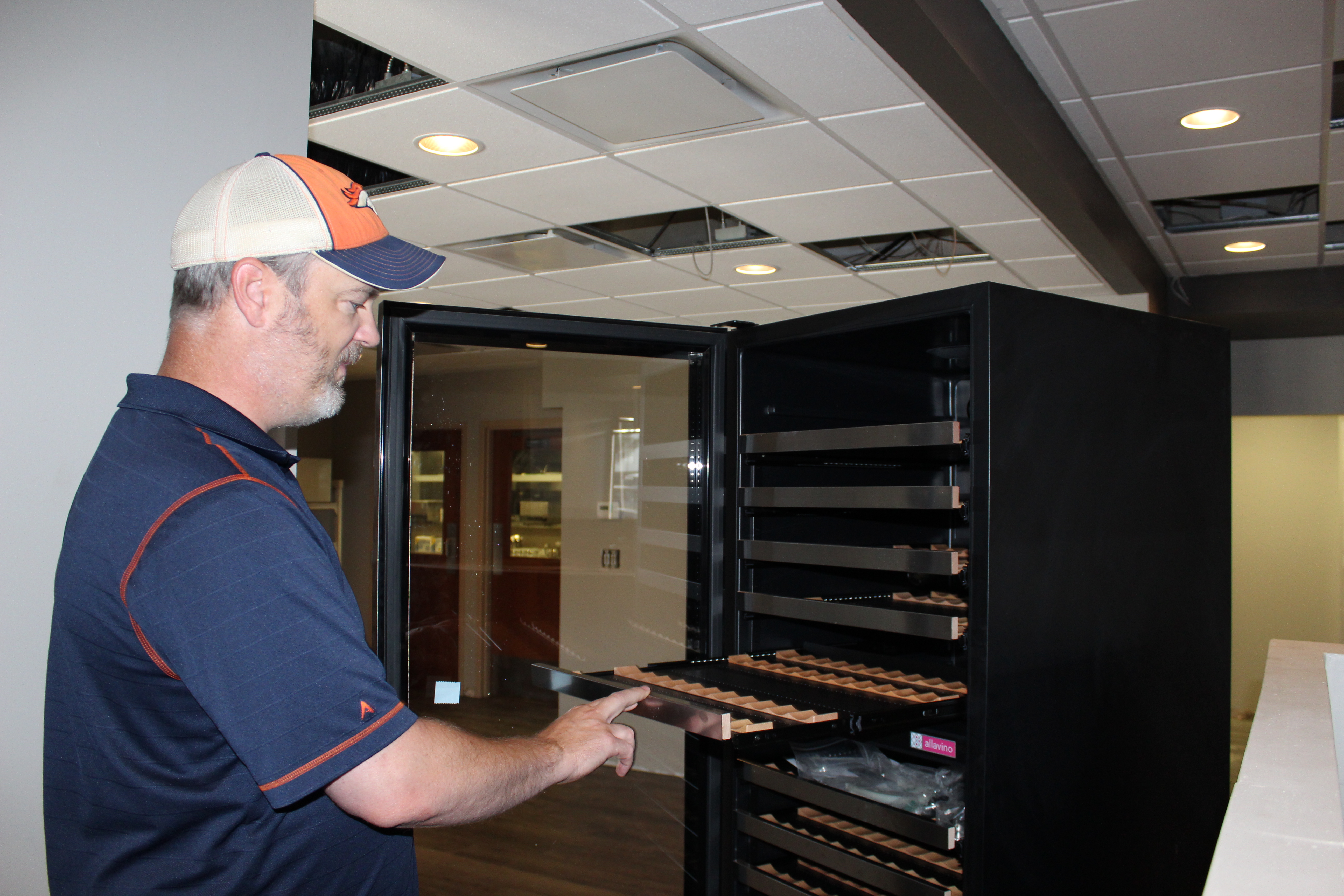
Operating partner Daman Hoar shows a chiller that will be used in Hickok’s Steakhouse.

Hickok’s will offer steaks, including ribeyes, sirloins, porterhouses and bison, if the demand is there.

“You may pay more for it,” he said, “but it has to be good.”

The restaurant’s grill has a smoking tray. Hoar would like to source fruit woods for the smoker for what he contends is a milder smoke than the traditional hickory.

The restaurant also has a small-batch smoker. Hoar would like to try sarsaparilla-smoked chicken.

“It’s fantastic,” he said.

Hickok’s will have the ability to grind its own hamburger and cut its own steaks as well as custom bread appetizers and chicken fried steaks and chicken.

This butcher block will be used by kitchen staff to cut the restaurant’s steaks and meats.

A cheese melter will allow Hickok’s to serve dishes, such as poutine, a Canadian dish made with gravy and cheese curds.

Hoar is a fan of seafood and expects to offer a weekly seafood special, which could include salmon, scallops, shrimp, halibut or sea bass.

Grilled oysters are a favorite Hoar picked up while working in Louisiana, and he hopes to offer them at Hickok’s as well.

The restaurant is equipped with a commercial steamer so it can offer lobster tails as an entrée or with a steak along with king crab legs.

Other offerings could include duck breast and veal. Sides could include creamed spinach, brussels sprouts, lobster mac and cheese, freshly baked bread, and hot one-pound potatoes.

The restaurant plans to source locally when able, including local pork and flour from locally sourced wheat.

The interior of the building is undergoing a complete renovation, using materials that harken back to Hays’ western heritage. The restaurant is working with the Ellis County Historical Society in attempts to reproduce some local historical photos for the restaurant.

Work is still being completed on this banquet room. This wall will soon be covered in reclaimed barn wood from rural Kansas.

Reclaimed barn wood from a granary in rural Kansas is being used on several walls of the restaurant.

The windows on the west side of the building were closed off to create ambiance and add privacy in the main dining hall, which will seat 40 and be available for private parties.

“We wanted to create an atmosphere you would want to eat in,” he said.

The restaurant will seat a total of 110 with both booths and tables. Hoar hopes to eventually add outdoor patio seating, which could provide seating for an additional 50 diners.

The wall dividing the kitchen from the dining area will include wine racks from which diners can hand-pick their bottles.

Some wine selections will be offered by the glass. Bar selections will also be offered. Selections will be dependent on customer demand.

The restaurant hopes to offer about 120 selections of bottled beer, which will be stored in these coolers.

Hoar said he wants to be a good neighbor to the residents and other businesses in Hays.

“We want to be another option,” he said.

The restaurant has a fairly large kitchen for the size of its seating area, and Hoar said he would ultimately like to add a to-go area in the rear of the building where diners could pickup family style meals.

Hoar anticipates the restaurant will employ about 40 people. The business is taking applications now and will begin hiring in earnest beginning the week of July 17.

The exterior of Hickock’s Steakhouse on Vine Street in Hays.

Local students named to Benedictine College honor lists

ATCHISON—Benedictine College has recognized those students who have distinguished themselves academically during the last semester. Those recognized were on the President’s List or the Dean’s List for the spring semester, which ended in May.

Of the 1,924 full-time undergraduate students on the Atchison campus, 557 made the Dean’s List and 132 made the President’s List. To make the Dean’s List, a student must carry a minimum of 12 credit hours and a grade point average of 3.5 or above for the semester. To make the President’s List, a student must have a perfect 4.0 grade point average for the semester with a minimum of 12 credit hours.

Makayla Crawford of Victoria was named to the Dean’s List.

Laura Krug of Hays was named to the Dean’s List.

Bethany Kuhn of Hays was named to the Dean’s List.

Jordan Pfannenstiel of Hays was named to the Dean’s List.

Founded in 1858, Benedictine College is a Catholic, Benedictine, residential, liberal arts college located on the bluffs above the Missouri River in Atchison.

Five lakes under public health warning due to blue-green algae

TOPEKA—The Kansas Department of Health and Environment, in conjunction with the Kansas Department of Wildlife Parks and Tourism, has issued a public health warning for five lakes and a watch for two lakes due to harmful algal blooms.

If a lake is under a public health warning for blue-green algae, activities such as boating and fishing may be safe. However, direct contact with water (i.e., wading, skiing and swimming) is strongly discouraged for people, pets and livestock. The lakes currently under a watch or warning status are

  • Warning: Marion Reservoir, Marion County
  • Warning: Milford Reservoir (all zones), Geary, Dickinson and Clay counties
  • Warning: Sam’s Pond, Syracuse, Hamilton County
  • Warning: Webster Lake, Rooks County
  • Warning: Wolf Pond, Barton County
  • Watch: Marion County Lake, Marion County
  • Watch: Overbrook City Lake, Osage County

 Lakes under a warning are not closed. Marinas, lakeside businesses and park camping facilities are open for business. If swim beaches are closed, it will be specifically noted. Drinking water and showers at parks are safe and not affected by algae blooms. Boating and fishing are safe on lakes under a warning, but contact with the water should be avoided. It is safe to eat fish caught during a harmful blue-green algae outbreak, as long as the fish is rinsed with clean water. Only the fillet portion should be consumed, and all other parts should be discarded. Hands should also be washed with clean water after handling fish taken from an affected lake. Zoned lakes may have portions fully open for all recreation even if other portions are under a warning.

 Kansans should be aware that blooms are unpredictable. They can develop rapidly and may float around the lake, requiring visitors to exercise their best judgment. If there is scum, a paint-like surface or the water is bright green, avoid contact and keep pets away. These are indications that a harmful bloom may be present. Pet owners should be aware that animals that swim in or drink water affected by a harmful algal bloom or eat dried algae along the shore may become seriously ill or die.

 When a warning is issued, KDHE recommends the following precautions be taken:

 Lake water is not safe to drink for pets or livestock.

  • Lake water, regardless of blue-green algae status, should never be consumed by humans.
  • Water contact should be avoided.
  • Fish may be eaten as long as they are rinsed with clean water and only the fillet portion is consumed, while all other parts are discarded.
  • Do not allow pets to eat dried algae.
  • If lake water contacts skin, wash with clean water as soon as possible.
  • Avoid areas of visible algae accumulation.

KDHE samples publicly accessible bodies of water for blue-green algae when the agency receives reports of potential algae blooms in Kansas lakes. Based on sampling results, KDHE reports on potentially harmful conditions.

 For information on blue-green algae and reporting potential harmful algal blooms, please visit www.kdheks.gov/algae-illness/index.htm.

Ad Astra Music Festival offers classical music for veteran, novice listeners

By CRISTINA JANNEY
Hays Post

Alex Underwood

RUSSELL — The Ad Astra Music Festival in Russell bills itself as a selection of new classic music mixed with professionally rendered performances of favorite historical pieces.

Alex Underwood, co-artistic director, said the music is easily digestible for both the new listener of classical music and the long-time lover of the genre.

Performances will include classical, opera, jazz with hints of bluegrass.

“We like to think each performance of the festival is slightly different — a different shade of music. I think we are able to produce music at a relatively high level,” Underwood said.

“I think that is what ties it all together. It is not just your everyday jazz. It is really, really great jazz, and it’s not just your community opera program. It is a really wonderful professional program. The same with the string quartet. We have such really strong musicians that we’re able to attract to the festival. I think that unites it.”

Tickets are now on sale for the concert series that goes through the end of July. Tickets can be purchased online at https://www.adastramusicfestival.org/tickets/, at the Russell Economic Development Office or at the door. Tickets are $10 per performance or $50 for the series.

For a complete schedule, click here.

The opening performance of the series is Friday, July 14.

Friday night’s a capella choral concert titled “Metamorphosis” features the world premiere of a work by composer Moira Smiley.

The title for the performance came from the text from a Renaissance piece to be performed that night by William Byrd.

“It is all about transformation,” Underwood said. “In this case in a religious setting, it is the wheat becoming bread, becoming the body of Christ and grapes becoming wine becoming the blood of Christ.”

The transformation theme was carried to the Smiley piece, which details the transformation of Russell.

The commissioned work is made possible through grants from the Dane G. Hansen Foundation and the Russell County Area Community Foundation.

The performance will feature the Ad Astra Chamber Choir, joined by Kansas bluegrass duo Scenic Roots. Start time is 7:30 p.m. at St. Mary Queen of Angels Catholic Church.

For a totally different listening experience, patrons have the opportunity to enjoy Jazz at the Barn at 8 p.m. Saturday, July 15 at Granny Mae’s Barn.

This is the second year for this event, which will feature Fort Hays State University jazz professor Brad Dawson on trumpet with his ensemble of Matt Otto, saxophone, Roger Wilder, piano, Gerald Spaits, bass and Todd Strail, drums. Cocktails and bar snacks will be served.

“Second Nature,” a contemporary opera in one act, which debuted in 2015 at the Lincoln Park Zoo in Chicago, will be the feature of Sunday afternoon’s performance. The opera is performed in English.

Read a synopsis of the opera by clicking here.

“Hopefully it is super digestible,” Underwood said. “It is an hour-long. It is not like we are going to the opera for five hours to listen to Wagner in German telling this epic ‘Lord-of the-Rings’-style tale.”

The work will feature local singers Calder Craig and Michael Davidson as well as other vocalists who have sung in prior years with the festival, including Aani Bourassa, Janie Brokenicky, Katelyn Mattson-Levy, and Dan Moore.

Returning conductor Max Holman will direct the performance with Mary Box at the piano, Kristin Pisano guest clarinetist, and Allison Lint, violinist. Pisano is a clarinet professor at FHSU. Lint also teaches in Hays.

The work, unlike most operas, is advertised with a performance time of one hour at the Deines Cultural Center beginning at 2 p.m.

The festival will conclude this year with a performance of Handel’s “Samson” from 7:30 to 9:30 p.m. Saturday, July 29. The libretto tells the Biblical tale of Samson after Dalila cuts his hair, robbing him of his strength. Samson struggles with his existence while in prison.

James Reece, a Yale graduate student is playing Samson. Megan Pachecano, who just sang at the Metropolitan Opera, returns to the festival this year to portray Dalila. Tim Parsons, tenor, portrays Micah. Parson sings at Trinity Wall Street in New York. Dan Moore, a Yale graduate who performs at St. Thomas Fifth Avenue in New York, will sing baritone.

The festival was founded in summer 2014, employing one full-time musician and 20 part-time musicians. This year’s festival employs 17 full-time and 32 part-time musicians in addition to more than 50 volunteers.

Library’s Community Threads program offers free clothing Saturday

By Cristina Janney
Hays Post

The Hays Public Library will offer its first Community Threads program from 9 a.m. to 4 p.m. Saturday in the Schmidt Gallery on the main floor of the library.

Katie Meitner, library assistant for the adult department, said the library has received about 15 large garbage bags full of clothing for the giveaway.

Free clothing for men and women — youth, adult and teen — will be offered. Both summer and winter clothing will be available. Also some business clothing will be offered.

Other items available include shoes, purses and belts.

A couple of baby shoes have been donated, but no baby or toddler clothing. However, Meitner said she had not gone through all of the bags of clothing as of Wednesday afternoon.

There is no limit to the number of items a person can take. People of all ages are encouraged to attend.

There are no income requirements for the giveaway.

The library has been taking donations since May for the event, but will not be taking anymore donations between now and Saturday.

Members of Friends of the Library will be assisting with the clothing giveaway.

The library came up with the Community Threads idea from a library in California that did a similar giveaway

Meitner said this is the first year for the Community Threads program, but if it is successful, the library would like to bring it back for future years.

Any clothing that is not given away Saturday will be donated to The Arc of Central Plains.

Hays board searches for new member

By CRISTINA JANNEY

Hays Post

Sarah Rankin, Hays school board vice president, has made her resignation official as of July 14.

Rankin is resigning because her family is moving out of state.

The board approved a motion at its meeting Wednesday night to publish the vacancy.

The board has to wait at least 15 days after the publication of the vacancy before it can appoint Rankin’s replacement. The person who is appointed would serve the two and half years left on Rankin’s term.

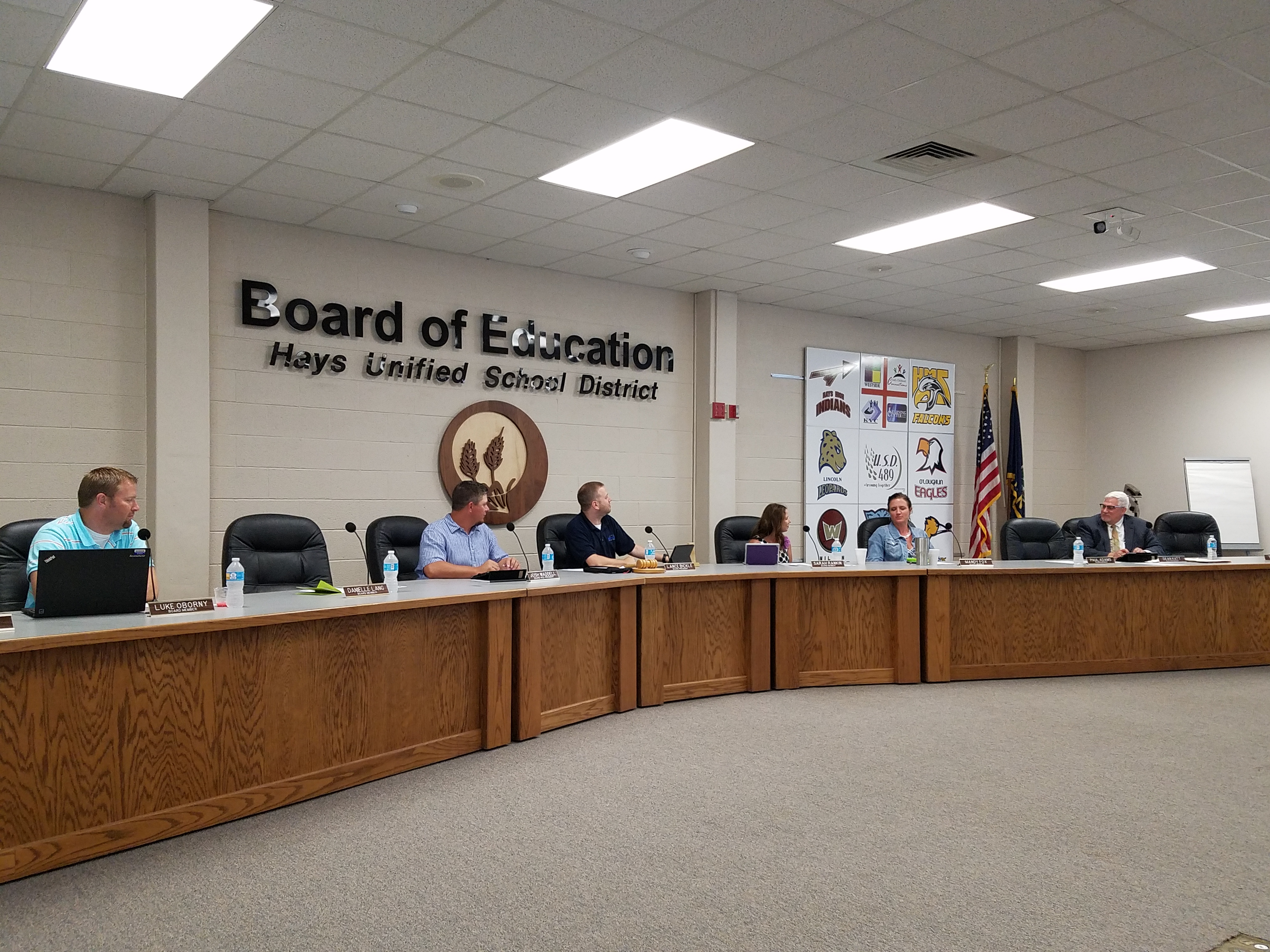
The board also had its annual reorganization meeting Wednesday night. This included the re-election of Lance Bickle as board president. Board member Mandy Fox was elected as vice president.

Kindergarten fee eliminated; Hays BOE considers other fee cuts

By CRISTINA JANNEY
Hays Post

Parents of kindergarteners will not have to pay a kindergarten fee this fall.

The Hays school board heard a report on the change at its meeting Wednesday night.

The state had paid for only half day kindergarten, but the Hays School District offered full-day kindergarten.

USD 489 had charged a $150 fee to help pay for the other half day of instruction with the rest of the funds to support the program coming from the general fund.

The Kansas Legislature this year approved funding across the state for full-day kindergarten. As a part of that legislation, the state required Kansas districts to eliminate their kindergarten fees.

The Hays kindergarten fee accounted for about $21,000 but will be offset by the new funding from the state, said Tracy Kaiser, USD 489 director of finance.

The district is also considering reducing the workbook/material fee for all students from $135 to $90—a 33 percent decrease.

The decrease in the fee will equal about a $90,000 decrease in revenue but will be offset by an increase in per pupil funding from the state.

“I think that is great,” board president Lance Bickle said. “As we continue to get funding, we are going to try to continue to adjust those fees and move them in a downward direction a little bit at a time. But at least we are getting there.”

The Kansas Legislature passed a school funding formula that would increase the per pupil funding to $4,006. This could mean as much as $1 million in funds for the Hays district.

The increase in funds was due to a lawsuit by multiple school districts alleging funding to Kansas school districts was constitutionally inadequate. Read more here.

The Kansas Supreme Court will hear oral arguments in the case on July 18. Until that time, the Legislature’s 2017-2018 funding plan has been allowed to become law.

The school district is working on its budget now, and will have other suggestions of how to use the increase in funds at the board’s next meeting on July 24.

In other business, the board:
• Set the meeting dates for the board for 2017-2018.

• Heard a report on the mileage reimbursement rate, which will be equal to the state’s rate of 53.5 cents per mile

• Heard a report on a memorandum of understanding for Ellis County schools on cooperation with law enforcement

• Approved a bid for $61,500 from Brian’s Concrete Services of Hays for concrete replacement at Hays High School

Copyright Eagle Radio | FCC Public Files | EEO Public File