We have a brand new updated website! Click here to check it out!

Closure of KVC beds leaves kids with psychiatric needs hundreds of miles from treatment

Courtesy KVC

By CRISTINA JANNEY
Hays Post 

The director of the community mental health center for northwest Kansas is concerned the closure of acute care psychiatric beds in Hays will create a barrier to treatment in western Kansas.

Children in western Kansas will have to travel as much as four to five hours one way to receive in-patient acute care.

Walt Hill, High Plains Mental Health director, said the closure of the only beds in western Kansas was breaking a promise made when those services were privatized 10 years ago.

Andy Brown, commissioner for Behavioral Health Services for the Kanas Department for Disability Services, said the closure of the acute care beds in not ideal, but children in Kansas have been traveling long distances for decades to receive treatment.

KVC has cited changes in Centers for Medicaid and Medicare regulations and issues with the space it rents at the Hadley Center for the closure. However, Brown said the decision to close the beds with made by KVC and was based on finances.

The acute care beds at KVC Hospital-Hays were the only acute care beds for youth in western Kansas. These placements were short-term stays for youth who are dangerously suicidal, aggressive or have made threats to hurt others.

Youth from Hays and western Kansas are being placed as far away as Denver, Kansas City or Kearney, Neb. New acute care psychiatric beds just opened in Wichita. However, Hill said it was his understanding that all the beds in Wichita have not opened yet.

Hill said the transportation of the children is complicated, because some of these children are threatening to jump out of vehicles, which makes parents frightened to transport the kids so far.

Hill also expressed concern the barrier of distance from treatment might discourage caregivers from seeking treatment for children or delay them from seeking treatment for kids.

Placing children so far from home might also interfere with their treatment, Hill said.

“It will be harder to do the type of family care that is needed often when children are in a psychiatric hospital,” he said. “How can you work with the family when the child and the treatment team is in Kansas City or Denver or Kearney or Topeka as opposed to here, relatively close by?”

HPMH has a 20-county catchment basin in northwest Kansas and refers 180 youth per year to acute psychiatric treatment. KVC-Hays’ catchment area includes all of western Kansas. Hill said Garden City has already had to send youth to Kansas City.

KVC had operated both a psychiatric residential treatment facility and acute care beds out of the Hadley Center in Hays since 2010. KVC, a nonprofit, was awarded a contract to provide youth acute care when the state closed juvenile acute care beds at Larned State Hospital. Juvenile psychiatric care is now privatized across the state.

In 2017, Brown said KDADS was informed that CMS was no longer going to allow residential treatment and acute care treatment to operate under the same license.

During a Joint Legislative Budget hearing on Oct. 2, Brown said CMS rules had been in place for a number of years, but Brown said KDADS was enforcing the rule now “because I am aware of it now,” and KVC had operated despite these rules by the “Grace of God.”

In that hearing, Brown said one of the concerns about commingling residential and acute care children was acute care children had become aggressive in the past and hurt residential children. However, he said he did not know an exact number.

KVC said none of these incidents had occurred at KVC.

KDADS sent a letter to KVC in February saying it would have to split the residential and acute care programs by April 2019. It did so, but opted to close the acute care beds in October and announced it would convert those beds to residential beds in the near future.

In its announcement of the closing of the acute care beds, KVC said it needed $1 million in renovations to keep the acute care beds open and suggested “legislators could create a line item in the governor’s budget, similar to funding provided for adult state psychiatric hospitals, that would assist with overhead costs and KVC would be open to exploring that as a sustainable operation.”

Hays Post asked KVC what specific renovations were needed and why these infrastructure needs had not been an issue earlier.

KVC responded, “The Class 1 psychiatric residential treatment facility (PRTF) regulations allowed different parameters for a facility than what is required to operate a standalone acute unit. Standalone acute units have higher levels of requirements. Over the past 10 years, we have made continuous enhancements to the space we lease in the Hadley Center to remain within compliance with these regulations and provide a safe and therapeutic environment for the children we serve.”

Hill, in his testimony at the budget hearing, said he was told there was an issue with a ceiling in the area of the acute care facility that did not meet standards and could be a hanging hazard.

However, Brown in the budget hearing said, “It’s not a matter of accommodations. It’s a matter of finances.”

He went on to say later in the hearing, “You could put it in terms of billing, the amount coming into the facility to cover the cost of the care was not sufficient in the eyes of KVC, to continue the facility as a split facility.”

KVC in its response Hays Post said “KVC is not able to financially sustain a standalone acute hospital unit in the western region.”

Hays Post asked what factors made providing care in western Kansas unsustainable. The Post specifically asked about cost of staffing, Medicaid and Medicare reimbursement rates, and the possibility of the center not operating at capacity.

KVC avoided answering this question directly saying, “The dual license was an innovative and necessary way to meet the psychiatric needs of children in the less populated areas of rural and frontier western Kansas where census numbers tend to be lower. It provided flexibility to meet different levels of need in a way that was sustainable for nonprofit providers such as KVC Hospitals.”

KVC also was asked how much money would be required to provide a sustainable acute care facility in western Kansas, but KVC would not assign a number to this question.

Hays Post asked KVC about the issue of distance.

KVC responded “At KVC, we believe it is beneficial for children to receive treatment as close to their families and support systems as possible. This is why it has always been our intent to maintain the license we have held since 2010, allowing us to provide acute services to children from Hays and surrounding areas.

“To further that effort, we opened a new hospital in Wichita to expand access to acute services for families in southwestern Kansas, due to many of these counties being nearly equal distance to Hays and Wichita.”

Hill said if the private sector can’t sustain acute care beds in western Kansas, it is the responsibility and duty under the state constitution to provide them. He suggested reopening juvenile beds at Larned Stated Hospital. He said instead of giving $1 million to remodel the Hadley Center, he said he would rather that go to Larned.

“It has always been the role of the state to provide that safety net for adults and children in the state,” he said. “The community-based services have their role for those people who don’t need to be in a hospital. Some would say the constitution of the state requires the state to take care of the welfare of the folks at that kind of level and the safety of the communities.”

Hill was very involved in the process of privatization.

“When the beds were privatized some 10 years ago, the commitment was made that there would be beds to replace those state hospital beds in western Kansas. We spent a lot of time with policy makers and local legislators, the city, talking about that,” he said. “I was very involved in those discussions. What I understood was that there was a commitment and a promise when the beds at Larned were closed, we would keep beds in western Kansas in some form.”

In his phone interview with Hays Post on Friday, Brown said the state was interested in providing acute psychiatric services in western Kansas, but no plans were in the works to do so. He said the juvenile psychiatric services were privatized nine years ago, because it was not sustainable for the state to offer those services.

The state is working on other treatment options he hoped would help keep children out of acute care. This includes crisis lines, mobile crisis units, peer support networks for parents and families, screeners who could come into people homes and other programs through the Family First Preservation Act.

KVC has announced it intends to convert its acute-care beds to 50 PRTF beds. This type of treatment generally lasts 30 to 90 days and is for youth who have been stabilized.

Hill said he was pleased more PRFT beds will be coming online. Kansas has about 200 children on a waiting list for residential treatment with a wait time of about five months. When all the acute care beds in Wichita and residential beds in Hays become available, Hill said there should be a net increase in psychiatric beds for youth in the state.

However, Hill said residential care “is really not helpful in the kinds of situations we are talking about where a youngster is talking about hurting themselves or somebody else or just out of control.”

Hill said community mental health centers do all they can do to keep children out of acute care. However, he said some kids need to be in the hospital.

“We need the services,” he said.

Defunct Plainville Livestock Commission’s debts yet to be settled

The former Plainville Livestock Commission buildings and property sold in June, but the defunct livestock seller’s debuts have yet to be settled.

By CRISTINA JANNEY
Hays Post 

Ranchers waiting to receive funds from the now-closed Plainville Livestock Commission are still waiting for resolution.

Much of the commission’s property, including the real property in Plainville, was liquidated during an auction in late June. The commission’s bankruptcy case is still open, although it has been changed from a Chapter 11, which is a reorganization, to a Chapter 7, liquidation.

However, the adversary case filed by Almena Bank is still winding its way through the court system.

Plainville Livestock Commission declared bankruptcy on March 1. Tyler Gillum, 47, and his wife, Camden Gillum, 50, owners of the Plainville Livestock Commission, were federally indicted for an alleged check-kiting scheme May 29. 

Dozens of cattle producers were caught up in the Gillums’ alleged scheme after money that was supposed to be set aside to pay cattle sellers was transferred from a custodial account to the Plainville Livestock Auction’s operating account. The Almena Bank froze both accounts, which resulted in bounced checks amounting to tens of thousands of dollars per producer.

The adversary case in federal court is seeking to determine how the $900,000 being held in trust by the court should be divided among  livestock producers and creditors.

According to court documents dated Oct. 24, counsel are working on a settlement in the case. The records also said one of the claims might need to go to trial. The next status conference in the case is set for 10:30 a.m. Dec. 12.

RELATED: Plainville Livestock Commission property sells at auction

RELATED: Ranchers express frustration as Plainville Livestock funds remain in court’s hands

RELATED: Producers try to recoup losses after Plainville Livestock Commission drains account

RELATED: Plainville economy trying to recover after two bankruptcies in a month

Hays sets another record low on Thursday

Hays Post

Hays set another record low Thursday of 15 degrees.

The previous record for Halloween of 18 degrees was set in 1991 and again in 1993. The high Thursday for Thursday was 50 degrees.

Hays also set a record low on Wednesday of 12 degrees.

The forecast for this afternoon is mostly sunny, with a high near 51. Breezy, with a north wind 16 to 23 mph, with gusts as high as 34 mph. The forecast for the weekend is for skies to remain clear with highs in the 50s.

Daylight savings time ends on Sunday. Don’t forget to turn your clocks back one hour. Sunrise on Sunday will be at 7:06 a.m. and sunset will be at 5:34.

Hays school board set to discuss bus purchases, tour Wilson

By CRISTINA JANNEY
Hays Post

The Hays USD 489 school board will discuss the purchase of three new buses at its work session at 6:30 p.m. Monday at Wilson Elementary School.

The purchase is part of the district’s transportation plan. One of the buses is a gas route bus, and the other two buses will be diesel route buses. The low bid was from Kansas Truck for a total of $279,223, which is $24,777 under budget.

The district’s transportation plan does not have the purchase of cars or Suburbans in the budget for this school year.

Rusty Lindsay, director of buildings and grounds, will give a presentation about infrastructure projects and the capital improvements budget for 2019-20.

The school board will also tour Wilson during its meeting.


State champion electric car club demonstrates vehicles for parents/sponsors

Savannah Pfeifer, HHS senior and member of HHITA, drives an electric car during the HHITA open house last week.

By CRISTINA JANNEY
Hays Post

Parents and family members got the chance to feel the pull of a corner and the grip of track during the Hays High electric car program open house last week.

The annual open house lets the students show off the cars to their loved ones and current and potential sponsors.

Last year, one of the Hays High Industrial Technology Association’s cars won the state championship, but with each year comes a new car and new challenges.

Quentin Rupp is a senior on the team and vice president of HHITA this year. He said the team’s state-winning car last year reached speeds of between 20 and 25 mph. This is in a vehicle that weighs less than 100 pounds. Drivers can weigh no more than 190 pounds. Weights are added during competition if drivers weigh less than 180 pounds.

The upper classmen get the first shot at racing. Students have to be at least 16 to race the cars.  The students compete for most laps in an hour; ties are broken with the fastest lap.

The team’s most common challenges are flat tires or a chain popping off in the middle of the race, Rupp said.

The cars each have three tires, two batteries, a chain and motor. Each car is fabricated from scratch each year.

“We are always working on them, always improving them,” he said. “We try to build a new one every year to improve our ability, and then we get rid of the older ones, so we can keep getting better and better as we go on.”

The students weld their own frames. Leon’s Welding bends some of the metal for the students, but the rest of the metal work is done by students.

“I like working hands-on and welding,” said Rupp, who has been on the team since his freshman year, “so I have worked on fabricating a lot of these cars, and I just enjoy racing.”

He added, “It’s the speed and adrenaline that gets me going. It’s just fun to drive.”

Rupp said the team of about 30 students has had to up its game in the last couple of years as the competition has been getting tougher.

“Last year, we had to make some improvements to the car,” he said. “When they work and you win, it’s really fun.”

Rupp plans to take technical training to the next level after graduation by attending Dodge City Community College or NCK-Tech and pursuing a degree in welding. His dream is to own his own fabricating business.

Chris Dinkel, career technical education teacher, said the open house puts the students in the limelight.

He said the students can learn a variety of skills in the program that can be applied to careers after graduation. They learn design processes, materials and processes through construction, as well as electrical and mechanical skills.

“There are a lot of different technologies that can stir the students’ interests,” he said. “We try to use as many of those type of applications.

“[We] get the kids thinking about problem solving — how the car performs and about changing and manipulating that system in order to get it to preform at higher efficiency.”

Students who have aspirations to be in the industrial fields, such as welding and fabrication, work side by side in this program with students who want to go on to college to be mechanical or electrical engineers.

“There is nothing more inclusive than an electric car program where they can do the design process and complete the project, engineer it for a specific application and move into where their interests are,” Dinkel said.

Like other extracurricular activities, Dinkel said the electric car team builds character.

“We try to build the type of student and the type of person we want to see in society,” he said. “We do that by trying to put them around people that can [be] models …”

The program sprung from grants from the Green Energies Act in 1995. Although federal money has gone away, HHS has been able to sustain the program through local donations and sponsorships.

“This was just too good of stuff for kids not to be exposed to,” Dinkel said.

The program is in need of sponsors for this year. If you would like to be an electrical car sponsor, you can contact any of the students in HHITA, Dinkel or an administrator at HHS at 785-623-2600.

Hays ties record low; chilly evening forecast for trick-or-treaters

By CRISTINA JANNEY
Hays Post

Hays’ Wednesday overnight low temperature, 12 degrees, matching a record set in 1993, according to the K-State Ag Research Center.

Wednesday’s high only hit 26 degrees.

Only three years ago on Oct. 30, Hays set a record high of 92 degrees.

Although temperatures are forecast to climb throughout the day to a high of 44, it is still forecast to be quite cold for trick-or-treaters tonight. Skies are forecast to be clear with a low of 20.

Sunset will be at 6:36 p.m. with temperatures falling into the 30s through the evening.

Hays received a 0.2 inches of snow this week. Total moisture for the month has been 1.48 inches. Total year-to-date moisture is 28.37 inches, compared to a year-to-date average of 21.26 inches.

Lincoln celebrates alternative to Halloween costume parties

By CRISTINA JANNEY
Hays Post

As an alternative to the traditional Halloween parade and class parties, Lincoln Elementary School this year had an afternoon of educational, but fun, games and activities.

Kerri Lacy, Lincoln principal, said the event kept parents from having the expense of buying Halloween costumes or excluding children whose families don’t celebrate Halloween.

Some of the activities the children participated in included, painting, Halloween yoga, slime making, minute-to-win it games, a Midwest Energy cash grab, a visit from the Sternberg Museum, snacks, crafts, face painting offered by the FHSU cheerleaders and a dance game.


UPDATE: Teachers frustrated with pay, insurance as negotiations go to fact-finding

A Hays teacher votes on her contract last year. This is the second year in a row the USD 489 school board and teachers have come to impasse in negotiations. Last year, negotiations were resolved through mediation. This year, the two groups have moved on to fact-finding. Hays Post file photo

By CRISTINA JANNEY
Hays Post

After failing to come to a contract agreement during federal mediation, the Hays USD 489 school board and Hays NEA have moved on to a fact-finding process.

The compensation package, specifically health insurance is the stumbling block in the negotiations.

“The compensation package is the difficult issue,” Mike Walker, board president, said. “The board had proposed a compensation package addressing both a salary increase and an adjustment to the health benefits package. Hays NEA has stated that they would like to consider each item separately.”

Walker said the board wants to provide a total compensation package to teachers and staff that increases base salaries and addressed the benefit package.

“We hope to reach agreement on the total compensation package soon so that employees will have time review their salary increases and any adjustments to the health benefits package before open-enrollment the following year,” he said.

RELATED: Teachers, Hays USD 489 locked in dispute over wages, insurance

The district had proposed setting a specific amount it pays toward family plans instead of a percentage. It currently pays about 83 percent. The district proposed continuing to pay 100 percent for single plans.

The district proposed capping the amount the district pays for dependent plans at $1,000. Having a set amount the district pays for dependent insurance rather than a percentage would help the district in setting its annual budget, the board contends. The district proposed the change in the insurance take affect next year.

Kim Schneweis, Hays NEA board president, said Tuesday night via email the major issues keeping teachers  from an agreement are health insurance and salary.

“Less than two years ago, the school board left the state employee’s Blue Cross & Blue Shield  insurance plan and chose Aetna,” she said. “The school board said they would find a plan that was the same or better than our Blue Cross plan, but the new plans are worse. The school board wants to cap how much they pay toward health insurance, starting in the 2020-2021 school year.”

She continued, “The teachers have serious concerns about the new insurance plan, especially the $3,500 deductible. Our previous deductible was $1,000, so that was a 250 percent increase. Teachers are paying more out-of-pocket for their health care due to the large deductible.

“Some are neglecting health care because they cannot afford the $3,500 deductible up front. We hesitate to agree to a cap on the premium when we already had a recent and dramatic increase in deductible. We also see no reason to rush this decision because health insurance premiums for the district did not increase this year.”

On the issue of salary, Schneweis said the district has received $1.3 million in new money this year from Topeka.

“The governor and legislators passed this finance bill with the expressed intent to increase teacher salaries and classroom funding,” she said. “Kansas teacher salaries lag behind in our nation, ranking around No. 40. The salary proposals from our school board this year are not proportionate with the new money sent from Topeka.

“The school board won’t agree to salary increases for the 2019-2020 school year unless we agree to reducing our insurance benefit for 2020-2021. In a year the legislators moved a mountain to increase teacher salaries, we feel frustrated our school board isn’t willing to pass on our intended share.”

 Schneweis said the teachers have offered numerous times to work with the school board to explore options for health insurance. She said the teachers support using a committee of all stakeholders to find the best option.

“Our last big insurance change was rushed and resulted in employees struggling with large increases in health care costs,” she said. “If we are going to consider changes to our insurance benefit, we do not want to rush the decision. We also do not want to negotiate insurance for the 2020-2021 school year, while we still have no contract for 2019-2020.”

 Schneweis said she did not know how long the fact-finding process could take, but it could be lengthy. She added the delay in reaching a contract agreement is creating a hardship for teachers.

“Currently, 11 weeks into the school year, teachers still do not have a contract for this year, and do not know their salary for certain,” she said. “When the new finance bill was finally passed, teachers were optimistic things would improve, so we are disappointed that the school board wants to further reduce benefits. We certainly have teachers who spent money on college hours with the expectation they would move on the pay scale.”

Schneweis said she thought the district needs to improve pay and benefits to retain and attract quality teachers.

 “It is a hardship for our current teachers, but the long-term effects on our district are hard to determine,” she said. “It’s hard to measure the effect of a promising new teacher choosing to go to another district or different career, or a seasoned professional retiring early due to stagnant pay.

When we create hardships for our teachers, we create hardships for our students, because their working conditions are the student’s learning conditions. We want the best for our students. Teachers would rather be preparing for their students than rushing off to a second or third job. Students are at the center of everything we do, and they deserve well-rested teachers who feel appreciated and supported.”

This is the second year in the row the school board and teachers union have come to an impasse during negotiations.

Further attempts were made during mediation to end the impasse, but as that was not a public session, Walker said he did not wish to disclose that information at this time.

“The board hopes to end the impasse and the board and Hays NEA will agree on a total compensation package,” he said.

Walker also said he did not know how long the fact-finding process might make.

Hays school psychologists honored for work with suicide prevention, autism

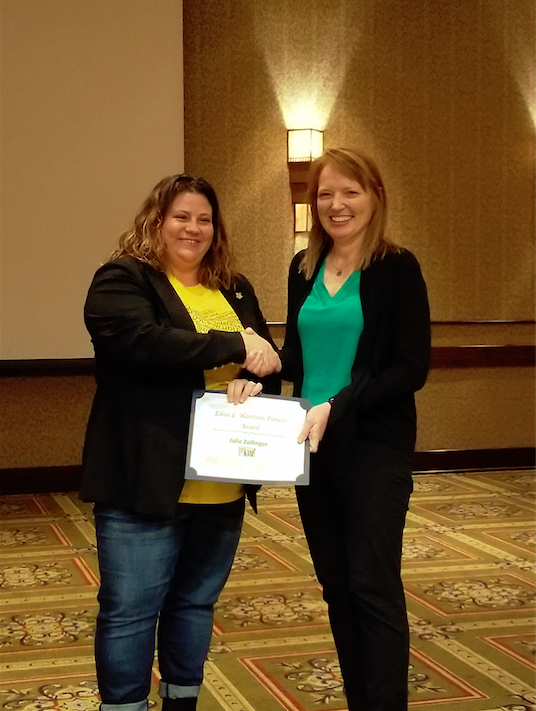
KASP President Jessica Medford congratulates 2019 Edna Harrison Pioneer Award winner Julie Zollinger from Hays USD 489 during the organization’s annual meeting Oct. 4 in Topeka.

By CRISTINA JANNEY
Hays Post

Two school psychologists from the Hays West Central Kansas Special Education Coop were recently honored for being top in their field.

Julie Zollinger, HMS school psychologist, was recognized for her work to bring a program to HMS that seeks to identify youth suffering from depression.

The Sign of Suicide (SOS) program began as a pilot program at Hays Middle School with a group of eighth-grade students last school year. This year, the program has been rolled out to the entire eighth grade.

Zollinger helped spearhead this program and was awarded the Edna Harrison Pioneer Award by the Kansas Association of School Psychologists.

The SOS program seeks to:

  • educate students about the link between mental illness and suicide
  • teach that suicide is, most often, a fatal response to a treatable disorder–depression
  • encourage individuals to seek help from adults
  • encourages students to seek help when they are concerned about themselves or a friend

The initial funding for program came from the USD 489 Foundation for Education Excellence. HMS Home and School and a donation from Golden Plains Credit Union helped support the program this year.

Students watch a video and receive a newsletter. To complete the session, they must fill out a depression screening and hand in a response card indicating if they are concerned about themselves or a friend.

During the pilot program, the organizers received several cards from students who were referred for further screening and treatment.

“We had a self report from a student who no one knew was actually struggling with depression. The student was very involved in school. Many teachers knew the student personally. Staff members knew the student,” Zollinger said. “The student reported to us, and the student was in significant crisis. That opened the door to say the student was having these symptoms. ‘I need to tell someone because this is not normal for me to be feeling this way.’

“The counselors and I have said it was so worth it for that one student, who was hiding it very well. The student was suffering in silence. This opened the door for the student to get help.”

Students are asked to write down on their exit cards who they see as trusted adults in their lives. Often those people are parents and other family members, but sometimes they are teachers.

“If we don’t know who that student is, we notify the teachers, ‘You have been identified as a trusted adult.’ They may have no idea who it is,” Zollinger said. “It could be a student in their class who doesn’t seem to engage or [the teacher may not] really think of themselves as a trusted adult, but they have touched one person.

“That’s why it is important to have the adults familiar with SOS — what to say or what to do if a kiddo comes up and says, ‘I don’t want to be here anymore. I want to kill myself.’ It’s scary. Giving teachers and parents the tools to respond to that is a huge part of suicide prevention.”

The next round of SOS classes for students will start on Nov. 5.

If the logistics go well with the eighth-grade class, school officials hope to roll out the program to the whole school, but the school needs more mental health providers to expand the program.

“It is much more challenging to do this for 230 eighth-graders versus our pilot program, which was about 70 students,” she said.
Zollinger was also recognized for a program she launched that allowed students to check in through their iPads and show their mood for the day. The model used is called the Zones of Regulation.

She said more work is needed on this program to make it a practical daily tool for middle school students. She is working with IT to refine the program.

Zollinger, 48, also won the School Psychologist of the Year Award from the KASP for the 2015-16 school year. She has worked as a school psychologist in Hays for 20 years.

She said she has seen an increase in awareness regarding mental health among young people and in schools. When she started as a school psychologist, schools did not talk about suicide, suicide prevention or self-harm.

“We knew it was happening, but as far as the reporting of self harm and self injury … And suicide, if someone died, adult or child died by suicide, it was not talked about,” Zollinger said.

Zollinger was humble about her accolades.

“I look at my job. I want to help kids and families and staff members be the best they can … I want them to get better—to reach out and get help,” she said.

She added, “I am being recognized for things I want to do anyway.”

Vickie Unruh

KASP President Jessica Medford congratulates 2019 Kansas School Psychologist of the Year Vickie Unruh from Hays USD 489 during the organization’s annual meeting Oct. 4 in Topeka.

Vickie Unruh, school psychologist for the district’s early childhood programs, was named School Psychologist of the Year by the KASP.

She has been a school psychologist for 29 years, 17 years of which have been with the Hays Coop.

Unruh said she decided to become a school psychologist while working as a paraeducator in college. She said she found a passion for working with the youngest children in the system.

“After working as a para, I really fell in love with special education and believed in the value of those services, and it lead into school psychology,” she said.

Unruh is usually the first person parents meet when their child is being considered for the special education program. She often screens children at about age 2-1/2 as they are getting ready to transfer out of their birth to 3 program.

She said parents can find it difficult to come to terms with the fact their child may have delays.

Kyle Carlin, assistant director of special education, in his nomination of Unruh for the award, commended her for the thoughtful and understanding manner she approaches parents.

Unruh said she tries to meet parents in an informal setting first, usually in their own home, before they have to go through the formal process of singing forms. She also evaluates the children in their homes if they have not started preschool yet.

“I try to talk about their strengths as well as their weaknesses,” she said, “and just to get to know them as a family and get to know that child.”

Unruh also co-coordinates the coop’s Autism Intervention Team, which is comprised of 10 members with varying specialties.

The teams offers behavioral, educational, instructional suggestion for the school teams to use with individual students on the autism spectrum. The team also offers screenings for autism.

Unruh thanked her administration team of Carlin and Coop Director Chris Hipp for their support and nomination.


Hays teachers, school board move to fact-finding in contract negotiations

By CRISTINA JANNEY
Hays Post

After failing to come to a contract agreement during federal mediation, the Hays USD 489 school board and Hays NEA have moved on to a fact-finding process.

The compensation package, specifically health insurance is the stumbling block in the negotiations.

“The compensation package is the difficult issue,” Mike Walker, board president, said. “The board had proposed a compensation package addressing both a salary increase and an adjustment to the health benefits package. Hays NEA has stated that they would like to consider each item separately.”
Walker said the board wants to provide a total compensation package to teachers and staff that increases base salaries and addressed the benefit package.

“We hope to reach agreement on the total compensation package soon so that employees will have time review their salary increases and any adjustments to the health benefits package before open-enrollment the following year,” he said.

RELATED: Teachers, Hays USD 489 locked in dispute over wages, insurance

The district had proposed setting a specific amount it pays toward family plans instead of a percentage. It currently pays about 83 percent. The district proposed continuing to pay 100 percent for single plans.

The district proposed capping the amount the district pays for dependent plans at $1,000. Having a set amount the district pays for dependent insurance rather than a percentage would help the district in setting its annual budget, the board contends. The district proposed the change in the insurance take affect next year.

Kim Schneweis, Hays NEA board president, said in a previous interview with the Hays Post, the teachers don’t want to lock themselves into that plan. Teachers have also been unhappy about the district’s change to Aetna away from the state’s Blue Cross Blue Shield plan. She was unavailable for comment Tuesday.

This is the second year in the row the school board and teachers union have come to an impasse during negotiations.

Further attempts were made during mediation to end the impasse, but as that was not a public session, Walker said he did not wish to disclose that information at this time.

“The board hopes to end the impasse and the board and Hays NEA will agree on a total compensation package,” he said.

Walker said he did not know how long the fact-finding process might make.

NW Kansas economic outlook predicts slow growth, increased wages in tight labor market

Jeremy Hill, director of the Center for Economic Development and Business Research at Wichita State University, speaks to the Hays Regional Economic Outlook Conference Thursday in Hays.

By CRISTINA JANNEY
Hays Post

A recession is not imminent and northwest Kansas is expected to experience slow growth in the next year, according to panelists at the Hays Regional Economic Outlook Conference.

During the conference Thursday in Hays, Jeremy Hill, director of the Center for Economic Development and Business Research at Wichita State University, said the labor market will remain tight, but that tight labor market is also driving up wages for employees.

Unemployment in northwest Kansas still remains extremely low.

The ag and oil industries have both seen hits in the last three years. Ag product demand is being affected by the trade war, but income in that sector was up largely because of government and crop insurance payments.

“Farmers don’t want government payments,” he said. “You don’t know what to plan for.”

He compared the payments to farmers wearing oxygen masks.

“You feel good because you have an oxygen mask. I’ll take this cash, but does a farmer really want an oxygen mask?” Hill said. “Absolutely not. They want to go out and deal with the real market the way it is and have an understandable market where they can say right up and down and this is what is going on.”

For several years, the government sector experienced cuts, Hill said. However, now the sector is seeing increases, especially in its largest subgroup, which is school districts.

“I think labor markets are working pretty darn well,” Hill said.

Ellis County saw a dip in employment in 2015 and 2016 when oil prices fell sharply. However, the employment rate has increased the last two years.

Ellis County accounts for 21 percent of the population in northwest Kansas, 25 percent of the employment and 28 percent of retail sales.

Surveys of employers indicate they anticipate they will be hiring in the next year. Hill said a high demand exists for top-quality, skilled employees. Companies are finding themselves paying higher wages for B- and C-level employees, he said.

Northwest Kansas employers are finding themselves paying workers more to keep from losing them to other regions of the state.

Hill said the region is seeing more what he called “job hoppers.”

“[The business panel] said, ‘Yeah we had low-skill workers who would just jump for just a $1 more or a few cents more or they thought it would be a better company. They are just moving really quickly,'” he said. “This year they are saying that they are even having some middle-skill people who are job hoppers that are moving from one to the next to the next.”

He added, “In this area, if you are not thinking about that wage, you better be thinking about that wage or someone is going to get up and leave for a couple dollars more or just the promise of a better job somewhere else.”

Rising wages are not good for profit margins, but they are good for the economy as it puts more cash in consumers’ hands.

However, Hill said Kansas is experiencing a lack of confidence from investors. Even investors inside the state are wanting to invest outside of the state because they can get better returns.

Kansas has had a four-year decline in taxable retail sales as more items are purchased online. Ellis County’s retail sales peaked in 2013 and are flat in 2019.

Kansas has had a shift in the state to more middle income and low-come jobs. Purchasing power also has an affect on taxable retail sales.

Migration continues to be out of rural areas into metro areas. Almost all of the population growth in Kansas in 2018 was in Johnson County. This means labor is also moving out of rural areas.

Hill finally looked at possible factors on the horizon that could lead to a recession.

“Economic expansions do not die of old age,” he said. “We could grow forever potentially, and there are countries I mentioned earlier that grow, grow, grow. What causes recession is something out there that causes it. The problem is that it is never something that we are thinking about.”

He said he did not think it would be Brexit or trade wars.

“Companies in Kansas are hedging the risk,” he said. “I’ve talked to quite a few businesses that have just stopped exporting because they just didn’t want to deal with it anymore.”

He thought labor markets should also not affect the economy.

Some business owners said cyber attack or cyber warfare could bring on a recession.

Farm debt and bankruptcies and oil prices could be factors, as well, he said.

Some economists have been concerned interest rates being lower on long-term bonds than short-term bonds could spark a recession. This has happened in the past.

However, Hill noted international trade is so dependent on the American dollar, global entities are still buying U.S. Treasury notes despite the reversal in the interest rates.

Kansas businesses for the coming year are realistically optimist that the economy will be stable or have slow growth. Estimates are for about .6 percent growth in Kansas, with the state adding almost 9,000 jobs, Hill said. Wages are expected to expand, but retail taxable sales are expected to decline.

Teacher of the Month: Wagoner teaches students they have a voice

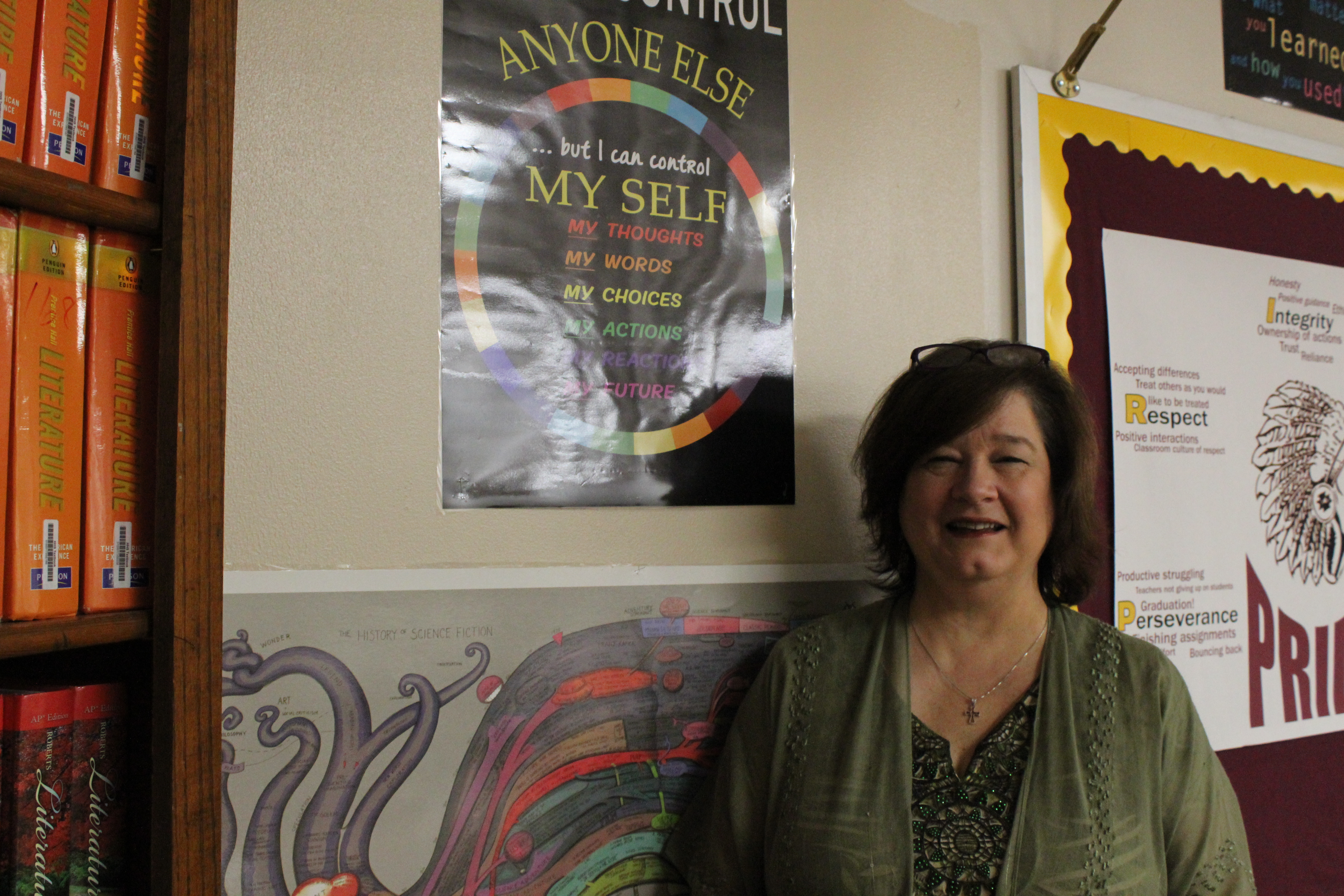
Kathy Wagoner, HHS English teacher, stands next to one of the inspirational posters in her classroom. It reads in part, “I can’t control anyone else, but I can control myself.”

By CRISTINA JANNEY
Hays Post

In an era when social media is king, Kathy Wagoner is trying to get kids to understand the power of the written word.

According to one of her students, she has been able to do that.

“Mrs. Wagoner is the only teacher I’ve ever had that has made me excited to write a five-page paper, ” Abbey Oborny, a senior at Hays High School, said in her nomination for Wagoner for Hays Post Teacher of the Month. 

“The way she teaches also keeps me wanting to learn more,” Oborny said. “We read a couple poems recently and were going over the theme and the meaning of them, and the way Mrs.Wagoner taught us to analyze them was amazing.

“I can see now easily the meanings of stories, why the author uses the literary devices that they use and how important writing is. I’ve actually used this new skill while listening to songs and it has made me realize how many metaphors and parallel structures the songs contain.”

Wagoner said she engages her students by “showing them they have a voice and they have control of their mind and the way they want to present themselves … showing them the power of the language and the power of punctuation.”

She tries to urge them to be more confident in experimenting with writing styles.

“I tell them in this class, right away, they are not writing for themselves, they are writing for the readers,” she said. “You need to make sure you communicate what you want them to feel and think.”

Wagoner said she gets along great with kids, but the first thing you need to know about young adults is you need to respect them.

“Just because they haven’t had the experiences I’ve had in life doesn’t mean their opinions don’t matter,” she said.

Wagoner does some writing herself. She was written quite a bit of poetry. She started a novel but said there is never time to work on her own project.

Wagoner, 58, has been a teacher for 28 years, all at Hays High.

Growing up in Oskaloosa, a town of 1,000, north of Lawrence, she said knew she wanted to teach by the third grade.

“It was in my blood,” she said. “I always wanted to do it.”

She received her bachelor’s of science in Education with distinction from the University of Kansas in 1990. She received her master’s degree in English from FHSU in 1999. In 2000, she passed the boards to receive a 10-year license as a National Board Certified teacher in Adolescence and Young Adulthood/English Language Arts. She renewed that license in 2010 and was just notified of her latest renewal, which will be good through 2030.

“I appreciate how [the kids] keep my mind young,” she said.

Wagoner said she was a little intimidated her first year at HHS as it was so much larger than what she grew up with—a rural school of 120 students.

“But when I got in the classroom, there were still just 25 kids,” she said. “Within the classroom, you are creating your own environment — style of family. That’s how I looked at it, so I wasn’t overwhelmed by everything.”

After her students leave her classes and graduate, she said she hopes they have “the confidence to tackle any issue or opportunity that they run across — that they can verbally and in writing communicate with others.”

Wagoner said social media is changing her students and making that more difficult.

“They just don’t want to read,” she said. “They don’t understand the power of the written word. They need to be able to read in order to be sure they are not being manipulated by others, and they can truly go after the opportunities that they desire. Without the ability to comprehend what you read, they are doing themselves an injustice.”

She continued, “Nowadays with the technology that is available to them. The instant gratification and how they seek it — I wouldn’t say all of them — but patience has been put on a back burner. Tolerance of others seems to be on a back burner because it is more about self-gratification. The social media gives them that.

“My students tell me, ‘I don’t want to spend 15 minutes reading a book or 20 minutes.’ One of my students said to me the other day, ‘Why do you have to make it so hard?’ I said, ‘All I want you to do is think. How is that hard?’ ”

Wagoner said it is a challenge finding books the students desire to read and will also challenge them.

Students want escape fiction. It is easy to read, ttakes you out of the environment, and you don’t have to think to read it. If you give them literary fiction, they have to ponder what they are reading, Wagoner said.

“It makes them think about the human condition,” she said, “and sometimes they don’t like to think about that.

“You always hear that, ‘I am one person. What am I supposed to do about it?’ ” she said. “Then you can use social media and show how one person can change the way people think. There are benefits along with the issues.”

Wagoner will admit that teaching English is not all about English.

“No matter what content area you’re teaching, when you are teaching high school, you are teaching the whole person,” she said.

Her students see this too, as Oborny’s nomination shows.

Most importantly while teaching all of us thousands of things (and never complaining about it) she inspires me to be a better person,” she said, “to have a more positive outlook and as her board says every day, ‘be present,’ which according to her means to be fully there, to live in the moment, and to keep your attention on the right things.”

Wagoner is also mentoring up-and-coming teachers. Last month’s Hays Post Teacher of the Month, Jaici Simon, Hay Middle School English teacher said Wagoner has been a role model for her.

“It warms you and humbles you at the same time,” Wagoner said. “I felt very humbled after I read that article. Then I thanked God and said, ‘You’ve set me on the right path.’ I ask Him all of the time to make sure that I am doing what you want me to do in the classroom to help these kids grow and be where they need in their lives.”

Copyright Eagle Radio | FCC Public Files | EEO Public File